I was the ‘invisible’ janitor. When a girl in a wheelchair asked me to dance, I didn’t hesitate. I didn’t know her billionaire mother was watching from the shadows. What happened next saved my life.
CHAPTER 1: The Ghost of the Night Shift
The smell of Preston Academy was a specific cocktail of teenage anxiety, floor wax, and old money.
My name is Aaron Blake. I’m forty-two years old. I have a bad back, a bank account that currently reads negative forty dollars, and a job that makes me invisible.
I’m the janitor.
Technically, my title is “Facilities Custodian,” but titles don’t pay the rent. Mopping up vomit in the boys’ bathroom does.
It was 9:45 PM on a Tuesday in November. Outside, the Detroit wind was howling, slapping sleet against the brick walls of the gymnasium. Inside, it was warm, smelling of fresh paint and expensive flowers.
Tonight was prep night. The annual “Winter Gala” was two days away. This wasn’t a school dance with punch and cookies; this was a fundraiser. The kind where tickets cost a thousand dollars a plate and the parents wear tuxedos.
I pushed my industrial-sized dust mop across the hardwood floor, collecting the debris left behind by the decorating committee. Glitter. Styrofoam packing peanuts. Snippets of silver ribbon.
“Hey, you! Garbage can is full!”
I didn’t look up. I knew the voice. Mrs. Van Der Hoven. Her husband owned half the car dealerships in the state.
“I’ll get it right away, ma’am,” I said, keeping my eyes on the floor.
“Well, hurry up. We’re trying to visualize the table settings.”
She didn’t thank me. They never did. I was just a mechanism in the room, like the thermostat or the light switch.
I wheeled the trash bin toward the double doors, my boots squeaking softly. I glanced up at the bleachers.
Way up in the top row, in the darkest corner, was a small bundle wrapped in a faded navy-blue parka.
Jonah.
My son was seven years old, and he was sleeping on a hard wooden bench because I couldn’t afford childcare. Our apartment—a two-room shoebox in a neighborhood where the streetlights were shot out—had lost heat yesterday. The landlord said the boiler was broken. I knew he was just trying to squeeze the last few tenants out so he could sell the building.
So, Jonah came to work with me. He did his homework in the supply closet, ate a sandwich I brought him, and then slept while I worked.
“Hang in there, buddy,” I whispered to the empty air.
I emptied the trash, my muscles burning. I used to be strong—gym rat strong. Now, I was just tired. The kind of tired that settles in your marrow and never leaves.
I checked my pocket. The eviction notice was folded into a tight square, burning a hole through the fabric of my uniform. I had three days to come up with $800. I had $42 in my pocket and a paycheck that wouldn’t clear until Friday.
I walked back onto the gym floor. The committee ladies were leaving.
“Caroline, are you coming?” Mrs. Van Der Hoven called out.
“In a minute,” a voice replied. “I want to double-check the lighting.”
Caroline Whitmore. I knew her by reputation. Everyone did. Whitmore Industries. Old money. Serious money. She was the chairwoman of everything. Intimidating. Sharp. Beautiful in a way that made you feel underdressed even if you were wearing a suit.
I kept my head down, buffing a scuff mark near the free-throw line.
The doors slammed shut. The chatter faded.
Silence descended on the gym. It was just me, the hum of the high-intensity lights, and the sleeping boy in the shadows.
And then, a sound.
Whirrr. Click.
It wasn’t a footstep. It was mechanical.
I stopped buffing. I looked toward the far corner, near the equipment room.
A girl was sitting there.
She was in a wheelchair, her hands resting in her lap. She looked like a porcelain doll that had been left on a shelf. Blonde hair, shiny and perfectly curled. A dress that shimmered like moonlight.
But her face was a tragedy.
I hesitated. I wasn’t supposed to talk to the students unless necessary. But the committee was gone. She was alone.
I took a step forward. “Miss?”
She jumped, her hands gripping the wheels of her chair. She looked at me, eyes wide.
“I… I’m sorry,” she stammered. “I didn’t know anyone was here.”
“I’m always here,” I said with a gentle smile. “I’m Aaron. The janitor.”
She relaxed slightly. “I’m Lila.”
“Nice to meet you, Lila. Did your ride forget you?”
“No,” she said, looking down at her lap. “My mom is making calls in the hallway. I just… I wanted to see the floor.”
She looked out at the expanse of polished wood. It was gleaming under the lights, a sea of amber perfection.
“It looks nice,” I said. “Ready for the big dance?”
Lila let out a bitter little laugh. “I’m not dancing.”
“Why not?”
“Because,” she gestured to her legs. “Wheels. The dance team… Sarah Miller said I’d ruin the aesthetic. She said the opening waltz requires symmetry.”
The venom in her voice was heartbreaking. Kids can be cruel, but rich kids can be surgical with their cruelty.
“Symmetry is overrated,” I said, leaning on my mop.
She looked at me. “Do you dance, Aaron?”
I laughed. A dry, rasping sound. “Me? Nah. I just push a broom.”
“I bet you could,” she said. Her voice was small, wistful. “I bet you’re better than the boys in my class. They just stand there and look at their phones.”
She rolled a few inches closer.
“I’ve never danced with a boy,” she whispered. “I just want to know what it feels like. Just for a minute.”
I looked at the clock. 10:15 PM. I had bathrooms to scrub. I had trash to haul. I had a life that was falling apart.
But I looked at her eyes. They weren’t asking for pity. They were asking for dignity.
I thought about Jonah. If he was in that chair, alone in the dark, wouldn’t I want someone to see him? To really see him?
I sighed, letting the mop handle clatter against the wall.
“Well,” I said, wiping my palms on my trousers. “I suppose the floor does need a test run.”
CHAPTER 2: The Waltz and the Watcher
I walked over to the sound system on the wall. I didn’t dare touch the expensive console, but I pulled my phone out of my pocket.
I tapped the screen, scrolling past the overdue bill notifications until I found my “Oldies” playlist.
I hit play. Unchained Melody by The Righteous Brothers began to play, tinny and small from my phone speakers, but in the acoustic cavern of the gym, it echoed.
I walked back to Lila.
She looked terrified now. “I… I don’t know the steps.”
“There are no steps,” I said. “That’s the secret.”
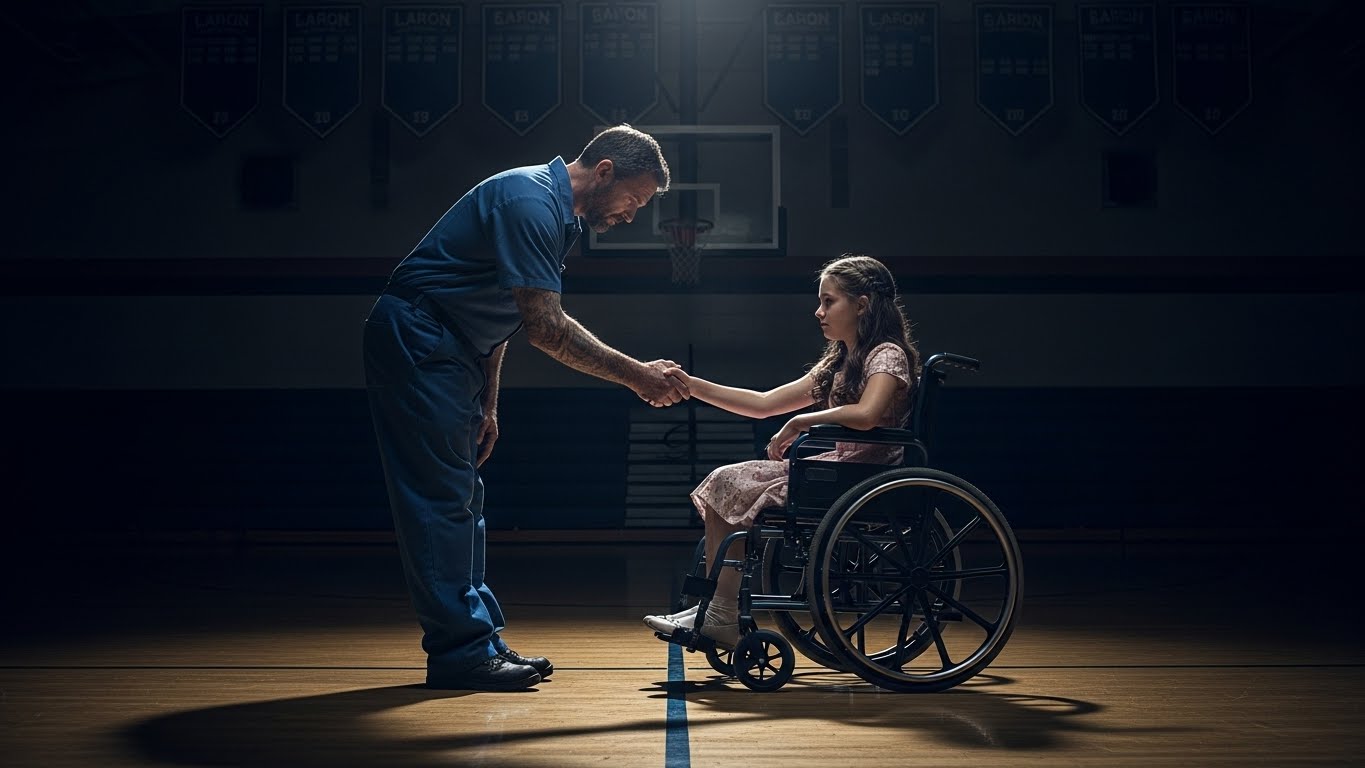
I bowed. Low and theatrical. “May I have this dance, Miss Lila?”
She giggled, her cheeks flushing pink. She reached out.
Her hand was tiny and soft in my rough, calloused grip. I held it gently, like I was holding a baby bird.
I stepped behind her chair first. “Ready?”
“Ready.”
I began to move. Not just pushing her. Dancing with her.
I stepped to the rhythm, swaying my body, guiding the chair in long, sweeping arcs. We spun. We glided.
Oh, my love… my darling…
I spun the chair on one wheel, a controlled pirouette. Lila threw her head back and laughed. It was a pure, joyful sound that cut through the silence of the empty gym.
“Faster!” she squealed.
“You got it!”
I picked up the pace. We were flying now. I ran alongside her, twirling her, then bringing her back to me.
For a moment, the eviction notice didn’t exist. The cold apartment didn’t exist. The shame of being forty-two and cleaning toilets didn’t exist.
There was just music, and motion, and a little girl who was feeling like a princess.
I moved to the front of the chair, holding both her hands, stepping backward in time with the music, looking her in the eye.
“See?” I panted, smiling. “You’re a natural.”
“I’m dancing!” she beamed. “Aaron, I’m really dancing!”
The song reached its crescendo. I spun her one last time, slowing down as the final notes faded into the air.
We stopped in the center of the court, right under the big chandelier.
Lila was breathless, her eyes shining with tears. “Thank you,” she whispered. “That was…”
Clack. Clack. Clack.
The sound of sharp heels on the hardwood floor.
The spell broke instantly.
I froze. The blood drained from my face.
I spun around.
Standing in the double doorway, illuminated by the harsh hall light, was a silhouette. Tall. Imposing. Arms crossed.
Caroline Whitmore.
She walked out of the shadows. Her face was stern, her jaw set tight. She was wearing a tailored wool coat that probably cost more than my car.
I immediately let go of Lila’s hands. I stepped back, my heart hammering against my ribs like a trapped bird.
“Mrs. Whitmore,” I stammered, my voice cracking. “I… I’m so sorry. I know I’m not supposed to… we were just…”
Thoughts raced through my head. Unauthorized interaction with a student. Misuse of time. Unprofessional conduct.
I was fired. I was absolutely fired. How was I going to feed Jonah?
Caroline didn’t look at me. She looked at Lila.
“Lila,” she said, her voice sharp.
“Mom, don’t be mad!” Lila said quickly, spinning her chair to face her mother. “I asked him! He didn’t do anything wrong! He was just…”
Caroline held up a hand. Silence fell over the gym.
She walked closer. She stopped right in front of me. She smelled of expensive vanilla and ice. She was staring at me with an intensity that made me want to shrink into the floorboards.
She looked at my nametag. A. Blake.
Then she looked at my dirty hands.
Then she looked at my eyes.
“Mr. Blake,” she said softly.
“Yes, ma’am,” I whispered, bracing for the impact.
“Did you… pick that song?”
I blinked. “Uh. Yes. It’s… it’s a classic.”
Caroline’s expression cracked. The ice melted. Her eyes, I realized with a shock, were swimming with tears.
She let out a shaky breath and looked at her daughter. Lila was glowing. Actually glowing.
“She hasn’t smiled like that in three years,” Caroline whispered, her voice trembling. “Not since the accident.”
She turned back to me. She didn’t look angry. She looked… stunned.
“I stood in that doorway for three minutes, Mr. Blake. I watched you.”
I swallowed hard. “I should get back to work.”
“No,” she said firmly. “You shouldn’t.”
She reached into her purse. I flinched, expecting her to pull out a notepad to write me up.
Instead, she pulled out a business card. It was thick, heavy cardstock with gold embossing.
The Whitmore Foundation.
“My daughter is invisible to most people in this school,” Caroline said, her voice gaining strength. “They see the chair, not the girl. Tonight, you saw the girl.”
She handed me the card.
“I don’t know what they pay you here, Aaron. But it’s not enough.”
I took the card, my fingers shaking. “Ma’am?”
“I’m opening a new community center in the city. For kids with disabilities. Adaptive sports, arts… and dance.” She looked at me intently. “I need a facilities manager. Someone who cares. Someone who sees people.”
I stared at her. “I… I don’t have a degree. I’m just a janitor.”
“You’re not just a janitor,” Lila piped up. “He’s a dancer, Mom.”
Caroline smiled. A genuine, warm smile that transformed her face. “Meet me for coffee tomorrow at 9:00 AM. The address is on the card. Bring a resume if you have one. If not, bring yourself.”
She walked over to Lila and kissed her forehead. “Ready to go, bug?”
“Yeah,” Lila said. She looked back at me. “Bye, Aaron! Thank you!”
“Bye, Lila,” I choked out.
I watched them leave. The heavy doors swung shut.
I stood alone in the center of the gym. I looked at the business card in my hand.
Whitmore Foundation.
I looked up at the bleachers where Jonah was sleeping.
I wasn’t fired.
I sank to my knees on the polished floor, burying my face in my hands. And for the first time in a long time, I let myself cry. Not from sadness. But from relief.CHAPTER 3: The Suit and the Skyscraper
I didn’t sleep that night.
We went back to the apartment, where the temperature was hovering around forty degrees. I bundled Jonah into his bed with three blankets and wearing his winter coat. I sat at the kitchen table, staring at the business card Caroline Whitmore had given me.
The Whitmore Foundation.
It felt heavy in my hand, like a gold coin.
But then my eyes drifted to the other piece of paper on the table. The eviction notice.
48 Hours.
If this meeting was a joke, or a charity pity-invite, or if I blew it, Jonah and I would be in a shelter by Friday. The stakes weren’t just a job; they were survival.
The sun came up grey and unforgiving. I dug into the back of my closet. I had one suit. I bought it ten years ago for my wedding. I wore it again for my wife’s funeral. It was black, polyester, and tight in the shoulders. It smelled faintly of mothballs and old grief.
I put it on. I looked in the cracked bathroom mirror. I didn’t look like an executive. I looked like a bouncer trying to go to church.
“You look fancy, Dad,” Jonah said, eating a cold Pop-Tart.
“Big day, buddy,” I said, forcing a smile. “Big day.”
I dropped him off at school, promising I’d be there at pickup. Then I took the bus downtown.
The Whitmore Building was a glass needle piercing the Detroit skyline. It screamed power. The lobby had marble floors that were cleaner than my kitchen table.
I walked to the reception desk. The woman behind it looked like she had been carved out of ice. She scanned my cheap suit, my scuffed shoes, and the nervous sweat on my forehead.
“Delivery entrance is around the back,” she said without looking up.
The shame hit me like a physical slap. It was the same shame I felt pushing the mop bucket past the rich kids. The assumption that I was purely functional, not a person.
“I have a meeting,” I said, keeping my voice steady. “With Mrs. Whitmore. 9:00 AM.”
She looked up then. Her eyebrows shot into her hairline. She checked her computer, clearly expecting to prove me wrong.
“Name?”
“Aaron Blake.”
She tapped a key. Her face fell. “Oh. You’re… on the list. Top floor.”
The elevator ride made my ears pop. When the doors opened, I wasn’t in an office. I was in a sanctuary. Floor-to-ceiling windows overlooking the city. Modern art. Silence.
Caroline was standing by the window. She turned when I entered.
“You came,” she said.
“You asked.”
She gestured to a chair. “Sit.”
I sat. I felt massive and clumsy in the delicate designer chair.
“I looked into your file, Aaron,” she said, cutting straight to the chase. “You’ve been at Preston High for four years. Before that, you were a foreman at the auto plant until the layoffs. You have a perfect attendance record. You’ve never had a complaint.”
“I do my job,” I said.
“You do more than your job,” she corrected. “I spoke to the principal this morning. He told me about the time you fixed the heating system in the library on a Sunday so the kids could study for finals. He told me you bring extra sandwiches for the students on scholarship who skip lunch.”
I shifted uncomfortably. “Kids can’t learn if they’re hungry.”
“And yet,” she said, leaning forward, “your own son sleeps on bleachers because you can’t afford heat.”
The air left the room. My hands clenched into fists. “I take care of my son.”
“I know you do,” she said, her voice softening. “But you’re drowning, Aaron. I can see it. I recognize the look. I saw it in the mirror for two years after my daughter’s accident.”
She slid a folder across the desk.
“This isn’t a janitorial job,” she said. “I have plenty of people to clean floors. I need a Director of Operations for the new center. I need someone who understands logistics, safety, and maintenance, yes. But more importantly, I need someone who understands dignity.”
I opened the folder. The salary figure on the first page made my head spin. It was more money than I had made in the last three years combined.
“Why?” I asked, my voice barely a whisper. “I’m just a guy with a GED and a bad suit.”
“Because last night, you didn’t see a wheelchair,” Caroline said fiercely. “You saw a dancer. My architects see ramps and elevators. My doctors see diagnoses and limitations. I need someone in that building who sees the children.”
She handed me a pen.
“The job starts today. There’s a signing bonus. It should cover your rent.”
I stared at the pen. I thought about the eviction notice. I thought about Jonah shivering in his coat.
I picked up the pen. My hand was shaking, but my signature was strong.
CHAPTER 4: The Broken Toy
The transition wasn’t like the movies. There was no montage where I suddenly knew everything. It was a war.
The “New Horizons Center” was a massive, renovated warehouse in the arts district. It was designed to be a paradise for kids with physical and cognitive disabilities. Adaptive gyms, sensory rooms, art studios.
But a building is just a shell. The chaos was inside.
For the first two weeks, I felt like an imposter. I was surrounded by physical therapists with PhDs, social workers with clipboards, and donors with opinions. I was the guy in the work boots trying to figure out why the hydrotherapy pool was leaking while simultaneously managing a staff of twenty.
I kept my head down. I fixed the leaks. I organized the schedules. I made sure the ramps were salted and the lights were bright. I tried to be the “Ghost” again—efficient, invisible.
But Caroline was watching.
On a Tuesday afternoon in December, three weeks into the job, the meltdown happened.
I was in the main atrium, fixing a loose hinge on the front door. The center was busy.
Suddenly, a scream shattered the air.
In the center of the “Sensory Zone,” a boy was thrashing on the floor. He was about ten years old. Big for his age. He was screaming, kicking, and throwing foam blocks everywhere.
Two young therapists were hovering over him, looking panicked.
“Marcus, use your words!” one shouted.
“We need to restrain him, he’s going to hurt himself!” the other yelled.
The other kids were crying. Parents were staring. It was a powder keg.
I saw Caroline on the balcony above, giving a tour to some major donors. She froze, watching the scene.
My instinct was to stay back. Not my job. I’m operations. I’m the fix-it guy.
But then I saw Marcus’s face. He wasn’t just angry. He was terrified. He was overwhelmed.
I dropped my screwdriver.
I walked into the Sensory Zone.
“Back up,” I said to the therapists. My voice was low, the same tone I used when I had to break up fights in the high school cafeteria.
“Mr. Blake, this is a clinical situation,” one therapist snapped. “You’re not trained for…”
“I said back up,” I repeated, stepping between them and the boy. “You’re crowding him. You’re too loud.”
They hesitated, but they moved back.
I didn’t try to touch Marcus. I didn’t try to restrain him.
I just sat down.
I sat cross-legged on the floor, about four feet away from him. I picked up one of the foam blocks he had thrown.
I didn’t look at him. I looked at the block. I started stacking it on top of another one.
Marcus screamed again, throwing a plastic ball at me. It bounced off my shoulder. I didn’t flinch. I didn’t react.
I just kept stacking.
One block. Two blocks. Three blocks.
“Man, this tower is terrible,” I muttered to myself. “It’s gonna fall.”
Marcus stopped screaming. He was panting, his chest heaving. He was watching me.
I knocked the tower over. Boom.
“Failed again,” I sighed.
Marcus sniffled. He reached out and grabbed a blue block. He slid it toward me.
“Blue is better,” he croaked.
“You think?” I asked, not looking up. “Blue is a strong foundation.”
I took the blue block. I started building again.
Slowly, painfully slowly, Marcus scooted closer. He picked up a red block. He placed it on top of mine.
“Red goes on blue,” he whispered.
“Good call,” I said.
For ten minutes, the entire center watched in silence as the janitor and the “problem child” built a castle out of foam.
When the castle was done, Marcus looked at me. His eyes were clear now.
“I didn’t mean to break it,” he said softly.
“Break what, Marcus?”
“The noise,” he said, tapping his ear. “The lights buzz. They hurt.”
I looked up at the fluorescent lights overhead. One of the ballasts was flickering. A high-pitched whine that most adults wouldn’t notice, but for a kid with sensory processing issues, it must have sounded like a siren.
“I hear it too,” I lied. “It’s annoying.”
“It makes me mad,” Marcus said.
“Tell you what,” I said, standing up and offering him a hand. “I’ve got a ladder and a toolkit. You want to help me turn it off?”
Marcus’s eyes went wide. “Really?”
“Yeah. But you gotta be my safety inspector. You gotta hold the flashlight.”
Marcus scrambled up.
I walked him over to the maintenance closet, grabbed the ladder, and let him hold the heavy Maglite. We changed the bulb together.
When the buzzing stopped, Marcus let out a long breath. He smiled.
I turned around. The therapists were staring at me with their mouths open.
I looked up at the balcony. Caroline was there. She wasn’t looking at the donors. She was looking at me. She gave me a small, almost imperceptible nod.
That night, as I was locking up, Caroline walked into my office.
“You broke protocol today,” she said.
“I fixed the problem,” I replied, hanging up my keys.
“The therapists are complaining that you undermined their authority.”
“The therapists were treating a diagnosis,” I said, feeling a surge of confidence I hadn’t felt in years. “I was treating a boy who had a headache.”
Caroline smiled. She placed a set of keys on my desk. Not the maintenance keys. The master keys.
“They’ll get over it,” she said. “Good work, Director.”
I drove home that night in a car with a working heater, to an apartment where the rent was paid three months in advance. Jonah was waiting for me with a drawing he made of me wearing a cape.
I wasn’t a superhero. I was just a guy who knew what it felt like to be broken.
But for the first time, I realized that maybe being broken was what made me qualified to help put things back together.CHAPTER 5: The Boardroom Battle
Spring arrived in Detroit, turning the grey slush of the streets into rain-slicked asphalt. Inside the New Horizons Center, however, it was always bright.
It had been six months since I traded my mop for a master key. Six months of learning that managing a nonprofit was harder than cleaning up after teenagers. The plumbing was the easy part; the politics were the nightmare.
I was sitting in the conference room on the top floor of the Whitmore Building. The table was mahogany, long enough to land a plane on. Around it sat the Board of Directors—twelve men and women who controlled the purse strings of the foundation. They wore Italian suits, checked Rolexes, and spoke a language of “ROI,” “quarterly projections,” and “brand synergy.”
I was wearing a suit I’d bought off the rack at Macy’s. It fit better than the funeral suit, but I still felt like a kid playing dress-up.
“Mr. Blake,” said Richard Sterling, a hedge fund manager with a smile that didn’t reach his eyes. “We’ve reviewed your budget proposal for the upcoming fiscal year. It’s… ambitious.”
“It’s necessary,” I said, keeping my hands folded on the table to hide the tremors. “We need to expand the adaptive sports program. We have a waiting list of fifty kids.”
“You’re allocating funds for ‘Sensory Integration Specialists’ and ‘Music Therapy,'” Sterling noted, looking at the spreadsheet like it smelled bad. “These are expensive, unquantifiable metrics. We need tangible results. We need prestige.”
“Prestige doesn’t help a non-verbal child learn to communicate,” I said, my voice tightening. “Music does.”
Sterling took off his glasses. “Let’s be frank, Aaron. Your background is… unconventional. We appreciate what you’ve done with the facility maintenance, but strategic planning requires a certain pedigree. Perhaps we should bring in a consultant. Someone with an MBA.”
The room went silent. The subtext was loud and clear: You are a janitor. Know your place.
I looked at Caroline at the head of the table. She was watching me, her pen hovering over her notebook. She wasn’t stepping in. She was letting me fight.
I thought about Marcus, the boy who threw blocks. Last week, Marcus had spoken his first full sentence to his mother. I thought about Lila, who was now leading a wheelchair dance class on Tuesdays.
I stood up.
“Mr. Sterling,” I said, my voice low and steady. “You’re right. I don’t have an MBA. I don’t know about brand synergy.”
I walked over to the window, looking down at the city.
“But I know that the HVAC system in the center hums at a frequency that drives autistic children into sensory overload, so I replaced the dampeners. I know that the wheelchair ramp at the back entrance was two degrees too steep, causing fatigue, so I re-graded the concrete myself on a Saturday.”
I turned back to face them.
“And I know that ‘ROI’ in my line of work isn’t measured in dollars. It’s measured in the first time a paralyzed child scores a basket. It’s measured in a mother crying because her son finally made a friend.”
I leaned my hands on the mahogany table, looking Sterling in the eye.
“You can hire a consultant. They’ll give you great charts. But they won’t know the name of every kid who walks through that door. I do. And if you cut that budget, you’re not cutting numbers. You’re cutting kids.”
Sterling stared at me. He blinked.
Caroline finally spoke. “The budget stands as Mr. Blake submitted it.”
Sterling huffed, gathering his papers. “Fine. But the Annual Gala is next month. We have five hundred donors coming. High-net-worth individuals. If this… ‘man of the people’ approach doesn’t resonate with them, Caroline, we will have a very different conversation.”
He looked at me. “You’re giving the keynote address, Mr. Blake. Don’t embarrass us.”
The meeting adjourned.
As the room cleared, Caroline remained seated.
“You handled him well,” she said.
I sank into a chair, loosening my tie. “I’m terrified, Caroline. I can’t give a speech. I clean floors. I fix leaks. I don’t talk to rooms full of billionaires.”
“You just did,” she smiled. “And you won.”
“That was twelve people. The Gala is five hundred. If I bomb, the funding dries up. The center closes.”
“Then don’t bomb,” she said simply. “Tell them the truth.”
I went home that night to a warm apartment. Jonah was at the kitchen table, doing math homework. He looked healthy. Happy.
“How was work, Dad?”
“Intense,” I said, grabbing a water from the fridge. “I have to write a speech.”
“For who?”
“For rich people.”
Jonah chewed his pencil. “Just tell them about the dancing.”
“It’s not that simple, bud.”
“Why not?” Jonah asked. “That’s how it started. You danced. And then everything got better.”
I looked at my seven-year-old son. Sometimes, the wisdom of children cuts through the noise like a knife.
CHAPTER 6: The Weight of the Mic
The weeks leading up to the Gala were a blur of logistics.
The venue was the Grand Ballroom at the Ritz-Carlton. The theme was “Unstoppable.”
I was sleeping four hours a night. During the day, I was running the Center—dealing with a broken pipe in the art room, hiring two new therapists, and calming down parents. At night, I stared at a blank Word document on my laptop, the cursor blinking like a mocking heartbeat.
Draft 1: Good evening, distinguished guests… (Deleted. Too stiff.)
Draft 2: The Whitmore Foundation is committed to excellence… (Deleted. Sounds like Sterling.)
Draft 3: Hi, I’m the janitor… (Deleted. Too pathetic.)
Two days before the event, I was in the gym at the Center. It was late. The kids had gone home.
I was sitting on the bleachers, my head in my hands.
“You look like you’re gonna throw up.”
I looked up. It was Lila. She was rolling across the court, wearing a hoodie and sweatpants. Her mom was in her office upstairs, finishing paperwork.
“I might,” I admitted. “Public speaking isn’t my thing, Lila.”
“It’s just talking,” she said, spinning her chair in a tight circle. “Like you talk to us.”
“It’s different. These people… they judge. They look at the suit, the shoes, the grammar. They’re waiting for a mistake.”
Lila stopped spinning. She rolled over to me.
“Do you remember what you told me? That first night in the school gym?”
I racked my brain. “I told you symmetry was overrated.”
“No,” she said. “Before that. When I said I didn’t have anyone to dance with. You said: ‘I’m here.’“
She looked at the polished floor of the new center.
“You didn’t care that I was in a chair. You didn’t care that you were wearing a uniform. You just showed up. That’s what you do, Aaron. You show up.”
She reached out and took my hand.
“Don’t try to be one of them. Be you. Be the Ghost.”
I squeezed her hand. “You’re getting too smart for your own good, kid.”
“I know,” she grinned. “Mom says I get it from her.”
The night of the Gala arrived with the force of a hurricane.
The ballroom was a sea of black ties and sequined gowns. Waiters moved like shadows with trays of champagne. A string quartet played softly in the corner.
I stood backstage, adjusting my cufflinks. Caroline had bought me a tuxedo. A real one. It fit like a second skin, but I felt like I was wearing a costume.
Jonah was there, looking dapper in a miniature suit, sitting with the nanny Caroline had hired for the night. He gave me a thumbs up.
Caroline walked up to me. She looked stunning in a silver gown, regal and terrifying.
“Nervous?” she asked.
“Petrified.”
“Good. Fear keeps you sharp.” She straightened my bow tie. “Sterling is at table one. He’s betting against you.”
“Nice guy.”
“Prove him wrong.”
The lights in the ballroom dimmed. A spotlight hit the stage.
The emcee, a local news anchor, walked to the microphone.
“Ladies and gentlemen, please welcome the Director of Operations for the New Horizons Center… Mr. Aaron Blake.”
Polite applause. The kind of applause you give to the salad course.
I walked out. The light blinded me. I couldn’t see the faces, just a mass of silhouettes.
I reached the podium. The microphone looked like a snake ready to strike.
I pulled out my index cards. My prepared speech. The one that used words like “synergy” and “fiscal responsibility.”
I looked down at the cards.
Then I looked out into the darkness. I saw the glint of Sterling’s glasses at the front table.
I thought about the janitor’s closet. I thought about the smell of bleach. I thought about Jonah sleeping on the bleachers.
I thought about the dance.
I took the index cards. I folded them in half. And I put them in my pocket.
I gripped the sides of the podium.
“I know what you’re thinking,” I said. My voice boomed through the speakers. It wasn’t the smooth voice of a CEO. It was gravel and grit. It was Detroit.
“You’re thinking: Who is this guy?“
Silence in the room.
“Six months ago, I was scrubbing the toilets at Preston Academy. I was the guy you walked past to get to your cars. I was invisible.”
I saw heads turn. The whispering stopped.
“I was a janitor. A widower. A father who couldn’t afford to heat his apartment, so my son slept on the bleachers while I buffed the floors.”
I leaned in closer to the mic.
“I know this room is full of power. Full of money. And that’s great. We need money. The electricity bill is high.”
A ripple of nervous laughter.
“But money doesn’t fix broken. Money doesn’t fix lonely.”
I pointed into the darkness.
“There is a girl named Lila. She’s here tonight. Six months ago, she thought her life was over because she couldn’t walk. She thought she was a burden. A glitch in the system.”
I paused.
“All she wanted was a dance. Not a cure. Not a check. A dance.”
I stepped out from behind the podium. I took the microphone with me. I walked to the edge of the stage.
“We live in a world that loves to look away. We look away from the janitor. We look away from the homeless. We look away from the disabled because it makes us uncomfortable. Because it reminds us that we are fragile.”
I scanned the room.
“My job—my real job—isn’t Director of Operations. My job is to tell you to stop looking away.”
“Because when you look… when you really see someone… miracles happen. I saw a girl, and she saved my life just as much as I saved her night.”
My voice broke, just a little.
“We aren’t building a gym. We aren’t building a tax write-off. We are building a place where no one is invisible. Where a janitor is a king, and a girl in a chair is a dancer.”
I took a deep breath.
“So, open your checkbooks. Yes. Please do. But more importantly… open your eyes.”
I dropped the mic to my side.
For three seconds, there was absolute silence. The kind of silence that sucks the air out of the room.
I thought I had failed. I thought I had gone too far.
Then, one person started clapping.
It was Jonah.
Then Caroline stood up.
Then Lila.
Then, slowly, the whole room rose. A wave of noise. Not polite applause. Thunder.
I looked at table one. Richard Sterling was standing. He wasn’t clapping enthusiastically, but he was standing. And he looked… chastened.
I looked at Caroline. She was crying. She mouthed one word to me.
See?
I walked off the stage. My legs were shaking, but my head was high.
I wasn’t the invisible man anymore.CHAPTER 7: The Checkbook and the Soul
The applause eventually died down, replaced by the clinking of silverware and the hum of energized conversation. The energy in the Ritz-Carlton ballroom had shifted. It wasn’t stiff anymore. It was electric.
I walked back to my table, my legs feeling like jelly. I collapsed into my chair next to Caroline.
She didn’t say a word. She just reached under the table and squeezed my hand hard. Her grip was shaking.
“I went off script,” I muttered, grabbing a glass of water.
“You shredded the script,” she whispered back, a fierce smile playing on her lips. “And then you set it on fire.”
A shadow fell over the table.
I looked up. Richard Sterling was standing there. The hedge fund manager who had wanted to replace me with a consultant. The man who measured human life in profit margins.
He looked at me, his face unreadable behind his wire-rimmed glasses. He held a flute of champagne in one hand and a checkbook in the other.
“Mr. Blake,” he said.
I braced myself. “Mr. Sterling.”
“I have attended thirty-four of these galas in the last decade,” he said, his voice flat. “I have heard thirty-four speeches about synergy, vision, and strategic alignment.”
He placed a check on the table. Face up.
I looked at the number. My breath hitched. It was for fifty thousand dollars.
“That was the first time,” Sterling said, adjusting his cufflink, “that I didn’t check my watch once.”
He looked at Caroline. “You were right. The MBA would have bored us to tears. The janitor woke us up.”
He turned back to me. He didn’t smile—men like Sterling don’t smile—but he nodded. A sharp, respectful nod.
“Don’t waste it, Blake. I expect results.”
“You’ll get them,” I said.
As Sterling walked away, the floodgates opened. People were coming up to the table. Strangers shaking my hand, parents wiping tears, donors asking how they could volunteer.
I saw Lila in the crowd, surrounded by a group of teenage girls—the same type of girls who would have ignored her at school. They were listening to her. They were seeing her.
Jonah had fallen asleep in his chair, his head resting on the white tablecloth, clutching a cookie.
Later that night, outside the hotel, the valet brought around Caroline’s car. It was raining again, a cold Detroit drizzle, but I didn’t feel it.
“We raised four million dollars,” Caroline said, looking at her phone. “That’s triple our goal. We can open the second wing. We can hire the music therapists.”
She looked at me. The streetlights reflected in her eyes.
“You changed everything tonight, Aaron.”
“I just told the truth,” I said, lifting the sleeping Jonah into the backseat of her car. “They were ready to hear it.”
“No,” she said. “They needed someone brave enough to say it.”
She touched my arm. “Go home. Sleep. You’re the Director of Operations. Tomorrow, the real work starts.”
I watched her drive away. I stood on the curb in my tuxedo, the rain soaking into the wool.
I took a bus home. I got some strange looks—a guy in a tuxedo riding the night bus to the working-class side of town.
But I didn’t care. I looked out the window at the passing city lights. The pawn shops, the liquor stores, the dark windows of apartments where people were struggling just like I had been.
I wasn’t leaving them behind. I was going to bring them with me.
CHAPTER 8: The Echo of the Dance
Five years later.
The New Horizons Center had become a beacon in Detroit. We had expanded to three buildings. We had a waiting list from three states.
I was in the main gym—the “Lila Whitmore Pavilion.” It was 8:00 PM. The programs were done for the day. The lights were dimmed.
I walked across the floor. I wasn’t wearing a tuxedo. I wasn’t wearing a suit. I was wearing khakis and a polo shirt with the Foundation logo.
But in my hand, I held a broom.
I didn’t need to sweep. We had a full custodial staff now—three guys I had hired personally, paying them a living wage with full benefits. I told them that they were the most important people in the building. I told them that a clean floor is a sign of respect.
But sometimes, on quiet nights, I liked to do it myself. It kept me grounded. It reminded me of the rhythm.
Swish. Step. Swish. Step.
“You missed a spot.”
I stopped. I leaned on the broom handle.
Standing in the doorway was a young man. He was tall, lanky, wearing a varsity jacket. He had my chin and his mother’s eyes.
Jonah. He was twelve now.
“Did I?” I asked.
“Right there by the free-throw line,” Jonah grinned, walking onto the court. He dribbled a basketball he had been carrying. The sound echoed—the heartbeat of the gym.
“You ready for tomorrow?” I asked.
Jonah shrugged. “It’s just the first day of middle school, Dad. No big deal.”
“It’s a huge deal. You got your schedule?”
“Yes.”
“You got your lunch money?”
“Dad, stop,” he laughed. He shot the ball. Swish. “Where’s Lila?”
“She’s in her office. Writing grant proposals. She’s worse than her mother.”
Lila was eighteen now. She was starting college in the fall, majoring in Non-Profit Management. She was fierce, brilliant, and terrifyingly efficient. She still used the chair, but she didn’t live in it. She lived in the world.
Just then, the double doors opened. Caroline walked in, followed by Lila.
Caroline had aged gracefully. The sharp edges had softened, replaced by a warmth that came from seeing her legacy thrive.
“Aaron,” Caroline said. “Stop cleaning. You’re the Executive Director. It confuses the new staff.”
“It’s therapeutic,” I said, sweeping up a dust bunny. “Besides, I don’t want to lose my touch.”
Lila rolled over to us. “Mom, tell him. The Board voted.”
I froze. “Voted on what?”
“We’re opening a second location,” Caroline said, beaming. “In Chicago. And they want you to oversee the launch.”
I looked at them. Chicago. A new city. A new challenge.
I looked at Jonah. He nodded. “Do it, Dad. We can handle Detroit.”
I looked at the gym floor. The wood was scarred from wheelchair tires, from basketball shoes, from walkers. Every scuff mark was a story. Every scratch was a victory.
“Okay,” I said softly. “Let’s do it.”
Lila rolled to the center of the court. She pulled out her phone and tapped the screen.
Music began to play over the high-end sound system I had installed myself. Not jazz this time. Something modern. Upbeat.
“Come on, old man,” Lila shouted. “One last dance before you go big time.”
I dropped the broom.
I walked over to her. I didn’t bow this time. I didn’t need to perform.
I took her hands.
We spun. We laughed. Jonah joined in, dribbling the ball around us. Caroline stood on the sidelines, clapping, just like she had that night at the Ritz.
For a moment, I saw the ghosts of who we used to be.
I saw the scared janitor with the eviction notice in his pocket. I saw the lonely girl crying in the dark. I saw the mother paralyzed by grief. I saw the little boy sleeping on the cold bleachers.
They were gone.
In their place was a family. Not bound by blood, but by something stronger. By the choice to see each other. By the choice to dance when the world wanted us to sit still.
I spun Lila one last time, her laughter ringing out like a bell.
I caught Caroline’s eye across the room. She mouthed two words.
Thank you.
I smiled.
I wasn’t the invisible janitor anymore. I was Aaron Blake. And I finally knew exactly who I was.
The music faded, but the dance… the dance would go on forever.
[END OF STORY]