THE BOY WHO WALKED INTO HIS OWN FUNERAL: A Police Chief Discovers a Living Child Holding His Own Death Certificate
Chapter 1: The Ghost in the Rain
The rain didn’t just fall on the town of Oakhaven; it hammered it with the malice of a personal grudge. It was a late October nor’easter, the kind that stripped the last of the autumn leaves from the maples and turned the gutters into rushing rivers of black sludge.
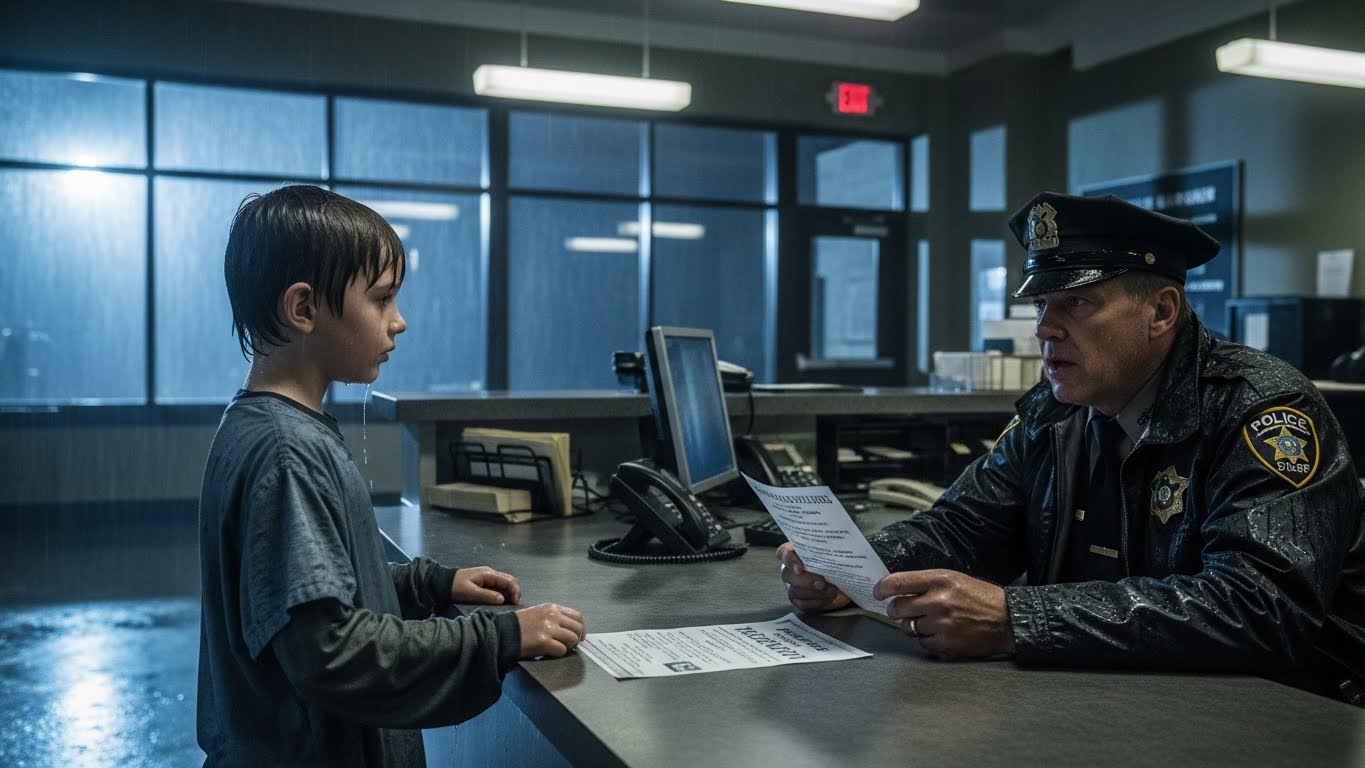
Inside the Oakhaven Police Station, Chief Tom Miller sat behind the high semicircular desk, listening to the wind howl against the reinforced glass. At fifty-five, Tom felt much like the weather: heavy, grey, and tired. He swirled the lukewarm coffee in his mug, staring at the “Retirement Planning” brochure pinned to the corkboard next to the dispatch radio. His wife, Martha, had been gone for three years now. The silence in his house was loud, but the silence in the station on a storm night was deafening.
He was the only one on duty at the front desk. The night shift dispatcher had called out due to flooded roads, and his two patrol cars were out dealing with a downed power line on Route 9.
“Just one more year, Martha,” he muttered to the empty room, rubbing the ache in his left knee. “Then I’ll go fishing. I promise.”
The station lights flickered, buzzed, and held. Then, the heavy double doors at the entrance burst open.
It wasn’t the wind.
A blast of freezing rain and dead leaves swirled into the lobby, soaking the linoleum. Tom stood up, his hand instinctively drifting toward his belt, though he didn’t unholster his weapon.
“We’re open, but you better close that door before we float away!” Tom called out, his voice gruff but not unkind.
A small figure struggled against the heavy door, finally managing to shove it shut against the gale outside. The silence returned, punctuated only by the dripping of water.
Standing on the welcome mat was a boy. He couldn’t have been more than eight or nine years old. He was soaked to the bone, his skin pale and translucent under the harsh fluorescent lights. He wasn’t wearing a raincoat. He was wearing a set of oversized, dirty green scrubs—hospital clothes—that hung off his skeletal frame like a tent. He was shivering so violently that Tom could hear his teeth chattering from ten feet away.
Tom’s police instincts, usually sharp and cynical, softened immediately into grandfatherly concern. He came around the desk, grabbing a thick wool blanket from the emergency bin.
“Hey there, son,” Tom said, keeping his voice low and steady. “You look like you went for a swim in the wrong ocean. You lost? Is your mom or dad out there?”
The boy didn’t answer. He backed away as Tom approached, his eyes wide and darting around the room like a trapped bird. He looked at the holding cells in the back, then at the exit, then at Tom’s badge.
“I’m not going to hurt you,” Tom said, stopping and holding out the blanket. “It’s just a blanket. You’re freezing.”
The boy stared at the wool fabric, then shook his head. He wrapped his thin arms around himself, his knuckles white. He was protecting something in the pocket of his scrubs.
“No blanket,” the boy whispered. His voice was raspy, as if he hadn’t used it in days.
“Okay. No blanket,” Tom agreed, tossing it onto a chair. “How about a name? I’m Chief Miller. Tom.”
The boy took a step forward, leaving a trail of muddy water. He walked right up to the high desk, standing on his tiptoes to see over the edge. His eyes were a piercing, intelligent green, but they were rimmed with red, exhausted shadows.
“Do you…” the boy paused, swallowing hard. “Do you have a piece of paper? And a pen? Please?”
Tom frowned. It wasn’t the request he expected. Usually, lost kids asked for a phone, or food, or their mommy. “I have plenty of paper, son. But why do you need it right now? Do you want to draw a picture?”
The boy shook his head frantically, water flying from his matted hair. “No. I need to write.”
“Write what?”
The boy wiped his nose on his sleeve. He looked at the door, as if expecting a monster to burst through at any second. Then he looked Tom dead in the eye, and the despair in his gaze broke Tom’s heart.
“I need to write a note,” the boy choked out, “So my Mom knows I’m still alive.”
Tom froze. The air in the room seemed to drop ten degrees. “Why wouldn’t she know you’re alive, son?”
The boy didn’t answer with words. Instead, he reached into the soggy pocket of his scrubs. His hand trembled as he pulled out a piece of paper. It had been folded and refolded a dozen times. It was laminated, which had saved it from the rain.
He placed it on the counter and slid it toward the Chief.
Tom picked it up. He adjusted his reading glasses, squinting under the flickering lights.
It was a tri-fold pamphlet. On the front was a picture of the boy standing in front of him—cleaner, happier, smiling in a school photo.
Below the photo, in elegant, scrolling calligraphy, were the words:
In Loving Memory of Leo Vance. January 12, 2016 – October 28, 2024. Tragically taken by fire. Rest in the Arms of Angels.
Tom felt a cold knot tighten in his stomach. He looked at the date of death. October 28th.
“Son,” Tom whispered, looking from the paper to the boy. “Today is October 29th.”
“I know,” Leo whispered, tears finally spilling over his freezing cheeks. “I died yesterday. But I’m not dead. She made me dead.”
“Who?” Tom demanded, his voice hardening into the tone of a man who had caught criminals for thirty years. “Who made you dead?”
“Mrs. Sterling,” Leo said. “At the Safe Harbor House. She put me in the basement. She told me Mommy didn’t want me anymore. But then I heard her on the phone… she said the insurance money came. She told the man to print the programs.”
Leo pointed a shaking finger at the pamphlet in Tom’s hand. “I stole that from her desk when the lights went out in the storm. I climbed through the vent. Please, mister. My Mom thinks I burned up. You have to tell her I didn’t burn up.”
Tom Miller looked at the pamphlet. It was high quality. Expensive cardstock. Professional printing. It was a lie printed on fancy stationery.
He looked at Leo. The boy was real. He was breathing. He was terrified.
And somewhere, a mother was grieving a child who was standing right here, begging to be found.
Tom grabbed his radio, his hand squeezing it so hard the plastic creaked. “Dispatch, get me the State Troopers. Now. And tell them to bring a blanket. I don’t care about the storm. We’re going for a ride.”
Chapter 2: The Architect of Grief
Tom Miller’s office was warmer than the lobby, but Leo Vance was still shaking. Tom had managed to get a heavy “Oakhaven PD” hoodie over the boy’s wet scrubs and had placed a cup of hot cocoa in his hands.
“Drink,” Tom ordered gently. “Sugar helps the shock.”
Leo took a small sip, his eyes never leaving the door.
“You said ‘Safe Harbor House’,” Tom said, sitting on the edge of his desk, notepad in hand. “That’s the big facility up on Chestnut Hill, right? The private one?”
Leo nodded. “The one with the big iron gates. Mrs. Sterling says the gates are to keep the bad people out. But they’re to keep us in.”
Tom knew the place. Safe Harbor was a prestige foster facility. It wasn’t run by the state; it was a private contractor, funded by high-end donors and state grants. It was run by Margaret Sterling, a woman Tom had met at a few charity galas. She was a pillar of the community—a woman who wore pearls and smelled of lavender and spoke about ‘saving the lost lambs.’
“Tell me about the fire, Leo,” Tom said. “The pamphlet says you died in a fire.”
“There wasn’t a fire,” Leo said, his voice gaining a little strength from the cocoa. “Two days ago, Mrs. Sterling came to my room. She said I was being ‘transferred’ to a special unit because I was bad. She took me to the basement. It’s soundproof down there. There are… there are other rooms. With other kids.”
Tom stopped writing. “Other kids?”
“I saw two others,” Leo whispered. “A girl named Maya and a baby. I don’t know the baby’s name. Mrs. Sterling locked me in a room with a mattress. Then yesterday, she was talking outside my door. She didn’t know the vent was open. She was on the phone. She said, ‘The policy cashed out. Mark him as deceased. Accidental fire in the outbuilding. No remains recovered due to intensity.'”
Leo looked up at Tom, his expression agonizingly adult. “She meant me. I’m the remains.”
Tom felt a surge of bile rise in his throat. He understood the scam instantly. It was horrific in its simplicity. Life insurance policies on state wards. State tragedy funds. Grants for ‘loss of life.’ And if the child is legally dead, they vanish from the system. No social worker checks on them. They become ghosts.
And ghosts can be sold. Trafficked. Used for labor. Because who looks for a dead child?
“I need to find your Mom,” Tom said, turning to his computer. He typed in Sarah Vance.
The database churned for a moment before popping up. Sarah Vance. 42 Elm Street, Apt 4B. Status: NOTIFIED.
Tom clicked on the incident report filed by Safe Harbor. It was all there. A report of an accidental electrical fire in a storage shed on the property. One casualty: Leo Vance. The coroner—a man Tom knew was up for re-election and owed money to the wrong people—had signed a preliminary death certificate based on “presumed incineration.”
Tom looked at the clock. It was 7:00 PM.
He pulled up Sarah Vance’s social media. The most recent post was from three hours ago. It was a black square. The caption read: The wake for my sweet Leo is tonight at my apartment. 6 PM – 9 PM. Please come say goodbye to my angel.
“Oh, God,” Tom breathed. “She’s doing it right now. She’s saying goodbye to you right now.”
Leo jumped off the chair. ” We have to go! She’s sad! She cries really loud when she’s sad!”
Tom grabbed his keys and his service jacket. He didn’t bother calling the local social services. If Sterling was doing this, she had people on the inside. He needed outside muscle.
“Dispatch,” Tom barked into his shoulder radio as he hustled Leo out to the squad car. “Where are those Troopers?”
“Five minutes out, Chief. The roads are washed out on the bridge.”
“Tell them to meet me at 42 Elm Street. Code 3. Lights and sirens. Tell them we have a kidnapping in progress and the perpetrator is on scene.”
“Copy that, Chief.”
Tom strapped Leo into the front seat of the Ford Explorer. The boy looked tiny against the black upholstery.
“Leo,” Tom said, looking the boy in the eye. “I need you to be brave for ten more minutes. Can you do that?”
“I climbed out of a vent,” Leo said, clutching the seatbelt. “I’m brave.”
“You’re the bravest man I know,” Tom said.
He slammed the car into gear and peeled out of the station lot, the sirens wailing a piercing harmony with the storm.
As they drove, Tom’s mind raced. He thought of Mrs. Sterling. He pictured her manicured nails, her soft voice, her fake sympathy. He imagined her sitting in Sarah Vance’s living room, drinking her tea, patting the hand of the woman whose life she had destroyed for a payout.
The indignation burned hotter than the heater in the car. It wasn’t just a crime. It was a violation of the sacred. It was stealing the grief of a mother and selling it for parts.
“Chief?” Leo asked, watching the windshield wipers fight the rain.
“Yeah, son?”
“Is my Mom going to be mad I’m late?”
Tom swallowed the lump in his throat. “No, Leo. I don’t think she’s going to be mad at all.”
They skidded around the corner onto Elm Street. It was a run-down block of brick tenements. Cars were double-parked. A small crowd of people dressed in black were standing on the sidewalk, smoking and huddling under umbrellas.
Tom pulled the cruiser right up onto the curb, his lights flashing red and blue against the wet brick.
“Stay here until I open the door,” Tom commanded.
He got out. The rain soaked him instantly. He marched toward the building entrance, his hand resting on his gun, not as a threat, but as a promise of justice.
Chapter 3: The Resurrection
The apartment was on the fourth floor. There was no elevator. Tom took the stairs two at a time, his anger propelling him upward. He could hear the low hum of voices as he reached the landing. Apartment 4B. The door was slightly ajar.
Inside, the air was thick with the smell of cheap lilies and damp coats. The apartment was small and poverty-stricken, but clean. Photos of Leo covered every surface—Leo at the park, Leo blowing out candles, Leo sleeping.
In the center of the room, on a small coffee table, sat a wooden box. An urn.
Sitting on the floor beside it was Sarah Vance. She looked like she had aged twenty years in twenty-four hours. Her eyes were swollen shut, her skin grey. She was rocking back and forth, clutching a stuffed bear.
And sitting on the sofa right next to her, holding her hand, was Mrs. Margaret Sterling.
Sterling looked impeccable in a black designer suit. She leaned in close to Sarah, her voice a soothing purr that carried across the room.
“He didn’t suffer, Sarah,” Sterling was saying. “I promise you. The smoke took him before the fire did. He went to sleep peacefully.”
The lie was so smooth, so practiced, that Tom felt physically sick.
He kicked the door all the way open. It banged against the wall with the sound of a gunshot.
The room went silent. Twenty mourners turned to look at the soaking wet Police Chief standing in the doorway, water dripping from his hat.
Mrs. Sterling stood up, indignantly smoothing her skirt. “Chief Miller? This is a private wake. Have some respect for the grieving mother.”
Tom didn’t look at her. He looked at Sarah.
“Sarah Vance?” Tom asked, his voice booming.
Sarah looked up, dazed. “Yes?”
“I need you to look at the door,” Tom said.
He stepped aside.
From behind the bulk of the Chief’s frame, a small figure in a police hoodie stepped out. He looked terrified of the crowd, but then he saw the woman on the floor.
“Mom?” Leo squeaked.
Sarah Vance froze. She stopped rocking. She stopped breathing. She stared at the boy as if her mind was trying to reject a cruel hallucination.
The room was so quiet you could hear the rain hitting the windowpane.
“Mommy?” Leo said louder, stepping into the room. “I’m not dead. She lied.” He pointed a small finger at Mrs. Sterling.
Mrs. Sterling’s face drained of color. She looked like a wax statue melting. She took a step back, bumping into the coffee table. The urn wobbled.
Sarah let out a sound that wasn’t human. It was a primal, gut-wrenching wail that started in her soul and tore through her throat. It was half agony, half ecstasy.
“LEO!”
She scrambled across the floor on her hands and knees. Leo ran to her. They collided in the center of the room. Sarah grabbed him, pulling him into her lap, burying her face in his neck, smelling his hair, touching his face, his arms, his back. She needed to feel the bone and muscle to believe it.
“You’re warm,” she sobbed, rocking him violently. “You’re warm. You’re warm. Oh God, you’re warm.”
The mourners gasped. Some started crying. Others looked at Mrs. Sterling with confused horror.
Sterling tried to edge toward the door. “There has been a mistake… a clerical error… the identity was confused…”
Tom Miller moved. He moved faster than he had in ten years. He blocked her path, looming over her.
“A clerical error?” Tom growled. “You printed a funeral program, Margaret. You have a fake urn on that table. You looked a mother in the eye and told her her baby burned to death.”
“It’s complicated,” Sterling stammered, her eyes darting for an exit. “The funding… the overhead…”
“You’re right,” Tom said. “It is complicated. But this part is simple.”
He grabbed her wrists and spun her around. He slapped the handcuffs on her—tight. He heard the ratchet click, and he gave it one extra squeeze.
“Ouch! That’s too tight!” Sterling shrieked.
“That’s for the paper,” Tom whispered in her ear.
Two State Troopers burst into the room behind him, shaking off the rain.
“Take her,” Tom said, shoving Sterling toward them. “And get a team to Safe Harbor. Now. Search the basement. Tear the walls down if you have to. There are more kids.”
As the Troopers dragged the protesting woman away, Tom turned back to the center of the room.
Sarah was still on the floor, holding Leo. She was kissing his forehead, his cheeks, his hands. Leo was crying too, holding onto his mother’s shirt like he would never let go.
“I missed you, Mommy,” Leo cried. “I saved the fruit cup for you but I lost it in the vent.”
“I don’t care,” Sarah wept. “I don’t care. I have you. I have you.”
Tom felt a tear hot and heavy, roll down his own cheek. He wiped it away quickly. He watched them for a moment longer—the resurrection of a family that the system had tried to delete.
Epilogue: The Paper Trail
The raid on Safe Harbor dominated the national news for weeks. They found twelve other children in the soundproofed basement. All of them had “died” on paper in the last two years. The investigation revealed a network of insurance fraud and illegal adoptions that spanned three states. Margaret Sterling was facing life in prison without the possibility of parole.
One week later, the storm had passed. The sun was shining on Oakhaven.
Chief Tom Miller was sitting at his desk, filling out the paperwork for the raid. The station door opened.
Sarah Vance walked in. She looked different. The grey cast to her skin was gone. She was wearing a bright yellow sweater. She held Leo’s hand.
Leo was wearing clean jeans and a superhero t-shirt. He walked right up to the high desk.
“Hi, Chief Tom,” Leo said.
“Hi, Leo,” Tom smiled, putting down his pen. “Staying out of the rain?”
“Yes, sir.” Leo reached into his pocket. “I brought you something. I didn’t have paper last time. But I have paper now.”
He handed Tom a drawing. It was done in crayon. It showed a tall stick figure with a blue uniform and a badge, holding hands with a small stick figure. A bright yellow sun filled the corner of the page.
Underneath, in messy, childish block letters, it said: MY HERO.
“Thank you, son,” Tom said, his voice thick. “This is… this is really something.”
“Mom says we’re moving to my Grandma’s in Florida,” Leo said. “Safe Harbor is closed forever.”
“That’s good news,” Tom said.
Sarah stepped forward. She didn’t say anything. She just reached over the desk and squeezed Tom’s hand. Her grip was strong. It was the grip of a woman who had been given her life back.
“Thank you,” she whispered.
They turned and walked out into the sunshine.
Tom watched them go. He looked at the drawing in his hand. Then, he looked at the “Retirement Planning” brochure on the corkboard.
He took a thumbtack. He pinned Leo’s drawing right over the brochure, covering it completely.
“Not yet, Martha,” Tom said to the empty room. “Not just yet.”