He Demanded I Let My Dog Die To Pay His Gambling Debts. He Didn’t Expect The Dying Dog To Save My Life One Last Time.
Chapter 1: The Weight of Silence
The silence in the farmhouse wasn’t empty; it was heavy, filled with the dust of fifty years and the echoes of a life that had slowly quieted down. For Frank Miller, that silence was a companion he had learned to tolerate, mostly because he wasn’t truly alone.
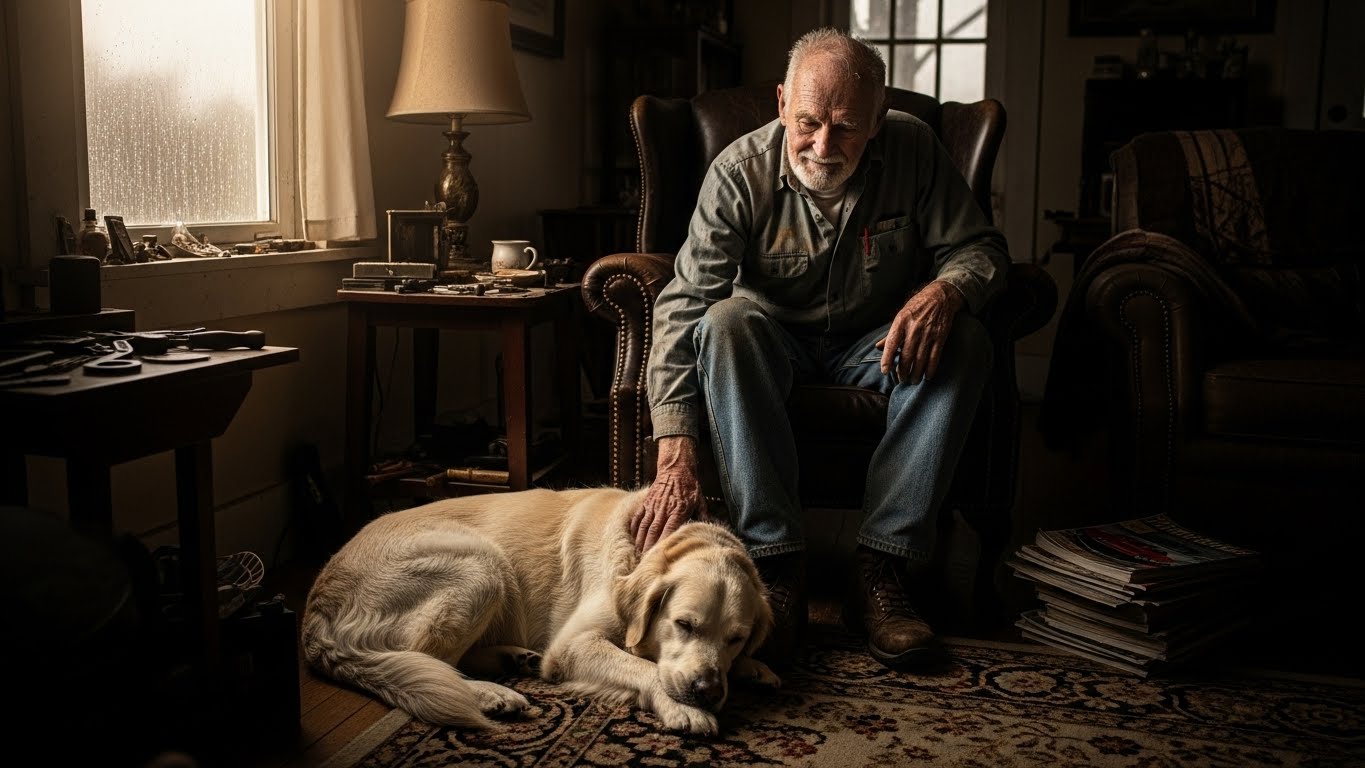
At seventy-four, Frank moved with the stiffness of an old engine that hadn’t been oiled in a while. His knuckles were swollen from decades of turning wrenches as a mechanic in town, and his back held a permanent ache from bending under hoods. He sat on his worn plaid armchair, the fabric thinning at the armrests, staring out the window at the Oregon rain drizzling against the glass. It was a gray, relentless afternoon in Whisper Creek.
At his feet lay Rusty.
Rusty was a Golden Retriever mix, fourteen years old—ancient for a dog of his size. His muzzle was entirely white, matching the stubble on Frank’s chin. One of Rusty’s eyes was clouded over with a milky cataracts, and he spent most of his days sleeping, his breathing producing a soft, rhythmic snoring that was the only music Frank needed.
“You okay down there, old man?” Frank asked softly, reaching down to scratch the velvety spot behind Rusty’s ear.
Rusty didn’t lift his head, but his tail gave a weak thump-thump against the faded Persian rug. That rug had been Martha’s favorite. She had bought it three months before the cancer took her, saying it would “brighten up the gloom.” Now, six years later, Rusty was the last living thing in this house that Martha had touched. He was the last gift she had given Frank—a wiggling puppy brought home in a cardboard box when she knew her time was running out. “So you won’t be lonely, Frank,” she had whispered.
But tonight, the mood was different. Earlier that morning, Rusty hadn’t greeted Frank at the bottom of the stairs. He hadn’t eaten his bowl of kibble, even when Frank mixed in the warm beef broth he usually couldn’t resist.
The visit to Dr. Evans, the local vet who had known Rusty since he was a pup, had shattered Frank’s quiet world.
“It’s aggressive, Frank,” Dr. Evans had said, her voice gentle but firm as she pointed to the X-rays illuminated on the wall. “Bone cancer in the rear leg. That’s why he’s limping. That’s why he’s whimpering.”
Frank felt a cold stone settle in his stomach. “What do we do? I can’t… I can’t lose him, Sarah. Not yet.”
Dr. Evans sighed, taking off her glasses. “There is a surgery. We remove the tumor and perform a bone graft. It’s complex, considering his age, but his heart is strong. It could give him another year, maybe two, of good, pain-free life. But Frank… it’s expensive. You’re looking at five thousand dollars, minimum, with the aftercare.”
Five thousand dollars.
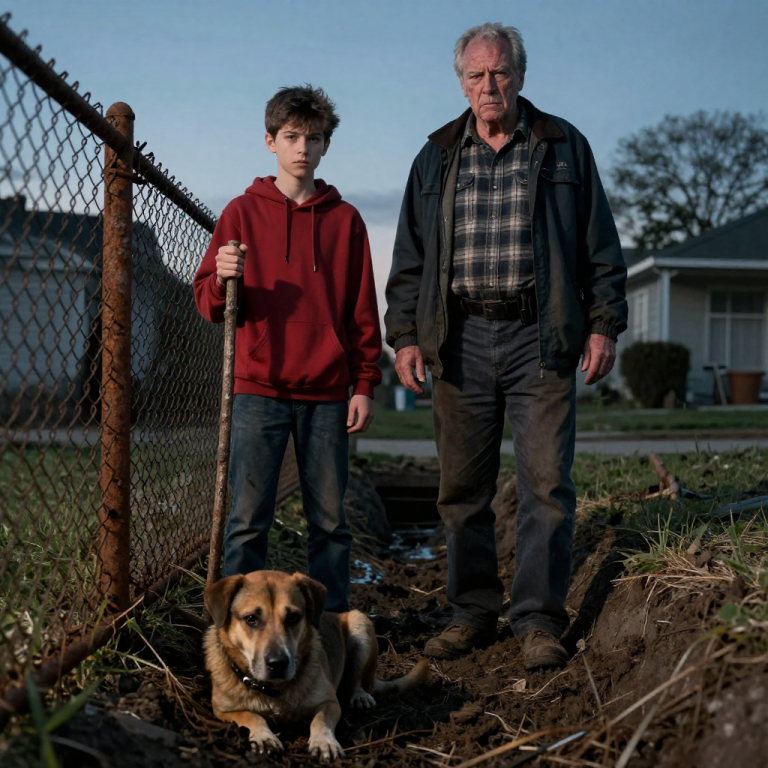
Frank looked around his modest living room now. He lived on a fixed pension. He fixed lawnmowers for cash on the side, but his hands weren’t as steady as they used to be. But he had the rainy-day fund.
It was a metal lockbox hidden behind the loose floorboard in the pantry. Martha had started it in 1985. It held exactly $5,200 in cash—emergency money. Money for a new roof, or a medical crisis.
Frank looked down at Rusty. The dog let out a sharp whimper in his sleep, his legs twitching as if chasing rabbits in a dream he could no longer catch.
“I got you, buddy,” Frank whispered, his voice cracking. “I got you.”
He made the decision instantly. The roof could leak. The truck could rust. But he wouldn’t let Martha’s boy suffer. He would pay for the surgery.
Just as Frank was about to head to the kitchen to make tea, the crunch of gravel on the driveway broke the silence. It wasn’t the mail carrier; it was too late for that.
Frank moved to the window, pulling back the lace curtain. A beat-up sedan, mud-splattered and sporting a dented bumper, had pulled up near the barn. The engine sputtered and died.
Frank’s heart hammered a warning rhythm against his ribs. He knew that car. Or rather, he knew the driving style—fast, reckless, and stopping only when necessary.
The car door opened, and a man stepped out. He was tall, wearing a leather jacket that looked too expensive for the rest of his attire. He looked at the house, shielding his eyes from the rain.
Todd.
It had been five years since Frank had seen his son. Five years since Todd had screamed that he hated this “nowhere town” and peeled out of the driveway, stealing Martha’s silver necklace on his way out to pawn it for God-knows-what.
Frank felt a mixture of instinctual fatherly hope and a deep, nauseating dread. He unlocked the front door just as Todd reached the porch steps.
“Dad!” Todd grinned, spreading his arms wide as if he hadn’t missed half a decade of birthdays and holidays. His smile was dazzling, the kind that could charm a snake, but it didn’t quite reach his eyes. His eyes were darting, scanning the property, scanning Frank. “Look at you. You haven’t changed a bit.”
“Todd,” Frank said, his voice steady, though his hands trembled slightly. He didn’t open the screen door yet. “What are you doing here?”
“Is that how you greet your prodigal son?” Todd laughed, a hollow sound. “I came to see you. I realized… I realized I’ve been a terrible son. I wanted to make things right. Reconnect. Take care of you.”
Frank hesitated. He wanted to believe it. Every parent wants to believe their child returns for love, not utility.
“Come inside,” Frank said, pushing the door open.
Todd stepped in, shaking off the rain. He smelled of stale cigarette smoke and nervous sweat. He looked around the living room, his gaze lingering on the antique clock, the television, and finally, landing on the sleeping dog.
“Jesus,” Todd sneered, his charming mask slipping for a millisecond. “That mongrel is still alive? He looks like a rug with a heartbeat.”
“Rusty is sick,” Frank said defensively, moving to stand between his son and the dog. “Be careful around him.”
“Right, right. Good old Rusty,” Todd said, forcing a smile back onto his face. He clapped Frank on the shoulder. “So, Dad. How have you been? You got any coffee? I’ve had a long drive.”
As Frank went to the kitchen, he didn’t see Todd’s eyes narrow, scanning the room not with nostalgia, but with the desperate calculation of a predator cornered by his own debts. The prodigal son hadn’t returned for forgiveness. He had returned because he had nowhere else to run.
Chapter 2: Snakes in the Grass
The first two days were an exercise in walking on eggshells. Todd was on his best behavior, or at least, a version of it that Frank tried hard to accept. Todd fixed a loose hinge on the porch (though he complained the whole time), he swept the kitchen, and he told stories about “business ventures” in Las Vegas that were always just about to pay off.
But Frank noticed things. He noticed how Todd’s phone would ring late at night, and Todd would rush to the porch, whispering in hushed, angry tones. He noticed the way Todd looked at the mail, specifically the bank statements.
And he noticed how Todd treated Rusty.
It wasn’t overt abuse—not while Frank was watching. It was the little things. Todd would “accidentally” bump into the sleeping dog’s bad leg, sending Rusty yelping awake. He would “forget” to fill the water bowl.
On the third evening, the tension in the house was thicker than the storm clouds gathering outside. A severe thunderstorm warning was in effect for Whisper Creek.
Frank sat at the kitchen table, counting the cash from the lockbox. He had retrieved it earlier, preparing to take Rusty to Dr. Evans first thing in the morning for the surgery. He had stacked the bills neatly: fifty-two hundred dollars.
“Whoa,” Todd said, walking into the kitchen. He froze, his eyes locked on the money. The hunger in his expression was so raw it made Frank flinch. “Dad? What is that? Did you hit the lottery?”
“It’s my savings,” Frank said, quickly putting the money back into the metal box. “It’s for Rusty.”
“For the dog?” Todd’s voice rose an octave. “What do you mean, for the dog?”
“He needs surgery. Tomorrow. It costs five thousand dollars.”
Todd laughed, a sharp, incredulous bark. “You’re joking. You’re going to spend five grand—five thousand American dollars—on a dying dog? Dad, that’s insane. That’s senile.”
“It’s my money, and he’s my family,” Frank snapped, clutching the box. “It’s none of your business.”
“I’m your family!” Todd shouted, slamming his hand on the table. “Me! I’m your flesh and blood! Do you know what I could do with that money? I have… debts, Dad. Bad debts. People are looking for me. That money could save my life, and you’re going to throw it into a hole in the ground for an animal that’s going to die anyway?”
“You got yourself into debt, Todd. Again,” Frank stood up, his military posture returning. “I’m not bailing you out for gambling. Not again. This money is for Rusty.”
Frank walked out of the room, taking the box to his bedroom and locking the door. He didn’t hear Todd follow. He only heard the silence return, but this time, it felt malicious.
That night, the storm hit. Thunder shook the farmhouse foundation. The wind howled like a banshee.
Around 2:00 AM, Frank woke up. He didn’t know what woke him—perhaps a father’s instinct, or the lack of the rhythmic snoring beside his bed. Rusty usually slept on the rug next to him.
“Rusty?” Frank whispered into the dark.
No answer.
Frank fumbled for the lamp. The rug was empty.
Panic, cold and sharp, pierced his chest. He grabbed his robe and hurried into the hallway. “Rusty!”
He went downstairs. The back door, leading to the yard, was wide open. The wind was whipping rain into the kitchen, soaking the linoleum.
“No,” Frank gasped. He ran to the door. “Rusty!”
The storm was raging. The rain was torrential. A dog in Rusty’s condition, blind in one eye and crippled by bone cancer, wouldn’t last an hour out there.
“Todd!” Frank screamed, looking around. The house was dark.
Frank grabbed his flashlight and ran out into the storm. The mud sucked at his slippers. The rain stung his face. “Rusty! Boy! Come here!”
He searched for twenty minutes, his heart pounding so hard he thought it would give out. Finally, near the edge of the woods, he saw a lump of wet fur huddled under a fallen log.
Rusty was shivering violently, soaked to the bone. He let out a weak whine when he saw the flashlight beam.
“Oh, God, I’m sorry,” Frank sobbed, scooping the heavy, wet dog into his arms. The adrenaline gave him the strength of a younger man as he carried the sixty-pound animal back to the house.
He kicked the back door shut and laid Rusty on the kitchen floor, grabbing towels to rub him vigorously.
“How did the door get open?” Frank muttered, trembling with rage. “I locked it. I know I locked it.”
He looked up and saw Todd standing in the doorway of the kitchen, leaning against the frame, eating an apple. He looked completely dry. He looked bored.
“Must have blown open,” Todd said, taking a bite. “Old house, Dad. Latches fail.”
“The deadbolt was on,” Frank growled, continuing to rub warmth into Rusty.
“Maybe you forgot,” Todd shrugged. “You’re getting old, Dad. You forget things. Like how to prioritize humans over beasts.”
Frank stopped moving. He looked at his son—really looked at him—and saw the monster that had replaced the boy he once raised. Todd hadn’t just left the door open; he had hoped nature would do his dirty work. He hoped the dog would wander off and die so the money wouldn’t be spent.
“Go to bed, Todd,” Frank whispered, his voice dangerous.
“Sure thing, Pop. Don’t catch a cold.”
Chapter 3: The Betrayal
The morning light brought no warmth, only a stark, gray revelation. Rusty was alive, but the night in the cold rain had weakened him significantly. His breathing was raspy, suggesting pneumonia might be setting in on top of the cancer.
Frank dressed quickly. He had to get to Dr. Evans immediately. He went to his bedroom closet, where he had hidden the metal box under a pile of sweaters after the argument.
He pulled the box out. It felt light.
Too light.
Frank’s hands shook as he pried the lid open.
Empty.
The five thousand two hundred dollars was gone.
A roar of pure, primal anger erupted from Frank’s throat. He didn’t think; he just reacted. He marched out of the bedroom, down the hall, to the guest room where Todd was staying.
He kicked the door open.
Todd was packing a duffel bag. The cash was already stuffed inside; Frank could see the green edges of the bills poking out from between a pile of shirts.
“Put it back,” Frank said, his voice surprisingly calm, the calm of a man holding a grenade.
Todd didn’t even flinch. He zipped the bag shut and turned around. “I can’t do that, Dad. I need to leave. My… creditors… they know I’m here. I have to go now.”
“That is Rusty’s life you have in that bag,” Frank stepped forward. “Give it to me.”
“It’s paper, Dad! It’s just paper!” Todd yelled, his face flushing red. “I’m in trouble! If I don’t pay these guys, they’re going to break my legs. Maybe worse. You’re choosing a dog over your son’s life?”
“You made your choices,” Frank said, reaching for the bag.
Todd shoved him.
It wasn’t a playful shove. It was violent. Frank stumbled back, catching himself on the doorframe.
“Get out of my way,” Todd spat. “I’m taking the car, too. Yours is better on gas.”
“You’re not taking anything,” Frank moved to block the hallway. “I’m calling the sheriff.”
Todd laughed darkly. “You can’t. I cut the phone line outside while you were playing nursemaid to the mutt. And I have your cell phone right here.” He pulled Frank’s flip phone from his pocket and smashed it against the wall. It shattered into plastic shards.
“Now,” Todd said, advancing on his father. “Move.”
“No,” Frank stood his ground. He was old, he was frail, but he was a father, and he was a protector.
Todd grabbed Frank by the collar of his flannel shirt and threw him. Frank hit the floor hard, his head striking the baseboard. Stars exploded in his vision. Pain radiated down his spine.
“Stay down, old man,” Todd sneered, adjusting his jacket. “Don’t make me hurt you more. You’ll thank me later when that dog is dead and you’re not wasting your inheritance on it.”
Frank tried to get up, but his dizziness pinned him to the floor. He watched as Todd stepped over him, heading toward the stairs, toward freedom, with the money that represented Rusty’s only chance at life.
Chapter 4: The Last Stand
Todd reached the top of the stairs, the duffel bag slung over his shoulder. He felt victorious. The old man was down, the money was his, and he’d be across the state line by noon.
He took the first step down.
A low, guttural sound vibrated through the hallway. It didn’t sound like a dog; it sounded like a wolf.
Todd looked down.
At the bottom of the stairs stood Rusty.
The dog shouldn’t have been standing. The cancer had eaten his hip bone; the pneumonia from the storm was filling his lungs. By all medical logic, he should have been comatose on the kitchen rug.
But Rusty was standing. His legs were trembling violently, holding up his weight through sheer, impossible will. His lips were curled back, revealing old, yellowed teeth. His one good eye was locked onto Todd with a ferocity that froze the man in his tracks.
Rusty smelled the adrenaline. He smelled the aggression. But most of all, he had heard his master hit the floor. The man who had fed him, loved him, and carried him through the storm was hurt. And the threat was right there.
“Get out of the way, you stupid mutt!” Todd yelled, stomping his foot to scare the dog.
Rusty didn’t flinch. He didn’t retreat.
Todd, impatient and panicked, rushed down the stairs, aiming a kick at the dog’s ribs to clear his path.
It was a mistake.
As Todd’s boot swung, Rusty lunged. It wasn’t the graceful leap of his youth, but a desperate, clumsy, gravity-defying surge of protective fury. Rusty’s jaws snapped shut around Todd’s calf.
“AHHH!” Todd screamed as the teeth sank into the denim and flesh.
He thrashed, losing his balance. He fell sideways, tumbling down the last four steps, crashing onto the hardwood floor of the foyer. The duffel bag skidded across the room.
Rusty didn’t let go. He held on, growling, his frail body acting as an anchor.
“Get off! Get off!” Todd shrieked, kicking wildly with his other leg.
He landed a solid, sickening kick to Rusty’s stomach.
Rusty yelped—a high-pitched sound of pure pain—and flew backward, sliding across the polished wood until he hit the wall with a dull thud. He didn’t get up. He lay there, wheezing, blood trickling from his mouth.
But the distraction was enough.
Click-clack.
The sound was unmistakable. It was the sound of a pump-action shotgun chambering a shell.
Todd looked up, clutching his bleeding leg.
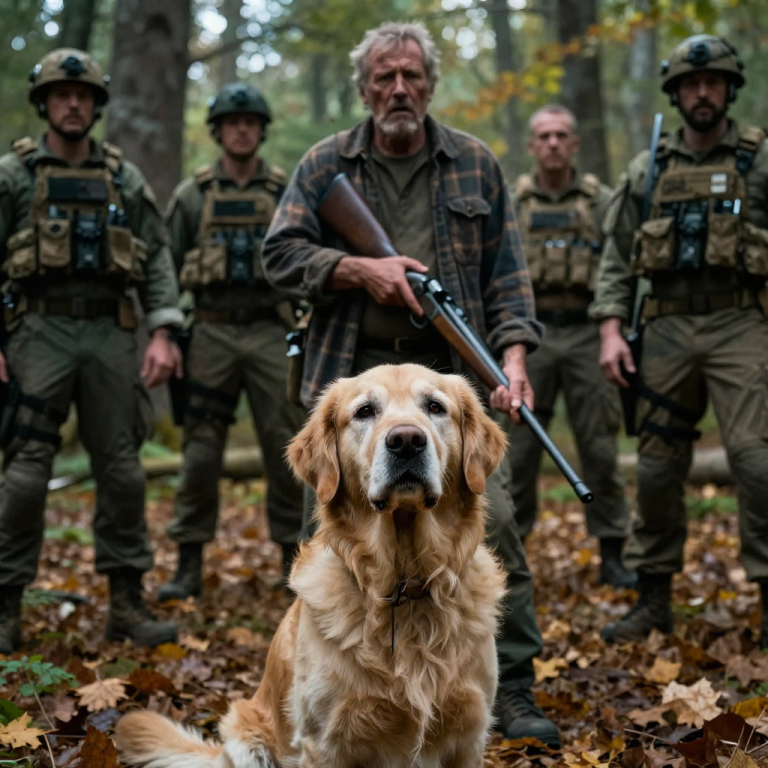
Frank stood at the top of the hallway entrance. He was swaying slightly, blood dripping from a cut on his forehead, but the Remington 870 in his hands was steady as a rock. He didn’t look like a mechanic anymore. He looked like the soldier he had been in 1969.
“Don’t,” Todd whimpered, raising his hands. “Dad, don’t. It’s me.”
“You stopped being my son the minute you raised a hand to me,” Frank said, his voice cold as ice. “And you stopped being human when you kicked that dog.”
Frank aimed the barrel at Todd’s chest.
“Get out,” Frank commanded. “Leave the money. Leave the car. Walk. If I see you on this property in ten seconds, I will bury you next to the barn.”
Todd saw the look in his father’s eyes. There was no hesitation there. Only resolve.
Todd scrambled up, limping, leaving a trail of blood. He didn’t touch the bag. He threw open the front door and ran out into the rain, disappearing down the long driveway on foot.
Frank didn’t lower the gun until Todd was out of sight. Then, the adrenaline crashed.
He dropped the gun and fell to his knees, crawling across the floor to where Rusty lay.
“Rusty… oh, buddy… no, no, no,” Frank wept.
The dog was lying on his side. His breathing was wet and ragged. The kick had likely ruptured something internal. The fight had used up the very last reserve of energy the old dog had.
Frank pulled Rusty’s head into his lap, stroking the soft fur. “You saved me. You foolish, wonderful boy. You saved me.”
Rusty’s good eye opened slowly. He looked up at Frank. There was no pain in that look, only a deep, abiding love. He saw Frank crying, and even in his final moments, his instinct was to comfort.
Thump.
Rusty’s tail hit the floor once.
“It’s okay,” Frank sobbed, burying his face in the dog’s neck. “You can go. Go find Martha. She’s waiting.”
Thump.
The tail hit the floor a second time, slower.
Rusty let out a long sigh, his tongue lolling out to lick the tears from Frank’s hand one last time.
Thump…
The tail raised halfway, then fell silent. The chest stopped moving.
The guardian of Whisper Creek was gone.
Chapter 5: Whispers of the Faithful
The house felt bigger in the days that followed. The silence was absolute now, but it wasn’t empty. It was filled with a strange, solemn peace.
Frank buried Rusty under the giant oak tree on the hill, right beside the small stone marker for Martha. He carved the cross himself out of cedar: Here lies Rusty. A Good Boy. A Better Hero.
Two days later, the Sheriff pulled up. He found Frank sitting on the porch.
“We found him, Frank,” the Sheriff said, taking off his hat. “Todd. We picked him up trying to hitchhike two towns over. He needed medical attention for a dog bite. We ran his ID. He’s got warrants in three states for fraud and grand larceny.”
Frank nodded slowly, looking out at the oak tree. “He’s no son of mine, Sheriff. Do what you have to do.”
“There’s something else,” the Sheriff added. “Dr. Evans told me what happened. About the surgery money.”
Just then, Dr. Evans’ truck pulled up. She walked up the steps, holding a file.
“Frank,” she said gently. “I heard about Rusty. I am so, so sorry.”
“He went out fighting, Doc,” Frank said, a sad smile touching his lips. “He saved me.”
“He did more than that,” Dr. Evans said. She sat down next to him. “Todd… he had been making calls around town before he came to you. He was inquiring about power of attorney. He was trying to build a case that you were senile, incompetent, so he could take control of your assets, sell the farm, and put you in a home.”
Frank went cold. “He what?”
“But he can’t,” the Sheriff interjected. “Because of the police report. The report states you defended your home. You were lucid, you were capable, and you protected your property. And frankly, the fact that the dog defended you… well, dogs don’t protect bad people, Frank. In the eyes of the law, and this town, you’re the sane one. Todd’s testimony that you’re ‘crazy’ won’t hold up in court after he assaulted you.”
Frank looked at the spot where Rusty was buried.
Even in death, the dog had protected him. Rusty had exposed Todd’s true nature, forced the confrontation, and ensured Frank kept his freedom.
“He really was a guardian,” Frank whispered.
That evening, as the sun set over Whisper Creek, painting the sky in hues of orange and purple, Frank sat on the porch rocker. He had the money box on his lap—the money he would now donate to the local animal shelter in Rusty’s name.
He closed his eyes. For a moment, he felt a phantom weight on his feet—warm, heavy, and comforting. He heard a phantom thump-thump against the floorboards.
Frank smiled, tears streaming down his face, but his heart was full.
“Good boy,” he whispered to the wind. “Good boy.”