Fired For Feeding A Starving Student: 20 Years Later, The Boy Returns To The Nursing Home Where She Was Left To Rot
Chapter 1: The Brown Paper Bag Protocol
The radiator in Room 304 rattled with a sound like a dying lung, a metallic wheeze that punctuated the silence of Iron Creek Elementary. Outside, the Pennsylvania winter was doing its best to bury the Rust Belt town in gray slush. Inside, Mrs. Eleanor Vance sat at her desk, her spine as rigid as a ruler, grading arithmetic quizzes with a red pen that moved like a surgeon’s scalpel.
Eleanor was fifty-eight years old, a widow for ten, and a teacher for thirty-five. She was not the kind of teacher who hugged children. She did not give high-fives. She did not use “gentle parenting” techniques or allow chaos in her domain. She was Old World. She believed in posture, penmanship, and silence. To the parents of Iron Creek, she was a relic, a dinosaur who hadn’t gotten the memo that children were now delicate flowers. To Eleanor, children were saplings; they didn’t need coddling, they needed a stake to grow straight against the wind.
But Eleanor Vance saw everything.
From her vantage point at the front of the room, behind the formidable oak desk, she saw the holes in the knees of Jacob’s jeans. She saw the bruises on Sarah’s arm that the girl tried to hide with a cardigan. And she saw Toby Miller.
Toby was eight years old, though he looked six. He was a wisp of a boy, pale and translucent as skim milk, with eyes that seemed too heavy for his neck to support. He wore a windbreaker in January because he didn’t have a winter coat, and his sneakers were held together by gray duct tape.
It was 11:45 AM. Lunch period had just ended. The class was settling into Silent Reading time. Eleanor watched Toby. He wasn’t reading. He was staring at the clock, his hand pressed subtly against his stomach.
Earlier that day, during the chaotic transition to the cafeteria, Eleanor had lingered in the hallway. She had seen Toby separate from the line. He hadn’t gone to the lunch counter. He didn’t have a lunchbox. Instead, he had drifted toward the large trash barrels near the exit. Eleanor had watched, her heart thumping an unfamiliar rhythm against her ribs, as the boy reached in and pulled out a discarded foil packet of ketchup. He had squeezed the red paste into his mouth quickly, furtively, like a stray animal fearing a kick, and then swallowed it whole.
That image—the ketchup packet—burned in Eleanor’s mind as she graded the papers. It violated the structured order of her world. In her classroom, A plus B equaled C. But in Toby’s life, nothing added up.
The bell rang for recess. The children surged like a tidal wave. “Walk, do not run!” Eleanor barked, her voice cutting through the noise.
Toby lagged behind, moving with the lethargy of low blood sugar.
“Mr. Miller,” Eleanor called out.
Toby froze near the door. His shoulders hunched. He expected trouble. In his world, adults only spoke his name when he had done something wrong. “Yes, ma’am?”
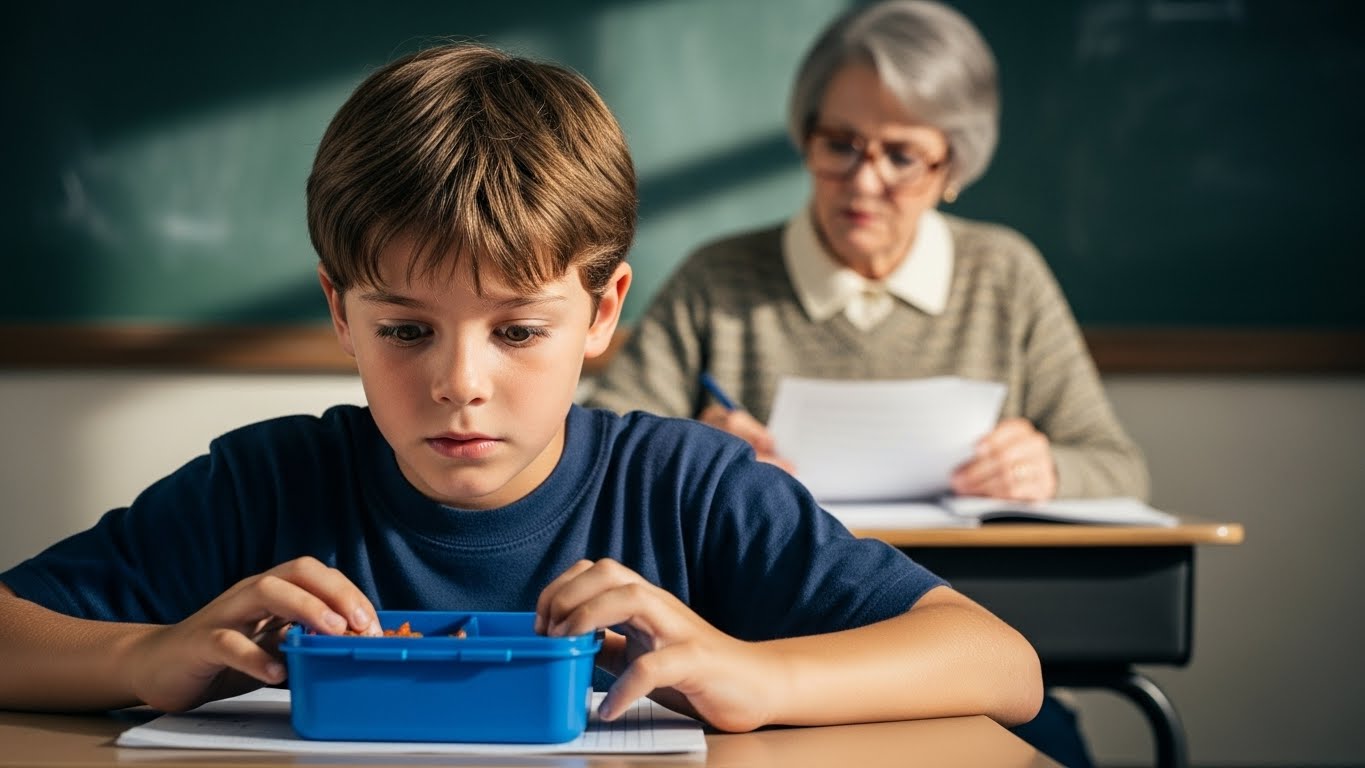
“I seem to have overpacked today,” Eleanor said, her voice flat, betraying no emotion. She opened the bottom drawer of her desk. She pulled out a sturdy, blue plastic lunchbox. It wasn’t hers. She had bought it during her lunch break, driving to the Dollar General with a speed that defied the speed limit.
Inside, she had packed what she considered a proper meal: a thick peanut butter and jelly sandwich on whole wheat (crusts on, because nutrients are in the crust), a Honeycrisp apple, a carton of milk she’d bought from the vending machine, and two chocolate chip cookies.
“I cannot abide waste, Toby,” she lied, looking him dead in the eye. “If this food goes in the trash, it is a sin. Do you understand?”
Toby looked at the box, then at her. He didn’t move. He was trembling.
“I have grading to do,” Eleanor said, feigning disinterest. She placed the box on the front row desk—Toby’s desk. “If that box is not empty by the time I look up, you will be in detention.”
She put her head down and pretended to write. She listened.
For a long moment, there was silence. Then, the scuff of a sneaker. The click of the plastic latch. The rustle of wax paper. And then, a sound that broke Eleanor’s heart—the ferocious, animalistic sound of a starving child eating too fast.
She did not look up. She let him have his dignity.
This became their ritual. The “Silent Pact.” Every day, Eleanor brought “extra.” Every day, she concocted a story about how she had made too much, or how the grocery store had a sale she couldn’t resist. She never asked about his home life. She knew the rumors—methamphetamine, a father in and out of jail, a mother who slept for days. If she reported it to Social Services, Toby would be swallowed by the system, likely moved to a foster home three counties away, separated from his older sister who was in middle school. Eleanor knew the system; it was a grinder. She decided to be the stopgap.
Winter turned to Spring. The change in Toby was subtle but undeniable. His skin lost that translucent, gray pallor. He grew an inch. He stopped falling asleep during History. His grades moved from D’s to B’s, and finally, to A’s.
He never said “thank you” out loud. Eleanor wouldn’t have allowed it; it would have acknowledged the charity. But the gifts started appearing in her desk drawer.
First, it was a dandelion, crushed but bright yellow. Then, a smooth river stone, polished with spit and shirt fabric until it shined. Finally, a drawing. It was crude, done in crayon. It showed a stick figure woman with glasses standing behind a desk, and a small boy standing next to her. Above the woman, he had written a single word: Safe.
Eleanor Vance, the woman who never cried, took that drawing home and placed it inside her Bible. She told herself she was just doing her civic duty. She told herself she wasn’t getting attached.
She was a liar.
Chapter 2: The Liability of Kindness
The end of the school year was approaching, bringing with it the humidity and the buzzing flies. It also brought Mr. Halloway.
Principal Halloway was thirty-two years old. He wore slim-fit suits that cost more than Eleanor’s car, and he spoke in a language of buzzwords. He didn’t care about education; he cared about “metrics,” “liability,” and “risk mitigation.” He viewed the older teachers as dead weight, obstacles to his vision of a streamlined, tech-savvy district. He was looking for excuses to trim the budget.
It was a Tuesday in May when the hammer fell.
Eleanor had just placed the blue lunchbox on Toby’s desk. The class was at Art. Toby had stayed behind, claiming a stomach ache, which was their code for “I didn’t eat breakfast.”
The door to Room 304 swung open. It wasn’t a student. It was Principal Halloway, flanked by the district nurse and the Vice Principal. A surprise inspection.
Halloway stopped. His eyes—cold, blue, and calculating—landed on the boy. Then they landed on the blue lunchbox. Then they landed on the sandwich in Toby’s hand.
“What is this?” Halloway asked. His voice was silky, dangerous.
Toby dropped the sandwich. It hit the floor with a wet thud. He looked terrified.
“It’s lunch, Mr. Halloway,” Eleanor said, standing up. She moved instinctively between the Principal and the boy. “Toby forgot his today.”
Halloway walked over to the desk. He picked up the lunchbox. He inspected the contents. “This isn’t cafeteria food, Mrs. Vance. This is homemade.”
“I made it,” Eleanor said. “Is there a crime against peanut butter?”
Halloway smiled, but it didn’t reach his eyes. “Nurse, please escort Mr. Miller to the clinic for a check-up. We need to ensure he hasn’t ingested any allergens.”
“He’s fine,” Eleanor snapped. “He’s been eating it for months.”
The room went silent. Eleanor realized her mistake immediately.
“Months?” Halloway repeated. He turned to the Vice Principal. “Note that down.”
They ushered Toby out. The boy looked back at Eleanor, his eyes wide with panic. “Mrs. Vance?” he whispered.
“Go, Toby. It’s alright,” she said, though her hands were shaking behind her back.
Ten minutes later, Eleanor was sitting in Halloway’s office. The air conditioning was set to freezing.
“Do you have any idea the liability you’ve exposed this district to?” Halloway asked, leaning back in his leather chair. He tapped a pen against the desk. “Unregulated food distribution. Potential allergic reactions. Favoritism. Grooming behavior.”
Eleanor slammed her hand on the desk. “Grooming? How dare you! The boy was starving, you bureaucratic vulture! He was eating ketchup packets out of the garbage!”
“Then you should have filed a form 12-B with Social Services,” Halloway countered calmly. “You should have followed protocol.”
“Protocol doesn’t fill a belly,” Eleanor spat. “Protocol takes six weeks to process. He would have wasted away by then.”
Halloway sighed. He opened a folder. “Mrs. Vance, you are two years away from full retirement benefits. If I take this to the board, you will be fired for cause. You will lose your pension. You will be blacklisted.”
Eleanor felt the blood drain from her face. She was a widow. That pension was her survival.
“However,” Halloway continued, sliding a piece of paper across the desk. “If you resign effective immediately… for ‘health reasons’… we will allow you to keep a portion of your benefits. It’s a generous offer. We’re trying to help you.”
It wasn’t help. It was a purge. He wanted her salary off the books to hire two young teachers for the price of one.
Eleanor looked at the paper. She thought of the river stone in her drawer. She thought of the drawing.
“I want to say goodbye to him,” she said quietly.
“No,” Halloway said. “That would be inappropriate. You will pack your things now. Mr. Henderson will escort you to your car.”
The walk of shame was long. Eleanor held her head high, carrying a single cardboard box. She walked past the playground. The children were outside. She scanned the fence.
There he was. Toby. He was standing by the chain-link fence, his fingers curled around the metal wire. He saw her carrying the box. He saw Mr. Henderson gripping her elbow like she was a criminal.
Toby didn’t wave. He just watched, his face crumbling. He thought he had done this. He thought that by eating the sandwich, he had been “bad” again. He thought she was leaving him because he wasn’t worth the trouble.
Eleanor wanted to scream. She wanted to run to the fence and tell him, You are worth everything. But she couldn’t. She got into her 1998 Toyota Camry, started the engine, and drove away. She cried for the first time in twenty years.
She never saw Toby Miller again.
Chapter 3: The Peanut Butter Legacy
Twenty years is a long time. It is enough time for a town to die and be reborn. It is enough time for a boy to become a man. And it is enough time for a strong woman to break.
Eleanor Vance was now seventy-eight. The “portion” of the pension Halloway had allowed her to keep hadn’t been enough. Inflation and medical bills had eaten it alive. She had lost her house.
Now, she resided at “The Willows,” a state-subsidized nursing facility that smelled of bleach, urine, and boiled cabbage. It was a warehouse for the forgotten.
Eleanor was skeletal. Her once-sharp eyes were cloudy with cataracts she couldn’t afford to fix. She spent her days in a wheelchair by the window, staring at a brick wall.
The care was abysmal. The facility was understaffed. Dinner was at 4:30 PM, and it was usually a scoop of unrecognizable gray mash and lukewarm water. If you were slow to eat, they took the tray away. Eleanor was slow. Her hands shook from Parkinson’s.
It was a Tuesday in November. Thanksgiving was approaching. The hallway was decorated with cheap paper turkeys that mocked the misery of the residents.
Eleanor was hungry. Her stomach growled, a sound that took her back to a classroom twenty years ago. She looked around to make sure the nurse wasn’t watching. With a trembling hand, she reached into her pocket. She pulled out a napkin. Inside was a crust of bread she had saved from breakfast. It was stale and hard, but it was food.
She raised it to her mouth, trying to hide it.
“Mrs. Vance?”
The voice was deep, resonant, and unfamiliar.
Eleanor froze. She tried to hide the bread. She didn’t want anyone to see her indignity. She turned her wheelchair slowly.
Standing in the doorway was a man. He was tall, dressed in a charcoal suit that fit him perfectly. He held a clipboard. He looked like the kind of man who owned buildings, not the kind who visited them. But his eyes… his eyes were wet.
“I’m sorry,” Eleanor croaked, her voice rusty from disuse. “I… I wasn’t hoarding. I was just…”
The man didn’t speak. He walked into the room. He didn’t look at the peeling paint or the stained floor. He looked only at her. He dropped the clipboard on the bed.
He knelt. It was a shocking gesture. Men in suits didn’t kneel on dirty linoleum floors. He knelt so he was eye-level with her wheelchair.
“Mrs. Vance,” he said again. His voice cracked.
Eleanor squinted. “Do I know you, young man? My memory isn’t what it used to be.”
The man reached into his jacket pocket. He pulled out something small. He held it out to her.
It was a river stone. Smooth. Polished. Ancient.
Eleanor’s breath hitched. Her heart hammered against her frail ribs. “Toby?” she whispered. “Toby Miller?”
“It’s Dr. Miller now,” Toby said, tears finally spilling over his cheeks. “But yes. It’s Toby.”
“You… you grew,” she said stupidly. It was all she could think to say.
“I did,” he laughed, a wet, choked sound. “I grew because you fed me.”
Just then, a nurse bustled in. A large woman with a sour expression. “Hey! Visiting hours are over. And you—” she pointed at Eleanor, “—give me that bread. You know the rules about food in rooms. Ants.”
She reached for the napkin in Eleanor’s hand.
Toby stood up. He didn’t just stand; he towered. The transformation was instant. The weeping boy was gone; the authority figure remained.
“Do not touch her,” Toby said. His voice was low, but it carried the weight of thunder.
The nurse froze. “Excuse me? I’m the head nurse here. Who are you?”
“I am Dr. Toby Miller,” he said, stepping between the nurse and Eleanor. “I am the new owner of the Omni-Health Medical Group. We finalized the acquisition of this facility this morning. Which means, Madam, that I am your employer.”
The nurse’s jaw dropped.
“And you are fired,” Toby said. “Get out.”
“You… you can’t…”
“I can. And I did. Get out.”
The nurse fled. Toby turned back to Eleanor. He pulled a chair close and sat down. He reached for a bag he had brought with him. It wasn’t a briefcase. It was a blue plastic lunchbox.
He popped the latch.
“I looked for you for years,” Toby said softly. “When I made my money, when I became a surgeon… you were the first person I wanted to tell. But you had moved. No one knew where.”
“I was ashamed,” Eleanor whispered. “I didn’t want you to see me like this.”
“Like what?” Toby asked. “Beautiful?”
He opened the lunchbox. Inside was a peanut butter and jelly sandwich on whole wheat (crusts on). A Honeycrisp apple. A carton of milk. And two chocolate chip cookies.
He took out the sandwich. He unwrapped it with the same care a jeweler handles a diamond. He broke off a piece.
“My hands shake,” Eleanor said, ashamed.
“That’s okay,” Toby said. “My hands used to shake too. Remember?”
He held the piece of sandwich to her lips. Eleanor opened her mouth. She took a bite. It tasted like peanut butter and tears. It tasted like redemption.
“Why?” she asked, chewing slowly. “Why did you come back?”
Toby smiled. He wiped a crumb from her chin gently.
“Because, Mrs. Vance,” he said. “You didn’t just give me a sandwich. You gave me a future. You taught me that even when the world is garbage, someone might still reach in and pull you out.”
He picked up the apple.
“We’re moving you today,” he said. “To my private facility. You’ll have a view of the garden. You’ll have real food. You’ll never be hungry again.”
Eleanor Vance, the teacher who never hugged, reached out her bony arms and pulled the man into an embrace. She sobbed into his expensive suit.
“I thought I failed,” she cried. “I thought I made no difference.”
Toby held her tight, rocking her like she had once comforted him with her silence.
“You saved a life, Eleanor,” he whispered. “And now, I’m going to save yours.