I’ve kicked down a thousand doors in this city, but tonight, a six-year-old boy whispered a question that shattered my badge and brought me to my knees in the rain.
Chapter 1: The Breach
The rain in Seattle doesn’t wash things clean; it just makes the grime slicker. It was 2:14 AM when the call crackled over the radio. A domestic disturbance at the infamous towering tenements on 4th Street. We call it “The Hive” because once you stir it up, everything inside tries to kill you.
My partner, Miller, gripped the steering wheel like he was trying to strangle it. “Another night, another drama, Jack,” he muttered, the wipers slapping a frantic rhythm against the glass. The condensation on the inside of the windshield was thick, blurring the city lights into streaks of neon despair.

I didn’t answer. I just checked the safety on my sidearm. I had a bad feeling. You get that after fifteen years on the force—a prickly heat at the back of your neck that tells you tonight isn’t just about paperwork. It’s a biological alarm bell, ringing somewhere deep in the reptile brain.
We pulled up to the curb. The blue and red lights painted the wet asphalt in dizzying strokes, illuminating the trash piled high against the chain-link fence. The front door of the apartment complex was propped open with a cinder block.
We took the stairs. The elevator had been broken since the 90s. Third floor. Unit 3B. The door was already ajar, splintered wood hanging by a hinge where someone had kicked it in.
“Police!” Miller shouted, drawing his weapon. His voice echoed in the stairwell, bouncing off the peeling lead paint.
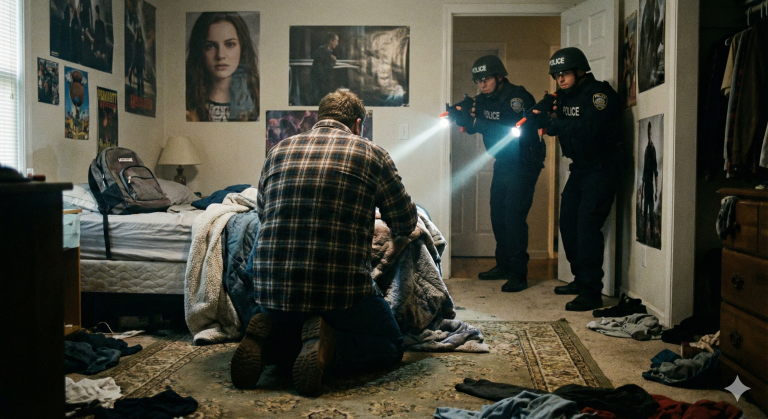
We moved in. The smell hit me first. Stale beer, burnt foil, and that distinct, metallic tang of old blood mixed with mold. The living room was a war zone of overturned furniture and shattered glass. A television lay face down, screen smashed. But it was the silence that scared me. Usually, domestics are loud. Screaming matches. Breaking plates. The chaotic noise of people tearing each other apart.
This was dead quiet. The kind of quiet you find in a graveyard.
I swept the kitchen. Clear. Roaches scattered under the beam of my tactical light. Miller took the back bedroom.
“Jack,” Miller’s voice was tight, strained. “You need to see this.”
I holstered my weapon and walked down the narrow hallway, my boots sticking slightly to the linoleum. Miller was standing in the doorway of the second bedroom. It was barely a closet, really. A single mattress on the floor, stained and yellowed, with no sheets.
And there, sitting in the center of the mattress, knees pulled to his chest, was a boy. He couldn’t have been more than six. He was wearing oversized pajamas with a superhero logo faded to gray. He was shivering, but he made no sound.
He didn’t look at us. He was staring at the window, watching the rain streak down the glass, mesmerized by the chaotic weather outside as if it made more sense than the room inside.
“Hey, buddy,” I said, keeping my voice low, the way you talk to a spooked animal or a man holding a detonator. “I’m Officer Reynolds. Jack. You okay?”
Nothing. Not a flinch. Not a blink.
I stepped closer, my boots crunching on something on the floor. I looked down. It was a picture frame, face down. I flipped it over. A woman, smiling, holding a baby. She looked healthy then. Happy. The sun was shining in the photo, a stark contrast to the gloom we were standing in.
“Is your mom here?” I asked, crouching down to his eye level.
The boy slowly turned his head. His eyes were huge, dark, and terrifyingly empty. They were the eyes of an old man trapped in a child’s body. “She went with the bad men,” he whispered.
My heart hammered against my ribs. “What bad men?”
“The ones who yell,” he said simply. “The ones who wanted the bag.”
Suddenly, a crash from the alleyway below. Metal hitting concrete. Miller bolted for the window, parting the dirty curtains. “Jack! Runner! Down the fire escape! Two of them!”
“Stay here!” I told the kid, my voice commanding but shaky.
I ran back to the living room, heading for the front door to cut them off. I burst out into the rain-slicked hallway and down the stairs, taking them three at a time, risking a broken ankle with every leap. I hit the alley just as Miller tackled a figure into a pile of wet cardboard boxes.
It was a woman. Skin and bones. Wild eyes. She was screaming, thrashing, fighting like a demon.
“Get off me! Let me go! I have to go!” she shrieked, clawing at Miller’s face.
It was the woman from the photo. The Mom. But the smile was gone, replaced by the hollowed-out look of meth and terror. Her teeth were ground down, her skin sallow.
“You’re under arrest,” Miller grunted, pinning her arms and cuffing her.
“No! You don’t understand! They’ll kill him!” she screamed, looking not at us, but at the dark sedan screeching away at the end of the alley, taillights fading into the mist.
“Who?” I grabbed her shoulder, spinning her to face me. “Who will they kill?”
“Let me go!” She spat at me.
We dragged her toward the cruiser. She fought every step, sobbing now, her legs giving out.
I looked back up at the third-floor window. The boy was there. His small hand pressed flat against the glass. Watching his mother being dragged through the mud.
Chapter 2: The Question
We secured the mother, Sarah—according to the ID we found in her pocket—in the back of the cruiser. She had gone catatonic, staring at the cage divider, rocking back and forth, muttering numbers under her breath. Miller stayed with her, radioing dispatch for transport and CPS.
I had to go back up. CPS was en route, but on a stormy Tuesday night in this district, they were at least twenty minutes out. I couldn’t leave the kid alone in that house of horrors.
I walked back into Unit 3B. The adrenaline was fading, replaced by a heavy, gray exhaustion that settled in my bones. I didn’t find the boy in the bedroom. I panicked for a second, my hand drifting to my belt.
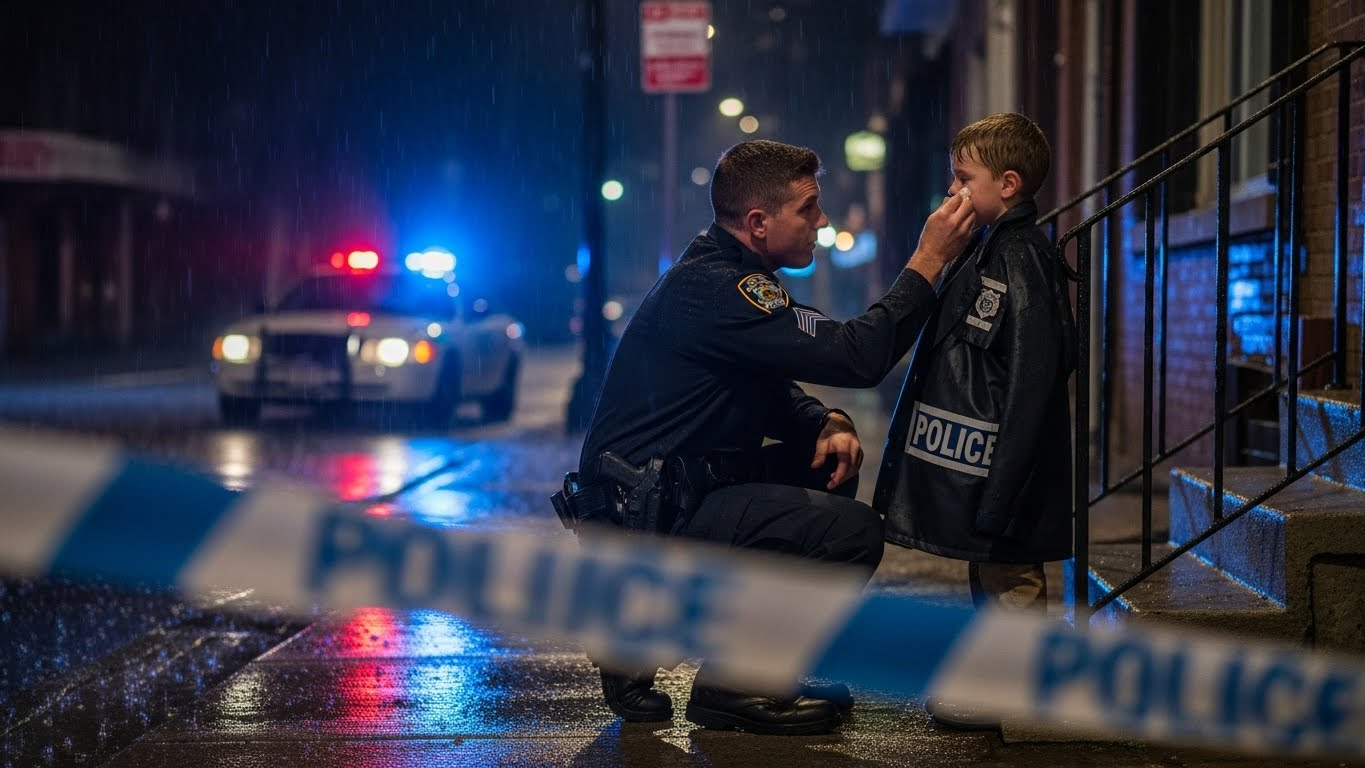
Then I saw him. He was sitting on the front stoop of the apartment building now. He must have slipped past us while we were wrestling with Sarah. He was sitting under the small concrete overhang, shivering slightly as the wind whipped the rain sideways.
I sat down next to him on the cold concrete. The rain was coming down harder now, a curtain of white noise that separated us from the rest of the world. The sirens were distant now, a backdrop to the immediate tragedy.
“You shouldn’t be out here, kiddo,” I said. “It’s cold. You’ll get sick.”
I took off my heavy patrol jacket. It was waterproof, lined with fleece. I draped it over his shoulders. It swallowed him whole. He looked like a miniature statue wrapped in midnight blue. He smelled like dust and baby shampoo, a scent so innocent it made my stomach turn.
“What’s your name?” I asked, though I probably could have guessed from the paperwork scattered upstairs.
“Leo,” he said. His voice was steady, clearer than mine.
“Leo. That’s a strong name. Like a lion. You brave like a lion, Leo?”
He didn’t answer. He looked at the flashing lights of the cruiser where his mother was locked inside. He didn’t cry. That was the thing that tore me up. Kids cry. They scream. They throw fits. When a kid is this quiet, it means they’ve seen too much. It means they learned a long time ago that crying doesn’t bring anyone to save you. It just brings attention you don’t want.
“Is she coming back?” Leo asked.
I swallowed hard. The lie was right there on my tongue. Sure, buddy. She’ll be back soon. Just a misunderstanding. It’s what we’re supposed to say. Keep them calm. Don’t traumatize them further. Let the social workers handle the heartbreak.
But I looked at his eyes. He wasn’t a baby. He was a survivor of a war I knew nothing about.
“Not tonight, Leo,” I said softly. “She has to talk to some people.”
He nodded, as if he expected that answer. He pulled the collar of my jacket tighter, burying his chin in the fabric.
We sat there for a long time. The radio on my shoulder chirped with dispatch codes—a robbery on 5th, a drunk and disorderly on Main—but I turned the volume down. I wanted to give him this moment of peace before the chaotic machinery of the foster system swallowed him up.
I reached into my pocket and pulled out a granola bar I kept for emergencies. Peanut butter. “You hungry?”
He looked at it, then at me. He took it. His hands were shaking. He struggled with the wrapper. I helped him peel it back. He took a small bite, chewing slowly, savoring it like it was a steak dinner.
“Officer Jack?”
“Yeah, Leo?”
He stopped chewing. He looked down at his sneakers, which were worn through the toes, his socks wet and gray. He took a deep, shuddering breath, his small chest hitching.
“Uncle… why did mom leave me?”
The word ‘Uncle’ hit me like a physical blow. It was a term of endearment, of trust, used in communities where everyone watches out for everyone. But hearing it from him, right now, felt personal. It felt like an accusation.
I froze. My training covered active shooters, high-speed pursuits, domestic violence, and hostage negotiations. It didn’t cover this.
How do you tell a six-year-old that his mother loves a needle more than him? How do you explain that she didn’t leave him because he wasn’t good enough, but because she was broken? How do you explain that the “bad men” she ran from were demons she invited in?
I looked at the cruiser. I looked at the dark alley. I looked at the rain washing the filth into the gutters.
I remained silent for a long time. The silence stretched, heavy and suffocating.
If I told him the truth, it would crush him. If I lied, he would grow up waiting for a ghost.
I looked back at Leo. A single tear had finally escaped, tracking a clean line through the smudge of dirt on his cheek. It hung there on his jawline, catching the reflection of the blue police lights, a diamond of pure sorrow.
I reached out with my rough, calloused hand. The hand that had handcuffed criminals, held guns, and pushed away danger. I used my thumb to gently wipe the tear away. His skin was cold.
“Leo,” I choked out, my voice betraying the tough-guy facade I’d spent years building. “She didn’t want to leave. She… she got lost. And sometimes, when people get lost, they make big mistakes. They do things they don’t mean. But it’s not because of you. Do you hear me? It is never, ever because of you.”
He looked at me, searching my face for the lie. He needed to find the crack in my armor.
“You promise?” he whispered.
“I promise,” I said. And I meant it.
And in that moment, as the rain poured and the sirens wailed in the distance, I made a silent vow. I wasn’t just going to hand this kid over to CPS and drive away. I was going to find out why she ran. I was going to find out who those men were.
Because the way she looked at the alley… she wasn’t running away from Leo. She was leading them away from him. She made a choice. A terrible, dangerous choice.
But she bought him time.
The radio crackled. “CPS is on scene. ETA one minute.”
I stood up, my knees cracking, and offered my hand to Leo. “Come on, partner. Let’s get you somewhere dry.”
He took my hand. His grip was surprisingly strong.
This wasn’t over. It was just beginning.
PART 2: THE HUNTER BECOMES THE HUNTED
Chapter 3: The Ghost in the Walls
I watched the CPS van pull away, its taillights dissolving into the misty gloom of the Seattle night. Leo didn’t look back. He just sat in the back seat, a small, dark silhouette against the safety glass, clutching my oversized jacket like it was the only raft in a drowning ocean.
“Let it go, Jack,” Miller said, lighting a cigarette. The flame illuminated the deep lines of fatigue etched into his face. “Case is closed. Mom’s in the system, kid’s in the system. We did our job.”
“Did we?” I asked, staring at the empty street. “You saw her eyes, Miller. She wasn’t high when she was screaming in that alley. She was terrified. Lucidly terrified.”
Miller blew smoke into the rain. “Meth makes you paranoid. You know that.”
“Paranoia is irrational,” I countered, opening the door to the cruiser. “She was leading them away from the apartment. That’s strategy. That’s maternal instinct overriding the addiction.”
Miller shook his head, flicking the butt into a puddle. “I’m going home to my wife. You should do the same. Don’t go digging in the boneyard, Jack. You never like what you find.”
He was right, of course. But I didn’t go home.
I drove around for an hour, the rhythmic thumping of the wipers acting as a metronome for my racing thoughts. Uncle… why did mom leave me? The question gnawed at me. Leo wasn’t just a victim of neglect; he was a piece on a chessboard I couldn’t see yet.
At 4:00 AM, I found myself back at The Hive.
The building loomed overhead, a monolith of brick and bad choices. The police tape across the door of Unit 3B was already sagging, wet and heavy. I ducked under it.
Inside, the apartment was even colder than before. The silence was heavier. I turned on my tactical flashlight, the beam cutting through the dust motes dancing in the stagnant air.
I went straight to the boy’s room. The closet. The mattress.
“Why did they want the bag?” I whispered to myself, replaying Leo’s words. “The ones who wanted the bag.”
But there was no bag. The place had been tossed. Drawers pulled out, cushions slashed. If there was a bag of drugs or money, the “bad men” or the initial responding units would have found it.
Unless Sarah was smarter than a junkie.
I stood in the center of the closet. I closed my eyes and tried to think like a terrified mother. If I had something that would get me killed, and I had to protect my son, where would I put it?
I looked at the window. The one Leo had been staring out of.
I walked over to it. The view was just the brick wall of the adjacent building and the fire escape. I ran my hand along the sill. Peeling paint. Rotting wood.
Then I looked down.
The radiator. It was an old cast-iron beast, painted a dozen times over. It sat right under the window. Leo had been sitting on the mattress, facing this spot.
I crouched down. There was a gap between the radiator and the wall, maybe two inches wide, filled with years of grime and dust bunnies. I pulled out my folding knife and shone the light into the crevice.
Something didn’t look right. The dust was disturbed.
I jammed my fingers into the gap, grimacing as I touched something sticky. I felt around. My finger brushed against plastic. Hard plastic.
I hooked it and pulled.
It wasn’t a bag. It was a taped brick, heavy and dense, wrapped in layers of black electrical tape. But it wasn’t the shape of a kilo of coke. It was too hard, too rectangular.
I cut the tape.
Inside was a hard drive. An external SSD, the kind you buy at Best Buy for a hundred bucks. But taped to the drive was a key. An old brass key with a number stamped on it: 404.
My heart rate spiked. This wasn’t drugs. This was data. And in my line of work, data is often more dangerous than dope. Drugs get you shot by a rival dealer. Data gets you erased by people who own senators.
I pocketed the drive and the key. As I stood up, the floorboard in the hallway creaked.
It wasn’t the settling of the building. It was the slow, deliberate shift of weight.
I killed my light.
I stood in the pitch black of the closet, my hand drifting to my holster. I held my breath, listening. The rain battered the window, masking the sound, but I heard it again. A wet shoe squeaking on linoleum.
Someone else was in the apartment.
I pressed my back against the wall. The intruder was in the living room, moving toward the hallway. I could see the faint sweep of a flashlight beam playing across the floor, getting closer.
“Clear the back,” a voice whispered. Low. Professional. Not a street thug.
“Copy,” a second voice replied.
Two of them.
I was trapped in a closet with one exit, and two hostiles were blocking it. I scanned the room. The window.
I moved silently to the glass. It was painted shut. If I broke it, the noise would give me away instantly. But I had no choice.
I waited until the flashlight beam hit the doorframe of the bedroom.
I unholstered my Sig Sauer P226.
“Police! Drop it!” I roared, the sound exploding in the small room.
Simultaneously, I kicked the radiator with my boot, creating a metallic clang, and dove to the left, away from the door.
Two suppressed shots—pfft, pfft—punched through the drywall where I had been standing a second ago.
Silencers. These weren’t cops. And they weren’t typical gangbangers.
“He’s in the kid’s room! Flank him!”
I didn’t wait. I raised my weapon and fired two rounds blindly through the wall toward the hallway, hoping to suppress them. I heard a shout of surprise and the sound of a body hitting the floor.
I used the distraction to smash the window with the butt of my gun. Glass shattered outward into the alley. I scrambled through, the jagged shards tearing at my uniform.
I hit the metal grate of the fire escape hard, the wind knocking the breath out of me.
Another shot pinged off the railing next to my head, sending sparks showering into my face.
I didn’t look back. I vaulted over the railing, sliding down the wet ladder to the second floor, then the first. I dropped the last ten feet into the alley, rolling in the muck to absorb the impact.
I sprinted toward the street, my lungs burning, the hard drive pressing against my ribs like a hot iron.
I made it to my personal truck—an old F-150 I’d parked two blocks away to avoid drawing attention. I fumbled with the keys, my hands shaking, and threw myself inside.
As I peeled away, tires screeching, I checked the rearview mirror.
No pursuit. Yet.
But I knew one thing for certain now. Sarah didn’t just steal from a dealer. She had stolen something that professionals were hired to retrieve.
And now, I had it.
Chapter 4: The Cage
The holding cells at the precinct smell of despair, ammonia, and unwashed bodies. It’s a smell you never truly scrub out of your pores.
It was 6:00 AM. My shift was technically over hours ago. I hadn’t slept. I hadn’t eaten. I had hidden the hard drive in a hollowed-out book in my apartment and the key in the lining of my boot.
I flashed my badge to the desk sergeant, a rookie named Evans.
“I need five minutes with Sarah Jenkins,” I said.
“She’s in isolation, Reynolds,” Evans said, looking up from his coffee. “Narcotics put a hold on her. No visitors.”
“I’m not a visitor. I’m the arresting officer. I need to clarify a statement for the report.”
Evans hesitated, then buzzed the door. “Five minutes. Don’t make me regret it.”
Sarah was sitting on the metal bench in Cell 4. She looked worse than she had in the alley. Her withdrawals were kicking in. She was shivering, her skin pale and clammy, sweat matting her hair to her forehead.
She didn’t look up when I entered.
“Sarah,” I said softly.
She flinched. “I don’t know anything. I told them. I don’t know anything.”
“I’m not Narcotics, Sarah. I’m the guy who found Leo.”
Her head snapped up. The mention of her son cut through the fog of withdrawal. “Leo? Is he safe? Did they… did they get him?”
“He’s safe,” I lied. CPS wasn’t ‘safe,’ it was just secure. “He’s in a foster home. They can’t get to him there.”
She let out a ragged sob, burying her face in her hands. “You don’t understand. Nowhere is safe. Not from them.”
I stepped closer to the bars. I lowered my voice to a whisper. “Who are ‘they,’ Sarah? I went back to the apartment.”
Her eyes went wide. Terror, pure and primal, washed over her face. “You… you went back?”
“I found the radiator, Sarah.”
She stopped breathing. The air left the room. She stared at me as if I was a dead man walking.
“You have it?” she whispered.
“I have the drive. And the key.”
“Oh god,” she moaned, rocking back and forth. “You’re dead. You’re both dead. Throw it away. Burn it. Throw it in the ocean.”
“Tell me what it is,” I demanded. “If I know what it is, I can use it. I can protect Leo.”
She stood up, stumbling to the bars, gripping them with white-knuckled desperation. “You think this is about drugs? You think I stole a few kilos? That drive… it’s insurance. It’s everything.”
“Whose?”
She looked around the empty holding area, checking for listeners. “Have you ever heard of the Meridian Group?”
I frowned. “The shipping company? They own half the docks.”
“They own more than the docks,” she hissed. “My boyfriend… Leo’s dad… he wasn’t a junkie. He was their accountant. He cooked the books. He laundered money for the cartels, for the Russians, for everyone. He kept a backup. A list of every payoff. Judges, politicians… cops.”
The blood drained from my face. “Cops?”
“Why do you think I didn’t call the police when they killed him?” she asked, tears streaming down her face. “Why do you think I ran? They have people inside, Officer Reynolds. Maybe even in this building.”
I felt a chill that had nothing to do with the air conditioning. If she was telling the truth, the two men in the apartment weren’t just hitmen. They could have been off-duty SWAT. Or worse.
“The key,” I said. “What is it for?”
“A locker,” she said. “Bus station. Downtown. There’s… there’s money. Enough to disappear. I was going to get it tonight. I was going to take Leo and run to Canada. But they found us.”
She reached through the bars and grabbed my wrist. Her grip was surprisingly strong.
“Listen to me. They will kill Leo to get to me. They will use him as leverage to get that drive back. As long as he is in the system, he is a sitting duck. You have to get him out.”
“I can’t just kidnap a child from CPS, Sarah.”
“Then he dies!” she screamed, her voice echoing off the concrete walls. “He dies, and it’s on you! You promised him! I saw you! You promised him he’d be okay!”
The door to the holding block buzzed open. Two men in suits walked in. They weren’t internal affairs. They looked like feds, but their eyes were too cold, their suits too expensive.
“Officer Reynolds,” one of them said. He had a scar running through his left eyebrow. “Step away from the prisoner.”
“Who are you?” I asked, my hand hovering near my belt.
“We’re taking over jurisdiction. Federal case. You’re dismissed.”
I looked at Sarah. She had retreated to the corner of the cell, curling into a ball. She knew who they were.
“I said step away,” the suit repeated, stepping closer.
I looked at his lapel. No pin. No badge visible.
“I need to see some ID,” I said, planting my feet.
The man smiled. It wasn’t a friendly smile. “Go home, Reynolds. Get some sleep. Before you have an accident.”
He didn’t show ID. He didn’t have to. The threat was clear.
I walked out of the holding block, my heart pounding in my throat. I walked past the desk sergeant, past the bustling morning shift, and out into the gray light of dawn.
Sarah was right. They were already here.
And Leo was sitting in a foster home somewhere, waiting for a mother who was never coming, protected by a system that was already compromised.
I got into my truck and locked the doors. I took out my phone and dialed the only person I trusted. My old training officer, now retired.
“Cap,” I said when he picked up. “I need a favor. I need to know where CPS placed a kid last night. Leo Jenkins.”
“Jack? It’s 6 AM. You sound like hell.”
“I’m in trouble, Cap. Real trouble. I need that address.”
There was a pause. “Give me ten minutes.”
I hung up. I gripped the steering wheel. I wasn’t a cop anymore. Not really.
I was a man who had made a promise to a boy with sad eyes.
And I was about to break every law I had sworn to uphold to keep it.
Chapter 5: The Race
The address Cap gave me led to a generic suburban house in Queen Anne. Nice lawn, white fence, the American Dream painted over a foster care paycheck.
I parked the truck a block away. My watch read 7:15 AM. The neighborhood was waking up. Sprinklers hissed. A dog barked.
I didn’t walk to the front door. I went around the back. I knew how these snatch-and-grab teams worked. If the Meridian Group wanted Leo, they wouldn’t knock.
I vaulted the back fence, landing in a bed of hydrangeas. I crept toward the back porch. Through the sliding glass door, I saw a woman in a bathrobe pouring coffee. Mrs. Gable, the foster mother.
And then I saw the black SUV pull into the driveway out front.
Two men got out. Suits. The same ones from the precinct.
I didn’t hesitate. I used the tire iron I’d grabbed from my truck and shattered the sliding glass door.
Mrs. Gable screamed, dropping the coffee pot. It shattered, hot liquid splashing her legs.
“Police! Get down!” I roared, flashing my badge, though I knew it was worthless now.
“Where is he?” I demanded.
“Upstairs! First door on the left!” she shrieked, cowering.
I heard the front door being kicked in. The wood splintered with a sickening crunch.
I took the stairs two at a time. I burst into the room. Leo was sitting on the edge of the bed, still wearing my oversized police jacket. He looked small, terrified, and utterly alone.
When he saw me, his eyes widened.
“Uncle Jack?”
“Come here, Leo. Now!”
I scooped him up with one arm. He wrapped his legs around my waist, burying his face in my neck.
“Check the upstairs!” a voice yelled from below. Heavy boots thundered on the stairs.
There was no way back down. I looked at the window. We were on the second floor. Below was a trellis covered in ivy. It wouldn’t hold my weight, but it might break the fall.
“Leo, hold on tight. Do not let go,” I whispered.
“I’m scared,” he whimpered.
“I know. Be brave like a lion.”
I kicked the screen out. I swung my legs over the sill. The bedroom door burst open behind us.
“Freeze!”
I didn’t freeze. I jumped.
We hit the trellis. It groaned and snapped, slowing us down for a split second before we crashed into the wet grass below. I took the brunt of the impact, rolling to protect Leo. My shoulder popped, a sharp bolt of pain radiating down my arm, but I scrambled up.
“Run!” I grunted, pushing Leo toward the back fence.
Gunshots popped behind us—suppressed, quiet thwips that tore up the turf at my heels. They were shooting to kill in a suburban backyard. They didn’t care anymore.
I threw Leo over the fence and scrambled after him. We sprinted down the alleyway, slipping on wet leaves. We reached my truck. I threw him in the passenger side and jumped in.
As I turned the key, the black SUV screeched around the corner, blocking the exit.
I didn’t hit the brakes. I floored it.
My heavy F-150 slammed into the front of their luxury SUV, metal crunching, glass flying. The impact spun them out of the way. I jumped the curb, tearing through a manicured lawn, and roared onto the main road.
I checked the rearview mirror. They were turning around.
“Are we bad guys now?” Leo asked, his voice trembling.
I looked at him. He was clutching the dashboard, eyes wide.
“No, Leo,” I said, wiping blood from a cut on my forehead. “We’re the only good guys left.”
Chapter 6: Shadows in the Rain
We drove for three hours, heading east into the Cascades. I ditched the truck in a dense patch of woods off an old logging road and we hiked three miles to a hunting cabin my grandfather had built. It was off the grid. No cell service. No GPS.
Inside, it was freezing. I started a fire in the woodstove while Leo sat on a dusty armchair, watching me.
“Are you hurt?” he asked.
I touched my shoulder. It was bruised, maybe a hairline fracture, but functional. “I’ll live. You hungry?”
I found a can of beans and heated them over the fire. We ate in silence. The rain hammered against the tin roof, a relentless drumbeat that reminded me the world was still out there, hunting us.
“Why do they want to hurt me?” Leo asked, scraping the bottom of the tin can.
I sat down next to him on the rug. The firelight cast long, dancing shadows on the log walls.
“They don’t want to hurt you, Leo. They want something your mom hid. They think using you is the way to get it.”
“The brick?” he asked.
I reached into my pocket and pulled out the hard drive. “Yeah. This brick.”
I had a laptop in my go-bag—an old tough-book I used for diagnostics. I hadn’t turned it on because I didn’t want the signal tracked. but out here, deep in the valley, there was no signal to track.
I booted it up. I plugged in the drive.
It was password protected. Of course.
I stared at the prompt. Enter Password.
“Do you know any special words your mom used?” I asked Leo. “Numbers? Dates?”
He shook his head. “She just cried a lot.”
I tried her birthday. Incorrect. I tried Leo’s birthday. Incorrect. I tried the address of the apartment. Incorrect.
I leaned back, frustrated. Then I remembered the picture frame. The one face down on the floor. The one time she was happy.
“Leo, did your dad have a nickname for your mom?”
Leo thought for a moment, screwing up his face. “He called her… Sunny.”
I typed in Sunny. Incorrect. I typed in Sunshine. Incorrect.
I looked at Leo. “What did she call him?”
“She called him…” Leo paused. “She called him ‘My North’.”
I typed in MyNorth.
Access Granted.
Folders appeared. Hundreds of them. Spreadsheets. Audio recordings. Scanned bank documents.
I opened a random file. It was a ledger. My eyes scanned the names.
Councilman Davies. Judge Halloway. Captain Miller.
My blood froze. Not my Captain. Miller. My partner.
There were payments. Monthly transfers of $5,000 going back three years.
I felt sick. The man who sat next to me in the squad car. The man who told me to go home. He wasn’t just lazy. He was on the payroll. He was the one who texted the hitmen when we found the apartment.
I slammed the laptop shut.
“Is it bad?” Leo asked.
“It’s the truth,” I said, my voice hard. “And the truth is heavy.”
We couldn’t stay here. If Miller was involved, he knew about this cabin. I had brought him here once for a fishing trip.
“Get your shoes on, Leo,” I said, kicking snow over the fire. “We have to move.”
“Where are we going?”
“To the lion’s den,” I said. “We’re going to finish this.”
PART 4: THE PROMISE KEPT
Chapter 7: The Standoff
We drove back to the city in a stolen sedan I hotwired at a trailhead. It was night again. It felt like the sun hadn’t risen in days.
I knew I couldn’t outrun the Meridian Group. They had resources I couldn’t dream of. They had the police. They had the politicians.
The only way to win was to make the game too expensive for them to play.
I drove to the Seattle Public Library downtown. It was closed, but the Wi-Fi signal was strong from the parking lot.
I set up a dead man’s switch. I uploaded the entire contents of the drive to a secure cloud server, set to auto-email every major news outlet, the FBI field office in DC (bypassing Seattle), and the DOJ in exactly one hour unless I entered a cancel code.
Then, I called Miller.
“Jack,” he answered on the first ring. “I knew you’d call. They’re going to kill her, Jack. Sarah. They have her.”
“I know you’re dirty, Miller,” I said, my voice calm.
Silence on the line. Then a sigh. “It’s not that simple. They own everyone. If I didn’t take the money, they would have taken my family. You have to bring the drive. And the boy.”
“The boy stays with me. I’m coming to you. Alone.”
“No deal,” a new voice came on the line. The Suit. “Bring the boy, or the mother dies in five minutes. And then we find the boy anyway.”
My grip tightened on the phone. “Pier 54. Thirty minutes. If I see a sniper, the data goes public. If I see a SWAT team, the data goes public. If you sneeze wrong, the data goes public.”
“We’ll be there.”
I looked at Leo. He was asleep in the passenger seat, exhausted.
I couldn’t take him. But I couldn’t leave him.
I drove to the nearest fire station. I wrote a note and pinned it to his jacket. Witness protection priority. Call Agent Halloway at FBI DC.
I carried him to the station door. I rang the bell. I kissed his forehead.
“Be a lion,” I whispered.
I ran back to the darkness before the firefighters opened the door.
Chapter 8: The Lion
Pier 54 was a ghost town of rain-slicked wood and rusting metal. The Ferris wheel loomed in the distance, a skeleton of light against the black sky.
I walked to the end of the pier. The rain was torrential now, washing away the sins of the city.
Three black SUVs were waiting.
Miller stood in the center, flanked by the Suits. Sarah was on her knees, a gun pressed to her head. She looked beaten, broken.
“Where is he?” The head Suit demanded.
“Safe,” I said, holding up the hard drive. “This is what you want.”
“Give it to me.”
“Let her go first.”
The Suit nodded. The goon holding Sarah shoved her forward. She stumbled toward me, weeping.
“Run, Sarah,” I said without looking at her. “Go to the fire station on 4th. Leo is there.”
“Jack…” she sobbed.
“Go!” I screamed.
She ran. Her footsteps faded into the rain.
“Now the drive,” Miller said, stepping forward. He looked sick. “Jack, just give it to them. We can walk away.”
“You can’t walk away from this, Miller,” I said. “You sold your soul.”
I tossed the drive. It skittered across the wet wood, stopping at Miller’s feet.
He picked it up. The Suit smiled. “Good. Now, kill him.”
Miller raised his gun. He pointed it at my chest. His hand was shaking.
“Do it,” the Suit commanded.
“I’m sorry, Jack,” Miller whispered.
I closed my eyes.
BANG.
The shot was deafening. But I didn’t feel the impact.
I opened my eyes.
The Suit was lying on the ground, a hole in his chest.
Miller turned the gun on the other guards. “Get down! Police!” he screamed, his voice cracking with desperation. He was trying to buy back his soul in the final seconds.
The guards returned fire. Miller went down in a hail of bullets.
I dove behind a crate, drawing my Sig. I popped up, firing. Two shots. Two guards down.
Sirens wailed in the distance. Not police sirens. Federal sirens. The hour was up. The email had gone out. The dead man’s switch had triggered.
The remaining guards scrambled, realizing the operation was blown. They jumped into the SUVs and peeled off, leaving the dead and the dying on the pier.
I ran to Miller. He was lying on his back, blood bubbling from his chest. He looked at the rain.
“Did… did I save him?” he wheezed.
“Yeah, Miller,” I lied, holding his hand as the life faded from his eyes. “You saved him.”
Epilogue: Three Months Later
The coffee shop was warm. Outside, the Seattle rain was just a drizzle.
I sat at a corner table. I wasn’t wearing a uniform anymore. They took my badge, of course. “Procedural misconduct.” “Vigilantism.” But the FBI commendation on my wall at home said something different.
The bell on the door chimed.
Sarah walked in. She looked good. Clean. She had gained weight. She was holding a hand.
Leo.
He looked different too. New clothes. New shoes. But the eyes—they were still old eyes, but they weren’t empty anymore.
They saw me.
Leo let go of his mom’s hand and ran. He slammed into my legs, hugging me tight.
“Uncle Jack!”
I knelt down and hugged him back. The pain in my shoulder flared, but I didn’t care.
“Hey, Lion,” I said, my voice thick.
“Mom got a job,” he said excitedly. “And we have a dog. And I go to school.”
Sarah walked up, tears in her eyes. “Thank you,” she whispered. “For the promise.”
I looked at Leo. I realized that kicking down doors and arresting bad guys was never the job. This was the job.
“I kept it,” I said.
Leo pulled back and looked at me seriously.
“Are you still a police?”
I smiled, ruffling his hair.
“No, buddy. I’m something better.”
“What?”
“I’m your Uncle.”
THE END.