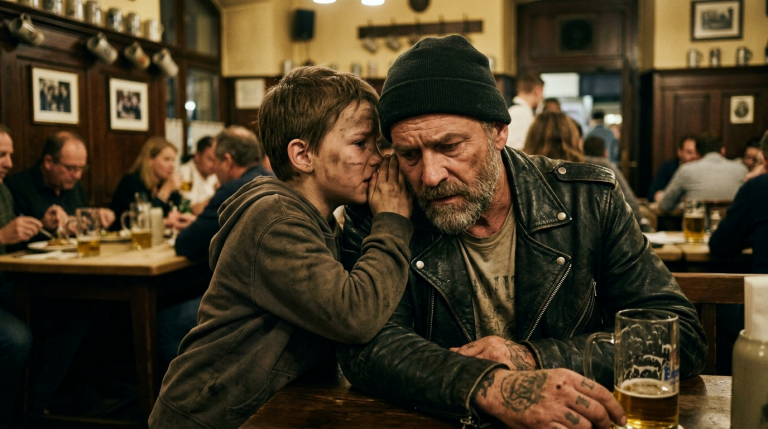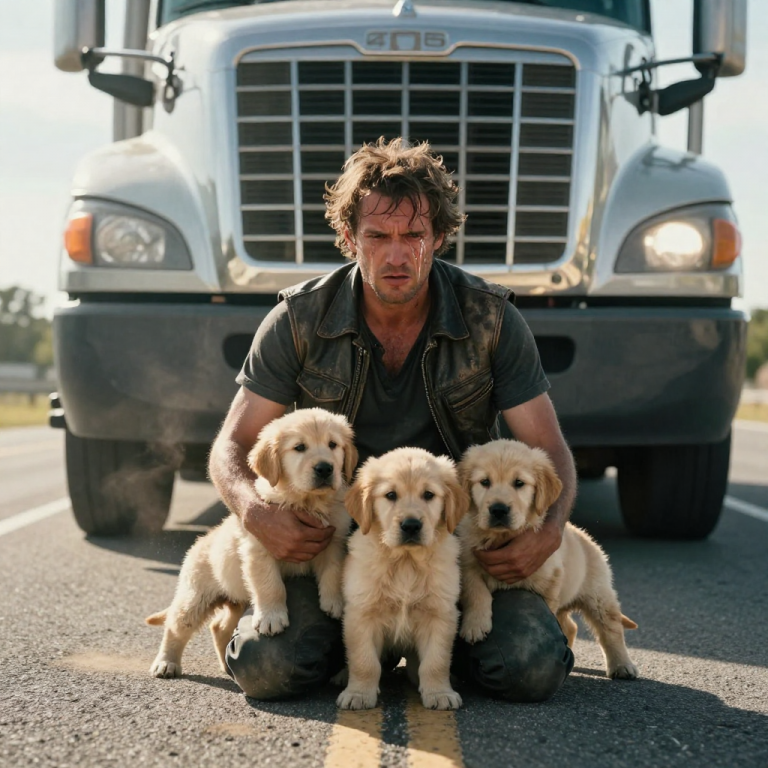
He Stopped His Harley For A “Roadkill” Lump On A Foggy Oregon Highway, But When The Creature Opened Its Eyes, He Saw A Human Soul Trapped Inside. He Raced Against Death To A Stranger’s Doorstep, And When A Broken Boy Screamed A Single Name, The Biker Realized He Hadn’t Just Saved An Animal—He Resurrected A Family That Died Long Ago.
PART 1
Chapter 1: The Gray Mile
The fog in Oregon doesn’t just obscure your vision; it swallows you whole. It rolls off the Pacific, climbs the coastal range, and settles in the valleys like a heavy, wet secret.
It was 4:00 PM, but it felt like midnight.
My name is Mark. I’ve been riding the 101 North for three days straight, trying to outrun a silence that’s been following me since I left the fire service back in Detroit. They call me a drifter now. I prefer “mechanic in transit.” I fix engines, I fix fences, I fix whatever’s broken in the towns I pass through. But I never stay long enough to let anyone try to fix me.
The Harley rumbled beneath me, a steady, rhythmic thumping that usually calmed my nerves. But today, the road felt hostile. The asphalt was slick with a mixture of oil and autumn rain, reflecting the gray sky like a dark mirror.
I was coming around a bend near Tillamook, a stretch of road bordered by dense, towering pines on one side and a steep drop-off into the churning river on the other. It’s a place where cell service goes to die and where you don’t want to break down.
That’s when I saw it.
A lump. A shape on the shoulder of the road, right where the gravel meets the mud.
My brain cataloged it instantly: Deer. Roadkill. Keep moving.
I kept my throttle hand steady, eyes shifting back to the center line. You see a lot of death on the highway. You learn to look past it, or you’ll never get where you’re going.
But as I roared past, something happened. A flicker of movement in my peripheral vision.
It wasn’t the wind. The wind doesn’t make a dead animal lift its head.
I swore under my breath, checked my mirrors—empty—and squeezed the brake lever. The bike protested, the rear tire sliding sideways on the wet leaves before gripping the pavement. I came to a halt fifty yards down the road.
The engine idled, a low growl in the silence of the forest.
Don’t do it, Mark, I told myself. It’s probably a coyote. It’s probably rabid. It’s probably already gone.
But I killed the engine.
I kicked the kickstand down and swung my leg over. The silence that rushed in was deafening, broken only by the drip-drip-drip of rain falling from the fir trees.
I walked back toward the shape. My boots crunched on the gravel.
As I got closer, the shape resolved itself. It wasn’t a deer. It wasn’t a coyote.
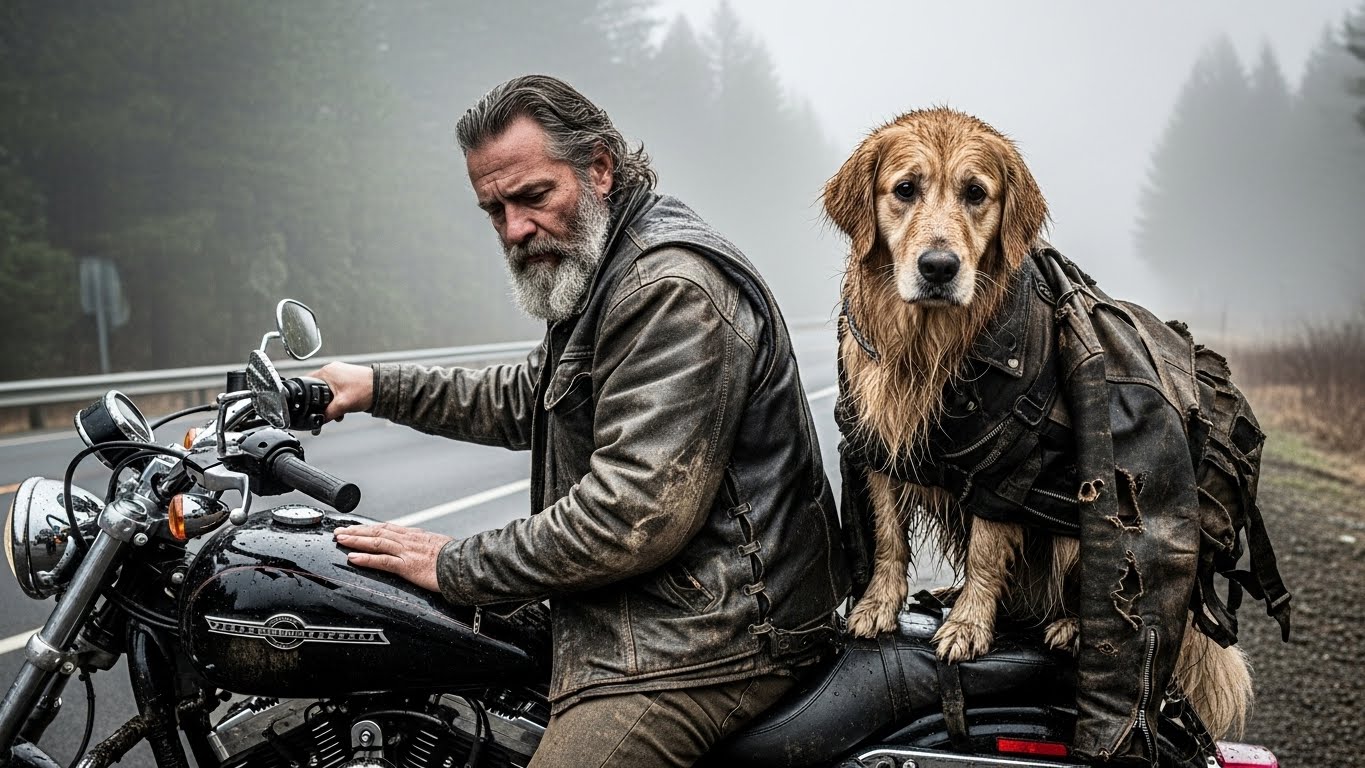
It was a dog. A Golden Retriever, to be exact, though you’d hardly know it from the mud caked into its coat.
He was lying on his side, half-submerged in a puddle of freezing sludge. His ribcage was visible, rising and falling in shallow, jagged hitches.
I stopped five feet away. “Hey,” I said, my voice sounding too loud in the quiet. “Easy now.”
The dog didn’t growl. He didn’t try to scramble away. He just opened his eyes.
That was the moment I lost.
If you’ve ever looked into the eyes of a dog that has given up, you know what I’m talking about. It’s a look of profound, crushing acceptance. He wasn’t asking for help. He was waiting for the end.
But when he saw me, a tiny spark flickered in that cloudy brown gaze. He let out a sound—not a bark, not a whine, but a sigh. A long, shuddering exhale that rattled in his chest.
I knelt down, ignoring the mud soaking into my jeans.
“What did they do to you?” I whispered.
I saw the rope then. A thick, frayed length of hemp rope tied tight around his neck. The end was shredded. He hadn’t been hit by a car—at least, not initially. He had been tied up. He had chewed through his own tether to escape, and he had made it this far before his body gave out.
I reached out a gloved hand. He flinched, closing his eyes, bracing for a blow.
“No, no,” I soothed, unzipping my leather jacket. “None of that. Not with me.”
I touched his head. He was freezing. His body temperature was dangerously low. Hypothermia was setting in. If I left him here to go get help, he’d be dead in twenty minutes.
I looked at his back leg. It was twisted at a sickening angle. Broken.
I looked at my bike, fifty yards away. Then I looked at the sky, darkening with the promise of a storm.
“Okay,” I said, gritting my teeth. “Here’s the deal. I’m going to pick you up. It’s going to hurt. But if you don’t bite me, I promise I won’t drop you.”
I stripped off my heavy leather jacket. The cold air bit through my flannel shirt instantly, stinging my skin. I wrapped the jacket around the dog, swaddling him like a baby.
He weighed next to nothing. He was just skin, bones, and wet fur.
As I lifted him, he let out a sharp yelp, his body tensing. I froze, waiting for the snap of jaws.
But instead, he just pressed his wet nose against my neck and licked the skin right above my collar.
“Yeah,” I choked out, standing up with him in my arms. “I got you, buddy. I got you.”
Chapter 2: The Impossible Passenger
Riding a motorcycle is about balance. It’s about being one with the machine. It is not designed for carrying an eighty-pound, critically injured animal on the gas tank.
I had managed to rig a makeshift harness using bungee cords from my saddlebags, strapping the dog—wrapped in my jacket—tightly against my chest. He was sitting on the tank, his head resting on my left arm, my body shielding him from the wind.
It was awkward. It was dangerous. It was probably illegal.
“Don’t die on me,” I shouted over the wind as I shifted into third gear. “You hear me? You didn’t come this far to check out on the back of a Harley.”
The dog didn’t move. I could feel the heat of his body leaching into mine, or maybe it was my heat going into him. I prayed it was enough.
The rain started up again, harder this time. It stung my face like needles. I couldn’t wear my helmet visor down because it kept fogging up, so I squinted against the downpour, scanning the road for potholes. One bad bump could finish him off.
We rode like that for fifteen miles.
My arms were cramping. The cold was seeping into my bones. Every time the dog twitched, my heart hammered against my ribs. Was he having a seizure? Was he gasping for air?
I reached down and stroked his head with my thumb. He was still warm. Still there.
Finally, the neon sign of “Joe’s Stop & Go” pierced the gloom. It was a beacon of dirty yellow light in a sea of gray.
I rolled in, cutting the engine before I even came to a full stop. I didn’t bother with the kickstand properly; I just let the bike lean against the concrete bollard near the door.
I untied the bungees with trembling fingers.
“We’re here,” I whispered.
I carried him inside. The bell above the door jingled cheerfully, a stark contrast to the bundle of misery in my arms.
The gas station was empty, save for the clerk. Earl. I knew him from a few days ago when I’d passed through to fix a generator at the local motel.
Earl was reading a newspaper, a cup of coffee steaming beside him. He looked up, annoyed at the draft, but his expression crumbled when he saw me.
“Mark?” he stood up, his chair scraping loudly against the linoleum. “What the hell happened to you? You’re soaked.”
“Not me,” I walked to the counter, laying the bundle down gently. “Him.”
I peeled back the leather jacket.
Earl stared. The dog was barely conscious now, his breathing shallow and rapid.
“Jesus, Mary, and Joseph,” Earl breathed. “Is that… is that a dog?”
“Found him on the highway. Near the ridge. He needs a vet, Earl. Is there anyone around here open this late?”
Earl didn’t answer immediately. He was staring at the dog’s face. He reached out a calloused hand and brushed the matted fur away from the dog’s eyes.
The dog blinked.
Earl’s hand froze. He traced the line of the dog’s jaw, stopping at a small patch of white fur on the snout, shaped distinctly like a diamond.
“No way,” Earl whispered.
“What?” I snapped, impatience rising. “Earl, the vet. Focus.”
“Mark, look at this.” Earl pointed to the wall behind him, past the rows of cigarettes and lottery tickets.
There was a corkboard covered in business cards and flyers. Earl ripped one down and slammed it on the counter.
It was a color photo, slightly faded. It showed a healthy, vibrant Golden Retriever sitting next to a young boy with a missing front tooth. They were both grinning.
MISSING: “MAX” REWARD: $500 If found, please call the Parkers immediately. Our son needs him back.
I looked at the photo. Then I looked at the broken creature on the counter. The diamond patch on the snout. The dark shading around the eyes.
It was him.
“That’s the Parker dog,” Earl said, his voice thick. “He vanished eight months ago. Same week Tom Parker—the dad—got crushed by a falling tree in the lumber yard. He survived, but he’s in a wheelchair now. They say when the ambulance took Tom away, the dog just… bolted. Ran into the woods and never came back.”
I felt a chill that had nothing to do with the rain.
“Eight months?” I asked. “He’s been out there for eight months?”
“The boy, Timmy…” Earl shook his head. “He stopped talking. Literally. Hasn’t said a word to anyone since the day Max left. The whole town looked for this dog, Mark. We combed every inch of those woods. We thought the coyotes got him.”
I looked down at Max. He seemed to sense we were talking about him. He thumped his tail—just once—against the countertop. A pathetic, hollow sound.
“He didn’t run away,” I said, my voice dark. I fingered the frayed rope around his neck. “Someone took him. Someone kept him.”
Earl saw the rope and his jaw tightened. “Who would do that?”
“Doesn’t matter right now,” I said, wrapping the jacket back around Max. “Where do the Parkers live?”
“Old Henderson Road. About six miles east. Big white farmhouse with the green shutters.”
I lifted Max up again. He felt heavier now, weighted down by the story he carried.
“Call them,” I told Earl. “Tell them I’m coming.”
“Mark,” Earl warned, “don’t get their hopes up. He looks… he looks like he’s got one foot out the door.”
I looked at Max. His eyes were closed, but he pressed his head against my chest again.
“Not if I can help it,” I said.
I walked back out into the rain.
PART 2
Chapter 3: The Weight of a Ghost
The rain in the Pacific Northwest has a way of getting inside you. It’s not just water; it’s a chill that seeks out old injuries and settles there.
As I pulled out of the gas station, the weather turned violent. The wind howled off the coast, bending the tops of the Douglas firs until they looked like they were bowing in submission.
I had six miles to go. On a clear day, that’s ten minutes. Tonight, it felt like crossing a minefield.
Max was getting heavier. Not physically—he was still a sack of bones—but his breathing had changed. It was wetter now, a rattling sound deep in his chest that I could feel vibrating against my own ribs.
“Stay with me, Max,” I shouted into the gale. “Don’t you dare quit on me now. We’re almost home.”
I shifted my weight, trying to shield him with my torso. My left arm, the one supporting his head, was burning with a cramp that started in my shoulder and shot down to my numb fingers. I didn’t care. I locked my elbow in place.
As the mile markers blurred past, my mind drifted. It does that when the adrenaline starts to fade and the cold takes over.
I wasn’t always a drifter on a Harley.
Three years ago, I was Captain Mark Sullivan, Detroit Fire Department, Engine 54. I had a life. I had a purpose. I had a team.
Then came the warehouse fire on 4th Street. The floor collapse.
I made a call. I told my rookie, a kid named Jason who had a baby girl on the way, to go left. I went right.
The left side of the building came down.
I pulled Jason out of the rubble, but I was too late. I spent six months in rehab for a shattered hip and a lifetime’s worth of guilt for a shattered soul. I couldn’t look his widow in the eye. I couldn’t look at myself in the mirror.
So I bought the bike. I sold the house. I started riding, looking for something to fix, maybe trying to balance a ledger that would never be balanced.
I looked down at the dog.
He was fighting so hard. Every breath was a battle. He wasn’t doing it for himself. Animals know when it’s time to die; they find a quiet bush and let go.
Max was holding on for someone else.
The realization hit me hard. This dog had more courage in his broken body than I had in my entire life. I was running away from my ghosts. Max was running toward his, even if it killed him.
“You’re a better man than me, Max,” I whispered.
I saw the turnoff for Henderson Road. It was a gravel track, washed out by the rain. Mud sprayed up, coating my boots and the bottom of the bike.
The Harley fishtailed. I wrestled the handlebars, gritting my teeth.
Steady. Steady.
If I dropped the bike now, with him strapped to the tank, it was over.
The trees cleared, opening up into a small valley. And there, sitting on a rise, was the house.
It was a classic American farmhouse, white siding, a wraparound porch. But even in the dark, I could see the neglect. The grass was overgrown. A shutter was hanging loose, banging rhythmically against the siding in the wind.
Bang. Bang. Bang.
It sounded like a heartbeat slowing down.
There were lights on inside, warm yellow squares against the darkness. I wondered what was happening in there.
Earl had said the father was in a wheelchair. The boy was silent. A family broken by tragedy, just like me.
I guided the bike up the driveway, the gravel crunching loudly. I killed the engine about twenty feet from the porch.
The silence returned, instant and heavy.
I looked down. Max’s eyes were closed. He wasn’t moving.
Panic, cold and sharp, spiked in my chest.
“Max?” I shook him gently. “Hey! Wake up!”
Nothing.
I ripped the bungee cords off, my hands shaking so bad I could barely work the hooks.
“No, no, no. Don’t you do this. Not when we’re ten feet away.”
I put my hand on his chest.
Thump.
A pause.
Thump.
It was faint, but it was there. He was unconscious, exhausted beyond measure.
I scooped him up, keeping the leather jacket wrapped tight around him. I stepped off the bike, my legs stiff, and walked toward the porch stairs.
Every step felt heavy. I wasn’t just carrying a dog. I was carrying eight months of grief, of lost hope, of a little boy’s silence.
I reached the door.
I didn’t knock. I couldn’t. My hands were full.
I kicked the bottom of the door with my boot. Three hard thuds.
Thud. Thud. Thud.
Then I waited, holding my breath, as the sound of footsteps approached from the other side.
Chapter 4: The Voice in the Silence
The door opened slowly, fighting the suction of the wind.
A woman stood there. She looked to be in her late thirties, but her eyes were ancient. She wore a faded cardigan and jeans, her hair pulled back in a messy bun. There were deep lines etched around her mouth—the kind that come from not smiling for a very long time.
She looked at me—a towering, bearded stranger in soaking wet clothes, holding a dirty bundle—and she flinched. Her hand went to the doorframe, ready to slam it shut.
“We don’t have any money,” she said, her voice tired and defensive. “Please. Just go.”
“I’m not here for money, ma’am,” I said. My voice was rough, cracking with emotion I wasn’t expecting.
From behind her, a man’s voice called out. “Sarah? Who is it?”
The sound of rubber wheels on hardwood followed. A moment later, a man in a wheelchair rolled into view. He looked frail, his legs covered by a blanket, but his jaw was set with a protective edge.
“What do you want?” the man demanded, wheeling himself closer to his wife.
I didn’t answer them directly. I couldn’t.
I looked past them.
Standing in the hallway, peeking out from behind the doorframe of the kitchen, was a boy.
He was small for his age, maybe ten. He wore a striped t-shirt and pajama bottoms. He was holding a toy truck in one hand, but his arm hung limp at his side.
His eyes were wide, fixed on the bundle in my arms.
Earl had said he hadn’t spoken in eight months. Since the accident. Since the dog left.
I looked back at the woman. “I met Earl at the gas station,” I said. “He told me about… about what you lost.”
The woman’s face hardened. “If this is a joke, it’s sick. Please leave.”
“It’s not a joke,” I whispered.
I knelt down on the porch, the wet wood soaking into my knees. I laid the bundle down.
“He has a scar,” I said, looking at the man. “Shaped like a star. On his left ear. And a diamond patch of white fur on his nose.”
The air left the room. It was as if I had sucked all the oxygen out of the universe.
The woman’s hand flew to her mouth. The man gripped the wheels of his chair so hard his knuckles turned white.
“No,” the man whispered. “That’s impossible.”
I peeled back the leather jacket.
Max lay there, a muddy, emaciated ruin. But as the warmth of the house hit him, or maybe the scent of his family, he stirred.
He lifted his head. It took every ounce of strength he had left.
He let out a low, shaky whine.
The woman gasped, a sound that was half-sob, half-scream. She fell to her knees beside me, her hands hovering over the dog, afraid to touch him, afraid he was a hallucination.
“Max?” she choked out. “Oh my god. Max?”
But it wasn’t the mother Max was looking for.
His cloudy eyes bypassed her. They bypassed me. They bypassed the father.
They locked onto the boy in the hallway.
The boy dropped the toy truck. It clattered loudly on the floor.
He took a step forward. Then another. He was trembling, his whole body vibrating like a tuning fork.
He walked past his frozen father. He walked out onto the porch, his bare feet splashing in the puddles I had tracked in.
He stopped two feet away.
Max tried to stand. His back legs failed him, but he dragged himself forward on his front paws, whining, his tail giving a pathetic, microscopic wag.
The boy fell to his knees. He grabbed the muddy, bloody head of the dog and pulled it into his chest. He buried his face in the wet fur.
For a second, there was silence.
And then, it broke.
“MAX!”
The scream tore through the night. It was raw, guttural, and loud. It was the sound of a dam breaking.
“MAX! YOU CAME BACK! YOU CAME BACK!”
The boy was sobbing, rocking back and forth, screaming the name over and over again.
“MAX! MAX! MAX!”
The father let out a sound of pure anguish and wheeled himself frantically through the doorway, reaching down to grab his son and the dog in one embrace. The mother collapsed on top of them, wrapping her arms around the whole pile.
They were a tangle of tears, mud, and fur.
I stood up slowly, backing away.
I watched as the boy, the silent boy, poured eight months of words into the dog’s fur.
“I knew it! I told them! I told them you weren’t dead! I told them you were just lost! I’m sorry I didn’t come find you! I’m sorry, Max! I’m sorry!”
The dog, broken and bleeding, closed his eyes and rested his chin on the boy’s shoulder. He let out a long sigh of pure contentment.
He was home.
I felt a lump in my throat the size of a grapefruit. My vision blurred.
I turned around and walked to the railing of the porch, looking out at the rain. I needed a second. I needed to breathe.
I had saved people from burning buildings. I had pulled victims from car wrecks.
But I had never seen anything like this. This wasn’t just a reunion. This was a resurrection.
The boy wasn’t just getting his dog back. The parents were getting their son back.
I wiped my eyes with the back of my glove, leaving a smear of grease on my face.
“Hey,” a voice said behind me.
I turned. The father had wheeled himself over. His face was wet with tears, his eyes red. He looked at me, and for the first time, I saw the man he must have been before the accident. Strong. Proud.
He reached out a hand. It was shaking.
“I don’t know who you are,” he said, his voice thick. “I don’t know where you came from. But you… you just gave us our lives back.”
I took his hand. His grip was iron.
“Just saw a dog on the road,” I said, trying to keep my voice steady. “Couldn’t leave him.”
“You didn’t just save a dog,” the man said, looking back at his son, who was now talking a mile a minute to the mother, describing Max’s injuries, demanding blankets, demanding food. “You saved us.”
“What happened to him?” the mother asked, looking up at me. Her eyes were fierce now. “He has a rope around his neck.”
My expression darkened.
“He was tied up,” I said. “Someone had him. For a long time.”
The father’s face went cold. “Who?”
“I don’t know,” I said, looking out into the darkness toward the woods. “But he escaped. He chewed through the rope and he came looking for you.”
“He came looking for Timmy,” the mother whispered.
I nodded. “Yeah. He did.”
The adrenaline was crashing now. I felt exhausted.
“I should go,” I said. “You folks need to get him dry. Get him some water. Warm him up slowly. Don’t feed him too much at once.”
“Go?” The boy, Timmy, looked up. His face was streaked with mud and tears, but his eyes were bright. Alive. “You can’t go! You’re… you’re the hero! You’re Max’s hero!”
“I’m just a guy with a bike, kid,” I said, managing a weak smile.
“Stay for dinner,” the mother insisted, standing up. “Please. It’s… it’s the least we can do. We have stew. It’s hot.”
I looked at my bike, sitting in the rain. I looked at the dark road. Then I looked at the warm kitchen, the light spilling out onto the porch.
I hadn’t had a home-cooked meal in three years.
“I’m pretty dirty,” I warned.
“So is Max,” Timmy said, grinning. It was the first time he had smiled in eight months.
“Alright,” I said. “Just for a bit.”
I didn’t know it then, but staying for dinner was going to complicate things. Because the story of Max wasn’t over.
The rope around his neck wasn’t just a restraint. It was a clue.
And while we sat there eating stew, listening to Timmy’s voice fill the silence of the house, I noticed something about the knot still hanging from Max’s collar.
It was a specific knot. A double figure-eight loop.
The kind used by climbers.
Or loggers.
And suddenly, I remembered where I had seen that knot before.
PART 3
Chapter 5: The Knot That Tied The Truth
The stew was hot, thick with beef and potatoes, the kind of meal that sticks to your ribs and warms you from the inside out. But as I sat at the Parkers’ small round kitchen table, a cold knot formed in my stomach that had nothing to do with hunger.
Max was sleeping under the table, his head resting on Timmy’s feet. Every few seconds, the boy would reach down to touch the dog’s fur, just to make sure he was real.
Timmy hadn’t stopped talking. He was telling his parents about a dream he had, about how school was boring, about how he wanted to be a vet when he grew up. It was a torrent of words from a dam that had been broken.
Tom and Sarah just watched him, their own food untouched, tears drying on their cheeks. They were witnessing a miracle.
But I couldn’t take my eyes off the rope I had placed on the counter.
“Tom,” I said softly, waiting for a lull in Timmy’s chatter. “You worked at the lumber yard, right?”
Tom looked up, startled out of his reverie. “Yeah. Foreman for ten years. Until the accident.”
I pointed to the rope. “That knot. It’s a double figure-eight, but the loop is reversed. It’s a climber’s knot, but modified for hauling heavy loads quickly. A logger’s hitch.”
Tom squinted at the rope. He wheeled himself over to the counter and picked it up.
He studied it for a long moment. His face, flushed with the joy of the evening, slowly drained of color. His hands began to shake again, but this time, it wasn’t from happiness. It was rage.
“I know this knot,” Tom whispered. The temperature in the room seemed to drop ten degrees. “There’s only one guy at the mill who tied his hitches like this. We used to tease him about it. Said he tied knots like he was trying to strangle the wood.”
“Who?” I asked, my voice low.
“Jeb Miller,” Tom said, the name tasting like poison in his mouth. “He was a temp. A drinker. He got careless with the machinery. I had to fire him three days before my accident.”
Sarah gasped, covering her mouth. “Tom… you don’t think…”
“He screamed at me in the parking lot,” Tom continued, his eyes wide with a horrifying realization. “He said I’d pay. He said he’d take something from me that I couldn’t replace.”
We all looked at Timmy, who had gone quiet, sensing the shift in the room. Then we looked at the empty wheelchair space where Tom’s legs used to work.
“The tree that fell on me,” Tom said, his voice trembling. “The cables snapped. The investigation said it was equipment failure. But if… if someone messed with the rigging…”
I stood up. The chair scraped loudly against the floor.
“Where does this Miller guy live?” I asked.
“Mark, no,” Sarah said, standing up too. “Call the Sheriff. Please.”
“I will,” I said, zipping up my leather jacket. It was still damp and cold, but I didn’t feel it. “But the Sheriff is twenty minutes away in town. If Miller sees my bike out front, if he knows the dog is back… he might run.”
“He lives in the old trailer park off Route 6,” Tom said, his voice hard. “Unit 4. The one with the junked cars out front.”
I looked at Tom. I saw a man who had been robbed of his legs, his livelihood, and his son’s voice, all by one man’s petty vengeance.
“Stay here,” I told them. “Lock the doors. Don’t open them for anyone but me or the cops.”
I looked down at Timmy. “Take care of Max, soldier.”
Timmy nodded, his eyes wide. “Is the bad man coming?”
“No,” I said, putting on my helmet. “The bad man isn’t coming anywhere.”
I walked out into the storm.
Chapter 6: The Devil in Unit 4
The rain had turned into a deluge. The wind was whipping the trees into a frenzy, branches clawing at the sky like skeletal fingers.
I rode the Harley hard. The rear tire slipped on the mud, but I wrestled it back into line. I wasn’t riding for safety anymore; I was riding for justice.
Route 6 was a desolate stretch of road. The trailer park was barely a blip on the map—a collection of rusted metal boxes sinking into the Oregon mud.
I killed the lights as I approached the entrance. I rolled in neutral, the engine just a low purr, barely audible over the storm.
Unit 4 was easy to spot. It was the eyesore of the dump. A mountain of trash bags, car parts, and empty beer cans littered the yard.
And there, parked crookedly in the driveway, was a battered pickup truck.
I parked my bike behind a cluster of bushes two lots down and walked the rest of the way. The mud sucked at my boots.
I crept up to the truck. I shone my small penlight into the bed.
My heart hammered against my ribs.
There, tangled in a pile of rusty chains, was a spool of hemp rope. The exact same rope that had been around Max’s neck.
And next to it, a small red nylon collar with a metal tag.
I reached in and grabbed the collar. I wiped the mud off the tag with my thumb.
MAX The Parker Family
I felt a surge of anger so pure, so hot, it almost blinded me.
This man, this Miller, hadn’t just killed a dog. He had kept him. He had kept Max tied up, starving, probably beating him, just a few miles away from the family that was grieving him. He had watched the flyers go up. He had heard the town searching.
And he had laughed.
He had broken a man’s spine and stolen a boy’s voice, all because he got fired for being incompetent.
I walked up to the trailer door.
I didn’t knock.
I kicked it.
The aluminum door buckled inward with a crash.
“Miller!” I roared.
The inside of the trailer smelled of stale beer, cigarettes, and mold. A single bulb swung from the ceiling, casting dizzying shadows.
A man scrambled up from a stained recliner. He was huge, pot-bellied, with greasy hair and wild eyes. He was holding a beer can in one hand and reaching for a shotgun leaning against the wall with the other.
“Who the hell are you?” Miller screamed, stumbling.
I didn’t give him time to grab the gun.
I crossed the room in two strides. I was a firefighter. I’ve kicked down burning doors and carried men twice my size. A drunk bully in a trailer was nothing.
I grabbed him by the collar of his dirty flannel shirt and slammed him against the wall. The trailer shook on its foundations.
“You remember the dog?” I growled, my face inches from his. “The Golden Retriever?”
Miller’s eyes went wide. He smelled of fear and cheap whiskey.
“I… I don’t know what you’re talking about!”
I pulled the red collar out of my pocket and shoved it in his face.
“This!” I shouted. “Max! You took him! You tied him up and let him rot!”
Miller’s face twisted into a sneer. He tried to push me off, but I tightened my grip on his throat.
“That mutt?” Miller spat. “He was just leverage. I was gonna send the collar to Parker. Let him know I had him. Make him beg.”
The cruelty of it—the sheer, pointless malice—took my breath away.
“Why?” I whispered.
“Because Parker thinks he’s better than me!” Miller screamed, spit flying. “He fired me! So I took his legs. And then I took his dog. I wanted him to hurt. I wanted him to sit in that chair and rot!”
I wanted to hit him. God, I wanted to hit him. My fist was clenched so tight my nails were digging into my palm.
But I didn’t.
I wasn’t a killer. And I wasn’t a monster like him.
I swept his legs out from under him. He crashed to the floor, wheezing.
I grabbed the shotgun, ejected the shells, and tossed it out the open door into the mud.
Then I grabbed a roll of duct tape from the table—probably used to patch the holes in his soul—and I went to work.
Chapter 7: The Road Goes On
By the time the Sheriff’s cruiser flashed its blue and red lights through the rain, Miller was taped securely to his own recliner. He was screaming obscenities, but he wasn’t going anywhere.
I met the Deputy outside. He was a young guy, looked terrified of the large biker standing in the rain.
“He’s inside,” I said, handing over the red collar. “He confessed. To the dog. And to rigging the cables that paralyzed Tom Parker.”
The Deputy’s jaw dropped. “You got a confession?”
“He was very talkative,” I said grimly. “Earl from the gas station called you guys, right?”
“Yeah,” the Deputy nodded. “Earl said a crazy biker was going to kill someone.”
“No killing tonight,” I said. “Just trash collection.”
I watched them haul Miller out. He looked smaller now, pathetic in the flashing lights.
I got back on my Harley. The adrenaline was fading, leaving me exhausted, my hip aching from the cold.
I rode back to the Parker farm.
The rain had stopped. The clouds were breaking, revealing a sliver of moon.
I didn’t go inside this time. I stopped at the end of the driveway.
The lights were still on in the kitchen. I could see silhouettes in the window.
I saw Tom, sitting in his wheelchair, his hand resting on Sarah’s shoulder.
And I saw Timmy. He was sitting on the floor, his arms wrapped around a golden lump of fur.
Max was sleeping. But he was safe.
I revved the engine once. A short, sharp burst of sound.
Inside, Timmy looked up. He ran to the window and pressed his face against the glass. He waved.
I raised my gloved hand in a salute.
You’re welcome, kid.
I put the bike in gear and turned back onto the highway.
The fog was lifting. The air was crisp and clean, scrubbed by the storm.
For three years, I had been riding to escape the memory of Jason, the rookie I couldn’t save. I thought that if I kept moving, the guilt couldn’t catch me.
But tonight, on a muddy Oregon road, I had stopped.
I had looked death in the face—in the eyes of a dying dog—and I had said, “Not today.”
I saved Max. And in doing so, I realized something.
I wasn’t broken. I was just stalled.
I touched the patch on my jacket, the old Fire Department patch I still kept in my pocket.
Maybe it was time to stop drifting. Maybe it was time to go home. Not to the firehouse—that part of my life was over—but to a life where I didn’t have to be a stranger.
I hit the throttle. The Harley roared, a sound of freedom and power.
I wasn’t Mark the drifter anymore.
I was the guy who brought Max home.
And for the first time in a long time, the road ahead didn’t look lonely. It looked like a beginning.
Chapter 8: The Question
The highway stretched out before me, a ribbon of silver under the moonlight.
I thought about the knot. A simple twist of rope that revealed a villain.
I thought about the boy’s voice. “Max!”
I thought about the dog. The way he had looked at me on the side of the road. He knew. He knew I wouldn’t leave him.
We all need someone to stop for us. We all need someone to look at our broken pieces and say, “I’ve got you.”
Tonight, I was that person for a dog.
Tomorrow? Who knows.
But I know this: The world is full of ghosts, full of pain, full of men like Miller who want to tear things down.
But it’s also full of people who will stop in the rain. Who will ruin their jackets. Who will fight for a stranger.
So keep your eyes on the road. Watch the shoulders.
You never know who might be waiting for you to save them.
Or who might be waiting to save you.
And you—what would you have done if you were that biker?
Would you have stopped for a muddy lump on the road in the middle of a storm?
Do you believe that animals come into our lives to heal us?
Share your thoughts in the comments below. And if this story touched your heart, please share it. You never know who needs to be reminded that hope is never truly lost.