He Begged for Water on the Hottest Day of the Year but Refused to Drink a Drop. When He Collapsed, the Secret He Whispered to the Nurse Exposed a Neighborhood Nightmare.
Chapter 1: The Heat Wave
The thermometer on the back porch of 42 Maple Street read 102 degrees Fahrenheit, but Marge Sullivan knew that on the asphalt, it was hot enough to fry an egg. It was the kind of heat that sat on your chest like a heavy wool blanket, stealing your breath and slowing your pulse.
At sixty-eight, Marge had seen her fair share of summers in this suburb of Richmond, Virginia. She remembered when the neighborhood was full of screaming children running through sprinklers and block parties that lasted until midnight. Now, Maple Street was different. It was quieter. The fences were higher, the security systems more advanced, and the neighbors less inclined to wave.
Marge sat in her wingback chair by the front window, adjusting her blinds to block out the relentless glare. She was a retired ICU nurse, a woman who had spent forty years listening to the beeping of monitors and the shallow breaths of the dying. She missed the purpose of the hospital, the adrenaline of saving a life. Now, her biggest daily challenge was keeping her hydrangeas alive in this drought.
Through the slats of the blinds, she saw movement on the street.
It wasn’t the mailman. It was a boy.
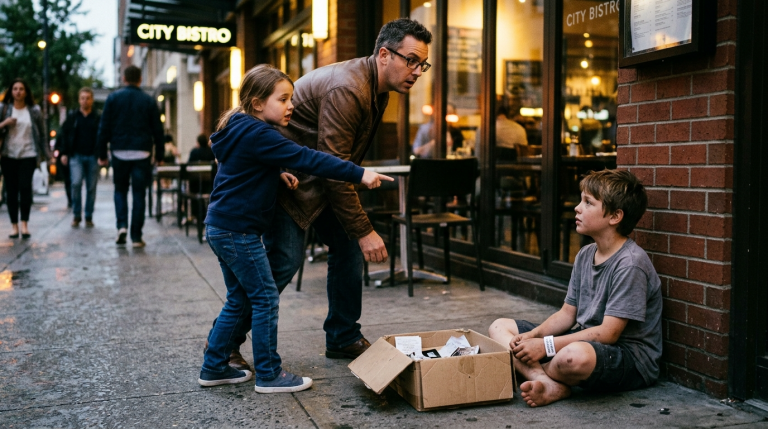
He looked out of place against the manicured, emerald-green lawns that were kept artificially lush by underground irrigation systems. He was small, maybe ten years old, wearing a dirty gray t-shirt that hung off his skeletal frame like a sheet on a scarecrow. He wasn’t walking; he was stumbling.
Marge leaned forward, putting her reading glasses on. The nurse in her began to assess him from fifty feet away. Gait is ataxic. Skin looks flushed but dry—anhidrosis. Signs of heatstroke.
She watched as the boy ran up the driveway of the Miller house across the street. He pounded on the door. It wasn’t a polite knock; it was a desperate, frantic hammering.
“Please!” she heard his voice crack, thin and reedy in the heavy air.
The Millers were good people, or so they thought, but they were terrified of scams. Marge saw Mrs. Miller peek through the curtain, shake her head, and lock the deadbolt.
“Go home, kid!” Mrs. Miller’s voice drifted across the street. “It’s too hot for pranks!”
The boy didn’t argue. He didn’t stomp his feet or yell an obscenity. He just pivoted, his sneakers slapping heavily against the melting tar of the driveway, and ran to the next house.
He looked like a wild animal—eyes wide, chest heaving, scanning the horizon for a predator.
He bypassed the Henderson house at the end of the cul-de-sac. That made sense, Marge thought. The Hendersons were the royalty of the neighborhood. Paul and Linda Henderson. They drove a Mercedes and a BMW. They ran some sort of foster care charity and were always being honored at the church. Their Victorian mansion was pristine, with a gate that was usually closed. You didn’t knock on the Hendersons’ door uninvited.
The boy stumbled again, nearly falling face-first into a patch of ornamental ivy. He righted himself and looked directly at Marge’s house.
Marge was already moving. Her knees popped as she stood up, but she moved with the speed of a woman who had run Code Blues for four decades. She unlocked the front door and pushed open the screen just as the boy reached her steps.
Up close, he was in worse shape than she thought. His lips were cracked and bleeding. His eyes were sunken, dark circles bruising the skin beneath them. He smelled of old sweat and something acrid, like urine.
“Help me,” he rasped.
“Come inside, honey,” Marge said, stepping back to hold the door wide. “The air conditioning is on. I’ll get you some juice.”
The boy recoiled as if she had brandished a weapon. He backed down a step, shaking his head violently.
“No!” he wheezed. “No inside. I can’t… I can’t be seen.”
He looked over his shoulder, back toward the end of the street, terror etched into every line of his dirty face.
“Okay,” Marge said, keeping her voice calm and level. The ‘ICU Voice.’ “You stay right there. I’ll bring the water to you.”
“Wait!” The boy reached out a trembling hand. “Do you have… a bucket? Or a jar? A bag?”
Marge paused. “A bag? You need to drink, son. Right now.”
“I need to carry it,” he insisted, tears cutting tracks through the dust on his cheeks. “Please, ma’am. I need a container.”
It was the strangest request she had ever heard from a dehydrated child. But Marge knew that when a patient was panicking, you didn’t argue with their logic; you stabilized them first.
“Okay,” she said. “Just wait.”
She turned and hurried to the kitchen. She grabbed a pitcher of ice water from the fridge and a plastic cup. Then, thinking of his request, she grabbed a large Tupperware container with a lid.
She was gone for less than thirty seconds.
When she returned to the porch, the boy wasn’t there.
Marge looked left, then right. She saw him near her garden hose spigot on the side of the house. He had turned the water on.
But he wasn’t drinking.
He was on his knees, holding a gallon-sized Ziploc freezer bag under the stream. He was filling it with warm water from the hose. His hands were shaking so badly he was spilling half of it, but he stared at the rising water level with an intensity that frightened her.
“Son!” Marge called out, stepping off the porch. “That water is hot from the sun! Drink this!”
She held out the pitcher of ice water.
The boy looked at the ice water. He licked his cracked lips. Marge saw the desperate thirst in his eyes—a primal need to snatch that pitcher and drain it.
But he didn’t.
He zipped the bag shut, clutching it to his chest like a bag of diamonds.
“I can’t,” he whispered. “I have to go back.”
“Back where? You’re going to collapse!”
“She stopped crying,” the boy said, his voice hollow. “I have to hurry. She stopped crying.”
Before Marge could grab him, he took off. He didn’t run with the energy of a child playing tag. He ran with the shambling, broken gait of a marathon runner at mile twenty-six. He clutched the heavy bag of warm water against his stomach, curling his body around it to protect it.
He was heading back toward the end of the cul-de-sac. Toward the Hendersons’.
Chapter 2: The Collapse
Marge didn’t think. She didn’t worry about her arthritis or her slippers. She dropped the pitcher—ice cubes skittering across the driveway—and ran after him.
The heat hit her like a physical blow, but she kept her eyes on the small figure moving down the street.
He made it past the Miller’s house. He made it past the stop sign.
But as he reached the edge of the pavement where the Hendersons’ perfectly manicured lawn began, his body simply quit. It was as if someone had cut his strings.
His knees buckled. He pitched forward.
Even in his fall, his instinct was protective. He twisted his body in mid-air, landing hard on his shoulder and hip to avoid landing on the Ziploc bag. He curled into a fetal position on the burning asphalt, groaning.
“I’m coming!” Marge yelled, her chest heaving.
She reached him a moment later. She knelt on the hot road, ignoring the burn against her knees. She rolled him onto his back, but he fought her with surprising strength for a dying boy.
“No! The bag! The bag!” he shrieked, his eyes rolling back in his head.
“I’ve got it, I’ve got it,” Marge soothed, placing a hand on his forehead. He was burning up. His skin felt like paper that had been left in an oven. Core temp is at least 104, she estimated. He’s going into hypovolemic shock.
She reached for her phone in her pocket and dialed 911.
“This is Nurse Sullivan,” she barked into the phone, her old authority returning instantly. “I have a pediatric male, approx ten years old, severe heatstroke, possible cardiac involvement. Location is 42 Maple Street. Get a rig here now. Lights and sirens.”
She hung up and looked down at the boy. He was fading in and out of consciousness.
“What’s your name, honey?” she asked, checking his pulse. It was thready and rapid. Tachycardic.
“Ethan,” he whispered.
“Okay, Ethan. You’re safe. We’re getting you help.”
“Not me,” Ethan mumbled, his head thrashing side to side. “Not me. The box. The hot box.”
Marge frowned. “What box, Ethan?”
He gripped her wrist. His fingernails were dirty and broken. “They put her in the hot box. Because she spilled the milk. She’s so little. She can’t… she can’t breathe in there.”
Marge felt a chill that had nothing to do with the heat. She looked up at the Henderson house. It loomed over them, a grand Victorian structure with wrap-around porches and closed shutters. It looked perfect. Silent.
“Who is in the box, Ethan?”
“Sarah,” he wept, the tears evaporating instantly on his hot face. “My sister. I tried to open it. I couldn’t. I needed water… to slide under the door. She said she was thirsty. Then she stopped talking.”
He tried to sit up, clutching the bag of water again. “I have to give it to her!”
Marge pushed him back down gently. “Ethan, listen to me. You cannot walk. You have done your job. You got the water. Now I need you to tell me exactly where she is.”
Ethan’s eyes focused on Marge. He saw the strength in her face. He saw that she wasn’t like the neighbors who closed their blinds.
“The basement,” he wheezed. “Behind the wine. The little room. Please… Mrs. Henderson has the key.”
Sirens wailed in the distance, growing louder.
Marge looked at the bag of water in Ethan’s arms. It was warm, dirty water from a garden hose. He hadn’t taken a single sip. He was dying of thirst, his kidneys likely shutting down, and he was guarding that water for someone else.
Marge Sullivan felt a rage ignite in her chest that she hadn’t felt since she fought insurance companies for her patients’ lives.
She stood up as the ambulance rounded the corner. She flagged them down, her face set in stone.
“Take the boy,” she told the paramedics as they jumped out. “Start a saline drip immediately. Cool him down.”
“Where are you going?” the lead paramedic asked.
Marge was already walking toward the Henderson house. She picked up a decorative garden rock from the Hendersons’ flowerbed—a heavy piece of river stone.
“I’m going to make a house call,” she said.
Chapter 3: The Basement
Marge marched up the brick walkway to the Hendersons’ front door. She didn’t knock. She rang the bell and pounded on the wood with the rock, leaving dents in the expensive finish.
Linda Henderson opened the door. She was wearing a crisp linen dress and pearls, looking like she had just stepped out of a magazine. She held a glass of iced tea.
“Marge?” Linda looked confused, her eyes darting to the rock in Marge’s hand. “What on earth is going on? I hear sirens. Is someone hurt?”
“Where is she?” Marge asked, her voice low and dangerous.
“Where is who? Marge, you look flushed. Are you okay?”
“Cut the crap, Linda. The boy. Ethan. He’s on the street dying of heatstroke. He told me about the box.”
Linda’s face didn’t crumble. It hardened. The sweet, church-going neighbor vanished, replaced by something cold and calculating.
“Ethan is a troubled child,” Linda said smoothly, stepping out onto the porch and closing the door behind her. “We took him in when no one else would. He has… delusions. He runs away. He tells stories. We were just about to call the police.”
“He has cigarette burns on his arms, Linda,” Marge lied. She hadn’t seen them yet, but she sensed them. She saw the flicker of panic in Linda’s eyes. “And he says Sarah is in the basement.”
“Sarah is napping,” Linda said, her smile tight. “Now, please get off my property before I call my husband. He’s in the study.”
“Good,” Marge said.
She didn’t wait. She shoved Linda Henderson.
It wasn’t a polite nudge. Marge used her shoulder and her weight, catching the younger woman off guard. Linda stumbled back in her heels, spilling her iced tea.
Marge stormed into the foyer. It was cool inside, smelling of lemon polish and potpourri.
“Paul!” Linda screamed. “Paul! Marge has gone crazy!”
Paul Henderson appeared at the top of the stairs. He was a large man, wearing a polo shirt and khakis. “What the hell is this?”
“The basement,” Marge muttered to herself.
She ran down the hallway. She knew the layout of these Victorian houses; she had lived in one for thirty years. The basement door would be under the stairs.
“Stop her!” Linda shrieked.
Marge found the door. It was locked.
She didn’t hesitate. She took the river stone she was still carrying and smashed it against the handle. It didn’t break.
Paul was coming down the stairs, heavy footsteps thudding. “Get away from there, you crazy old bat!”
Marge turned. She was cornered. But then, the front door burst open.
“Police! Nobody move!”
The paramedics had called it in. When a child claims abuse, the response is immediate. Two uniformed officers, young and fit, stepped into the hallway, guns drawn low.
“She broke into our house!” Paul yelled, pointing at Marge. “Arrest her!”
“Officer,” Marge said, breathing hard. “The boy outside says his four-year-old sister is locked in a box in the basement. Behind the wine rack.”
The officer looked at Paul. He looked at Marge. Then he looked at the locked basement door.
“Sir, open this door,” the officer commanded.
“This is ridiculous,” Paul sputtered. “I have rights. You need a warrant.”
“Exigent circumstances,” the officer said, stepping forward. “A child’s life is in danger. Open it, or I kick it down.”
Paul hesitated. That hesitation was all the confession the officer needed. He kicked the door near the lock. Wood splintered. The door swung open.
A wave of heat rushed up from the darkness. It was hotter down there than it was outside.
“Jesus,” the officer muttered. He turned on his flashlight. “Stay here,” he told Marge.
He went down. Marge followed anyway.
The basement was finished—a nice game room with a pool table. But Marge saw the wine rack against the far wall. It looked built-in.
“Ethan said behind the wine,” Marge shouted.
The officer grabbed the shelf. It was on hinges. He pulled. It swung open to reveal a hidden door, heavy and insulated like a meat locker. There was no handle on the inside.
The officer threw the bolt and yanked the door open.
The smell hit them first. Urine, sweat, and fear.
It was a room no bigger than a closet. The walls were lined with soundproofing foam. There was no window. A single bare bulb hung from the ceiling. The heat from the furnace room next door leaked directly into this unventilated space. It must have been 110 degrees inside.
In the corner, curled into a tiny ball on the concrete floor, was a little girl. She was wearing only a diaper. Her skin was gray.
“Sarah!” Marge cried.
The girl didn’t move.
Marge rushed past the officer. She scooped the child up. Sarah was limp, her skin scorching hot but dry as bone.
“She’s not breathing!” Marge yelled. “Get the paramedics down here! Now!”
Chapter 4: The Neighborhood’s Guilt
The scene outside 42 Maple Street had turned into a spectacle. Three police cars, two ambulances, and a fire truck blocked the cul-de-sac.
The neighbors, the ones who had stayed behind their blinds, were now standing on their lawns. Mrs. Miller was there, hand over her mouth. The Higgins family stood by their gate.
They watched as Paul and Linda Henderson were led out in handcuffs. Paul was shouting about his lawyer. Linda was weeping, trying to hide her face from the cameras.
But the crowd went silent when the stretcher came out.
It wasn’t Ethan. It was Sarah.
Paramedics were bagging her—pumping oxygen into her tiny lungs. Marge was walking beside the stretcher, holding the IV bag, her face streaked with sweat and tears.
“Is she alive?” Mrs. Miller called out, her voice trembling.
Marge stopped. She looked at Mrs. Miller. She looked at the neighbors who had ignored the knocking.
“She’s alive,” Marge said, her voice cutting through the humid air. “No thanks to any of you.”
She pointed to the Hendersons’ house. “They had a torture chamber in their basement. And that boy? Ethan? He knocked on every one of your doors. He didn’t want money. He didn’t want a ride. He wanted water for his sister.”
The neighbors looked down. Shame, heavy and suffocating, settled over the crowd.
“He carried a bag of water,” Marge continued, her voice breaking. “He was dying of thirst, and he didn’t take a sip. He saved it for her.”
Marge climbed into the back of the ambulance with Sarah. As the doors closed, she saw the “For Sale” sign on the Hendersons’ lawn—a symbol of a perfect life that was rotten to the core.
At the hospital, the extent of the horror was revealed.
Ethan had multiple healed fractures. Sarah was severely malnourished. The Hendersons had been running an unlicensed “disciplinary” foster home, taking money from the state and private checks from parents who wanted to “toughen up” their children. They used the soundproof room to break them.
Ethan and Sarah were in the ICU for three days.
On the second day, Ethan woke up. Marge was sitting by his bed.
His eyes darted around the room, panic rising. “The water… did I spill it?”
Marge took his hand. It was clean now, bandaged where he had scraped it falling.
“You didn’t spill it, Ethan,” Marge said softly. “You saved her. She’s in the next room. She’s drinking apple juice right now.”
Ethan stared at Marge. His lower lip trembled. And then, the brave little soldier, the boy who fought the sun and the monsters, finally allowed himself to be a child. He cried.
Chapter 5: The Recovery
Six months later.
Richmond rarely got snow, but this December, a soft white blanket covered Maple Street. It hid the scars of the summer. It made the world look clean.
The Henderson house sat empty, seized by the state. The windows were dark.
But Marge Sullivan’s house was glowing with warmth.
Inside, the fireplace crackled. Marge sat in her wingback chair, but she wasn’t alone.
Ethan was lying on the rug, reading a comic book. He had gained weight. His cheeks were round, his eyes bright. He wore a sweater that Marge had knitted—it was slightly uneven, but he wore it every day.
Sarah, now five, was sitting on Marge’s lap, helping her hold a mug of cocoa.
The legal battle had been long. Marge was too old to adopt them outright, the state argued. But Marge had a daughter, a lawyer in D.C., who had moved back home to help. Together, they had formed a kinship care plan. Marge was their legal guardian, their grandmother in every way that mattered.
“Nana Marge?” Ethan asked, looking up.
“Yes, honey?”
“Can I have some water?”
It was a simple question. But in this house, it carried the weight of history.
“You know where it is,” Marge smiled.
Ethan stood up. He walked to the kitchen.
He didn’t rush. He didn’t look over his shoulder. He took a glass from the cabinet. He went to the refrigerator dispenser.
He filled the glass. Clear, cold, abundant water.
He walked back into the living room. He didn’t hoard it. He didn’t pour it into a bag.
He took a long, slow sip. He swallowed. He smiled at Marge.
“Good?” she asked.
“Perfect,” he said.
Marge looked out the window at the snow. The neighborhood was quiet, but it wasn’t the silence of secrets anymore. It was the silence of peace. The monsters were gone. And the boy who ran through the fire had finally found a place to rest.