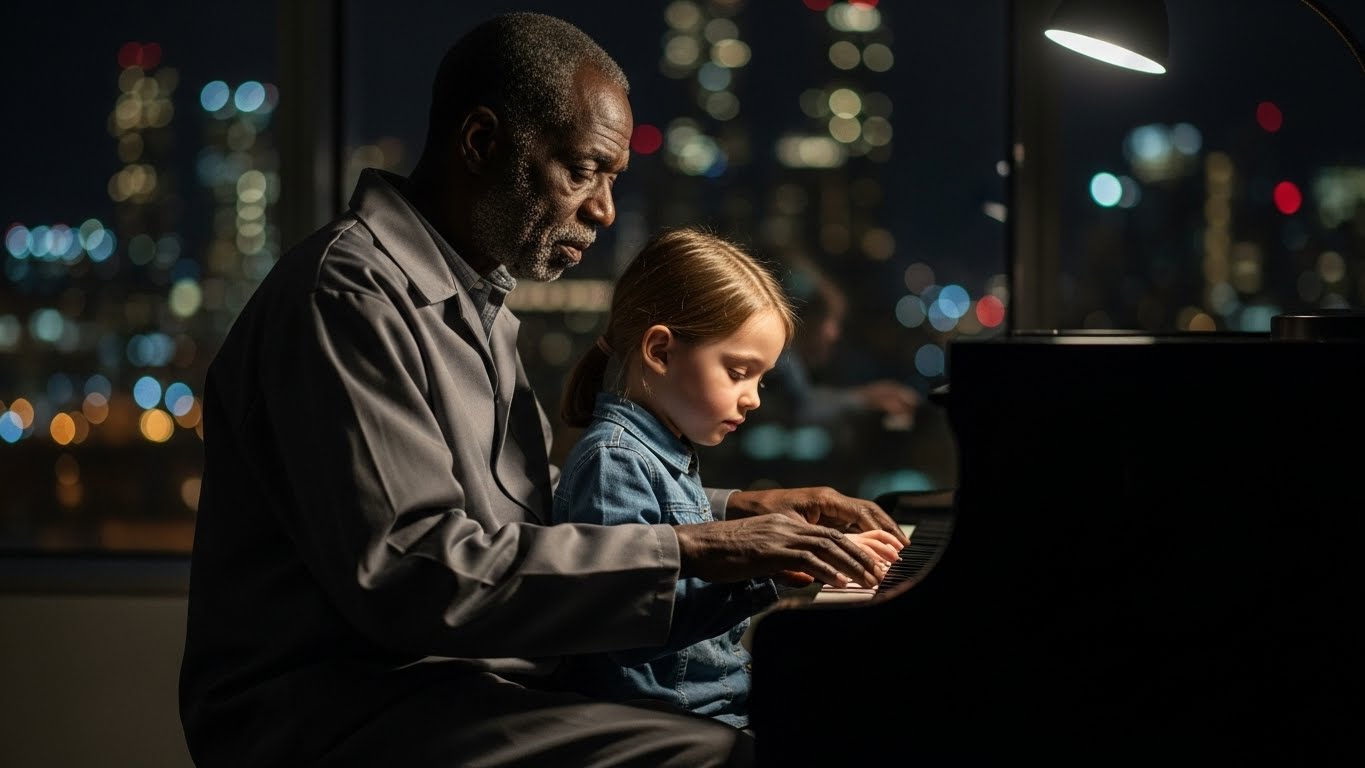
They Treated Me Like Human Garbage For Touching The CEO’s Piano. Then The Silence Broke Them.
PART 1
Chapter 1: The Invisible Man
Chicago at night is a deception. From the outside, looking at the skyline from the highway, it’s a jewel box of gold and silver light, promising dreams and power. But when you are inside the glass tower of Stone Enterprises, cleaning the toilets on the 20th floor at ten o’clock at night, the glamour dissolves. It just becomes a cage.
My name is Mike Rivers. I’m forty-two, but my knees feel sixty. I served two tours in the Sandbox, played trumpet in the Army band until a roadside IED scrambled my hearing just enough to ruin my pitch for the orchestra, but not enough to qualify for full disability. Then Sarah got sick. The medical bills ate the savings, then the house, then the car. Now, I’m the guy who buffs the scuff marks off the marble floors where millionaires walk.
I am a ghost in a gray jumpsuit.
“Missed a spot, Rivers.”
The voice grated against my spine like sandpaper. I didn’t have to turn around to know it was Henderson. The building manager. A man with a cheap suit and an expensive haircut, who smelled of stale coffee and arrogance.
I paused the industrial buffer, the heavy machine jerking slightly as the pad stopped spinning. I looked down. The floor was flawless. You could see your reflection in the black marble.
“Where, sir?” I asked, keeping my eyes low. That’s rule number one of survival here: never make eye contact with the suits. It makes them uncomfortable to acknowledge you’re a human being.
Henderson pointed the toe of his polished Oxford shoe at a microscopic speck of dust near the baseboard. “Right there. Standards, Rivers. Mrs. Stone pays for perfection. If you can’t provide it, there are plenty of people in the unemployment line who can.”
“Yes, sir,” I said, my grip tightening on the handle of the buffer until my knuckles turned white. “I’ll get it right away.”
He scoffed, checked his watch, and marched toward the elevators. “I’m heading out. Security is monitoring the cameras. Don’t think you can slack off just because the floor is empty.”
“Have a good night, Mr. Henderson.”
He didn’t answer. The elevator doors slid shut, swallowing him whole.
I let out a breath I didn’t know I was holding. The silence returned, heavy and pressurized. Being on the executive floor was eerie. It was a ghost town of mahogany desks, leather chairs, and family photos in silver frames that faced empty rooms.
I pulled the buffer over to the “spot” Henderson had pointed out. There was nothing there. Just a trick of the light. But I buffed it anyway. I buffed it because I had rent to pay. I buffed it because my landlord didn’t accept pride as payment.
I moved down the hallway, the rhythmic thrum-thrum-thrum of the machine lulling me into a trance. It was meditative. It stopped me from thinking about Sarah. It stopped me from thinking about the trumpet gathering dust in my closet, the valves seizing up from disuse.
Then, I heard it.
It broke through the mechanical drone of my work—a sharp, violent crash.
I stopped the machine immediately. The sudden silence was ringing in my ears. I waited. Was it a fallen shelf? A window breaking?
Then came another sound. A chaotic jumble of notes. Someone slamming their forearms onto a piano keyboard.
I frowned. The Music Room.
Evelyn Stone, the CEO, had a “Music Room” installed at the end of the hall. It was a glass-walled trophy case featuring a Steinway Model D concert grand. It was a beautiful instrument, black as midnight, with a tone that could break your heart. But in the three years I’d worked here, I had never heard anyone play it. It was just another asset. Another thing to own.
I walked softly toward the double doors, my rubber-soled work boots silent on the marble.
I heard a voice. A child’s voice.
“I hate you!”
Smash. Another discord of notes.
“I hate you, I hate you, I hate you!”
I crept closer, staying in the shadows. Through the frosted glass, I saw the silhouette. A small girl, maybe ten years old, sitting on the bench. Her feet didn’t even touch the pedals.
It was Lily Stone.
I knew about Lily. Everyone did. She was the “tragic secret” of Stone Enterprises. Blind from birth. Her father had left years ago, unable to handle the “complication.” Evelyn Stone kept her daughter fiercely guarded, dragging her to the best specialists in the world, trying to fix her. Trying to make her normal.
I shouldn’t go in. Henderson’s voice echoed in my head: Security is monitoring the cameras.
If I walked into that room, I was trespassing. I was “disturbing a VIP.” I was firable.
But then Lily put her head down on the keys, and the soft, dissonant chime of the depressed notes under her forehead sounded like a weep. Her shoulders shook.
I looked at the camera mounted in the hallway ceiling. It slowly panned left. I had a ten-second window before it panned back.
I didn’t think. I didn’t calculate. I just felt that old tug in my chest—the one that used to pull me toward a fellow soldier who was cracking under the pressure.
I opened the door and stepped inside.
Chapter 2: The First Lesson
The air in the Music Room was different. It smelled of cedar, old felt, and the expensive perfume that Evelyn Stone wore, which lingered like a ghost.
“Mom?” Lily’s head snapped up. Her eyes were unfocused, darting frantically in the darkness. She looked terrified.
“No, Miss,” I said, pitching my voice to be as gentle as possible. “It’s Mike. The janitor.”
She froze. Her hands hovered over the keys as if she were about to be struck. “You… you have keys?”
“I have keys to the garbage closets,” I said, taking a slow step forward. “I was just cleaning the hall. I heard… well, I heard a fight. Between you and the piano.”
She lowered her hands, her chin trembling. “It won. It always wins.”
“It’s a Steinway, Miss Lily. They’re stubborn beasts. They don’t like to be bossed around. You have to ask them nicely.”
She turned her face toward my voice. In the dim light of the city bleeding through the windows, she looked so small. So fragile. “I can’t play,” she whispered. “The teacher said my brain doesn’t work right for it. He said because I can’t see the sheet music, I’ll never understand the structure.”
I felt a surge of anger so hot it almost burned my throat. Structure? Music wasn’t architecture. It was blood. It was breath.
“That teacher,” I said, moving closer until I was standing by the curve of the piano, “sounds like he learned music from a textbook, not from life.”
“He’s from Juilliard,” she said, as if that explained everything.
“I’m from the South Side of Chicago,” I replied. “And I’m telling you, you don’t need eyes to play. You have ears. You have hands. And,” I paused, looking at her tear-streaked face, “you have plenty of feelings. That’s all you need.”
She hesitated. “Are you going to tell my mom I was banging on it? She says this piano cost more than a house. She gets mad if I treat it like a toy.”
“I won’t tell if you won’t tell,” I said. “Technically, I’m not supposed to be talking to you. If Mr. Henderson sees me, I’m toast.”
“Toast?” A small smile tugged at the corner of her mouth.
“Burnt toast. Scraped into the bin.”
She giggled. It was a watery sound, but it was real.
“Move over a little,” I said.
She scooted to the left on the padded bench. I sat down. The leather groaned under my weight. I was conscious of my smell—sweat and cleaning fluid—compared to her lavender shampoo. I hoped she didn’t mind.
“Give me your hand,” I said.
She reached out tentatively. Her hand was tiny, warm, and soft. My hand was a rough landscape of calluses and scars. I took her index finger.
“Don’t think about notes,” I instructed softly. “Don’t think about C-sharp or B-flat. Close your eyes. Well… just listen.”
I pressed her finger down on a key. A middle C. The note rang out, clear and pure, vibrating through the wood and into our bodies.
“Feel that?” I asked. “That vibration? That’s the piano saying hello.”
“It tickles,” she whispered.
“Good. Now, listen to this.”
I kept one hand on hers, and with my other hand, I began to play a simple accompaniment. Just a low, rolling chord progression. Nothing fancy. Just a bedrock for her to stand on.
“Now,” I guided her finger. “Step up. Like climbing a ladder. One… two… three.”
I guided her through a simple melody. Mary Had a Little Lamb. The simplest song in the world. But I played the chords underneath it in a minor key, turning the nursery rhyme into something haunting, something bluesy.
Lily gasped. “It sounds… sad. But pretty.”
“That’s the blues, kid,” I said. “It’s taking the sad things and making them beautiful so they don’t hurt as much.”
We played for maybe ten minutes. I forgot about the cameras. I forgot about the buffer sitting in the hallway. I forgot that I was a nobody. For ten minutes, I was a musician again. And she wasn’t a blind girl; she was a student.
She was a natural. Her hearing was acute. She anticipated the rhythm changes before I even made them. She felt the music in a way sighted people often miss because they are too busy reading the dots on the page.
When we stopped, the silence that followed wasn’t heavy anymore. It was peaceful.
Lily turned to me, her face glowing. “Can we do it again?”
I looked at the clock on the wall. 10:45 PM. I had to finish the floor before the shift supervisor did his rounds at 11:00.
“I have to work, Lily. If I don’t finish the floors, I don’t get paid.”
Her face fell. The light went out of her features, and she looked like the lonely child I’d found earlier.
I couldn’t leave it like that.
“But,” I whispered, leaning in like a conspirator. “I’m here every night. Same time. If you’re here… maybe the piano will need another check-up.”
“Tomorrow?” she asked, breathless.
“Tomorrow,” I promised.
I stood up, my knees cracking. “Now, I gotta go make the marble shine.”
I slipped out of the room, checking the hallway. Empty. I exhaled.
I walked back to my buffer, turned it on, and let the hum fill the air. But as I worked, for the first time in years, I wasn’t just walking through the motions. I was humming. A melody was playing in my head, drowning out the noise of the machine.
I didn’t know it then, but I had just started a war. A war between the people who sign the checks and the people who clean the floors. And the battlefield would be that piano.
PART 2
Chapter 3: The Midnight Conservatory
The next two weeks became a double life.
By day, I was Mike the nobody. I slept in my cramped studio apartment in the South Loop, listening to the elevated train rattle the windows every twenty minutes. I ate instant oatmeal and stared at the photo of Sarah on my nightstand, asking her if I was crazy.
You’re playing with fire, Mike, her silent smile seemed to say. But you always did like the heat.
By night, I was Maestro.
Every evening at 10:15 PM sharp, I would park the buffer down the hall, wedging it against the wall so it looked like I was just grabbing supplies. I would slip into the Music Room. Lily would be waiting.
We developed a language that didn’t require eyes.
“The room is a box of echoes, Lily,” I told her one night, guiding her hands over the ivory. “When you play soft, the walls disappear. When you play loud, you’re building a roof over your head. You control the space.”
She wasn’t just learning scales. She was learning to see through sound.
I taught her the songs Sarah used to love. “This one is ‘Clair de Lune’,” I whispered, my voice rough with a memory I hadn’t touched in years. “It means moonlight. You can’t see the moon, Lily, but you can feel the cold air at night? That stillness?”
“Yes,” she breathed, her fingers hovering.
“Play the stillness.”
And she did. God, she did. She played with a hunger that scared me. It was as if she had been starving for years, and the piano was the only food that could fill her.
We talked, too. That was the dangerous part. Talking created a bond, and bonds in my line of work were liabilities.
She told me about her mother. Evelyn Stone wasn’t evil; she was just absent. She was a woman trying to run a billion-dollar empire while terrified of her own daughter’s disability. She threw money at problems because she didn’t know how to give time.
“She buys me things,” Lily said, her fingers tracing the black keys. “Braille tablets. Talking computers. Soft clothes. But she never sits here. She never… listens.”
“She’s scared,” I said, polishing the brass pedals with my rag while Lily played a chord.
“Scared of what?”
“Scared that she can’t fix you. Parents want to be heroes, Lily. When they can’t save their kids from the hard stuff, they feel like failures. So they work. They hide in the office.”
Lily stopped playing. “You sound like a dad.”
I froze. The rag stopped moving. “I was going to be. Once.”
“What happened?”
“Life,” I said, my throat tight. “Life happened. Sarah got sick before we could… well. Anyway. Back to the keys. C-Major. Let’s go.”
I pushed the grief down, burying it under the music.
For fourteen nights, we got away with it. I started cleaning the floors faster, sweating through my jumpsuit so I could steal an extra ten minutes with her. I became efficient. I became happy.
But happiness in a place like Stone Enterprises is a security breach.
I should have known Henderson was watching. A man like that doesn’t sleep; he just waits.
Chapter 4: The Contamination
It was a Thursday. The rain was lashing against the floor-to-ceiling windows, turning the Chicago skyline into a blur of weeping neon.
Lily was struggling with a complex jazz progression I was teaching her—something Dave Brubeck would have appreciated. She was laughing, actually laughing, because her fingers had tripped over each other.
“It’s like my fingers are drunk!” she giggled.
“That’s syncopation,” I smiled, leaning over her shoulder to correct her posture. “It’s supposed to feel off-balance. That’s the swing.”
I reached out to guide her pinky finger to the right key.
SLAM.
The double doors of the Music Room didn’t just open; they exploded inward. The sound was like a gunshot in the quiet room.
Lily screamed, her hands flying to her ears.
I spun around, instinctively stepping in front of her, putting my body between the child and the threat.
It was Henderson. And he wasn’t alone. Two security guards, big guys with necks as thick as tree stumps, stood behind him.
The look on Henderson’s face wasn’t just anger. It was disgust. Pure, unadulterated revulsion. As if he had walked in and found a rat gnawing on the furniture.
“Get away from her,” Henderson hissed. His voice was low, trembling with rage.
“Mr. Henderson, I—”
“I said, get away from her!” he roared.
He marched forward, his shoes clicking violently on the hardwood. He pointed a shaking finger at me. “You. You filth. What do you think you are doing?”
“I was teaching her,” I said, standing my ground. My military training locked my knees. I wasn’t going to cower. “She was practicing.”
“Teaching her?” Henderson laughed, a cruel, barking sound. “You? A janitor? You are here to remove the trash, Rivers. Not to touch the assets. And Miss Stone…” He looked at Lily, who was trembling on the bench, crying silently. “Miss Stone is the most valuable asset in this building.”
“She’s a child,” I snapped. “Not an asset.”
“She is the CEO’s daughter!” Henderson screamed, spittle flying from his lips. “And you… look at you. You reek of bleach and sweat. And you have your dirty, calloused hands on a hundred-thousand-dollar Steinway? You have your hands on her?”
He turned to the guards. “Get him out. Now.”
“Wait!” Lily screamed. She stood up, knocking over the bench. It crashed to the floor. “No! Don’t hurt him! He’s my friend!”
“He is not your friend, Lily,” Henderson said, his voice dropping to a condescending coo. “He is the help. He is taking advantage of you.”
“No!” Lily reached out blindly, her hands grasping at the air. “Mike!”
One of the guards grabbed my arm. His grip was iron.
“Don’t touch me,” I growled. “I can walk.”
“You’re trespassing,” the guard said, shoving me toward the door.
I stumbled, catching myself on the doorframe. I looked back. Lily was on her knees, feeling for the fallen bench, sobbing.
“It’s okay, Lily!” I yelled over the commotion. “Remember the middle C! Just remember the anchor!”
“Shut him up!” Henderson yelled.
The guard shoved me harder, propelling me into the hallway. I nearly tripped over my buffer.
“You’re fired, Rivers,” Henderson said, standing in the doorway, blocking my view of the crying girl. “obviously. And I’m going to make sure you never work in a corporate building in Chicago again. I’ll blacklist you so hard you won’t be able to get a job sweeping gutters.”
“You’re making a mistake,” I said, my voice shaking with a rage I hadn’t felt since Tikrit. “She needs this. She needs the music.”
“She needs professionals,” Henderson sneered. “Not a wash-out with a mop.”
He slammed the doors in my face.
The last thing I heard before the heavy glass sealed shut was Lily screaming my name.
Chapter 5: The Sound of Silence
Three days.
I spent three days sitting in my apartment, watching the dust motes dance in the sliver of sunlight that made it through the blinds.
I was forty-two years old. I was a decorated veteran. I was a widower. And now, I was unemployed. Again.
The anger sat in my chest like a hot stone. It wasn’t about the job. I hated the job. I hated cleaning up after ungrateful suits who left half-eaten sandwiches in the conference rooms.
It was about her.
I couldn’t get the sound of Lily’s crying out of my head. I kept imagining her sitting in that dark room, the silence pressing in on her. For a blind child, silence isn’t peace. It’s the void. It’s nothingness. I had given her a way to fill the void, and Henderson had ripped it away because of the uniform I wore.
I looked at my trumpet case in the corner. I walked over and popped the latches. The brass was tarnished, dull and sad. I picked it up. I brought the mouthpiece to my lips.
I tried to play a scale. It sounded thin. Weak. My embouchure was shot. My hearing aid whined with feedback.
I lowered the horn and wept. I wept for Sarah. I wept for the music I lost. I wept for the little girl in the ivory tower who was probably thinking I had abandoned her.
I was ready to give up. I was ready to pack my bags and move to my brother’s couch in Ohio.
Then, on the fourth morning, my phone rang.
It wasn’t a number I recognized. It was a private line.
“Hello?” I rasped. I hadn’t spoken in days.
“Is this Mr. Rivers?”
The voice was female. Sharp. Authoritative. But there was a crack in it. A fracture of exhaustion.
“Who’s asking?”
“This is Evelyn Stone.”
I sat up straight, the blood draining from my face. The CEO. Henderson must have called the police. They were pressing charges for trespassing. Or harassment.
“Look, Mrs. Stone,” I started, my heart hammering. “I didn’t steal anything. I didn’t hurt your daughter. I was just—”
“Shut up,” she interrupted. But she didn’t say it angrily. She said it desperately. “Just… stop talking and listen.”
There was a pause. I could hear her breathing on the other end. Shaky, ragged breaths.
“My daughter hasn’t eaten in three days,” Evelyn said. “She hasn’t spoken. She sits at that damn piano and just… hits one key. Over and over again. Middle C. She just hits Middle C and waits.”
I closed my eyes. The anchor.
“I hired the head of the Chicago Symphony to come in yesterday,” Evelyn continued, her voice breaking. “Lily threw a vase at him. She screamed that he ‘didn’t smell like lemon and rain’.”
Lemon polish. And the rain from that night on my coat.
“Mr. Rivers,” Evelyn said, and now she was openly crying. “I don’t know who you are. I don’t know what you did to my daughter. Henderson tells me you’re a disturbed stalker. But my daughter says you’re the only one who can hear the music.”
I gripped the phone tight. “I’m just a janitor, ma’am.”
“I don’t care if you’re a convict,” she snapped, the CEO steel returning for a second. “I’m sending a car. It will be there in twenty minutes.”
“For what?”
“To fix this,” she said. “Please. Just… come fix the silence.”
The line went dead.
I looked at the phone. Then I looked at the trumpet. Then I looked at the gray jumpsuit hanging on the back of my door—the uniform of the invisible man.
I didn’t put on the jumpsuit. I put on my one good suit—the navy blue one I wore to Sarah’s funeral. I polished my shoes. I shaved.
I wasn’t going back as a janitor. I was going back as a musician.
PART 3
Chapter 6: The Enemy at the Gate
The car Evelyn Stone sent was a black Lincoln Town Car with tinted windows. It glided through the Chicago traffic like a shark through water. I sat in the back, gripping my knees, feeling like an imposter in my own life.
When we pulled up to the curb of Stone Enterprises, my stomach twisted. This was the place where I had been humiliated. This was enemy territory.
The driver, a stoic man named Arthur, opened my door. “Ms. Stone is expecting you on the 20th floor, sir.”
I nodded, took a deep breath of the cold city air, and walked toward the revolving doors.
I made it three steps into the lobby before the alarm bells went off—metaphorically speaking.
“Stop right there!”
The voice boomed across the marble floor. It was Henderson. Of course, it was Henderson. He was standing near the security desk, holding a clipboard, looking like a vulture scanning for carrion.
He saw me, and his eyes bulged. He marched over, flanked by the same two security guards from three days ago.
“I didn’t think you were stupid enough to come back, Rivers,” Henderson sneered, stepping into my path. He looked me up and down, noting my suit. “What is this? Dressed up for court? Because that’s where you’re going.”
“I have a meeting,” I said calmly, though my pulse was racing. “With Ms. Stone.”
Henderson threw his head back and laughed. It was a dry, ugly sound. “A meeting? With the CEO? You’re delusional. You’re a fired janitor who accosted a child. You’re lucky I haven’t filed a restraining order yet.”
He turned to the guards. “Grab him. Call the police. I want him arrested for trespassing and harassment.”
“Wait,” I said, raising my hands. “She sent a car for me. Check with her assistant.”
“I don’t need to check anything!” Henderson yelled, his face turning a blotchy red. “You are trash, Rivers! You don’t belong in this lobby, you don’t belong in this building, and you certainly don’t get to speak the CEO’s name! Get him out of my sight!”
The guards moved in. One of them grabbed my shoulder, his fingers digging into the fabric of my suit.
“Sir, you need to leave,” the guard grunted.
“Get your hands off me!” I shouted, struggling. A few people in the lobby stopped to watch—executives in expensive coats staring at the scene with mild amusement.
“Drag him out back!” Henderson commanded. “Throw him in the alley with the rest of the garbage!”
I was being manhandled toward the exit. The humiliation was burning my face. It was happening again. The powerlessness. The class divide crushing me into the dirt.
Ding.
The sound of the executive elevator cut through the noise. The doors slid open.
“STOP!”
The command cracked like a whip. It wasn’t loud, but it carried an authority that froze everyone in the room.
Evelyn Stone stepped out of the elevator. She wasn’t wearing her usual tailored armor. She looked disheveled. Her hair was pulled back in a messy bun, and she was wearing a cardigan over a blouse that looked slept-in. Her eyes were red-rimmed.
She walked across the lobby, her heels clicking rapidly on the stone.
“Ms. Stone!” Henderson beamed, adjusting his tie, oblivious to the storm approaching him. “I apologize for the disturbance. This… individual tried to sneak back in. I was just having security remove the threat.”
Evelyn didn’t even look at him. She walked straight up to the guard holding me.
“Let. Him. Go.”
The guard dropped my arm like it was on fire. “Yes, ma’am.”
Evelyn looked at me. For a second, the CEO mask slipped, and I saw a terrified mother. “Mr. Rivers. Thank you for coming.”
Henderson’s jaw hit the floor. “Ms. Stone? You… you invited him? But… he’s the janitor. He’s the one who molested the piano!”
Evelyn slowly turned to face Henderson. The look in her eyes could have frozen hell over.
“Mr. Henderson,” she said, her voice deadly quiet. “In the last three days, my daughter has lost five pounds. She has not spoken a single word. The only thing she has asked for… is him.”
She gestured to me.
“But… he’s uneducated. He’s…” Henderson stammered.
“He is the only person in this entire building who noticed my daughter was in pain,” Evelyn cut him off. “While you were busy worrying about fingerprints on the furniture, he was giving her a reason to smile.”
She took a breath. “Get out of my way.”
She grabbed my arm—gently this time—and pulled me toward the elevators. “Come with me, Mike.”
We left Henderson standing in the middle of the lobby, looking like a man who had just realized he was standing on a trapdoor.
Chapter 7: The Storm and the Rainbow
The elevator ride was silent. When the doors opened on the 20th floor, the silence was even louder. It wasn’t the peaceful quiet of a library; it was the suffocating silence of a hospital waiting room.
We walked down the hall. The buffer was gone. The floor was shiny, but it felt cold.
Evelyn stopped at the door to the Music Room. She hesitated, her hand trembling on the handle.
“She’s in there,” Evelyn whispered. “She sits on the floor under the piano. She won’t come out.”
I nodded. “Let me go in alone first.”
Evelyn nodded and stepped back.
I opened the door.
The room was dark, the blinds drawn tight. In the shadows, curled up beneath the massive black body of the Steinway, was a small lump.
“Lily?” I said softly.
The lump moved. A head lifted.
“Mike?” Her voice was a croak. Weak. Fragile.
“Yeah, kid. It’s me.”
I walked over and sat on the bench. I didn’t try to pull her out. I just sat there.
“You left,” she whispered. “Henderson said you left because I was a bad student. Because I was too much work.”
My heart broke. “Henderson is a liar, Lily. I didn’t leave. I was kicked out. But I’m back now. And I’m not going anywhere.”
I placed my hands on the keys.
“Do you remember the storm?” I asked.
She sniffled. “The storm?”
“The song we were working on. The one about the thunder.”
I played a low, rumbling chord. Dark. Ominous. “This is the storm, Lily. This is how you feel right now. Sad. Angry. Scared. It’s okay to feel that. Put your hands up here.”
Slowly, hesitantly, she crawled out from under the piano. She pulled herself onto the bench next to me. She looked terrible—pale, thin, with dark circles under her unseeing eyes.
She placed her trembling hands on the keys.
“Play the storm, Lily,” I commanded gently. “Let it out. Don’t hold it in.”
She hit a chord. Then another. Harder.
“That’s it,” I encouraged. I added a bass line, a driving rhythm of conflict. “Tell me how much you hate it. Tell me how much it hurts.”
She started to play. It was chaotic at first, but then it found a rhythm. She poured her frustration into the instrument. The notes clashed and fought. It was loud. It was ugly. It was beautiful.
“Now,” I whispered, shifting the key from minor to major. “The storm is passing. The rain is stopping. What comes next?”
“The rainbow?” she whispered.
“The rainbow. The sun coming through the clouds. Play the light, Lily.”
I guided her into a melody—a soaring, simple tune that rose above the chaos we had just created. It was the musical equivalent of a deep breath after a long cry.
Her shoulders relaxed. A tear rolled down her cheek, but she wasn’t sobbing anymore. She was smiling. A tiny, fragile smile.
We played that transition—from storm to rainbow—over and over. The room filled with music. The heavy atmosphere lifted.
I looked up. Standing in the doorway was Evelyn. She had her hand over her mouth, tears streaming down her face, ruining her makeup. She was watching her daughter come back to life.
For the first time, she wasn’t looking at the “project” or the “disability.” She was watching a musician.
I nodded to Evelyn. She nodded back. A silent truce. A silent thank you.
Chapter 8: The Janitor’s Concerto
When the music finally stopped, Lily leaned her head on my shoulder. She was exhausted, but it was a good exhaustion.
“I’m hungry,” she murmured.
Evelyn let out a sob that sounded like a laugh. She rushed into the room. “I’ll order anything. Pizza? Burgers? Ice cream?”
“Pizza,” Lily said. “With extra cheese.”
Evelyn knelt by the bench, hugging Lily’s waist. She buried her face in her daughter’s lap. “I’m sorry, baby. I’m so sorry.”
I stood up quietly. My job here was done. I had fixed the silence.
I started to walk toward the door.
“Where are you going?” Evelyn asked, looking up.
“I should go,” I said. “I technically don’t work here anymore.”
Evelyn stood up. She wiped her face, regaining some of her composure. “You’re right. You don’t work here anymore.”
My stomach dropped. “Right. Well. Goodbye, Lily.”
“No,” Evelyn said firmly. “You don’t work here as a janitor anymore.”
She walked over to me. She looked at my hands—the rough, scarred hands of a working man. She took one in hers.
“Mr. Henderson is being escorted out of the building as we speak,” she said. “He won’t be returning.”
I raised an eyebrow. “Is that so?”
“I have a foundation,” Evelyn said. “The Stone Foundation. We support the arts. But we’ve always just written checks. We’ve never actually… done the work.”
She looked at Lily, who was happily swinging her legs on the bench.
“I want to start a program,” Evelyn said, looking back at me. “A music program for children with disabilities. Children who are told they ‘can’t’ learn. I want a center right here in the building.”
“That sounds like a good tax write-off,” I said, guarding my heart.
“It is,” she smiled weakly. “But I need a Director. Someone who understands that music isn’t about eyes or technique. Someone who teaches the… what did you call it? The vibration?”
She paused. “I can’t pay you a CEO salary, Mike. But I can pay you double what you made as a janitor. And you’ll never have to touch a mop again.”
I looked at her. Then I looked at Lily.
“Can I still teach her?” I asked.
“I insist on it,” Evelyn said.
I smiled. “Then you’ve got a deal.”
FIVE YEARS LATER
The Chicago Symphony Hall is packed. The velvet seats are filled with donors, critics, and music lovers.
I’m standing in the wings, adjusting my tie. I’m the Director of the Stone Conservatory now. I wear suits every day. My hands are still rough, but they don’t smell like bleach anymore.
“Nervous?” I ask.
Lily Stone stands next to me. She’s fifteen now. Tall, beautiful, wearing a black concert gown. She holds a white cane in one hand.
“Terrified,” she admits.
“Good,” I say. “Fear is just energy. Use it.”
“Walk me out?” she asks.
“Always.”
I take her arm. We walk onto the stage. The applause is polite. They see a blind girl and a middle-aged man. They expect a charity case. They expect a simple song.
I seat her at the piano. I sit next to her, not to play, but just to turn the pages she doesn’t need—a symbolic gesture of support.
She takes a deep breath. She lifts her hands.
She doesn’t play a nursery rhyme. She plays Rachmaninoff.
It’s powerful. It’s complex. It’s a storm. And then, it’s a rainbow.
The audience is stunned into silence. They aren’t watching a disability anymore. They are listening to a master.
In the front row, Evelyn Stone is weeping openly, clutching the program to her chest.
As Lily hits the final chord, the vibration shakes the floorboards and travels up through my shoes. It feels like victory.
The applause that follows isn’t polite. It’s thunderous. A standing ovation.
Lily turns her head toward me, beaming. “Did they like it?”
“They loved it, kid,” I whisper. “They loved it.”
They say music is the universal language. Maybe that’s true. But I think it’s something more. Music is the sound of the soul waking up.
And sometimes, the person holding the key to that soul isn’t the professor in the tuxedo. Sometimes, it’s just the guy in the hallway, holding a mop, waiting for someone to listen.
(THE END)