I Called My Student A Liar When He Said His Dad Was A ‘Shadow’ In The Ceiling. Then The Lockdown Alarm Started, And The Ceiling Tiles Exploded.
Chapter 1: The Void on the Page
The rain in Northern Virginia has a way of making everything feel gray. It was one of those relentless, soaking Tuesdays where the clouds press down on the roof of Oak Creek Elementary like a heavy wool blanket. The kind of day that makes fourth-graders restless and teachers dream of their second cup of coffee.

My name is Mark Anderson. I’ve been teaching for twelve years, long enough to know the rhythm of a classroom better than the rhythm of my own heartbeat. I know that when the radiator hisses, the kids in row three get distracted. I know that if I turn my back for more than five seconds, paper airplanes will fly. And I know when a kid is lying to me.
Or at least, I thought I did.
We were in the middle of our Social Studies block, but I had pivoted to an art activity to calm the energy in the room. The prompt was simple: “Draw what your parents do for work.”
It’s usually a safe bet. You get a lot of drawings of doctors with stethoscopes, mechanics with wrenches, or people sitting at desks typing on computers. It’s wholesome. It’s safe.
I was walking the aisles, praising the crude crayon renditions of suburban life, when I stopped at Leo’s desk.
Leo was new this semester. He was a small kid, slight frame, with hair that was always cut a little too short, almost military style. But it was his eyes that got you. They were dark, watchful, and entirely too old for a nine-year-old face. He didn’t have friends. He didn’t have enemies. He just existed in a bubble of silence.
On his paper, Leo hadn’t drawn a person. He hadn’t drawn an office or a hospital.
He had taken his black crayon and pressed it into the paper with such intensity that the wax had built up in thick, shiny ridges. He had colored the entire page black. A solid, impenetrable void.
In the dead center of the blackness, he had scratched out two tiny white circles. Eyes.
“Leo?” I asked, keeping my voice low so as not to embarrass him.
He didn’t look up. He was still coloring, filling in the microscopic white gaps he’d missed near the corners. “Yes, Mr. Anderson?”
“The assignment was to draw what your dad does. Or your mom.”
“My mom is gone,” Leo said matter-of-factly.
“I know, Leo. I’m sorry. But your dad… what is this?” I pointed to the black mess.
Leo finally stopped coloring. He looked up at me. “He’s a shadow.”
I rubbed my temples. This again. Last week, Leo had claimed his dad couldn’t come to the parent-teacher conference because he was “on a roof in Yemen.” The week before that, he told the guidance counselor his dad slept with a knife under his pillow because “the bad men are still looking.”
We had marked it down as a coping mechanism. An overactive imagination dealing with the trauma of a single-parent household.
“Leo,” I said, my patience fraying like an old rope. “We’ve talked about this. We need to be grounded in reality. Shadows aren’t a job. Is your dad a security guard? A police officer? It’s okay if he doesn’t have a job right now, but we don’t make things up.”
“I’m not making it up,” Leo said. His voice wasn’t defiant. It was just… flat. “He waits in the dark. He watches. He protects.”
“Okay,” I said, standing up and straightening my tie. “That’s enough. I want you to start over. Draw something real. Or you can spend recess inside explaining to Principal Skinner why you refuse to follow instructions.”
I walked away. I felt a pang of guilt, but I pushed it down. I was the adult. It was my job to prepare these kids for the real world, and in the real world, dads weren’t ninjas or ghosts. They were accountants and plumbers.
I sat down at my desk and looked at the clock. 10:14 AM.
I had no idea that in exactly four minutes, my understanding of the “real world” was going to be shattered.
Chapter 2: The Sound in the Ceiling
The classroom settled into a low hum of activity. The smell of wet raincoats and pencil shavings filled the air. I opened my grade book, trying to catch up on the math quizzes from yesterday.
Scritch.
I paused. The sound came from above.
Our school was old, built in the late seventies. The ceiling was a grid of drop tiles, the kind made of pressed fiber that stained brown whenever the roof leaked.
Scritch. Thud.
It sounded heavy. Not like a rat or a squirrel. It sounded like a boot dragging across a metal beam.
I looked up. The tile directly above my desk—the one slightly askew—seemed to vibrate.
“Mr. Anderson?”
It was Leo. He had walked up to my desk without me hearing him. He wasn’t holding his drawing. He was standing with his arms rigid by his sides.
“Leo, sit down,” I sighed. “If you’re done, you can read quietly.”
“He’s here,” Leo whispered.
“Who is here?”
“My dad.”
I slammed my pen down. The noise made half the class jump. “Leo, stop it! This isn’t funny anymore. Your dad is not in this school. He is at work. You are disrupting the class.”
Leo shook his head slowly. He looked terrified, but not of me. He was looking at the vent above my head. “No, Mr. Anderson. You don’t understand. If he’s here… that means they found us.”
“Who is ‘they’?” I asked, my voice dripping with sarcasm. “The aliens? The monsters?”
” The cleanup crew,” Leo said.
Before I could respond, before I could send him to the principal’s office for insubordination, the world tilted on its axis.
The intercom on the wall buzzed. Usually, there’s a chime before an announcement. A pleasant ding-dong.
This time, there was only a click. Then, the sound of a struggle. A wet cough. And then a voice I didn’t recognize. It sounded synthetic, filtered through a mask or a modulator.
“Code Red,” the voice screeched, echoing through the terrifyingly silent school. “West wing breached. North wing breached. Fatalities confirmed. This is not a drill.”
The blood drained from my face so fast I felt dizzy. Fatalities?
I stood up, my chair knocking over behind me. “Everyone!” I shouted, my voice cracking. “Corner! Now! Like we practiced! Move!”
The kids knew the drill. They scrambled, eyes wide, abandoning their crayons. They rushed to the corner of the room away from the door and windows, huddled behind the cubbies.
I ran to the door. My hands were shaking so badly I couldn’t find the keyhole to lock it from the inside.
Pop-pop-pop.
Gunshots. Distinct, dry, and loud. They were close. Just down the hall.
I finally turned the lock and slapped the magnetic strip over the window. I turned off the lights. The room plunged into the gloomy gray light of the rainy afternoon.
I crouched next to the door, grabbing a heavy stapler off my desk. It was a pathetic weapon, but it was all I had.
“Mr. Anderson,” a whisper came from the darkness.
I looked over. Leo hadn’t gone to the corner. He was standing in the middle of the room, looking up at the ceiling tile above my desk.
“Leo! Get down!” I hissed.
“He’s coming out,” Leo said.
“What?”
“My dad. He’s coming out.”
I started to crawl toward him to drag him to safety. “Leo, your dad isn’t—”
I never finished the sentence.
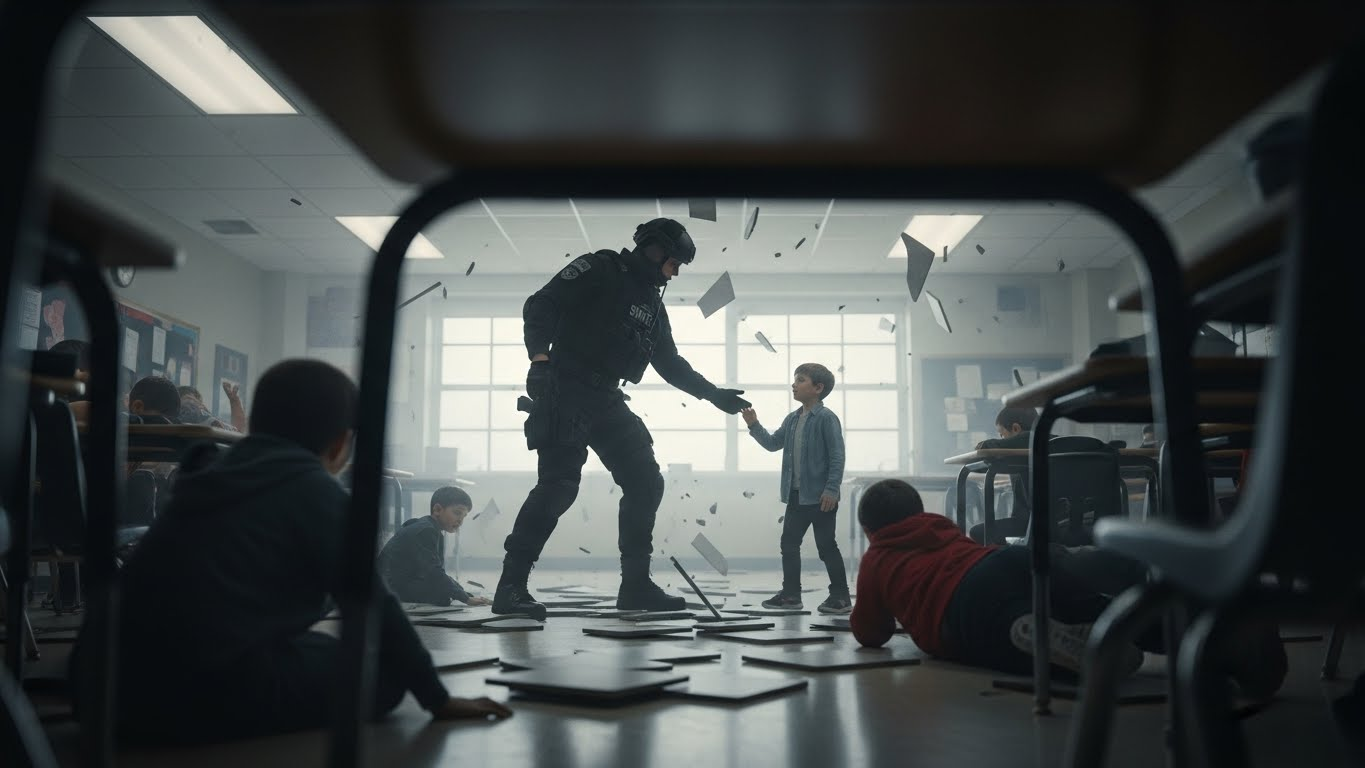
The ceiling tile above my desk didn’t just fall. It disintegrated.
A massive weight crashed onto my desk, splitting the wood in half. Monitors flew. Papers scattered like confetti.
In the center of the wreckage, crouched on top of my ruined grade book, was a figure.
He was huge. Clad in matte-black body armor from neck to toe. He wore a ballistic helmet with quad-lens night vision goggles flipped up. His face was covered by a black mandible mask.
He held a suppressed assault rifle in one hand and a combat knife in the other.
He looked like something out of a nightmare. He looked like death.
The figure slowly uncoiled, standing up to his full height. He checked the chamber of his rifle, then turned his head. The mask stared directly at me.
I was frozen, clutching my stapler, unable to breathe.
The figure raised a hand, pointing a gloved finger at the door I had just locked. Then, he spoke. His voice was muffled, deep, and sounded familiar.
“Mr. Anderson,” the soldier said. “Get away from the door. That lock won’t hold a breaching charge.”
I stared at him. “How… how do you know my name?”
The soldier reached up and unclipped his mask. It hissed as the seal broke. He pulled it off.
Underneath the high-tech gear was a face I had seen in a file photo. A bit older, a bit more scarred, with a jagged line running down his cheek. But the eyes—dark, intense, watchful—were unmistakable.
He looked at Leo.
“Dad?” Leo whimpered.
The man didn’t smile. He just nodded. “Code Black, Leo. Just like we talked about.”
He looked back at me.
“I told you,” Leo said to me, his voice trembling. “He’s always watching.”
BOOM.
The door to the classroom didn’t open. It exploded inward.
Chapter 3: The Ghost in the Smoke
The explosion didn’t sound like a movie. In movies, explosions are fiery and roaring. In a small classroom, a breaching charge is a concussion that slaps your brain against the inside of your skull.
I was thrown backward, sliding across the linoleum until my back hit the whiteboard. My ears were ringing so loud it felt like physical pain, a high-pitched scream that drowned out the world.
Through the thick gray dust swirling where the door used to be, two men stepped in.
They weren’t police. They wore drab olive fatigues and ski masks. They moved with a terrifying, aggressive purpose. The lead man raised a rifle, the laser sight cutting through the smoke, scanning the room for targets.
He wasn’t looking for the kids. He was looking for him.
Leo’s dad didn’t wait.
While I was cowering against the whiteboard, clutching a stapler like a lifeline, Leo’s dad moved. He didn’t run; he flowed. He vaulted over the wreckage of my desk, a black blur against the gray smoke.
The first intruder turned, but he was too slow.
Leo’s dad slammed into him, driving a combat knife into the gap between the man’s vest and his neck. It was brutal, efficient, and silent.
The second intruder shouted something in a language I didn’t recognize and swung his rifle.
Leo’s dad used the first man’s falling body as a shield. Bullets thudded into the dead man’s vest with dull whacks. In the same motion, Leo’s dad raised his own pistol—a sleek, suppressed weapon—and fired twice.
Pfft. Pfft.
The second intruder dropped.
It was over in four seconds.
Four seconds. That’s how long it took for the “ghost” to kill two armed men in front of a class of fourth-graders.
Silence returned, heavier than before. The ringing in my ears began to fade, replaced by the sound of sobbing children huddled in the corner.
Leo’s dad stood over the bodies. He didn’t look winded. He checked the hallway, then kicked the intruders’ rifles away. He turned to the class.
“Eyes on me!” he barked. It was a command, not a request. The crying quieted down.
He walked over to Leo, who was trembling now, the shock finally setting in. The man—this killer, this soldier—knelt down and gently cupped his son’s face.
“Did you follow protocol?” he asked softly.
Leo nodded, tears streaking his face. “I… I stayed away from the windows. I watched the exits.”
“Good boy.” The dad kissed Leo’s forehead, then stood up and turned to me.
I pushed myself up, my legs feeling like jelly. I looked at the bodies on the floor, then at the man I had threatened to call security on just ten minutes ago.
“Who are you?” I whispered.
“Name’s Miller,” he said, checking the magazine in his pistol. “And right now, Mr. Anderson, I’m the only reason you and these kids are going to see lunchtime.”
He walked over to me, grabbing my shoulder. His grip was like iron.
“Listen to me. These men are professionals. They are a cleaning crew for a cartel I dismantled six months ago. They aren’t here for a school shooting. They are here for us.” He pointed at Leo. “But they won’t leave witnesses. Do you understand?”
I nodded, unable to speak. My mouth was dry as sand.
“Good. You’re the teacher. They trust you. I need you to keep them calm. Can you do that?”
I looked at my students. Little Sarah was clutching her teddy bear. Michael was hyperventilating. They were looking at me, waiting for me to tell them it was a nightmare.
“Yes,” I choked out. “Yes, I can.”
“Good,” Miller said. He handed me a spare magazine from his vest. “Put this in your pocket. Don’t ask why. Just take it.”
He moved to the door, listening.
“We can’t stay here,” he said. “They know we’re in this room. We have to move to the extraction point.”
“Where?” I asked.
” The roof,” he said. “My team is inbound. ETA three minutes. But in this building, three minutes is a lifetime.”
Chapter 4: The Hallway of Echoes
Leaving the classroom was the hardest thing I’ve ever done.
The hallway, usually filled with artwork and the smell of floor wax, was a war zone. The emergency lights strobed in a nauseating rhythm. Smoke hung low near the ceiling.
“Single file!” Miller ordered. “Low profile. Stay against the lockers. Move!”
I took up the rear, ushering the twenty terrified children forward. Miller took point, his rifle raised, moving with that predatory grace.
We passed Mrs. Higgins’ classroom. The door was closed, the lights off. I prayed they were safe.
“Dad,” Leo whispered, keeping close to Miller’s leg. “Drone.”
Miller stopped instantly. He held up a fist. The line of kids froze.
I heard it then. A low buzz, like an angry hornet.
A small quadcopter drone hovered around the corner of the T-intersection ahead. It had a blinking red light and a camera lens that swiveled toward us.
“Cover!” Miller shouted.
He grabbed Leo and threw him behind a row of lockers just as the drone let out a high-pitched whine.
CRACK-CRACK-CRACK.
Bullets tore into the lockers where Leo had been standing a second ago. The drone was armed.
I screamed, diving on top of three students, shielding them with my body. Sparks showered down on us as bullets chewed up the metal lockers above our heads.
Miller rolled out from cover, sliding on his knees. He didn’t fire blindly. He took a single breath, aimed, and fired one shot.
The drone exploded in a shower of plastic and sparks, crashing to the floor.
“Move! Go! Go!” Miller roared.
We scrambled up, running now. The stealth was gone.
“Mr. Anderson!” Miller yelled over the blaring fire alarm. “Take them to the stairwell! The North stairwell!”
“That’s near the main entrance!” I yelled back. “They’ll be waiting!”
“Exactly,” Miller said, grimly. “I’m going to draw their fire. You get the kids to the roof access.”
“You can’t take them all alone!”
Miller looked at me. For a second, the hard soldier facade cracked, and I saw a tired, desperate father.
“I promised his mother,” he said. “I promised I’d be a shadow. A shadow doesn’t die, Mr. Anderson.”
He reached into his vest and pulled out a flashbang grenade.
“Take care of my boy,” he said.
And then, he turned and sprinted—not toward the safety of the stairwell, but directly toward the main lobby, where the shadows of more gunmen were lengthening on the floor.
He yelled something, a challenge, drawing their attention.
“Run!” I screamed at the kids. “Up the stairs! Now!”
I grabbed Leo’s hand. He was looking back at his father.
“Come on, Leo!” I pulled him.
“He’s not coming back,” Leo sobbed, stumbling up the stairs. “He’s not coming back this time.”
“He is,” I lied, my heart breaking. “He’s the ghost, remember? He’s invincible.”
We burst into the stairwell, the heavy steel door slamming shut behind us, muffling the sudden eruption of automatic gunfire that exploded from the lobby below.
We were alone. We were trapped. And the only man who knew how to save us had just walked into a firing squad.
Chapter 5: The Stairwell to Nowhere
The stairwell was a concrete echo chamber. Every ragged breath, every squeak of a sneaker, sounded like a scream.
“Keep moving!” I urged, herding the children up the steps. “Don’t look back!”
We were on the second-floor landing when we heard the steel door below us—the one we had just come through—slam open.
“They’re inside!” a voice shouted from below. “Sweep the stairs!”
Panic, cold and sharp, spiked in my chest. We had one flight of stairs left to reach the roof access door. If that door was locked…
I sprinted past the kids to the front of the line. I reached the gray metal door labeled ROOF ACCESS. I grabbed the push bar and shoved.
It didn’t budge.
“No, no, no,” I muttered, slamming my shoulder against it. Locked. Of course it was locked. It was a school. We kept kids off the roof, not on it.
“Mr. Anderson?” It was Sarah, clutching her teddy bear, her eyes wide with terror. “Are the bad men coming?”
I looked down the stairwell. I could hear heavy boots clanging on the metal steps. They were fast. They would be here in thirty seconds.
I looked at the heavy padlock hasp on the door. I looked at the stapler in my hand. Useless.
“Move,” a small voice said.
Leo squeezed past me. He didn’t look like a fourth-grader anymore. He looked focused. He reached into his pocket and pulled out a small, multitool-like device. It wasn’t a toy. It was a lock pick tension wrench.
“Leo, what are you—”
“Quiet, please,” Leo murmured, sliding the metal pick into the keyhole. “Dad taught me. Feel the pins. Apply tension. Click.”
Clang. Clang. Clang. The boots were on the landing below us now.
“There they are!” a voice roared from below. A gunshot rang out, the bullet ricocheting off the concrete railing inches from my head. Concrete dust sprayed into my eyes.
“Get down!” I screamed, pushing the kids flat against the landing floor.
“Almost…” Leo whispered, his hands steady despite the chaos.
I stood up, grabbing the fire extinguisher mounted on the wall. It was heavy, red, and my only hope. I pulled the pin.
A man in black tactical gear rounded the corner of the stairs below, raising his rifle.
I didn’t think. I didn’t hesitate. I leaned over the railing and squeezed the handle.
A massive cloud of white chemical powder blasted downward, filling the stairwell shaft. The gunman coughed, blinded, his shots going wild into the ceiling.
Click.
“Got it!” Leo yelled.
He shoved the bar. The roof door swung open, letting in a blast of cold, wet wind and gray light.
“Go! Go! Go!” I shouted, grabbing kids by their backpacks and heaving them through the doorway.
I waited until the last child—Leo—was through. I looked back down the stairwell. The white cloud was clearing. The gunman was wiping his eyes, raising his weapon again.
I threw the empty fire extinguisher at him with all my strength and slammed the heavy steel door shut behind me.
Chapter 6: No Way Out
The roof was a desolate landscape of gravel, puddles, and humming HVAC units. The rain was coming down harder now, stinging our faces.
We were exposed. Completely exposed.
“Where is it?” I yelled over the wind, scanning the sky. “Where is the extraction?”
The sky was empty. Just low, bruising clouds. No helicopter. No rescue.
The kids huddled together behind a large air conditioning unit, shivering and wet. They were done. The adrenaline was fading, replaced by the freezing cold and the crushing reality of our situation.
Leo stood at the edge of the roof, looking down at the parking lot.
“They blocked the perimeter,” Leo said, his voice hollow. “Look.”
I joined him. Below, black SUVs had formed a barricade around the school entrance. Police cars were there, but they were held back at the main road, kept at bay by what looked like heavy suppressor fire from the cartel’s ground team.
We were alone.
BAM.
The door to the roof rattled. Someone was throwing their shoulder against it from the inside.
BAM.
They were breaking it down.
I looked around for a weapon. A loose pipe? A rock? There was nothing. Just gravel.
I knelt down in front of the kids. “Listen to me,” I said, trying to keep my voice from shaking. “Stay behind this metal box. No matter what happens, do not stand up. Do you hear me?”
They nodded, tears mixing with the rain on their faces.
The roof door flew open with a screech of tearing metal.
Three men spilled out onto the roof, spreading out in a tactical formation. They saw us immediately.
I stood up. I don’t know why. Maybe it was instinct. Maybe it was just the refusal to die on my knees. I stood between the gunmen and my students.
The leader, a tall man with a scar running through his eyebrow, lowered his rifle slightly. He smiled. It was a cruel, shark-like smile.
“The teacher,” he shouted over the rain. “Noble. But stupid.”
“Let them go,” I yelled, my hands raised. “They’re children! You want the boy? Take me instead. Let the others go!”
The leader laughed. “We don’t leave loose ends, teacher. We clean the slate.”
He raised his rifle, aiming directly at my chest.
I closed my eyes. I thought about my wife. I thought about the unfinished coffee on my desk.
Thwip.
The sound was soft. Like a finger snapping.
The leader’s head snapped back violently. A red mist sprayed into the rain. He crumpled to the wet gravel, dead before he hit the ground.
The other two gunmen spun around, confused, looking for the shooter.
Thwip. Thwip.
Two more shots. Two more bodies dropping into the puddles.
I opened my eyes, gasping.
At the far edge of the roof, climbing over the parapet like a spider, was a figure in black.
He was bleeding. His armor was cracked. He was limping. But he was alive.
“Dad!” Leo screamed.
Chapter 7: The Ghost of Oak Creek
Miller didn’t run to us. He couldn’t. He was hurt bad. I could see a dark stain spreading on his side.
But he moved with a terrifying determination. He dragged himself over the ledge and rolled into a crouch behind a ventilation fan, scanning the door.
“Stay down!” Miller rasped, his voice wet and strained.
“You’re alive,” I breathed, running over to him. I grabbed his arm to help him up.
“Barely,” he grunted. “The lobby… was a mess.”
He checked his rifle. “Empty,” he muttered, tossing it aside. He pulled his pistol. “Two rounds left.”
“There are more coming,” I said, pointing to the door. “I can hear them on the stairs.”
Miller looked at me, then at Leo. He reached into his vest and pulled out a small, rectangular device with a red button.
“Extraction is scrubbed,” Miller said. “The LZ is too hot. They can’t land.”
“So what do we do?” I asked, panic rising again.
“We improvise.” He handed me the device. “This is an IR beacon. High frequency. If you press this, every allied asset in a fifty-mile radius will see it. But so will the bad guys.”
“Why are you giving it to me?”
Miller looked at the door. “Because I’m out of ammo. And I’m not going to be able to walk much further.”
“No,” Leo cried, rushing forward. “Dad, no!”
Miller grabbed his son with his good arm, pulling him into a hug that looked like it took the last of his strength. “Leo, look at me. You remember the rules? Rule number one?”
“Survive,” Leo sobbed.
“Survive,” Miller repeated. “Mr. Anderson is going to take you to the far side of the roof. There’s a fire ladder. You go down. You run to the police line.”
“What about you?” Leo asked.
“I’m going to hold the door,” Miller said. He pulled a combat knife from his boot. The blade gleamed in the gray light.
“Mr. Anderson,” Miller said, looking at me. “Take my son.”
I hesitated. Leaving him here to die felt like a crime. But looking at the twenty kids behind me, I knew I had no choice.
I grabbed Leo’s hand. “Come on, Leo.”
“No!” Leo fought me. “I won’t leave him!”
“Go!” Miller roared. It was the scariest sound I had ever heard.
We ran. We splashed through the puddles toward the fire escape on the north side.
Behind us, the roof access door filled with shadows. More men.
I looked back one last time.
Miller was standing in the open, exposed to the rain and the guns. He held the knife in a reverse grip. He wasn’t cowering. He was waiting.
The first gunman stepped out. Miller lunged.
And then, the sky tore open.
It started with a thrumming vibration that shook the fillings in my teeth. Then, a wind so powerful it knocked me to my knees.
Rising up from behind the roof edge, like a dragon from the deep, was the sleek, black nose of a stealth helicopter. No markings. Just pure, predatory machinery.
A minigun mounted on the side spun up with a mechanical whine.
BRRRRRRRT.
A line of fire erupted, tearing up the gravel, the ventilation units, and the doorway where the gunmen stood. The concrete disintegrated. The gunmen didn’t stand a chance. They were vaporized in a cloud of dust and red mist.
The helicopter hovered, the wash from its rotors flattening us against the roof.
A cable dropped. Two operators in full gear slid down, hitting the roof instantly. They didn’t go to the kids. They went to Miller.
They grabbed him, hooking him to a hoist. One of them signaled to me. Get on.
“The kids!” I yelled, pointing to my class.
The operator nodded, speaking into his comms. A second helicopter rose into view on the other side.
“Go!” the operator yelled.
Chapter 8: The Grade
The next hour was a blur of noise, blankets, and flashing lights.
We were airlifted to a secure airfield, not the local hospital. The kids were checked by medics who moved with military precision. Parents were called. There were tears, reunions, and a lot of confused shouting.
I sat on the back of an ambulance, wrapped in a shock blanket, holding a cup of lukewarm water.
I watched as they loaded a stretcher into a black medical van. Miller was on it. He was unconscious, hooked up to IVs, an oxygen mask over his face.
Leo was walking beside the stretcher, holding his dad’s hand.
Before they loaded him in, Leo stopped. He looked across the tarmac and saw me. He let go of the stretcher and ran over.
He stopped in front of me. He looked small again. Just a kid in a wet hoodie.
“Mr. Anderson?”
“Yeah, Leo?”
“Did… did my dad do a good job?”
I felt tears prick my eyes. I thought about the man who dropped from the ceiling, who took bullets for strangers, who faced down a hit squad with a knife to save a fourth-grade class.
“Yeah, Leo,” I choked out. “He did a good job. The best.”
Leo nodded. He reached into his pocket and pulled out a crumpled, soggy piece of paper.
It was the drawing. The black void with the two eyes.
“You can grade it now,” Leo said. “If you want.”
He handed it to me, then turned and ran back to the medical van. The doors slammed shut, and the convoy sped away, disappearing into the rainy Virginia afternoon.
It’s been two weeks since the “Gas Leak” at Oak Creek Elementary. That’s the official story. A gas main rupture caused hallucinations and structural damage. The parents were paid off. The school was renovated overnight.
I’m back in the classroom today. The ceiling tiles are new. The door is fixed. The kids are a little quieter, a little clingy, but they’re resilient. They’re bouncing back.
Leo isn’t here. His desk is empty.
I haven’t heard from him or his father. I probably never will. Men like Miller don’t exist on paper. They are shadows. They do the work no one else can do, and then they vanish.
I sat at my desk during recess, grading papers. I reached the bottom of the pile.
There it was. The soggy, wrinkled drawing of the black void.
I smoothed it out. The wax was cracked. The paper was stained with rain and maybe a little blood.
I picked up my red pen.
At the top of the page, I wrote:
Grade: A+ Comment: exceptional realism.
I pinned it to the bulletin board, right in the center, where the eyes in the darkness could watch over the whole room.
Because I know now. The darkness isn’t empty. There are things in there that watch. And sometimes, if you’re very lucky, they are watching out for you.