Rich Mom Denied Food To A Poor Kid When We Were Trapped. Four Days Later, The Tables Turned.
Chapter 1: The Invisible Boy
The air on the bus smelled of stale potato chips, diesel fumes, and teenage hormones. It was the specific, suffocating cocktail of a seventh-grade field trip, and I was right in the middle of it. As a student teacher, I was technically an authority figure, but to the kids of Oak Creek Academy, I was just a glorified babysitter with a lanyard.
We were winding our way back from the State Museum, the bus tires humming against the asphalt of the mountain highway. The sun was setting behind the peaks, casting long, bruised shadows across the valley. Inside, the noise level was steadily rising.
In the back of the bus sat Eli Parker.
Eli was easy to miss if you weren’t looking for him, which seemed to be the preferred state of affairs for the student body. He was a scholarship kid in a school where tuition cost more than most people’s cars. He wore a faded navy hoodie that had seen better days, and his sneakers were generic brand, scuffed white against the dark floor mat.
“Hey, Parker,” Mason, the star quarterback of the junior team, leaned over the seat back. “Is it true your mom takes the bus to work? Like, the city bus?”
A ripple of laughter went through the back rows.
“My dad says his mom cleans houses,” Lila Whitmore added, her voice sharp and carrying that particular cruelty that only thirteen-year-old girls can master. She flipped her long, blonde hair over her shoulder. “She probably cleans Mason’s toilet.”
“Eli probably doesn’t even have a dad,” Mason sneered.
I tightened my grip on the seat back in front of me. I had heard enough. I stood up, trying to project a confidence I didn’t quite feel yet.
“Hey, that’s enough,” I said, my voice cutting through the chatter. “Let’s keep the conversation respectful. Lila, turn around. Mason, sit down.”
From the front row, Mrs. Whitmore shifted. She was the head chaperone, the PTA president, and the woman who had single-handedly funded the new gymnasium. She turned her head, peering at me over the rim of her designer sunglasses, even though it was dusk.
“Oh, relax, honey,” she said, her voice dripping with condescension. “They’re just teasing. Boys will be boys. You know, if Eli wasn’t so… strange, maybe they’d include him more. You can’t force popularity.”
I felt the heat rise in my cheeks. “It’s not about popularity, Mrs. Whitmore. It’s about basic decency.”
She scoffed, turning back to her phone. “You have a lot to learn about the real world. Toughen up.”
The other parents, a cluster of Oak Creek’s elite, offered polite, uncomfortable chuckles. They wouldn’t cross her. Nobody did.
I looked back at Eli. He hadn’t flinched. He was staring out the window at the passing rock face, his jaw set so tight a muscle feathered in his cheek. He had learned the hardest lesson of poverty early: silence is the only shield you have.
The bus driver, a gruff man named Jerry, shifted gears as we approached the mouth of the Black Ridge Tunnel. “Everyone settle down,” he called out over the intercom. ” entering the tunnel. Signal’s gonna cut out.”
The bus swallowed the light as we entered. The overhead lights flickered on, casting a sickly yellow glow on everyone’s faces. The hum of the tires changed pitch, echoing off the concrete walls.
We were about a mile in, deep under the mountain, when it happened.
It didn’t sound like a crash. It sounded like the earth itself was screaming.
A deep, guttural roar vibrated through the floorboards, shaking my teeth in my skull. Then came the slam—a violent, concussive force that threw everyone forward. The bus screeched, fishtailing wildly as Jerry fought the wheel.
“Hold on!” Jerry screamed.
Dust—thick, choking, blinding dust—billowed into the bus instantly. It was like someone had thrown a gray blanket over the world. Rocks, massive and heavy, hammered the roof of the bus. Bang. Bang. CRUNCH.
The screaming started then. A high-pitched, collective shriek of terror from thirty children.
The bus slammed to a halt, tilting slightly to the left. The engine sputtered and died.
Total darkness.
Chapter 2: The Pizza Box
For a moment, there was no sound but the hissing of the radiator and the settling of debris. Then, the chaos erupted.
“Mom! Mom!”
“I can’t see!”
“My head hurts!”
“Everyone stay in your seats!” I yelled, my voice cracking. I fumbled for my phone, turning on the flashlight. Beams of light began to crisscross the bus as other kids did the same. The air was thick with particulate matter; the light beams looked like solid bars of white fog.
I scrambled to the front. Jerry was already prying the door open. He looked shaken, blood trickling from a cut on his forehead.
“You okay?” I asked.
“Yeah,” he coughed. “We need to check the exits.”
We stepped out into the tunnel. It was a nightmare. Behind us, a wall of jagged boulders and twisted rebar blocked the way we came. Jerry ran to the front of the bus, shining his heavy-duty flashlight into the gloom.
“Blocked,” he choked out. “Both ends. The ceiling came down.”
We were sealed in.
Inside the bus, Mrs. Whitmore was trying to maintain order, but her voice was shrill. “Everyone calm down! My husband is going to hear about this! Who is responsible for this tunnel maintenance?”
I climbed back on. “Is anyone hurt?”
Remarkably, aside from bumps, bruises, and a few bloody noses from hitting the seatbacks, everyone was alive. The reinforced roof of the bus had saved us from the smaller rocks, and the main collapse had happened just feet in front of and behind us.
“Phones,” Mrs. Whitmore snapped. “Call 911.”
“I have no bars,” Lila whined, staring at her screen in horror.
“Me neither,” Mason said. “SOS only. But it’s not connecting.”
“Don’t worry,” Mrs. Whitmore said, smoothing her expensive blazer, though her hands were trembling. “We’re in America. They know we’re here. They’ll have us out in an hour. Probably less.”
But an hour passed. The dust settled, coating everything in a ghostly gray powder. The air grew still and cool.
Two hours.
Three hours.
By the fourth hour, the adrenaline had worn off, replaced by the gnawing ache of hunger. It was past dinner time. The kids were getting restless, complaining of stomach aches and thirst.
“I’m starving,” a girl named Sophie cried softly.
Mrs. Whitmore’s eyes lit up. “The lunch catering! We have leftovers.”
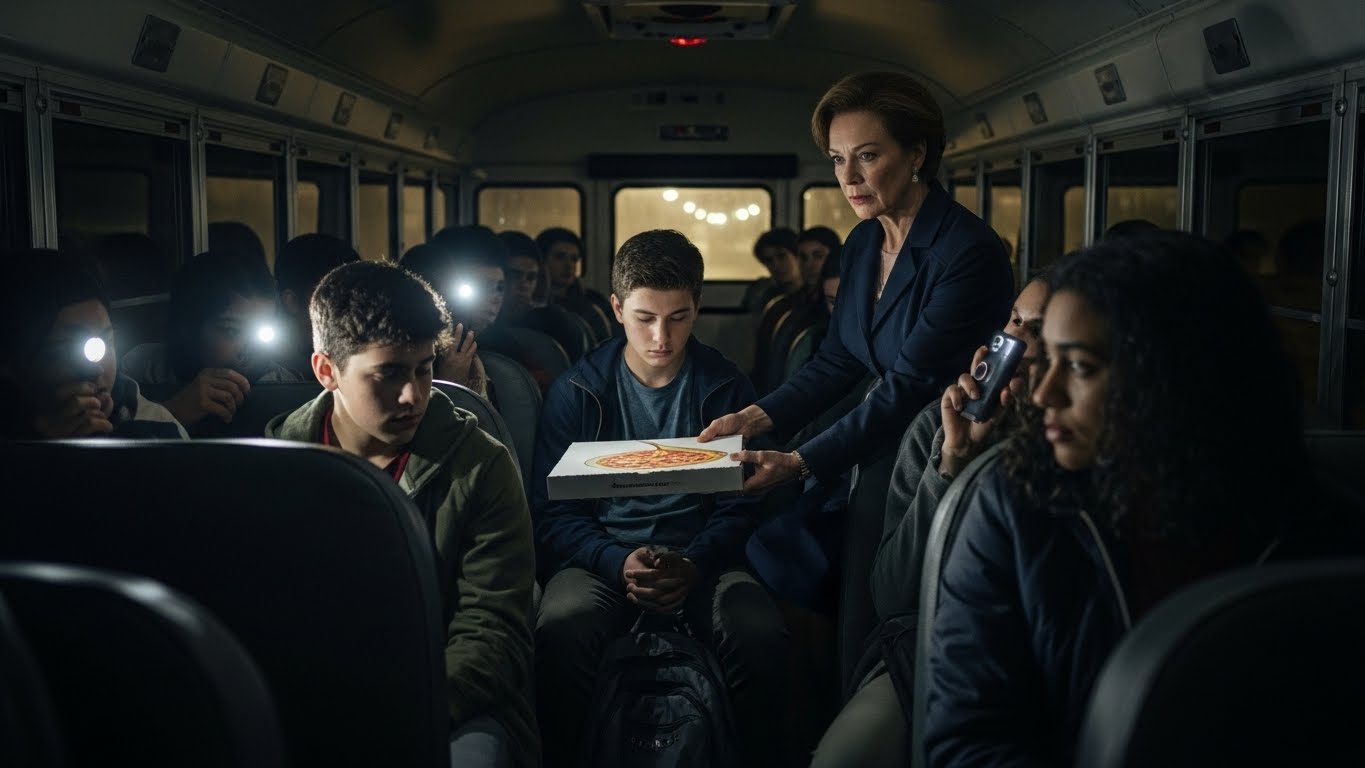
She moved to the luggage rack and pulled down three large, flat boxes. They were from an upscale Italian place in the city—fancy pizzas that had been ordered for the staff and chaperones but barely touched.
“Alright, everyone,” she announced, assuming the role of savior. “Line up. One slice each. Let’s be civilized.”
The smell of cold pepperoni and cheese wafted through the stagnant air, smelling like heaven. The kids scrambled, hands outstretched. Mrs. Whitmore handed them out like a queen bestowing favors.
“Here you go, Mason. Here, Lila, take the biggest one.”
She worked her way down the aisle. I watched from the back, checking on a student who was feeling nauseous.
She reached the back row. Eli looked up. He hadn’t complained once. He hadn’t cried. He just looked… hungry.
Mrs. Whitmore looked at the slice in her hand, then at Eli, and then she put the slice back in the box and closed the lid.
I froze. “Mrs. Whitmore?”
She turned to walk back to the front.
“Wait!” I lunged forward, blocking the aisle. “You missed Eli. He needs to eat.”
She stopped, looking me up and down with that same icy stare from earlier. “Eli didn’t pay for the field trip lunch package,” she said loudly. The bus went quiet. “The permission slip clearly stated that the $15 fee covered the bus and the catered lunch. His mother signed the form but didn’t check the box. No payment, no food.”
I stared at her, my mouth slightly open. I couldn’t process the level of pettiness. “Are you serious? We are trapped in a collapsed tunnel. We don’t know when rescue is coming. You’re worried about four dollars worth of pizza?”
“It’s the principle,” she sniffed. “If I give him some, it’s unfair to the parents who actually paid. It teaches him that he can get a free ride. I won’t support that.”
“He is a child!” I snapped, my voice rising. “Give me a slice. I’ll pay you the fifteen dollars right now.” I reached for my wallet.
“No,” she said, slapping the box as I reached for it. “I am the head chaperone, and I decide how the resources are distributed. He gets nothing.”
The other parents, the ones who had laughed at her jokes earlier, looked away. They studied their shoes. They checked their dead phones. Cowards.
I was about to scream, to physically wrestle the box from her, when a quiet voice spoke up.
“It’s okay.”
Eli stood up. He looked small in the gloom, but he stood straight. He pulled his backpack onto his lap and unzipped it.
“I don’t want her pizza,” Eli said, his voice calm, lacking any of the anger I felt on his behalf.
He reached into the bag and pulled out two liters of water, a large bag of baby carrots, a family-sized bag of trail mix, and three sleeves of saltine crackers.
“I have my own food,” he said. “My mom always packs extra. She says you never know what might happen.”
He looked at Mrs. Whitmore, his eyes clear and hard. “You can keep your pizza.”
Mrs. Whitmore turned a shade of crimson I had never seen before. She huffed, spun on her heel, and marched to the front of the bus. “Fine! See if I care. But don’t come crying to me when you run out.”
The bus was silent. But the dynamic had shifted. The line had been drawn.
In the front were the privileged kids, feasting on greasy pizza, led by a woman who measured life in dollar signs.
In the back were me, Jerry the driver, and Eli.
The rich kids had chips, candy, and soda—sugar and salt that would make them thirsty within an hour. They laughed and played games on their phones until the batteries died.
Eli carefully opened his trail mix. He counted out ten peanuts and five raisins. He ate them slowly. Then he took one small sip of water.
“We have to ration,” he whispered to me. “We don’t know how long we’ll be here.”
I looked at this twelve-year-old boy, wearing shoes held together by tape, who had more wisdom and dignity than every adult on that bus combined.
“You’re right, Eli,” I whispered back. “We ration.”
We settled in for the night. The temperature dropped further. We huddled together for warmth.
We didn’t know it yet, but the pizza was just the beginning. The real horror—and the real heroism—was yet to come. The tunnel was about to test us in ways that money couldn’t fix.Chapter 3: The Silence of the Mountain
The first night in the tunnel was a blur of uncomfortable dozing and sudden, jerking awakenings. The air grew colder with every passing hour, a damp chill that settled into our bones. The bus, once a vehicle of noise and energy, had become a steel tomb.
When my watch read 7:00 AM, there was no sunrise. Just the same suffocating darkness, broken only by the dying glow of the emergency lights and the occasional beam of a flashlight.
“They’re coming today,” Mrs. Whitmore announced the moment people started stirring. She was trying to fix her hair in the reflection of the bus window, but her hands were shaking. “I know my husband. He’s probably got a private excavation crew out there right now.”
But the hours dragged on.
By noon on the first full day, the reality of our situation began to bite. The pizza was long gone. The chips and candy the other kids had gorged on the night before had turned into a curse. The salt and sugar had dehydrated them faster than if they hadn’t eaten at all.
“My mouth is dry,” Mason groaned, his head resting against the cold glass. “Mrs. Whitmore, do you have any water?”
Mrs. Whitmore looked around nervously. She had a small Evian bottle in her purse, but I watched her take a quick, greedy swig before hiding it back away. “No, Mason. We just have to wait. Be patient.”
In the back of the bus, it was a different world.
Eli was awake. He had used a black marker to draw a line on the back of the seat in front of him. A tally mark. Day One.
He sat cross-legged, his backpack serving as a pantry. He had his water bottle cap unscrewed.
“Mr. Miller,” he whispered to me. “Jerry. Take a sip. Just to wet your tongue. Don’t swallow immediately. Let it sit.”
I did as he said. The water was lukewarm, but it felt like life itself. Jerry, the driver, took his sip next.
“Thanks, kid,” Jerry grunted. He looked pale. He was a big guy, diabetic, I suspected, though he hadn’t said anything.
Throughout the afternoon, we heard it—a faint, rhythmic thumping from deep within the rock walls.
“Drilling!” Mrs. Whitmore shrieked, jumping up. “I told you! They’re here!”
The kids cheered, a weak, ragged sound. They rushed to the windows, banging on the glass, screaming for help.
“We’re here! We’re here!”
We listened intently, hearts pounding against our ribs. The thumping grew louder, then metallic screeching, like gears grinding against stone.
And then… silence.
A deep, settling rumble shook the ground beneath us, followed by the terrifying sound of falling rock somewhere ahead of us. The tunnel groaned.
Then, absolute quiet.
The drilling had stopped. They had hit something, or the tunnel was too unstable.
The hope in the bus evaporated instantly, replaced by a dread so heavy it felt physical. Lila Whitmore burst into tears. “They aren’t coming! We’re going to die in here!”
“Stop it!” Mrs. Whitmore snapped, though her voice cracked. “Stop crying! You’re wasting energy!”
But the panic was setting in. Thirst was becoming agony. I saw kids licking their lips, their skin looking gray in the dim light. The parents were arguing in hushed, angry whispers. One dad was blaming Mrs. Whitmore for not letting the bus turn back sooner. She was blaming the driver.
In the back, Eli remained a statue of calm. He checked his watch.
“Time to eat,” he whispered.
He broke a single saltine cracker in half. He handed one half to me, one half to Jerry, and took one for himself.
“Chew it until it’s liquid,” he instructed softly. “Tricks your stomach.”
I looked at this boy, who had been mocked for his poverty, for his duct-taped shoes. He was currently the richest person on the bus. He possessed the only currency that mattered: preparation and discipline.
“Eli,” I whispered, chewing the dry paste of the cracker. “If they don’t come soon…”
“They’ll come,” he said, his eyes fixed on the darkness outside. “But until they do, we survive. My dad… before he left… he used to take me camping. He taught me the Rule of Threes. You can survive three minutes without air, three days without water, three weeks without food.”
He looked at the front of the bus, where Mrs. Whitmore was frantically typing on a dead phone.
“They don’t know the rules,” Eli said.
Chapter 4: The Rebellion
Day Two.
The smell inside the bus was becoming unbearable. The chemical toilet in the back was nearing capacity, but worse was the smell of fear—a sour, metallic tang that hung in the air.
The thirst was no longer just uncomfortable; it was dangerous. The kids who had eaten the salty chips were suffering the most. Mason was lethargic, his eyes glossy. A girl named Sarah was sobbing quietly, dry heaving because her stomach was empty but she had nothing to bring up.
Mrs. Whitmore was losing her grip. Her expensive blowout was matted, her makeup smeared. She sat in the front seat, clutching her purse, muttering to herself about lawsuits and incompetence.
“Mom,” Lila rasped. “I need water. Please.”
“I don’t have any!” Mrs. Whitmore screamed, finally snapping. She stood up, wild-eyed. “Do you think I’m hiding a faucet in my purse? Shut up, Lila!”
The slap of her words was harder than a physical blow. The bus went deathly silent.
That was the moment the hierarchy broke.
From the back of the bus, the sound of a zipper cut through the tension.
Eli stood up.
He didn’t look at Mrs. Whitmore. He looked at the kids. He walked down the aisle, stepping over backpacks and outstretched legs. He held his water bottle in one hand and the bag of baby carrots in the other.
He stopped at Lila’s seat. The girl who had made fun of his shoes. The girl who had laughed when her mother denied him pizza.
Eli uncapped the bottle.
“Lila,” he said gently.
She looked up, her eyes wide and rimmed with red. She looked at the water, then at Eli. Shame washed over her face, warring with desperation.
“Sip,” Eli said, holding the bottle out. “Don’t gulp. Just a sip.”
Lila hesitated, glancing at her mother.
“Don’t you dare,” Mrs. Whitmore hissed. “We don’t need his charity. He’s just trying to make a point.”
Lila looked at her mother, then back at the boy she had tormented. She reached out with trembling hands and took the bottle. She took a small sip, closed her eyes, and let out a whimper of relief.
“Thank you,” she whispered. “Eli, I’m sorry. I’m so sorry.”
“It’s okay,” Eli said. He took the bottle back and moved to the next seat. Mason.
“You too, Mason. Small sip.”
Mason, the quarterback who had mocked Eli’s lack of a father, looked like he was about to cry. “I was a jerk, man. I’m sorry.”
“Save your energy,” Eli said. “Here. Take a carrot. Chew it slowly.”
I watched in awe as this twelve-year-old boy systematically dismantled the social structure of Oak Creek Academy. He moved from seat to seat, bypassing the parents, attending strictly to the children. He gave each one a precise ration—a sip of water, a half a cracker, or a baby carrot.
“We can last,” he told them, his voice projecting calm authority. “If we share, we can last five days. Five bites and one sip per day.”
Mrs. Whitmore stood in the aisle, blocking him as he tried to cross to the other side.
“Stop it!” she demanded. “You’re undermining me! You’re making them think this is a desperate situation!”
“It is a desperate situation,” I said, standing up and moving to Eli’s side. “And he’s the only one doing something about it.”
“He’s rationing crumbs!” she spat. “It’s pathetic.”
“It’s leadership,” Jerry the driver said, pulling himself up from his seat. He stood behind Eli, a looming wall of support.
The other parents were watching. They were hungry, too. They were thirsty. But they saw their children—their precious, pampered children—looking at Eli Parker not with disdain, but with total, unadulterated worship.
“Mom,” a boy named Tyler said, standing up. “I’m going to sit in the back.”
“Tyler, sit down,” his mother warned.
“No,” Tyler said. “Mrs. Whitmore is crazy. Eli has a plan.”
He grabbed his backpack and walked to the back of the bus.
Then Lila stood up. “Me too.”
One by one, the students of Oak Creek Academy abandoned the front rows. They left the proximity of the “chaperones” and the authority figures who had failed them. They packed into the back rows, squeezing three or four to a seat, surrounding Eli.
It was a mutiny. A quiet, shuffling revolution.
By the time Eli returned to his seat, he was surrounded. The back of the bus had become a commune. The front of the bus was a ghost town of angry, humiliated adults.
Mrs. Whitmore sat alone in the front row, fuming. She had the title, she had the money, and she had the pizza boxes. But she had lost the room.
Eli sat in the center of the circle of kids. He opened his notebook.
“Okay,” he said, and the kids leaned in, hanging on his every word. “We need to preserve body heat tonight. Everyone needs to pair up. We sleep in shifts. Two people awake at all times to listen for the drill.”
I sat there, watching him, and realized I was witnessing something rare. I wasn’t just seeing a survival strategy; I was seeing the birth of a leader.
But as night fell on Day Two, the temperature dropped sharply. And while the kids were calmer, I noticed something that made my blood run cold.
Eli hadn’t taken a sip of water during his entire round. He had given it all to them.
He was shivering. Not the subtle shiver of the cold, but the violent, rattling tremor of a body starting to shut down. He rubbed his arms, trying to hide it, but I saw the sheen of sweat on his forehead despite the freezing air.
He was giving everything he had, literally draining his own life force to keep his tormentors alive. And I was terrified that the price of his heroism was going to be his life.Chapter 5: The Fever and the Vulture
Day Three.
The concept of time had begun to dissolve. There was only the dark, the cold, and the thirst. The air in the bus was heavy with carbon dioxide and the sour stench of unwashed bodies. We were lethargic, moving in slow motion, our energy reserves completely depleted.
But in the back of the bus, a new crisis was unfolding.
Eli didn’t wake up for the morning ration count.
He was slumped against the window, his head lolling at an unnatural angle. I crawled over to him, my own limbs feeling like lead.
“Eli?” I whispered, shaking his shoulder gently.
He groaned, a low, pained sound that bubbled up from his chest. His eyes fluttered open, but they were unfocused, glassy and swimming.
“Did… did everyone get their sip?” he rasped. His voice was like sandpaper.
I touched his forehead and recoiled. He was burning up. His skin was dry and papery, radiating a frightening amount of heat.
“You’re burning up, Eli,” I said, panic tightening my chest. “You need water. Now.”
I reached for the water bottle. It was light. Too light. There were maybe three ounces left. He had given it all away.
“No,” he mumbled, pushing my hand away weakly. “Save it. For the little ones. I’m fine.”
“You are not fine!” I hissed. “You have a fever. Probably an infection or severe dehydration.”
The commotion woke the other kids. They gathered around, their faces pale and drawn in the flashlight beams. They looked at their leader, their savior, now trembling uncontrollably in his seat.
“Is he okay?” Lila asked, her voice trembling.
“He’s sick,” I said, trying to keep my voice steady. “He gave us too much. He didn’t keep enough for himself.”
A heavy silence fell over the group. The guilt in the air was palpable. These kids, who had mocked him for his poverty, now realized the cost of their survival.
Then, I heard footsteps.
Mrs. Whitmore was walking down the aisle. She looked like a spectre. Her eyes were sunken, her lips cracked and bleeding. The veneer of civilization had completely stripped away, leaving something primal and ugly underneath.
She stopped at our row, looking down at Eli. She didn’t look concerned. She looked calculating.
“He looks bad,” she said, her voice a dry croak.
“He has a fever,” I said protectively, shielding Eli with my body. “He’s dehydrated.”
Mrs. Whitmore’s eyes darted to the backpack sitting at Eli’s feet—the backpack that still held the last few crackers and the dregs of the water.
“He’s delirious,” she said, taking a step closer. “He’s not lucid anymore.”
“Back off, Mrs. Whitmore,” I warned.
She ignored me. She looked at the other parents, who were watching from the middle rows. “Look at him,” she said, gesturing to the shivering boy. “He’s barely breathing. Let’s be realistic.”
She turned her gaze back to me, and her next words chilled me more than the tunnel air.
“Let’s take his rations,” she said. A twisted grin appeared on her face. “He’s not going to make it anyway. Why waste the food on a dying cause? The rest of us need to survive.”
The sheer cruelty of the sentence hung in the air. I was too stunned to speak. I couldn’t believe a human being, a mother, could say that about a child.
“He’s twelve,” I whispered.
“He’s weak,” she snapped, reaching for the bag. “Give it to me.”
I braced myself to shove her, to fight her physically if I had to. I didn’t care about my job anymore. I was going to break her nose.
But I didn’t have to.
Chapter 6: The Wall of Children
Before Mrs. Whitmore’s manicured hand could touch the strap of the backpack, a small hand shot out and grabbed her wrist.
It was Lila.
“No,” Lila said. Her voice wasn’t loud, but it was firm.
Mrs. Whitmore looked at her daughter in shock. “Lila, let go. I’m doing this for us. For you.”
“No, you’re not,” Lila said, standing up. She was weak, swaying slightly, but she didn’t let go. “You’re doing it because you’re mean. You’re a bad person, Mom.”
Mrs. Whitmore gasped, yanking her hand back. “How dare you! I have given you everything!”
“You gave us nothing!” Mason shouted, standing up next to Lila. He stepped into the aisle, blocking Mrs. Whitmore’s path. “Eli gave us everything. He gave us his water. He gave us his food. He saved us when you wouldn’t even give him a slice of pizza.”
“He’s right,” another girl, Sophie, stood up. “Get away from him.”
It was a chain reaction. One by one, the students of Oak Creek Academy rose. They formed a tight, impenetrable semi-circle around Eli’s seat. They stood shoulder to shoulder—the jocks, the cheerleaders, the nerds. The social hierarchy was gone. There was only the pack, protecting its own.
“Have you all lost your minds?” Mrs. Whitmore screeched, looking around wildly. “He gave you a few drops of water and now you’re on his side? I am the adult here!”
“You’re a monster,” I said, standing behind the wall of children. “Look at yourself. You’re trying to steal from a dying child.”
I looked at the other parents. “Are you going to let her do this? Are you going to watch her rob the boy who kept your children alive?”
Mrs. Whitmore looked to her peers for support. “Help me! We need that water!”
But the tide had turned.
One of the fathers, a man who had laughed at the “duct tape shoes” joke on the bus, slowly stood up. He walked over to Mrs. Whitmore. I thought for a second he was going to help her.
Instead, he took her by the arm. “Sit down, Karen. Just sit down and shut up.”
“But—”
“I said sit down!” he roared, his voice echoing off the metal roof. “You’re embarrassing us. You’re embarrassing humanity.”
Mrs. Whitmore’s face crumpled. She looked at the wall of children staring at her with pure loathing. She looked at the parents turning their backs. She was completely, utterly alone.
She retreated to the front seat, curling into a ball, defeated.
The kids turned back to Eli. He was worse. His breathing was shallow, his lips blue.
“We need to cool him down,” I said. “Sophie, give me that water.”
Using the very last of the water Eli had saved for them, we soaked a piece of cloth torn from a t-shirt. I dabbed his forehead, his neck, his wrists.
“Stay with us, Eli,” Lila whispered, holding his hand. “Please don’t die. My dad is going to buy you a thousand pizzas. Just stay.”
We sat like that for hours. The kids took shifts holding his hand, whispering stories to him, trying to keep him tethered to the world.
Then, it happened.
A sound different from the falling rocks. A mechanical, high-pitched whine. Then a crunch.
A beam of pure, blinding white light sliced through the darkness at the front of the tunnel. It hit the dust, illuminating the bus like a stage spotlight.
The kids screamed. Not in terror, but in deliverance.
“Over here! We’re here!”
Men in high-visibility gear and respirators came climbing over the rubble. They pried the bus doors open with hydraulic tools.
“Everyone out! Single file!” the lead rescuer shouted. “Walk towards the light!”
The parents rushed forward. Mrs. Whitmore was the first one at the door, pushing past others.
But the kids didn’t move.
“Come on!” the rescuer yelled. “Is anyone injured?”
“We aren’t leaving,” Mason yelled back, standing his ground in the aisle.
“What?” the rescuer looked confused.
“We aren’t leaving until Eli is out,” Lila said. She pointed to the unconscious boy in the back. “He goes first.”
The rescuer shone his light to the back, seeing the wall of children protecting the fallen boy. He softened visible. “Okay. Okay, kids. Let’s get him out.”
Chapter 7: The Rescue and the Threat
The rescuers moved quickly once they realized the gravity of Eli’s condition. Two paramedics squeezed through the aisle, carrying a collapsible stretcher and a heavy medical bag.
“Clear the way!” one shouted.
The kids parted like the Red Sea, but they didn’t leave. They watched with hawk-like intensity as the paramedics assessed Eli.
“Pulse is thready,” I heard one say. “Temp is 104. Severe dehydration. Possible sepsis. We need to move him now.”
They lifted Eli onto the stretcher. He was limp, a ragdoll in his oversized hoodie. As they strapped him in, he mumbled something unintelligible.
“It’s okay, buddy,” the paramedic said. “We got you.”
As they began to carry him out, the kids finally moved. They formed a procession behind the stretcher, ignoring their own parents waiting by the tunnel exit. They were an honor guard.
Lila held onto the side of the stretcher as they navigated the rubble. “He’s the hero,” she told the paramedics fiercely. “He saved us.”
“I see that,” the paramedic said, looking at the devotion in these kids’ eyes.
We emerged from the tunnel into blinding daylight. The transition was jarring. The air was fresh and sweet, smelling of pine and rain. The world was loud—sirens, helicopters, shouting, weeping.
A triage tent had been set up. Parents were running towards their children, sobbing, hugging them. But the Oak Creek kids pulled away from their parents’ embraces to stay close to the stretcher as it was loaded into an ambulance.
“Who is riding with him?” a paramedic asked. “Is a parent here?”
“His mom is an hour away,” I said, stepping forward. “I’m his teacher. I’m going.”
“Hop in,” the paramedic said.
As I climbed into the back of the ambulance, a hand grabbed my arm.
I turned to see Mrs. Whitmore. She had been checked by a medic and was wrapped in a foil blanket, drinking a bottle of water. She looked haggard, but the venom was back in her eyes.
She pulled me close, her voice a low hiss so the cameras and police nearby wouldn’t hear.
“This isn’t over,” she whispered. “You humiliated me in there. You turned my daughter against me. I will have your license. I will sue the school. I will bury you.”
I looked at her—really looked at her—and realized I wasn’t afraid. The tunnel had stripped away the illusion of her power. She was just a small, sad bully with a checkbook.
I yanked my arm away. “Mrs. Whitmore,” I said, loud enough for the paramedic to hear. “If you ever come near me or Eli again, I will tell the entire world exactly what you did with that pizza box. And I have thirty witnesses who will back me up.”
Her face went pale. She looked at the group of kids nearby—including her own daughter, who was glaring at her with crossed arms.
Mrs. Whitmore stepped back, her mouth opening and closing like a fish.
I slammed the ambulance doors shut.
Chapter 8: The Aftermath and Justice
The ambulance ride was a blur of beeping monitors and the smell of antiseptic. I sat by Eli’s side, holding his hand, watching the IV fluids drip into his arm.
“He’s a fighter,” the paramedic said, adjusting the flow. “His electrolytes are critically low, but his heart is strong.”
Eli drifted in and out of consciousness. At one point, he opened his eyes and looked at me, panicked.
“The crackers,” he whispered. “Did Mason get his half?”
“Yes, Eli,” I soothed him, tears finally spilling down my dirty cheeks. “Mason got his half. Everyone ate. You did it. Mission accomplished.”
He smiled, a faint, ghostly thing, and closed his eyes again.
When we arrived at the hospital, it was chaos. Doctors swarmed the stretcher. I was ushered into a waiting room, suddenly alone. The adrenaline crash hit me like a physical blow. I sat in a plastic chair, shaking, covered in tunnel dust.
Mark Sullivan, one of the quiet fathers from the bus, came in about twenty minutes later. He looked exhausted.
“I told them,” he said, sitting next to me.
“Told who?”
” The police. The rescue coordinator,” Mark said. “I told them everything. About the pizza. About Mrs. Whitmore trying to take the food from a sick kid. About how the kids had to protect him.”
I looked at him, grateful. “Thank you, Mark.”
“I was a coward on that bus,” he said, staring at the floor. “I let her run the show because it was easier. Watching those kids stand up… it woke me up.”
The doors burst open. A woman ran in—Maria Parker. She was wearing a maid’s uniform, breathless, her eyes wild with terror. A tall man, Carlos, was right behind her.
“Eli!” she screamed. “Where is my son?”
I stood up. “Mrs. Parker?”
She ran to me, grabbing my hands. “Is he alive? Please, tell me he’s alive.”
“He’s alive,” I said quickly. “He’s stable. The doctors are with him. He’s going to be okay.”
She collapsed into Carlos’s arms, sobbing with a relief so profound it shook her whole body. I told her the story—the short version. I told her how Eli was the leader. How he saved everyone. How he was the bravest person I had ever met.
She cried, but this time with pride. “He is a good boy,” she sobbed. “He is my good boy.”
An hour later, the hospital waiting room was full. Principal Lawson and Dr. Reed, the Superintendent, arrived. They looked grim.
Mrs. Whitmore was there, too, in the corner, trying to spin her narrative to a police officer. I saw her gesturing wildly, pointing at me.
Principal Lawson walked straight to me. “I need a statement,” she said. “Now.”
” gladly,” I said.
I sat with Dr. Reed and the Principal and laid it all out. I held nothing back. I told them about the bullying before the crash. The denial of food. The hoarding. The “he’s not going to make it” comment.
As I spoke, Dr. Reed’s face grew darker and darker. She looked over at Mrs. Whitmore.
“Is this corroborated?” Dr. Reed asked.
“Ask the children,” I said. “Ask any of them.”
Just then, the doctor came out. “Family of Eli Parker?”
Maria and Carlos rushed forward.
“He’s awake,” the doctor smiled. “He’s asking for his backpack. Says he needs to return the library book inside.”
We all laughed—a wet, hysterical laughter of relief.
A week later, the story broke. Not the story Mrs. Whitmore wanted, but the truth. The kids had taken to social media. Lila posted a video on TikTok explaining everything, crying as she apologized to Eli. It got ten million views in a day.
Mrs. Whitmore was removed from the PTA. Her husband’s company released a statement distancing themselves from her “personal conduct.” She became a pariah in Oak Creek.
As for Eli?
When he returned to school two weeks later, still a little pale, he didn’t walk to the back of the bus.
Mason was waiting at the bottom of the steps.
“Hey, Eli,” Mason said, looking at his feet, then up at Eli’s eyes. “Saved you a seat. Next to me.”
Eli smiled, hitched his backpack—now brand new, a gift from the class—onto his shoulder.
“Thanks,” Eli said.
He walked down the aisle, and for the first time, he wasn’t invisible. He was the boy who shared his crackers. He was the King of the Tunnel. And he would never walk alone again.