“The Anvil” Sergeant Freezes When His 4-Year-Old Daughter Grabs His Leg, And What The Platoon Leader Does Next Breaks Everyone In The Room
Chapter 1: The Geometry of Goodbye
The gymnasium at Fort Campbell smelled of floor wax, stale coffee, and the damp, wooly scent of wet uniforms. It was a gray morning in Kentucky, the kind of day where the sky hangs low and heavy, pressing down on the earth as if trying to keep secrets from escaping. Outside, a steady drizzle slicked the asphalt where the convoy of white buses sat idling, their diesel engines rumbling a low-frequency bass note that vibrated in the chests of the three hundred men standing inside.
Staff Sergeant John Carver stood near the bleachers, his posture rigid. At thirty-two, John was built like a slab of granite. His skin was weathered from tours in arid deserts and humid jungles, and his eyes, currently hidden behind a pair of black Oakley sunglasses, were known for being unreadable. In Bravo Company, they called him “The Anvil.” You could hammer on him all day, beat him with stress, fatigue, and enemy fire, and he wouldn’t break. He wouldn’t even bend. He just absorbed the strikes and stayed solid.
That was the reputation, anyway.
Right now, standing on the polished hardwood floor of the gym, The Anvil felt a hairline fracture forming in his chest.
“John?”
The voice was soft, laced with a tremor that tried to be brave. John looked down. Sarah, his wife of eight years, was fixing the collar of his camouflage blouse. Her hands were shaking. She smoothed the fabric over his clavicle, picking off a microscopic piece of lint. It was a nervous tic. She had done it four times in the last minute.
“I’m here, babe,” John said. His voice was steady. It had to be. If he cracked, she would shatter. That was the deal. He carried the weight so she didn’t have to be crushed by it.
“Did you pack the extra socks? The ones with the reinforced heels?” Sarah asked, her eyes darting over his gear. “I read that the issued ones wear out too fast in the mountains.”
“I got them,” John nodded. “Top pocket of the ruck.”
“And the calling card? The international one?”
“In my wallet.”
“Okay,” Sarah breathed out, her breath hitching. “Okay.”
John reached out and took her hands. They were cold. “Sarah, listen to me. The gutters. I cleaned them yesterday, but if we get a big storm in November, you need to call Miller. Don’t get up on the ladder. Promise me.”
“I promise,” she whispered.
“And the car. The oil change is due in three thousand miles. The sticker is on the windshield. Take it to the guy on 4th Street, not the dealership. The dealership rips you off.”
He was listing logistics. He was focusing on the mundane mechanics of suburban life because if he stopped talking about oil changes and gutters, he would have to talk about the fact that in twenty minutes, he was getting on a bus to go to a place where people would try to kill him for the next twelve months. He was building a wall of checklists to keep the emotions out.
“Daddy?”
The small voice came from knee-height. John looked down.
Ellie.
His four-year-old daughter was a splash of vibrant color in a sea of olive drab and gray. She was wearing her favorite dress—a puffy pink thing with sparkles that she insisted on wearing even though it was raining. Her blonde hair was pulled into two lopsided pigtails, bouncing slightly as she looked up at him.
Ellie didn’t understand war. She didn’t understand geopolitics or deployments. To her, Daddy went to “work” at the base every day and came home for dinner. Sometimes he went to “the field” for a few days, which meant Mom let her eat pizza and watch movies late. She knew this time was different—she could feel the tension in the air, the way the other mommies were crying—but she couldn’t process the timeline. A year was an eternity to a four-year-old. It was a concept beyond her grasp.
“Hey, Peanut,” John said, crouching down. His knees popped. Even crouched, he was massive next to her.
“Are you going to the field?” Ellie asked, clutching a stuffed rabbit by the ear.
“Yeah, baby. A long field trip,” John lied. It was a gentle lie. A necessary one. “But I’ll be back. I always come back.”
“Will you be back for my birthday?”
John swallowed. Her birthday was in three months. “Not this time, sweetie. But Mommy is going to throw you a huge party. And I’ll send a present. A big one.”
Ellie frowned, scrutinizing his face behind the sunglasses. “I don’t want a present. I want you to push me on the swing.”
The hairline fracture in John’s chest widened. He reached out and tapped the tip of her nose. “I’ll push you so high you’ll touch the moon when I get back. Deal?”
“Deal,” she whispered.
Across the gym, a voice boomed over the PA system. It was a voice that cut through the murmur of families like a knife.
“ALL PERSONNEL, FALL IN. PREPARE TO BOARD.”
The air in the room changed instantly. The casual chaos evaporated. The sobbing grew louder. The time for checklists was over.
Chapter 2: The Wall of Uniforms
The transition was physical. John stood up. He wasn’t Sarah’s husband or Ellie’s dad anymore. He was Staff Sergeant Carver, Squad Leader, 2nd Platoon.
He looked at Sarah. This was the hardest part. The “Clean Break.” You couldn’t drag it out. If you dragged it out, you hesitated. If you hesitated, you died a little inside.
“I love you,” he said, his voice dropping an octave, becoming rougher. “You got this. You’re the strongest woman I know.”
Sarah bit her lip so hard it turned white. She nodded, tears finally spilling over. “Be safe, John. Just… come home.”
He kissed her hard, a desperate press of lips that tried to convey a lifetime of promises in two seconds. Then he leaned down and kissed Ellie on the forehead.
“Be good for Mommy,” he said.
Then, he turned his back.
It was the discipline of the drill. About face. Step off.
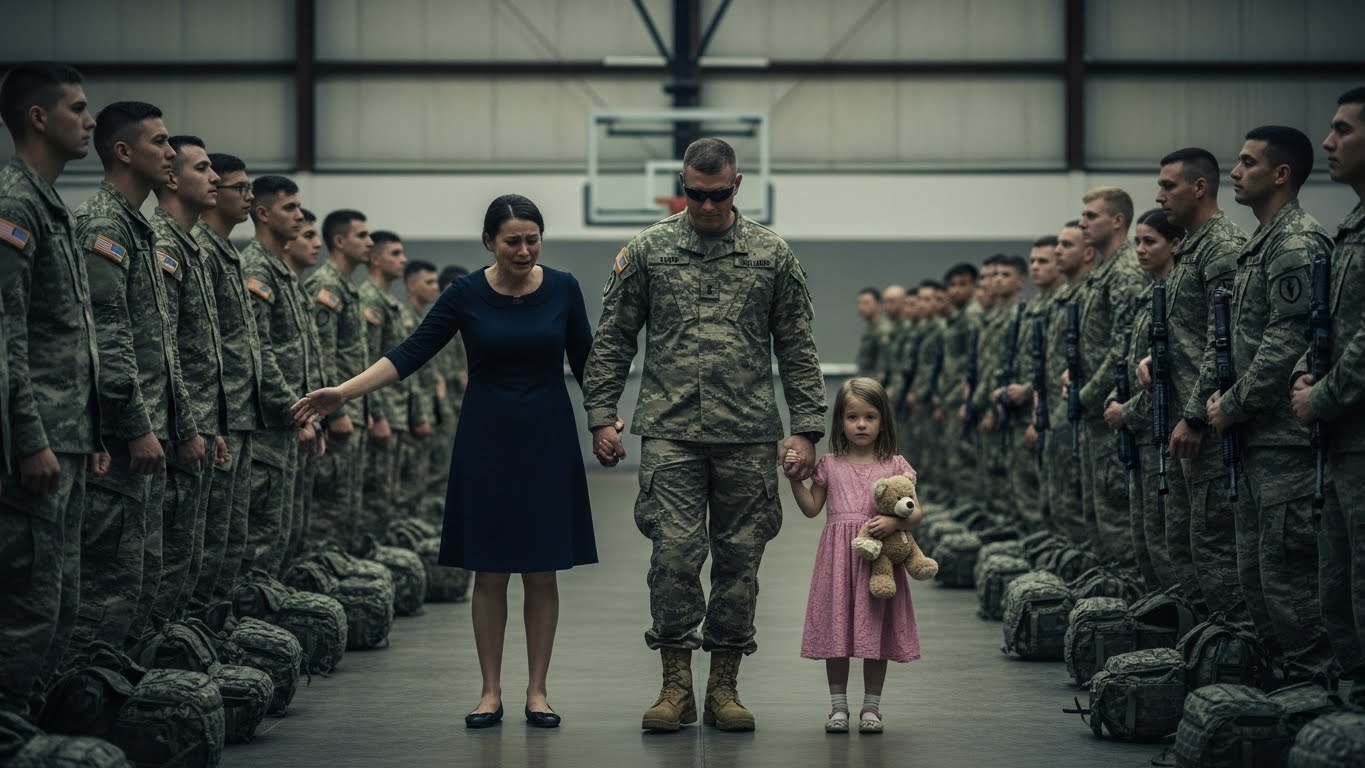
John joined the formation. Around him, three hundred other men did the same. They turned away from wives, girlfriends, parents, and children. They merged into a single entity—a wall of digital camouflage. The individuality was stripped away. They were a unit now.
First Sergeant Halloway paced the front of the line. Halloway was a legend in the battalion. He was in his late fifties, a man with skin like tanned leather and a voice that sounded like gravel grinding in a cement mixer. He had been to Panama, Somalia, Iraq twice, and Afghanistan. He didn’t smile. He didn’t joke. And he certainly didn’t tolerate weakness.
“Dress right, dress!” Halloway barked.
The arms went up. The line straightened. The emotional connections to the civilians on the sidelines were severed by the invisible blade of military protocol.
“Ready, front!”
The arms dropped. The sound of three hundred boots slapping the floor in unison echoed like a gunshot.
“Right, face!”
The platoon turned toward the double doors, toward the idling buses, toward the war.
John adjusted the straps of his assault pack. He stared at the back of Corporal Miller’s head in front of him. He focused on the stitching of Miller’s collar. Focus on the gear. Focus on the mission. Don’t look back.
He took the first step.
Left. Right. Left. Right.
The cadence began. The shuffling of boots. The sobbing from the families behind them rose to a crescendo, a wave of grief washing against the backs of the soldiers. John clenched his jaw so tight his teeth ached. Just get to the bus. Once I’m on the bus, I can breathe. Just get to the bus.
He was ten feet from the double doors. He could smell the diesel fumes drifting in. He was almost free of the pain.
Then, he heard the sound.
It wasn’t a scream. It was the rapid, slapping sound of small patent-leather shoes running on a hardwood floor.
Chapter 3: The Anchor
The rhythm of the march faltered. Soldiers near the back of the line glanced to the side.
A blur of pink shot past the line of formation. It was fast—propelled by the desperate, adrenaline-fueled panic that only a child can feel when they realize their world is walking away.
“Ellie, no!” Sarah’s voice rang out, frantic, but she was too far back.
Ellie didn’t stop. She didn’t trip. She had a target.
John was three steps from the door when the impact hit him.
It wasn’t a hard hit, not like a linebacker. It was a soft, desperate collision. Ellie threw herself at his right leg. She wrapped her tiny arms around his combat boot and his shin, burying her face into the rough, bloused fabric of his trousers.
John froze.
He tried to take a step, but the weight on his leg wasn’t just physical; it was existential. He couldn’t drag her. He couldn’t shake her off.
The formation crumbled. The soldiers behind him bumped into each other, the domino effect stopping the entire platoon.
Silence rippled outward from John’s position. The sobbing in the gym quieted to a stunned hush. Everyone was watching.
John looked down. All he could see was the top of her blonde head and the pink sparkles of her dress against the dirty floor. She was holding on with a grip that turned her knuckles white.
“Ellie,” John said, his voice cracking. The “Anvil” was chipping. “Ellie, honey. You have to let go. You have to go to Mommy.”
She didn’t move. She shook her head against his shin, tightening her grip.
“No,” she muffled into his pant leg.
“Ellie, please,” John whispered, panic rising in his chest. This was against protocol. He was holding up the movement. He was making a scene. “Daddy has to go.”
Ellie pulled her face back just an inch, looking up at him. Her face was streaked with tears, her eyes red and puffy. She looked at him with a logic that was so pure, so childish, and so devastatingly heartbreaking that it knocked the wind out of him.
“No,” she said, her voice trembling but loud enough for the squad to hear. “If I hold you, the bus can’t take you.”
John stared at her.
“I’m a big girl now, Daddy,” she sobbed, squeezing his leg harder. “I’m heavy. I ate all my breakfast. If I hold on, I’m too heavy. The bus can’t go if I’m holding you down.”
She was trying to be an anchor. She believed, with every fiber of her four-year-old being, that her physical weight could overcome the momentum of the United States Army. She was trying to ground him to the earth with her love.
Chapter 4: The Crack in the Armor
The words hung in the air. I’m too heavy.
John felt his throat close up. The Anvil melted.
He forgot the Colonel was watching from the podium. He forgot about the timeline. He forgot about the enemy.
He looked at Sarah, who was standing ten feet away, her hands over her mouth, sobbing too hard to move forward to retrieve her. She couldn’t do it. She couldn’t act the villain and pull the girl away.
John looked back down at his daughter.
“Oh, God,” he whispered.
He dropped his rucksack. It hit the floor with a heavy thud.
Then, Staff Sergeant John Carver dropped to one knee. He ignored the mud on the floor. He ignored the breach of discipline. He wrapped his massive arms around the tiny girl in the pink dress and pulled her into his chest.
He buried his face in her neck, right where her pigtails met her skin, and he let out a sound that wasn’t a sob—it was a shudder. A deep, racking shudder that shook his armor.
“You are heavy, baby,” John whispered into her hair, tears finally slipping past his sunglasses, running down his cheeks. “You are the heaviest thing in the world.”
The soldiers around them looked away. Private Miller, a nineteen-year-old tough guy, was staring at the ceiling, blinking rapidly.
“Don’t go,” Ellie begged, her hands gripping his collar. “I’ll be heavier. I promise.”
“I have to, Ellie. I have to.”
Then, a shadow fell over them.
John tensed. He knew who it was. It was First Sergeant Halloway. The gravel-voiced disciplinarian. Halloway was coming to chew him out. He was coming to tell him to get his act together, to stop embarrassing the unit, to hand the kid off and move out.
John prepared himself for the reprimand. He looked up, shielding Ellie with his body.
But Halloway wasn’t yelling.
The old First Sergeant stood over them. He looked at the crying girl clinging to her father’s leg. He looked at John, his best Squad Leader, breaking down on the gym floor.
Halloway’s face, usually a mask of stone, softened. His eyes, which had seen more war than anyone in the room, suddenly looked very old and very tired.
Halloway didn’t bark an order. He didn’t check his watch.
Instead, the First Sergeant turned his back to the scene. He faced the rest of the platoon, shielding John and Ellie from the view of the onlookers. It was a protective gesture. He was giving them a private room in a public space.
Then, 1SG Halloway took off his patrol cap. He raised a gloved hand and wiped his eyes.
He cleared his throat, but his voice was thick. “Take a minute, Sergeant Carver,” Halloway said, his voice unusually quiet. “Take a minute. The war can wait.”
Chapter 5: The Heart’s Weight
The permission from Halloway broke the tension, but it didn’t fix the heartbreak.
John pulled back to look at Ellie. He used his thumbs to wipe the tears from her cheeks. He needed to give her something. He needed to give her a reason why her anchor hadn’t worked, something that wouldn’t make her feel like she had failed.
“Ellie, look at me,” he said softly.
She sniffled, looking into his black sunglasses. He took them off. He let her see his red, wet eyes. He let her see that he was sad too.
“You are heavy,” John said. “You’re so strong. You almost stopped the bus.”
“I did?” she asked, her voice small.
“You did. But Daddy has to go help some other people now. But listen…” He took her small hand and pressed it against the ceramic plate of his body armor, right over his heart. “You can’t hold my leg anymore. It makes it too hard to walk. But I need you to stay right here.”
He tapped his chest.
“I’m going to carry you in my heart,” John said. “And you know what? You’re even heavier in there. You’re the biggest thing in there. I’m going to take you with me everywhere. Every step I take, you’re going to be right here.”
Ellie looked at his chest, then at his face. “In your heart?”
“Right inside. Safe. And I’ll bring you back with me. Okay?”
Ellie thought about this. It wasn’t the answer she wanted, but it was an answer she could understand. She nodded slowly.
“Okay,” she whispered.
John stood up. It was the hardest physical movement of his life. It took more strength than deadlifting four hundred pounds. He lifted Ellie up and walked the few steps to Sarah.
He passed his daughter to his wife. Sarah took her, burying her face in Ellie’s hair, her eyes locking with John’s.
“I love you both,” John said. His voice was raw.
“Go,” Sarah whispered, mercy in her eyes. “We’ll be here.”
John turned. He picked up his rucksack. He put his sunglasses back on, not to look cool, but to hide the devastation.
He walked past Halloway.
“Thank you, Top,” John whispered as he passed.
Halloway nodded, putting his hat back on. “Move out, Sergeant.”
Chapter 6: Handprints on the Glass
John boarded the bus. The interior was dark and smelled of stale air. He walked to the middle, finding a window seat. He sat down, the gear pressing him into the uncomfortable vinyl seat.
The engine roared, revving higher. The air brakes hissed—a sound of finality.
John looked out the window. The rain was streaking the glass, distorting the world outside.
He saw them. Sarah was holding Ellie. They were standing by the chain-link fence that separated the loading zone from the parking lot.
Ellie wasn’t crying anymore. She was staring at the bus, looking for him.
John raised his hand. He pressed his palm flat against the cold, dirty glass.
Ellie saw it. She reached out. Her tiny hand, pink and small, pressed against the air, matching the spot where his hand was.
Hand to hand. separated by glass, rain, and duty.
The bus lurched forward. The vibration rattled John’s teeth. He kept his hand on the glass. Ellie kept her hand up, waving.
As the bus picked up speed, turning the corner toward the main gate, the image of the little girl in the pink dress became smaller and smaller. She became a dot of color in the gray world. Then, she was gone.
John pulled his hand back. He sat back in his seat, staring at the empty seat ahead of him. The bus was silent. No one was talking. No one was joking. Every man on that bus had seen what happened. Every man was thinking of their own anchors back home.
John closed his eyes. He could still feel the phantom weight of her arms around his leg.
I’m too heavy, she had said.
John took a deep breath, the air shuddering in his lungs. He placed his hand over his heart, feeling the steady beat beneath the armor.
Yeah, baby, he thought. You are.
And he knew, as the bus drove toward the airfield and the war waiting beyond, that carrying that weight was the only thing that would bring him home alive.