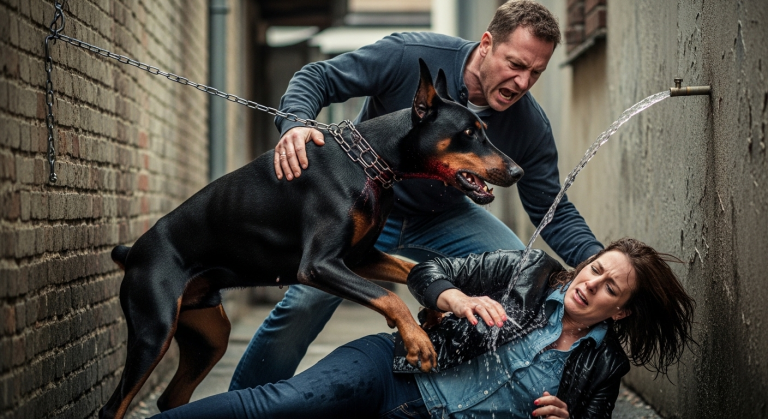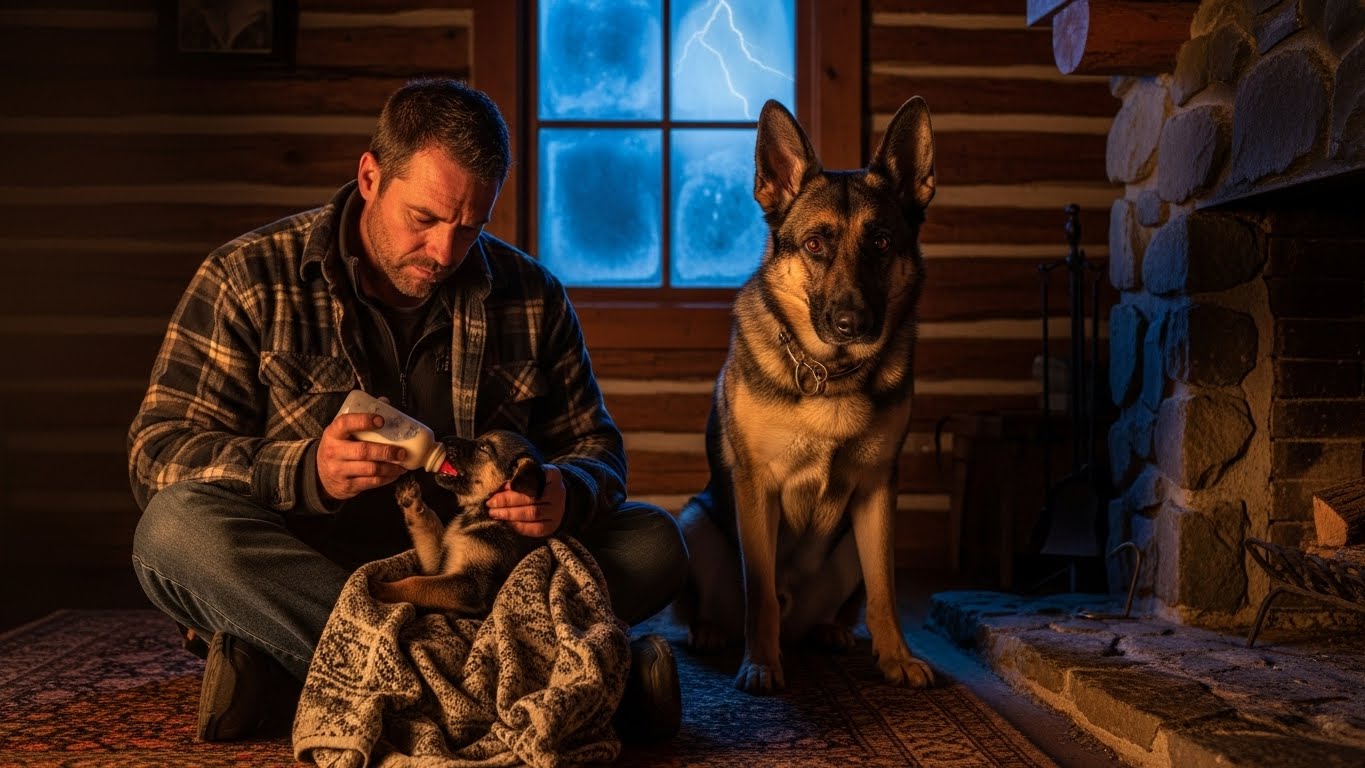
I Cut Down Two Frozen Shapes Hanging From A Tree In A Blinding Snowstorm—But When My Flashlight Hit The Snow Below, I Realized This Wasn’t Just Cruelty. It Was A Breadcrumb Trail To A Nightmare Hiding In Plain Sight. What I Found Next Broke My Heart, Then Healed It Forever.
PART 1
Chapter 1: The Hanging Shapes
The storm had no mercy that night. It wasn’t just snow; it was shards of glass falling from a pitch-black sky, burying the Blue Ridge Forest in a silence so heavy it felt like fear itself. I’ve lived in these mountains my whole life, patrolling these winding roads for twenty years, but I had never felt a cold quite like this. It was a malice that sought out every crack in the window, every gap in your armor.
I was crawling along the old logging trail in my black patrol SUV, the headlights cutting a weak, milky tunnel through the swirling white. I’m Lieutenant Evan Ward. At forty-two, life had carved me down to the basics: duty, silence, and the badge.
Beside me sat Valor, my K-9 partner. He’s a five-year-old German Shepherd, ninety pounds of muscle and loyalty wrapped in a coat the color of wet steel. We were a pair, Valor and I—both of us a little too quiet, both of us watching the world with eyes that had seen too much.
Tonight, though, Valor wasn’t quiet.
He was pacing in the passenger seat, his nose pressed hard against the frosted glass, leaving wet smudges. His ears were swiveling, twitching like radar dishes trying to catch a signal through the static of the wind.
“What is it, boy?” I murmured, my hand resting on the gear shift.
Valor didn’t look at me. He let out a low, vibrating whine that started deep in his chest. It wasn’t aggression. It was distress.
I felt the hair on the back of my neck stand up. I trust this dog more than I trust most people. If he said something was out there, something was out there. I eased the SUV to a halt, the engine idling with a rough purr. I killed the heater fan.
Silence rushed in, heavy and suffocating. I rolled the window down an inch. The wind shrieked through the crack, stinging my eyes.
Then, I heard it.
It was faint, barely a scratch against the roar of the storm. A high-pitched, trembling cry. It sounded like a bird, or maybe a child. But out here? In this weather?
“Show me,” I told Valor.
I grabbed my heavy Maglite, shoved the door open, and stepped into the abyss. The snow was knee-deep instantly, sucking at my tactical boots. The cold didn’t just bite; it chewed. It went right through my thermal layers, hunting for heat.
Valor surged ahead, plowing a furrow through the drifts with his chest. He wasn’t tracking a scent on the ground—the wind was too chaotic for that. He was following the sound.
I trudged after him, shielding my face with a gloved hand. We moved about fifty yards off the road, deep into a grove of ancient pines. The trees groaned overhead, their branches sagging under the weight of the ice.
Valor stopped abruptly at the base of a twisted spruce. He looked up and barked—a sharp, demanding sound.
I aimed the beam of my flashlight upward. The light caught the falling snowflakes, turning them into a dazzling curtain. Then, the beam punched through and hit the lower branches.
My heart slammed against my ribs. I actually stumbled back a step.
“Oh, God,” I whispered.
Two small shapes were dangling from a thick limb, swaying sickeningly in the wind.
They were puppies. German Shepherds, black and tan, tiny things that couldn’t have been more than four weeks old. Someone had looped a thin, yellow nylon rope around their bodies—right under their front legs—and strung them up.
They weren’t fighting. They were just hanging there, exposed to the sub-zero wind.
The one on the left was limp, eyes closed, a layer of frost coating its muzzle like a death mask. The one on the right was twitching, a weak, convulsive shudder running through its frame as it let out that terrible, thin cry I had heard from the road.
I didn’t think. The protocol, the procedure, the caution—it all evaporated.
I lunged forward, snapping my pocket knife open. My hands were shaking, not from the cold, but from a rage so white-hot it nearly blinded me. I reached up, my boots slipping on the hidden roots. I grabbed the first pup, the crying one, supporting its weight to take the tension off the rope.
Slice.
The cord gave way. The puppy fell into my hand, light as a feather. Too light.
I cut the second one down. The limp one.
I dropped the knife into the snow and pulled them both against my chest. I unzipped my heavy patrol coat and shoved them inside, pressing their frozen fur against the wool of my uniform shirt, right over my beating heart.
“I’ve got you,” I gasped, the wind tearing the words from my mouth. “I’ve got you.”
Valor was circling my legs, whining, licking at the tiny tails protruding from my jacket. I stood there for a second, surrounded by the hostile dark, trying to transfer every ounce of my body heat into these two broken things.
That’s when I swung the light down to check my footing, and the beam swept across the snow at the base of the tree.
The wind was working fast to cover the scene, but the trees had blocked enough of the drift to preserve the story written in the ice.
There were boot prints. Heavy tread, size twelve maybe. And drag marks—parallel lines, like a heavy metal cage had been hauled through the powder.
My eyes followed the trail. It led away from the tree, down a slope towards a secondary logging track that intersected the main road. And there, rapidly filling with snow but still visible, were tire tracks. Wide ones. Dually tires.
I crouched down, careful of the burden in my coat. Near the drag marks, something glittered in the light. I brushed the snow away.
It was a small glass vial. The label was torn, but I could read the medical print: Xylazine. A horse tranquilizer.
A cold knot tightened in my stomach, harder than the ice. This wasn’t a case of unwanted puppies being dumped by a cruel owner. You don’t use Xylazine for that. You don’t use cages and drag lines.
This was a transaction. This was a business.
Someone had been here, likely transferring stock. Maybe the puppies were sick, or “defective,” or just extra weight that slowed them down. So they hung them up like trash and drove off.
I looked down at the lumps under my jacket. One of them moved—a faint, desperate clawing against my ribs.
“Hang on,” I gritted out. “You just hang on.”
We weren’t just dealing with animal cruelty anymore. I had just found the discarded waste of an organized crime ring operating in my backyard. And if they treated the babies like this, I didn’t even want to imagine what was happening to the mother.
I turned back to the SUV, Valor flanking me like a bodyguard. The storm howled, trying to erase the evidence, trying to kill the witnesses tucked inside my coat.
But the storm was too late. I had them now. And I was angry.
Chapter 2: The Thaw
The drive back to my cabin was a blur of white knuckles and white snow. I didn’t dare blast the siren; I needed to focus, and the roads were treacherous sheets of black ice. Every bump, every slide of the rear tires made my heart lurch, terrified I was jostling the fragile lives inside my jacket.
I kept one hand on the steering wheel and the other pressed against my chest, feeling for the rhythm of their breathing. It was there—faint, fluttery, like a moth trapped in a jar—but it was there.
My cabin sits on the edge of the reserve, a solitary wooden structure that usually smells of cedar and silence. Tonight, I kicked the door open with a violence that shook the frame, ushering Valor inside and slamming the world out behind us.
The fire in the stone hearth had burned down to embers. I didn’t take my coat off yet. I went straight to the woodpile, throwing three split logs onto the coals and blowing until flames licked up the dry bark. Only when the heat began to radiate outward did I carefully unzip my jacket.
I laid a thick wool blanket on the rug in front of the fire and gently, so gently, pulled them out.
Seeing them in the light was worse than the dark.
They were skeletons wrapped in fur. Their ribs pushed against their skin like the rungs of a ladder. The rope burns around their chests were raw and red, cutting deep into the muscle. The smaller one—the one that had been limp—was a female. Her breathing was shallow, a terrifying hitch in her chest every few seconds. The male, slightly larger, was conscious but dazed, his eyes clouded with trauma.
“Okay,” I whispered, my voice sounding rusty in the empty room. “Okay, let’s get you warm.”
I moved into a mode I hadn’t accessed in years. Combat medic mode. Father mode.
I filled a pot with water and set it on the wood stove. While it heated, I grabbed my first aid kit. I soaked a clean cloth in warm—not hot—water.
“Valor, watch,” I commanded softly.
My big shepherd lay down instantly, curling his body around the blanket to create a living wall against drafts. He rested his chin on his paws, his eyes never leaving the puppies. He knew. He understood the stakes.
I started with the female. I rubbed her vigorously with the warm towel, trying to stimulate circulation. “Come on, little one. Fight.”
She was so cold. It felt like holding a stone from the river.
I remembered the night I lost Clare and Marcy. The highway patrolman had told me they died on impact, that they didn’t feel the cold of the snowbank they landed in. I had clung to that lie for six years. But looking at this puppy, feeling the chill seeping out of her, I knew that freezing to death was a slow, quiet terror.
I wasn’t going to let that happen again. Not tonight. Not in my house.
I checked her gums. Pale gray. Shock.
I mixed a slurry of sugar and warm water in a dropper. I pried her jaws open—they were stiff—and dripped a few drops onto her tongue.
“Swallow,” I ordered. “Do it.”
Nothing. The liquid pooled in her cheek.
I felt a crack in my composure. A fissure in the dam I’d built around my emotions. “Don’t you die on me,” I said, my voice breaking. “I am not digging a hole in the frozen ground tonight. Do you hear me?”
I picked her up, unbuttoned my flannel shirt, and placed her directly against my skin again, wrapping my arms around her and rocking back and forth by the fire. I closed my eyes, visualizing my own heart pumping heat into hers.
I thought about the truck tracks. The Xylazine. The callousness of it. Who were these people? How many times had they driven through my town?
Minutes passed. The logs popped and hissed. Valor let out a soft whine.
Then, I felt it.
A twitch against my stomach. Then a deep, shuddering inhale.
I looked down. The female puppy opened her eyes. They were dark, unfocused, and filled with confusion, but they were open. She let out a tiny, squeaking yawn and burrowed her nose into my armpit.
The relief that washed over me was so intense it made me dizzy. I let out a laugh that sounded half like a sob.
“There you are,” I whispered. “Welcome back.”
I set her down next to her brother, who had crawled closer to Valor’s warmth. The male puppy licked her face, a clumsy, slow gesture of comfort.
I sat back on my heels, watching them. The adrenaline was fading, leaving me exhausted, but my mind was sharpening. I pulled the glass vial of Xylazine out of my pocket and set it on the floorboards.
I took a picture of it with my phone. Then I walked over to my desk and booted up my laptop. I needed to access the county traffic camera database.
The tracks were fresh. The storm was heavy. That truck couldn’t have gone far. A vehicle hauling heavy cages on these mountain roads in a blizzard? They would have to stick to the main arteries or risk sliding off a cliff.
I pulled up the feed for the junction of Route 9 and the old logging road—the only paved exit from where I found them.
I rewound the footage two hours.
Screen by screen, I watched the snow fly past the lens. Nothing. Nothing. A snowplow. Nothing.
And then, at timestamp 11:42 PM:
A white box truck. Mud-spattered. One taillight burned out.
I zoomed in. The license plate was obscured by snow, but on the side of the door, barely visible through the graininess of the night vision, was a logo. It looked like a paw print inside a gear.
I memorized the shape.
I looked back at the fire. The puppies were sleeping now, a pile of breathing fur protected by Valor. They were safe.
But the mother… the mother was still in that truck. Or in a cage somewhere nearby.
I grabbed my radio off the belt. I didn’t key the mic yet. I just held it, staring at the digital channel display.
If I called this in now, the Sheriff would tell me to wait for the storm to break. He’d say it’s a property crime, not a priority. He’d tell me to file a report in the morning.
But I looked at the raw rope burns on those puppies. I felt the phantom cold of their bodies against my skin.
“Not this time,” I said to the empty room.
I wasn’t going to wait for the storm to end. I was going into it.
I stood up, grabbed a fresh box of ammo from the shelf, and looked at Valor. He lifted his head, his ears perked.
“Stay,” I told him. “Guard.”
He rested his head back down, his body curling tighter around the pups. He understood his mission.
I put my coat back on. It was still cold, damp from the melted snow, but I didn’t care. I had a truck to find. And God help the man driving it when I did.
PART 2
Chapter 3: The House of Rust
The storm had turned the world into a blur of gray static. My SUV crawled down the mountain, fighting for grip on the switchbacks. I wasn’t heading back to the station. I was following the only lead I had: the faint, rapidly burying tire tracks of a dually truck with a burnt-out taillight.
The tracks were ghosts, appearing and disappearing in the drifts. But I knew this county. I knew where a truck that size, hauling illegal cargo in a blizzard, would go. It wouldn’t stay on the highway. It would head for the “Boneyard”—a stretch of defunct industrial lots on the southern edge of the timberline.
It took me forty minutes to get there. The wind died down as I descended into the valley, replaced by a thick, suffocating fog that clung to the ground like wet wool.
I killed my headlights a mile out, rolling forward on just the amber parking lights. I didn’t want to spook anyone.
The Boneyard was a graveyard of industry. Rusted silos, collapsed logging sheds, and fences topped with razor wire that had long since rusted through. It was the kind of place where things went to be forgotten.
Then, I saw it.
About two hundred yards off the main access road, tucked behind a wall of overgrown, frozen kudzu, was a metal warehouse. It looked abandoned—the roof was patched with mismatched tin sheets, and the windows were boarded up with plywood.
But there was a heartbeat.
A faint, rhythmic thrum-thrum-thrum vibrated through the air. A generator. And from a rusted pipe on the side of the building, a thin wisp of exhaust smoke curled into the snow.
I pulled my vehicle into a cluster of trees, hiding it from view. I checked my service weapon—a Sig Sauer P320. Chambered. Ready.
I left the warmth of the car and moved toward the building. The snow here was slushy, mixed with oil and mud. The smell hit me before I even reached the door.
It wasn’t the smell of industry. It was the smell of misery.
Ammonia. Bleach. Wet fur. And underneath it all, the copper tang of old blood.
I’ve smelled that scent at crime scenes, in trap houses, and on highways after pile-ups. It’s the scent of violence.
I reached the main sliding door. It was padlocked from the outside, but the lock was shiny. New. I moved around the perimeter, testing the boarded windows. One of the plywood sheets on the north side was loose. I wedged my fingers under the rot and pulled. It gave way with a groan of wet wood.
I slipped inside.
The temperature dropped ten degrees. The air inside was frigid, refrigerated by the lack of insulation, but the generator kept it just above freezing. I clicked on my tactical light, keeping the beam low and sweeping the floor.
Rows of metal cages stretched out into the darkness.
My stomach turned over. There were dozens of them. Most were empty, their doors swinging open, revealing bare wire floors with no bedding, no comfort. Just cold metal grids that would mutilate a dog’s paws if they stood on them too long.
I moved deeper into the warehouse, my boots silent on the concrete. Chains hung from the ceiling rafters, swaying slightly in the draft. On a workbench to my right, I saw the tools of the trade.
Shock collars. Catch poles. Syringes. And a stack of shipping manifests.
I picked one up. It was an invoice for “Livestock Transport.” The destination was a research facility across state lines. The “livestock” listed wasn’t cattle or pigs.
Canine. Mixed Breed. 4 Units.
Canine. G-Shep. Pure. 6 Units.
My hand crushed the paper. They weren’t just breeding them; they were stealing them and selling them for testing, or bait, or God knows what else. The puppies I found hanging in the tree weren’t just trash to these people—they were defective inventory.
Suddenly, a metallic clang echoed from the back of the warehouse.
I froze. I wasn’t alone.
I thumbed the safety off my holster and moved into the shadows of a large crate. The sound came again—the scrape of a shovel against concrete.
I crept forward, the beam of my light off, relying on the faint ambient light filtering through the cracks in the roof. In the far corner, near a massive industrial sink, a figure was moving.
They were scrubbing the floor. Hard.
I raised my weapon, stepping into the open.
“Police!” I barked, my voice booming in the cavernous space. “Hands where I can see them! Now!”
Chapter 4: The Cleaner and the Collar
The figure gasped, dropping the shovel. It clattered loudly against the cement. Hands shot up into the air, trembling violently.
“Don’t shoot! Please, I—I just clean here!”
I clicked my light on, blinding them for a second before lowering the beam to their chest. It wasn’t a hardened criminal. It was a woman.
She looked to be in her late fifties, wrapped in a tattered brown coat that was two sizes too big. Her gray hair was pulled back in a messy braid, and her face was a roadmap of hardship—deep lines etched by poverty and mountain winters. Her eyes were wide, terrified.
“Turn around,” I ordered, keeping the distance. “Slowly.”
She complied, sobbing quietly. “I didn’t do it. I swear. I just clean the messes. They pay me in cash. I don’t ask questions.”
“Who pays you?” I asked, moving closer to check for weapons. She was clean. Just a rag in her pocket and a bottle of industrial disinfectant on the floor.
“Turn back around. Look at me.”
She turned, tears streaking her dirty cheeks. “His name is Dale. Dale Morren. He drives the truck.”
Morren. The name rang a bell. A small-time crook from the next county over, busted for grand theft auto a decade ago. He had graduated to something far worse.
“Where is he, Martha?” I asked, reading the name stitched onto her second-hand work jacket. “Where is the truck?”
“He… he left. Yesterday morning. He had a run to make up north. He came back late last night to dump the… the bad ones.” She choked on the words, looking at the floor. “He said they were sick. He told me to clean the cages before the next load came in.”
“The next load?” I stepped closer. “When?”
“Tonight,” she whispered. “He’s greedy. The storm delayed him, so he’s behind schedule. He’s got a buyer coming to meet him for the breeders. The adults.”
My mind raced. The adults. The mother.
“The German Shepherd,” I said, my voice dropping to a growl. ” The mother of the pups he dumped. Is she here?”
Martha shook her head frantically. “No. No, he took the adults with him in the truck. He keeps them mobile so nobody finds them. He’s got them in the back right now, probably parked up somewhere waiting for the buyer.”
“Where?”
“I don’t know,” she wailed. “He doesn’t tell me the spots. He just texts me when to come clean.”
I looked around the grim workspace. There was a pile of refuse in the corner she hadn’t cleared yet. Old kibble bags, broken leashes, and trash.
I walked over to it and kicked through the debris. Something metallic skittered across the floor.
I bent down and picked it up. It was a dog collar. Expensive leather, but old and worn. Attached to the D-ring was a brass tag. It was scratched, but I could still read the engraving.
RIA.
Microchip ID #7249.
I closed my fist around the cold metal. Ria. She had a name. She wasn’t just inventory. She was someone’s dog, stolen and turned into a machine for these monsters. And now her babies were fighting for life in front of my fireplace while she was shivering in the back of a truck.
I turned back to Martha. “You’re going to help me, Martha.”
She shook her head, backing away. “He’ll kill me. You don’t know him. He’s got a gun. He’s crazy.”
“He’s not going to touch you,” I said, stepping into her space. “Because you’re going to help me catch him. You said he has a buyer tonight?”
“Yes. Someone from the city. They pay big money for the purebreds.”
“How does he talk to them?”
“Burner phones,” she said. “He keeps a spare one in the office—in the desk. For when the signal is bad in the mountains.”
I holstered my weapon. “Show me.”
She led me to a small, glass-walled office at the front of the warehouse. It was a mess of papers and fast-food wrappers. In the bottom drawer of a rusted filing desk, buried under a stack of unpaid bills, was a cheap flip phone.
I picked it up. It was powered on.
I scrolled through the messages. The last one was sent three hours ago.
Buyer: Storm is clearing. Where do we meet?
Morren: Wait for the location. Cash only.
There was no follow-up. He hadn’t sent the location yet.
I looked at the phone, then at Martha. “Get out of here,” I told her. “Go home. Lock your doors. If anyone asks, you were never here tonight.”
She nodded, trembling, and bolted for the door. She didn’t look back.
I stood alone in the office, the ghostly green light of the flip phone illuminating my face. I had a direct line to the monster. And I had the leverage.
I typed a message, mimicking the brevity I saw in the history.
Morren: Change of plans. Too much heat at the usual spot. Meet at Aspen Creek Bridge. 4:00 AM. Bring the bitch and the rest of the stock.
I hit send.
Then I waited. One minute. Two minutes.
The phone buzzed.
Buyer: Copy. 4 AM.
I realized my mistake—I had messaged the buyer, thinking I was messaging Morren’s partner, but looking closer at the thread, Morren was the middleman. He was coordinating multiple people.
I needed to intercept Morren before the buyer got there. Or better yet, catch them both.
I scrolled up. There was another number labeled “Truck.”
I took a breath. I typed again, this time to the “Truck” number.
Buyer: My truck is stuck. Meet me at Aspen Creek Bridge instead. 4 AM. I have the cash.
It was a gamble. If he called to verify, I was burned. If he knew the buyer’s voice, I was burned.
The phone buzzed again.
Truck: Fine. Don’t be late.
I let out a breath I didn’t know I was holding. The trap was set. But I couldn’t do this alone. Not with a suspect who was armed and desperate.
I needed a ghost. I needed Cole.
Chapter 5: The Sniper and the Storm
I was back in my SUV, speeding toward the north ridge. I dialed a number from my personal cell. It rang once.
“Evan?” The voice on the other end was clear, alert. No “hello,” no sleepy confusion. Just readiness.
Officer Cole Henders was thirty-one, former Army Rangers, now the best marksman in the county. He was the kind of guy who cleaned his rifle when he was stressed. We had served together on the force for five years. He was the only one who knew about the nightmares I still had about the accident.
“I need you,” I said. “Off the books. Right now.”
“Location?” Cole asked. No ‘why’, no ‘what for’. Just ‘where’.
“Aspen Creek Bridge. The old wooden one over the gorge. I’ve got an animal trafficking exchange going down in two hours. Suspect is armed. He’s got hostages.”
“Hostages?” Cole’s voice tightened.
“Dogs,” I said. “A mother Shepherd. Maybe others. And the guy… Cole, he’s the one who hung those pups I found.”
There was a silence on the line. A heavy, dangerous silence. Cole had a soft spot for dogs that was wider than the Blue Ridge itself.
“I’m on my way,” Cole said. “I’ll take the ridge position. You take the blocking spot. Do we have a green light to engage?”
“Only if he draws,” I said. “I want him alive. I want to look him in the eye when I put the cuffs on. But if he points a weapon at those dogs… you do what you do.”
“Understood. Out.”
The line went dead.
I checked the time. 2:45 AM.
I had an hour to get into position. Aspen Creek Bridge was a narrow, single-lane wooden structure spanning a hundred-foot drop into a frozen river. It was the perfect choke point. Once he was on that bridge, he had nowhere to go but through me or over the edge.
I drove fast, the image of Ria—the dog I had never met but felt I knew—burned into my mind. I thought of the puppies back at the cabin. Ash and Fern. I had named them in my head on the drive over. Ash for the gray of the storm, Fern for the resilience of the forest floor.
I wasn’t just a cop tonight. I was a guardian.
When I reached the bridge, the fog was so thick I could barely see the hood of my car. I parked the SUV horizontally across the far end of the bridge, blocking the exit. I killed the lights.
I sat in the darkness, the cold seeping into the cabin. I unbuckled my seatbelt and checked my weapon again.
The silence of the woods was heavy. It was the dead hour of the night, where the world feels empty of God.
I thought about Clare. My wife. I thought about the night she died, the screech of tires, the silence that followed. For six years, I had been living in that silence. I had pushed everyone away, including myself. I had become a ghost haunting my own life.
But tonight, saving those puppies… feeling that tiny heart restart against my chest… it was like a spark in a dark room.
“I’m still here,” I whispered to the rearview mirror. My eyes looked back at me—tired, lined, but sharp. “I’m still here.”
My radio clicked. A static hiss, then Cole’s voice, barely a whisper in my earpiece.
“Visual established. I see headlights. North road. One mile out.”
“Copy,” I said. “Hold fire.”
“He’s moving slow,” Cole whispered. “Heavy load. Evan… that truck looks bad. If he rams you…”
“He won’t ram me,” I said, gripping the steering wheel. “He wants his money.”
“Roger. I’ve got your six. Watch the driver’s side. Heat signature shows two occupants.”
Two. Martha hadn’t mentioned a passenger. That complicated things.
“Understood,” I said.
I saw the glow first. Two sickly yellow beams cutting through the fog, bouncing off the icy trees. The rumble of a diesel engine grew louder, a grinding, unhealthy sound.
The white box truck emerged from the mist like a monster from the deep. It rolled onto the wooden planks of the bridge, the timbers groaning under the weight.
It slowed down as the driver saw my SUV blocking the path. He probably thought I was the buyer.
The truck stopped twenty feet away. The engine chugged, idling rough.
I stepped out of my car, my hand resting on my holster. I didn’t turn on my flashlight yet. I stood in the silhouette of the fog.
The driver’s door of the truck opened. A large boot hit the wood. Then a man stepped out. Dale Morren. He was big, bearded, wearing a dirty Carhartt jacket. He looked exactly like the kind of man who would hang a puppy and feel nothing.
“You the guy?” he called out, his voice gravelly. “You’re blocking the road. Where’s the cash?”
I didn’t answer. I just walked forward, slow and steady.
“Hey!” he shouted, reaching behind his back. “I said, where’s the money?”
I stopped ten feet from him. I clicked on my tactical light, blinding him with 1000 lumens of white-hot LED.
“The payment is a cell,” I said, my voice calm, lethal. “Police! Hands on your head!”
Morren squinted, shielding his eyes. For a split second, I saw the calculation in his face. He looked at me, then back at the truck cab. Then his hand moved to his belt.
“Gun!” Cole’s voice screamed in my ear.
Time slowed down. Morren pulled a revolver. He wasn’t aiming at me. He was aiming at the windshield of his own truck—at the passenger. Or the cargo. He was going to take everything down with him.
“Drop it!” I roared, drawing my weapon.
But Morren just sneered, a look of pure malice twisting his face. “You want ’em? You can scrape ’em off the ice.”
He began to turn the gun toward the back of the truck, toward the cages. Toward Ria.
I had a split second. A heartbeat.
Then, a single crack of a rifle shot echoed from the ridge.
PART 2
Chapter 6: The Sniper and the Saint
The sound of the rifle shot didn’t echo like a bang; it snapped like a whip cracking the sky in half.
Dale Morren jerked backward, his scream swallowed by the gorge below. The revolver spun out of his hand, clattering across the frozen planks of the bridge. Cole hadn’t aimed to kill. He’d aimed to disarm. The bullet had struck the steel of the gun barrel, the impact shattering Morren’s wrist.
“On the ground!” I roared, closing the distance before Morren could recover from the shock.
He stumbled, clutching his hand, his eyes wild with pain and rage. He looked at me, then at the edge of the bridge. For a second, I thought he was going to jump.
But then a black streak of lightning hit him.
I had hit the remote release on my belt. Valor launched from the SUV, clearing twenty feet of icy road in three bounds. He hit Morren center-mass, driving him into the slush.
Morren went down hard, the wind knocked out of him. Valor stood over him, teeth bared inches from the man’s throat, a low, rumbling growl vibrating through the air. It was the sound of a wolf that had found its prey.
“Don’t move,” I panted, drawing my cuffs. “Give him a reason, Dale. Please.”
Morren froze, staring up into the abyss of my dog’s throat. The fight drained out of him instantly. I flipped him over and cuffed him, tightening the metal ratchets until they bit into his skin.
“Secure,” I said into my radio.
“Clear,” Cole replied from the ridge. “Watch the passenger.”
I looked up. The passenger door of the truck was open. A woman in a thin denim jacket had stumbled out, hands raised, shaking so hard her knees were knocking together. It wasn’t a partner. It was just another desperate soul caught in Morren’s orbit, probably working for a fix or a ride.
“Stay right there,” I ordered. She sank to the ground, weeping.
I left Morren with Valor—he wasn’t going anywhere—and ran to the back of the box truck. The padlock on the rear door was heavy, rusted shut. I didn’t have the key.
I grabbed the crowbar from my trunk. I wedged it into the hasp and threw my weight against it. The metal groaned, screeched, and then snapped.
I swung the doors open.
The smell hit me first. It was a physical wall of ammonia, feces, and fear. I clicked my flashlight on, the beam cutting into the gloom of the cargo hold.
Three cages. Stacked tight.
In the bottom two, there were other dogs—a frantic Collie mix and a terrifyingly thin Boxer. But in the top cage, shoved into the corner, was a German Shepherd.
She didn’t bark. She didn’t growl. She just pressed herself against the back bars, trying to become invisible.
Her coat was matted with filth, her ribs visible through the fur. But I knew her eyes. They were the same shape, the same deep, intelligent brown as the puppies back at my cabin.
“Ria,” I whispered.
Her ears flicked. She knew her name.
I reached in, unlatching the cage door. “It’s okay, girl. I’ve got them. I’ve got your babies. We’re going home.”
She trembled, her body rigid. I didn’t drag her. I just offered my hand, palm up. I waited. The wind howled outside, but inside that truck, time stood still.
Slowly, agonizingly, she stretched her neck forward. She sniffed my glove. She smelled the woodsmoke of my cabin. She smelled the wool of my blanket.
And then, she smelled them.
The scent of her puppies was still on my jacket.
She let out a sound that broke me—a high, keening whimper that was half-sob, half-hope. She crawled forward, her legs shaking, and laid her head heavy in my hands.
I wrapped my arms around her neck, burying my face in her dirty fur. tears pricked my eyes, hot and sudden.
“I promised,” I choked out. “I promised I’d find you.”
Chapter 7: The Reunion
The sun was just starting to bleed over the peaks of the Blue Ridge Mountains when I pulled back into my driveway. The storm had broken, leaving the sky a bruised purple and the world covered in a fresh, blindingly white sheet of snow.
Ria was in the back seat, wrapped in a thermal blanket. She hadn’t slept. Her head had been resting on my shoulder through the partition gap the entire ride.
I killed the engine. The silence of the cabin was welcoming this time. It wasn’t empty.
I opened the back door and helped Ria down. She was weak, her back leg favoring an old injury, but she moved with a desperate kind of energy. She pulled toward the front door, her nose working furiously.
I unlocked the door and pushed it open.
The fire was low, just glowing coals. Valor, who I had let in first, stepped aside.
On the rug, the two puppies—Ash and Fern—were curled into a single ball of fuzz. They were asleep.
Ria froze in the doorway. She let out a soft wuff.
Ash’s head popped up. His ears, still too big for his head, perked forward. He blinked, sniffing the air. Then Fern woke up.
For a second, nobody moved.
Then, chaos.
The puppies exploded from the blanket, tripping over their own paws, squealing with a sound that was pure, unadulterated joy. Ria lunged forward, ignoring her bad leg, meeting them in the middle of the room.
She collapsed onto the rug, and they swarmed her. She was licking them frantically—their faces, their ears, their bellies—checking them over, making sure they were real, making sure they were whole. She made low, grunting noises of reassurance, her tail thumping a steady rhythm against the floorboards.
I stood in the doorway, watching them. Valor came and leaned against my leg, his weight solid and grounding. I rested my hand on his head.
I felt a tightness in my chest loosen, a knot that had been there for six years finally untying.
Later that afternoon, a knock came at the door.
It was Martha. She looked different—cleaner, her hair brushed, wearing a coat that didn’t have holes in it. She was holding a Tupperware container.
“I heard,” she said, standing on the porch, her breath clouding in the cold air. “I heard you got him.”
“We got him,” I corrected. “Your statement locked it down, Martha. He’s not getting out. Not for a long time.”
She nodded, looking past me into the cabin where Ria was nursing the pups by the fire. A look of profound peace settled over her worn face.
“I brought these,” she said, holding out the container. “Biscuits. For the dogs. And… some soup for you. You look like you haven’t eaten in a week.”
I took the food. “Thank you, Martha.”
“You saved them,” she whispered. “You saved me, too, I think.”
She turned and walked back down the snowy path. I watched her go, realizing that the web of this crime had trapped more than just animals. It had trapped people in fear and silence. And tearing it down had set us all free.
Chapter 8: The Thaw
A week passed.
The cabin, once a place of solitude, was now a chaotic ecosystem of life. There were chew toys under the table, water bowls in the kitchen, and a constant, comforting shuffle of paws.
Ria was gaining weight. Her coat was beginning to shine, the dullness of the cage fading with every meal and every hour of sleep. She followed me everywhere. If I went to the kitchen, she was there. If I sat by the fire, her head was on my foot.
I had started looking at the photo on the mantle again. The one of Clare and Marcy.
For years, looking at it had felt like touching a hot stove. It burned. But now, with the warmth of the dogs around me, the pain was different. It was a dull ache, a scar rather than a wound. I could look at Marcy’s smile and remember the joy of it, not just the loss of it.
On Tuesday morning, a county vehicle crunched up the driveway.
It was Tara Knox from Animal Control. She was a kind woman, efficient and gentle, who had helped coordinate the vet checks for the other dogs we found in the truck.
She knocked, holding a clipboard.
“Morning, Lieutenant,” she said, smiling as Ash tried to untie her shoelaces. “I’m here for the transfer. We’ve got a foster family lined up in Ridgefield. Good people. Big yard.”
I stiffened. “Right. The transfer.”
I had known this was coming. That was the deal. I was just the emergency hold. I was the weigh station, not the destination.
Tara walked over to Ria, checking her healing wounds. “She looks amazing, Evan. You worked a miracle here. They’re going to make someone very happy.”
She pulled a form out of her clipboard. “Just need your signature here to release custody.”
The room went quiet.
I looked at the pen in her hand. Then I looked at the rug.
Ria was watching me. She wasn’t looking at Tara. She was looking at me. Her eyes were calm, trusting. She had brought her babies to me when they were nothing but ice and fear. She had trusted me to be the shield.
I looked at Ash and Fern, wrestling with Valor’s tail. Valor, who usually didn’t tolerate nonsense, was letting them climb all over him.
I thought about the silence of the cabin before that storm. The crushing, suffocating silence.
I thought about the night I found them. The way saving them had forced me to start breathing again.
“Evan?” Tara asked softly. “Is everything okay?”
I took the clipboard. I looked at the line that said Release to Foster Care.
“No,” I said.
Tara blinked. “No?”
“They’re not going to Ridgefield,” I said, my voice steady.
I took the pen and crossed out the transfer section. In the box marked Adoption, I wrote my own name. Evan Ward.
“They’re already home,” I said.
Tara stared at me for a second, and then a slow grin spread across her face. She took the clipboard back. “I was hoping you’d say that. I brought the adoption papers just in case.”
She handed me the new stack. I signed them without hesitation.
When she left, the house felt different. It wasn’t temporary anymore. It was permanent.
I walked out onto the porch. The sun was high and bright, reflecting off the miles of snow that covered the valley. The air was crisp and clean.
I opened the door and whistled.
Valor, Ria, Ash, and Fern tumbled out into the snow. The puppies rolled in the powder, yapping. Ria stood beside me, leaning her weight against my leg, watching them play.
I took a deep breath, filling my lungs with the cold, clean air.
They say that God works in mysterious ways. Sometimes, He sends a storm to clear the path. Sometimes, He sends a tragedy to test our foundations.
But sometimes, the miracle doesn’t come with thunder or lightning. Sometimes, it comes as a faint cry in the dark. It comes on four paws, frozen and broken, hanging from a tree, waiting for you to decide who you are going to be.
I didn’t just save these dogs that night. I know that now.
When I cut that rope, I cut the tether that was holding me to the past. When I warmed them by the fire, I was thawing my own heart.
We are all lost in the storm at some point. We all hang by a thread. But if you listen closely enough, if you are willing to step into the cold and do the hard thing, you might just find that the life you save is your own.
If this story touched your heart, share it. Leave a comment below about a time an animal changed your life. And if you believe that every soul deserves a second chance, hit that follow button. We’re building a family here, one story at a time.