He Watched His “Trashy” Neighbor Die From His Window, Then Found The Horrifying Truth Inside Her Refrigerator.
Chapter 1: The Frost on the Window
The winter in Allentown, Pennsylvania, had teeth that year. It wasn’t just the cold; it was a gray, relentless oppression that seeped into the bones of the houses and the people inside them.
Arthur Pendelton, seventy-two years old and carrying the weight of five years of widowerhood like a sack of wet cement, sat in his usual spot. His armchair, upholstered in a fading plaid fabric that smelled of dust and old pipe tobacco, was positioned strategically by the front bay window. The blinds were drawn, but the slats were tilted just enough to allow a sliver of the world to enter—or rather, for Arthur to inspect the world without participating in it.
He took a sip of his lukewarm Folgers coffee and grimaced. It tasted bitter, much like his thoughts.
“Look at her,” Arthur muttered to the empty room. “Coming home at 3:00 AM again. Probably high as a kite.”
Across the street, under the flickering amber glow of the streetlamp, a rusted Honda Civic sputtered into the driveway of the rental property—the “Blue Door House,” as the neighbors called it. The car door groaned open, and a young woman stepped out. She was thin, painfully so, her coat looking two sizes too big for her frame. She stumbled slightly as she walked up the path.
To Arthur, the stumble was proof of intoxication. He didn’t see the exhaustion. He didn’t see the trembling caused by hypoglycemia. He only saw what his hardened heart wanted to see: a reckless, irresponsible mother.
Her name was Lena. Arthur knew this because the mailman, a chatty fellow named Greg, had mentioned it. She had a son, Leo, a seven-year-old boy who looked as scrawny and neglected as the lawn Lena never mowed. Arthur had seen the boy sitting on the porch steps in the dead of winter, wearing a thin windbreaker, clutching a plastic dinosaur.
“Should call CPS,” Arthur grumbled, setting his mug down on a coaster that his late wife, Martha, had crocheted. “Boy deserves better than a junkie for a mother.”
But Arthur never called. Involvement required energy. It required caring. And Arthur had stopped caring the day he buried Martha. He had built a fortress of cynicism around himself. The world was going to hell, the economy was broken, people were lazy, and he was the last decent man left in a neighborhood that had gone to seed.
The days blended into weeks. The snow piled higher. The temperature dropped to record lows.
Arthur noticed the lights in the Blue Door House were often off, even in the evenings. “Can’t pay the electric bill, but can probably afford a carton of cigarettes,” he judged silently. He saw Lena leaving the house at odd hours—early mornings, late nights. To him, she was partying. In reality, she was working the graveyard shift at a diner, the lunch rush at a burger joint, and cleaning offices on weekends.
Then came the Tuesday of the blizzard.
The forecast called for twenty inches of snow. The wind howled like a banshee, rattling Arthur’s storm windows. He turned up his thermostat to a cozy seventy-two degrees, wrapped himself in an afghan, and fell asleep in his chair watching reruns of Gunsmoke.
He was awoken by a sound that didn’t belong.
Thump. Thump. Thump.
It was weak. Barely audible over the wind.
Arthur blinked, confused. He looked at the grandfather clock. 2:15 AM.
Thump… thump.
Someone was at his front door.
Grumbling, Arthur pushed himself up. His knees popped. He grabbed the heavy flashlight he kept by the recliner—more of a weapon than a tool—and shuffled into the hallway. “If this is someone selling magazines at this hour, I’m calling the sheriff,” he growled.
He flipped the porch light on and peered through the peephole. He saw nothing but swirling white snow.
He unlocked the deadbolt and cracked the door open, keeping the chain on.
At first, he looked out at eye level. Empty. Then, a small movement caught his eye. He looked down.
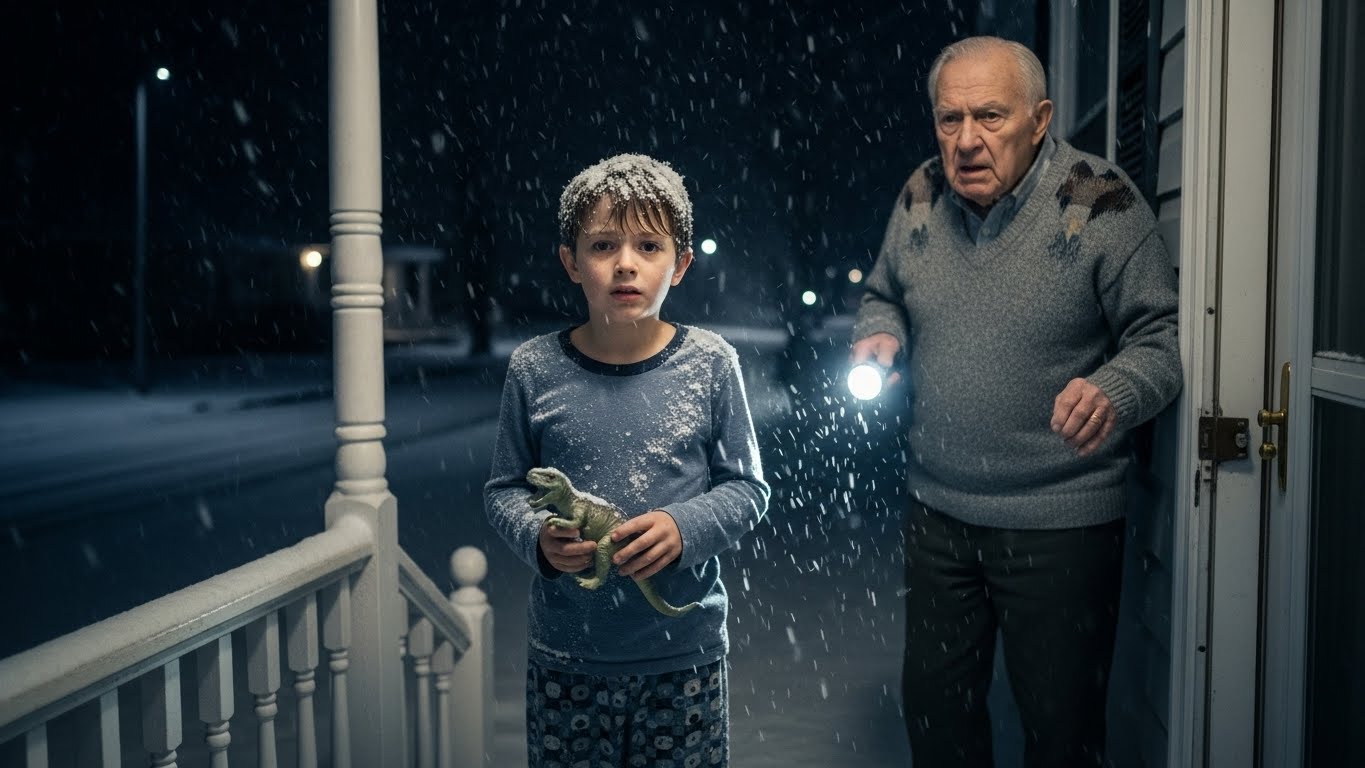
There, standing in two feet of snow, was Leo.
The boy was blue. Literally blue. He was wearing Spongebob pajama bottoms and a t-shirt. No coat. No shoes. His socks were soaked through. He was shivering so violently that his teeth weren’t chattering; they were vibrating.
“Mr… Mr. Arthur?” the boy whispered. The wind snatched his voice away.
Arthur forgot the chain. He forgot his grumbling. He slammed the door shut to release the chain and threw it open wide. The blast of cold air hit him, but the sight of the freezing child hit harder.
“Boy? What in God’s name—”
“Mommy won’t wake up,” Leo stammered, his eyes wide and glassy. He was clutching that plastic dinosaur so hard his knuckles were white. “She’s really cold. Can you help my mom?”
Adrenaline, a chemical Arthur hadn’t felt in years, surged through his veins. He grabbed Leo by the arm and yanked him into the warm hallway. “Stay here. Do not move.”
Arthur grabbed his heavy wool coat from the rack, threw it over his pajamas, and shoved his feet into his boots. He didn’t know why, but a sense of dread, heavy and dark, settled in his stomach.
“Is the door open?” Arthur asked, his voice sharp.
Leo nodded. “It’s… it’s really cold in there, Mr. Arthur.”
Arthur grabbed his flashlight and ran. He hadn’t run in a decade, but he ran now, trudging through the drifts across the street to the Blue Door House.
The front door was ajar. The moment Arthur stepped inside, he gasped. It wasn’t just cold; it was colder inside than it was outside. The air was still and stagnant, holding the chill like a tomb. There was no hum of a furnace.
“Hello? Lena?” Arthur shouted.
Silence.
He swept the flashlight beam around. The living room was barren. There was no sofa. No TV. Just two mattresses on the floor in the corner, piled with every blanket imaginable.
Arthur approached the larger mattress.
Lena lay there. She was curled in a fetal position. Her skin was pale, waxy. Arthur reached out, his hand trembling, and touched her cheek.
Ice.
She had been gone for hours.
“Oh, God,” Arthur whispered, stumbling back. He felt bile rise in his throat.
He looked around the room, trying to make sense of the poverty he was seeing. This wasn’t a drug den. It was a shelter of last resort.
He walked into the kitchen, looking for a phone to call 911, though he knew it was too late. On the counter, he saw a spiral-bound notebook. Next to it was a pile of bills.
Curiosity, or perhaps a need to find a reason for this horror, made him shine the light on the notebook. It was open to a page dated two days ago.
“Electric shut off notice came today. I have to choose. Insulin or the heating bill? If I pay the heat, I can’t buy the vials. If I don’t buy the vials, I can’t work. Leo needs food. I’ll stretch the last dose. I can make it to Friday payday. Just need to keep Leo warm with the blankets. I’m sorry, baby. Mommy is trying.”
Arthur stared at the words. The handwriting was shaky.
He turned the flashlight to the refrigerator. He pulled it open. It was dark—no power. Inside, there was a half-gallon of milk, a block of government cheese, and a small white box.
He opened the box. Empty insulin vials.
Arthur dropped the box. It clattered on the linoleum floor.
The realization hit him with the force of a physical blow. She wasn’t high. She wasn’t a junkie. She was a Type 1 Diabetic. The “stumbling” he saw was her body shutting down from lack of medicine. The “partying” was her working herself to death to keep a roof over that boy’s head.
She had sacrificed her life, quite literally rationing her own survival, to feed her son.
And Arthur? He had sat in his seventy-two-degree house, sipping coffee, and judging her for not having a better coat.
He collapsed onto one of the rickety kitchen chairs, covering his face with his hands. The silence of the house was deafening. It screamed at him.
You watched, the silence said. You watched and you did nothing.
Sirens wailed in the distance, getting louder. Arthur stood up. He had to go back to Leo. He had to tell a seven-year-old boy that his mother had died saving him, while the man next door had watched it happen.
Chapter 2: The Vultures and The Village
The next three days were a blur of flashing lights, social workers, and the crushing weight of bureaucracy.
Arthur didn’t sleep. He couldn’t. Every time he closed his eyes, he saw Lena’s frozen face and the empty insulin box.
Because the state moved slowly and the storm had paralyzed the roads, the emergency placement for Leo became a complicated matter. The local foster facility was over capacity, and the roads made transport to the next county dangerous.
“Mr. Pendelton,” the social worker, a weary woman named Mrs. Gomez, had said that first night. “I can’t believe I’m asking this, but you’re the neighbor. The boy knows you. Can you keep him for 48 hours until we clear the roads and find a placement?”
Arthur looked at Leo, who was sitting on Arthur’s sofa wrapped in three blankets, staring blankly at the TV.
“He stays,” Arthur said, his voice gruff. “As long as he needs.”
For the first time in five years, Arthur’s house wasn’t silent. It was filled with the quiet shuffling of a grieving child. Arthur, who hadn’t cooked a real meal since Martha died, found himself making grilled cheese sandwiches and tomato soup. He dug out old toys from the attic—dusty trucks that had belonged to a son he and Martha never had, kept for nephews who never visited.
But as the news of the tragedy spread, the world outside began to encroach.
A local reporter picked up the story: “Mother Freezes to Death Saving Son in Allentown.” It went viral. People were outraged. The “system” was blamed. Healthcare costs were debated. A neighbor set up a GoFundMe page for “Leo’s Future.”
In forty-eight hours, the fund hit $50,000. By day three, it was over $150,000.
That was when the vulture arrived.
Arthur was in the kitchen showing Leo how to properly dunk a sandwich in soup when the doorbell rang. It wasn’t the hesitant knock of a child; it was the confident, rhythmic rap of entitlement.
Arthur opened the door to find a man in his mid-thirties. He wore a leather jacket that looked expensive but smelled of stale cigarettes, and a smile that didn’t reach his eyes.
“Can I help you?” Arthur asked, blocking the doorway.
“I’m here for my son,” the man said, flashing a set of perfect, whitened teeth. “I’m Travis. Leo’s dad.”
Arthur felt a chill that had nothing to do with the winter air. “Travis. Haven’t seen you around these past five years.”
Travis shrugged, a practiced motion of feigned regret. “Yeah, well, Lena and I had our differences. She kept him from me. Terrible tragedy, what happened. But I’m here now to step up. Take responsibility.”
Arthur narrowed his eyes. “You’re here for the boy? Or did you hear about the money?”
Travis’s smile faltered for a fraction of a second, then returned, tighter this time. “Watch it, old man. That’s my flesh and blood. I have legal rights. You’re just a babysitter.”
Arthur slammed the door in his face.
The war had begun.
The following week was a nightmare. Travis filed for emergency custody. He had a lawyer—a slick, strip-mall attorney who specialized in “Fathers’ Rights.” On paper, Travis looked fine. He had a job (manager at a car dealership), an apartment, and no felony convictions. The fact that he hadn’t paid child support in five years was “an administrative oversight” he claimed he was willing to rectify immediately.
Mrs. Gomez, the social worker, looked pained when she visited Arthur.
“The law favors the biological parent, Mr. Pendelton,” she explained gently. “Unless we can prove he’s unfit, the judge will likely grant him custody. And control of the trust fund being set up with the donation money.”
“He doesn’t want the boy!” Arthur shouted, slamming his hand on the table. Leo flinched in the other room. Arthur lowered his voice immediately. “He wants the cash. He’s a shark. You give him that boy, and that money will be gone in a year, and Leo will be back in a freezing house.”
“We need proof,” Mrs. Gomez said. “Character witnesses. Anything.”
Arthur had no proof. Just his gut instinct.
That night, Arthur sat in the dark living room. Leo was asleep upstairs in the guest room. Arthur could hear the boy’s soft breathing. He thought about Martha. What would you do, Marty? he asked the darkness.
You fight, Arthur, her voice whispered in his memory. You fight like hell.
Arthur stood up. He walked to the corner where he had piled Lena’s few belongings that the police had released to him. A box of clothes. Some cheap jewelry. And the notebook.
He had only read the last page. He hadn’t invaded her privacy further. But now, he needed ammunition.
He sat under the lamp and opened Lena’s journal from the beginning.
He read through the years of struggle. The loneliness. The joy of Leo’s first steps. And then, he found the entries about Travis.
May 12, 2019: Travis called. He found out I was working at the diner. He said if I tried to file for support, he’d tell the courts I was a junkie. He said he knows people. He said he’d make me disappear.
August 4, 2020: Leo asked about his daddy today. I didn’t know what to say. I couldn’t tell him his father told me to ‘get an abortion’ seven years ago.
December 20, 2023: I saw Travis at the mall. He didn’t see me. He was buying a new truck. I can’t even afford insulin. I hate him. Not for leaving me, but for forgetting Leo exists.
Arthur’s hands shook. This was it. But it was just writing in a book. It wasn’t sworn testimony. It was hearsay.
The next morning, the court hearing was scheduled. Travis was coming to take Leo.
Arthur looked at his bank account. He had his savings—his “end of life” fund. It wasn’t huge, but it was enough.
He picked up the phone and dialed the number of the most vicious, expensive family law attorney in Pennsylvania. A woman named Sarah “The Barracuda” Jenkins.
“I can’t hire you,” Arthur told her when she picked up. “I’m just a neighbor. I have no standing.”
“You have the boy currently,” Jenkins said, her voice like gravel. “And if you have money, I can buy you time. I can file for ‘Interim Guardianship based on Extraordinary Circumstances.’ It’s a long shot, Mr. Pendelton. It will cost you everything you have.”
Arthur looked out the window at the Blue Door House, now empty and silent.
“Sell my car,” Arthur said. “Sell my bonds. I don’t care. Just get to the courthouse.”
Chapter 3: The Verdict of the Heart
The courtroom smelled of floor wax and misery.
Judge Harrison, a stern man with thick glasses, looked over the file. On one side sat Travis, looking somber in a rented suit, his lawyer smirking. On the other side sat Arthur, looking every day of his seventy-two years, flanked by Sarah Jenkins.
“This is highly irregular,” Judge Harrison said. “Mr. Pendelton, you are a neighbor. Mr. Miller is the biological father. The statutes are clear.”
“Your Honor,” Travis’s lawyer interjected smoothly. “This is a simple case of a grieving old man who has grown attached. It’s sad, really. But my client is ready to take his son home. He has even set up a bedroom for him.”
Travis nodded solemnly. “I just want to be a dad, Your Honor. I made mistakes staying away, I admit that. But I want to make it right.”
It was a performance worthy of an Oscar.
Sarah Jenkins stood up. “Your Honor, we move to admit the mother’s personal journal into evidence.”
“Objection! Hearsay!” Travis’s lawyer barked.
“Sustained,” the Judge said. “Mr. Pendelton, unless you have concrete evidence of abuse or unfitness, I have to rule in favor of the father.”
Arthur felt his heart hammering against his ribs. He was losing. He was going to watch Leo walk out of those doors with a monster.
Arthur stood up.
“Mr. Pendelton, sit down,” his lawyer hissed.
“No,” Arthur said. He looked at the Judge. “Your Honor, may I speak?”
“Mr. Pendelton, this is not—”
“I watched his mother die!” Arthur’s voice boomed, cracking with emotion. The courtroom went silent. “I watched from my window. I judged her. I thought she was trash. And because I was too proud, too stubborn to walk fifty feet and ask if she was okay, she froze to death to save that boy.”
He pointed a shaking finger at Travis. “And where was he? He was buying trucks. He was threatening her. You want to talk about the law? Fine. The law says he’s the father. But nature? Nature says a father protects his young. This man is a vulture. He’s here for the check that comes with the boy. Look at him! Ask him what Leo’s middle name is. Ask him what his favorite dinosaur is!”
Travis shifted uncomfortably. “It’s… uh… James?”
“It’s Martha!” Arthur yelled. “Lena gave him my wife’s name as a middle name because my wife was the only person who ever was kind to her at the grocery store! It’s on the birth certificate you didn’t even bother to read!”
The courtroom was stunned. Travis’s face turned red.
“That’s enough, Mr. Pendelton,” the Judge said, but his voice was softer. “However… the court is concerned about the sudden interest of the father coinciding with the fundraising efforts.”
“Your Honor!” Travis’s lawyer shouted. “That is speculation!”
Suddenly, the doors at the back of the courtroom opened. A young woman walked in. She had bright pink hair and looked terrified.
Sarah Jenkins looked at her phone, then smiled. A predatory smile. “Your Honor, I have one more witness. A surprise witness who just contacted my office this morning. Ms. Tiffany Ray. Mr. Miller’s current live-in girlfriend.”
Travis’s face went white.
Tiffany took the stand. She was crying.
“He told me…” she sobbed into the microphone. “He told me we were going to be rich. He said the kid was a ‘goldmine.’ He said we’d get custody, take the money, and put the kid in boarding school or something. He called Leo a ‘winning lottery ticket.’ I can’t… I can’t be part of that. My sister is diabetic. When I read the story…”
Pandemonium broke out. Travis jumped up. “You shut up, you lying—”
“Sit down!” the bailiff shouted.
Judge Harrison slammed his gavel. The sound echoed like a gunshot. He looked at Travis with pure disgust.
“Mr. Miller,” the Judge said, his voice ice cold. “I am stripping you of all parental rights pending a criminal investigation for fraud and extortion. If you come within five hundred feet of that boy, I will put you under the jail.”
The Judge turned to Arthur. “Mr. Pendelton. The state usually frowns on guardians of your age. However, given the circumstances… and the evident bond… I am granting you permanent guardianship of Leo, with state oversight and support.”
Arthur slumped into his chair. He felt Sarah Jenkins squeeze his shoulder.
He had done it. He hadn’t just watched. He had acted.
Six Months Later
The summer sun was warm on Arthur’s back. The snow was a distant memory.
Arthur was on his knees in the garden—a garden that had been barren for five years. Now, rows of tomato plants, peppers, and marigolds stretched across the yard.
“Grandpa Artie! Look!”
Arthur looked up. Leo was running across the grass, holding a massive, glistening red tomato. The boy was filled out now, his cheeks rosy, his eyes bright. He wore clean clothes and sneakers that fit.
“That’s a prize-winner, Leo,” Arthur beamed, wiping sweat from his forehead.
“Can we give it to the new neighbors?” Leo asked.
Arthur looked at the Blue Door House. A young couple had just moved in. They were unloading boxes.
Old Arthur would have pulled the blinds. Old Arthur would have grumbled about the noise.
But Arthur wasn’t that man anymore. That man had died in the snow along with Lena.
Arthur stood up, his knees cracking, but he felt stronger than he had in twenty years. He took the tomato from Leo.
“You know what?” Arthur said. “Let’s take them a whole basket. And invite them for dinner.”
He took the boy’s hand. Together, they walked across the property line, crossing the space that had once been a chasm of judgment, bridging it with kindness.
The blue door opened before they even knocked.