I Threw My Stepson Out After My Wife Died Because He Wasn’t “Mine”—10 Years Later, A Secret In His Diary Brought Me To My Knees.
PART 1
Chapter 1: The House of Ghosts
The casserole dishes were piling up on the granite countertop, forming a leaning tower of pity. Tuna casserole. Lasagna. Green bean almandine. The food of the grieving. They were wrapped in aluminum foil, labeled with masking tape and sympathy: “Thinking of you, Dan,” or “Heat at 350 – The Millers.”
I stared at them, the hum of the refrigerator the only sound in the house, and I felt a sudden, violent urge to sweep them all onto the floor.
It had been thirty days. Thirty days since Sarah collapsed in this very kitchen. Thirty days since the aneurysm that stole my wife and left me with a silence so loud it made my ears ring.
I wasn’t a drinker before. Maybe a beer during the game on Sundays. But now, the amber liquid in the square glass was my only anchor. It numbed the edges of the picture frame in my mind—the image of her laughing, her hair messy from the wind, her hand in mine.
“Daniel?”
The voice was small, tentative. It cut through my haze like a unwanted needle.
I didn’t turn around. I knew who it was. Noah.
“What?” I snapped, the word coming out harsher than I intended. Or maybe exactly as harsh as I intended.
“I’m hungry,” the boy said.
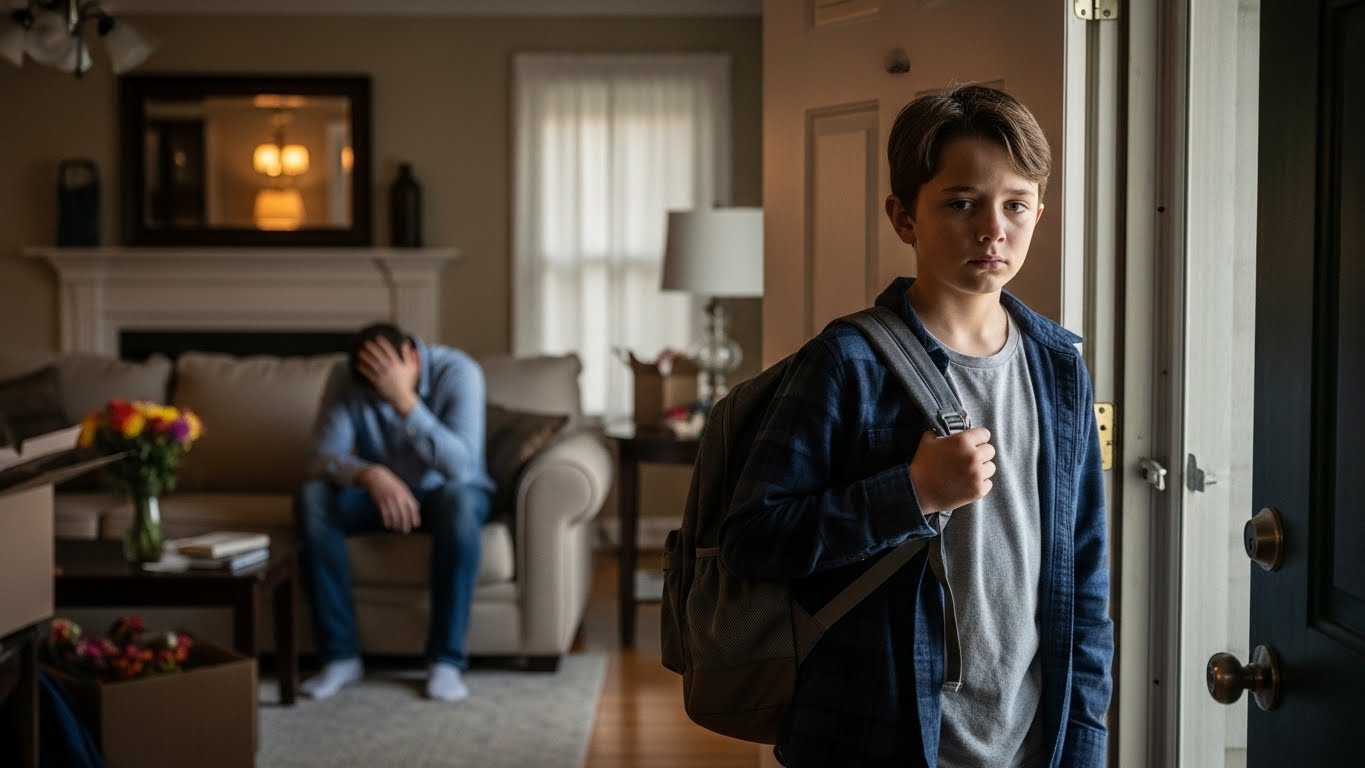
I turned then. He was standing in the doorway of the kitchen, wearing a t-shirt that was two sizes too big—one of my old ones that Sarah used to let him sleep in. He was twelve, but he looked smaller lately. He had Sarah’s chin, her slight frame, but his eyes… those dark, brooding eyes belonged to the man who came before me. The biological father. The man who left Sarah when she was pregnant, the man whose DNA was stamped all over this kid.
For ten years, I had played the part. I was the stepdad. I coached the Little League team. I paid for the braces. I sat through the parent-teacher conferences. I did it because I loved Sarah, and Sarah came as a package deal. I loved her so much that I made room in my heart for her son.
But now that she was gone, the love was draining out of me, leaving behind a residue of bitter resentment. Every time I looked at Noah, I didn’t see a son. I saw a stranger. I saw a responsibility I didn’t ask for, tethered to a woman who had abandoned me by dying.
“There’s food on the counter,” I gestured vaguely at the tower of casseroles with my glass. “Pick one.”
“I don’t know how to use the oven,” he murmured, looking at his feet.
The rage flared—irrational, hot, and quick. “You’re twelve years old, Noah. Figure it out. I’m not your servant. I’m not… I’m not doing this tonight.”
I brushed past him, my shoulder bumping his. He stumbled slightly but didn’t say a word. That was his new thing: silence. He used to be a chatterbox, always talking about comic books and space and bugs. Now, he was a ghost haunting the hallways of a house I couldn’t afford to keep and didn’t want to live in.
I retreated to the living room and sank into the leather recliner. The television was off. I stared at the black screen, seeing my own reflection. A man, forty-two years old, unshaven, disheveled, holding a drink at 5:00 PM on a Tuesday.
I wasn’t a monster. I knew that, logically. I was a man in pain. But pain has a way of twisting you, of turning your insides out until the ugly parts are all that show.
I closed my eyes and tried to summon Sarah’s face. But all I could see was Noah. Noah eating at my table. Noah sleeping in the room upstairs. Noah needing clothes, needing school supplies, needing love.
I didn’t have any love left to give. The well was dry.
“She’s not coming back,” I whispered to the empty room.
I took a long drink. The whiskey burned, but the thought burned hotter: Why am I still taking care of him?
Legally, I was his guardian. Sarah’s parents were dead. The biological father was a ghost in the wind. I was it. But the thought of spending the next six years raising a boy who wasn’t mine, in a house filled with memories of a dead woman, felt like a prison sentence.
I wanted to run. I wanted to sell everything, move to a city where no one knew my name, and start over. A clean slate. A life without the baggage of grief.
But there was Noah. The anchor dragging me down.
The smell of burning cheese drifted from the kitchen. He had tried to use the oven.
I groaned, slamming my glass down on the coasterless table. “For God’s sake,” I muttered, pushing myself up.
I stormed into the kitchen. Noah was standing in front of the stove, panic in his eyes. Smoke was curling out of the oven vents. He had put the plastic wrap in with the casserole.
“I’m sorry!” he yelped, backing away as I grabbed a towel and yanked the oven door open.
“You idiot!” I shouted, coughing as the acrid smoke hit my face. I grabbed the tray and threw it into the sink, running water over the melting plastic. “What is wrong with you? Are you trying to burn the house down?”
“I didn’t know! I forgot to take the cover off!” He was trembling now.
I turned on him, my chest heaving. The frustration of the last month, the grief, the anger—it all focused into a laser beam pointed directly at this small, frightened boy.
“You don’t think,” I spat. “You never think. You just take up space and make messes.”
It was the whiskey talking. It was the grief talking. But they were my words.
Noah looked at me, his lip quivering. “I miss Mom.”
The words were a trigger. They shouldn’t have been, but they were.
“Don’t,” I warned, my voice dropping to a dangerous whisper. “Don’t you dare talk about her. You think you miss her? You have no idea. You’re just a kid. You’ll forget. I’m the one who has to live with this.”
“I won’t forget,” he said, a sudden defiance in his tone.
“You’re not even her real son,” I said.
The room went dead silent. The water running in the sink sounded like a roar.
I saw the light go out in his eyes. I saw the exact moment his heart broke.
I should have stopped. I should have dropped to my knees and begged for forgiveness. I should have hugged him.
But I didn’t.
Chapter 2: The Severed Tie
The words hung there, suspended in the smoky kitchen air. You’re not even her real son.
It was a lie, of course. He was her flesh and blood. What I meant was, You’re not mine. But the way it came out was designed to hurt, designed to push him away so far that he couldn’t touch me. If he was far away, he couldn’t remind me of her.
Noah stood frozen. He looked down at his hands, which were covered in soot from the oven mitts.
“I know,” he said quietly. “I know I’m not yours.”
“Then why are you still here?” The question slipped out before I could check it. It was the alcohol. It had to be.
Noah looked up. “Because this is my home.”
“No,” I said, shaking my head. The darkness in me was steering the ship now. “This was Sarah’s home. And she’s gone. I’m selling it. I’m selling everything.”
“But… my school. My friends.”
“I don’t care about your friends, Noah!” I shouted, slamming my hand on the counter. The plates rattled. “I don’t care! I can’t do this! I can’t look at you every day and pretend like we’re a happy family. We aren’t a family! We were two people who loved the same woman, and now she’s dead. That’s it. That’s the only connection.”
Noah took a step back, hitting the refrigerator. He looked small. So incredibly small.
“So… what do you want me to do?” he asked. His voice was steady, eerily calm. It was a survival mechanism. I recognized it, and I hated it.
“I want you to leave,” I said.
I didn’t have a plan. I didn’t know where he would go. I just knew I needed him gone. I needed the air in the house to be mine again.
“Pack your things,” I said, turning my back on him to stare out the window at the darkening backyard. “I want you gone. Tonight.”
“Tonight?” His voice cracked. “It’s dark. Where will I go?”
“Call your Aunt Linda in Jersey. She always wanted kids. Or go to a friend’s. I don’t care. Just… get out.”
I heard him take a shaky breath. “You really hate me, don’t you?”
I closed my eyes. “I don’t hate you, Noah. I just… I can’t be your father. I never was. I was just filling a seat.”
I heard his footsteps retreat from the kitchen. I stayed by the window, my heart hammering against my ribs. Part of me—the part that was still Daniel, the good man Sarah married—was screaming. Stop him. Apologize. This is insane. You can’t kick out a twelve-year-old.
But another part, a cold, selfish part, felt a wave of relief.
I went back to the living room and poured another drink. I sat there, listening.
I heard the zip of a suitcase. The heavy thud of shoes being dropped. The closet door opening and closing.
Twenty minutes later, Noah walked down the stairs. He was wearing his backpack and carrying a small duffel bag. He was wearing his winter coat, even though it was only October. He looked like a refugee in his own life.
He stopped at the bottom of the stairs.
“I called Tyler’s mom,” he said. “She said I can stay there tonight.”
I didn’t look at him. I stared at the TV screen. “Good. Fine.”
“I took the photo,” he said. “The one from the mantle. Is that okay?”
The photo of the three of us. Disney World, three years ago. We looked happy.
“Take it,” I waved my hand dismissively. “Take whatever you want.”
He hesitated. I could feel his gaze on the side of my face, burning. He wanted me to look at him. He wanted me to see him one last time.
“Goodbye, Daniel,” he said. Not Dad. He hadn’t called me Dad in weeks. But hearing him use my first name finalized it.
“Bye,” I grunted.
He walked to the door. He opened it, letting in a gust of cool autumn wind. The leaves swirled on the porch.
He paused in the doorway. “She loved you, you know,” he said softly. “She really did.”
Then he stepped out, and the door clicked shut.
I sat there in the silence. The clock on the wall ticked. Tick. Tick. Tick.
I waited for the regret to hit me. I waited for the impulse to run after him, to grab him, to drag him back inside and promise to be better.
But it didn’t come. Not then.
Instead, I felt lighter. The house was empty. The ghost of the boy was gone. I finished my drink, poured another, and fell asleep in the chair.
The next morning, I called a realtor.
I sold the house two months later. I packed up my life, put Sarah’s things in storage, and moved to Austin, Texas. I started a construction company. I worked eighteen hours a day. I made money. I met a woman named Rachel who didn’t ask about my past, and I married her.
I buried Noah in the deepest, darkest corner of my mind, right next to the memory of Sarah’s funeral.
I thought I had escaped.
But the past is a patient hunter. It doesn’t need to run. It just waits.
And ten years later, it found me.
PART 2
Chapter 3: The Fortress of Solitude
Austin, Texas, is a city of noise. Live music spilling out of bars on 6th Street, construction crews hammering away at the skyline, the roar of traffic on I-35. It was the perfect place to drown out a quiet conscience.
Ten years had passed. Ten years of building a fortress around myself.
I was fifty-two now. My hair was gray at the temples, and the lines around my eyes had deepened, etched by long days and sleepless nights. Turner Construction was one of the biggest firms in the city. I built skyscrapers. I built luxury condos. I built things that were cold, hard, and permanent. Things that didn’t feel.
I had a new wife, Rachel. She was twelve years younger than me, a real estate agent with a shark’s smile and a heart that operated on pure logic. We were perfect for each other. We had a prenup, separate bank accounts, and a mutual understanding that the past was a locked room we didn’t enter.
We had no children. That was my one non-negotiable condition.
“I’m too old,” I had told her. “I’ve done that part of my life.”
It was a lie. I hadn’t done it. I had failed at it.
Our house in West Lake Hills was a masterpiece of modern architecture. Floor-to-ceiling windows, white marble floors, minimalist furniture. It looked like a museum. It felt like a freezer.
Every now and then, the cracks would show. I’d be at a stoplight and see a father teaching his son how to change a tire. Or I’d be in a meeting and notice a client’s phone background—a picture of a kid with a messy face eating ice cream.
A sharp, phantom pain would shoot through my chest. I’d push it down, bury it under spreadsheets and blueprints. He’s fine, I’d tell myself. He’s with family. He’s better off without a bitter old man.
I never looked him up. I was too much of a coward. If I looked him up and found out he was in jail, or on drugs, or dead, it would destroy the delicate lie I had constructed. As long as I didn’t know, he could be anything. He could be happy.
One humid Thursday evening in November, I was in my home office, reviewing a bid for a new stadium. The house was silent. Rachel was at a gala.
My personal cell phone buzzed. It sat on the mahogany desk, vibrating against the wood like an angry insect.
I didn’t recognize the number. A New York area code.
I almost let it go to voicemail. I didn’t know anyone in New York anymore. But something—maybe boredom, maybe fate—made me pick it up.
“This is Daniel,” I said, my voice gravelly.
“Mr. Turner?” The voice was female, polished, professional. “My name is Claire Vane. I’m the curator at the Ellis Gallery in downtown Austin.”
I frowned. “I don’t buy art, Ms. Vane.”
“I’m not trying to sell you anything, Mr. Turner. I’m calling with an invitation.”
“I’m busy,” I said, moving to hang up.
“It’s for an opening this Saturday,” she continued hurriedly. “The artist specifically requested your presence.”
I paused. “I don’t know any artists.”
“He says he knows you. He says you were… instrumental in his life.”
A cold chill ran down my spine, contrasting with the humid Texas heat outside.
“Who is he?” I asked.
“The artist goes by the name ‘N.T.’,” she said. “But his name is Noah.”
The name hit me like a physical blow. The air left my lungs. The phone felt slippery in my hand.
Noah.
“I… I can’t,” I stammered.
“He said you’d say that,” the woman replied, her voice softening slightly. “He also said to tell you that he doesn’t want anything from you. He just wants you to see what he made.”
I sat there for a long time, the hum of the air conditioner the only sound in the world. Ten years.
“Mr. Turner?”
“I’ll be there,” I whispered.
Chapter 4: The Walk of Atonement
I didn’t tell Rachel. I told her I had a late site visit on Saturday night. She didn’t look up from her iPad. “Don’t be too late,” was all she said.
I put on my best suit. I shaved close. I looked in the mirror and saw a man who looked successful, powerful. A man who had it all together. But my hands were shaking so badly I could barely tie my tie.
Driving to downtown Austin felt like driving to my own execution.
The Ellis Gallery was in a refurbished warehouse district. Exposed brick, industrial lighting, people spilling out onto the sidewalk holding flutes of champagne. They looked wealthy, sophisticated. The kind of people who discussed “texture” and “negative space.”
I parked my truck three blocks away and walked. The night air was cool. My heart was hammering a frantic rhythm against my ribs. What am I doing here?
I almost turned back twice.
But curiosity is a powerful drug. And guilt is even stronger.
I walked into the gallery. It was bright, stark white, and crowded. The hum of conversation was low and respectful.
I kept my head down, moving through the crowd, afraid to make eye contact. I was looking for him, but I was also terrified of finding him.
Then, I looked at the walls.
The paintings were large, chaotic, and dark. They were violent splashes of black and charcoal, mixed with sudden, jarring streaks of red. They were uncomfortable to look at. They felt like screaming.
I moved closer to one. It was a canvas painted entirely in shades of gray, depicting a small, empty room with a single window. The title card read: “The night the door closed.”
I swallowed hard.
I moved to the next one. A silhouette of a man seen from the back, sitting in a chair, a glass in his hand. The figure looked distorted, monstrous, yet sad. Title: “The Guardian.”
My breath hitched. These weren’t just paintings. They were memories. My memories. Or rather, his memories of me.
I felt stripped naked. Everyone in this room was sipping wine and admiring the trauma I had inflicted on a child. They were calling it “brave” and “visceral.” I knew it was just pain.
“Mr. Turner?”
I froze.
I knew that voice. It was deeper now, resonant, but it had the same cadence.
I turned slowly.
He was standing near a pillar, holding a glass of sparkling water. He was tall—taller than me now. He was lean, wearing a fitted black suit with no tie. His hair was longer, tied back in a messy bun.
But the face… the face was the same. The same high cheekbones. The same chin. And those eyes. Sarah’s eyes? No. The stranger’s eyes.
“Noah,” I breathed.
He didn’t smile. He didn’t frown. He just looked at me with a terrifying calmness.
“You came,” he said.
“You invited me.”
“I didn’t think you’d show up. You were always good at running away.”
The jab landed, but I didn’t defend myself. I deserved it.
“You look… good,” I said, the words feeling clumsy and inadequate.
“I am good,” he said. “I’m successful. I’m happy. I survived.”
Survived me. He didn’t say it, but we both heard it.
“Noah, I…” I started, but the words died in my throat. What could I say? I’m sorry? It wasn’t enough.
“Save it,” he said, raising a hand. “I didn’t bring you here for an apology, Daniel. I don’t need it. I made peace with who you are a long time ago.”
“Then why?” I asked. “Why bring me here?”
He swirled the water in his glass. “Because there’s something you need to see. Something I found. And because… she would have wanted you to know.”
He gestured toward the back of the gallery. “Come with me.”
Chapter 5: The Masterpiece
I followed him through the crowd. People nodded at him, whispered his name as he passed. He was the star. I was the ghost.
He led me to a private alcove at the very back of the gallery. It was roped off with a velvet cord. A single painting hung on the wall, covered by a heavy black cloth.
There was a security guard standing there. Noah nodded to him, and the guard stepped aside.
“Just us,” Noah said.
We stepped into the small space. It was quiet here, the noise of the party muffled.
“I painted this three years ago,” Noah said, staring at the cloth. “I’ve never shown it to anyone. Not even the gallery owner.”
“Why show me?”
“Because it’s about you. And her.”
He reached out and grabbed the corner of the cloth.
“You threw me out because you said I wasn’t yours,” Noah said, his voice devoid of emotion. “You said I was a reminder of a stranger. You let that jealousy eat you alive until it destroyed our family.”
“I know,” I whispered, shame burning my face. “I was weak. I was grieving.”
“You were wrong,” Noah said.
He pulled the cloth down.
The painting was different from the others. It wasn’t dark. It wasn’t chaotic. It was hyper-realistic, bathed in a soft, warm light.
It was Sarah.
She was sitting in a hospital bed, looking tired but beautiful. Her hair was matted, her face pale. She was looking down at a bundle in her arms. A baby.
But it was the detail that stopped my heart.
In the background of the painting, standing in the doorway, was a man. A younger man. He was looking at Sarah with an expression of pure, terrified love.
The man was me.
I recognized the shirt. I recognized the watch. It was the day Noah was born.
But… that was impossible. I wasn’t there when Noah was born. Sarah had Noah before I met her. That was the story. That was the truth I had lived with for twenty-two years.
“I don’t understand,” I stammered, pointing at the canvas. “I wasn’t… I didn’t meet Sarah until Noah was two.”
Noah turned to look at me. His eyes were hard, searching.
“That’s what she told you,” he said. “That’s what she told everyone.”
He reached into the inside pocket of his jacket and pulled out a small, leather-bound book. It was old, the cover cracked and worn.
“What is that?”
“Her diary,” Noah said. “I found it in the box of things you let me take. I didn’t open it until I was sixteen. I was too angry.”
He held it out to me.
“Read the page marked with the blue ribbon.”
Chapter 6: The Lie That Saved Me
My hands were shaking so bad I almost dropped the book. I recognized the smell of the paper—it smelled like her perfume. Vanilla and old books.
I opened it to the marked page. The date was twenty-three years ago.
October 14th.
“He came into the diner again today. Daniel. The man with the sad eyes and the construction boots. We talked for three hours. He made me laugh. I haven’t laughed in so long.”
I remembered that. I remembered meeting her at the diner. But… the date. That was a year before we “officially” started dating. A year before she told me she had a son.
I skipped down the page.
November 2nd.
“I did something reckless. I slept with him. I know I shouldn’t have. He’s leaving for a job in Dallas next week. He says he’s not ready for a relationship. He says he’s a drifter. But God, I think I love him.”
I stopped reading, my head spinning. We had slept together. Once. A fling before I moved away. I came back a year later, found her, and we fell in love properly. She had a one-year-old son then. She told me the father was a guy named Mark who ran off. I never questioned it.
I read the next entry.
January 15th.
“I’m pregnant. It’s Daniel’s. I know it is. Mark has been gone for six months. It has to be Daniel.”
My knees gave out. I stumbled back, catching myself on the wall.
“I can’t tell him. If I tell him now, he’ll think I’m trying to trap him. He’ll think I’m just looking for a paycheck or a father for the baby. He’s finally getting his life together in Dallas. If he comes back to me, I want it to be because he loves me. Not because of an obligation. Not because of a baby.”
“I’ll tell him it’s someone else’s. I’ll tell him the father is gone. If he loves me enough to accept another man’s child, then I’ll know. I’ll know he’s the one. And one day… one day when we’re safe, when we’re old and gray, I’ll tell him the truth. That Noah is his. That he’s always been his.”
The book fell from my hands and hit the floor with a thud.
The room spun. The painting of Sarah looked down at me, her eyes filled with a secret she took to the grave.
Noah—my Noah—stood there, watching me crumble.
“You…” I gasped, looking at him. “You’re mine.”
I looked at his face again. Really looked. The chin wasn’t hers. It was my father’s. The way he stood, the way his shoulders set… it was me.
I had thrown out my own son.
Because I was too proud. Because I was too jealous. Because I was a fool.
“She wanted to protect you,” Noah said softly. “She wanted to be sure you loved her. And you did. You were a great dad, Daniel. For ten years, you were the best father a kid could ask for. Until she died.”
“I didn’t know,” I sobbed, the tears finally breaking the dam. “Oh God, Noah, I didn’t know.”
“Would it have mattered?” Noah asked. The question was a knife.
“Yes! No… I mean…” I struggled for air. “I should have loved you regardless. That’s the sin, isn’t it? I only loved you when I thought you came with her. When she was gone, I stopped loving you.”
Noah nodded slowly. “Exactly.”
“I am so sorry,” I wept. I wanted to reach out and touch him, but I didn’t dare. I was filthy with guilt.
Noah looked at the painting of Sarah. “She never got the chance to tell you. The stroke happened so fast. She died with this secret.”
He picked up the diary and dusted it off.
“I hated you for a long time, Dad,” he said. The word Dad hit me like a sledgehammer. “I hated you for kicking me out. For making me sleep on Tyler’s couch. For making me go into foster care for six months until I turned eighteen.”
“Foster care…” I whispered. A fresh wave of horror washed over me.
“But then I read this,” he tapped the book. “And I realized… we were both just victims of a lie she told out of love. And you… you were just a man in pain.”
He stepped closer to me.
“I’m not asking you to be my father now,” Noah said. “I’m a grown man. I don’t need a dad to teach me to ride a bike. But… I thought you should know. You didn’t throw away a stranger. You threw away yourself.”
Chapter 7: The Bridge Over the Void
I couldn’t leave the gallery. I couldn’t go back to my empty mansion and my empty wife and my empty life.
I sat on a bench outside the gallery, my head in my hands. The revelation was rewriting my entire history. Every memory of Noah—every baseball game, every report card, every time he looked at me—was different now. He was my blood. My legacy. And I had treated him like garbage.
About an hour later, the gallery began to clear out. The lights dimmed.
The door opened, and Noah walked out. He had his jacket slung over his shoulder. He saw me sitting on the bench.
He hesitated, then walked over.
“You’re still here,” he said.
“I don’t have anywhere else to go,” I admitted. “Not really.”
He sat down next to me. Not too close. There was still a canyon between us, carved by ten years of silence.
“What happens now?” I asked.
Noah shrugged. “I go back to New York tomorrow. I have a show in London next month.”
“Can I…” I choked on the words. “Can I help? Do you need money? Connections?”
Noah laughed, a dry, humorless sound. “I don’t need your money, Daniel. I’m doing fine. My paintings sell for fifty thousand a pop.”
“Right. Of course.”
Silence stretched between us.
“But,” Noah said, looking at the stars. “You could come to London. If you want.”
My head snapped up. “What?”
“The show in London. It’s big. I could use… a friendly face. I don’t have any family left. Just you.”
Hope is a dangerous thing. It bloomed in my chest, painful and bright.
“I would like that,” I said. “I would like that very much.”
He stood up. “Don’t expect miracles, Daniel. We’re not going to play catch in the yard. You broke something that can’t be fully fixed. But… we can try to glue it back together.”
He pulled a card from his pocket and handed it to me.
“My number. Text me.”
He started to walk away.
“Noah!” I called out.
He stopped and turned.
“She would be proud of you,” I said, my voice trembling. “Not just the art. But the man. You’re a better man than I ever was.”
Noah smiled, a genuine smile this time. It lit up his face. It was the smile of the boy I used to know.
“I had a good teacher,” he said. “For the first ten years, anyway.”
Chapter 8: The Road Home
I divorced Rachel six months later. It cost me half my fortune, but I didn’t care. I sold the house in West Lake Hills. I sold the big truck.
I moved into a smaller place. I started painting again—not art, but houses. I downsized the business. I simplified.
I went to London. I stood in the back of the gallery and watched my son—my son—charm the critics. We went to dinner afterward. It was awkward. We talked about the weather. We talked about art. We didn’t talk about the night I kicked him out. Not yet.
It’s been two years since that night at the gallery. We’re not perfect. There are days he doesn’t answer my texts. There are days the guilt is so heavy I can’t get out of bed.
But last week, I got a package in the mail.
It was a small painting. A watercolor.
It showed a house—our old house. On the porch, there were two figures. A man and a boy. The man was pointing at the sky, showing the boy a constellation.
On the back, in Sarah’s familiar handwriting—copied from her diary—was a quote:
“Love is messy. Love is hard. But love is the only thing that stays.”
And below that, in Noah’s jagged scrawl:
“See you at Thanksgiving, Dad.”
I held the painting to my chest and cried.
I had thrown him away because he wasn’t my blood. I found him again because he was my heart.
The truth shattered me, yes. But sometimes, you have to be broken apart so you can be put back together the right way.
I’m Daniel Turner. I’m a father. And this time, I’m never letting go.