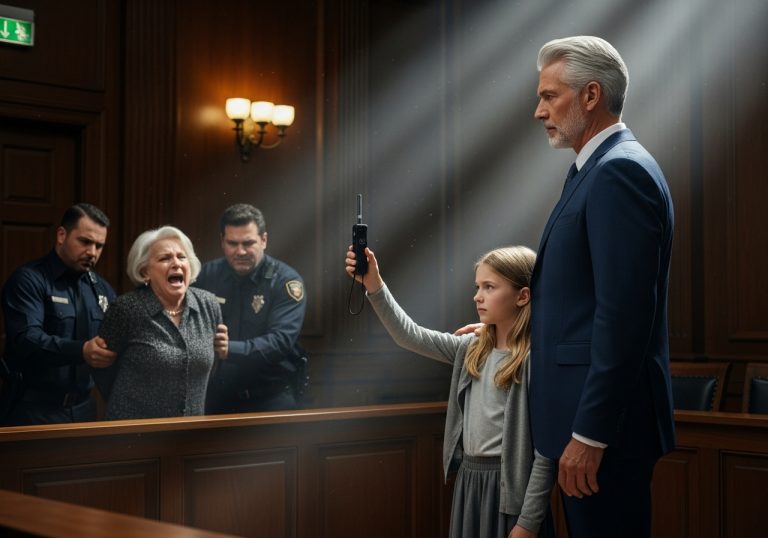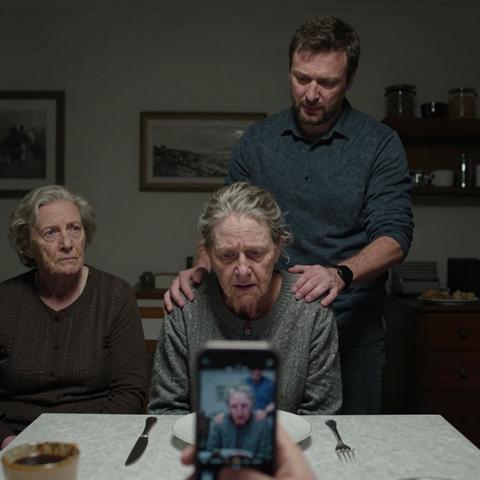
The One-Dollar Call to Heaven: The Boy Who Broke a Town’s Heart on Christmas Eve
Chapter 1: The Frost and the Fur
The wind on State Street didn’t just blow; it bit. It was a carnivorous thing, a howling beast that tore through the decorated garlands of downtown Oak Creek, Wisconsin. It was 6:00 PM on Christmas Eve, the kind of night where the cold seeped into the marrow of your bones, making you question why anyone lived this far north. But inside Harriman’s Department Store, the air was thick with the scent of cinnamon pinecones, expensive perfume, and the stress-sweat of last-minute shoppers.
I stood near the jewelry counter, shifting my weight from one aching knee to the other. My name is Arthur, and at seventy-two, I’ve seen enough Christmases to know the rhythm of them. This one felt frantic. The economy wasn’t great, the news was full of bad tidings, and people were buying things they couldn’t afford to impress people they didn’t particularly like. I was just there to buy a replacement watch battery for my granddaughter, a simple task that had turned into a forty-minute ordeal in the checkout line.
Directly in front of me stood a woman who looked like she owned the building, or at least acted like she should. Mrs. Eleanor Gable. Everyone in Oak Creek knew Eleanor. She was the widow of a banking tycoon, a woman who wore her wealth like a suit of armor. She was draped in a floor-length mink coat that probably cost more than my first house. Her hair was a helmet of silver spray, immobile and perfect. She was currently berating the cashier, a young girl named Jenny who looked like she was about to cry, over the price of imported Belgian truffles.
“I saw these for three dollars less at the boutique in Chicago,” Eleanor snapped, her voice cutting through the holiday music like a jagged piece of glass. “It is robbery. Pure and simple. You people think because it’s Christmas Eve you can gouge the loyal customers who actually keep this town afloat?”
“I’m sorry, Mrs. Gable,” Jenny stammered, her hands trembling as she scanned the box again. “The system sets the price. I can’t change it.”
“Well, get someone who can,” Eleanor huffed, tapping a manicured fingernail on the glass counter.
I sighed, checking my watch. The line behind me was growing, a snake of impatient, tired bodies. We were all just wanting to get home to our warm living rooms and our eggnog. We were all looking inward, wrapped in our own little bubbles of inconvenience.
That was when the bell above the heavy glass doors jingled, a weak, tinny sound against the roaring wind outside.
At first, nobody looked. But then, a gust of freezing air swept through the front of the store, strong enough to make the crystal chandeliers sway. Silence rippled through the queue as heads turned.
Standing on the welcome mat was a boy.
He couldn’t have been more than seven years old. He was small, shockingly small, a fragile collection of bones wrapped in clothes that were a tragic comedy of errors. He wore a man’s flannel shirt that hung to his knees, stained with grease and mud. His coat was a denim jacket with a shearling collar, torn at the shoulder, offering zero protection against the zero-degree blizzard raging outside. He wore no hat. His hair was matted, dark blonde strands plastered to his forehead by melting snow.
But it was his hands that caught my eye. They were raw, chapped to the point of bleeding, shaking violently as he clutched a crumpled piece of paper. He wasn’t wearing gloves.
He took a step forward, his sneakers squelching on the polished tile. They were canvas sneakers, soaking wet.
“Hey!” Mark, the store manager, looked up from the return desk. Mark was a good man usually, but Christmas Eve retail breaks the best of us. He was red-faced, sweating, and currently dealing with a jammed register. “Kid! Where are your parents? You can’t be in here dripping like that.”
The boy didn’t answer. He didn’t look at Mark. His eyes, wide and terrified, were fixed on the line of people. Specifically, he was looking at the woman in the fur coat.
He walked past the displays of glittering ornaments and cashmere scarves. He moved with a singular, desperate focus. He didn’t look at the toys. He didn’t look at the candy. He walked straight up to Mrs. Eleanor Gable.
I watched, fascinated and horrified. Eleanor sensed his presence before she saw him. She turned, her nose wrinkling as if she smelled something foul.
“Excuse me,” the boy said. His voice was a raspy whisper, barely audible over the Bing Crosby song playing on the speakers.
Eleanor looked down. She pulled her mink coat tighter around herself, stepping back as if the boy were contagious. “Where is security?” she announced to the room, not addressing the child. “Why is there a beggar in the store?”
The boy reached out. He didn’t touch her—he seemed to know better—but he hovered his shaking hand near her sleeve.
“Ma’am,” the boy tried again, his teeth chattering so hard the words were chopped up. “Please. I just need one dollar.”
The audacity of it seemed to stun the room. A dollar.
Eleanor let out a sharp, incredulous laugh. She turned to the rest of the line, seeking allies. “Do you hear this? The entitlement. It starts so young now.” She looked back at the boy, her face hardening into a mask of disdain. “Boy, where is your mother? Is she outside in the car waiting for you to collect money for her cigarettes? Or maybe something worse?”
The boy flinched as if she had struck him. “No, ma’am. Please. The payphone outside… it ate my quarter. It’s frozen. I tried to get it back but I couldn’t.” He held up his raw, bloody knuckles as proof. “I just need a dollar to use the phone inside. Just one dollar.”
“I am not a bank, and I am certainly not a charity for neglected children,” Eleanor snapped, turning her back on him to face the cashier again. “Jenny, ring up the truffles. I want to get out of here before I catch lice.”
The cruelty was breathtaking. It hung in the air, heavy and suffocating.
But the boy didn’t leave. He couldn’t leave. The desperation in his eyes was something ancient, something that went beyond simple want. It was a need so profound it overrode his shame.
He moved around to the side of her. “Please,” he begged, tears beginning to spill down his dirt-streaked cheeks, cutting clean lines through the grime. “I have to call her. It’s six o’clock. It’s the rule. If I don’t call now, she won’t hear me.”
“Get away from me!” Eleanor shrieked, actually swatting at the air near his head with her leather gloved hand.
That was the signal. The dam broke.
“Where is the manager?” a man in a beige trench coat yelled from behind me. “This is a safety hazard!”
“Somebody call the cops,” a woman whispered loudly. “He looks like he’s on drugs. Or his parents are.”
Mark, the manager, came rounding the corner of the counter, his walkie-talkie swinging from his belt. He looked exhausted. He looked at Eleanor, his most important customer, and then at the shivering heap of a child.
“Kid, I’ve told you,” Mark said, his voice loud, trying to project authority. “No begging in the store. You’re scaring the customers. You have to go. Now.”
Mark reached out and grabbed the boy by the collar of his oversized flannel shirt. The fabric was so old it looked like it might tear.
“No!” The boy screamed. It wasn’t a scream of defiance; it was a scream of pure panic. He dropped to his knees, his wet sneakers sliding on the floor, making him dead weight. He wrapped his arms around the leg of the counter display. “I can’t go! I have to make the call! It’s Christmas Eve! I promised!”
“Let go of the counter,” Mark grunted, trying to pry the boy’s frozen fingers loose.
“Please!” The boy was sobbing now, a guttural, heaving sound that echoed off the high ceilings. “I don’t want the money for me! I don’t want candy! I just need to use the phone! Please, mister! I’ll sweep the floor! I’ll clean the bathroom! Just one call!”
Eleanor Gable looked down at the struggling child with a look of pure disgust. “This is absolutely ridiculous. Mark, if you don’t remove him, I am never shopping here again. And I will tell everyone at the Country Club to do the same.”
The threat hung there. Money. It always came down to money. Mark’s face went pale. He yanked harder on the boy.
That was the moment I couldn’t stand it anymore. The silence of the good people—that’s what allows the darkness to win. And I had been silent for too long.
Chapter 2: The Verdict of the Crowd
I stepped out of the line. My knees popped audibly, but I didn’t care. I slammed my cane down on the tile floor with a crack that sounded like a gunshot.
“Let the boy go, Mark,” I boomed.
My voice is deeper than most, a remnant of my days as a foreman at the steel mill. It carries.
Mark froze. Eleanor spun around, her eyes widening. The boy stopped struggling, looking up at me from the floor with eyes that were wide, blue, and terrified.
“Arthur,” Mark said, breathless. “He’s causing a disturbance. Mrs. Gable is—”
“Mrs. Gable is acting like a heartless gargoyle,” I said, cutting him off. A gasp went through the line. Nobody spoke to Eleanor Gable that way. “And you, Mark, are bullying a child who weighs forty pounds soaking wet.”
I reached into my pocket and pulled out my wallet. My hands were shaking, not from the cold, but from rage. I pulled out a crisp five-dollar bill. I walked up to the counter and slapped it down next to Mrs. Gable’s expensive truffles.
“Here,” I said, staring Mark dead in the eye. “Here is five dollars. That covers the cost of a phone call. It covers the ‘disturbance.’ It covers whatever ‘tax’ Mrs. Gable thinks she’s owed for breathing the same air as a poor person.”
I looked down at the boy. “Get up, son.”
He scrambled to his feet, wiping his nose on his sleeve. He looked at me as if I were an angel, though I felt more like an old fool who should have spoken up five minutes ago.
“The phone,” I pointed to the landline sitting behind the service desk. “Let him use it.”
Mark hesitated. He looked at Eleanor. She was fuming, her face a mottled red. “If you let that street rat use the store phone,” she hissed, “you are sanitizing it before I touch anything on that counter.”
“Mark,” I said, my voice low and dangerous. “Let him use the phone.”
Mark sighed, his shoulders slumping. The fight went out of him. He realized, perhaps, that kicking a crying child out into a blizzard on Christmas Eve wasn’t something he wanted on his conscience, or perhaps he just realized the rest of the customers were starting to look at him with unease.
“Fine,” Mark grumbled. He lifted the beige receiver of the store’s landline and placed it on the counter. “But make it quick, kid. And if you ask for money, or drugs, or anything illegal, I’m hanging up and calling the sheriff. You hear me?”
The boy nodded vigorously. “Yes, sir. Thank you, sir.”
He reached for the phone. But there was a problem. The counter was high, built for adults. The boy was too short. He couldn’t reach the receiver to his ear and dial at the same time. He stretched, straining on his tiptoes, but the cord was tangled.
“Put it on speaker,” I suggested softly. “So we can all hear that he’s not asking for money. That should satisfy Mrs. Gable, shouldn’t it?”
I looked at Eleanor. She crossed her arms, looking away, refusing to engage, but she didn’t leave. She wanted to be right. She wanted to hear the boy call a deadbeat dad or a junkie mom so she could say, ‘I told you so.’
Mark pressed the ‘Speaker’ button. The dial tone hummed through the store, loud and clear. It was a lonely sound.
The boy’s fingers, blue with cold, punched in a number. He didn’t need to look it up. He knew it by heart. Seven digits.
The store went completely silent. Even the Bing Crosby music seemed to fade into the background. Twenty people stood frozen, listening to the ringing of a telephone.
Ring…
Ring…
Ring…
“Pick up,” the boy whispered, closing his eyes tight. “Please, Mommy, pick up.”
Ring…
Then, a click. The call connected.
But no one spoke. Instead, a recording began to play. It was a woman’s voice. It was warm, vibrant, and full of laughter. The kind of voice that sounded like sunshine.
“Hi! You’ve reached Sarah. I can’t come to the phone right now because I’m probably down at the station polishing the truck, or I’m chasing my superhero son, Leo, around the park!”
There was a pause in the recording where the woman laughed—a genuine, throaty laugh.
“Leave a message, and I’ll love you forever. Be safe!”
Then, the robotic voice of the operator cut in, harsh and metallic. “The number you have dialed is no longer in service. This is a recording. Please hang up.”
The boy didn’t hang up. He didn’t seem to hear the operator telling him the line was dead. He only heard his mother’s voice.
He leaned into the speakerphone, his face inches from the plastic grill. He closed his eyes, and a single tear tracked through the dirt on his nose.
“Hi Mommy,” he whispered.
The sound of his voice, so small against the silence of the store, broke something inside of me.
“It’s Leo,” he said, his voice trembling but gaining strength. “It’s 6:00 PM. It’s Christmas Eve. You told me… you told me that even if you went to heaven, if I called you at exactly this time, the lines would be open. You said you’d be listening.”
Mrs. Gable’s hands, which had been gripping her purse so tightly her knuckles were white, suddenly went slack. Her mouth opened slightly.
Leo took a deep, shuddering breath. “I’m following the rules, Mommy. I’m being brave. But… but it’s really hard right now.”
He sniffled, wiping his eyes with his dirty palms.
“Dad got taken by the police again,” Leo continued, talking to the dead line. “He got mad because I lost his cigarettes. He hit me, Mommy. He hit me really hard on my ear. But I didn’t cry. I promise I didn’t cry until he left.”
A woman in the back of the line let out a choked sob. Mark, the manager, looked like he had been punched in the gut. He stared at the boy, his hand hovering over the phone base, forgotten.
“The social worker lady… Mrs. Higgins… she’s coming to the house at 7:00,” Leo said, rushing his words now, as if he knew his time with the angel on the other end was running out. “She says I can’t stay there anymore. She says I have to go to a group home in the city. I’m scared, Mommy. I don’t know anyone there. I don’t have my backpack. I ran away so I could come call you first.”
He paused, listening to the static on the line, imagining her response.
“I just wanted to hear your voice one last time,” he whispered, his voice breaking into a fractured sob. “So I can be brave when she takes me. I miss you. I miss you so much. Merry Christmas, Mommy. I love you to the moon and back.”
He stood there for a second longer, listening to the silence of the disconnected line. Then, with a gentleness that betrayed his age, he reached out and pressed the button to end the call.
Chapter 3: The Warmth of Winter
The silence that followed was absolute. It was heavy, pregnant with a collective shame that weighed tons.
The boy, Leo, stood back from the counter. He looked exhausted, as if that phone call had drained the last of his energy. He turned to Mark.
“I’m sorry, sir,” Leo said softly. “I didn’t mean to cause trouble. I’ll leave now. I’ll go wait for Mrs. Higgins outside.”
He turned his small, shivering body toward the glass doors. Toward the blizzard. Toward a world that had failed him so completely.
“No.”
The word came from Eleanor Gable.
It wasn’t a shout. It was a croak. A broken sound.
Leo stopped and looked back, flinching, expecting another insult.
Eleanor dropped her purse. It hit the floor with a heavy thud, spilling expensive cosmetics and credit cards across the tile, but she didn’t look at it. She was looking at Leo. Her face, usually so composed and painted, was crumbling. Her mascara was running in dark rivers down her cheeks.
She walked toward him. She moved not with the grace of a socialite, but with the urgency of a grandmother.
“No,” she repeated, her voice shaking uncontrollably. “You are not going outside.”
She reached him and fell to her knees. She didn’t care about her stockings. She didn’t care about the dirty floor. She didn’t care that he was covered in grime and grease.
She wrapped her arms around him, burying her face in his dirty, wet shoulder. “Oh, dear God,” she sobbed. “Oh, baby. I’m so sorry. I’m so, so sorry.”
Leo stood stiffly at first, confused. He wasn’t used to being held. But as the warmth of her coat and the sincerity of her tears washed over him, he melted. He collapsed against her, his small hands clutching the back of her mink coat.
“I’m sorry,” Eleanor wept, rocking him back and forth. “I didn’t know. We didn’t know.”
The store erupted into motion. The paralysis broke.
The man in the trench coat—the one who had yelled for security—was ripping his coat off. He rushed over and draped it over Leo’s shivering back. “Get him some hot chocolate!” he yelled at the staff. “Someone get a blanket! Turn up the heat!”
Jenny, the cashier, was already running toward the employee breakroom. Mark was on the phone, but he wasn’t calling the sheriff.
“Yes, this is Mark at Harriman’s,” he was saying, his voice thick with emotion. “I need the direct line for Child Protective Services. No, not to report a kid. I need to speak to Mrs. Higgins. Tell her… tell her the boy is here. And tell her he’s not going to a group home tonight. Not if I have anything to say about it.”
I walked over to Eleanor and the boy. I knelt down beside them.
“Leo,” I said gently.
He looked at me, his eyes red.
“Your mom,” I said, my throat tight. “Sarah. Was she… Sarah Miller? With the Oak Creek Fire Department?”
Leo nodded slowly. “Yes. She died in the warehouse fire. Two years ago.”
I closed my eyes. I remembered that fire. I remembered the funeral. The whole town had turned out. We had called her a hero. We had promised to never forget her sacrifice.
And yet, here was her son, two years later, begging for a dollar to hear her voice on a disconnected line, starving and freezing while we bought chocolates and watches. We had forgotten.
“She was a hero, Leo,” I said, placing a hand on his shoulder. “And she raised a brave man.”
By the time the police arrived—not to arrest Leo, but because Mark had called them to help—the scene in the store had transformed.
Leo was sitting on a velvet ottoman in the shoe department. He was wrapped in three different coats. He was drinking hot cocoa from Mark’s personal mug. And he was surrounded.
The customers who had been judging him ten minutes ago were now his guard. They were emptying their shopping bags. One woman gave him a scarf. Another man, a local mechanic, was checking his ears for frostbite.
Eleanor Gable was sitting next to him, holding his hand. She hadn’t let go of him once. She was on her cell phone, speaking to her lawyer with a ferocity that was terrifying to behold.
“I don’t care what the paperwork says, George,” she was barking into the phone. “I am an emergency foster certification holder. I let it lapse, but you will get a judge to sign an emergency order tonight. I have five bedrooms. The boy comes with me. Tonight. Or I will buy the law firm and fire you. Do you understand?”
She hung up and looked at Leo. Her face was soft, stripped of all its vanity.
“Leo,” she said quietly. “You don’t have to be scared anymore. You’re not going to a group home. You’re going to come stay with me for Christmas. And we’re going to get your dad the help he needs… away from you. But you? You’re safe.”
Leo looked at her, stunned. “Really? But… I don’t have any money.”
Eleanor smiled, and for the first time, it reached her eyes. “You have something better. You reminded me that I have a heart. That’s worth more than all the money in this store.”
When Mrs. Higgins, the social worker, finally arrived, she looked ready to fight. But she found no fight. She found a fortress of people protecting one small boy.
That night, as the snow continued to fall on Oak Creek, the lights in Harriman’s Department Store stayed on a little longer. We didn’t leave. We stood there, strangers who had become a community again, watching a miracle unfold.
I walked home that night in the cold, but I didn’t feel it. I thought about the dial tone. I thought about the voice of a mother reaching out from the past to save her son.
Leo was right. The lines to heaven are open on Christmas Eve. You just have to be willing to listen.