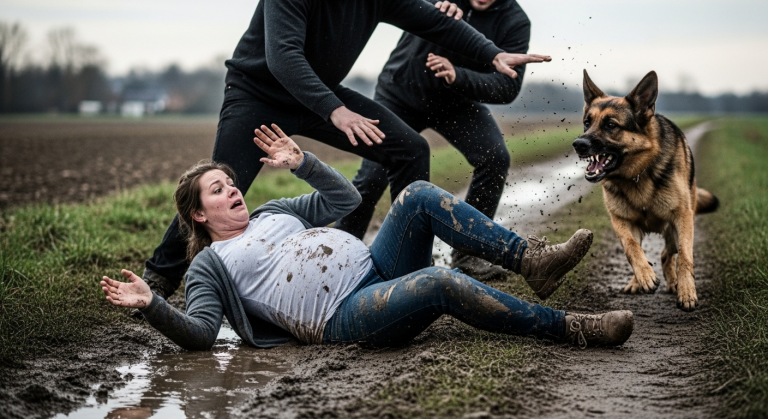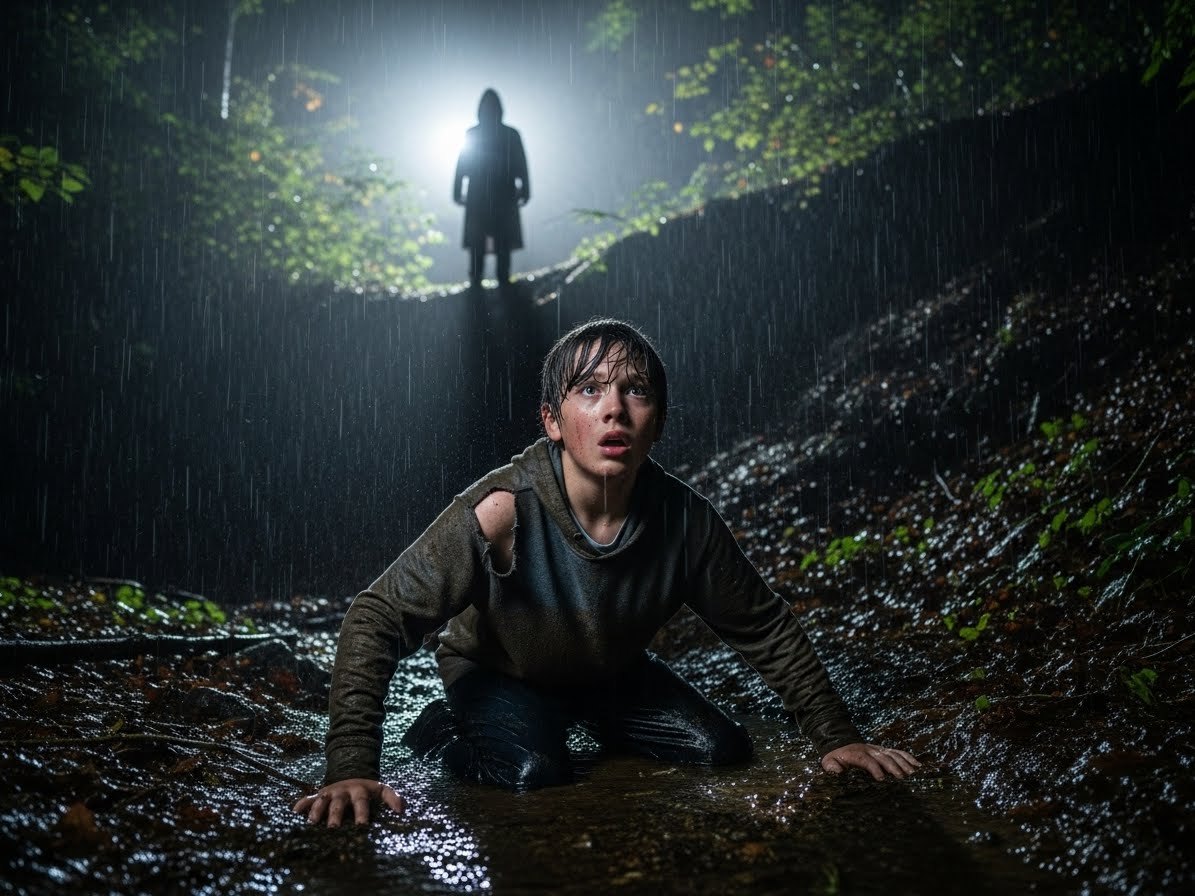
I thought we were playing a game in the woods behind my house until I saw the glint of the knife and realized the hunter wasn’t stopping.
PART 1
Chapter 1: The Silence Before the Scream
It was a Tuesday. I remember that because Tuesday was the day my mom worked the double shift at the diner, leaving me alone in our house at the edge of the Bitterroot National Forest.
I was twelve. Old enough to be trusted with a microwave dinner, but young enough to still be afraid of the dark when the wind howled through the pines.
And the wind was definitely howling that night.
I was sitting on the living room rug, playing a video game. The volume was up, drowning out the storm outside. I was totally zoned in, my thumbs working the controller in a rhythmic blur.
Then, the power cut.
It didn’t flicker. It didn’t buzz. It just died. Instantly. The TV went black. The hum of the refrigerator ceased. The only light came from the screen of my phone, sitting on the coffee table, casting a ghostly blue glow on the ceiling.
Silence rushed into the room like cold water.
I froze. I held my breath, listening.
Usually, when the power goes out in Montana, you hear the transformer pop down the road. Or you hear the thunder that caused it.
But there was no thunder. Just the wind, scratching the branches against the siding.
I reached for my phone. 8:42 PM. I turned on the flashlight app. The beam cut through the living room, illuminating dust motes dancing in the stale air.
“Mom?” I whispered, feeling stupid immediately after. She wasn’t there. She wouldn’t be back until midnight.
I stood up, my socks sliding on the hardwood. I needed to check the fuse box in the garage. Maybe a breaker just tripped.
I walked into the kitchen. The sliding glass door that led to the backyard was a wall of blackness. It reflected my flashlight beam back at me, creating a mirror image of a scared kid in a baggy sweatshirt.
I stopped.
Something was different.
I couldn’t place it at first. The kitchen looked normal. The dishes were in the sink. The magnets were on the fridge.
Then I looked at the floor by the sliding door.
There was a wet footprint.
It was faint. Muddy. And it was inside.
My heart hammered against my ribs like a trapped bird. I traced the beam of my flashlight up from the floor to the door handle.
The latch was down. Unlocked.
I knew—I knew for a fact—that I had locked it after school. Mom had a rule. “Door locked before the sun drops.” I was obsessive about it.
I hadn’t opened it since.
A cold prickle danced down the back of my neck. I wasn’t alone.
I slowly turned the flashlight beam toward the hallway leading to the bedrooms.
“Hello?” I called out, my voice shaking. “Is someone there?”
Nothing. Just the settling of the house.
Then, a floorboard creaked.
It came from right behind me. From the living room I had just left.
I didn’t think. I didn’t turn around to look. A primal instinct, something ancient and buried deep in my DNA, screamed RUN.
I bolted toward the front door.
My hand slapped the deadbolt. I twisted it. It wouldn’t budge.
I twisted harder, panic rising in my throat like bile. It was jammed. Or… blocked from the outside?
“Leo,” a voice said.
It was a man’s voice. Calm. Low. Terrifyingly familiar, but I couldn’t place it. It sounded like gravel crunching under tires.
I spun around, pressing my back against the front door, my breath hitching.
He was standing in the archway between the kitchen and the living room. He was a silhouette against the darkness, but my flashlight caught the glint of something in his right hand.
A hunting knife. The blade was long, serrated, designed to gut elk.
“Don’t make this hard,” he said. He took a step forward.
He was wearing a heavy rain slicker, the kind loggers wear. The hood was up, casting his face in shadow.
I looked at the stairs. If I went up, I was trapped.
I looked at the kitchen. That was where he was.
I looked at the window next to the front door.
He took another step. The boots hit the floor with a heavy, wet thud. He was big. He filled the hallway.
I threw my phone.
It wasn’t a calculated move. It was pure desperation. I chucked it as hard as I could at his head.
He ducked, raising an arm to deflect it.
That was my second.
I grabbed the heavy ceramic umbrella stand by the door and smashed it through the side window.
The glass shattered with a deafening crash. The wind roared in immediately, wet and freezing.
I didn’t care about the jagged shards. I dove through.
I felt glass tear at my sweatshirt, felt a sharp sting on my ribs, but I tumbled out onto the wet front porch.
I scrambled up, slipping on the slick wood.
“You little brat!” he roared from inside. The calmness was gone.
I jumped off the porch railing, landing hard in the mud of the flowerbed.
I didn’t look back. I sprinted toward the treeline.
Our house backed up to thousands of acres of dense forest. It was the only place to go. The nearest neighbor was three miles down the main road, and he would catch me on the asphalt before I made it a hundred yards.
I hit the tree line just as I heard the front door of the house explode outward.
Chapter 2: The Hunter’s Playground
The woods at night are not like the woods during the day.
During the day, they are green and brown and smell like pine needles. At night, they are a grayscale labyrinth of tripping hazards and shadows that look like reaching hands.
I ran until my lungs burned.
I have asthma. Not the mild kind where you wheeze a little after gym class. The kind where your throat closes up like a fist if you push too hard.
And I didn’t have my inhaler. It was in my backpack. Inside the house. With him.
I crashed through a patch of huckleberry bushes, the thorns tearing at my jeans.
Thump-thump. Thump-thump.
My heartbeat was louder than the storm.
I risked a glance over my shoulder.
A beam of light was cutting through the trees behind me. He had a flashlight. A powerful one. It swept back and forth, slicing through the rain like a lightsaber.
He wasn’t running. That was the scariest part.
I was sprinting, scrambling, falling, and getting up again.
He was just walking. Fast, sure-footed strides. Like he knew exactly where I was going. Like he had walked these woods a thousand times.
“Leo!” he shouted. His voice carried over the wind. “It’s cold out there, buddy! You’re gonna get sick!”
The fake concern made my skin crawl. It reminded me of when I broke my arm and the doctor told me it wouldn’t hurt right before he snapped the bone back in place.
I needed to hide. I couldn’t outrun a grown man, especially not with my chest starting to tighten.
I spotted a massive fallen Douglas Fir up ahead. The root ball had been ripped out of the ground, creating a dark, muddy crater behind it.
I dove into the hole, pressing myself into the wet earth. The smell of rot and wet dirt filled my nose.
I covered my mouth with both hands to stifle the sound of my wheezing.
Wheeze… click… wheeze… click.
My chest rattled. It felt like someone was sitting on my sternum.
I watched the beam of his flashlight dancing through the trees.
It got closer.
It swept over the trunk of the tree I was hiding behind.
I squeezed my eyes shut. Please don’t see me. Please don’t see me.
I heard his boots stop. He was maybe twenty feet away.
Silence.
Then, the whistling started.
It wasn’t a tune. It was just a slow, two-note whistle. High, then low. Like he was calling a dog.
Whuuuu-whooooo.
“I know you’re tired, Leo,” he said. He sounded breathless now, but only slightly. “I just want to talk. Your mom sent me.”
My eyes snapped open.
Mom?
For a split second, hope flared in my chest. Did she send someone? Was there an emergency?
But then I remembered the knife. I remembered the jammed door. I remembered the way he had kicked the door open.
Mom wouldn’t send a man with a knife who destroys our house.
He was lying. He was trying to lure me out. He was using my trust against me.
Crunch.
A twig snapped. Closer.
He was moving again. Not toward me, but parallel to me. He was grid-searching.
I realized with horror that this wasn’t a random break-in. He wasn’t looking for a TV or jewelry.
He was hunting. And I was the game.
I waited until the light moved further to the left.
I had to move. If I stayed here, my wheezing would give me away eventually. The cold air was making my asthma worse by the second.
I needed to get to the Old Logging Road. It was about a mile north. If I could get there, maybe I could flag down a logging truck. Or at least run on flat ground.
I crawled out of the hole, mud caking my front.
I moved low, crouching, trying to keep the thick brush between me and his light.
Rain plastered my hair to my forehead. I was freezing. My fingers were numb.
I took ten steps. Twenty.
Then my foot caught on a hidden root.
I went down hard. My knee slammed into a rock.
I bit my tongue to keep from screaming, tasting copper blood.
But the sound of my fall was unmistakable. It was a loud thud followed by the rustle of dry leaves.
The whistling stopped instantly.
The beam of light swung around. It moved fast, erratic, searching.
It hit the tree next to me.
Then the bush I was behind.
Then, it hit me.
I was blinded by the white glare. It felt physical, like a slap. I threw my hand up to shield my eyes.
“Found you,” he whispered.
He was only ten yards away.
I scrambled backward, crab-walking through the mud.
He lunged.
I saw the knife flash in the light.
I rolled to the right just as he brought it down. The blade sank into the mud where my leg had been a second ago.
I kicked out. My sneaker connected with his shin.
He grunted, stumbling slightly.
I scrambled to my feet, ignoring the screaming pain in my knee.
I ran. Blindly. Into the pitch black.
I didn’t care about the noise anymore. I just needed distance.
“You can’t run forever, Leo!” he screamed behind me. He sounded angry now. Really angry. “I’m going to cut your little legs off!”
I tore through a patch of ferns.
My chest was tightening rapidly. The air felt like broken glass sliding down my throat.
I needed my inhaler. I was going to die without it. If he didn’t kill me, the asthma would.
Suddenly, the ground beneath me disappeared.
I had run straight off the edge of a ravine.
I fell, tumbling down the steep slope, smashing into rocks and roots. The world spun in a violent blur of pain and darkness.
I hit the bottom with a splash.
I was in the creek. The water was ice cold, shocking my system.
I tried to stand, but my ankle gave out. I collapsed back into the water.
I looked up at the ridge I had just fallen from.
The flashlight beam appeared at the edge.
He stood there, high above me, looking down into the ravine. The light created a halo around him, making him look like a monster.
“Batter up,” he yelled, his voice echoing off the ravine walls.
Then, he started sliding down the slope after me.
PART 2
Chapter 3: The Cold Embrace
The water in the creek wasn’t just cold; it was a physical assault. It hit me like a sledgehammer made of ice, stealing the breath from my lungs before I even had a chance to scream.
My ankle throbbed with a dull, sickening rhythm, syncing up with the frantic pounding of my heart. I tried to stand, but my left leg buckled immediately. It felt like stepping on a bag of crushed gravel.
Above me, the sounds of the slide continued. Schlhhhk. Snap. Thud.
He was coming down. He wasn’t being careful anymore. He was surfing the mudslide I had created.
I couldn’t outrun him. Not with a busted ankle. Not in waist-deep water.
I needed to disappear.
The creek bank on the far side had been undercut by years of erosion. It formed a deep, shadowed overhang, a sort of cave beneath the roots of a massive cedar tree that leaned precariously over the water.
I threw myself toward it.
I didn’t swim. I clawed. I dragged my body through the freezing current, my fingers digging into the rocky bottom. The stones scraped my palms raw, but the pain was distant, muffled by the adrenaline flooding my system.
I jammed myself under the overhang just as a massive splash echoed through the ravine.
He had landed.
I pulled my knees to my chest, curling into the tightest ball possible. The icy mud of the bank pressed against my back. The gnarled roots of the cedar tree brushed my face like skeletal fingers.
I held my breath.
Or I tried to.
My asthma was flaring. The cold air and the freezing water had tightened my airways into a straw. My lungs were screaming for oxygen.
Wheeze…
It was faint. A tiny, high-pitched whistle on the intake.
I clamped my hand over my mouth and nose. I bit down on my own palm, hard. The taste of blood mixed with the muddy water on my skin.
“Leo…”
His voice was right there. He was standing in the water, maybe ten feet away.
The beam of his flashlight cut through the darkness. It slashed across the water’s surface, illuminating the rain that fell in silver sheets.
He was wading upstream. Toward me.
“I hurt my leg too, Leo,” he said. His voice was conversational, almost friendly. It was the voice of a guy asking for directions at a gas station, not a man hunting a child. ” twisted it on a root. We’re a pair of cripples now, huh?”
He splashed closer.
The water under the overhang rippled as his wake hit me. It washed over my legs, freezing me to the bone. My teeth wanted to chatter. I clenched my jaw so hard I thought my molars would crack.
Sweep. Sweep.
The light played over the far bank. Then the trees. Then the water.
He was looking for ripples. He was looking for a heat signature. He was looking for me.
The light hit the water directly in front of my hiding spot.
I squeezed my eyes shut. I pressed myself back until the roots dug into my spine. I am a rock. I am a shadow. I am nothing.
The light lingered.
For five seconds—which felt like five years—the beam stayed fixed on the water just inches from my face. If he crouched down, if he changed the angle by just a few degrees, he would see the white of my sneakers.
“I know you’re close,” he whispered.
He didn’t sound angry anymore. He sounded excited.
Then, the light snapped away.
“Maybe you went downstream,” he mused aloud. “Current would carry you faster.”
He turned. I heard the heavy slosh of his boots moving away from me.
I didn’t move. I didn’t breathe.
I waited until the light was a distant firefly dancing in the ravine. I waited until the splashing faded into the roar of the wind.
Only then did I let out the breath I had been holding.
It came out as a ragged, wet cough.
I was shivering violently now. Hypothermia was the new enemy. If I stayed in the water, I would die. If I climbed out, he might see me.
But I had to move.
I dragged myself out from under the roots. My limbs felt heavy, like they were filled with lead. My ankle was a balloon of pain, but the cold had numbed it slightly.
I looked up the opposite bank. It was steep, but there were plenty of handholds.
I began to climb.
It was a nightmare of mud and slipping. Every time I pulled myself up, I slid back down a foot. Mud filled my fingernails, my mouth, my ears.
But I kept going. I had to get out of the ravine.
I crested the top of the ridge and collapsed onto a bed of wet pine needles.
I lay there for a moment, staring up at the stormy sky. The rain felt warmer up here, which was a bad sign. It meant my body temperature was dropping dangerously low.
I rolled onto my stomach and looked around.
I was in a part of the forest I didn’t recognize. The trees here were older, thicker. The underbrush was dense.
But about fifty yards ahead, I saw a shape.
It was geometric. Straight lines in a world of curves.
A roofline.
It was a small structure. A shed? A hunting blind?
I didn’t care. It was shelter. It was walls. Maybe it had a lock.
I forced myself up. I couldn’t walk, so I hobbled, using a fallen branch as a crutch.
I moved toward the dark shape, praying it wasn’t a trap. But in the woods, everything is a trap if you’re not careful.
Chapter 4: The Old Cabin
The structure was an old trapper’s cabin. You see them sometimes in Montana, rotting away in the deep woods, leftovers from a time when men disappeared into the mountains for months to hunt beaver and marten.
This one was in bad shape. The roof was sagging like a broken spine. The logs were black with rot. The front door hung on a single rusted hinge, banging softly against the frame in the wind.
Bang. Creak. Bang.
It sounded like a heartbeat.
I limped onto the small porch. The wood groaned under my weight, threatening to snap.
I pushed the door open.
The smell hit me instantly. It wasn’t just the smell of mold and wet wood. It was the smell of something old and dead. Musk. decay. And underneath it all… stale tobacco.
My stomach turned over.
I fumbled for my phone to use the light, then remembered I had thrown it at the killer back at the house.
I was blind.
I waited for my eyes to adjust. A little bit of moonlight was filtering through the gaps in the roof shingles.
The cabin was one room. In the center was a potbelly stove, rusted to a flakey orange. In the corner was a bed frame with no mattress, just a pile of dirty rags.
I limped inside and pushed the door shut. It wouldn’t latch. The wood was too swollen from the damp.
I looked around for something to jam it with.
There was a heavy wooden chair lying on its side. I dragged it over and wedged it under the door handle. It wasn’t a deadbolt, but it would buy me a few seconds.
I needed heat.
I looked at the stove. If I lit a fire, the smoke would give me away instantly. He would see it against the night sky.
No fire.
I moved to the corner, away from the door and the windows. I sat down on the pile of rags. They smelled like wet dog, but they were dry-ish. I pulled them around me, trying to trap whatever body heat I had left.
My chest was tight. Every breath was a battle. The wheezing was louder now. It sounded like a broken accordion in my chest.
I needed a weapon.
I scanned the room. The moonlight illuminated a few objects on a shelf above the stove.
I stood up, my legs shaking, and walked over.
There were a few rusty cans. A glass jar filled with something black. And a heavy iron poker for the stove.
I grabbed the poker. It was solid iron, about two feet long, with a hooked end. It felt heavy and reassuring in my hand.
As I turned back to the door, my foot kicked something on the floor.
It slid across the wood with a metallic skitter.
I crouched down to see what it was.
It was a lighter.
Not an old, rusted Zippo. A bright yellow Bic lighter.
And it was almost full.
I picked it up, my blood running cold.
This lighter hadn’t been here for fifty years. It hadn’t even been here for a year. The plastic was clean.
Someone had been here recently.
I flicked the lighter. The flame sparked to life, casting dancing shadows on the log walls.
I held it up, looking around the room with new eyes.
That’s when I saw the wall next to the bed.
It was covered in carvings.
I stepped closer, the flame trembling in my hand.
They were tally marks. Groups of five, scratched deep into the wood with a knife.
There were dozens of them. Maybe a hundred.
And above the tally marks, carved in jagged, angry letters, was a single word:
FOUND.
I backed away, terror seizing my throat.
This wasn’t just an abandoned cabin. This was a blind. A place where someone waited.
Wait… the tobacco smell.
The man chasing me. When he was in the kitchen, before I ran, I hadn’t smelled it. But now, the memory of his voice… it sounded raspy. Like a smoker.
He knew this place. He probably brought me in this direction on purpose.
I wasn’t escaping. I was running a maze he had built.
I looked at the window. It was small, covered in grime.
Through the glass, I saw a beam of light cut through the trees.
It was higher up the ridge than I expected. He wasn’t in the creek anymore. He had circled around. He was coming from the high ground.
He was coming here.
I killed the flame on the lighter. Darkness swallowed the room again.
I gripped the iron poker until my knuckles turned white.
I couldn’t stay here. If he trapped me in this box, I was dead. There was no back door. The windows were too small to squeeze through quickly.
But if I went out there, I was exposed.
I looked at the floorboards.
One of them, near the stove, looked loose. It was warped, curling up at the edges.
I dropped to my knees and jammed the hooked end of the poker under the board. I pried it up.
It came loose with a groan of rusty nails.
Underneath was a crawlspace. It was tight, filled with dirt and cobwebs, but it was dry.
I heard a footstep on the porch.
The wood creaked.
He was here.
I didn’t have time to think. I slid into the hole in the floor.
I pulled the board back into place above me just as the front door rattled.
Chapter 5: The Cat and Mouse Game
The crawlspace was a coffin.
It smelled of earth and ancient dust. There was barely enough room to turn my head. The floorboards were two inches above my nose.
I could hear everything.
The door handle jiggled. Then, a heavy shove.
The chair I had wedged against the door scraped across the floor with a screech that set my teeth on edge.
The door banged open.
Wind and rain blew into the cabin above me.
Heavy boots stepped onto the floorboards. Thump. Thump.
Dust filtered down through the cracks, landing in my eyes. I blinked, tears streaming down my face, but I didn’t make a sound.
“Leo…”
His voice was right above me.
“I saw the light, buddy. I saw the little flicker.”
He walked to the center of the room. The boards bowed under his weight, pressing down toward my face.
“You’re trying to be smart,” he said. He sounded amused. “Finding shelter. Getting a weapon. I like that. It makes it more fun.”
I heard the metallic clank of him picking something up. The stove poker? No, I had that with me, clutched to my chest.
He was picking up the cans.
“Beans,” he said. “Expired in 1994. I wouldn’t eat those if I were you.”
He dropped the can. It rolled across the floor.
My heart was beating so hard I was terrified the floorboards were vibrating.
I was struggling to breathe. The dust in the crawlspace was murder on my asthma. My lungs felt like they were filled with cement. The urge to cough was a physical pressure building in my throat, expanding like a balloon about to pop.
I buried my face in my sweatshirt sleeve. I breathed through the fabric, trying to filter the air.
Wheeze… click.
“Come out, Leo,” he said. “I have your inhaler.”
My eyes went wide in the dark.
He shook something. It made a familiar rattling sound.
The little plastic canister. The medicine.
“I found it in your backpack,” he said. “You must be tight right now. Chest feels like it’s in a vice, doesn’t it? The air feels thin.”
He was taunting me with my own survival.
“Just come out,” he crooned. “Take a puff. Breathe easy. We’ll go home. Mom is worried.”
Liar.
He walked toward the bed.
I heard him run his hand over the carvings on the wall.
“You see my art?” he asked. “I’ve been working on it for a long time. There’s a spot right there, at the end of the second row, just waiting for a new mark.”
He wasn’t a burglar. He wasn’t a kidnapper. He was a serial killer. And this cabin was his trophy room.
I gripped the poker. If he found the loose board, if he looked down… I would have one shot. One swing at his ankle or his face.
Suddenly, he stopped walking.
He was standing directly on top of the loose board I was hiding under.
The wood groaned. Dust showered down onto my face.
I held my breath until my vision started to spot.
“Hmm,” he grunted.
He shifted his weight.
He knew. He had to know. The board felt different under his feet. It was loose.
He stomped his foot.
Bam.
Dust exploded around me.
Bam.
He stomped again, harder.
He was testing it.
I couldn’t stay here. He was going to stomp right through, or he was going to pry it up and stab me like a fish in a barrel.
I needed a distraction.
I looked around the dark crawlspace. Near my feet, about six feet away, I saw a glimmer of light.
It was a ventilation grate in the foundation. It was small, maybe eight inches high, but the mesh screen was rusted through.
It was my only way out.
But if I moved, he would hear me crawling.
I needed him to move away from the board.
I reached into my pocket. I found a loose coin. A quarter.
I waited for the wind to gust outside, rattling the cabin.
As soon as the wind roared, I flicked the quarter as hard as I could toward the far corner of the crawlspace, away from the vent.
It hit a stone foundation pillar with a sharp clink.
Above me, the boots went still.
“What was that?” he whispered.
He stepped off the board. He moved toward the corner of the room, listening.
Now.
I army-crawled toward the vent. I ignored the pain in my ankle. I ignored the screaming in my lungs.
I reached the grate. I pushed on the rusted mesh.
It gave way with a silent crumble of iron oxide.
I squeezed my head through. Then my shoulders.
It was tight. The stone foundation scraped the skin off my back. My sweatshirt snagged.
I pulled. I kicked.
I popped out into the wet mud under the porch.
I was out.
But I was still under the porch. And he was right above me.
I crawled out from under the decking, into the rain.
I needed to stand up and run. But as I planted my hands in the mud to push myself up, a beam of light hit me from inside the cabin.
He was looking out the window.
He saw me.
“Found you!” he roared.
The glass shattered as he smashed the window out. He didn’t bother with the door. He was climbing through the window, vaulting over the sill with a knife in his teeth.
I didn’t think. I swung the iron poker.
I didn’t swing it at him. I was too far away.
I swung it at the support post of the porch roof. The post that was already leaning, rot eating halfway through it.
CRACK.
The iron hit the rot. The wood splintered.
The corner of the porch roof collapsed.
It came down with a groan of timber and shingles, crashing directly in front of the window, blocking his exit.
I heard him shout in surprise as the debris rained down.
I turned and ran.
I scrambled up the hill, toward the logging road.
My chest was burning. My vision was tunneling. I was running on pure terror now.
I needed help. I needed a car. I needed to breathe.
But the night wasn’t over. And neither was he.
PART 3
Chapter 6: The Road to Nowhere
My escape from the cabin bought me maybe thirty seconds.
The collapse of the porch roof was loud, a chaotic crunch of timber that echoed through the valley. But it wouldn’t hold him for long. A man who hunts children for sport isn’t stopped by a pile of rotten wood.
I scrambled up the slope behind the cabin. It was steep, slick with mud and pine needles. I was practically crawling, digging my fingers into the earth to pull myself up.
My ankle was screaming. It wasn’t just a throb anymore; it was a hot, white spike of agony every time my foot touched the ground.
But my lungs were the real problem.
The asthma attack was fully seated now. My airways were swollen shut. Breathing felt like trying to suck a milkshake through a coffee stirrer.
Wheeze… cough… gag.
I couldn’t get enough air. My vision was starting to swim. Little black spots danced in front of my eyes, mixing with the rain and the darkness.
I needed to reach the logging road. It was the only way out.
I crested the ridge and saw it.
A strip of grey gravel cutting through the black forest. It looked like a scar on the earth.
I stumbled onto the road. My legs gave out, and I collapsed onto the sharp stones.
I lay there for a second, gasping. The rain lashed my face.
Get up. You have to get up.
I forced myself to my hands and knees.
Then, I saw lights.
Headlights.
They were coming from the south, sweeping around a bend in the road about half a mile away. Twin beams of salvation cutting through the storm.
“Help!” I tried to scream.
It came out as a pathetic squeak. My voice was gone. My throat was too tight.
I waved my arms. I tried to stand, but I fell again.
The car was moving fast. Too fast for this weather.
It was a truck. A big, lifted pickup.
I dragged myself to the center of the road. I was going to force them to stop.
The lights got brighter. The roar of the engine grew louder.
Stop. Please stop.
The truck rounded the final curve. The high beams blinded me.
I shielded my eyes, waving frantically with my other hand.
The truck didn’t slow down.
The driver didn’t see me. I was a heap of dark clothes on a dark road in the middle of a downpour.
At the last second, I realized he wasn’t stopping.
I rolled.
I threw my body to the side, toward the ditch.
The truck roared past. The wind from its passing buffeted me. Mud sprayed from the tires, coating my face.
I watched the red taillights disappear around the next bend.
They were gone.
I was alone again.
I lay in the ditch, sobbing. Not tears of sadness, but tears of pure, exhaustion-fueled despair. I was going to die here. I was going to suffocate in a ditch while a killer walked calmly toward me.
Then, I heard it.
The whistling.
Whuuuu-whooooo.
It was coming from the woods below the road. Right where I had climbed up.
“Leo,” his voice drifted up. “That was dangerous. You could have been hit by a car.”
He was on the road.
I heard his boots crunching on the gravel.
He wasn’t running. He wasn’t out of breath. He was just walking.
I couldn’t run anymore. My legs wouldn’t work. My lungs were empty.
I looked around the ditch.
There was a culvert pipe running under the road. A concrete tube, maybe three feet wide.
It was filled with rushing water, but there was a few inches of air space at the top.
I didn’t have a choice.
I slid into the pipe.
The darkness was absolute. The roar of the water was deafening. I crawled in about ten feet, until the water was up to my chin.
I pressed my face against the cold concrete roof of the pipe, gasping for the tiny pocket of air.
I waited.
The crunching footsteps stopped directly above me.
He was standing on the road, right over the culvert.
He knew.
Chapter 7: The Final Bargain
For a long time, nothing happened.
I floated in the freezing water, my body shaking so hard I was creating my own waves inside the pipe.
My chest was on fire. I was dizzy. The lack of oxygen was making my brain fuzzy. I felt like I was drifting away, like falling asleep.
Don’t sleep. If you sleep, you drown.
Then, a light appeared at the end of the tunnel.
He was leaning over the edge of the road, shining his flashlight into the culvert.
The beam hit the water, illuminating the trash and debris floating past me.
“I see you, Leo,” he said. His voice echoed down the pipe, distorted and metallic. “You look like a sewer rat.”
I didn’t move. I couldn’t.
“Come out,” he said. “I have something you need.”
He reached into his pocket and pulled out the inhaler.
He held it in the beam of the light. The little blue plastic canister looked like the most beautiful thing in the world. It was life. It was air.
“One puff,” he said softly. “That’s all it takes. Just one puff and the pain goes away. The tightness in your chest… gone.”
My body lurched forward involuntarily. I wanted it. I needed it.
“I’m not going to kill you right away,” he lied. “I just want to talk. I promise. You come out, take your medicine, and we’ll talk.”
I knew he was lying. I knew as soon as I crawled out of this pipe, he would use that knife.
But I was dying anyway.
The edges of my vision were black. My fingers were numb. I was losing consciousness.
If I stayed here, I drowned. If I went out there, I got stabbed.
But if I went out there… maybe, just maybe, I could get one breath before the end.
I made a choice.
I started to crawl backward, out of the pipe.
“That’s a good boy,” he cooed. “Come on out.”
I emerged from the culvert, coughing up water. I collapsed onto the muddy bank of the ditch.
He was standing at the top of the embankment, looking down at me. He looked like a giant in his rain slicker.
He held the knife in his right hand and the inhaler in his left.
“Throw it,” I wheezed. My voice was barely a whisper.
He smiled. It was a cold, thin smile that didn’t reach his eyes.
“No,” he said. “Come and get it.”
He stepped back, away from the edge. He was luring me up to the road. To the flat ground where he could move freely.
I dragged myself up the embankment. Mud slid under my fingernails.
I reached the gravel. I pulled myself to my knees.
He was standing five feet away.
“Please,” I gasped.
He tossed the inhaler.
It landed in the gravel between us.
“Take it,” he said.
I reached for it.
As my fingers touched the blue plastic, he lunged.
I knew he would. It was the game. He wanted to give me hope before he took it away.
But I didn’t grab the inhaler to use it.
I grabbed it, rolled onto my back, and kicked upward with my good leg.
I wasn’t aiming for him. I was aiming for the inhaler.
I smashed the canister with my heel just as he stepped on it.
CRACK.
The pressurized canister exploded.
It wasn’t a bomb, but it was a sudden, loud POP of compressed gas. A cloud of white mist exploded upward, directly into his face.
Albuterol and propellant sprayed into his eyes.
He roared, stumbling back, clutching his face. “My eyes! You little freak!”
It wasn’t much. It wasn’t a weapon. But it was a surprise.
And in that moment of confusion, I saw my real chance.
He had dropped the knife when he clutched his face.
It was lying on the gravel.
I scrambled for it.
My hand closed around the rubberized grip. It felt heavy. Lethal.
I rolled to my knees and pointed the blade at him.
He blinked, his eyes red and streaming tears. He saw me holding his own weapon.
The smile vanished.
“You don’t have the guts, Leo,” he snarled. “Give me back my knife.”
He took a step forward.
I didn’t retreat. I couldn’t.
“Stay back,” I wheezed.
My chest was tightening to the point of failure. I had destroyed my medicine. I had bought myself seconds, but I had sacrificed my survival.
He saw it. He saw me swaying. He saw the color draining from my face.
“You’re done,” he said. “You’re suffocating. You’re going to pass out in ten seconds.”
He was right.
He took another step.
I gripped the knife with both hands.
I wasn’t going to stab him. I didn’t have the strength.
I turned and ran.
Not away from him.
Toward the edge of the road.
Where the logging deck was.
Chapter 8: The Sunrise
The logging deck was a massive clearing just off the road where the timber company stacked the logs before loading them onto trucks.
There were piles of pine logs stacked twenty feet high. Huge, unstable pyramids of wood.
I ran toward the biggest stack.
“Where are you going?” he yelled, laughing now. He was jogging behind me, taking his time. He knew I was cornered.
I reached the base of the log pile.
There were metal chocks—heavy wedges—holding the bottom logs in place.
If you remove the chocks, gravity does the rest.
I fell to my knees at the corner of the stack.
The chock was jammed in tight. It was a heavy steel triangle.
I jammed the tip of the hunting knife under the chock. I used it as a lever.
My vision was almost gone. I was seeing grey tunnels. My lungs were seizing.
Pull. Pull.
The killer slowed down. He saw what I was doing.
“Don’t!” he screamed. Panic finally entered his voice. “You’ll kill us both!”
He sprinted toward me.
I put every ounce of my fading strength into the knife handle.
The steel groaned.
The chock popped loose.
It pinged away like a bullet.
For a second, nothing happened. The logs hung there, defying gravity.
The killer was ten feet away. He lunged for me.
Then, the mountain moved.
A deep, low rumble shook the ground. The bottom log rolled.
Then the one above it.
Then the whole face of the stack sheared off.
I threw myself sideways, rolling under the heavy steel frame of a parked log loader machine nearby.
The killer didn’t make it.
He tried to turn. He tried to run back toward the road.
But you can’t outrun an avalanche.
The sound was apocalyptic. Hundreds of tons of timber crashed down, snapping like gunshots, churning the earth.
The ground shook so hard my teeth rattled. Dust and bark filled the air.
And then, silence.
Just the sound of the rain.
I lay under the machine, gasping.
I couldn’t breathe. This was it. I had won, but I had lost.
I stared out at the wall of fallen logs.
There was no sign of the man. Just a massive, chaotic pile of wood where he had been standing.
I closed my eyes. The darkness was warm. It was inviting.
Leo?
I heard a voice.
Leo!
It sounded like Mom.
I opened my eyes.
Blue and red lights were flashing against the wet timber.
A siren.
It was faint, but it was getting louder.
The truck. The pickup truck that had passed me.
It had come back.
I tried to crawl out, but I couldn’t move.
A pair of boots appeared in my vision. Not logging boots. Police boots.
“He’s here! I found him!” a voice shouted.
Strong hands grabbed me. I was pulled from under the machine.
Someone put a mask over my face.
Oxygen.
Cool, pure, life-giving oxygen flooded my lungs.
I took a breath. Then another. The vice in my chest began to loosen.
I looked up.
A deputy was kneeling over me. And behind him, crying and running through the mud, was my mom.
She collapsed beside me, grabbing my face, checking me for cuts, kissing my muddy forehead.
“I’ve got you,” she sobbed. “I’ve got you, Leo.”
I looked past her, toward the log pile.
The police were shining spotlights on it.
I saw a hand sticking out from under a massive Ponderosa pine. It was limp. The rain was washing the dirt off the fingers.
It wasn’t moving.
I closed my eyes and took another deep breath of the oxygen.
The wind was still howling, but for the first time that night, I wasn’t afraid of the dark.
Because I knew that when the sun came up, I would still be here to see it.
THE END.