I Saw A Student Tie His Backpack Shut With Heavy Rope Every Morning. When I Heard A Whimper Coming From Under His Desk, I Opened The Bag And Froze.
Part 1
Chapter 1: The Boy with the Yellow Rope
My name is Arthur Henderson. I’ve been teaching fifth grade at Eastside Elementary for twenty-two years. I’ve seen it all. I’ve seen the kids who come to school hungry, the kids who come to school angry, and the kids who don’t want to come at all.
But I never saw a kid like Elias.
Elias joined my class in November, three months into the semester. He was a transfer from out of state—the paperwork was vague, listing only a P.O. Box and a temporary guardian.
He was small for his age, with hollow cheeks and hair that hung in greasy curtains over his eyes. He wore the same oversized gray hoodie every single day.
But the most distinct thing about Elias was his backpack.
It was a JanSport, or it had been once. Now it was a canvas wreck, stained with mud, grease, and things I didn’t want to identify. The main zipper was blown out, the teeth stripped away like a broken jaw.
To keep it closed, Elias didn’t use safety pins or duct tape. He used rope.
A thick, bright yellow nylon rope. The kind you use for towing a car or securing a tarp in a hurricane.
Every morning, Elias would walk into my classroom at 7:55 AM. He wouldn’t look at me. He would go straight to his desk in the back corner. He would place the bag between his feet.
He never used the cubbies. He never used the lockers.
If a classmate walked too close to his desk, Elias would stiffen. His hand would shoot down to check the knot.
“Elias,” I asked him during his first week. “Why don’t you put your bag in the coatroom? You’ll have more legroom.”
He looked up at me. His eyes were dark, rimmed with red, and filled with a frantic, animalistic fear.
“No,” he whispered. “It has to stay with me.”
“Is there something valuable in there? A video game?”
He shook his head. “Just… my stuff. It’s not safe out there.”
I let it go. We are taught to pick our battles. If a kid needs a security blanket, you let him have it until he feels safe enough to let go.
But Elias didn’t let go. He got worse.
By the third week, the smell started.
It wasn’t a strong smell at first. Just a whiff of sourness when you walked past his desk. Like damp clothes that had been left in the washer too long. Or spoiled milk.
I asked the school nurse to check him for hygiene issues. She sent a note home. It came back unsigned. The phone number on file was disconnected.
Then came the rope ritual.
I watched him one morning before the bell rang. He had opened the bag slightly to retrieve a pencil. When he closed it, he didn’t just tie a shoelace knot. He wove the yellow rope through the shoulder straps, around the main body, and tied three distinct double-knots.
He pulled the rope so tight his knuckles turned white. He was sealing it.
“That’s a serious knot, Elias,” I commented, sipping my coffee.
He jumped. He looked at the rope, then at me.
“He can’t get out,” he mumbled.
I frowned. “Who can’t get out?”
Elias’s eyes widened, realizing he’d slipped. “My… my homework. It falls out. The zipper is broken.”
It was a lie. A clumsy, desperate lie.
I made a mental note to call social services that afternoon. I should have done it sooner. I’ll regret that hesitation for the rest of my life.
Chapter 2: The Silent Reading
It was Thursday. 10:15 AM. Silent Reading time.
The classroom was peaceful. Twenty-five kids had their noses buried in Harry Potter or Diary of a Wimpy Kid. The rain was drumming softly against the windows, masking the usual school noises.
I was at my desk, grading math quizzes.
Huff.
I paused. It sounded like a sneeze.
I looked up. No one was moving.
Whimper.
It was soft. High-pitched. The sound a dog makes when it’s dreaming.
I scanned the room. My eyes landed on the back corner.
Elias wasn’t reading. He was staring straight ahead, his posture rigid. He was sweating. Sweat was rolling down his temple, dripping onto his gray hoodie.
His right hand was under the desk. He was patting the bag. Rhythmic, soothing pats.
Thump.
The bag moved.
It didn’t fall over. It kicked.
I stood up slowly. The hair on my arms stood up.
“Elias?”
He didn’t answer. He started to rock back and forth. He was whispering something. I strained to hear it.
“Shhh. Please. Shhh. Not now. Be good. Please be good.”
I walked down the aisle. The other students looked up, sensing the shift in the atmosphere. Kids are like sharks; they know when there’s blood in the water.
“Mr. Henderson?” Jenny, a girl in the front row, asked. “What’s that smell?”
The smell was stronger today. It was pungent. Ammonia. Feces. Rot.
I reached Elias’s desk.
“Elias, son,” I said, keeping my voice low. “We need to look in the bag.”
He looked at me. He was crying. Silent, heavy tears tracking through the grime on his face.
“No,” he whispered. “You can’t. He’s sick. He needs to sleep.”
“Who needs to sleep?”
“The… the puppy,” he lied again. “I found a puppy. Stepdad was gonna drown it. I had to save it.”
A puppy. It made sense. A boy hiding a stray dog. It explained the rope. It explained the smell.
But then the bag made a sound that no dog makes.
It was a cough. A wet, rattling, congested cough that ended in a low moan.
“That’s not a dog, Elias,” I said, my voice hardening. “Stand up.”
“No! He’ll hear you! He’ll kill us both!”
“Who?”
“Stepdad! He said if I told anyone, he’d put us in the river!”
The panic in his voice was contagious. I knew I couldn’t wait for the principal. I couldn’t wait for a counselor.
I knelt down next to the desk. “Elias, move your hands.”
He grabbed the yellow rope. “I can’t untie it! I tied it too tight this morning! I can’t get him out!”
He was clawing at the knots, breaking his fingernails. The bag was shaking now. Whatever was inside was waking up, and it was distressed.
I reached into my pocket and pulled out my Leatherman tool. I flicked the blade out.
“Move your hands, Elias.”
He pulled back, sobbing into his sleeves.
I grabbed the yellow rope. It was greasy. I sawed through the nylon. One loop. Two loops.
The tension released. The bag slumped.
I pulled the flap back.
The smell hit me like a physical blow. I gagged, tasting bile.
I peered into the gloom of the backpack.
There, curled into a fetal ball among candy wrappers and dirty socks, was a child.
A baby boy. Maybe ten months old.
He was wearing a diaper that hadn’t been changed in days. His skin was a terrifying shade of gray. His eyes were crusted shut with infection.
He opened his mouth to cry, but no sound came out. Just a dry, rasping wheeze. He was too weak to scream.
“Oh my God,” I whispered.
I looked at Elias. He was on the floor, curled in a ball, mirroring the baby.
“I tried,” Elias sobbed. “I gave him crackers. I gave him Mountain Dew. It’s all I had. Mom didn’t come back. It’s been three days.”
Part 2
Chapter 3: The Lockdown
For a second, the world stopped.
I was staring at a dying infant in a JanSport backpack.
Then, instinct took over.
“Jenny!” I shouted to the girl in the front row. “Run to the office. Tell Mrs. Gable to call 911. Tell her we need an ambulance in Room 302. Run!”
Jenny bolted.
I reached into the bag. The baby felt cold. dangerously cold. I lifted him out. He was light—too light. Like holding a bundle of dry sticks.
“Okay, okay,” I murmured, cradling him against my chest, trying to share my body heat. “I’ve got you. I’ve got you.”
The rest of the class was standing up now. Some were screaming. Some were filming with phones they weren’t supposed to have.
“Everyone out!” I roared. “Go to the library! Mr. Evans is next door, go to him! Get out!”
They scattered.
I sat on the floor with the baby. I used my thumb to wipe the crust from his eyes. He blinked up at me, his gaze unfocused.
“Elias,” I said. “Elias, look at me.”
Elias looked up. He was shaking so hard his teeth were chattering.
“You did good,” I told him fiercely. “You kept him alive. You saved him.”
“Is he dead?” Elias asked, his voice tiny.
“No. He’s breathing. The doctors are coming.”
The baby wheezed again, his little chest hitching. I saw bruises on his arms. Fingerprint marks. Dark purple against the pale skin.
“Where is your stepfather, Elias?” I asked.
Elias flinched. He looked at the door. “He works at the garage. But he comes home at lunch. If he sees the bag is gone… if he sees Toby is gone…”
“Toby? His name is Toby?”
“Yeah. Tobias.”
“Okay. Stepdad isn’t coming here. The police are coming.”
The door burst open.
It wasn’t the police. It was the school nurse, followed by the principal.
“Oh, dear Lord,” the nurse gasped, dropping her kit and sliding to her knees beside me. She immediately checked for a pulse.
“Pulse is thready,” she barked. “Respiration shallow. He’s severely dehydrated. Arthur, keep him warm.”
“I’m trying.”
“Police are two minutes out,” the principal said, his face white as a sheet. He looked at Elias. “Elias, son, we need to know. Is anyone else in your house?”
Elias shook his head. “Just Mom. But she… she’s asleep. She won’t wake up.”
My stomach dropped. “What do you mean she won’t wake up?”
“She took the needle,” Elias whispered. “On Monday. She sat in the chair and went to sleep. Stepdad said to leave her alone.”
Monday. It was Thursday.
The mother was dead. The stepfather had left her body in the house, and left a ten-year-old to care for a baby, threatening to drown them if they told.
And Elias, in his desperate, ten-year-old logic, decided the safest place for his brother was school.
Chapter 4: The Intruder
The sirens were loud now. I could hear them peeling into the parking lot.
But I heard something else, too.
A heavy diesel engine idling right outside the classroom window.
My classroom is on the ground floor, facing the back parking lot near the loading dock.
I looked up. Through the blinds, I saw a black pickup truck. Rusted wheel wells. A cracked windshield.
Elias saw it too. He let out a shriek that I will never forget.
“It’s him! It’s the truck! He knows!”
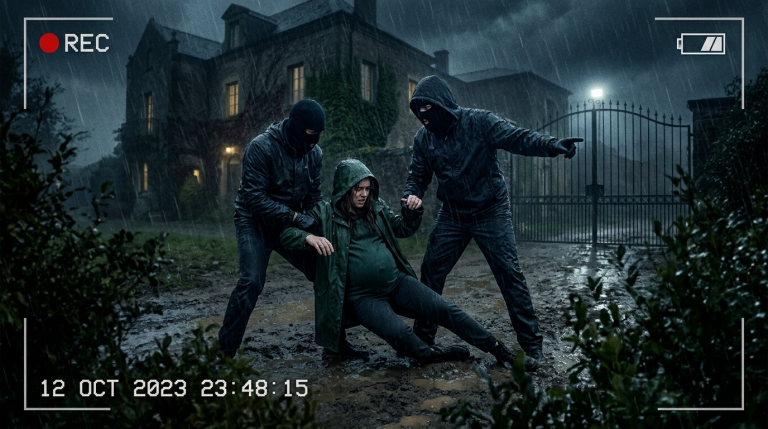
The truck door opened. A man stepped out.
He was huge. Wearing a grease-stained mechanic’s jumpsuit. He had a shaved head and a beard that looked like wire wool. He was holding a tire iron.
He didn’t go to the main entrance. He walked straight toward my classroom window.
He must have tracked the phone. Or maybe he just knew the schedule. Or maybe he was coming to finish what he started.
“Lock the door!” I yelled to the principal.
The man outside swung the tire iron.
SMASH.
The glass of the emergency exit door shattered.
“He’s here!” Elias screamed, scrambling under my desk.
The nurse shielded the baby with her body.
I stood up. I am a teacher. I wear cardigans. I teach long division. I am not a fighter.
But I looked at that baby gasping for air. I looked at Elias terrified under the desk.
I grabbed the heavy metal fire extinguisher from the wall.
The man stepped through the broken glass, crunching shards under his boots. He smelled like gasoline and violence.
“Where is the brat?” he roared. “Give me the bag!”
He saw me holding the extinguisher. He laughed.
“Sit down, teach. This ain’t your business.”
“Get out,” I said. My voice sounded strange to my own ears. Calm. Cold. “The police are here.”
“I got two minutes before they get inside,” the man growled. “Plenty of time to toss some trash.”
He lunged for the nurse.
Chapter 5: The Lesson
I didn’t think. I reacted.
As he lunged, I swung the fire extinguisher. I didn’t aim for his head. I aimed for his knee.
CRACK.
The steel tank connected with his kneecap. It was a sickening sound.
The man howled and buckled, dropping the tire iron. He hit the floor, clutching his leg.
“You broke my leg!” he screamed.
“I’ll break the other one if you touch them!” I yelled, raising the tank again.
He tried to crawl toward the nurse. He was fueled by meth and rage. He reached out a dirty hand to grab the baby’s leg.
I pulled the pin on the extinguisher.
I aimed the nozzle at his face.
I squeezed the trigger.
A cloud of white chemical powder blasted him point-blank in the eyes and mouth. He gagged, blinded, coughing and retching.
“I can’t see! I can’t see!”
“Stay down!” I screamed.
The classroom door flew open.
“POLICE! DROP IT!”
Three officers stormed in, guns drawn. They saw me standing over a blinded, weeping giant with a fire extinguisher, while a nurse huddled over a baby.
“He’s the threat!” I yelled, pointing at the man. “He’s the stepfather!”
The officers swarmed him. They cuffed him and dragged him out, still screaming about his eyes.
Paramedics rushed in past the cops. They took Toby from the nurse. They put an oxygen mask on his tiny face.
“He’s critical,” one medic said into his radio. “We’re moving. Code 3 to Children’s Hospital.”
They loaded Toby onto a gurney.
Another medic went to Elias.
“Come on, son,” the medic said gently. “Let’s get you checked out.”
Elias refused to move. He was staring at me.
“Mr. Henderson?”
“I’m here, Elias.”
“Did you kill the bad man?”
“No,” I said, putting a hand on his shoulder. “But I made sure he isn’t coming back.”
Elias looked at the empty, cut-open backpack on the floor. The yellow rope lay beside it, severed and useless.
“I’m sorry I ruined class,” he whispered.
I pulled him into a hug, ignoring the smell, ignoring the dirt. I hugged him until he started to cry, real tears of relief.
“You didn’t ruin anything, Elias. You’re the bravest boy I’ve ever met.”
Part 3
Chapter 6: The Ghost in the Machine
The hospital smells the same everywhere. Antiseptic, floor wax, and bad coffee.
I spent the next three days sleeping in a plastic chair in the Pediatric ICU. I wasn’t technically family, but the nurses knew who I was. I was “The Fire Extinguisher Guy.” They let me stay.
Elias refused to leave Toby’s side.
The doctors told us the extent of the damage. Toby was severely dehydrated, malnourished, and had a respiratory infection from breathing in the dust and lint inside the backpack. But he was a fighter. By the second day, the gray color had left his skin. By the third day, he opened his eyes and looked at Elias.
It was the first time I saw Elias smile. It wasn’t a big smile—just a small quirk of the lips—but it was there.
The police came to interview me. Detective Miller, a gruff man with kind eyes, took my statement.
“You did a hell of a thing, Henderson,” he said, closing his notebook. “The stepfather… his name is Frank. He has a rap sheet a mile long. We found the mother in the house. It looks like an overdose. The coroner says she’s been gone since Monday.”
I felt a wave of nausea. Elias had been living in a house with his mother’s body for three days, terrified, caring for a baby, knowing that if he made a sound, Frank would kill them.
“Did Frank talk?” I asked.
“He’s talking a lot,” Miller said grimly. “Mostly about suing you for blinding him. But don’t worry. The DA is throwing the book at him. He’s never seeing the outside of a cell again.”
Miller left, and I walked back into the room.
Elias was peeling an orange. He offered a slice to me.
“Mr. Henderson?”
“Yeah, Elias?”
“What happens when Toby gets better? Do we go back to the house?”
He asked it so casually, but I saw his hand tremble.
“No,” I said firmly. “You are never going back to that house. The police put ‘Do Not Enter’ tape all over it.”
“So where do we go?”
That was the question I had been dreading.
Chapter 7: The System
The answer came in the form of Mrs. Klein, a social worker from Child Protective Services. She was a nice woman, overworked and underpaid, carrying a stack of files that looked ready to topple over.
She pulled me into the hallway on Friday afternoon.
“We have a problem,” she said, straight to the point.
“What is it?”
“We can’t find any kin. No grandparents listed on the birth certificates. No aunts or uncles who answer the phone. They are effectively alone.”
“Okay,” I said. “So you find a foster home.”
Mrs. Klein rubbed her temples. “It’s not that easy, Mr. Henderson. Toby is now a ‘medically fragile’ placement. He needs monitoring for his lungs. Elias is a ten-year-old trauma victim. There are very few foster homes that take siblings, especially when one has high medical needs. The protocol… the protocol is usually to separate them to ensure the baby gets the medical care.”
I felt the blood drain from my face.
“Separate them?” I hissed. “You can’t. Elias is the only reason that baby is alive. He carried him in a backpack. If you take Toby away, you destroy Elias.”
“I know,” she said, her voice cracking. “I hate it. But I have to follow the regulations. Unless a kinship placement steps forward—someone who knows the children and has a pre-existing bond—I have to put Toby in a medical home and Elias in a group home.”
I looked through the glass. Elias was stroking Toby’s hair. He was whispering to him. Probably telling him it was safe now.
I thought about my quiet life. My books. My Sunday mornings with the crossword puzzle. My silence.
Then I thought about the yellow rope.
Elias had knotted that rope to hold his world together. He had taken on a burden no child should bear.
I couldn’t let the system cut the rope now.
“I’ll take them,” I said.
Mrs. Klein blinked. “Excuse me?”
“I’ll take them. I’m their teacher. That’s a pre-existing bond. I’m ‘kin’ by community.”
“Mr. Henderson,” she stammered. “You’re… you’re a single man. You work full time. You have no experience with infants.”
“I have a master’s degree in child development,” I countered. “I have a steady income. I have a clean record. And I have something no foster home has.”
“What’s that?”
“I love that boy,” I said, pointing at Elias. “And I will fight for him.”
Mrs. Klein looked at me for a long moment. Then, a slow smile spread across her tired face.
“Get your apartment certified,” she said. “I can fast-track the background check since you’re a school employee. It’s going to be hard, Arthur. Really hard.”
“I know,” I said. “But I have a fire extinguisher.”
Chapter 8: The New Backpack
The next six months were the hardest of my life.
I learned that babies don’t sleep. I learned that formula stains everything. I learned that trauma doesn’t disappear just because you’re safe.
Elias had nightmares. He would wake up screaming, checking under his bed for the yellow rope. He would hoard food in his pockets.
But slowly, the knots began to loosen.
We went to therapy. We painted his new room blue—bright blue, not the dirty blue of the old bag. We visited Toby in his crib (which was now in my bedroom) every morning.
The court battle was long. Frank tried to cause trouble from prison, claiming parental rights. But the judge—a stern woman who had seen the photos of the backpack—shut him down in five minutes.
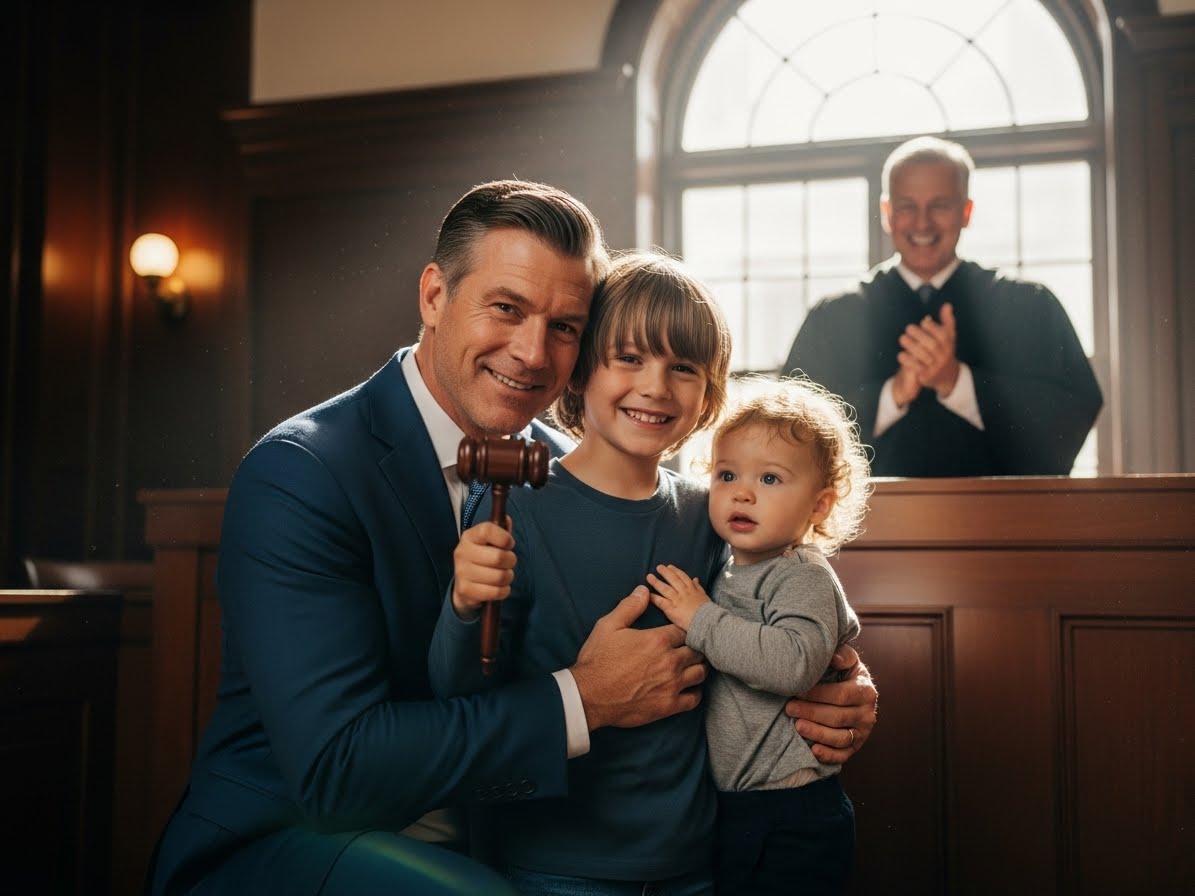
“Mr. Henderson,” the judge said at the final hearing. “You are asking to adopt two boys. You are fifty-one years old. Why?”
I stood up. Elias was next to me, wearing a suit that was slightly too big.
“Because, Your Honor,” I said. “Elias taught me something. He taught me that you do whatever it takes to protect the people you love. He carried his brother. Now it’s my turn to carry them.”
The gavel banged.
Adoption Granted.
We walked out of the courthouse into the bright sunlight. Toby was in a stroller, laughing at a pigeon. Elias was walking beside me.
“So,” I said. “We need to stop at the store.”
“Why?” Elias asked.
“School starts on Monday,” I said. “You need supplies.”
Elias froze. He looked down at his feet. The old trauma flared up. School meant hiding. School meant the bag.
“It’s okay,” I said gently. “We’re going to get a new bag.”
We went to Target. We walked down the aisle of backpacks. There were superhero bags, plain bags, patterned bags.
Elias walked slowly. He touched a few. Then he stopped in front of a bright red one. It had a sturdy zipper.
He unzipped it. He looked inside. It was empty. Clean.
He looked at me.
“Do I need rope?” he asked quietly.
I knelt down in the aisle, right there in front of the binders and pencils.
“No, son,” I said. “You never need rope again. This bag is for books. Just books. And maybe a lunch.”
“And Toby?”
“Toby stays with the babysitter. Or with me. He doesn’t go in the bag.”
Elias took a deep breath. He picked up the red backpack. He zipped it shut. Zip. It was a clean, smooth sound.
He put it on his shoulders. He stood a little taller.
“Ready?” I asked.
“Ready, Dad,” he said.
It was the first time he had called me that.
I tried to keep it together, but I think I got some dust in my eye.
We walked out of the store, a father and his two sons. The yellow rope was gone, cut away and thrown in the trash where it belonged. But the bond that replaced it—the invisible knot that tied the three of us together—was something that no knife could ever sever.
[STORY COMPLETE]