I Screamed At A Homeless Girl To Get Away From My Bakery Table, But When She Handed Me A Note From Her “Mommy,” I Realized I Just Evicted My Own Granddaughter.
Chapter 1: The Fortress of Solitude
My name is Arthur Sterling. If you live in Manhattan, you know my name. It’s on the skyline. Sterling Tower. Sterling Plaza. Sterling Heights. I deal in steel, glass, and eviction notices. I don’t deal in feelings. Feelings are variables, and variables are bad for the bottom line.
At sixty-five, I had successfully curated a life of absolute, pristine isolation. I had a penthouse overlooking Central Park that was quiet enough to hear a pin drop on the velvet carpets. I had a driver who knew never to speak unless spoken to. And I had a net worth that could buy a small European country.
But I ate breakfast alone. Every single day.
My routine was sacred. It was the armor I wore against the chaos of the world. 8:00 AM sharp. Le Petit Four, a high-end bakery on 5th Avenue. I sat at the corner table—Table 4. I drank my black coffee, imported from a specific region in Ethiopia. I read the Wall Street Journal. And I ignored the human race.
But for the last week, the human race had decided to annoy me.
She was there again.
A little girl. Maybe seven years old. A smudge of humanity on my pristine view.
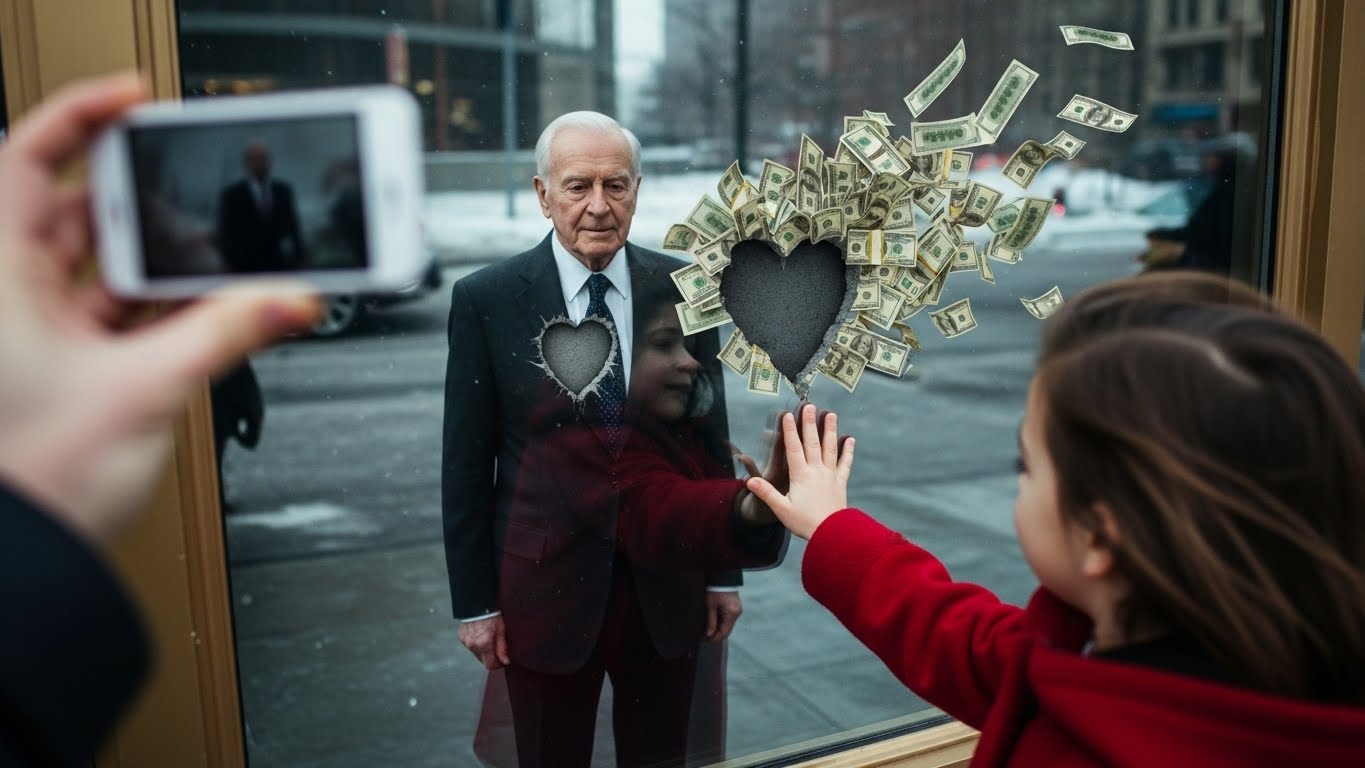
She was sitting on the freezing pavement directly outside the bakery window, wrapped in a puffer coat that was three sizes too big. It was a dirty, faded pink, stained with mud and city grime. She didn’t have a cup for coins. She didn’t have a cardboard sign with a sob story.
She just stared.
Her nose was pressed against the glass, her breath fogging up the windowpane as she looked at the display case. Specifically, she was fixated on the Strawberry Chiffon Cake—the bakery’s signature dessert, a three-tiered masterpiece of cream and spun sugar that cost eighty dollars a slice.
It irritated me.
It ruined the aesthetic. It made the customers inside—women in furs and men in power suits—shift uncomfortably in their seats. It was bad for business. And if it was bad for business, it was my problem.
“Pierre,” I snapped, not looking up from my stock report.
The waiter, a thin man who feared me more than God, rushed over. “Yes, Mr. Sterling? More coffee?”
“Why is she still there?” I asked, gesturing with my Montblanc pen toward the window. “I told you yesterday to call the police. She’s a vagrant.”
“I… I tried, Mr. Sterling,” Pierre whispered, wringing his hands. “I went out there. She won’t move. She says she’s waiting for someone. She’s very polite, sir. She doesn’t ask for money.”
“Waiting?” I scoffed, folding my newspaper with a sharp snap. “She’s waiting for a bleeding heart to drop a twenty in her lap. It’s a tactic, Pierre. Guilt is a currency, and she’s spending it.”
I looked at her again. She hadn’t moved. She was just watching the cake, mesmerized.
“I’ll handle it,” I said, standing up.
“Sir, you don’t have to—” Pierre started.
“Clearly, I do,” I interrupted. “Because you lack the spine.”
I adjusted my five-thousand-dollar suit jacket, checked my reflection in the brass mirror, and marched toward the door. The little bell chimed above my head—a cheerful sound that contrasted sharply with the ice in my veins.
I pushed the door open. The December wind hit me like a physical blow, biting and cruel. Manhattan was in the grip of a freeze, the kind that turns the city into a grey tomb.
“Hey!” I barked, my voice booming over the traffic noise.
The girl jumped. She pulled her knees to her chest, looking up.
Her face was smudged with dirt, but her eyes…
They were green. Startlingly, painfully green. Like emeralds caught in a sunbeam.
For a split second, I felt a ghost walk over my grave. I knew those eyes. I had seen those eyes across a dinner table ten years ago, screaming at me through tears.
Sarah.
I crushed the thought instantly. Sarah was gone. I had made sure of that.
“You,” I pointed a gloved finger at the street. “You are scaring away the customers. You are fogging up the glass. If you want money, go to a shelter. If you want food, go to a soup kitchen. But get away from this window. You’re bad for property values.”
She didn’t cry.
Most kids would have cried. They would have run.
Instead, she scrambled to her feet. She was tiny. Malnourished. She reached into her dirty pocket, her hand shaking violently from the cold. Her knuckles were red and chapped, cracked to the point of bleeding.
She pulled out a crumpled, grease-stained piece of notebook paper.
“I don’t want money, sir,” she whispered. Her voice was thin, like a wind chime made of glass. “I just wanted to give this to the Baker.”
I frowned, confused. “The baker? The chef is in the kitchen. Go around back if you want to beg for crusts.”
“No,” she shook her head stubbornly. She looked at me with an intensity that stopped my heart. “My mommy said you are the Baker. She said you make the strawberry cake. She pointed you out to me yesterday.”
The world tilted on its axis.
“Give me that,” I snatched the paper from her hand.
I wanted to drop it. It was filthy. It smelled of cheap frying oil and sickness.
But I opened it.
Chapter 2: The Drawing in the Grease
It was a child’s drawing. Done in wax crayon.
It showed a tall stick figure of a man in a grey suit. He was holding the hand of a little girl in a pink dress. In the man’s other hand, he was holding a giant, disproportionate strawberry cake.
Underneath the man, in jagged block letters, it said: GRANDPA THE BAKER.
I stared at it. My throat felt dry.
“Turn it over,” the girl whispered.
I flipped the paper.
On the back, written in shaky, spidery handwriting—handwriting that looked like it had been penned by someone too weak to hold the pen steady—were three sentences.
“Daddy, please don’t be mad at her. I told her you were a baker because I didn’t want her to know you were the man who evicted us. I wanted her to love you. Please, give her a slice. – Sarah.”
The air left my lungs.
The noise of the city—the taxis, the sirens, the shouting pedestrians—went silent. It was as if someone had hit the mute button on reality.
My knees buckled. For the first time in thirty years, Arthur Sterling stumbled. I had to grab the cold metal railing of the bakery to stop myself from falling into the snow.
Sarah.
My daughter.
The daughter I had disowned ten years ago.
The memory hit me like a freight train. She had stood in my office, twenty-two years old, full of fire. She wanted to go to culinary school. She wanted to bake.
“I’m not paying for you to make cupcakes, Sarah,” I had told her, my voice cold. “You go to law school, or you get out. You’re a Sterling. We own the city; we don’t feed it.”
She had chosen the cupcakes. And I had chosen my pride. I cut her off. I changed the locks. I never spoke to her again.
And now… this.
I looked down at the girl. She was shivering, hugging herself for warmth.
“Who is your mother?” I rasped, my voice unrecognizable.
“Sarah,” the girl said. “My name is Maya.”
“Where is she?” I demanded, gripping the paper so hard it tore. “Where is Sarah?”
Maya looked down at her boots, which were held together with duct tape.
“She’s at home,” Maya said softly. “She’s sleeping. She sleeps a lot now. She told me to come find you. She said… she said you fix things.”
She told her I was a baker.
The lie twisted in my gut like a knife. Sarah hadn’t told her daughter that her grandfather was a monster. She hadn’t told her that I was a billionaire tyrant who had let them starve.
She told her I made cakes. She tried to make me a hero in this child’s eyes.
Why?
“Take me to her,” I commanded. “Now.”
“But… the cake?” Maya looked at the window. “Mommy really wants a taste. She hasn’t eaten in two days.”
I felt a tear—hot and foreign—burn the corner of my eye.
I turned to the window. Pierre was watching, nose pressed against the glass.
“Pierre!” I roared, slamming my hand against the pane.
He jumped and ran to the door. “Mr. Sterling?”
“Bring the cake,” I ordered.
“A slice, sir?”
“The whole thing,” I screamed. “Bring the whole damn cake! And box it up. Now!”
Pierre scrambled.
I took off my five-thousand-dollar wool coat. I draped it over Maya’s shoulders. It swallowed her whole. She looked up at me, eyes wide.
“It’s warm,” she whispered.
“Let’s go,” I said, my hand trembling as I took hers. Her hand was so small. So cold.
I signaled my driver, who was idling at the curb in the Rolls Royce.
“We’re not going to the office,” I told him as Pierre ran out with the cake box.
“Where to, sir?”
I looked at Maya. “Where do you live?”
“The basement,” she said. “On 142nd Street.”
Harlem. The slums.
“Get in,” I told her.
As the car pulled away, leaving the warmth of 5th Avenue behind, I realized I wasn’t the Ice King anymore. The ice was cracking, and what was underneath was bleeding. Here is Part 2 of the story (Chapters 3, 4, and 5).
—————-FULL STORY (PART 2)—————-
Chapter 3: The Basement of Ghosts
The Rolls Royce glided through the city, a silver shark swimming through a sea of grey slush. The transition from the Upper East Side to Harlem was jarring. The holiday lights thinned out. The doormen vanished. The buildings grew squat, dark, and weary.
Maya sat next to me on the leather seats, her legs not even reaching the edge. She was still wearing my coat, drowning in the cashmere wool. On her lap, she balanced the white box from Le Petit Four as if it contained the Crown Jewels.
She didn’t speak. She just stared out the window, watching the world blur by.
“Does your mother… does she talk about me?” I asked. The silence in the car was suffocating me.
Maya looked at me. “Sometimes. When the pain is bad.”
“What does she say?”
“She says you work very hard. She says your hands are magic with flour.” Maya paused. “Why do you wear a suit to bake, Grandpa?”
The word Grandpa hit me like a physical blow. It was a title I hadn’t earned. A title I had bought with a lie I didn’t even tell.
“I… I have to meet customers,” I lied. “Show me where to turn.”
We stopped in front of a crumbling brownstone on 142nd Street. The windows were boarded up on the first floor. Graffiti scarred the brickwork. It was a building I would have marked for demolition without a second thought.
“Here,” Maya said.
She scrambled out of the car. I followed, telling my driver to wait.
We didn’t go up the front steps. We went down. To the cellar entrance.
The smell hit me first. Dampness. Mold. And beneath that, the sickly-sweet, unmistakable scent of decay.
Maya pushed open a rusted metal door.
“Mommy?” she called out into the darkness. “I found him! I found the Baker!”
The apartment was a single room. It was freezing—colder inside than it was on the street. A single bare bulb hung from the ceiling, casting harsh shadows on the peeling paint. There was a hot plate in the corner, a pile of clothes, and a mattress on the floor.
On the mattress lay a skeleton.
That was my first thought. It wasn’t a woman. It was skin stretched over bone. Her hair, once the same golden color as her mother’s, was thin and dull. Her eyes were sunken into dark hollows.
But when she turned her head, I saw her.
Sarah.
My Sarah.
She blinked, her eyes adjusting to the light. When she saw me standing in the doorway in my bespoke suit, clutching a cake box that Maya had handed me, she didn’t smile.
She started to cry.
“You came,” she whispered. Her voice was a rattle in her chest.
I walked over. My Italian leather shoes crunched on the grit of the concrete floor. I fell to my knees beside the mattress, ignoring the filth.
“Sarah,” I choked out. “My God. Sarah, what happened?”
“Life,” she wheezed, trying to sit up but failing. “Cancer. Ovarian. Same as Mom.”
I froze. My wife had died of ovarian cancer twenty years ago. We had caught it too late. And now… history was repeating itself in a basement in Harlem.
“Why didn’t you call me?” I demanded, anger mixing with the grief. “I have the money. I have the doctors. I could have saved you!”
“You said…” Sarah coughed, a wet, hacking sound that shook her frail body. “You said if I walked out that door, I was dead to you. I didn’t want to be a burden. I wanted to prove I could make it.”
“You were starving!” I roared, gesturing at the room.
“I made it… for ten years,” she whispered. “I had a bakery, Dad. ‘Sarah’s Sweets.’ It was beautiful. But then I got sick. The insurance… the rent… it all went.”
She looked at Maya, who was standing by the door, looking terrified.
“I didn’t call for me,” Sarah said softly. “I sent her to you. I knew… I knew you couldn’t hate her. No one can hate her.”
Chapter 4: The Last Meal
“Maya,” Sarah said, her voice gaining a momentary strength. “Did you get the cake?”
“Yes, Mommy!” Maya ran over. “Grandpa brought the whole thing!”
“Open it,” Sarah smiled.
I placed the box on the floor. I undid the silk ribbon. I lifted the lid.
The Strawberry Chiffon Cake sat there, perfect and absurd in this setting. The whipped cream peaks were white as snow. The strawberries were glazed and gleaming.
“It’s beautiful,” Sarah breathed. She looked at me. “Just like you used to make… in my stories.”
I realized then what she had done. She hadn’t just protected my image; she had created a fantasy version of me to comfort herself. In her mind, I wasn’t the tyrant CEO. I was the father who used to make pancakes on Sunday mornings before I got rich, before I got cold.
“I… I brought a knife,” I stammered, patting my pockets, realizing I had nothing.
“It’s okay,” Sarah said. “Use your hands. We’re not fancy here.”
I broke off a piece of the cake. My hands, which signed million-dollar contracts without shaking, were trembling so hard I almost dropped it.
I held the piece to Sarah’s lips.
She took a bite. She closed her eyes.
“Sweet,” she whispered. “It tastes like… home.”
She swallowed with difficulty. Then she looked at Maya.
“Eat, baby. Grandpa made it for you.”
Maya didn’t wait. She dug in with her hands, devouring the cake with the ferocity of a child who hadn’t eaten a real meal in days. Cream smeared on her face. She looked happy.
For a moment, in that freezing basement, we were a family. A broken, tragic, lying family, but a family nonetheless.
“Dad,” Sarah beckoned me closer.
I leaned in, my ear hovering over her lips.
“I’m tired,” she said.
“No,” I said firmly. “No, you are not giving up. I am Arthur Sterling. I am making a call. I’m getting the best oncologist in the city. We’re going to Mount Sinai. We’re going to fix this.”
I reached for my phone.
Sarah’s hand, cold and bony, grabbed my wrist. Her grip was surprisingly strong.
“It’s too late,” she said. “The doctors gave me two weeks… a month ago. I’m running on fumes, Dad.”
“Don’t say that.”
“Listen to me,” she hissed. “I don’t need a hospital. I need a promise.”
She looked at Maya, who was licking icing off her fingers, oblivious to the conversation.
“She has no one,” Sarah said. “Her father left before she was born. I have no friends left. If I die… the state takes her. They’ll put her in the system.”
Tears streamed down her hollow cheeks.
“You failed me, Dad,” she said. It wasn’t an accusation; it was a fact. “You let me go. But her? She’s innocent. She thinks you’re a hero. She thinks you’re the Baker.”
“I will take her,” I vowed. “I swear, Sarah. She will have everything. The best schools. The best clothes. She will never be cold again.”
“Not money,” Sarah shook her head. “She doesn’t need your money. She needs you. She needs the man you’re pretending to be right now. Can you be him? Can you be the Baker?”
I looked at my daughter. I saw the twenty-two-year-old girl I had kicked out. I saw the wasted years. The silence I had bought with my pride.
“I will be him,” I whispered. “I promise.”
Chapter 5: The Long Night
We didn’t go to the hospital. Sarah refused. She wanted to be with Maya.
I called my driver. “Go to the penthouse. Bring blankets. Pillows. Bring the heater from the guest room. Bring food. Soup. Bread. Everything.”
“Sir?” the driver asked, confused.
“Do it!” I screamed into the phone.
I spent the night on the floor of a basement in Harlem. I, Arthur Sterling, who hadn’t worn a shirt twice in ten years, sat in the dirt, holding my dying daughter’s hand.
Maya fell asleep curled up at the foot of the mattress, wrapped in my coat.
Sarah drifted in and out of consciousness.
Around 3 AM, she woke up. Her breathing was shallow. The “death rattle”—a sound I remembered from my wife’s passing—had started.
“Dad?” she whispered.
“I’m here.”
“Did I… did I make a good bakery?” she asked, her eyes unfocused.
“The best,” I lied, tears dripping off my chin onto her hand. “You were the best baker in New York. I was jealous. That’s why I was angry. I was jealous of your talent.”
A faint smile touched her lips.
“I knew it,” she breathed.
She squeezed my hand.
“Take care of my little muffin,” she murmured.
And then, the squeeze loosened.
Her chest rose one last time, hitched, and fell.
The silence returned to the room. But this time, it wasn’t the silence of my penthouse. It wasn’t a peaceful silence. It was a silence that screamed.
I sat there for a long time. I didn’t move. I just held her hand until it turned cold.
I looked at Maya. She was still sleeping, her chest rising and falling in a rhythm that Sarah’s never would again.
I had spent my life building towers. I had spent my life accumulating power. I thought I was a giant.
But as I sat next to the body of the child I had failed, I realized the truth.
I was a small, small man. And I had just been given a job that was too big for me.
I had to tell a seven-year-old girl that her mother was gone.
And then, I had to figure out how to become a baker. Here is the final part of the story (Chapters 6, 7, and 8).
—————-FULL STORY (PART 3)—————-
Chapter 6: The Morning After
The sun did not rise the next morning. The sky just turned a lighter shade of grey, illuminating the cracks in the basement walls.
Maya woke up first.
She sat up, rubbing her eyes, still wrapped in my cashmere coat. She looked at me, sitting in the chair I had dragged over, keeping vigil. Then she looked at Sarah.
Children know. There is a primal instinct in them that understands stillness.
Maya didn’t scream. She didn’t shake her mother. She just crawled up the mattress and laid her head on Sarah’s silent chest.
“Mommy?” she whispered.
“Maya,” I said, my voice cracking. I reached out to touch her shoulder.
“She’s cold,” Maya said. She looked at me, her green eyes wide and terrifyingly calm. “Is she gone?”
“Yes,” I said. “She’s gone.”
Maya nodded slowly. Tears spilled over her eyelids, tracking through the dirt on her face. “She said she was going to go. She said the angels were coming to eat cake with her.”
She buried her face in the blanket and began to sob. It was a small, high-pitched sound that tore through the remaining shreds of my heart.
I picked her up. She didn’t resist. She was limp, like a doll with the stuffing pulled out. I held her against my chest, rocking her back and forth in that dank, miserable room.
“I’ve got you,” I whispered. “Grandpa’s got you.”
The next few hours were a blur of bureaucracy. The coroner. The police. The questions.
“Who are you to the deceased?” the officer asked, looking skeptically at my suit and the squalor around us.
“I am her father,” I said, handing him my business card.
He looked at the card. Arthur Sterling. CEO. He looked at the dead woman on the mattress. He looked back at me. His expression changed from suspicion to disgust.
“Right,” he said curtly. “We’ll take it from here.”
I took Maya out of there before they moved the body. I couldn’t let her see that.
We walked out into the cold morning air. My driver was waiting, looking exhausted and worried.
“Home, sir?” he asked, opening the door.
I looked at the car. Then I looked at Maya, who was clutching the empty cake box.
“No,” I said. “Not home.”
“Sir?”
“Take us to Le Petit Four,” I said.
Chapter 7: The Hostile Takeover
The bakery was just opening. Pierre was flipping the sign to “Open.” The smell of fresh croissants was wafting out onto the street.
I walked in, holding Maya’s hand. I looked like a madman. My suit was wrinkled and covered in basement dust. My eyes were red. I hadn’t shaved.
Pierre gasped. “Mr. Sterling! Are you alright? We were worried when you left yesterday.”
“Where is the owner?” I asked.
“Mr. Dubois? He is in the back office.”
I marched to the back, dragging Maya with me.
Jean-Luc Dubois was a fat, happy man who owed the bank a lot of money. I knew this because I owned the bank.
“Mr. Sterling!” He stood up, knocking over a stack of invoices. “To what do I owe this honor?”
“I want to buy it,” I said.
“Buy what? A pastry?”
“The bakery,” I said. “The building. The brand. The ovens. The aprons. Everything.”
Dubois laughed nervously. “Mr. Sterling, you are joking. This is a family business.”
“I’m offering you two million dollars,” I said flatly. “Cash. Today.”
Dubois stopped laughing. Two million was five times what the place was worth.
“But… why?” he asked.
“Because my granddaughter likes the cake,” I said, looking down at Maya.
“I… I can’t say no to that,” Dubois stammered.
“Good. Get your lawyers on the phone with mine. But there is one condition.”
“Anything.”
“You have to teach me,” I said.
Dubois blinked. “Teach you? Teach you what?”
“How to bake,” I said. “Specifically, the Strawberry Chiffon Cake.”
Dubois looked at my hands—hands that had never held anything heavier than a fountain pen in thirty years.
“Mr. Sterling, baking is an art. It takes years to master. It requires patience. Gentle hands. You are… if I may say… a man of iron.”
“Then melt me down,” I said. “I have a promise to keep.”
Chapter 8: The Sweetest Legacy
Six Months Later.
The headline in the Wall Street Journal read: STERLING EMPIRE SOLD. CEO RETIRES TO “KNEAD” DOUGH.
They thought I had lost my mind. The board members called me senile. My competitors laughed. I sold my majority stake in Sterling Enterprises. I liquidated the assets. I put the billions into a trust for Maya and a foundation for single mothers with cancer.
I didn’t care about the towers anymore.
I cared about flour.
It was 4:00 AM. The city was asleep.
I was in the kitchen of Sarah’s Bakery—I had renamed it the day the deed cleared.
I was covered in white powder. My back ached. My hands were cramping.
“No, Grandpa,” a small voice corrected me. “You’re over-mixing. Mommy said you have to fold it. Like a letter.”
Maya was sitting on the counter, swinging her legs. She was wearing a tiny white apron that matched mine. Her cheeks were rosy, and she had gained weight. The hollow look was gone.
“Like this?” I asked, gently turning the spatula.
“Yes,” she nodded critically. “Better.”
I looked at the batter. It was light. Airy.
We put the pans in the oven. We sat on the floor in front of the glass door, watching the cakes rise. This had become our ritual.
“Do you think she sees us?” Maya asked, leaning her head on my shoulder.
“I know she does,” I said.
“Do you think she likes the name of the shop?”
“I think she loves it.”
The timer dinged.
I pulled the cakes out. They were golden brown. Perfect.
We let them cool, then we began the frosting. This was the hard part. The strawberries had to be arranged just so.
When we were done, I placed the cake in the display window.
It was 7:00 AM. The sun was coming up.
I went to the front door and unlocked it.
Pierre was there, ready to work. But I waved him off.
“I’ve got the first customer,” I said.
I walked outside.
There was no one sitting on the sidewalk today. No shivering girl. No ghost.
But there was a young man in a suit, rushing to work, looking stressed. He glanced at the window, then stopped. He looked at the cake.
I stepped out.
“Rough morning?” I asked.
The man looked at me—an old guy in a flour-covered apron. He didn’t know I used to own his office building.
“Yeah,” he sighed. “Just busy. No time to eat.”
“Come in,” I said. “On the house.”
“Really?”
“Yeah,” I smiled. It felt genuine. It felt light. “My granddaughter recommends the strawberry.”
I walked back inside. Maya was behind the counter, holding the cake knife.
“Ready, Grandpa?” she asked.
“Ready, Chef,” I replied.
I took the knife. I cut a slice.
And as I handed it to the stranger, I finally felt it. The warmth. The pride.
I wasn’t Arthur Sterling, the Titan of Industry.
I was Arthur, the Baker.
And for the first time in my life, I was a rich man.
Chapter 6: The Morning After
The sun did not rise the next morning. The sky just turned a lighter shade of grey, illuminating the cracks in the basement walls.
Maya woke up first.
She sat up, rubbing her eyes, still wrapped in my cashmere coat. She looked at me, sitting in the chair I had dragged over, keeping vigil. Then she looked at Sarah.
Children know. There is a primal instinct in them that understands stillness.
Maya didn’t scream. She didn’t shake her mother. She just crawled up the mattress and laid her head on Sarah’s silent chest.
“Mommy?” she whispered.
“Maya,” I said, my voice cracking. I reached out to touch her shoulder.
“She’s cold,” Maya said. She looked at me, her green eyes wide and terrifyingly calm. “Is she gone?”
“Yes,” I said. “She’s gone.”
Maya nodded slowly. Tears spilled over her eyelids, tracking through the dirt on her face. “She said she was going to go. She said the angels were coming to eat cake with her.”
She buried her face in the blanket and began to sob. It was a small, high-pitched sound that tore through the remaining shreds of my heart.
I picked her up. She didn’t resist. She was limp, like a doll with the stuffing pulled out. I held her against my chest, rocking her back and forth in that dank, miserable room.
“I’ve got you,” I whispered. “Grandpa’s got you.”
The next few hours were a blur of bureaucracy. The coroner. The police. The questions.
“Who are you to the deceased?” the officer asked, looking skeptically at my suit and the squalor around us.
“I am her father,” I said, handing him my business card.
He looked at the card. Arthur Sterling. CEO. He looked at the dead woman on the mattress. He looked back at me. His expression changed from suspicion to disgust.
“Right,” he said curtly. “We’ll take it from here.”
I took Maya out of there before they moved the body. I couldn’t let her see that.
We walked out into the cold morning air. My driver was waiting, looking exhausted and worried.
“Home, sir?” he asked, opening the door.
I looked at the car. Then I looked at Maya, who was clutching the empty cake box.
“No,” I said. “Not home.”
“Sir?”
“Take us to Le Petit Four,” I said.
Chapter 7: The Hostile Takeover
The bakery was just opening. Pierre was flipping the sign to “Open.” The smell of fresh croissants was wafting out onto the street.
I walked in, holding Maya’s hand. I looked like a madman. My suit was wrinkled and covered in basement dust. My eyes were red. I hadn’t shaved.
Pierre gasped. “Mr. Sterling! Are you alright? We were worried when you left yesterday.”
“Where is the owner?” I asked.
“Mr. Dubois? He is in the back office.”
I marched to the back, dragging Maya with me.
Jean-Luc Dubois was a fat, happy man who owed the bank a lot of money. I knew this because I owned the bank.
“Mr. Sterling!” He stood up, knocking over a stack of invoices. “To what do I owe this honor?”
“I want to buy it,” I said.
“Buy what? A pastry?”
“The bakery,” I said. “The building. The brand. The ovens. The aprons. Everything.”
Dubois laughed nervously. “Mr. Sterling, you are joking. This is a family business.”
“I’m offering you two million dollars,” I said flatly. “Cash. Today.”
Dubois stopped laughing. Two million was five times what the place was worth.
“But… why?” he asked.
“Because my granddaughter likes the cake,” I said, looking down at Maya.
“I… I can’t say no to that,” Dubois stammered.
“Good. Get your lawyers on the phone with mine. But there is one condition.”
“Anything.”
“You have to teach me,” I said.
Dubois blinked. “Teach you? Teach you what?”
“How to bake,” I said. “Specifically, the Strawberry Chiffon Cake.”
Dubois looked at my hands—hands that had never held anything heavier than a fountain pen in thirty years.
“Mr. Sterling, baking is an art. It takes years to master. It requires patience. Gentle hands. You are… if I may say… a man of iron.”
“Then melt me down,” I said. “I have a promise to keep.”
Chapter 8: The Sweetest Legacy
Six Months Later.
The headline in the Wall Street Journal read: STERLING EMPIRE SOLD. CEO RETIRES TO “KNEAD” DOUGH.
They thought I had lost my mind. The board members called me senile. My competitors laughed. I sold my majority stake in Sterling Enterprises. I liquidated the assets. I put the billions into a trust for Maya and a foundation for single mothers with cancer.
I didn’t care about the towers anymore.
I cared about flour.
It was 4:00 AM. The city was asleep.
I was in the kitchen of Sarah’s Bakery—I had renamed it the day the deed cleared.
I was covered in white powder. My back ached. My hands were cramping.
“No, Grandpa,” a small voice corrected me. “You’re over-mixing. Mommy said you have to fold it. Like a letter.”
Maya was sitting on the counter, swinging her legs. She was wearing a tiny white apron that matched mine. Her cheeks were rosy, and she had gained weight. The hollow look was gone.
“Like this?” I asked, gently turning the spatula.
“Yes,” she nodded critically. “Better.”
I looked at the batter. It was light. Airy.
We put the pans in the oven. We sat on the floor in front of the glass door, watching the cakes rise. This had become our ritual.
“Do you think she sees us?” Maya asked, leaning her head on my shoulder.
“I know she does,” I said.
“Do you think she likes the name of the shop?”
“I think she loves it.”
The timer dinged.
I pulled the cakes out. They were golden brown. Perfect.
We let them cool, then we began the frosting. This was the hard part. The strawberries had to be arranged just so.
When we were done, I placed the cake in the display window.
It was 7:00 AM. The sun was coming up.
I went to the front door and unlocked it.
Pierre was there, ready to work. But I waved him off.
“I’ve got the first customer,” I said.
I walked outside.
There was no one sitting on the sidewalk today. No shivering girl. No ghost.
But there was a young man in a suit, rushing to work, looking stressed. He glanced at the window, then stopped. He looked at the cake.
I stepped out.
“Rough morning?” I asked.
The man looked at me—an old guy in a flour-covered apron. He didn’t know I used to own his office building.
“Yeah,” he sighed. “Just busy. No time to eat.”
“Come in,” I said. “On the house.”
“Really?”
“Yeah,” I smiled. It felt genuine. It felt light. “My granddaughter recommends the strawberry.”
I walked back inside. Maya was behind the counter, holding the cake knife.
“Ready, Grandpa?” she asked.
“Ready, Chef,” I replied.
I took the knife. I cut a slice.
And as I handed it to the stranger, I finally felt it. The warmth. The pride.
I wasn’t Arthur Sterling, the Titan of Industry.
I was Arthur, the Baker.
And for the first time in my life, I was a rich man.