The Guard Stole Her Tuition Money on Christmas Eve, But He Didn’t Know Who Was Watching
Chapter 1: The Ice Queen of Michigan Avenue
The wind off Lake Michigan didn’t just blow; it bit. It had teeth, sharp and unforgiving, gnawing at the exposed skin of anyone foolish enough to walk down the Magnificent Mile in late December without a scarf wrapped three times around their neck.
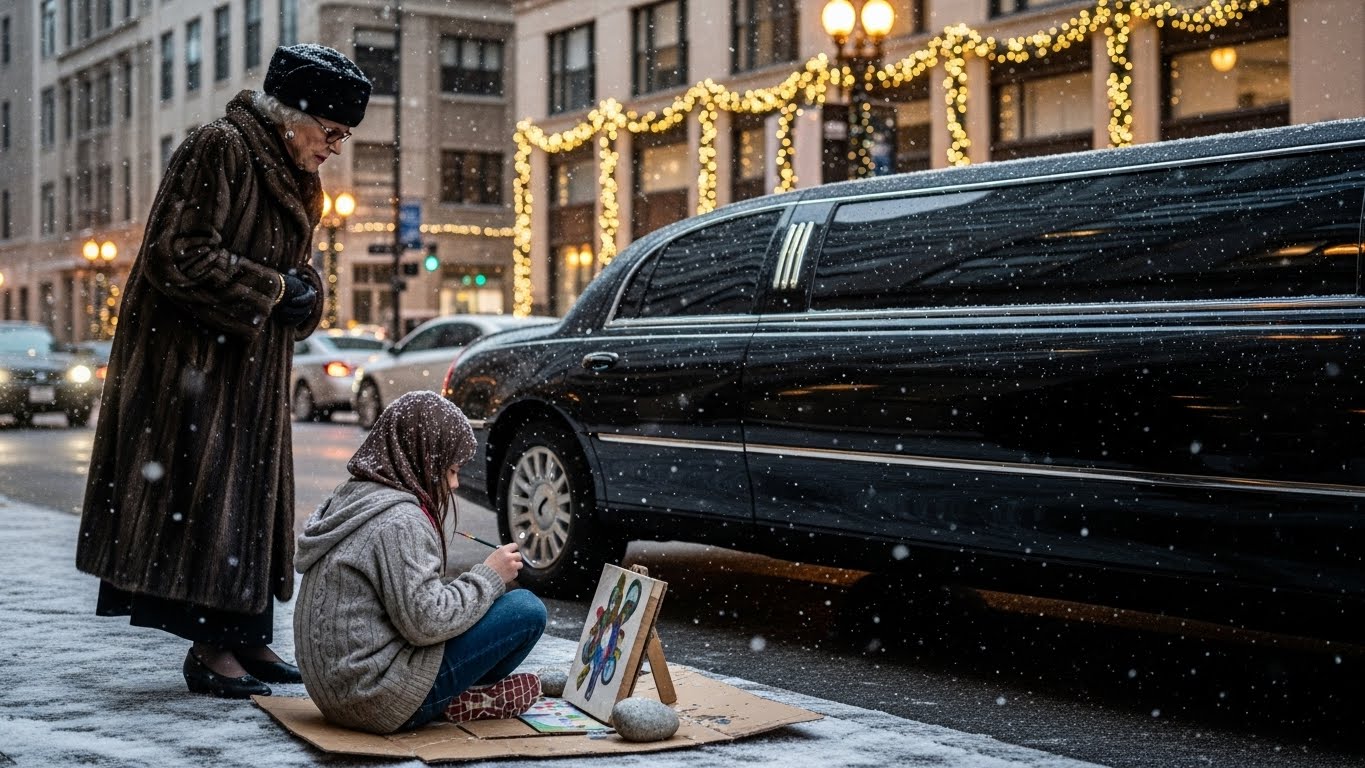
Martha Holloway, seventy-two years old and worth a sum she stopped checking a decade ago, felt none of it. Enveloped in a cashmere coat that cost more than a mid-sized sedan and seated in the back of a climate-controlled Lincoln Town Car, the winter was merely a visual effect—a backdrop of gray and white swirling outside her tinted window.
“Stop here, driver,” Martha said. Her voice was like the city outside: cold, clipped, and expecting no resistance.
“Here, ma’am? In front of Saks?” the driver asked, glancing in the rearview mirror. “The loading zone is quite busy.”
“I said here, Robert. I’m not an invalid. I can walk ten feet to the door.”
Martha stepped out. The noise of Chicago at Christmas hit her instantly—a cacophony of bells, car horns, and the murmuring of thousands of shoppers desperate to buy affection with credit cards. Martha adjusted her gloves. She hated Christmas. Not the holiday itself, perhaps, but what it had become. And more than that, she hated the crowds.
But she hated her empty house more. Since her husband, Richard, had passed and she had retired from being the principal of St. Jude’s Academy, silence had become her roommate. So, she shopped. She bought things she didn’t need to fill rooms no one visited.
As she navigated the slushy sidewalk toward the revolving doors, her eyes narrowed. There, nestled between a large concrete planter and a garbage bin, was a blemish on the pristine facade of luxury.
It was a child.
A girl, no older than ten, sitting cross-legged on a piece of wet cardboard. She was drowning in a coat that was clearly scavenged from a donation bin—a men’s oversized gray wool trench coat that pooled around her like a tent. Her hands were bare, red and raw, yet they were moving with precise, delicate determination.
Martha paused, her lips pursed in disapproval. Where are the parents? she thought, the familiar judgment rising like bile. Probably around the corner, waiting for the girl to collect enough sympathy cash for a bottle of something strong. Disgraceful.
Martha believed in order. She believed in rules. She had run her school with an iron fist for forty years. She believed that poverty was often—though not always—a symptom of a lack of discipline.
She stepped closer, intending to ignore the child, but something caught her eye. The girl wasn’t holding a cup. She wasn’t saying, “Spare change.”
She was painting.
Laid out on the cardboard in front of her were six smooth river stones. They weren’t just daubed with paint; they were masterpieces of miniature art. One featured a cardinal sitting on a snowy branch, the red so vibrant it seemed to burn. Another showed the Chicago skyline at sunset, every skyscraper meticulous.
Next to the stones was a small, hand-lettered sign written in neat cursive on the back of a cereal box: “Art for Tuition. $5 each.”
And beside the stones, open to the wind and the spitting snow, was a book. It was battered, the spine taped together with duct tape. Advanced Mathematics: Grade 5.
Martha stopped dead. The crowd flowed around her like a river around a stone. She watched. The girl painted a stroke on a stone, then looked down at the math book, her lips moving silently.
“Seven times eight is fifty-six,” the girl whispered, her teeth chattering audibly. “Carry the five…”
Martha felt a strange prickle in her chest. She shook it off. It’s a prop, she told herself. A prop to make rich old ladies like me open their purses.
Martha marched into the department store, leaving the girl in the cold. But for the first time in years, the warmth of the store didn’t make her feel better. The image of that open math book in the snow burned in her mind.
Chapter 2: The Invisible Equation
For the next three days, Martha found herself returning to the spot. She told herself she needed to return a scarf, or buy a new perfume, but deep down, she knew she was observing.
The girl was always there. From 10:00 AM to 6:00 PM.
Martha watched from the warmth of the vestibule. She saw the girl, whose name she overheard was Sophie, interact with the world. Most people looked through her. They looked at their phones, at the sky, at their shopping bags—anywhere but at the child freezing at their feet. This was the superpower of the homeless: invisibility.
But Sophie didn’t seem to mind. She had a system. She would paint for twenty minutes, then study for twenty minutes.
On the second day, a woman in a fur coat dropped a quarter onto the cardboard, missing the jar. “Buy yourself some candy,” the woman said dismissively.
Sophie picked up the quarter, put it in her jar, and whispered, “Thank you, ma’am. That’s 0.125 percent of the goal.”
Martha, standing near the door, blinked. The girl wasn’t just begging. She was calculating.
On the third day, Martha’s curiosity broke her resolve. She waited until the crowd thinned slightly and approached the girl. She loomed over her, her shadow falling across the math book.
“You’re going to ruin the binding leaving it open in this humidity,” Martha said sharply.
Sophie jumped, looking up with wide, terrified eyes. They were green, intelligent, and framed by dark circles that spoke of chronic exhaustion.
“I… I’m sorry, ma’am,” Sophie stammered. She tried to shield the book with her arm. “I’m not bothering anyone. I promise.”
“I didn’t say you were bothering anyone,” Martha corrected. “I said you were ruining the book. Is it yours?”
“It’s the library’s,” Sophie said, looking down. “But it was in the ‘discard’ bin because the cover was ripped. So it’s mine now.”
“And the sign?” Martha pointed with her cane. “‘Art for Tuition’? What kind of scam is that? Public school is free.”
Sophie stiffened. She sat up a little straighter, pulling the oversized coat around her dignity. “It’s not a scam. I got into the Hawthorne Magnet School for the Gifted. The acceptance letter came last week.”
Martha knew Hawthorne. It was the best school in the city. It was also public, but it was rigorous. “If it’s public, why do you need money?”
“Uniforms,” Sophie said. “And the registration fee for the books and the tablet. It’s $200. I have to pay it by this Friday at 5:00 PM, or they give my spot to the next kid on the waiting list.”
“And how much do you have?”
Sophie looked at the glass jar—an old pickle jar half-filled with crinkled bills and coins. “I have $184.50. I just need to sell three more stones.”
Martha looked at the stones. They were beautiful. She looked at the girl’s hands—blue with cold. She looked at the math book, its pages damp and curling at the edges.
“Why?” Martha asked. “Why sit out here? Why not go to a shelter?”
“Shelters are loud,” Sophie said simply. “I can’t study there. And… my mom says we have to earn our way up. If I get into Hawthorne, I can stay inside a warm building for eight hours a day. And they have a cafeteria with hot breakfast.”
The logic was heartbreakingly sound. Education wasn’t just a future for Sophie; it was a survival strategy for the present.
Martha reached into her purse. She felt her wallet. She could give the girl the $15.50 right now. It would be nothing to her. Less than a tip for lunch.
But the old educator in her hesitated. If I give it to her, does she learn the value of the struggle? It was a cruel thought, a remnant of her rigid past.
“Good luck with your calculation,” Martha said stiffly, and walked away.
She made it halfway down the block before she stopped. You old bat, she scolded herself. She’s ten.
Martha turned around to go back and buy a stone. But as she turned, she saw the flashing lights of a security cart.
Chapter 3: The King of the Sidewalk
It was Christmas Eve. The pressure in the air was palpable. Shoppers were frantic. The snow had turned to a slushy gray mush.
Sophie was smiling. She had checked her jar. A kind man had just bought a stone for $10. She had $195. One more sale. Just one more stone, and she could walk to the post office and buy the money order for the school.
She was humming a song under her breath, packing her bag.
“Hey! You!”
The voice boomed like a cannon. Sophie froze.
Officer Miller was new. He was young, beefy, and wore his mall security uniform as if he were a general in the Marines. He had been told by the mall manager to “clean up the riff-raff” before the VIP holiday party that evening.
He marched up to Sophie, his boots splashing heavy slush onto her cardboard display.
“I told you yesterday to beat it,” Miller shouted. “No soliciting on private property.”
“I’m on the sidewalk,” Sophie said, her voice trembling but brave. “The sidewalk is public property, sir. I checked the city ordinance.”
“Don’t you lawyer me, you little rat,” Miller sneered. He looked at the high-society shoppers passing by, feeling the need to perform his authority. “You’re an eyesore. You’re blocking the flow of foot traffic.”
“I’m leaving,” Sophie said quickly, reaching for her jar. “I just finished. I’m going.”
“Not so fast.” Miller stepped on the corner of her cardboard. “You’ve been selling things illegally. That makes this proceeds of a crime.”
He bent down and snatched the pickle jar.
Sophie gasped. “No! Please! That’s for school! Please give it back!”
“It’s confiscated,” Miller said, holding the jar high. “Evidence. Now get out of here before I call the real cops and have them haul you and your junkie parents away.”
“I don’t have junkie parents!” Sophie screamed. It was the first time she had raised her voice. “My mom is sick! Please, it’s $195! It took me three months!”
She lunged for the jar. Miller shoved her back effortlessly. She fell into the snow, hard.
“Scram!” Miller yelled.
Sophie scrambled up, but in the commotion, her backpack had tipped over. The math book—the precious, taped-together textbook—slid out into the slush.
Miller looked down at it. He looked at Sophie. He saw the desperation in her eyes, and instead of pity, he felt a surge of cruel power.
“And take your trash with you,” he said.
He stomped his heavy, rubber-soled boot directly onto the open pages of the book. He ground his heel, tearing the wet paper, smearing the equations into the dirt. Then, with a grunt of effort, he kicked the ruined book toward the curb, where a street sweeper was passing.
The book tumbled into the gutter and was swallowed by the gray sludge.
Sophie didn’t scream. She didn’t fight. She just collapsed. Her legs gave out, and she sat in the freezing wet snow, her hands covering her face. The silence of her heartbreak was louder than the city traffic.
Shoppers walked by, averting their eyes. They clutched their shopping bags tighter. Don’t look. Don’t get involved. It’s just a homeless kid.
Chapter 4: The Fury of Martha Holloway
Martha had seen it all from her car window as it pulled up to the curb.
She saw the jar being taken. She saw the shove. She saw the boot grinding into the book.
Something inside Martha snapped. It was a physical sensation, like a rubber band breaking in her chest. For forty years, she had been a stickler for rules. She had been the “bad cop” principal. She had expelled students for less.
But she had never been cruel. And she had never, ever destroyed a book.
The sight of that man—a grown man, armed with a badge and a baton—destroying the only hope of a ten-year-old girl triggered a rage Martha didn’t know she possessed. It was the rage of a mother she never got to be. It was the rage of an educator seeing the spark of a child being snuffed out by a boot.
“Open the door, Robert,” Martha commanded. Her voice was low and dangerous.
“Ma’am, it’s slippery—”
“OPEN. THE. DOOR.”
Martha stepped out. She didn’t use her cane. Adrenaline straightened her spine. She marched across the sidewalk, her $500 Italian leather boots crunching into the snow.
Miller was turning away, the jar tucked under his arm, looking pleased with himself.
“Excuse me!” Martha’s voice rang out. It was her ‘Principal Voice’—the one that could freeze a chaotic cafeteria in three seconds flat.
Miller turned, surprised. He saw an elderly woman in a fur hat and an expensive coat glaring at him.
“Can I help you, ma’am? Just clearing out the trash for you folks,” Miller said, putting on a polite smile.
“The only trash I see on this sidewalk,” Martha said, stepping into his personal space, “is standing in a security uniform.”
The crowd stopped. People stopped walking. Phones came out.
Miller’s face turned red. “Excuse me?”
“You heard me,” Martha hissed. “I saw what you did. You bullied a child. You stole her property. And you destroyed educational material. Is this the policy of the Magnificent Mile Association? Because I am personal friends with the CEO, and I think he would be very interested to know his guards are mugging children on Christmas Eve.”
“I… she was soliciting…” Miller stammered, his confidence evaporating under Martha’s steely gaze.
“She was sitting!” Martha shouted. “Give her the jar.”
“It’s evidence…”
“It is a pickle jar full of pennies!” Martha roared. She held out her gloved hand. “Give. It. To. Me. Or I will have your badge and your job before the sun sets.”
Miller looked at the crowd. He looked at the phones recording him. He looked at the terrifying old woman. He handed over the jar.
Martha snatched it. She turned her back on him as if he didn’t exist and knelt down in the snow.
Her knees cracked, and the cold wet soaked instantly into her expensive pants, but she didn’t care. She shuffled over to Sophie.
The girl was rocking back and forth, staring at the gutter where her book had vanished.
“Sophie,” Martha said softly.
Sophie didn’t look up. “He took it,” she whispered. “He took the numbers.”
“I got the money back,” Martha said, placing the jar in Sophie’s lap. “Look. It’s all here.”
Sophie looked at the jar, but her eyes were dead. “It doesn’t matter. The book is gone. I can’t finish the review. I’ll fail the entrance exam part two. It’s over.”
“Why didn’t you scream?” Martha asked, her heart breaking. “Why didn’t you fight him?”
Sophie looked up, tears freezing on her cheeks. “Mom says we’re invisible. If I make noise, the police come. If the police come, they see Mom. They take her away because she’s sick. I can’t lose Mom.”
Martha felt the air leave her lungs. “Where is your mother, child?”
Sophie pointed a trembling finger toward the dark alley behind the department store, where the delivery trucks idled.
Chapter 5: The Ghost in the Alley
Martha told her driver to wait. She took Sophie’s hand. It was like holding a piece of ice.
They walked to the alley. There, parked between two dumpsters, was a rusted sedan with a flat tire. The windows were covered with blankets.
Sophie opened the back door. “Mom? It’s me.”
A woman lay across the backseat, buried under a mountain of old clothes. She was pale, her breathing rattling in her chest. It sounded like pneumonia.
“Sophie?” the woman rasped. “Did you… did you get the tuition?”
“I…” Sophie started to cry again.
Martha squeezed past Sophie and leaned into the car. The smell of sickness and stale air was overwhelming.
“Ma’am?” Martha said. “My name is Martha Holloway. Your daughter is safe.”
The woman’s eyes fluttered open. They were the same green as Sophie’s, but dim. “Please… don’t call social services. I just need… I just need a few days to rest.”
“You need a hospital,” Martha said firmly.
“No money,” the woman whispered. “No insurance.”
Martha looked at the woman, then at Sophie, who was clutching the jar of pennies like a lifeline. She realized the tuition wasn’t just about school. It was about hope. It was the only thing keeping them from completely giving up.
Martha made a decision. It was the most reckless decision of her disciplined life.
“Robert!” she called out to her driver, who had followed them. “Help me get her into the Lincoln.”
“Ma’am?”
“We are taking them home,” Martha said. “And call Dr. Evans on the way. Tell him to meet us at the house. Tell him if he wants his endowment for the new wing of the hospital, he’ll be there in twenty minutes.”
Chapter 6: The Warmth of Christmas
The next twenty-four hours were a blur.
Sophie’s mother, whose name was Elena, was stabilized by Dr. Evans in Martha’s guest bedroom. It was severe pneumonia and malnutrition, but treatable with antibiotics and rest.
Sophie sat in the kitchen. It was a kitchen larger than any apartment she had ever lived in. She stared at the plate of hot turkey and mashed potatoes Martha’s housekeeper had placed in front of her. She didn’t eat. She just held her fork, staring at the steam.
Martha walked in. She had changed into a sensible wool sweater.
“Eat,” Martha said. “It helps the brain work.”
Sophie took a bite. Then another. Then she began to eat voraciously.
When she was done, she looked at Martha. “How much do I owe you?”
Martha blinked. “Excuse me?”
“For the doctor. For the food. For the ride.” Sophie reached for her pickle jar. “I have $195.”
Martha felt tears prick her eyes for the second time that day. This child, who had nothing, was obsessed with paying her way. She had more integrity in her little finger than most of the board members Martha had worked with.
“You don’t owe me anything,” Martha said. “Consider it a… scholarship.”
“But I lost my book,” Sophie said, her voice small. “The entrance exam part two is the day after tomorrow. Without the review, I won’t pass.”
Martha smiled. It was a rusty, creaky smile, but it was real.
“Follow me.”
Martha led Sophie down the long hallway to a set of double oak doors. She pushed them open.
Sophie gasped.
It was a library. Floor-to-ceiling shelves filled with thousands of books. A rolling ladder. A fireplace crackling with logs. And in the center, a large mahogany desk.
“My husband was a professor,” Martha said. “I was a principal. Between us, we have every textbook printed in the last fifty years.”
Martha walked to a shelf, pulled out a pristine hardcover book, and blew the dust off it. Advanced Mathematics: Grade 5.
She handed it to Sophie.
“But,” Martha added, her voice turning stern again, “I expect you to show your work. No shortcuts.”
Sophie hugged the book to her chest. Then, she ran forward and wrapped her thin arms around Martha’s waist.
Martha stiffened for a second, then, slowly, her hand came down to pat the girl’s messy hair.
Chapter 7: The Stone on the Mantle
They stayed for two weeks. Elena recovered. Martha pulled strings—so many strings—to get them into a transitional housing program that was actually safe. She paid the tuition for Hawthorne. She bought the uniforms.
On the day they were leaving, Sophie stood at the door. She looked different. Her cheeks had color. Her coat fit.
“I have something for you,” Sophie said.
She handed Martha a stone.
It wasn’t one of the ones she had been selling. It was fresh paint.
It depicted the department store entrance. But in the painting, the snow wasn’t gray slush; it was sparkling white. And there was no security guard. Instead, there was a tall, elegant woman in a coat, holding the hand of a little girl, both of them looking up at a bright star.
“It’s how I see it now,” Sophie said.
Martha took the stone. Her hands trembled.
“Go,” Martha said, her voice cracking. “Go be brilliant, Sophie. And… come back for tutoring on Tuesdays. If you’re late, I’m locking the door.”
Sophie grinned. “Yes, Mrs. Holloway.”
Chapter 8: The Empty Chair
Twenty Years Later.
The Chicago winter was just as cold, but inside the “Holloway Community Center for Youth,” it was warm.
The grand opening was packed. The press was there. The Mayor was there.
At the podium stood a woman of thirty. She was sharp, confident, wearing a tailored suit. Her green eyes scanned the crowd. Dr. Sophie Miller (no relation to the guard, a glorious irony she enjoyed) cleared her throat.
“When I was ten years old,” Sophie began, her voice echoing in the hall, “I learned that the world can be cold. I learned that authority can be cruel. I learned that people will walk past you as if you are invisible.”
She paused.
“I sat in the slush selling stones to buy a future. And when that future was crushed under a boot, I thought it was the end.”
She looked at the front row. There, in the center, was a single empty chair. On the seat lay a smooth, hand-painted river stone.
“But I also learned that help comes from unexpected places. I learned that dignity is not something you buy; it is something you force the world to recognize. And I learned humanity from a woman who saw me when the world looked away.”
Sophie smiled, tears shining in her eyes.
“Martha Holloway didn’t just give me money. She gave me her library. She gave me her time. She gave me the expectation of excellence. She taught me that winter doesn’t last forever.”
Sophie raised a pair of scissors to cut the ribbon.
“This center is for every child who feels invisible. Here, we see you. Here, you are safe. Here, you can study.”
She cut the ribbon. The crowd cheered.
And somewhere, in the warmth of the applause, the memory of a bitter old woman and a freezing little girl melted into something eternal.