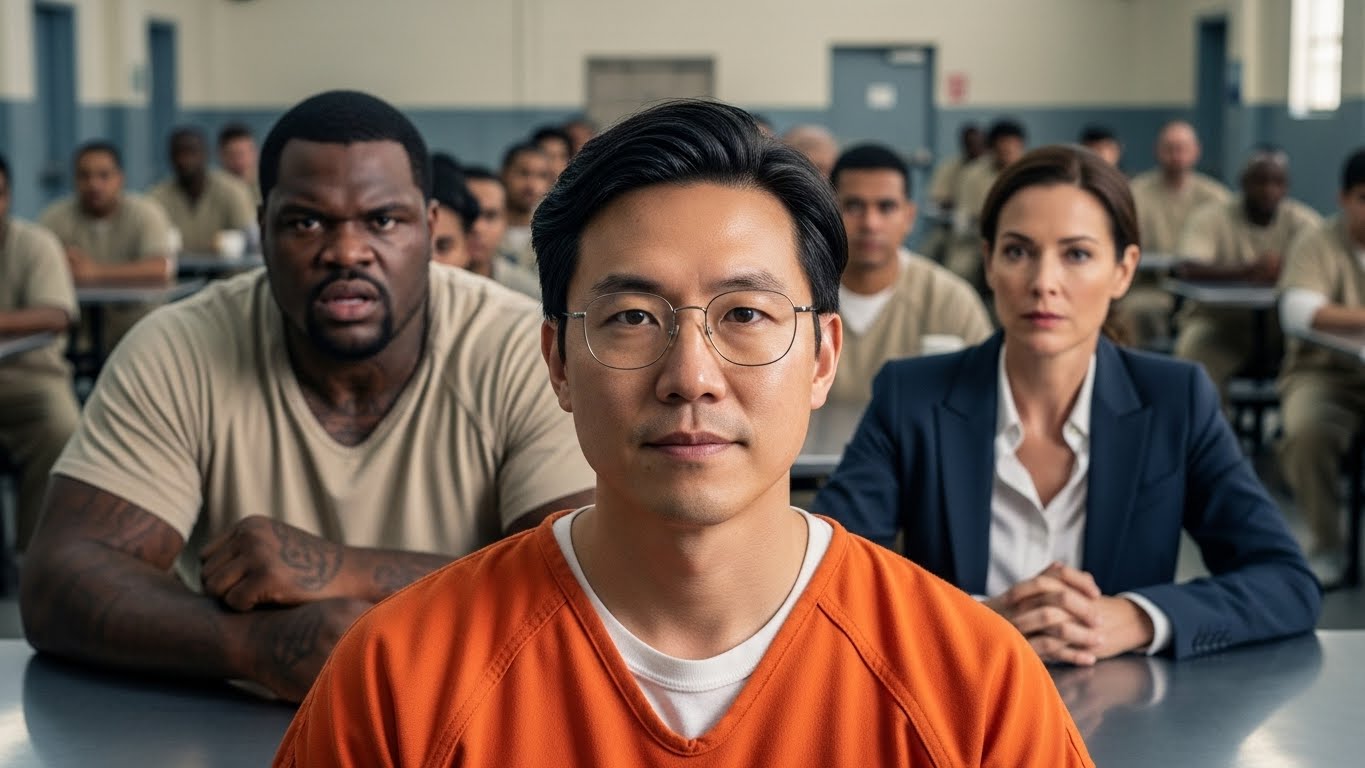
The Prison Kingpin Poured Boiling Coffee On The “Weak” Librarian To Make Him Scream. He Didn’t Expect The Librarian To Be A Classified Weapon.
PART 1: THE AWAKENING
Chapter 1: The Ecosystem of Violence
The cafeteria at Blackwater State Penitentiary didn’t smell like food. It smelled of burnt coffee, stale sweat, and the distinct, metallic tang of aggression. It was a scent that settled in the back of your throat and refused to leave, a constant, suffocating reminder of where you were.
In here, the air was thick with unwritten rules, a code more rigid than the state law. You didn’t look at the guards for too long. You didn’t ask what was in the meatloaf. And you absolutely, under no circumstances, looked in the direction of Table 4 unless you were invited.
Table 4 was the throne room. And the King was Marcus “Tank” Williams.
Tank was less of a man and more of a geological feature of Cell Block C. Standing six-foot-four and weighing nearly three hundred pounds, he was a wall of muscle wrapped in standard-issue orange. His arms were the size of most men’s thighs, covered in ink that told the story of a life wasted on violence. A spiderweb on the elbow for time served. A teardrop under the eye for a life taken.
He sat with his back to the corner—the strategic position of every predator who knows he has enemies. Around him sat his lieutenants: Snake, a wiry meth-head with a shank usually taped to his ankle, and Biggs, a silent giant who did what he was told.
“Pass the salt,” Tank grunted.
Three men from nearby tables scrambled to obey. That was the power Tank held. He didn’t have to shout. He barely had to move. The threat of his violence was enough to bend the reality of the room around him.
The guards, stationed by the steel double doors, watched with bored indifference. Officer Miller adjusted his belt and looked away. As long as no one was bleeding out on the linoleum, Miller didn’t care who ran the zoo. It was easier this way. Tank kept the other gangs in check, and the guards let Tank eat first. It was a symbiotic relationship born of laziness and corruption.
Then the doors buzzed open.
The noise in the cafeteria dipped—just a fraction—as the new intake walked in. Fresh fish. Walking targets. Usually, they came in looking one of two ways: puffed up with fake bravado, chest out, eyes darting around trying to look tough; or terrified, shoulders hunched, clutching their trays like shields.
The man who walked in next was neither.
His name was David Chen. He was in his mid-thirties, of average height and build. He looked like the guy who did your taxes, or maybe the quiet neighbor who mowed his lawn at 8:00 AM on Saturdays. He wore wire-rimmed glasses that sat slightly askew on his nose.
But it was the way he moved that caught the attention of the room.
He didn’t shuffle. He didn’t strut. He glided. His feet seemed to roll over the floor, making no sound. His breathing was rhythmic, deep, and invisible. While other new inmates flinched at the sound of a dropped tray or a slamming door, David’s head didn’t jerk. His eyes simply shifted, assessed the noise, categorized it as ‘non-threat,’ and moved on.
He walked to the serving line, took a tray, and accepted a scoop of gray oatmeal and a carton of milk. He nodded a polite “thank you” to the server—a gesture so alien in Blackwater that the server almost dropped his ladle.
Tank, watching from his throne, felt a prickle of irritation on the back of his neck.
“Look at this,” Tank muttered, nudging Snake. “We got a librarian.”
Snake snickered, revealing yellowed teeth. “Looks like he got lost on the way to Bible study.”
“He’s too quiet,” Tank said, his eyes narrowing. “Disrespectful quiet. Like he thinks he’s better than this place.”
Tank hated that. He thrived on fear. Fear was the currency of the realm, and if someone wasn’t paying up, it meant the economy was crashing. He couldn’t allow that.
David turned from the line and began to walk toward the empty tables near the back. He moved with a fluid grace, his center of gravity low. He wasn’t looking at Tank. He wasn’t looking at anyone. He was just a man trying to eat breakfast.
Tank stood up.
The sound of his chair screeching backward was the signal. The cafeteria froze. Forks stopped halfway to mouths. Conversations died mid-sentence. The ecosystem paused, holding its collective breath, knowing that violence was about to occur.
Tank stepped into the main aisle, blocking David’s path. He expanded his chest, taking up as much space as possible. A mountain blocking the sun.
“You lost, boy?” Tank rumbled. His voice was deep, a bass note that vibrated in your chest.
David stopped. He looked up at Tank, blinking calmly behind his glasses. He didn’t step back. He didn’t step forward. He just stopped.
“Excuse me,” David said. His voice was polite, steady. “I’m just looking for a seat.”
“I didn’t ask what you were looking for,” Tank said, stepping closer until he was looming over the smaller man. “I asked if you were lost. Because in here, you walk where I tell you to walk. You sit where I tell you to sit.”
David looked at Tank for a long moment. It wasn’t a look of defiance. It was the look of a mechanic listening to a car engine, diagnosing a problem.
“I understand,” David said softly. “I don’t want any trouble.”
“Trouble?” Tank laughed, looking back at his crew. “He doesn’t want trouble.”
Tank turned back, his face hardening into a mask of cruelty. “Trouble found you, sunshine.”
With a quick, violent motion, Tank slapped the tray out of David’s hands.
The plastic tray clattered loudly against the floor. The milk carton burst, sending white liquid splashing across David’s orange pant leg. The oatmeal splattered onto his shoes.
The disrespect was absolute. In prison, this was a declaration of war.
David looked down at the mess. He stood perfectly still. He didn’t clench his fists. He didn’t grit his teeth. He just looked at the spilled milk.
“Clean it up,” Tank ordered.
David bent down.
The crowd watched, some with pity, most with the hungry excitement of spectators at a gladiator match. The new guy was breaking. He was submitting. Tank had won again.
But as David reached for the tray, Tank decided that submission wasn’t enough. He needed a show. He needed to burn the lesson into the new guy’s skin.
Tank reached over to the table next to him and grabbed a Styrofoam cup of coffee. It had just been poured. It was steaming.
“You missed a spot,” Tank whispered.
Chapter 2: The Dragon Wakes
Gravity seemed to work in slow motion as Tank tipped the cup.
The dark, scalding liquid cascaded over the rim. It splashed onto David’s head, soaking his hair, running down his forehead, behind his glasses, and into the collar of his jumpsuit.
It was boiling hot. It should have caused immediate, blinding panic.
The cafeteria went deathly silent. Everyone waited for the shriek. They waited for the frantic flailing, the desperate attempt to wipe the burning liquid away.
David didn’t move.
He remained in his crouch, one hand on the fallen tray. The coffee dripped off his chin.
He closed his eyes.
Inhale.
Exhale.
It was a breath that seemed to pull the oxygen out of the room. When David stood up, he didn’t scramble. He rose like a puppet being pulled by a string—straight, smooth, effortless.
He took his glasses off. They were dripping with coffee. He pulled a small cloth from his pocket and wiped them methodically.
“That was unnecessary,” David said.
The tone of his voice had changed. The polite softness was gone. In its place was a cold, hard steel. It was the voice of a parent scolding a child, or perhaps a judge delivering a death sentence.
Tank blinked. This wasn’t the script. The victim was supposed to be crying by now.
“You got something to say, fresh fish?” Tank sneered, masking his sudden unease with aggression. He stepped forward, cocking his massive right arm back. “I’ll give you something to cry about.”
Tank threw the punch. It was a haymaker, a wild, looping swing meant to shatter a jaw. It had 300 pounds of weight and bad intentions behind it.
If it had connected, David Chen would have been eating through a straw for six months.
But it hit nothing but air.
David didn’t duck. He didn’t run. He simply rotated. His left foot pivoted, his hips turned, and his upper body slipped inside the arc of the punch. He was now inside Tank’s guard, chest-to-chest with the giant.
Tank’s eyes went wide.
David’s movement was a blur of kinetic poetry. His left hand shot up, palm open, and struck Tank’s bicep, deadening the arm. Simultaneously, his right palm slammed into Tank’s solar plexus.
It wasn’t a hard shove. It was a strike. A transfer of energy that went through muscle and fat and shocked the diaphragm.
WOOSH.
The air left Tank’s body instantly. The giant gasped, his eyes bulging.
Before Tank could stumble back, David hooked his leg behind Tank’s right knee. With a sharp twist of his hips, David executed a perfect Osoto Gari—a major outer reap.
Physics took over. Tank’s upper body was going backward, his legs were swept out from under him.
BOOM.
The floor shook. Tank hit the concrete flat on his back, the impact knocking the wind out of him a second time. The sound was sickening—like a side of beef being dropped from a truck.
Silence. Absolute, terrifying silence.
Snake dropped his fork. Officer Miller at the door stood up, his hand hovering over his radio, mouth open.
Tank groaned, trying to roll over, trying to comprehend how the ceiling was suddenly staring back at him. He tried to rise, rage fueling him now. “I’m gonna kill y—”
David stepped forward. He didn’t kick Tank. He didn’t stomp on his head. He knelt down, his knee pressing gently but firmly onto Tank’s chest, pinning him.
David leaned in close. His face was inches from the terrifying gang leader. Coffee still dripped from David’s hair onto Tank’s face.
“Stay down,” David whispered. “Or the next one breaks the bone.”
Tank looked into David’s eyes and saw something he had never seen in prison. He didn’t see fear. He didn’t see anger. He saw boredom. He saw a man who had fought demons that made Tank look like a playground bully.
“Who… who are you?” Tank wheezed, tears of pain and humiliation leaking from his eyes.
David stood up and stepped back. He adjusted his uniform. He put his glasses back on.
“I’m just the guy trying to eat his oatmeal,” David said.
Suddenly, the spell broke.
“GET ON THE GROUND! EVERYONE ON THE GROUND!”
The guards were rushing in now, batons out, radios crackling. The riot squad was breaching the doors.
David raised his hands slowly, calm and compliant. He looked at Officer Miller.
“He slipped,” David said.
Miller looked at the devastated form of the prison’s toughest inmate, gasping for air on the floor. He looked at the small, coffee-stained man standing over him.
“Cuff him!” Miller yelled, pointing at David. “Take him to the Hole!”
Two guards grabbed David, slamming him against the wall. David didn’t resist. He let them cuff him. He let them drag him away.
As he was marched out of the cafeteria, David caught the eye of a young inmate in the front row—Tommy. Tommy’s mouth was agape, his eyes wide with hero worship.
David gave him a nearly imperceptible nod.
The doors slammed shut behind him, leaving the cafeteria in a state of shock. The King was fallen. The hierarchy was shattered. And the legend of David Chen had just begun.
Back in the Warden’s office, Warden Margaret Sullivan was looking at a computer screen. Her brow was furrowed.
“Who is this guy?” she asked the intake officer. “You processed him as a simple assault?”
“Yes, ma’am,” the officer said nervously. “Bar fight. He didn’t say much.”
Sullivan clicked open the attachment the FBI had just forwarded. Her eyes widened as she read the file.
Subject: David Chen. Former US Olympic Taekwondo Team. 7th Degree Black Belt. Dishonorable Discharge: No. Classified. Combat Instructor: 12 years.
“My God,” Sullivan whispered. “He’s not an inmate. He’s a weapon.”
She looked up at the officer.
“Get him out of the Hole. Now. Before the other gangs try to test him. If they go after him… we’re going to need a lot more body bags.”
PART 2: THE RECKONING AND THE REFORMATION
Chapter 3: The Silence of the Wolf
The Hole at Blackwater wasn’t just a place; it was a psychological weapon. It was a six-by-eight concrete box where time went to die. There was no natural light, only a buzzing bulb caged in steel mesh that flickered with a maddening, irregular rhythm. The air was cold, stale, and tasted of industrial disinfectant and despair.
David Chen sat in the center of the floor, his legs crossed in a perfect lotus position.
Most men screamed when they were thrown in here. They banged on the heavy steel door until their knuckles bled. They cursed the guards, the system, and God. Then, inevitably, the crying would start. The sensory deprivation stripped away the ego, leaving only raw, naked fear.
David didn’t scream. He didn’t bang the door.
He simply breathed.
Inhale for four seconds. Hold for four. Exhale for four. Hold for four.
To the guards watching the monochrome monitor in the control booth, he looked like a statue. He hadn’t moved in three hours. He wasn’t suffering; he was calibrating.
He wasn’t angry about what happened in the cafeteria. Anger was a waste of caloric energy. It clouded judgment and tightened muscles that needed to be loose. What he felt was a profound, heavy regret.
He had come to Blackwater to disappear. He wanted to serve his thirty-six months for the aggravated assault charge—a charge that was technically true but morally complicated—and go back to his dojo in Portland. He wanted to teach kids how to stand up straight. He didn’t want to be a gladiator.
But the ecosystem of violence didn’t care about what you wanted. It only cared about what you could do. And David had just shown everyone exactly what he could do.
News of Tank’s downfall traveled through the prison ventilation shafts and drain pipes faster than a virus. The “Grapevine” was the prison’s internet, and the server was overloaded.
The King was dead. Long live the… librarian?
The story mutated with every retelling. By the time it reached Cell Block D, David hadn’t just tripped Tank; he had used a Vulcan nerve pinch. By the time it hit the exercise yard, David was a Shaolin monk who could catch bullets.
But in the infirmary, the reality was far grimmer.
Tank lay in a hospital bed, his neck in a brace, his massive frame looking deflated. His physical injuries were minor—a concussion, a bruised ego, and a back spasm from hitting the concrete. But his reputation was in critical condition.
In prison, reputation is life insurance. Without it, you’re prey.
Tank stared at the ceiling tile, counting the cracks. He knew the sharks were circling. If he didn’t act, his own lieutenants would turn on him within the week. He needed to re-establish dominance, and he needed to do it with overwhelming force.
He called over a nurse—a sympathetic older woman he had bribed with chocolate bars for years. He pressed a folded scrap of paper into her hand.
“Get this to Viper in Block B,” Tank rasped. “Tell him I’m offering the laundry contract. All of it.”
The nurse’s eyes widened. The laundry contract was the most lucrative hustle in the prison. It was how drugs moved. Giving it up was an act of desperation.
“Are you sure, Marcus?” she whispered.
“Just do it,” Tank growled. “I want the librarian’s head on a spike.”
Viper was a different breed of animal than Tank. If Tank was a sledgehammer, Viper was a scalpel. He ran the Latino gangs with a cold, corporate efficiency. He didn’t care about honor or respect. He cared about market share.
When he received the note, he smiled. He didn’t care about Tank’s vendetta. But he wanted the laundry. And if the price was taking out one soft-looking Asian guy who got lucky with a coffee cup? That was a bargain.
An alliance was forged in the dark. The brute force of Block C and the calculated lethality of Block B were uniting. Their target was a man sitting in silence, breathing in the dark.
Meanwhile, in the administrative wing, Warden Margaret Sullivan was having a crisis of conscience.
She was a career bureaucrat, a woman who believed in rules, forms, and procedures. She hated surprises. And David Chen was the biggest surprise of her career.
“How did we miss this?” she asked, her voice tight.
She was staring at a computer screen, the blue light reflecting in her glasses. The intake officer, a sweating man named Jenkins, shifted uncomfortably.
“He didn’t say anything, Warden. He just gave his name and prints. The system flagged him for simple assault. A bar fight in Oregon.”
“A bar fight?” Sullivan clicked the mouse, opening a classified attachment that had just been decrypted by the Department of Defense. “Jenkins, look at this.”
She spun the monitor around.
Subject: David Chen. Rank: Master Sergeant (Retired). Specialization: Close Quarters Combat Instructor, 1st Special Forces Group. Martial Arts Rank: 7th Dan Black Belt, Taekwondo. 4th Dan, Hapkido. Status: Highly Classified. Do Not Antagonize.
“He hospitalized seven men in that bar,” Sullivan read aloud, her voice dropping to a whisper. “They were harassing a female bartender. He broke twelve arms and five legs in under two minutes. And he sat on a stool and waited for the cops.”
“Jesus,” Jenkins breathed. “So he’s not an inmate.”
“No,” Sullivan said, taking off her glasses and rubbing the bridge of her nose. “He’s a weapon of mass destruction that we put in a cage with a bunch of insecure bullies.”
She realized the precariousness of the situation. If the gangs went after him—and they would—David wouldn’t just defend himself. He would dismantle them. The infirmary would be overflowed. The state would investigate. Her prison would be on the national news.
“Get him out of the Hole,” Sullivan ordered. “Bring him here. Now.”
Twenty minutes later, David sat in the plush leather chair across from Sullivan’s desk. He was still in his orange jumpsuit, his hands cuffed in front of him. He looked like he was waiting for a bus—patient, calm, unbothered.
“Mr. Chen,” Sullivan began, trying to project authority. “We have a problem.”
“I agree, Warden,” David said softly. “The oatmeal is terrible.”
Sullivan blinked. “I’m not talking about the catering. I’m talking about the fact that you possess lethal skills that you failed to disclose during intake.”
“I wasn’t asked if I knew how to fight,” David replied. “I was asked if I had any communicable diseases. I do not.”
“Tank is mobilizing,” Sullivan said, leaning forward. “My intel says he’s partnered with Viper. They are going to make a move on you as soon as you hit General Population. They want to make an example of you.”
David nodded slowly. “Logic dictates they would. I disrupted the hierarchy. Nature abhors a vacuum.”
“I can put you in Protective Custody,” Sullivan offered. “Isolation. For your own safety.”
“No,” David said immediately. “Isolation is a slow death. And it confirms their belief that I am weak. It will only delay the inevitable.”
“Then what do you suggest?” Sullivan asked, exasperated. “I can’t have a war in my cafeteria.”
David adjusted his glasses with his cuffed hands.
“Let me go back to the unit. Let me go to breakfast tomorrow.”
“They will kill you,” Sullivan said bluntly. “There will be thirty of them. Maybe forty.”
“They won’t kill me, Warden,” David said. “But they will try. And when they fail, the hierarchy will be reset permanently. Then, we can talk about peace.”
Sullivan looked at him. She saw the steel behind the wire-rimmed glasses. She realized she couldn’t stop him.
“If you start a riot, Chen, I will bury you under the prison.”
“I won’t start anything,” David promised. “But I will finish it.”
Chapter 4: The Alliance of Ruin
The next morning, the atmosphere in Cell Block C was heavy enough to crush a man’s lungs.
It was the silence that gave it away. Usually, the morning routine was a cacophony of shouting, metal clanging, and radios blaring. Today, it was a tomb.
Every inmate knew what was coming. The guards knew it too. Officer Miller had called in sick. No one wanted to be in the splash zone when the two biggest gangs in Blackwater collided with the “Library Ninja.”
David’s cellmate, Tommy, was pacing the small cell, his face pale and sweating.
“Don’t go out there, man,” Tommy pleaded. “Just refuse the tray. Stay in the cell. They got Viper’s crew involved. These guys are lifers, David. They got nothing to lose.”
David was making his bed. He smoothed the gray wool blanket until there wasn’t a single wrinkle.
“Fear is a choice, Tommy,” David said calmly. “Danger is real. But fear? Fear is just a story you tell yourself about what might happen.”
“They’re gonna stab you!” Tommy practically screamed.
“Then I’ll have to make sure they don’t,” David said. He turned to the door as the buzzer sounded. “Coming to breakfast?”
Tommy looked at David, then at the floor. “I… I can’t watch.”
“Stay here,” David said kindly. “Read a book.”
David walked out of the cell.
The walk to the cafeteria felt like a funeral procession. Inmates pressed themselves against the walls as he passed, eyes wide, waiting for the blood.
When the double doors opened, the scene was set.
It was theater.
Tank was there, standing at the center table, neck brace on, eyes burning with hate. Flanking him were fifteen men from his crew. On the other side stood Viper—a lean, scarred Latino man with cold, reptile eyes. Behind Viper stood fifteen of his own soldiers.
Thirty men.
They were armed. Not with guns, but with the terrifying ingenuity of prison violence. Padlocks stuffed into heavy wool socks—a flail that could crush a skull. Toothbrushes melted and sharpened into shanks. Razor blades taped to the ends of plastic handles.
They formed a semi-circle around the serving line.
David didn’t hesitate. He walked in, his gait smooth and rhythmic. Heel, toe. Heel, toe.
He walked past the line of stun-shocked guards who were hanging back by the exit, hands hovering over their batons but too terrified to intervene.
David picked up a tray. He took an apple. He took a carton of milk. He took the oatmeal.
He turned around and faced the army.
“Good morning, gentlemen,” David said.
“Get him,” Tank whispered.
It wasn’t a shout. It was a release.
The mob surged forward. It was a tidal wave of orange jumpsuits and violence.
David didn’t take a fighting stance. He didn’t put his fists up like a boxer.
He sat down.
He sat at the nearest steel table, placed his tray down, and opened his milk.
The first attacker—a massive brute named Biggs—swung a padlock-sock at David’s head with enough force to crack concrete.
At the last possible fraction of a second, David ducked. He didn’t just duck; he melted. His upper body collapsed onto the table, the padlock whistling through the air where his head had been a millisecond before.
The momentum carried Biggs forward. As he stumbled, David’s leg shot out from under the table, hooking Biggs’ ankle.
Crash. Biggs face-planted into the steel edge of the table, instantly unconscious.
David stood up. The milk carton was still in his hand.
The chaos erupted. Three men rushed him at once.
This was no longer a bar fight. This was high-level kinetic chess.
David moved into the center of the group. This was counter-intuitive—most men try to back away. But David knew that in the center, the enemies got in each other’s way.
A man with a shank lunged. David sidestepped, grabbed the man’s wrist, and pulled. He used the attacker’s own forward energy to throw him directly into the path of another attacker wielding a chair. The two collided in a tangle of limbs.
David was a ghost in the machine. He was spinning, pivoting, and redirecting.
He used Aikido principles to flow with the attacks, and Taekwondo strikes to end them.
Snap. A palm strike to a jaw. Crack. An elbow to a solar plexus. Thud. A sweeping low kick that took two men off their feet simultaneously.
He wasn’t fighting thirty men. He was fighting one man at a time, very, very quickly.
He used them as human shields. When Viper’s lieutenant tried to stab him, David rotated a stunned attacker into the blade’s path. The shank went into a heavy shoulder muscle (non-lethal, but stopping).
The cafeteria was a cacophony of screams, grunts, and the sickening sound of bodies hitting the floor.
Viper watched from the back, his eyes narrowing. He saw the pattern. David wasn’t getting tired. He was barely breathing hard. Every move was efficient. Minimal effort, maximum damage.
Viper decided to end it. He pulled a specialized weapon from his waistband—a heavy industrial bolt sharpened to a needle point, wrapped in leather.
He waited for David to be engaged with two other men. Then, Viper struck. He moved silently, aiming for the kidney—a crippling shot.
David felt the shift in air pressure behind him. His “spider-sense”—honed by years of combat training—screamed DANGER.
David didn’t turn around. He dropped.
He performed a perfect drop-split, his legs shooting out wide. Viper’s thrust hit nothing but air.
From the ground, David coiled like a spring. He launched himself upward in a spinning back kick.
His heel connected squarely with Viper’s chin.
The sound was like a gunshot. CRACK.
Viper was lifted off his feet. He flew backward, crashing into the salad bar, lettuce and ranch dressing exploding everywhere. He didn’t get up.
The room froze.
Tank was the last one standing. His army was a groaning pile of bruised bodies on the floor. Twenty-five men were down. Five were backing away, hands raised in surrender.
David stood in the center of the carnage. His glasses were slightly crooked. There was a splash of oatmeal on his shoulder.
He adjusted his glasses. He took a deep breath through his nose.
He looked at Tank.
“Are we done?” David asked.
Tank looked at Viper, unconscious in the salad bar. He looked at Biggs, sleeping under the table. He looked at David, who looked like he was ready to teach a calculus class.
Tank’s knees gave out. He sat down heavily on the floor, putting his head in his hands.
“I’m done,” Tank wept. “I’m done.”
The tactical team burst through the doors a second later, clad in riot gear, shotguns raised.
“EVERYBODY DOWN! NOW!”
They expected a riot. They found a massacre.
And in the middle of it, David Chen sat back down at his table. He peeled the foil lid off his apple sauce.
Sergeant Rodriguez approached him, weapon lowered, eyes wide with disbelief.
“Chen,” Rodriguez barked, his voice trembling slightly. “Did you… did you do this?”
David took a spoonful of apple sauce.
“They fell,” David said. “It’s a very slippery floor, Sergeant. You should have maintenance look at it.”
Chapter 5: The Teacher and the Truce
The aftermath of the “Cafeteria Massacre” was unprecedented.
Usually, an incident of that magnitude would result in mass transfers, extended solitary confinement, and new charges. But Warden Sullivan had a problem.
The security cameras showed the truth. David hadn’t thrown the first punch. In fact, he hadn’t technically “attacked” anyone. He had evaded, redirected, and neutralized. It was the most violent case of self-defense in state history.
Charging him would mean a public trial. A public trial would mean the footage would leak. If the public saw one inmate defeat thirty gang members, the prison administration would look incompetent, and David would become a folk hero.
So, Sullivan got creative.
She summoned David to the library three days later.
“No more solitary,” she said. “I’m putting you to work.”
David raised an eyebrow. “Stamping license plates?”
“Teaching,” she said.
She slid a paper across the desk. The Blackwater Discipline Initiative.
“You broke them, Chen. Now you fix them. The yard is a mess. The power vacuum is dangerous. These men are scared, and scared men are violent. They need whatever… voodoo it is that you have.”
“It’s not voodoo,” David said. “It’s discipline.”
“Fine. Teach them discipline. You get the library for one hour a day. Anyone can sign up. If they fight in your class, they go to the Hole. If you fight, you go to a Supermax in Colorado. Deal?”
David smiled. It was the first time Sullivan had seen him smile. It transformed his face.
“Deal.”
The first class was awkward.
Twelve men showed up. Most were there out of morbid curiosity. They wanted to see the “Ninja” up close.
Among them was Jerome, a 50-year-old lifer who had run the kitchen crew for a decade. He was skeptical, crossing his massive arms over his chest.
And in the back, terrified but determined, was Tommy.
David stood in the center of the circle of chairs. He wasn’t wearing a gi. He was wearing his orange jumpsuit, just like them.
“I am not going to teach you how to fight,” David started.
A groan went around the room.
“I know how to fight,” Jerome grunted. “I want to know how you did that backflip kick thing.”
“That kick,” David said, turning to Jerome, “is useless if you don’t know when to use it. Fighting is the last resort. Fighting means you have already failed to control the situation.”
David walked over to Jerome. The size difference was significant. Jerome outweighed him by eighty pounds.
“Hit me,” David said.
Jerome blinked. “What?”
“Hit me. Right in the chest. As hard as you can.”
Jerome looked at the guard by the door. The guard nodded.
Jerome shrugged. He wound up and threw a massive punch.
David didn’t block it. He simply exhaled sharply and stepped two inches to the left.
The punch sailed past his shoulder. Jerome stumbled.
“Again,” David said.
Jerome swung again. Harder.
David stepped to the right.
Jerome swung a third time, frustrated now, growling.
David stepped back, caught Jerome’s wrist gently, and guided him into a chair. Jerome sat down hard, confused.
“You are fighting the air, Jerome,” David said softly. “You are fighting your own anger. I am just standing here.”
The room was silent.
“The first lesson,” David addressed the group, “is not a punch. It is a breath. If you can control your breath, you can control your mind. If you control your mind, no one in this prison can touch you. Not the guards, not the gangs, not the walls.”
He taught them the Box Breath.
Inhale. Hold. Exhale. Hold.
For twenty minutes, twelve hardened criminals sat in a circle, eyes closed, just breathing.
At first, there was giggling. Then, fidgeting.
But then, something shifted. The tension in the room—the constant, high-wire voltage of prison life—began to drop. Shoulders slumped. Fists unclenched.
For the first time in years, the room was truly quiet.
When the hour was up, Jerome stood. He looked at David. He didn’t bow—that was too much—but he nodded. A deep, respectful nod.
“Same time tomorrow?” Jerome asked.
“Same time tomorrow,” David replied.
As the men filed out, Tommy hung back.
“You think this will work?” Tommy asked. “You think guys like Viper will listen to this?”
“Viper is in the hospital,” David said. “But when he gets out, he’ll have a choice. He can keep fighting the air, or he can learn to breathe. We just have to keep the door open.”
The seed was planted. The “Library Ninja” was gone. The Teacher had arrived. But the prison was a volatile place, and the old world wouldn’t die without one last, terrifying scream.
PART 2: THE RECKONING AND THE REFORMATION (Continued)
Chapter 6: The Philosophy of Strength
Weeks turned into months, and the “Blackwater Discipline Initiative” metastasized. What began with twelve skeptics in a dusty library had become the heartbeat of the prison.
Warden Sullivan had to open the gymnasium to accommodate the class size. Fifty, sixty, sometimes eighty men would line up in rows, their orange jumpsuits a sea of uniform brightness against the gray concrete.
David stood at the front, a conductor of energy.
He taught them the “Three Pillars”: Posture, Balance, and Breathing.
Posture: “Look at how you walk,” David instructed, mimicking the prison shuffle—slumped shoulders, eyes down, protecting the vital organs. “This is the posture of a victim. It tells the world you expect to be hurt. Now, look at the posture of a bully.” He puffed his chest out, arms wide, chin up. “This is the posture of fear masquerading as strength. It is brittle. It breaks easily.”
He stood naturally, spine straight, shoulders relaxed, eyes on the horizon. “This is the posture of a man. It is ready for anything, but asking for nothing.”
Balance: He would bring inmates up to demonstrate. He brought up “Tiny,” a 240-pound enforcer for the Aryan Brotherhood. “Push me,” David said. Tiny pushed. David absorbed the force, rooted to the ground like an old oak tree. “Now,” David said, “think about the time your parole was denied. Feel that anger. Now push me.” Tiny roared and shoved. David simply pivoted. Tiny, over-committed by his rage, stumbled past him. “Anger destroys your balance,” David told the class. “When you are angry, your center of gravity rises to your chest. You become top-heavy. You become easy to topple. Keep your mind in your dan-tien—two inches below your navel. That is your anchor.”
Breathing: This was the hardest lesson. In prison, holding your breath is a survival mechanism. You hold your breath when you walk past a guard. You hold your breath when the lights go out. “Breathe,” David commanded, walking through the rows. “If you are not breathing, you are dying. The breath is the bridge between the mind and the body. When the panic starts, when the rage comes—find the breath.”
The results were tangible. The noise level in the cell blocks dropped. Fights in the yard decreased by 40%. The library was checking out more books on philosophy and Eastern religion than ever before.
Jerome, the former kitchen bully, had become David’s star pupil. One afternoon in the chow hall, a new inmate—a young, jittery kid trying to make a name for himself—knocked Jerome’s tray over.
The old Jerome would have beaten the kid into a coma. The cafeteria went silent, waiting for the violence.
Jerome looked at the spilled peas. He looked at the trembling kid.
He took a deep breath. Inhale. Exhale.
“You nervous, son?” Jerome asked, his voice deep and calm.
The kid blinked, terrified. “I… yeah.”
“It’s a scary place,” Jerome said. He bent down and picked up his tray. “Watch where you step. And breathe.”
Jerome walked away.
The kid was left standing there, confused and unharmed. The “violence loop” had been broken.
But not everyone was happy with the peace.
Viper had returned from the infirmary. His jaw was wired shut, sipping his meals through a straw. Every sip was a reminder of his humiliation. He watched the rows of men breathing in the gym, and he didn’t see progress. He saw a cult.
And he saw weakness.
Viper knew he couldn’t beat David in a fair fight. He had learned that the hard way. But he also knew that David was leaving. His sentence was up in three months.
Viper didn’t want to beat David. He wanted to destroy David’s legacy. He wanted to prove that the “breathing” was bullshit, and that blood was still the only law that mattered.
He needed a monster.
Chapter 7: The Unbroken Shield
The transfer bus arrived on a rainy Tuesday.
It carried only one passenger in the high-security cage at the back.
His name was Brutus.
Brutus wasn’t just a criminal; he was a legend of the corrections system. He had killed two men in Folsom. He had started riots in three different states. He was six-foot-six, nearly 300 pounds of pure, unadulterated malice. He didn’t want money. He didn’t want power. He just liked to hurt people.
Viper met him in the yard during his first recreation period.
“The Asian guy,” Viper hissed through his wired jaw. “He thinks he runs this place. He thinks he’s untouchable.”
Brutus looked across the yard. David was walking the track, talking quietly to Tommy.
“He looks like a math teacher,” Brutus grunted.
“He’s fast,” Viper warned. “Don’t box him. Crush him.”
Brutus grinned, revealing a mouth full of silver teeth. “I don’t box. I break.”
The confrontation happened two days later.
It was graduation day for the first cohort of the Discipline Initiative. Fifty men were gathered in the gym, receiving certificates of completion printed on standard copy paper. It was a moment of pride for men who had very little to be proud of.
The doors burst open.
Brutus walked in, followed by Viper and a dozen holdouts who rejected David’s teachings.
The music stopped. The breathing stopped.
“Cute,” Brutus boomed, his voice echoing off the high ceiling. “Very cute. Little diplomas for the little girls.”
David stepped forward. He placed a hand on Jerome’s chest, stopping the big man from charging.
“Can we help you?” David asked.
“I’m here to cancel class,” Brutus said. He ripped a certificate out of a nearby inmate’s hand and tore it in half. “This peace crap is over. We’re taking the gym back.”
“You are welcome to join us,” David said evenly. “There is plenty of room.”
“I don’t join cults,” Brutus snarled. “I squash them.”
He charged.
It was like watching a grizzly bear charge a sapling. The ground shook.
David didn’t move. He stood in his “Natural Stance”—feet shoulder-width apart, hands open at his sides.
The class gasped. Move, David! Move!
Brutus swung a fist the size of a Thanksgiving turkey. It was a blow meant to decapitate.
At the moment of impact, David disappeared.
He dropped into a low crouch, his body folding completely. The fist passed inches over his head.
From the crouch, David exploded upwards. But he didn’t strike Brutus’s face. He drove his shoulder directly into Brutus’s armpit—a vulnerable nerve cluster.
Simultaneously, David grabbed Brutus’s belt with one hand and his collar with the other.
He used Brutus’s own forward momentum. He pulled the collar down and lifted the belt up.
It was a textbook Seoi Nage—a shoulder throw.
But doing it to a 300-pound man required perfect timing and absolute commitment.
David roared—a Kihap so loud it shook the windows.
Brutus’s feet left the ground. The giant rotated in the air, a massive, slow-motion windmill.
WHAM.
Brutus hit the gym floor flat on his back. The sound was like a car crash. The breath was blasted out of his lungs in a ragged whoosh.
David didn’t stop. He transitioned instantly into a submission hold. He pinned Brutus’s arm, applying pressure to the elbow joint.
“Don’t move,” David whispered into Brutus’s ear. “I can snap this arm before your brain even registers the pain.”
Brutus gasped, his eyes wide with shock. He tried to buck, but David adjusted his weight, pressing Brutus’s face into the floor.
“It’s over,” David said.
David looked up. Viper was standing by the door, his eyes wide.
“Viper,” David called out.
Viper flinched.
“Come here.”
Viper hesitated, then walked slowly toward the center of the gym. The other inmates parted like the Red Sea.
David looked at the man who had tried to kill him twice.
“You have a choice,” David said, still pinning the giant Brutus. “You can keep trying to break things. Or you can help us build something. But the violence ends today. Right now. Do you understand?”
Viper looked at Brutus, the unstoppable monster, defeated in ten seconds. He looked at the fifty men standing behind David—men who used to be his soldiers, now standing tall, silent, and disciplined.
Viper looked at David.
Slowly, painfully, Viper nodded.
David released Brutus’s arm. He stood up and offered the giant a hand.
Brutus stared at the hand. Then, he took it. David pulled him up.
“Good balance,” David told Brutus. “But your breathing is terrible.”
Chapter 8: Legacy and Departure
The day of David’s release was a Tuesday. It was raining in Portland—a soft, cleansing drizzle.
He walked out of the processing center wearing the same clothes he had been arrested in: jeans, a flannel shirt, and his wire-rimmed glasses.
He carried a clear plastic bag with his few belongings.
At the gate, Warden Sullivan was waiting. She wasn’t usually there for releases, but this was different.
“You’re leaving a vacuum, Mr. Chen,” she said, handing him his wallet.
“No,” David said, looking back at the gray fortress. “I’m leaving a structure.”
“Jerome is taking over the morning class,” Sullivan said with a smile. “And believe it or not, Brutus is leading the stretching. He says it helps his back.”
David smiled. “Brutus has potential. He just needed to learn that strength isn’t about hurting people. It’s about protecting them.”
“What will you do now?” Sullivan asked.
“Go home,” David said. “Open my dojo. Teach.”
“You know,” Sullivan said, “if you ever want a job… as a consultant…”
David shook his head. “I think I’ve had enough of prison food, Warden.”
He shook her hand and walked out through the heavy chain-link gate.
He didn’t look back.
A year later, a letter arrived at David’s dojo in downtown Portland. It had a Blackwater return address.
Inside was a photograph. It showed the prison gym, packed wall-to-wall with inmates. In the front row stood Jerome, Tommy, Viper, and Brutus. They were all standing in perfect Natural Stance, hands at their sides, chins up.
On the back of the photo, in rough handwriting, was a message:
“Sensei David, We are still breathing. No fights in Block C for six months. Thank you for the tea. – The Class”
David pinned the photo to the bulletin board in his office, right next to his black belt certificate.
He looked out at his dojo floor, where twenty children were practicing their forms. They were loud, clumsy, and full of energy.
“Okay, everyone!” David clapped his hands. “Stop! Listen!”
The kids froze.
“What is the first rule?” David asked.
A little girl in the front row raised her hand. “Breathe?”
David smiled.
“That’s right,” he said. “Just breathe.”
[THE END]