They Laughed When I Said My Dog Smelled Danger. Now They’re Bleeding Out In A Ditch, And I’m The Only One With The Training To Save Them.
Chapter 1: The Silence of the Wolf
The sound was low, a vibration that started deep in the earth and rumbled up through the soles of my boots. It was 4:30 a.m. in the Arizona borderlands, a time when the world holds its breath. We were caught in the gray seam between the deep, star-dusted black of night and the first pale wash of dawn.
The growl came again, this time from its true source: deep in the chest of the Belgian Malinois standing beside me.
Ryder, my partner, was a veteran of four years of this grinding, dusty work. Right now, he was a statue carved from shadow and tension. His ears were pricked forward, radar dishes scanning a frequency no human could hear. His eyes, fixed on the patrol route that dissolved into the darkness ahead, saw something my own couldn’t.
Lieutenant Silas Morrison, however, saw only an annoyance.
He didn’t turn. He didn’t even break the rhythm of his gear check. He just let his voice, cold and sharp as a shard of obsidian, cut through the pre-dawn quiet.
“Keep the dog quiet, Fletcher.”
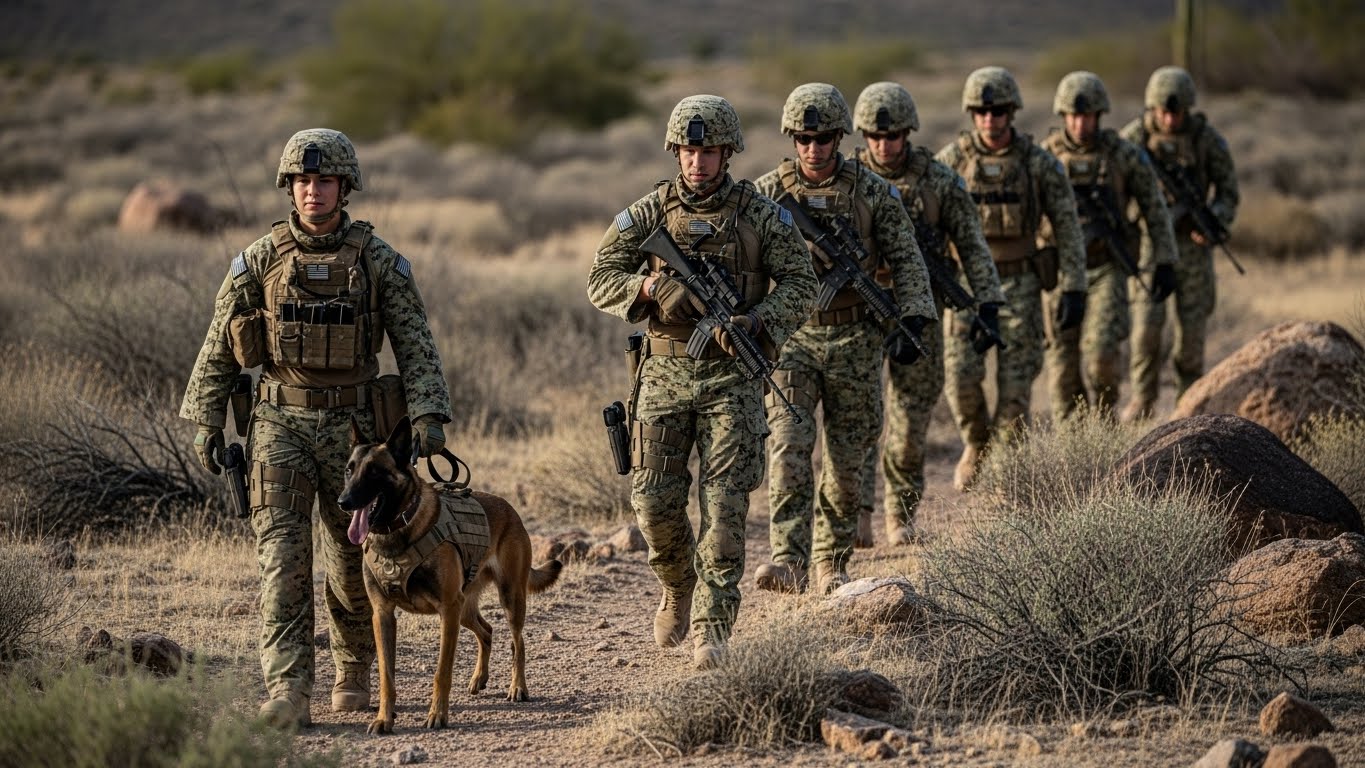
Behind him, seven shadows detached themselves from the larger gloom, chuckling. They were SEALs, part of a special operations task force hunting cartel scouts in this godforsaken corner of the border. They moved with the liquid arrogance of men who believe they are the apex predators of the food chain.
Petty Officer Hugo Bennett, whose call sign was “Hammer” for reasons that were immediately obvious given the size of his biceps, shook his head. He feigned a theatrical disgust that was meant for me to see.
“Support personnel,” he muttered, just loud enough to carry over the wind. “Why are we dragging a babysitter along?”
My hand, already firm on Ryder’s leash, tightened. A reflex. The leather was worn smooth, a familiar texture in a world that had become brutally unfamiliar.
I said nothing.
Two weeks. That’s how long I’d been attached to Morrison’s team. Two weeks of learning that silence was my only armor. Every time I opened my mouth, they found a new way to shove me back into the box they’d built for me: small woman, oversized uniform, dog handler. Irrelevant.
Ryder growled again, the sound more insistent now. A sharp tug on the leash followed.
It wasn’t aggression; it was a warning. A desperate, urgent signal I had learned to read like a second language. Four years we’d been partners, from the sweltering humidity of South American jungles to the high, thin air of these desert plateaus. His instincts were a finely tuned instrument, and right now, that instrument was screaming.
I could feel it in the taut line of the leash, in the subtle shift of his weight from his haunches to his forelegs, ready to spring. Something was wrong.
“Sir,” I said, my voice barely a whisper, afraid to break the fragile morning air. “Ryder’s detecting something.”
“Specialist Fletcher, you are a K-9 handler,” Morrison cut me off, his voice dripping with condescending patience. He didn’t even look at me. “You are not here to interfere with combat decisions.”
The words were a slap. He waved a hand forward, a king dismissing a courtier. “Move out.”
The team fell into their practiced formation as if pulled by invisible strings. A fluid, eight-man machine of lethality. Morrison at point, Hugo and Chief Warrant Officer Gaston Reed on the flanks. Sergeant Caleb Ford, the medic, in the middle. The rest spread out in a textbook tactical diamond.
And then there was us. Willow and Ryder. Bringing up the rear. The afterthought. The last, the forgotten.
Twenty minutes. In twenty minutes, everything would change. The assumptions they had built around me, the casual cruelty, the arrogant dismissals—it would all burn away in a flash of cordite and terror. They were about to discover who the small woman in the shadows really was. And by then, ignoring Ryder’s warning would become the deadliest mistake of their careers.
The patrol slipped through the compound gates and into the uncertain world beyond. The Sonoran Desert at this hour was a liminal space. It was too dark to see clearly with the naked eye, but the approaching dawn threw just enough ambient light into the sky to make full night vision a liability. A sudden sunrise could flash-blind you. It was a treacherous time. A seam in the fabric of the day where monsters hid.
My hand rested on the back of Ryder’s harness, a constant, silent conversation passing between us through the pressure of my palm. He pulled, a slight, insistent tug to the left.
My eyes followed his line of sight, scanning the dusty ground. And then I saw it.
A faint, metallic glint in the starlight. A filament, thin as fishing line, stretched taut across the path at ankle height. A tripwire. My pulse gave a hard, sudden kick against my ribs.
“Sir, there’s—” I started, my voice sharp with urgency.
Morrison waved me off again, a flick of his wrist, not even bothering to look back. “Keep moving, Fletcher. Radio discipline.”
Sergeant First Class Jasper Cole, the team’s sniper and their quiet observer, glanced back at me. I saw a flicker of something in his eyes—not dismissal, but curiosity. He’d seen me spot the wire. He’d registered the speed of my recognition, the immediate tactical assessment that didn’t quite fit the profile of an inexperienced “babysitter.”
But he said nothing. He just adjusted his path, stepping wide around the wire I’d seen. The others, trusting their point man, did the same, oblivious.
The patrol continued. The only sounds were the crunch of boots on gravel and the soft crackle of routine check-ins on Morrison’s radio. Everything normal. Everything routine. Just another walk in a place where death hid under rocks and behind sun-bleached scrub.
Caleb Ford, the medic, shifted the weight of his pack and fell back to walk beside me.
“You even know how to use that field kit?” he asked, nodding at the compact pouch on my belt. It wasn’t a genuine question. It was a prod, a little jab to remind me of my place.
Before I could form a response, Hugo laughed from the flank, a low, ugly sound. “She probably thinks it’s for treating the dog.”
“That’s what she’s here for, isn’t it?” Gaston added, his voice loud in the quiet. “Dog maintenance.”
My jaw locked so tight I felt a muscle jump in my cheek. I kept my eyes forward. My hand, of its own accord, moved to my side, fingers brushing against the raised, ropy line of a scar through the fabric of my uniform. It was a gesture so brief, so unconscious, it was almost nothing.
But Jasper, walking a few paces ahead, saw it. The sniper’s eyes narrowed.
That small, self-soothing touch. That phantom ache of an old wound. It was a familiar tell. He’d seen it in operators who’d survived the unsurvivable, men who carried the ghosts of past battles in their very posture. It was the language of combat veterans, and it didn’t belong to a rookie dog handler.
Chapter 2: The Kill Zone
We reached a staging point, a cluster of crumbling adobe walls that marked the edge of a long-abandoned settlement. Morrison called a halt.
The team gathered in a loose, professional circle, checking weapons, sipping water. I automatically moved to a position with clear sightlines to all approaches, my back protected by a low wall. It was instinctive. Tactical positioning learned in a school far harder than any K-9 academy.
Jasper watched me do it. I could feel his gaze, analytical and sharp. His curiosity was no longer a flicker; it was a steady, burning flame.
“Alright, listen up,” Morrison said, spreading a laminated map on the dusty ground, the light of his red-lensed headlamp painting it in blood. “We’re moving through this cluster of structures, then dropping into the arroyo. Standard sweep pattern.”
My eyes scanned the map upside down. The lines of the terrain screamed at me.
“The arroyo is a natural kill zone,” I said. The words slipped out, quiet, almost to myself. But in the pre-dawn stillness, they rang out like a gunshot.
Every head snapped up. Morrison’s eyes found mine, glittering with fury in the red light. “Excuse me, Specialist?”
The air crackled. The entire team turned to stare. Hugo’s face was a mask of open mockery. Gaston crossed his arms, settling in for the show. Caleb shook his head, a look of second-hand embarrassment on his face.
I felt Ryder press his body against my leg. A solid, warm presence. I’m here.
“Nothing, sir,” I said, dropping my gaze to the ground. “I apologize.”
“No, no, please,” Morrison said, his voice dripping with venomous sarcasm. “Enlighten us. Share your vast tactical wisdom with the group.”
I took a breath, the cold desert air searing my lungs. I kept my voice level, academic. I pointed to the map.
“The arroyo has elevated positions on three sides,” I said, tracing the lines with my eyes. “The approach has limited cover. If I were setting an ambush, that’s where I’d…” I stopped, catching myself. I’d said too much. “But you’re right, sir. I apologize for speaking out of turn.”
Morrison held my gaze for a long, hard moment, his eyes searching for a crack in my composure. Finding none, he turned back to the map with a huff. “As I was saying,” he said, his voice laced with contempt, “before being interrupted by someone with precisely zero combat experience.”
But Jasper wasn’t looking at the map anymore. He was looking at me, his focus absolute.
My analysis hadn’t just been good; it had been perfect. Textbook anti-ambush doctrine. But it was more than that. It was the way I’d phrased it: If I were setting an ambush.
Not defending against one. Setting one. That was the language of the hunter, not the hunted. It was the language of an operator. And it came from somewhere Morrison, in his towering arrogance, was completely deaf to.
We moved out again, entering the maze of derelict buildings. The structures were little more than skeletons, their adobe walls slowly surrendering to the wind and sun.
Morrison led with his usual unshakeable confidence, his team a river of silent, deadly movement flowing around him. They were a single organism, honed by eight months of working together. They trusted each other’s instincts. They did not trust me.
As he passed, Hugo deliberately slammed his shoulder into mine, a petty act of aggression designed to put me off balance. “Move aside, support,” he grunted. “Combat personnel coming through.”
I stumbled, catching myself against a crumbling wall.
Ryder, however, had no such reservations about rank. His ears flattened, and he moved with a liquid grace, planting himself squarely between Hugo and me. He didn’t growl, didn’t show his teeth. He just stood there, an immovable wall of fur and muscle.
Hugo noticed and let out a short, derisive laugh. “Oh, the puppy’s gonna protect you? That’s adorable.”
“Ryder’s not a puppy,” I said, my voice dangerously quiet. “He’s a combat veteran with more deployment time than some of the humans I could mention.”
The words hung in the charged air. Hugo’s face darkened, flushing with anger. “You got something to say to me, Fletcher?”
“Stand down, both of you,” Morrison ordered over his shoulder.
We pushed on. We entered the approach to the arroyo just as the sky began to bleed from black to a deep, bruised purple. The land fell away before us, a jagged scar in the earth. The canyon walls rose up on three sides, stark and menacing, just as I had described.
Ryder’s entire demeanor changed. This was no longer a low growl of warning. Every muscle in his body went rigid. His ears swiveled like radar dishes. A low, keening whine escaped his throat.
It wasn’t a growl of aggression anymore. It was pure, distilled anxiety. My own heart began to hammer against my ribs.
“Sir,” I said, and this time there was no hiding the urgency. “We need to stop. Right now.”
“Not this again, Fletcher,” Morrison sighed, not even breaking stride.
“Sir, Ryder is never wrong about this. Something is—”
“One more word and you’re walking back to the TOC,” Morrison snapped.
I stopped. I couldn’t go forward. I wouldn’t.
“I’m trusting my K-9’s judgment, sir,” I replied, my voice hard, a diamond edge that made even Hugo pause. “Ryder has a ninety-seven percent accuracy rate on threat detection. And right now, he is telling us there is a lethal threat directly ahead.”
“Dogs make mistakes,” Morrison said dismissively.
“Ryder doesn’t.”
“Then maybe he’s finally due.” He turned his back on me, a final, absolute dismissal. “We continue. Move out.”
But I didn’t move. And neither did Ryder. He had broken from his heel position and now stood stock-still in the middle of the narrow path, physically blocking the team’s advance.
“Move that animal, Fletcher, or I’ll have it removed from service,” Morrison threatened.
My expression went utterly flat. Something died in my eyes, and something else—something cold and ancient and dangerous—was born in its place.
I pulled Ryder aside, off the path. He whined, a sound of pure protest, but obeyed.
Morrison nodded, satisfied. He resumed walking. The team fell in behind him, moving into the narrowest part of the arroyo approach.
Gaston took a step. His boot snagged on something. He looked down.
Time seemed to warp, stretching like heated plastic. A thin, dark wire was pulled taut across the path, directly against his boot.
“Freeze!” Gaston’s voice was a choked, terrified cry. “TRIPWIRE!”
Everyone froze. Absolute, heart-stopping stillness. Seven elite warriors, frozen in mid-stride.
My eyes swept the scene, my brain processing the data with cold, professional speed. I saw what they hadn’t. The wire wasn’t the primary trap. It was a herding mechanism. On either side of the path, barely concealed under the dust, were the circular outlines of pressure plates.
“Don’t move laterally!” I yelled, my voice a commander’s bark. “There are secondaries!”
Before the words had even fully registered, the world ripped apart.
It wasn’t the tripwire. It was a rocket-propelled grenade, fired from the building at two o’clock. It slammed into the ground fifteen meters in front of Morrison, showering the team with a concussion wave and a deadly spray of rock and shrapnel.
Morrison went down, a ragged cry torn from his throat. Blood instantly blossomed across his chest.
And then the world became chaos.
Chapter 3: The Ghost Emerges
Gunfire erupted from three positions at once.
The buildings at ten and two o’clock lit up with muzzle flashes. A window in a ruined structure dead ahead poured fire into the chokepoint. It was a perfect, professionally executed crossfire. The exact ambush Ryder and I had tried to warn them about.
Hugo screamed and collapsed, a round tearing through his thigh.
Caleb dove for the minimal cover of a low wall, his medical pack ripped from his back by a near miss.
Gaston was still a statue of terror, pinned by the tripwire, exposed and helpless.
Jasper was already returning fire, his sniper’s training kicking in as he targeted the most immediate threat on the rooftop.
Aiden scrambled toward Morrison, trying to drag his wounded lieutenant to safety. The radio on Morrison’s back shattered into a thousand pieces, a shower of sparks signaling our isolation.
No comms. No backup. No quick reaction force.
The SEAL team, the confident, elite predators, were being torn to shreds in seconds.
And in that instant of fire and blood, Willow Fletcher, the meek K-9 handler, ceased to exist.
Something else took her place.
I moved with a speed that defied logic, a blur of focused intent. In the three seconds it took for the others to process the shock, I had covered the distance to Gaston. My eyes took in the tripwire mechanism, identified the pin, the tensioner.
“On three, step straight back,” I commanded.
It wasn’t a suggestion. It wasn’t a scream. It was an order, delivered in a voice of absolute, unquestionable authority. A voice that had commanded men in the darkest corners of the world.
“One… two… THREE.”
Gaston obeyed without thinking, his body reacting to the sheer force of my command. He stepped back.
The wire went slack. No explosion.
He stared at me, his face a canvas of disbelief. He realized instantly that if he had jumped sideways—the standard reaction—he would have triggered the pressure plates I had spotted moments ago.
“Northeast rooftop,” I snapped at Jasper, not even looking at him. “Two hostiles. Suppressing fire. Now.”
He obeyed instantly. His body moved before his mind could catch up to the fact that the “dog handler” was giving him firing coordinates. He laid down a precise volley of fire, forcing the two figures on the rooftop to duck for cover.
I dropped to my knees beside Morrison. My hands were already moving, a surgeon in the field of battle.
Shrapnel had punched through his body armor, tearing into his chest and nicking an artery in his leg. I applied direct pressure to his chest with one hand while my other snatched a tourniquet from my own belt.
“Caleb!” I shouted over the roar of the firefight. “Medical pack! Move!”
He scrambled, shoving the torn pack across the dusty ground. I caught it one-handed, never breaking pressure on Morrison’s wound. I ripped it open and began working with a speed and competence that made Caleb’s jaw hang open.
I wasn’t fumbling. I wasn’t hesitating. I was performing a needle decompression to relieve the pressure in Morrison’s chest—a procedure usually reserved for combat medics or surgeons.
But it was more than the medicine. It was the calm. The absolute, terrifying calm under fire.
While maintaining pressure on Morrison’s wound with one hand, I raised my M4 carbine with the other.
I didn’t spray and pray. I fired controlled, single shots.
Pop. Pop.
Two rounds. One target.
A cartel gunman in the forward position crumpled, his weapon falling silent.
Hugo, lying on the ground clutching his bleeding leg, stared at me as if I were an apparition.
“What… what are you?” he whispered into the cacophony.
I didn’t answer. I was too busy saving their lives.
Chapter 4: The Trident
The firefight raged on, but the momentum had shifted. My commands had galvanized the shattered team, turning their panic into a coordinated, effective defense.
“Jasper! Shift fire left! Ten meters!” I called out, tracking a muzzle flash.
“Copy!” Jasper yelled back, shifting his aim without question.
In the chaos of treating Morrison, the torn fabric of my combat shirt sleeve had ripped further away. My shoulder was now clearly visible to the Lieutenant lying beneath me.
Morrison’s eyes, glazed with pain, suddenly went wide with shock.
There, etched in black ink against my skin, was a symbol that commanded instant reverence in his world.
A Navy SEAL trident.
But not just any trident. Above it, an inscription: DEVGRU.
Below it, another: Task Force Crimson.
And beneath that, a call sign that was whispered about in mess halls and briefing rooms as a myth: Ghost 7.
Morrison tried to speak, blood bubbling at his lips. His hand, trembling, reached toward the tattoo.
“You’re…”
I met his eyes as I cinched the tourniquet tight around his thigh, cutting off the flow of blood.
“Yes, sir,” I said quietly. “I am.”
The gunfire still hammered around us, but the universe had tilted on its axis. The surviving SEALs—Jasper, Gaston, Caleb, Aiden—were staring at me with expressions of raw, undiluted shock.
The quiet handler was gone. In her place was an operator moving with the lethal grace and efficiency that only came from years of training and fighting at the highest, most secret levels of the United States military.
“Jasper,” I said, my voice cutting through the noise. “Northeast rooftop. Two more targets, behind the brick chimney. Engage.”
“On it,” he replied, his response automatic.
“Gaston! Secure the ten o’clock building. Watch for a secondary assault team.”
Gaston, his face pale with shock, moved to obey, his eyes still fixed on my tattoo for a fraction of a second too long.
“Aiden! Cover our six. Nothing gets behind us.”
“Yes, ma’am,” Aiden stammered. The formal address was an unconscious reflex.
“Caleb. Take over on Morrison. Keep pressure on that chest wound. The tourniquet will hold. Don’t touch it.”
Caleb scrambled to my side, his hands shaking as he took over. He had thought he knew field medicine. What he had just witnessed was a masterclass taught in the middle of a firefight.
I stood up. My M4 came up in a single, smooth motion. I moved to Hugo, who was staring at me like I’d just stepped out of a ghost story.
“You’re… DEVGRU?” he whispered, the words choked with disbelief. “SEAL Team Six?”
“Was,” I corrected quietly, my eyes scanning the ridge line. “Past tense.”
“But… how? Women can’t…”
“We can now,” I said, my voice flat. “Been able to for six years. Some of us even do it well.”
I tapped my headset, realizing the team frequency was clogged with panic. “Radio silence,” I ordered. “Maintain fire discipline. They’re pulling back.”
The cartel shooters were professionals, but they weren’t suicidal. They had expected an easy kill—a panic-stricken patrol caught in a trap. Instead, they had run into a buzzsaw of precision fire directed by a tier-one operator.
Realizing they had lost the element of surprise, the enemy fire began to slacken. Shadows retreated into the deeper gullies.
Then, silence.
A ringing, profound silence, broken only by Morrison’s ragged breathing and Hugo’s pained groans.
Ryder trotted to my side, his body language calm, professional. He had been covering our rear flank the entire time, silently and efficiently neutralizing a gunman who had tried to circle around behind us.
I dropped a hand to his head, a brief, firm acknowledgment. Good boy. Always.
Chapter 5: Authentication Code
Gaston returned from clearing the nearest building, his weapon lowered but ready.
“Three hostiles down. No others visible. We’re clear, for now.”
“Good,” I said. “Aiden, I need you to climb to that rise.” I pointed to a small, rocky hillock about fifty yards away. “Signal the TOC with a mirror flash. We’re too far for hand signals, but they’ll see a mirror. Tell them we need immediate medevac. Two critical casualties. Coordinates to follow.”
Aiden pulled out his signal mirror and scrambled up the rise without a single question. It would only be later that he’d wonder how I knew he carried a signal mirror—an piece of “old-school” tech that most of the new guys didn’t bother with.
I knelt beside Morrison again, checking his vitals.
His eyes were open, lucid. They were fixed on me with a galaxy of pain, confusion, and dawning, horrified understanding.
“Ghost Seven,” he whispered. “I’ve heard the stories. They said you died. The Sahel… 2021.”
“Almost,” I corrected gently. “But not quite. Medical discharge. Classified mission.” I adjusted the bandage on his chest. “You’re going to be okay, sir. Help is coming.”
“Why?” he asked, his voice a raw rasp. “Why didn’t you tell us?”
A bitter smile touched my lips.
“Would you have believed me, Lieutenant? Or would you have accused me of stolen valor? Thought I was some fantasist lying for attention?”
I met his gaze, and for the first time, I let him see the steel underneath.
“It was safer to stay quiet. Safer to let Ryder do the talking.”
His face crumpled, the arrogant mask shattering into a thousand pieces of shame. “We ignored him. We ignored you. I almost… We could have…”
“You made a mistake,” I said. My voice was devoid of accusation. It was just a fact. “Everyone makes them. You’ll live to learn from it. That’s what matters.”
A sudden crackle of static burst from Jasper’s backup radio. The main comms were down, but the emergency channel had punched through.
“Team One, this is TOC (Tactical Operations Center). We have visual on your mirror signals. Medevac inbound, ETA eight minutes. Authenticate status.”
Gaston, who was standing near Jasper, froze. He looked at the call sign roster taped to the back of the radio.
“We can’t authenticate,” Gaston said, panic rising. “Morrison has the codes, and his book is shredded. If we don’t give the code, they won’t land. They’ll think we’re being coerced.”
“Authenticate!” the radio voice commanded again, sharper this time. “Team One, give me the code of the day or we are aborting approach.”
I stood up. I walked over to Jasper and took the radio from his numb fingers.
I pressed the transmit button.
“Authentication code: Crimson Falcon Seven-Niner,” I said. My voice was calm, clear, and utterly distinct. “Ghost Seven confirms. Two critical casualties requiring immediate evacuation. Hostile contact neutralized. Area secured.”
There was a long, stunned silence on the other end. The static hissed.
Then, a new voice came on the line. Older. Weighed down with authority and something that sounded like disbelief.
“Ghost Seven, this is Command Actual. Colonel Cross on net. Is that… is that really you?”
I closed my eyes for a brief moment. The past rushed back in a tidal wave. The desert heat, the blood, the loss.
“Yes, sir. It’s me.”
“What is your current assignment, operator?”
“K-9 Special Operations Unit, sir. Handler designation.”
Another pause, even longer this time. When Colonel Edwin Cross spoke again, his voice was tight with emotions I couldn’t begin to decipher.
“Copy that, Fletcher. Medevac is inbound. You hold your position. We’ll debrief when you’re back on base.”
“Roger, sir.”
The radio went silent.
I handed the handset back to Jasper. The surviving members of the team were staring at me.
They were really seeing me for the first time.
Not as support personnel. Not as a liability. Not as a woman to be mocked.
They were seeing one of the most elite, most mythologized operators in the entire U.S. military. A ghost story made of flesh and blood.
Hugo spoke first from the ground, his voice thick with pain and a shame so profound it was almost a physical presence.
“I’m… I’m so sorry.”
“Apology accepted, Petty Officer,” I said simply.
“Why K-9?” Caleb asked, his voice filled with genuine, bewildered confusion. “Why step down from DEVGRU to… no offense, but… to this?”
I looked down at Ryder. He sat beside me, his tongue lolling out in a grin, looking ridiculously pleased with himself.
“Because he needed me,” I said softly. “And because after the Sahel, I needed something that wasn’t about ego, or glory, or proving anything. I needed a partner who would always tell the truth. Who would never lie. Who would trust me absolutely, and deserve my trust in return.”
I scratched Ryder behind the ears.
“Dogs don’t play politics. They just do the work.”
Chapter 6: The Weight of Silence
“But you’re wasted here,” Gaston protested, his voice straining against the noise of the approaching helicopter. “Your skills… your experience…”
“I’m not wasted,” I interrupted, my voice quiet but firm enough to cut through the rising wind. “I am exactly where I chose to be. The fact that people like you couldn’t see that says a lot more about your assumptions than it does about my capabilities.”
The words landed with the force of physical blows. Gaston flinched. Hugo looked away. Even Morrison, through his pain, couldn’t meet my eyes.
The thumping sound of helicopter rotors grew louder, beating against the canyon walls like a giant heart. The medevac Blackhawk was almost on us.
I stood and began directing the casualty loading. My commands were crisp and efficient.
“Aiden, secure the LZ. Jasper, pop green smoke. Let’s get them home.”
They obeyed without hesitation. The team’s hierarchy had completely inverted from what it had been only thirty minutes before. The Lieutenant was the casualty; the “babysitter” was the commander.
As the helicopter descended, kicking up a storm of dust and grit, I shielded Morrison’s body with my own. The ramp dropped before the wheels had even fully touched down.
Captain Shaw emerged, running across the clearing with two flight medics. She stopped dead when she saw me. Recognition and shock warred on her face.
“Fletcher,” she said, her voice careful. “Situation report.”
“Two critical, stable for transport,” I reported. My tone was as professional and precise as if I were back in the field with my old team. “Multiple minor injuries. Hostile ambush neutralized. Six confirmed enemy KIA. No friendly fatalities. Recommend immediate departure and full debrief upon return to TOC.”
Shaw nodded slowly. Her eyes were drawn to the exposed tattoo on my shoulder—the trident that shouldn’t be there.
“Copy that. We’ll… talk later.”
“Yes, ma’am.”
The medics loaded Morrison and Hugo aboard. The rest of the battered, shocked team followed. I climbed in last with Ryder. As always, bringing up the rear.
But as the Blackhawk lifted off, banking hard over the arroyo, the atmosphere inside the cabin was heavy.
The way the other SEALs looked at me had changed forever. It wasn’t dismissal or mockery anymore. It was something closer to awe. And fear.
Because they had just realized, in the most brutal way imaginable, how badly they had misjudged me. And how close that misjudgment had come to getting every single one of them killed.
The ride back to the TOC was a roaring silence. The thrum of the rotors was a physical weight in the air.
Morrison drifted in and out of consciousness, his system flooded with painkillers. But every time his eyes flickered open, they found me. He was trying to reconcile two irreconcilable images: the quiet, dismissed dog handler and the legendary operator who had saved his life.
Jasper sat across from me, his gaze direct and unblinking. He wasn’t being hostile; he was studying me, trying to piece together the puzzle I represented.
“How long were you with DEVGRU?” he finally asked, his voice low enough that only I could hear over the engine noise.
“Three years active operations,” I replied. “Two years of training and selection before that.”
“The Sahel,” he stated. It wasn’t a question.
“Classified.”
“They said Ghost Seven died in the Sahel. That the entire team was lost on Operation Crimson Dune.”
A shadow passed over my heart. I looked out the window at the desert rushing by below.
“Most of them were,” I said. My gaze went distant, seeing not the Arizona rocks but a dusty, blood-soaked compound half a world away. “I was lucky.”
“Doesn’t look like luck,” Jasper observed. His eyes fell to the scars now visible on my arms and neck where my uniform had been torn—the tell-tale burn patterns and peppered marks of a close-quarters IED.
“Lucky enough to survive,” I clarified. “Not lucky enough to stay in the rotation. Medical discharge. Psych eval said I was compromised. Too much risk to the unit.”
“But not too much risk to be a K-9 handler in a combat zone?” Caleb asked from beside him, his voice laced with incredulity.
I shrugged, a small, tired movement.
“Different evaluation standards. Different mission. The K-9 unit was willing to take me. And I was willing to serve in whatever capacity allowed me to stay in the fight.”
I looked down at Ryder, who had laid his head in my lap, fast asleep.
“Found out I prefer it this way. It’s simpler. Clearer.”
“We treated you like dirt,” Aiden said. The young private had been silent until now, his face a mask of shame. “We were horrible to you.”
“Yes,” I agreed. My voice was flat and honest. “You were.”
The bluntness of it made them all flinch. I wasn’t going to sugarcoat it for them.
“Why didn’t you correct us?” Gaston asked, his voice barely a whisper. “Why not just show us your credentials?”
“Because credentials shouldn’t matter,” I said, my voice rising slightly. A flicker of the frustration I’d held back for weeks finally broke through.
“Ryder’s warning should have been enough. My tactical analysis should have been enough. The simple fact that I was telling you the truth should have been enough.”
I met each of their eyes, one by one.
“You didn’t listen because you had already decided I wasn’t worth listening to. No piece of paper, no tattoo, would have changed that until you were forced to see differently.”
Morrison stirred on his stretcher. His voice was weak, but clear enough to be heard.
“She’s right,” he rasped. “We made assumptions. Lazy, arrogant, deadly assumptions. It got us hurt. It should have gotten us all killed.”
His gaze found mine, filled with a bottomless well of shame.
“Ghost Seven saved our lives, and we spent two weeks treating her like she was worthless.”
“Not worthless,” Hugo mumbled from his stretcher. “Worse. We treated her like she was a liability.”
He looked at me, his eyes swimming.
“You weren’t the liability, Fletcher. We were.”
I gave a slight nod. There was nothing more to say. They knew. Now they had to live with it.
Chapter 7: The Debrief
The helicopter touched down on the dusty pad at TOC Diablo. The organized chaos of a medical reception took over.
As Morrison and Hugo were rushed toward the field hospital, Captain Shaw intercepted me.
“Fletcher,” she said, her voice quiet but firm. “Colonel Cross wants to see you. Immediately.”
I nodded. “Yes, ma’am.”
“I’ll take Ryder to the kennels,” she offered. It was a gesture of respect that spoke volumes coming from a Captain to a Specialist. “Get him fed and watered. He’s earned it.”
“Thank you, ma’am.” I handed her the leash. Ryder whined, reluctant to leave my side.
“It’s okay, boy,” I murmured, scratching his head. “Stand down. Rest.”
He obeyed, but his eyes followed me as Shaw led him away.
I walked across the sprawling, dusty base toward the main command building. I could feel the eyes on me. Word travels faster than light on a military base. Whispers and rumors were already spreading like wildfire.
The quiet K-9 handler was Ghost Seven. The legend. The ghost.
It was everything I had tried to escape. The attention I had explicitly chosen to leave behind. I had wanted to serve without the crushing weight of my past. Now, it was all back.
Colonel Cross’s office was at the end of a long, quiet corridor. The staff sergeant standing guard snapped to attention as I approached.
“The Colonel is expecting you, ma’am.”
The ma’am was new. It wasn’t the casual courtesy given to a junior specialist. It was the hard-earned respect afforded to a proven operator. Word had definitely spread.
I entered and stood at attention. “Handler Fletcher reporting as ordered, sir.”
Colonel Edwin Cross looked up from his desk. He was a man in his fifties, with graying hair and a face weathered by three decades in the world’s most dangerous places. He had been my commanding officer in DEVGRU. He was the one who had visited my hospital bed after the Sahel.
“At ease, Fletcher,” he said, his voice a low gravel. “Or should I be calling you Ghost Seven?”
“Fletcher is fine, sir. That’s who I am now.”
He rose and walked around the desk, his eyes studying me with an intensity that would have made most people wilt. I held his gaze. We had been through too much together for games.
“Morrison’s team almost died out there today,” he said bluntly. “They would have died, if not for you.”
“If they’d listened to Ryder, it never would have gotten that far, sir.”
“They didn’t listen because they didn’t respect you.”
“Yes, sir.”
“And they didn’t respect you because you didn’t tell them who you were.”
My jaw tightened. “With all due respect, sir, I shouldn’t have had to. My analysis was correct. My warnings were valid. The fact that I have a particular résumé shouldn’t be a prerequisite for being believed.”
Cross allowed a small, wry smile. “Still as stubborn as ever.”
“It’s not stubbornness, sir. It’s principle.”
“Sometimes, principle gets people killed, Fletcher.”
“And sometimes, arrogance does,” I countered. “You tell me which was the bigger factor today.”
He stared at me for a long moment, and then he laughed—a short, sharp bark of a sound. “You always were direct. I’ll give you that.”
He returned to his desk.
“Morrison will live. So will Bennett. The rest of that team is going to need a hard psychological reset after coming to terms with how badly they screwed the pooch.”
“They made a mistake, sir.”
“Did they?” Cross asked sharply. “Or was it systemic bias and chauvinism dressed up as professional judgment?”
I hesitated. “It can be both, sir.”
“And you’re willing to forgive that?”
“I’m willing to let them learn from it, sir. It’s not the same thing.”
He nodded slowly.
“You could come back, you know. To DEVGRU. Full active status. Your performance today… your skills haven’t degraded. You’re sharper than ever. The Sahel took a lot from you, but it didn’t break you. There’s a place for you.”
I had known this was coming. The offer. The chance to reclaim the ghost.
“No, sir,” I said quietly, but firmly.
“No?”
“No, sir. With all due respect, I am where I belong.”
Chapter 8: The New Mission
Colonel Cross leaned back in his chair, eyebrows raised. “You belong in a K-9 unit, after everything you’ve accomplished?”
“Yes, sir,” I said, my voice unwavering.
“Ryder needs me, and I need him. What happened today proves that these teams are undervalued and underutilized. If I can change that, if I can show people that this partnership saves lives… that’s more valuable than adding one more trigger-puller to the DEVGRU roster.”
“You really believe that.”
“I do, sir. Dogs don’t care about rank. They don’t have egos. They just want to do the job. I relate to that.”
He studied me, then gave a slow, deliberate nod.
“Alright. You stay with the K-9 unit.”
He held up a hand before I could react.
“But you’re getting a rank adjustment. Staff Sergeant, effective immediately. Your current rank is an insult to your capabilities. And,” he continued, overriding my attempt to protest, “you’re going to be training.”
“Training, sir?”
“You’ll be in charge of developing a new course on tactical integration of K-9 assets. You’re going to teach operators like Morrison how to respect this partnership.”
He smirked.
“In fact, you’re going to be Lieutenant Morrison’s personal instructor when he returns to duty. You, and Ryder. He and his entire team are going to learn from their mistake by learning from you.”
A small, genuine smile finally touched my lips.
“That’s going to be… uncomfortable for everyone involved, sir.”
“Good,” Cross said bluntly. “Comfortable people don’t learn. Now get out of my office, Fletcher. Get some rest.”
He stood.
“And for the record… I’m proud of you. Not for the heroics. But for the choice you made to serve quietly. That’s the real strength.”
“Thank you, sir.”
I rendered a crisp salute. He returned it with equal formality.
I walked out into the harsh desert sunlight, my world irrevocably altered. New rank. Training duties. Morrison as my student. My quiet life was over. But maybe that was okay.
I found Ryder in the kennel. He launched himself at me with a joy so pure it almost knocked me over. I knelt and let him cover my face in happy, wet licks, laughing for what felt like the first time in years.
“Good boy,” I whispered into his fur. “You tried to tell them. Such a good boy.”
Ryder yipped. Vindicated.
“Come on,” I said, standing up. “Let’s go see if the mess hall has a steak big enough for a hero. You’ve earned it.”
We walked together across the base, and I felt the stares again. But they were different now.
They were looks of respect. Recognition. It was the way people looked at warriors, and at the partners who stood beside them.
It would take some getting used to. But with Ryder at my side, I figured I could handle just about anything.
The ghosts of the past were still there, but for the first time in a long time, they weren’t haunting me. They were just watching. And the future?
The future was walking right beside me, wagging its tail.