He Mocked The Janitor For Years. Then The Admiral Saluted Him.
PART 1
Chapter 1: The Invisible Man
The mornings at the Norfolk Tactical Center in Virginia always broke the same way. It wasn’t with a bugle call or the roar of a jet engine, but with a low, electric hum as the fluorescent lights flickered awake in the long, sterile corridors.
The air smelled of stale government coffee and industrial pine cleaner. Outside, the Atlantic ocean churned against the seawall, gray and cold. Inside, the silence was heavy, waiting to be broken by the boots of men who thought they owned the world.
But long before the analysts and the officers arrived, someone else was already there.
His name was Brian Hail.
He moved through the hallways with the unhurried steadiness of a man who had made peace with silence. His mop bucket, a yellow plastic contraption with a squeaky left wheel, rolled softly behind him. He moved with an economy of motion that was almost beautiful—a practiced glide that disturbed nothing.
His graying hair was pulled back in a loose tie, brushing the collar of a work shirt that had been washed so many times it was a pale, defeated green. He was fifty, maybe older. To the people who worked here, he was part of the building. A shadow. A janitor.
But if you watched him—truly watched him—you would see the glitches in the matrix.
You would see the way he paused at every T-junction in the hallway, his eyes sweeping left, then right, then checking the reflection in the glass of the fire extinguisher case. It wasn’t a glance; it was a sector scan.
You would see the way his hands, though calloused from bleach and rough towels, moved with a startling, surgical precision. He didn’t just wipe a table; he cleared it.
Most of all, you would see his eyes. They were the color of deep ocean water, and they held a thousand-yard stare that didn’t belong in a janitor’s closet. They were the eyes of a man who had seen the end of the world and decided to keep walking.
At exactly 0600 hours, Brian pushed open the door to Classroom 4B.
This was the elite simulation lab. In two hours, it would be filled with the bright, arrogant energy of young Marine officers eager to prove they were the next generation of warfighters.
Brian began his routine. Dip the mop. Wring it out. Swab the deck.
“You missed a spot, Hail.”
The voice sliced through the quiet like a serrated knife. Brian didn’t flinch. He knew that voice. It belonged to Captain Henry Dalton.
Dalton strode into the room, flanked by two young Lieutenants who looked like they were trying too hard to mimic their boss’s swagger. Dalton was a man who wore his rank like a shield. His uniform was tailored tight, his medals gleaming, his jawline sharp enough to cut glass. He was the kind of officer who believed respect was something you demanded, not something you earned.
Brian slowly turned, resting his hands on the mop handle. “Morning, Captain.”
Dalton walked over to a desk Brian had just wiped down. He ran a manicured finger across the surface, then held it up, inspecting it with theatrical disgust.
“Dust,” Dalton announced. He smirked, looking at his lieutenants for approval. “I swear, the standards on this base are slipping every day. If you cleaned this room with half the effort I put into my morning shave, we might actually get somewhere.”
One of the lieutenants snickered.
Brian looked at the desk. It was spotless. But he didn’t argue. He knew the game. “I’ll take care of it, sir.”
“See that you do,” Dalton said, stepping into Brian’s personal space. He smelled of expensive cologne and insecurity. “Tell me something, Hail. Do you ever get tired of this?”
Brian looked up, meeting the Captain’s eyes. “Tired of what, sir?”
“This,” Dalton gestured vaguely at the mop, the bucket, the room. “Being a servant. Cleaning up after real men who are actually doing something with their lives. It must be… humbling.”
The room went quiet. The insult hung in the air, gross and unnecessary.
Brian’s pulse didn’t jump. His breathing didn’t hitch. In his mind, he wasn’t in a classroom in Virginia. He was back in the Hindu Kush, feeling the biting wind, waiting for a signal that would determine who lived and who died. Compared to that, Henry Dalton was just a buzzing fly.
“It’s honest work,” Brian said softly. “Everyone has a role.”
Dalton laughed, a sharp, barking sound. “Yeah. Some roles just matter more than others. Remember that.”
He turned his back on Brian, dismissing him as if he were a piece of furniture, and began barking orders at his lieutenants.
Brian watched him for a second longer than necessary. He saw the tension in Dalton’s neck, the way his hands fidgeted. Insecurity, Brian analyzed. Overcompensating. Dangerous in a firefight.
He dipped his mop back into the water and continued his work. He had promised himself he was done with war. But war, it seemed, had a way of finding him, even in a janitor’s closet.
Chapter 2: The Ghost in the Machine
By 1300 hours, the Norfolk Tactical Center was a hive of controlled chaos.
The sound of boots hitting tile echoed like gunfire. Radios crackled with static and acronyms. The air was thick with the scent of ozone from the server rooms and the nervous sweat of young men competing for approval.
Brian was pushing his cart past Simulation Lab 4B again when he heard it.
It was a sound most people wouldn’t have noticed. A faint, rhythmic electronic chirp coming from inside the room. To an untrained ear, it was just background noise.
To Brian Hail, it was a discrepancy.
He stopped. He tilted his head slightly, listening. Beep… click… pause… Beep… click… pause.
The cycle is off, he thought. The radar sweep is lagging by 0.4 seconds.
He shouldn’t care. It wasn’t his job. His job was trash cans and toilet paper. But old habits were hard to kill, and perfectionism was a disease he had caught in the special forces.
The door to 4B was propped open. Inside, Captain Dalton was leading a briefing for twenty officer candidates. The massive wall-sized screen displayed a complex tactical map of a coastal insertion zone. Red and blue icons moved across the grid.
“As you can see,” Dalton was saying, tapping the screen with a laser pointer, “the enemy radar net has a blind spot here, in the northern quadrant. We will exploit this gap for a HALO jump insertion.”
Brian stood in the doorway, clutching a trash bag. He looked at the screen. He looked at the data scrolling on the sidebar.
The blind spot wasn’t real.
The radar wasn’t showing a gap; it was showing a “ghost return”—a technical glitch caused when the atmospheric density filter wasn’t calibrated for coastal humidity. If those boys jumped into that “blind spot” in a real operation, they would be jumping directly into a wall of anti-aircraft fire.
Brian bit his lip. Walk away, Hail. Just walk away.
But he looked at the faces of the young Marines. They were barely twenty-two. Kids. They were taking notes, trusting their Captain, trusting the machine. They reminded him of his old team. The ones who didn’t come back.
Brian sighed. He stepped into the room.
“Excuse me, Captain.”
Dalton froze. He turned slowly, looking at Brian like he had just found a roach on his dinner plate. “I am in the middle of a briefing, Hail. Empty the trash later.”
“It’s not the trash, sir,” Brian said, his voice low and raspy. “It’s the screen. Your radar calibration is off.”
Silence. Absolute, stunned silence.
One of the candidates in the front row dropped his pen.
Dalton stared at him, blinking. Then, a slow, cruel smile spread across his face. “Excuse me? Did the janitor just offer tactical advice?”
“It’s the atmospheric filter,” Brian continued, ignoring the mockery. He pointed a calloused hand toward the bottom corner of the data stream. “See that flutter in the signal return? That’s not a gap in coverage. That’s a ghost echo. If you send a bird in there, the enemy SAM sites will light it up before the chutes even open.”
The room was deadly quiet. The young officers looked from the janitor to the Captain, confused.
Dalton’s face turned a shade of violent crimson. He marched over to Brian, invading his space, chest out.
“Listen to me, you mop-pushing has-been,” Dalton hissed, loud enough for the back row to hear. “I don’t know what kind of action movies you watch in your mom’s basement, but this is advanced warfare. This is calculus. You clean toilets. Do not confuse your hobby with my profession.”
“Check the diagnostic,” Brian said calmly. He didn’t back down an inch.
“I will do no such thing!” Dalton roared. “You are disrupting a military briefing! That is an offense!”
“Sir,” a hesitant voice spoke up from the console desk. It was Corporal Jenkins, the tech specialist. “Sir… I’m running the diagnostic now.”
“I didn’t tell you to do that, Jenkins!” Dalton snapped.
“I know, sir, but…” Jenkins’ face went pale as he looked at his monitor. “The janitor is right.”
The air left the room.
“What?” Dalton whispered.
“The atmospheric filter,” Jenkins stammered. “It was set to ‘Desert’ instead of ‘Maritime.’ It was creating a false negative. If we had run the sim, the entire platoon would have been wiped out.”
All eyes turned to Brian.
He didn’t gloat. He didn’t smile. He just shifted his weight. “Just didn’t want anyone getting hurt,” he mumbled.
Dalton looked at the screen. Then at his men. Then at Brian. He had been humiliated. In his own classroom. By a man who made minimum wage.
Dalton’s pride didn’t just crack; it shattered. And in its place, a cold, vindictive rage took root. He couldn’t let this stand. He couldn’t let the janitor win.
“You think you’re smart?” Dalton said, his voice dropping to a menacing growl. “You think guessing a glitch makes you a soldier?”
“No, sir,” Brian said.
“I think you’re a liar,” Dalton stepped closer, poking a hard finger into Brian’s chest. “I think you’re one of those stolen valor frauds. Walking around here, soaking up the atmosphere, pretending you used to be somebody. Well, I’m going to expose you, Hail. Right now.”
Brian sighed, a sound of infinite weariness. “Captain, let it go.”
“No,” Dalton grinned, his eyes manic. “We’re going to have a little ‘verification session.’ Since you know so much about tactics, why don’t you teach the class?”
He grabbed Brian’s arm.
“Sit down, everyone,” Dalton commanded the room. “The janitor is going to tell us his war stories.”
Brian pulled his arm away gently but firmly. His grip was like iron. For a split second, a flash of something dangerous flickered in his eyes—the Ghost Falcon waking up.
“You don’t want to do this,” Brian warned.
“Oh, I really do,” Dalton sneered.
The Captain had no idea that he wasn’t poking a janitor. He was poking a sleeping dragon. And the fire was about to come.
PART 2
Chapter 3: The Tribunal of Fools
The atmosphere in Lecture Hall 4B shifted from awkward to suffocating. It felt less like a classroom and more like a coliseum where the lions were being starved.
Captain Dalton gestured grandly to the front of the room. “Please, Mr. Hail. Take the floor. Since you have so many opinions on military strategy, I think it’s only fair you share them with the class.”
Brian stood by the door, his hand still gripping the handle of his mop bucket. His knuckles were white. Not from fear, but from the immense effort it took to keep his feet planted on the ground and not walk out.
“I have work to do, Captain,” Brian said quietly.
“Work?” Dalton scoffed, stepping closer. “You call pushing dirty water around ‘work’? No, no. Today, your work is here. You’re going to answer a few questions.”
Dalton turned to the twenty young officer candidates sitting in the tiered rows. They looked uncomfortable. They shifted in their seats, exchanging nervous glances. They knew this was wrong. They knew an officer bullying a janitor was beneath the dignity of the uniform. But they were young, and Dalton was their grading officer. Silence was their only safety.
“Sit,” Dalton barked at Brian, pointing to a stool in the center of the room usually reserved for guest lecturers.
Brian didn’t sit. He stood tall, his posture naturally aligning into a parade rest that was so subtle, yet so perfect, that Corporal Jenkins in the front row frowned in confusion. Janitors don’t stand like that, Jenkins thought.
“I’m waiting,” Dalton said, crossing his arms. “Let’s start with the basics. You claimed to know about radar systems. Where did you learn that? Video games? Wikipedia?”
Brian looked at the Captain. His eyes were flat, unreadable mirrors. “I learned it in the field.”
“The field,” Dalton repeated, mocking the words. “Which field? The cornfield behind your trailer?”
A few sycophantic chuckles from the lieutenants.
“The field where mistakes get people killed,” Brian answered. His voice dropped an octave, losing its raspy subservience. It was suddenly clear, resonant, and cold.
Dalton blinked, unsettled by the shift, but he pushed harder. “Oh, we have a storyteller! Okay, hero. Let’s play. What unit were you in? If you served, you have a unit. A battalion. A company. Name it.”
Brian remained silent.
“Can’t remember?” Dalton sneered. “Or maybe it never existed? See, men, this is what we call ‘Stolen Valor.’ It’s a disease. Civilians who couldn’t make the cut, desperate to steal a little bit of our glory.”
He walked around Brian, circling him like a shark.
“Did you wash out of boot camp, Hail? Did you get kicked out for drugs? Or did you just never have the guts to sign the paper in the first place?”
Brian closed his eyes for a second. In the darkness behind his eyelids, he saw the faces of the men he couldn’t save. He heard the scream of incoming mortars in the Korangal Valley. He felt the weight of the silver star in his drawer at home—the one he never wore.
“I served,” Brian said.
“PROVE IT!” Dalton screamed, slamming his hand on the desk. The sound echoed like a gunshot. “Give me a name! A rank! A deployment!”
“I can’t,” Brian whispered.
“Because you’re a liar!” Dalton triumphed. “You’re a fraud! You are insulting every man and woman who wears this uniform by standing here and pretending you’re one of us!”
The accusation hung in the air, thick and poisonous.
Brian looked at the young Marines. He saw the doubt in their eyes. He saw the disgust Dalton had planted there. And for the first time in years, the injustice of it burned him. Not for his own ego, but for the truth.
“I don’t need to prove anything to you, Captain,” Brian said. “The men who know, know. And the men who don’t… well, they usually end up screaming in classrooms.”
Dalton’s face went purple. He looked like he was about to strike Brian.
“You are dismissed,” Dalton hissed, trembling with rage. “Get out of my sight. And expect a report to the base commander. I’ll have your job by noon.”
Brian nodded once. He turned to grab his cart.
“Wait,” a voice called out.
It wasn’t Dalton. It was Corporal Jenkins. The tech specialist stood up, his face pale but determined.
“Sit down, Corporal!” Dalton shouted.
“No, sir,” Jenkins said, his voice shaking. “You asked him to prove it.”
Jenkins pointed at the massive tactical screen behind them. “If he’s a liar, let him fail. But if he knows the radar glitch… maybe he knows the solution.”
Dalton looked at Jenkins, then at Brian. He saw a chance for the ultimate humiliation.
“Fine,” Dalton smiled cruelly. “Excellent idea, Corporal.”
He gestured to the console.
“You say you know tactics, Hail? Show us. Solve the scenario. If you can save this simulated platoon, I’ll let you keep your mop. If you fail… you leave this base today and never come back.”
Brian looked at the screen. The simulation was a death trap. A “Kobayashi Maru” scenario designed to be unwinnable.
He looked at Dalton. “You really want to do this?”
“I insist.”
Brian let go of the mop bucket. He stepped toward the console. And as he walked, the janitor disappeared.
Chapter 4: The Impossible Solution
Brian approached the tactical display with a familiarity that sent a chill down Corporal Jenkins’ spine. He didn’t look at the keys. His hands hovered over the interface, fingers moving with the fluidity of a concert pianist.
The screen showed a trapped unit. A platoon of Marines pinned down in a valley, surrounded by hostile forces on the high ground, with enemy armor approaching from the north. Standard doctrine said they were dead. Standard doctrine said you called in an airstrike on your own position and prayed.
“The scenario is a blind ambush,” Dalton narrated smugly to the class. “Casualty projection is 100%. There is no escape. The lesson here is about accepting loss.”
“There is always an escape,” Brian murmured.
He didn’t look back. He started typing.
Command override: Delta-Nine. Reroute comms to frequency 44.5. Initiate thermal ghosting.
On the big screen, the blue icons—the Marines—didn’t retreat. They split.
“What is he doing?” a Lieutenant whispered. “He’s dividing his force? That’s suicide. You never split your force when outnumbered.”
“Watch,” Brian said softly.
On the screen, half of the blue dots began to move erratically, firing wildly, drawing the enemy’s attention toward the narrowest part of the canyon. The enemy red dots swarmed toward them, sensing a kill.
“You’re leading them into a slaughter,” Dalton laughed. “You just killed half your platoon to save the other half. Pathetic.”
“Look closer,” Brian said.
Dalton squinted at the screen.
The blue dots that were drawing fire… they weren’t slowing down. They weren’t taking casualties.
“They’re moving too fast,” Jenkins muttered, his eyes wide. “Wait… those aren’t men.”
Brian typed a final command: Detonate.
On the screen, the erratic blue dots exploded. But not in flesh and blood. They exploded in massive bursts of white phosphorus and electronic noise.
“Decoys,” Jenkins gasped. “He rigged the comms equipment to mimic bio-signatures and mounted them on the drones. The enemy thought they were attacking the main force.”
While the enemy was blinded by the white phosphorus and confused by the electronic screaming of the drones, the real blue dots—the actual Marines—had moved. They hadn’t retreated. They had climbed.
They were now on the ridge line behind the enemy armor.
“Flanking maneuver complete,” Brian said. “Targeting enemy rear armor. Fire for effect.”
The simulation screen flashed. The red dots—the tanks, the soldiers, the ambushers—began to disappear.
Enemy Neutralized. Friendly Casualties: 0.
The words flashed in bright green text on the monitor.
The room was so quiet you could hear the hum of the cooling fans in the computers.
Brian stepped back from the console. He wiped his hands on his pants, as if he had just finished fixing a leaky faucet.
“You don’t fight the enemy where they are,” Brian said to the stunned room. He spoke not to Dalton, but to the students. “You fight them where they think you are. War is perception. If you control what they see, you control the battlefield.”
He turned to Dalton.
“That’s how you save the platoon, Captain.”
Dalton’s mouth was open. He looked at the screen, then at Brian. His brain couldn’t process it. It was impossible. That maneuver… that wasn’t in the manual. That was something else. That was genius.
And he hated him for it.
“You… you cheated,” Dalton stammered. “You hacked the system. That wasn’t a valid maneuver!”
“It’s called the Shadow Split,” Brian said. “I used it in Fallujah in ’04. It works.”
“Liar!” Dalton shrieked. The humiliation was total now. He had been bested in his own domain by a man who scrubbed toilets. “You hacked the code! I’m calling the MPs! I’m having you arrested for sabotage!”
Dalton grabbed his radio. “Security! Get a team to Room 4B! I have a hostile civilian! Repeat, hostile civilian!”
The students looked terrified. Jenkins stood up. “Sir, stop! He just taught us—”
“Silence!” Dalton roared. He turned on Brian, his face twisted into a mask of pure malice. “You’re finished, Hail. I’m going to bury you. You’ll be in a federal cell so deep you won’t see the sun for twenty years.”
Brian stood his ground. He didn’t run. He didn’t fight. He just looked at Dalton with a profound sadness.
“Ego kills, Captain,” Brian said softly. “It’s killing you right now.”
“Shut up!” Dalton lunged, grabbing Brian by the collar of his work shirt.
And then, the universe shifted.
Chapter 5: The Star on the Collar
CRACK.
The sound of the double doors hitting the walls was like thunder.
It wasn’t just a door opening. It was an entrance.
“CAPTAIN DALTON!”
The voice was female, but it carried the weight of a freight train. It cut through Dalton’s rage instantly. He froze, his hand still gripping Brian’s collar.
Every head in the room snapped toward the entrance.
Standing there, framed by the harsh hallway light, was a figure that made every spine in the room straighten by instinct.
She wore the pristine white dress uniform of the United States Navy. On her shoulders, four silver stars gleamed under the fluorescent lights. Her face was stern, her eyes sharp as polished steel.
It was Admiral Diana Brooks. Commander of the U.S. Atlantic Fleet. The God of this base.
Behind her stood two massive MPs and her Chief of Staff, but nobody was looking at them. They were looking at the Admiral, and the pure, unadulterated fury on her face.
Dalton let go of Brian as if he were holding a burning coal. He scrambled back, snapping into a frantic, trembling salute.
“Admiral! Ma’am! I… we… I was just detaining a security threat!” Dalton stammered, sweat instantly breaking out on his forehead. “This janitor… he sabotaged the simulation equipment! He’s a fraud, ma’am! I caught him stealing valor!”
Admiral Brooks didn’t even look at Dalton. She walked right past him. The click of her polished shoes on the linoleum was the only sound in the world.
She walked straight to Brian.
Brian stood at attention. Not the sloppy attention of a civilian, but the rigid, perfect posture of a man who had spent a lifetime in the regiment.
The Admiral stopped two feet from him.
The fury in her eyes vanished. It was replaced by something else. Shock. Disbelief. And then… tears.
The Admiral’s lower lip trembled. She looked at the janitor—at the gray hair, the stained shirt, the tired eyes.
“Is it…” she whispered, her voice breaking. “Is it really you?”
Dalton blinked, confused. “Ma’am? That’s Hail. He’s the janitor. I was just telling him—”
“Shut your mouth, Captain,” Brooks said. She didn’t turn her head. Her voice was lethal.
She kept her eyes locked on Brian.
“We looked for you,” she said, her voice trembling with emotion. “For three years, we looked. After the extraction in the Valley… the logs said you were MIA. Then KIA. We buried an empty casket, Brian.”
Brian looked down at his boots. “I needed to be dead, Diana. It was the only way to stop the noise.”
The room gasped.
Diana.
The janitor just called the four-star Admiral by her first name.
Dalton looked like he was going to vomit. “Ma’am… you know him?”
Admiral Brooks finally turned to face the room. She looked at the young candidates, then she looked at Dalton with a gaze that could peel paint off a bulkhead.
“Captain Dalton,” she said, her voice ringing with authority. “You accused this man of Stolen Valor?”
“Yes, ma’am,” Dalton squeaked. “He refused to name his unit. He has no records.”
“Of course he has no records,” Brooks snapped. “Because his file is classified Level Omega.”
She stepped closer to Dalton, towering over him despite being three inches shorter.
“You wanted to know his unit? He didn’t have one. He was the unit.”
She pointed a shaking hand at Brian.
“This man is Commander Brian Hail. Callsign: Ghost Falcon. He was the lead tactician for SEAL Team 6 and the architect of the Phoenix Protocol. He is the only man in Naval history to be awarded three Navy Crosses and the Medal of Honor… classified.”
Dalton’s knees buckled. He actually grabbed a desk to stop from falling.
“The Medal of Honor?” Corporal Jenkins whispered.
“Seventy-three men,” the Admiral continued, tears finally spilling onto her cheeks. “In 2014, when the embassy in Yemen fell, Ghost Falcon went in alone. Communications were cut. Support was gone. He held the perimeter for 36 hours against four hundred insurgents. He saved seventy-three American lives that night. And then… he vanished.”
She turned back to Brian.
“We thought you died in the desert, Brian. I wrote the letter to your daughter myself.”
Brian looked up. His eyes were wet. “She never got it. We moved. I just wanted peace, Di. I just wanted to be a dad.”
The Admiral took a deep breath. She wiped her face, regaining her composure. She stood tall, squared her shoulders, and looked at the man in the dirty green shirt.
And then, she did the unthinkable.
Slowly, deliberately, the four-star Admiral raised her hand.
She saluted him.
It wasn’t a quick salute. It was long. It was respectful. It was the salute of a subordinate to a superior in spirit, if not in rank.
The MPs behind her saluted. The Chief of Staff saluted.
And then, slowly, Corporal Jenkins stood up and saluted. The other candidates rose, one by one, until the entire room was standing at attention, honoring the janitor.
All except Dalton.
Dalton stood there, pale, shaking, realizing that his career, his pride, and his life as he knew it were over. He had tried to crush a bug, only to find out he was standing under the foot of a giant.
Brian looked at the Admiral. He hesitated. Then, slowly, he raised his hand and returned the salute. His form was perfect.
“Welcome home, Ghost Falcon,” the Admiral whispered.
Brian lowered his hand. He looked at Dalton, who was staring at the floor.
“I didn’t want this,” Brian said quietly.
“I know,” the Admiral said. “But heroes don’t get to choose when they are revealed. And neither do cowards.”
She turned to Dalton. “Captain, surrender your sidearm and your badge. You are relieved of command, effective immediately.”
Dalton looked up, tears of shame in his eyes. “Ma’am… I didn’t know.”
“You didn’t ask,” Brian said.
And in the silence that followed, the janitor picked up his mop bucket. But this time, nobody looked at the bucket. They only saw the man.
PART 3
Chapter 6: The Weight of Mercy
The silence in Lecture Hall 4B was heavy enough to crush a tank.
Captain Dalton stood stripped of his pride, his face pale, his hands shaking as he held out his sidearm to the MP. He was a man watching his life implode in real-time. He had built his entire identity on the gold bars on his collar, and now, he was nothing.
Admiral Brooks looked at him with cold finality. “Escort the Captain to the brig for processing. Charges of conduct unbecoming and gross negligence will be filed by morning.”
“Wait.”
The single word cut through the tension. It was Brian.
He hadn’t moved from the center of the room. He was still holding his mop bucket, a stark contrast to the high-ranking officers surrounding him.
Admiral Brooks turned, her expression softening instantly. “Brian, you don’t have to do this. He humiliated you. He disgraced this center.”
“He’s not a criminal, Diana,” Brian said softly. “He’s just blind.”
Brian let go of the cart. He walked over to Dalton. The young Captain flinched, expecting a blow, or perhaps a final insult to seal his fate.
Brian stopped inches from him. He looked Dalton in the eye—not with anger, but with a weary, devastating pity.
“You think the uniform makes you strong,” Brian said, his voice low and raspy. “You think shouting makes you a leader. But that’s fear, Captain. That’s just fear loud enough to hear.”
Dalton swallowed hard, tears streaking his face. “I… I didn’t know.”
“Ignorance is forgivable,” Brian said. “Arrogance isn’t.”
Brian turned to the Admiral.
“Diana, don’t court-martial him.”
The Admiral’s eyebrows shot up. “He tried to have you arrested. He mocked a Medal of Honor recipient.”
“He mocked a janitor,” Brian corrected her. “And if I was just a janitor, nobody would care. That’s the problem.”
He looked back at Dalton.
“If you fire him, he learns nothing. He just becomes a victim in his own head. He needs to learn what it actually costs to lead.”
Brian looked at the tactical screen, still glowing with the “Mission Success” notification from his simulation run.
“Keep him,” Brian said. “But strip him of his command. Make him retake the basic leadership course. Let him start at the bottom. Let him scrub a few floors.”
Brian offered a small, dry smile. “I can show him how to use the mop.”
The Admiral stared at Brian for a long moment. She saw the same tactical genius that had saved seventy-three men in Yemen. The ability to see the long game. To turn an enemy into an asset. To save a man who didn’t deserve saving.
She sighed, shaking her head. “You haven’t changed, Ghost. You still try to save everyone.”
“Not everyone,” Brian whispered, a shadow passing over his face. “Just the ones who can still be saved.”
The Admiral turned to the MPs. “Belay that order. Captain Dalton is restricted to quarters pending a disciplinary review. Get him out of my sight.”
Dalton slumped, the relief washing over him so violently he almost fell. He looked at Brian—really looked at him—for the first time.
“Thank you,” Dalton choked out. “Sir.”
Brian didn’t salute. He just nodded. “Don’t thank me, Henry. Just be better.”
As the MPs escorted a broken Dalton out of the room, the young officer candidates sat in stunned silence. They had just witnessed a masterclass in leadership that no textbook could ever teach.
They had learned that strength isn’t about crushing your enemy. It’s about mercy.
Chapter 7: The Empty Chair
Twenty minutes later, Brian sat in the Admiral’s office.
It was a room he knew well from a lifetime ago. Mahogany desk. The smell of old paper and brass polish. The view overlooking the gray Atlantic ocean.
Admiral Brooks poured two glasses of amber liquid. No ice. She slid one across the desk to the janitor.
“It’s 15-year-old scotch,” she said. “I’ve been saving the bottle for the day you came back.”
Brian looked at the glass but didn’t touch it. He looked tired. The adrenaline of the confrontation was fading, leaving behind the bone-deep exhaustion he carried every day.
“I’m not back, Diana,” he said gently.
“You can be,” she leaned forward, her eyes intense. “Brian, listen to me. The world is getting darker. The threats we’re seeing… they aren’t like the old days. Cyber-warfare, drone swarms, asymmetric terror cells. The Academy is churning out kids who know math, but they don’t know people. They don’t have your instinct.”
She gestured to the empty leather chair next to the window.
“The position of Tactical Chief of Special Operations has been vacant for three years. I kept it open. Everyone told me to fill it. I told them no.”
Brian looked at the chair. He knew what it represented. Power. Respect. A chance to matter again in the way he used to.
“We need you, Ghost,” Diana pleaded. “Come back to the fold. Take the chair. Train the next generation. Stop scrubbing floors and start saving lives again.”
It was a seductive offer. To be a hero again. To be looked at with awe instead of pity. To stop hiding.
Brian picked up the glass. He swirled the liquid, watching the light catch the amber depths.
“You know why I left, Di,” he said softly.
“Because of Yemen,” she nodded.
“No,” Brian shook his head. “Yemen was the job. I left because of what happened after.”
He looked out the window at the parking lot below. He could see his rusted Ford truck parked in the back row.
“I came home from Yemen with a medal and a shattered shoulder,” Brian said. “I walked into my house, and my daughter… she was three years old. She looked at me, Diana. She looked at me and she screamed.”
The Admiral went still.
“She didn’t know who I was,” Brian’s voice cracked. “I had been gone so long, been a ‘ghost’ for so many years, that my own child thought I was a stranger. An intruder.”
He took a sip of the scotch. It burned, but the memory burned hotter.
“I spent ten years fighting for my country, and I lost my family. My wife left. She couldn’t take the silence anymore. She couldn’t take the man who woke up screaming in the middle of the night reaching for a rifle that wasn’t there.”
Brian set the glass down.
“So I made a choice. I put the medals in a box. I put the uniform in the shredder. I took a job that nobody wants, so I could be home every single day at 4:00 PM to pick Harper up from school.”
He looked at Diana with a fierce, protective light in his eyes.
“She’s eight now. She knows my face. She knows my laugh. She knows I’m the one who makes her grilled cheese sandwiches on Tuesdays. That is the only mission I care about, Admiral. And I won’t fail that one again.”
Diana sat back in her chair. The room was silent, save for the ticking of the grandfather clock.
She looked at the legendary Ghost Falcon. And she realized that he was stronger now than he had ever been in the field.
“You’re a good father, Brian,” she whispered.
“I’m trying,” he said. “It’s harder than disarming a bomb.”
Diana smiled, a sad, wistful expression. “Okay. I accept your decision. The chair will remain empty.”
She stood up.
“But, Brian? There is one thing you need to do before you leave.”
“What?”
“Walk out the front door.”
“I always walk out the back,” he said. “It’s quieter.”
“Not today,” Diana ordered, putting her cover on. “Today, you leave through the front. That is a direct order, Commander.”
Chapter 8: The Gauntlet of Honor
Brian pushed his cart toward the janitor’s closet to drop it off for the last time. He grabbed his lunchbox. He changed out of his work shirt into his civilian jacket—a worn denim coat that had seen better days.
He headed for the back exit, out of habit.
Then he stopped. Direct order.
He sighed and turned toward the main lobby.
As he turned the corner into the main arterial hallway of the Tactical Center—a corridor that stretched for two hundred yards—he stopped dead in his tracks.
The hallway wasn’t empty.
It was lined.
On both sides of the corridor, standing shoulder-to-shoulder, were the Marines.
There were hundreds of them. The officer candidates from Classroom 4B. The analysts from the server rooms. The mechanics from the motor pool. The administrative staff.
At the far end, near the glass doors, stood the MPs. And right in the center stood Corporal Jenkins, flanked by the very Lieutenants who had laughed at Brian that morning.
The moment Brian stepped into the hallway, a voice rang out.
“ATTENTION ON DECK!”
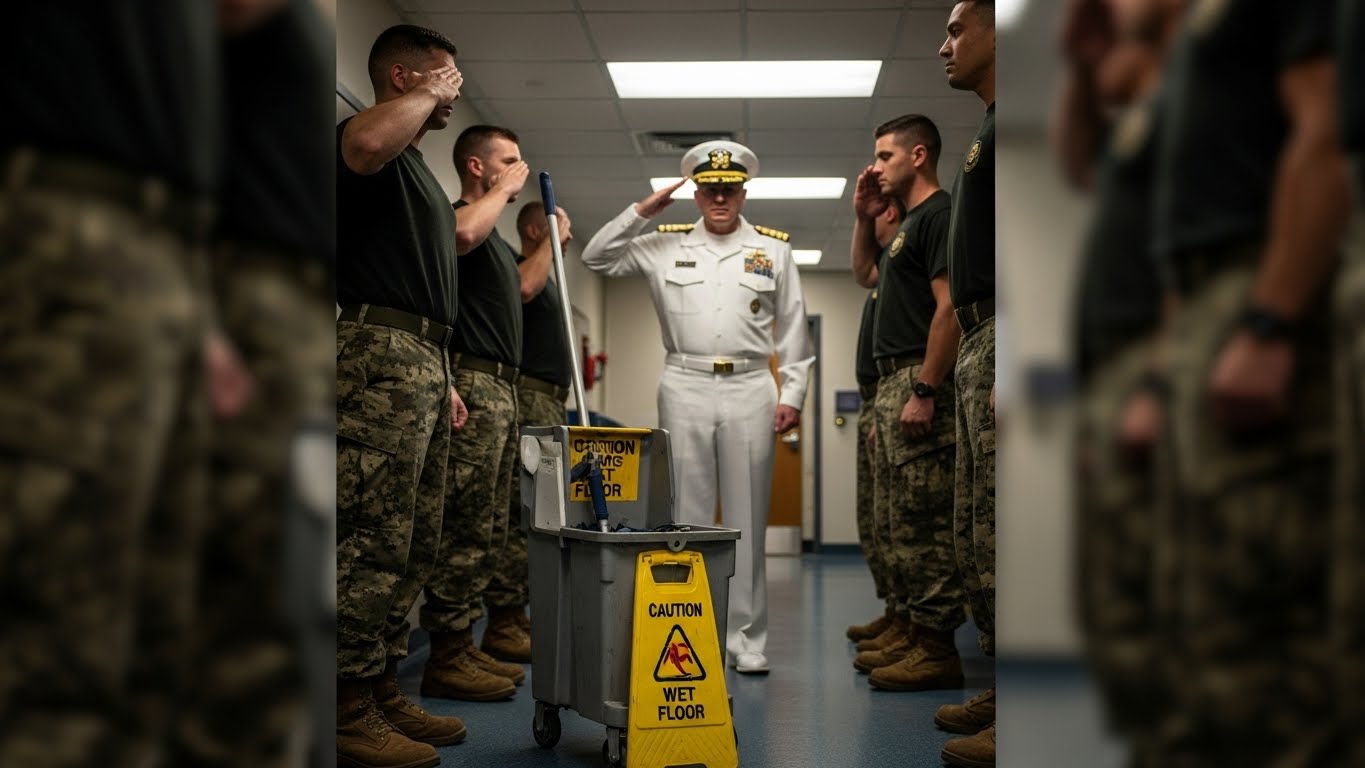
The sound was deafening. Three hundred heels snapped together in unison. The crack echoed off the tile walls like a thunderclap.
Brian froze. His heart hammered against his ribs. He gripped his lunchbox tight.
“Present… ARMS!”
Three hundred hands snapped up in a perfect, synchronized salute.
It was a gauntlet of honor. A silent tribute from the new generation to the old. They weren’t saluting an officer; they were saluting the man who had cleaned their floors while carrying the weight of the world.
Brian had to walk through it.
He took a step. His legs felt heavy. He looked at the faces as he passed.
He saw the young Lieutenant who had snickered at him earlier. The boy was crying, tears streaming silently down his cheeks, his hand rigid at his brow.
He saw Corporal Jenkins, looking at Brian with pure hero worship.
He saw Captain Dalton.
Dalton was standing near the exit. He wasn’t wearing his rank insignia. He was in his undershirt, having been stripped of his uniform jacket. But he was standing at attention.
As Brian passed him, Dalton didn’t look away. He looked Brian in the eye and mouthed two words: I’m sorry.
Brian nodded to him. A peace offering.
Brian walked the length of the hall. The silence was absolute, heavy with respect. It was the medal ceremony he had never had. It was the parade he had never wanted.
When he reached the glass doors, Admiral Brooks was waiting.
She held the door open for him.
“Dismissed, Commander,” she whispered, her voice thick with emotion.
“Goodbye, Di,” Brian said.
He stepped out into the cool Virginia evening.
The sun was setting, painting the sky in streaks of purple and gold. The air smelled of salt and freedom.
He walked to his truck. His hands were shaking. He took a deep breath, letting the cold air fill his lungs, letting the Ghost Falcon fade back into the shadows.
He climbed into the driver’s seat and turned the key. The engine sputtered to life.
He drove to the elementary school three miles away. He parked in the pickup line, just like he did every day.
The bell rang. Children flooded out, a chaotic wave of color and noise.
And then he saw her.
Harper. She was wearing her pink backpack, her hair in messy pigtails, holding a drawing in her hand.
She scanned the line of cars. When she saw the rusted blue truck, her face lit up like a sunrise. She ran toward him.
Brian opened the door and stepped out. He knelt down on the pavement.
“Daddy!”
She launched herself into his arms. He caught her, burying his face in her small shoulder. She smelled of crayons and strawberry shampoo. She smelled like life.
“You’re crying,” Harper said, pulling back to look at him. She touched his cheek with a small hand. “Did you have a bad day?”
Brian looked at her. He thought about the Admiral. He thought about the salutes. He thought about the war he had finally, truly left behind.
“No, baby,” Brian smiled, and for the first time in twenty years, the smile reached his eyes. “I had a really good day. I’m just happy to see you.”
“I drew you a picture,” she said, holding up a piece of paper.
It was a drawing of a stick figure man holding a mop. Underneath, in messy crayon letters, she had written: MY DAD. MY HERO.
Brian stared at the drawing. It was better than the Medal of Honor. It was better than the Navy Cross.
“It’s perfect,” he whispered.
He picked her up, threw her backpack into the truck, and climbed in.
“Can we get ice cream?” Harper asked as he pulled onto the road.
“We can get anything you want,” Brian said.
As they drove away, leaving the base and the ocean behind them, Brian Hail didn’t look in the rearview mirror. He looked forward. The road ahead was quiet. And for the first time, he wasn’t looking for threats. He was just driving home.