He Pressed “Decline” on His Sister’s Dying Call—Then Found a Voicemail That Destroyed Him
Chapter 1: The Fortress of Pride
The rain in Blackwood, Vermont, didn’t just fall; it accused. It hammered against the cedar siding of Arthur Miller’s small, isolated cottage like a thousand tiny fists demanding entry. Inside, the air was stale, smelling of sawdust, old coffee, and the distinct, sharp scent of solitude.
Arthur sat in his leather armchair, the one that had begun to crack along the armrests, much like the man sitting in it. At sixty-eight, Arthur was a structure built of hard angles and silence. He was a retired carpenter who had spent forty years building homes for other families while systematically dismantling his own.
The grandfather clock in the hallway chimed. Eleven o’clock.
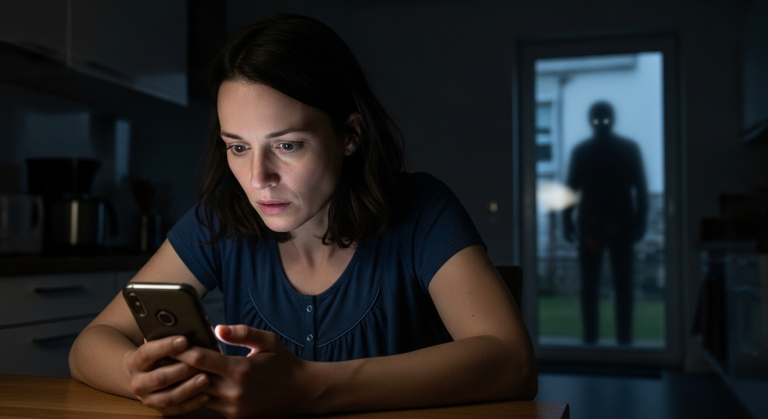
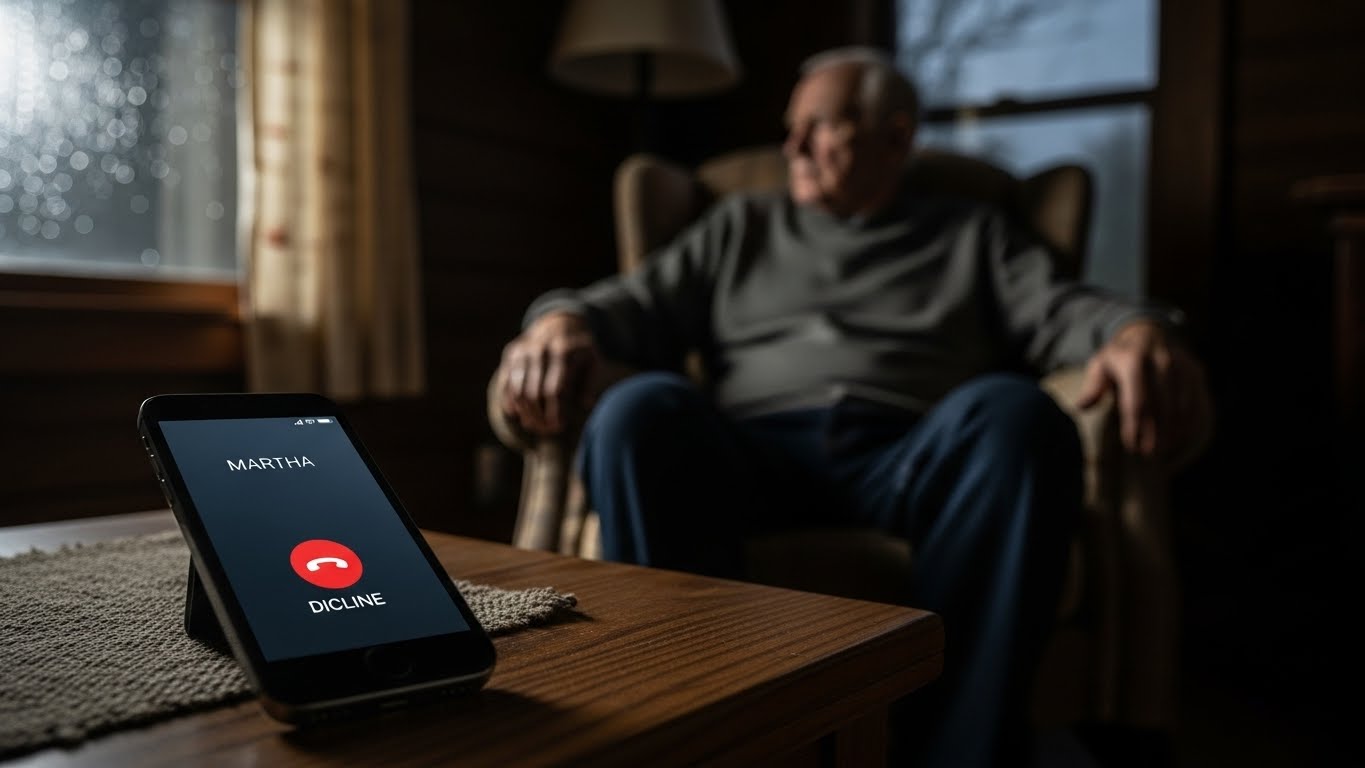
Arthur stared at the television, though the volume was muted. The blue light flickered across his face, illuminating deep-set eyes that had grown cold over the last five years. On the small oak table beside him, his smartphone buzzed. It was an angry, vibrating sound against the wood.
He didn’t need to look to know who it was, but he looked anyway.
The screen lit up the dark room: Martha.
Arthur’s jaw tightened. A muscle in his cheek jumped. He reached for his mug of bourbon, took a slow sip, and set it back down with a deliberate clack. The phone continued to buzz. It danced slightly toward the edge of the table.
“Give it a rest, Marty,” he muttered to the empty room. His voice was gravelly, unused to conversation.
Five years. That’s how long it had been since the feud. When their parents passed, the estate had been a mess, but the crown jewel was the lake house on Lake Willoughby. It wasn’t a mansion, just a sprawling, shingled beauty that smelled of pine needles and childhood summers. Arthur wanted to keep it. He wanted to retire there. But then came Rick—Cousin Rick, the struggling real estate developer with a smile like a used car salesman and a heart made of ledger sheets.
Rick had produced documents. He claimed there were debts. He claimed the market was peaking. And Martha… sweet, soft-headed Martha… she had sat at the kitchen table, tears in her eyes, and said, “Artie, maybe Rick is right. Maybe we should sell. It’s too much for us to manage.”
Arthur had seen it as the ultimate betrayal. He believed she had sided with the enemy for a quick payout. He had thrown his keys on the table, walked out, and told her to enjoy her blood money. He hadn’t spoken to her since.
The phone buzzed again. The screen flashed.
She’s probably calling for money, Arthur thought, his mind hardening around the grudge he had polished like a gemstone for half a decade. Or maybe she’s sick. Maybe she wants forgiveness. Well, she can’t have it. Not tonight.
He reached out, his calloused thumb hovering over the screen. He could have just let it ring. He could have let it go to voicemail naturally. But Arthur wanted to send a message. He wanted her to know he was there, he saw her, and he was choosing to ignore her.
He pressed the red DECLINE button.
The buzzing stopped instantly. The room returned to the silence of the clock and the relentless rain.
Arthur felt a grim sense of satisfaction. It was a small victory in his war of principle. He picked up the phone and, for good measure, turned it face down on the table. He didn’t want to see the notification light blinking. He didn’t want to think about her.
He finished his bourbon, feeling the warmth burn down his throat.
“You made your bed, Martha,” he whispered. “Now lie in it.”
He stood up, his knees popping, and switched off the lamp. He shuffled toward his bedroom, leaving the phone on the table in the living room. Outside, the wind howled, shaking the window panes. It was a nasty storm, a Nor’easter that had swept in earlier that evening, turning the winding backroads of Vermont into treacherous rivers of mud and slick asphalt.
Arthur climbed into his cold bed. He pulled the quilt up to his chin. He told himself he was right. He told himself he was the victim. He fell asleep listening to the rain, unaware that the silence he had just enforced would become the loudest sound he would ever hear.
Chapter 2: The Knock at the Door
The morning sun did not bring warmth; it brought a harsh, blinding clarity. The storm had passed, leaving the world scoured and raw. Leaves plastered the driveway, and a large branch from the old oak tree had snapped, blocking part of the walkway.
Arthur was in the kitchen, making his second pot of coffee. He liked his coffee black and strong enough to strip paint. He was frying bacon, the grease popping in the cast-iron skillet, when he heard the sound of tires crunching on the gravel outside.
He frowned. He wasn’t expecting anyone. He lived far enough out of town that casual visitors were non-existent.
He wiped his hands on a rag and walked to the front window. A cruiser was parked in his driveway. Not just any cruiser—it was the Sheriff’s Department.
Arthur’s heart gave a strange, unexpected thump. He watched as Sheriff Jim Miller (no relation, though they had joked about it for thirty years) stepped out of the car. Jim was a big man, usually wearing a wide-brimmed hat and an easy smile.
Today, he wasn’t wearing his hat. And he wasn’t smiling.
Arthur opened the front door before Jim could knock. The cool morning air rushed in, smelling of wet earth.
“Jim,” Arthur said, nodding. “You here to ticket me for that branch in the yard?”
Jim didn’t laugh. He stopped at the bottom of the porch steps. He looked tired. His uniform was wrinkled, like he hadn’t slept. He took a breath, looked at his boots, and then looked up at Arthur.
“Arthur,” Jim said, his voice heavy. “Can I come in?”
Arthur stepped back, the unease in his gut twisting into a knot. “Sure. Coffee’s fresh.”
They went into the kitchen. Jim ignored the offer of coffee. He stood by the table, his hands resting on the back of a chair. Arthur turned off the burner under the bacon. The silence in the kitchen was sudden and suffocating.
“What is it?” Arthur asked, crossing his arms. “Is it Rick? Did that weasel get into trouble again?”
Jim shook his head. “It’s not Rick, Arthur.” He paused, searching for the words. “It’s Martha.”
Arthur felt the blood drain from his face. The name hung in the air between them. “What about her? I haven’t spoken to her in five years, Jim. You know that.”
“I know,” Jim said softly. “Arthur… there was an accident last night. On Route 9. Near the ravine.”
Arthur’s mind flashed to the storm. The wind. The rain. “An accident?”
“She lost control of her vehicle,” Jim continued, his voice steady but pained. “The roads were washed out. It looks like she hydroplaned and went through the guardrail. It… it was a steep drop, Artie.”
Arthur stared at the Sheriff’s badge. It was catching the sunlight. “Is she hurt?”
Jim didn’t answer immediately. He walked around the chair and put a hand on Arthur’s shoulder. “She didn’t make it, Arthur. She died on impact. We found her early this morning when the fog lifted.”
The world tilted. Arthur grabbed the edge of the counter to steady himself. Died? Martha? It didn’t make sense. Martha was the careful one. She drove like a grandmother even when she was thirty.
“No,” Arthur said. It came out as a croak. “That’s… that’s not right. Where was she going? Route 9 leads out here. She lives in the city.”
“We don’t know for sure,” Jim said. “But her car was headed this way. Westbound. Toward your place.”
Arthur felt a cold chill start at the base of his spine and crawl upward. Westbound. Toward me.
“What time?” Arthur asked. “What time did it happen?”
Jim consulted a small notepad from his pocket. “Coroner estimates time of death around 11:30 PM. Maybe 11:45.”
11:30 PM.
Arthur closed his eyes. The image of his phone screen flashing in the dark room burned behind his eyelids. 11:00 PM. She had called him. He had pressed decline. Thirty minutes later, she was dead.
“I have to go see her,” Arthur said, pushing past Jim. He felt a frantic need to move, to deny the reality forming around him.
“Arthur, wait,” Jim said, grabbing his arm. “Take a minute. You’re in shock.”
“I’m not in shock!” Arthur roared, the anger exploding out of nowhere. “I need to see my sister!”
He needed to see her because if he saw her, maybe she would just be injured. Maybe it was a mistake. Or maybe, if she was dead, he could look at her face and find some absolution for the button he had pressed.
“I’ll drive you,” Jim said quietly. “Get your coat.”
Chapter 3: The Box of Ghosts
The morgue was in the basement of the county hospital, a place of fluorescent lights and sanitized air that smelled of antiseptic and despair. Arthur identified her. It was quick. A sheet pulled back, a pale face that looked like it was sleeping, only the bruising on the temple betraying the violence of her end.
He didn’t cry. He couldn’t. He felt frozen, like a piece of wood left out in the frost.
After the formalities, a young administrative assistant handed him a clear plastic bag. “These were her personal effects, Mr. Miller. We… we thought you should have them since you’re the next of kin.”
Arthur took the bag. It was light. Inside was her wallet, a silver locket he remembered their mother giving her, a set of keys, and her cell phone. The screen of the phone was shattered, a spiderweb of cracks obliterating the glass.
“Thank you,” Arthur mumbled.
He had Jim drop him off back at the cottage. He didn’t want company. He didn’t want casseroles or condolences. He wanted to figure this out.
He sat at his kitchen table, the plastic bag in front of him. He dumped the contents out. The locket slid across the wood. He picked it up and opened it. Inside was a tiny, faded photo of the two of them as children, standing on the dock at the lake house. Arthur was holding a fish; Martha was smiling at him, looking at him like he was a hero.
He put the locket down, his hand trembling.
He picked up the phone. It was an older model, battered. He pressed the power button on the side. Nothing happened. He pressed it again, holding it down.
Please, he thought. Please work.
The screen flickered. A battery icon appeared—red, critical, but alive. The phone buzzed and booted up. The shattered glass made the display distorted, fracturing the light.
He bypassed the lock screen—she never used a password. “In case of emergency,” she used to say. “I want people to know who to call.”
He went to the call log.
Yesterday. 11:10 PM – Outgoing Call to: Artie. (Declined)
The word “Declined” seemed to pulse on the screen. It was an indictment. A formal record of his rejection.
Then, he saw a notification icon at the top of the screen. He pulled down the menu.
Voicemail recording saved. 11:10 PM.
She hadn’t just called. She had left a message. But wait—this was her phone. Why was there a voicemail recording on her phone?
Arthur realized she must have been using a voice memo app or perhaps she had started leaving a message and the signal cut out, saving it to her device draft. Or maybe she sent a voice note.
He navigated to her messages. There, in a thread addressed to him that she had never hit “send” on because the signal failed, was an audio file.
He stared at the play button. His finger hovered over it, just as it had hovered over the “Decline” button the night before. But this time, the stakes were infinite.
Outside, the sun had gone behind a cloud. The kitchen grew dim. Arthur pressed play.
Chapter 4: The Voice from the Rain
The sound was static at first. The hiss of rain. The rhythmic thwack-thwack of windshield wipers working frantically.
Then, her voice. It filled Arthur’s kitchen, so clear and present that he instinctively looked around, expecting her to be standing at the stove.
“Artie…”
Her voice was shaking. She sounded terrified, but there was a steeliness underneath it he hadn’t heard in years.
“Artie… please pick up. I’m driving to your house. I know it’s late. I know you hate me. I know you think I sold you out.”
A pause. A loud honk from a passing truck, then the sound of her car accelerating.
“But Rick… that son of a bitch. I found the papers, Artie. I went to his office tonight to sign the final release for the cemetery plot, and I saw his file on the lake house. He forged them. He forged Mom’s signature on the debt transfer. The lake house was never in debt. He lied to us. He wanted to flip it to some developer from Boston.”
Arthur’s grip on the phone tightened so hard his knuckles turned white. His breath hitched in his chest. Rick.
“I stole the deed, Artie,” Martha’s voice cracked, turning into a sob that she quickly swallowed. “I have it right here on the passenger seat. I saved it. The lake house is yours. It’s always been yours. I just… I was so stupid. I trusted him because he was family. But I should have trusted you.”
The sound of the rain got louder on the recording. The storm was intensifying.
“I’m bringing the deed to you tonight. I can’t wait until morning. I just want to see you. I want to tell you… you were right. I’m so sorry I wasn’t strong enough to stop him sooner. I just want my big brother back.”
Arthur’s eyes burned. Hot tears spilled over, tracking through the deep lines of his face.
“Please, Artie. If you get this, put the coffee on? I’m cold. And I miss you. I love you, big brother. I—”
SCREECH.
The sound was deafening. Tires screaming against wet asphalt. A sickening crunch of metal. The sound of glass shattering—the very sound that had resulted in the screen Arthur was now looking at. Then, a rolling, tumbling noise.
And then, silence.
Just the sound of rain hitting metal.
Then, a small, ragged breath.
“Artie…” A whisper.
Click.
The recording ended.
Arthur sat in the silence. He didn’t move. He couldn’t move. The silence of the house was no longer peaceful; it was a vacuum that sucked the air out of his lungs.
She hadn’t called to beg. She hadn’t called to nag. She had been on a crusade. She had driven into a hurricane to bring him back his birthright, to fix a mistake he had blamed her for.
And he had pressed decline.
If he had answered…
The thought hit him like a physical blow to the stomach. If I had answered. She would have put the phone to her ear. She would have slowed down. She would have pulled over to talk. She would have been distracted from that patch of black ice.
He had killed her. His pride had killed her just as surely as the ravine had.
A scream built up in Arthur’s chest, a primal roar of grief and rage that had no words. He stood up and hurled his own coffee mug against the wall. It shattered, sending ceramic and black liquid everywhere.
“ARGHHHH!”
He fell to his knees in the middle of the kitchen floor, clutching her shattered phone to his chest, rocking back and forth, sobbing like a child.
Chapter 5: The Reckoning
Grief is a heavy coat, but rage is a fire. And Arthur was burning.
Three days later was the funeral. It was a small affair at the town church. Rick was there. Of course he was. Cousin Rick, wearing a suit that cost more than Arthur’s truck, standing near the front, accepting condolences, looking somber.
Arthur stood in the back. He hadn’t shaved. He looked like a spectre.
After the service, people gathered outside near the hearse. Rick was holding court, shaking hands. He spotted Arthur and walked over, his expression molding into one of practiced sympathy.
“Arthur,” Rick said, extending a hand. “I’m so sorry. Poor Martha. She was always a bit… scattered, wasn’t she? Driving in that storm.”
Arthur looked at the hand. He didn’t take it.
“She wasn’t scattered, Rick,” Arthur said. His voice was low, but it carried. The chatter nearby stopped.
Rick lowered his hand. “Now, Artie, I know you’re grieving—”
“She was coming to see me,” Arthur said, stepping closer. “She was bringing me something.”
Rick’s eyes flickered. A moment of genuine fear behind the mask. “Is that so?”
Arthur reached into his coat pocket. He pulled out a thick, water-stained envelope. He had found it in the wreckage of the car, tucked under the passenger seat where she said it would be.
“She found the forgery, Rick,” Arthur said.
The color drained from Rick’s face. “I don’t know what you’re talking about.”
“The debt transfer on Mom’s estate,” Arthur shouted, his voice booming now. Everyone was watching. “You forged her signature! You lied to Martha to get her to sign over the power of attorney so you could sell the lake house!”
“You’re crazy,” Rick stammered, looking around for support. “He’s senile. The grief has made him crazy.”
“I have the voice recording!” Arthur yelled. He held up Martha’s shattered phone. “She left a recording, Rick! She detailed everything. She was on her way to bring me the proof when you… when your lies put her on that road!”
Arthur lunged. It took the Sheriff—Jim—and two other deputies to hold him back. But Arthur didn’t need to hit him. The look on Rick’s face—the sheer, naked guilt—was enough for the town.
Jim looked from Arthur to Rick. He looked at the water-stained documents in Arthur’s hand.
“Rick,” Jim said, his voice cold. “Why don’t you come down to the station? We need to have a chat about some fraud allegations.”
Rick was led away, protesting weakly. The townspeople stared. Justice was in motion.
But as Arthur watched the police car drive away, he felt no triumph. The victory was ash in his mouth. He had saved the house. He had exposed the villain. But the hearse was still there. The coffin was still inside.
He walked over to the hearse and placed his hand on the cold metal window.
“I got him, Marty,” he whispered. “But I’d give it all back just to answer that phone.”
Chapter 6: The Garden of Regret
Six months passed.
The legal battle was swift. With the documents and the investigation, Rick was facing prison time. The sale of the lake house was annulled. It belonged to Arthur, free and clear.
Arthur moved in. He sold his cottage in Blackwood and moved to the lake house. It was exactly as he remembered—the smell of pine, the gentle lapping of the water against the dock.
But it was haunted. Not by ghosts, but by memories.
Every room reminded him of Martha. The kitchen where she used to bake. The porch where they played cards.
He spent his days fixing the place up. He sanded the floors until his hands bled. He replaced the roof. He worked from dawn until dusk, trying to exhaust himself so he wouldn’t dream.
One afternoon, while clearing out the attic, he found an old box labeled “Martha’s Dreams.”
He opened it. It was full of gardening magazines, seed packets, and a journal. He sat on the dusty floor and opened the journal.
The entries were recent.
July 15th: I miss Artie. I drove past his house today but I was too scared to stop. I wish we could go back to the lake. If we ever get it back, I know what I want to do. I want to plant hydrangeas. Hundreds of them. Huge white ones, like clouds. Mom loved them. I want to line the whole driveway with them so when Artie drives up, he feels like he’s coming into heaven. I’d make him coffee and we’d sit on the porch and watch them bloom.
Arthur closed the journal. He wept. He cried for the wasted years. He cried for the love she had held for him even when he was hating her.
He knew what he had to do.
He went to the nursery in town. He bought every white hydrangea they had. He ordered more.
For weeks, Arthur was on his knees in the dirt. He dug until his back screamed. He mixed the soil with compost and care. He planted them along the driveway. He planted them around the porch. He planted them by the water.
It was his penance. It was his apology.
Chapter 7: Coffee is On
It was autumn again. A year since the accident.
Arthur sat on the porch of the lake house. The air was crisp, smelling of fallen leaves and woodsmoke.
The garden was magnificent. The hydrangeas had taken root and, though the blooms were fading now with the season, they stood tall and thick, a promise of the beauty that would return in the spring. It was a sea of white and green, exactly as she had described.
Arthur looked older. His hair was completely white now. But the hardness around his eyes was gone. It had been replaced by a quiet, somber softness.
On the small table beside his rocking chair sat two mugs of coffee. Steam rose from both of them, curling into the cool air.
Arthur reached into his pocket and pulled out the old, shattered phone. He had kept it charged. He didn’t play the message anymore. He didn’t need to. The words were etched into his soul.
Please, put the coffee on?
Arthur looked at the empty rocking chair beside him.
“Coffee is on, Martha,” he said, his voice steady. “I’m sorry it took me so long.”
He took a sip from his mug. A single red leaf drifted down from the oak tree and landed on the arm of the empty chair.
Arthur smiled, a small, sad smile. He watched the sun dip below the tree line, casting long shadows across the garden he had built for her. He was alone, but for the first time in a long time, the silence wasn’t heavy. It was just peaceful.
The echo of her silence had finally found a place to rest.
The End