I Thought I Was Building a Dynasty, But I Was Digging His Grave: The Secret Tape That Revealed My Son’s True Cause of Death
Chapter 1: The Architecture of Silence
The phone call that ended Eleanor Vance’s life as she knew it came at 2:14 PM on a Tuesday. It was a crisp, clear autumn day in Connecticut, the kind of day that usually signaled productivity and order. Eleanor, a retired Superior Court judge, was in her study reviewing the bylaws for the Historical Society. When the phone rang, she answered it with the same sharp, authoritative tone she had used for forty years on the bench.
“Eleanor Vance speaking.”
The voice on the other end was hesitant, professional, and terrifyingly apologetic. It was the Seattle Police Department.
When they told her, Eleanor did not scream. She did not drop the phone. She did not collapse. She sat very still, her spine not touching the back of her leather chair, her hand gripping the receiver until her knuckles turned the color of old parchment.
“Cardiac arrest,” the officer said. “Induced by a combination of exhaustion and… pharmaceuticals. We found him in his apartment. It appears to have been accidental, Mrs. Vance, but… his body just gave out.”
Julian was thirty-two.
“I see,” Eleanor said. Her voice was steady, void of tremors. “I will make the arrangements. Please ensure the press does not get hold of the toxicology report before I arrive.”
She hung up. She stared at the wall of her study, lined with leather-bound books and framed degrees. Harvard. Yale. The commendations. The awards. Julian’s architectural accolades were there, too. Top 30 Under 30. The Pritzker Prospective.
She stood up and walked to the window. “He worked too hard,” she said aloud to the empty room. It was a statement of fact, a justification, and a strange sort of pride. In Eleanor’s world, working oneself to death was not a tragedy; it was the ultimate sign of dedication. It was the Vance way. Emotions were messy; achievements were permanent.
She didn’t cry on the flight to Seattle. She spent the six hours drafting the obituary in a leather notebook. It would be dignified. It would list his buildings, his firms, his net worth. It would paint the picture of a titan cut down in his prime, a martyr to the god of Industry. She would not let people whisper about “overdose” or “weakness.” Julian was a Vance. He was successful. That was what mattered.
When she arrived in Seattle, the city was gray and weeping rain, a stark contrast to her dry eyes. She took a town car directly to his building. It was a glass needle piercing the sky, one of the most exclusive addresses in the Pacific Northwest. Julian lived in the penthouse.
The elevator ride was smooth, silent, and suffocating. When the doors slid open, Eleanor stepped into her son’s world.
It was breathtaking. It was also freezing.
The apartment was a masterpiece of modern minimalism. Floor-to-ceiling windows offered a panoramic view of the sound, but the interior felt less like a home and more like a surgical theater. The floors were polished concrete. The furniture was sharp-edged, Italian leather, black and chrome. There were no photographs. No throw pillows. No clutter. No signs of life.
It was exactly the kind of life she had demanded he build.
“Clean lines, Julian,” she had told him when he was twelve and trying to paint his room a chaotic purple. “A cluttered space is a cluttered mind. We aim for clarity. We aim for perfection.”
She walked through the silent living room, her heels clicking loudly on the hard floor. She found his architectural drafting table in the corner. It was pristine. Too pristine. There were no sketches, no blueprints, no pencil shavings.
She moved to the kitchen. The refrigerator contained three bottles of expensive sparkling water and a row of protein shakes. Nothing else. No food. No comfort.
“Efficient,” she whispered, though a small, cold knot began to tighten in her stomach.
She met the executor of the estate and the cleaning crew the next morning. She directed them with military precision. “Pack the suits. Donate the furniture to the museum, not a thrift store. This is high-end Italian design.”
It was on the third day, while she was personally inspecting his walk-in closet—a space larger than most people’s bedrooms—that she found it.
She was checking the back of the closet, ensuring no custom suits were left behind, when her hand brushed against the rear panel. It shifted. It wasn’t a solid wall. It was a spring-loaded panel, cleverly disguised by the cedar lining.
Eleanor frowned. “Sloppy construction,” she muttered, pushing against it to latch it back in place.
Instead, the panel clicked and swung inward.
A rush of stale, cool air hit her face. It smelled different than the rest of the sterile apartment. It smelled like old paper, dust, and… rosin?
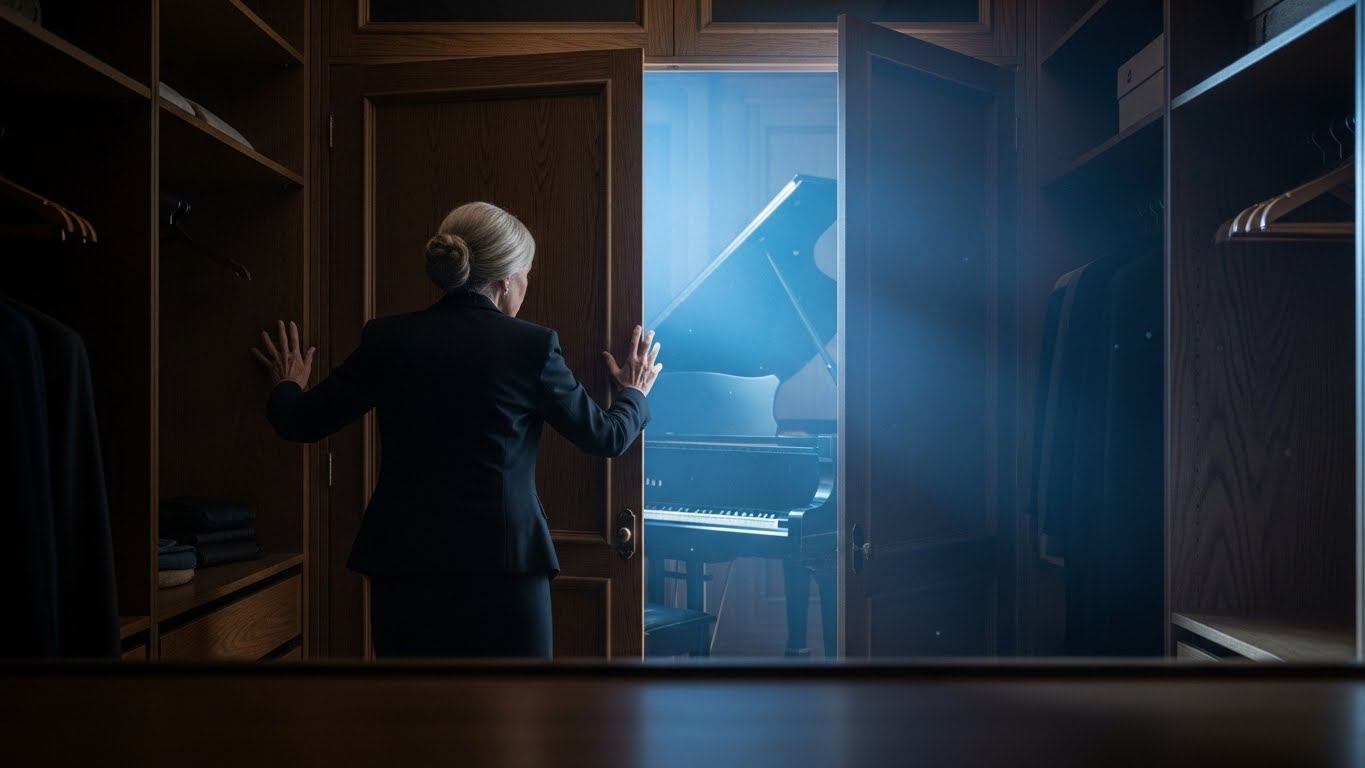
Eleanor stepped through the opening. She fumbled for a light switch on the wall. A track light flickered on, illuminating a hidden room that shouldn’t have existed in the blueprints.
The room was soundproofed. Thick acoustic foam lined the walls. But it wasn’t an office.
In the center of the room sat a Steinway grand piano. It was old, scuffed, and covered in a fine layer of dust, but it was majestic. Around it, the floor was littered with sheets of paper—music scores. Handwritten, chaotic, frantic notes scrawled in ink.
Eleanor froze. Her breath hitched.
She hated that piano. Not this specific one, but what it represented.
“Music is a hobby for the poor, Julian,” she had told him a thousand times. “It doesn’t pay the bills. It doesn’t build legacies. You are an architect. You build things that last. Music disappears the moment you stop playing.”
She walked further into the room. Against the far wall, there was a desk. Unlike the pristine drafting table outside, this desk was a mess. It was covered in hard drives. Dozens of them. They were labeled neatly with years, starting from ten years ago up until… two days ago.
2014. 2015. 2016…
Next to the drives was a high-end camera setup on a tripod, pointed directly at the piano and the chair.
Eleanor felt a strange vibration in her hands. She reached out and picked up the drive labeled 2014. That was the year he had been accepted into the Master’s program for Architecture. The year she had been so proud.
She sat down in the chair facing the computer monitors. She didn’t want to look. She wanted to leave this room, seal the wall, and pretend this secret shame didn’t exist. Julian was an architect. He was a success.
But she was a judge. And a judge always examined the evidence.
She plugged the drive in.
The screen flickered to life. A video file appeared. She clicked play.
The face of her son filled the screen. He looked so young. He was twenty-two. His eyes were red, swollen. He was crying.
“Day 1,” Julian’s voice came through the speakers, shaky and thin. “I got the acceptance letter today. Mom is… she’s throwing a dinner party. She’s telling everyone. She’s so happy.”
On the screen, Julian looked down at his hands.
“I feel like I’m going to throw up,” he whispered. “I don’t want to go. I don’t want to build glass cages. I want to play. I just want to play. But I can’t tell her. She’ll look at me with that face. That disappointment. It’s worse than if she hit me.”
He looked up at the camera, right into Eleanor’s eyes across the decade.
“I’m doing this for you, Mother. Please love me for it. Because I think it’s going to kill me.”
Eleanor sat in the dark, soundproof room, the silence of the Seattle penthouse pressing in on her. The knot in her stomach was no longer a knot. It was a knife. And it was just beginning to twist.
Chapter 2: The Chronology of Decay
For the next two days, Eleanor did not leave the apartment. She did not answer the calls from the funeral home. She did not eat. She sat in the hidden room, the blue light of the monitor casting a ghostly pallor over her aged face, witnessing the slow-motion disintegration of her son.
She watched the tapes in chronological order. It was a documented descent into hell, and she was the architect of the dungeon.
She watched the file from 2016. Julian was twenty-four. He had just graduated at the top of his class. Eleanor remembered that day vividly. She had worn a Chanel suit. She had shaken the Dean’s hand. She had told Julian, “This is just the beginning.”
On the screen, Julian was sitting at the piano. He looked thinner. There were dark circles under his eyes that makeup couldn’t hide.
“I graduated,” he said to the camera, his voice flat, devoid of affect. “Top of the class. Mom says we need to aim for Junior Partner within three years. She sent me a list of firms to apply to. She didn’t ask if I was happy. She asked about the starting salaries.”
He turned to the piano and played a chord. It was a dissonant, jarring sound.
“I haven’t slept in three days,” he whispered. Then, he rolled up the sleeve of his dress shirt. Eleanor gasped, her hand flying to her mouth.
There were cuts. fresh, red lines traversing the pale skin of his forearm.
“It’s the only way the noise stops,” Julian said to the lens. “The only way I can feel something other than the pressure. Vances don’t get sad, right Mom? Vances get results.”
Eleanor squeezed her eyes shut, a memory forcing its way to the surface. Julian, age sixteen. He had been crying in the kitchen, overwhelmed by AP classes and piano practice. She had slapped the table. “Stop it,” she had snapped. “Tears are a luxury for people who don’t have a future to build. Go wash your face. You look pathetic.”
She opened her eyes. The Julian on the screen was bandaging his arm. “I’m so tired,” he said.
She swapped the drives. 2019.
Julian was twenty-seven. This was the year he won the National Design Award. Eleanor had framed the newspaper clipping in her study.
In the video, Julian was drunk. A bottle of scotch sat on the piano keys. He was holding the award, a heavy glass obelisk, loosely in one hand. He was laughing, but it was a wet, jagged sound.
“Look at this!” he shouted, waving the trophy. “Look at this piece of glass! Are you happy now, Mother? Is this enough? Can I stop now?”
He slammed the award down on the piano, cracking the wood.
“I hate it,” he hissed, leaning into the camera. “I hate every building I draw. I hate the steel. I hate the concrete. I feel like I’m cementing myself into a wall. But you… you looked at me tonight and you actually smiled. A real smile. Not that tight, polite thing you do. You smiled.”
He took a swig of the scotch. “I’ll do it for another year. Just one more year. Then I’ll tell her. Then I’ll quit.”
But he didn’t quit. Eleanor knew he didn’t. Because she had kept pushing.
She found the physical evidence in the drawers of the desk. Prescription bottles. Xanax. Klonopin. Oxycodone. The dates went back years.
She remembered finding a bottle of antidepressants in his bag when he was twenty-five. She had flushed them down the toilet. “You do not need chemical crutches,” she had lectured him. “It’s all in your head, Julian. Exercise more. Focus. Do not embarrass us by being a mental patient.”
So he had hidden them. He had hidden his pain behind a false wall, just like he hid his piano.
The videos grew darker. The music he played in them changed. It went from melancholic classical pieces to angry, thundering compositions that sounded like a war.
By 2023, the Julian on the screen was a ghost. He was gaunt. His eyes were dead. He barely spoke. He would just turn on the camera, sit at the piano, and play for hours—music that wept, music that screamed. He was a high-functioning shadow, attending board meetings by day and bleeding his soul out onto these keys by night.
Eleanor’s composure, the iron armor she had worn for sixty-five years, was disintegrating. She wasn’t just watching her son die; she was watching herself kill him. Every award she celebrated was a nail in his coffin. Every criticism she levied was a twist of the knife.
She had measured his worth in income and status. He had measured his worth in her approval. And the exchange rate had bankrupt him.
Finally, she reached the last hard drive. It was labeled with a date just two days before the phone call.
Eleanor’s hands shook so badly she dropped the drive twice before plugging it in.
Chapter 3: The Glass Concerto
The video file opened. The resolution was crisp, 4K, capturing every pore of Julian’s exhausted face. He was wearing a tuxedo—the same one he had been found dead in. He had just come back from a gala.
He didn’t look drunk this time. He looked incredibly, frighteningly calm.
He sat at the piano. He didn’t look at the camera immediately. He ran his long fingers over the keys, a silent caress.
“Hello, Mother,” he said softly.
Eleanor flinched. It felt like he was in the room, standing right behind her.
“If you’re watching this, you found the room. I knew you would. You’re thorough. You check the details. That’s why you were such a good judge.”
He smiled, but it didn’t reach his eyes.
“I know what the coroner will say. Cardiac arrest. Accidental overdose. And in a way, it is accidental. I didn’t mean to take so many tonight. I just… I needed the noise in my head to stop. The pressure. It’s like a physical weight, Mom. It sits on my chest.”
He looked down at his hands.
“You won. I want you to know that. I built the skyscrapers. I made the millions. I became the man you wanted. But the foundation is rotten, Mom. You built a skyscraper on a swamp.”
He took a deep breath.
“I’m so tired of pretending. I’m thirty-two years old, and I don’t think I’ve made a single choice for myself since I was six. I loved you so much. I wanted to please you so much. But your love was a transaction. And I’ve run out of currency.”
He turned to the piano.
“I wrote this for you. I finished it tonight. It’s called ‘Eleanor’s Lullaby.’ It’s not happy. But it’s the truth. It’s the only truth I have left.”
He began to play.
It started soft, deceptive, a mimicking of a traditional lullaby, but the notes were slightly off, sour. It sounded like a childhood memory corroding. Then, the tempo shifted. The music became frantic, complex, demanding. It was the sound of anxiety. It was the sound of striving for an impossible standard.
Eleanor watched, tears finally streaming down her face, hot and stinging. She saw his hands flying over the keys—the hands she had told him were made for drafting, not playing. He was a virtuoso. He was brilliant. And she had thrown it in the trash.
The music built to a crescendo. It was violent. Heavy chords slammed down like gavels. It was the sound of her own voice, her own demands, crushing him.
And then, abruptly, the music stopped.
Julian held the final silence. He looked at the camera, tears tracking through the light makeup on his face.
“I’m sorry I wasn’t strong enough to be what you wanted,” he whispered. “And I’m sorry I wasn’t strong enough to be who I was.”
He reached out. The screen went black.
Eleanor sat in the silence. The silence of the grave.
Then, a sound tore out of her throat. It wasn’t a word. It was a primal, animalistic scream. It was the sound of a mother realizing she had cannibalized her own child. She doubled over, clutching her chest, wailing into the empty room.
She screamed until her voice gave out. She screamed at the walls, at the piano, at the God she barely believed in. She had prosecuted criminals, murderers, thieves. But she was the worst criminal of them all. She had stolen a life.
Two days later, the funeral was held in Connecticut.
The elite of the state were there. Judges, senators, architects. The flowers alone cost more than a house. Everyone expected Eleanor to be the pillar of strength. They expected a eulogy about Julian’s brilliance in design, his future in the firm.
Eleanor walked up to the podium. She looked older. Her hair was pulled back, but for the first time in decades, she wore no makeup. Her face was pale, exposed.
She looked out at the crowd. She saw their expectant faces.
“My son was not an architect,” Eleanor said. Her voice was rasping, damaged from the screaming.
A ripple of confusion went through the crowd.
“He was a musician,” she continued. “He was a composer. And he was a beautiful, broken soul.”
She signaled to the audio technician.
“I told him music was garbage,” Eleanor said, gripping the podium. “I told him his feelings were a weakness. I pushed him into a mold that squeezed the life out of him. You are all here to celebrate his success. But his success is what killed him.”
The crowd was dead silent. People shifted uncomfortably. This was not the script.
“I killed him,” Eleanor said, her voice breaking. “My pride killed him. My standards killed him.”
She pressed a button on the laptop connected to the speakers.
“This is who Julian was. Please, listen.”
The recording of Eleanor’s Lullaby filled the cathedral. The haunting, discordant, tragic piano music swirled around the stone pillars. It was uncomfortable. It was painful. It forced everyone in that room to feel the agony of the young man who had played it.
Eleanor stood with her head bowed, letting the music judge her.
Epilogue: The Sanctuary
Six months later.
The penthouse in Seattle was sold. The profits, along with a significant portion of Eleanor’s own fortune, went into purchasing a sprawling estate in upstate New York.
The sign on the gate read: The Julian Vance Sanctuary for the Arts.
It was not a competitive school. It was a retreat. It was a place for young people who were burning out, who were crushed by parental pressure, who suffered from high-functioning depression. It offered therapy, rest, and soundproof rooms where they could play whatever they wanted, without judgment.
In the main hall of the sanctuary, the old Steinway from the hidden room sat in a place of honor.
Eleanor sat at the bench. Her hands were stiff with arthritis, but she was trying. She was playing a simple C-major scale. It was clumsy. It was imperfect.
A young girl, a resident at the sanctuary, walked by. “That sounds nice, Ms. Vance,” she said.
Eleanor looked up. Her eyes were softer now. The steel was gone, replaced by something more fragile, but more human.
“It’s not perfect,” Eleanor said, looking at the keys where her son’s tears had once fallen. “But it’s mine. And that is enough.”
She pressed the keys again, listening to the sound fade into the air, finally understanding the language her son had tried to speak to her for thirty-two years