She Called My Son A ‘Pathological Liar’ For Saying His Dad Was A General. She Didn’t Hear The Motorcade Pull Up. The Look On Her Face When I Walked In? Priceless.
Part 1: The Arrival
Chapter 1: The Ghost in the Machine
The tarmac at Andrews Air Force Base always smells the same. It’s a mix of burnt jet fuel, ozone, and that specific, humid heaviness that hangs over the Potomac in late September. It’s the smell of returning to the world of the living.
I stepped off the C-37A Gulfstream, my joints popping. Eighteen hours in the air. Two refueling stops in places that don’t appear on standard maps. A briefing folder thick enough to stop a 9mm bullet was tucked under my left arm.
I was tired. The kind of tired that goes into your bones and stays there, festering. The kind of tired you only get after three months in a location that officially doesn’t exist, negotiating with warlords who would rather see you dead than shake your hand. My eyes felt like they were filled with sand.
All I wanted was a shower, a rare steak, and to see my son, Leo.
My security detail was waiting at the bottom of the stairs. Two black Chevy Suburbans, engines idling, looking like polished beetles against the gray runway. The heat waves shimmering off their hoods were the only thing moving.
Sergeant Miller, my lead driver, opened the back door of the lead vehicle. He’s a good kid. Ex-Recon. Doesn’t talk much. He knows better than to ask about the trip.
“Welcome home, General Sterling,” he said, offering a sharp, crisp nod.
“Good to be back on American soil, Miller,” I grunted, tossing my cover—my uniform hat—onto the beige leather seat next to me.
I slid into the back, the heavy armor-plated door thudding shut, sealing out the roar of the airfield. The silence was instant and luxurious. It felt like entering a vacuum. I pulled my personal cell phone out of my bag. It had been powered down and locked in a faraday bag for ninety days.
As soon as it connected to the local tower, it started vibrating. It buzzed against my palm like an angry hornet.
Ding. Ding. Ding.
Messages from my wife, Sarah. A few automated alerts from the bank. And one voicemail.
It was timestamped forty-five minutes ago.
The caller ID read: Oak Creek Elementary.
I frowned, the lines on my forehead deepening. Leo was ten. He was a good kid. Quiet. Observant. He didn’t get into trouble. He was the kind of kid who rescued worms from the sidewalk after it rained. If the school was calling, he was either sick or hurt.
I pressed play, holding the phone to my ear as the convoy began to roll toward the exit gate.
“Mr. Sterling… or, well, I suppose I should address the ‘mother’ since I’ve never actually seen a father listed,” a woman’s voice began.
It was high-pitched, dripping with a sugary, condescending venom. The kind of voice that smiles while it stabs you.
“This is Mrs. Gable, Leo’s homeroom teacher. I’m calling because we had a… disturbing incident today during our ‘Family Heroes’ presentation.”
My grip on the phone tightened. The leather case creaked under the pressure of my fingers.
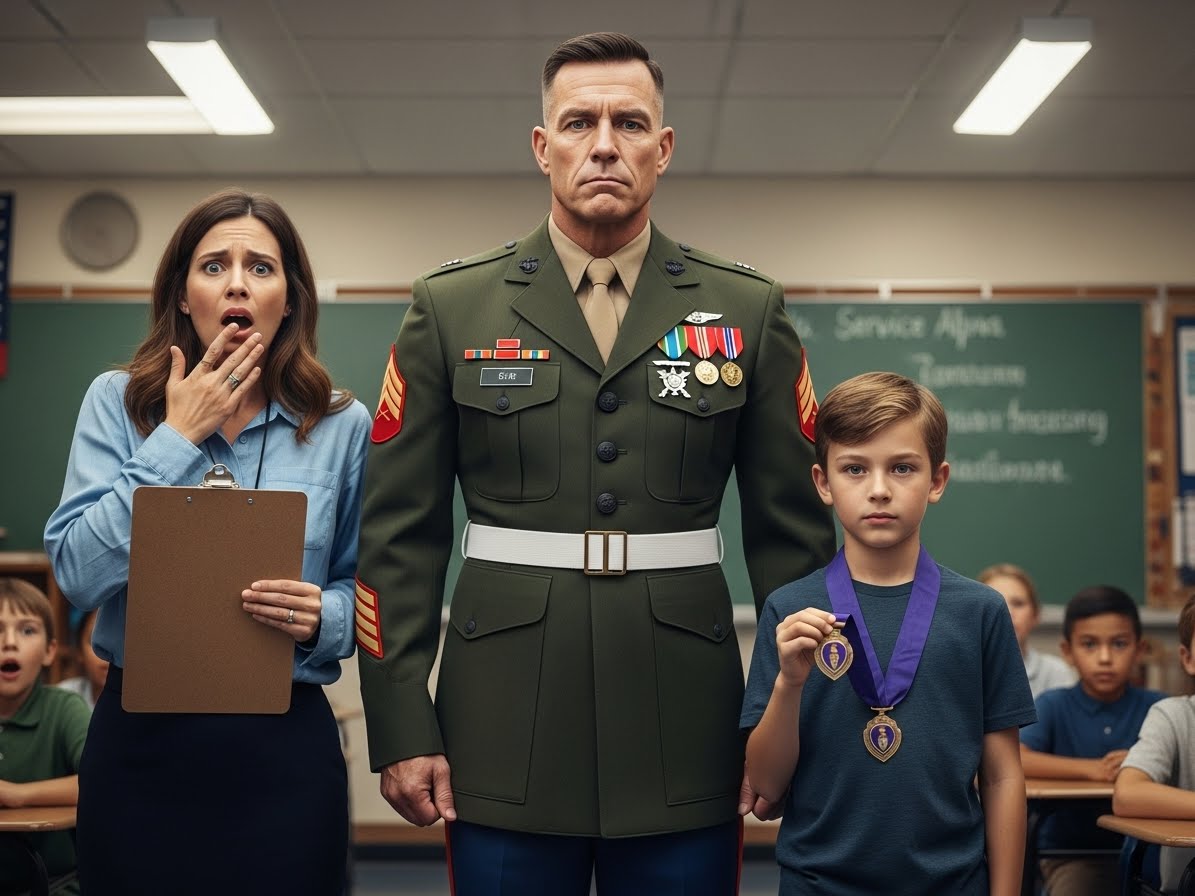
“Leo insisted on standing up and telling the class that his father is a Lieutenant General in the Marine Corps. Now, look, I understand that boys need role models, and single-parent households can be hard on a developing mind. But Leo brought in a medal. A Purple Heart. He claimed it was yours.”
I felt the blood temperature in my veins rise about ten degrees. That medal was in the safe in my study. Leo must have cracked the code. Smart kid. But reckless.
“I tried to be gentle,” Mrs. Gable continued, her voice dropping to a theatrical whisper, as if sharing a dirty secret. “But he refused to admit he bought it at a surplus store. He became belligerent. He started yelling about ‘classified missions.’ Honestly, it’s pathological. I had to stop the presentation. I told him that lying to make himself feel important is a sign of deep emotional disturbance. I’ve sent him to the quiet corner to think about honesty. We need to schedule a meeting. I won’t have a pathological liar disrupting my classroom dynamic.”
The voicemail ended with a sharp click.
For three seconds, I just stared at the beige interior of the SUV. The silence in the car was heavy, suffocating.
Pathological liar.
Single-parent household.
Surplus store.
I looked at Miller in the rearview mirror. He was watching me. He knew the look. It was the same look I had on my face right before I ordered a chaotic extraction in the Korangal Valley back in ’09. It was the look of a man who had run out of patience.
“Miller,” I said. My voice was very quiet. Very calm. Terrifyingly calm.
“Sir?”
“Change of plans. We aren’t going to the residence.”
“Where to, General?”
“Oak Creek Elementary School. Fairfax. And Miller?”
“Yes, Sir?”
“Turn on the lights.”
Chapter 2: Fortress of Solitude
The distance from the base to the school was usually a forty-minute drive in D.C. traffic.
We made it in twenty.
There is something undeniably powerful about a government motorcade. People don’t just move; they scatter. When the red and blue strobes are flashing in the grille of a blacked-out Suburban, and the siren does that low, guttural whoop-whoop at intersections, the sea parts. We drove over medians. We bypassed red lights.
I sat in the back, staring out the tinted window, but I wasn’t seeing the Virginia suburbs passing by. I wasn’t seeing the manicured lawns or the strip malls. I was seeing Leo.
I saw him the night before I deployed. He was sitting on the edge of his bed, wearing his Star Wars pajamas, clutching a plush Wookiee. He looked so small. So fragile.
“Are the bad guys going to shoot at you, Dad?” he had asked, his lower lip trembling.
“I’m the one who knocks, kiddo,” I’d told him, trying to make him laugh, quoting a show he was too young to watch. “Besides, I have to go. It’s my job to keep the bad stuff far away from here. Far away from you.”
“Mrs. Gable says the military is for people who aren’t smart enough for college,” he had said, looking at his feet.
I remembered the rage I felt then, a hot spike in my chest. But I had swallowed it. I had a plane to catch. I had a duty.
“Mrs. Gable doesn’t know everything,” I had said, tucking him in.
Apparently, Mrs. Gable didn’t know anything. She didn’t know about the nights I spent awake in the desert, looking at a photo of Leo to remember why I was fighting. She didn’t know that the Purple Heart Leo held wasn’t a prop—it was the price I paid for a piece of shrapnel in my shoulder three years ago.
“ETA two minutes, General,” Miller said, snapping me back to the present.
I looked down at my uniform. I was in my Service Alphas. The green coat. The Sam Browne belt. The stars on my collar gleaming like warnings. And a ribbon rack that looked like a spilled box of crayons on my left chest—each stripe a story of survival or loss.
Usually, I’d change into civvies before picking him up. I didn’t want to draw attention. I wanted to be just “Leo’s Dad.”
Today? Today I wanted attention. I wanted all of it. I wanted to be the thunder.
“Miller,” I said. “Radio the chase car. I want full security protocol. We park at the front entrance. Block the fire lane. Two men on the doors. You stick with me.”
“Copy that. Are we expecting hostiles, Sir?” Miller asked, though I could hear the smirk in his voice. He loved this stuff.
“Just one,” I said, checking my reflection in the window. “Civilian. Hostile intent. Psychological warfare on a minor.”
Miller chuckled darkly. “Understood. Engaging.”
The school was a sprawling brick building nestled in a quiet neighborhood. As we turned the corner, I saw the playground. Kids were running around. It was recess for the younger grades.
We didn’t slow down until we hit the curb.
The tires screeched slightly as the two SUVs halted in a V-formation right in front of the main glass doors. It was aggressive. It was designed to intimidate. It said: We are here, and we are not asking for permission.
I didn’t wait for Miller to open my door. I shoved it open and stepped out.
The sound of the playground died instantly. A hundred heads turned.
I stood up to my full height—six foot four. I adjusted my cover, pulling the brim low over my eyes. I smoothed the front of my tunic.
Miller and two other MPs—Corporal Rodriguez and Sergeant Hayes—were already out, flanking me. They were in full dress blues, because they had been part of the honor guard for the diplomatic mission. They looked like statues carved out of granite, wearing sunglasses that reflected the fear of anyone who looked at them.
“Let’s go,” I said.
We marched toward the glass doors. I could see the receptionist inside. She was on the phone, probably gossiping or ordering lunch. She looked up as the shadow of four large military men fell over her desk.
The phone dropped from her hand. It literally clattered onto the desk.
I pushed through the double doors, the magnetic lock giving way under the force of my shove before she even buzzed us in.
The air inside smelled like floor wax, dry erase markers, and cafeteria pizza. The smell of childhood.
The receptionist, a woman named Brenda according to the placard, was standing up, her mouth opening and closing like a fish out of water.
“S-Sir? You can’t… you need a visitor’s pass… I have to scan your license…” she stammered, her eyes darting to the sidearms on the MPs’ hips. They were holstered, of course, but the visual impact was undeniable.
I stopped at the desk. I didn’t yell. I didn’t bang my fist. I just leaned in, resting my knuckles on the countertop.
“I am Lieutenant General Marcus Sterling,” I said, my voice projecting that command tone that can cut through a sandstorm. “I am here to collect my son, Leo Sterling. And I am here to have a word with Mrs. Gable.”
“She’s… she’s in class. Room 302. Down the hall,” Brenda squeaked, pointing a trembling finger.
“I know where she is,” I said.
I turned to Miller. “Secure the lobby. Don’t let anyone leave.”
“Aye, Sir.”
I turned on my heel and began the long walk down the hallway. The linoleum cracked under the hard heels of my dress shoes. Click. Click. Click.
It was the sound of a reckoning.
As I approached Room 302, I could hear a voice. It was the same shrill voice from the voicemail.
“…and that is why we don’t tell tall tales, class. Because when we lie, we hurt ourselves. Leo, sit up straight. Stop crying. Tears are a manipulation tactic.”
I stopped outside the closed door. I took a deep breath. I adjusted my tie.
I didn’t knock. I grabbed the handle and threw the door open.
Part 2: Contact Front
Chapter 3: The Quiet Corner
The door didn’t just open; it announced itself. It swung inward with enough force to bounce off the rubber stopper on the floor, creating a dull thud that echoed like a gunshot in the small room.
The classroom froze.
It was a tableau of elementary school life interrupted by a force of nature. Twenty-five faces turned toward me. Twenty-five pairs of wide, innocent eyes.
And then there was Mrs. Gable.
She was standing at the whiteboard, a red marker in her hand. She looked exactly as she sounded on the phone. Late forties. tightly wound hair. A floral dress that looked like it was made from old curtains. Her mouth was open mid-sentence, the word “integrity” half-formed on her lips.
I didn’t look at her. Not yet.
I scanned the room. Tactical assessment. Habit.
Rows of desks. A globe in the corner. A hamster cage. And there, in the back right corner—segregated from the rest of the class by a small bookshelf—was a single chair facing the wall.
The “Quiet Corner.”
My son was sitting there. His shoulders were shaking.
I stepped into the room. The air displacement seemed to suck the oxygen out of the space. My dress shoes clicked rhythmically on the tile floor, a slow, deliberate cadence.
Click. Click. Click.
“Who… who are you?” Mrs. Gable stammered. Her voice had lost that sugary venom. Now it was just thin and brittle. “You can’t be in here. This is a secure campus!”
I ignored her. I walked past the rows of stunned children. One little girl in the front row, wearing pigtails, looked at my uniform, then at my face, and whispered loudly, “Wow.”
I reached the back of the room.
“Leo,” I said. My voice was soft now. The command tone was gone, replaced by the tone I used when I woke him up from nightmares.
He spun around in the chair. His face was a mess. Red blotches on his cheeks. Eyes puffy and swollen. Snot running down his nose. He looked broken.
When he saw me, his eyes went wide. For a second, he looked like he didn’t believe it. Like I was a hallucination brought on by stress.
“Dad?” he croaked.
“Stand up, Marine,” I said, a small smile playing on my lips.
He jumped up, wiping his nose on his sleeve. He rushed forward and buried his face in the green wool of my tunic. I felt his small arms wrap around my waist, squeezing with everything he had.
I placed a hand on the back of his head, feeling the soft hair. I looked down at the desk next to the chair.
There it was.
My Purple Heart. It was sitting on a piece of paper where Mrs. Gable had written: Confiscated – Contraband/Fake.
I felt a muscle in my jaw jump.
I gently disentangled Leo from my coat. I knelt down on one knee so I was eye-level with him. I ignored the fact that I was creasing trousers that had taken twenty minutes to press.
“Did you tell the truth, Leo?” I asked, looking him dead in the eye.
“Yes, sir,” he sniffled. “I told them about the mission. I told them about the shrapnel. She said… she said I was making it up. She said you weren’t real.”
“I’m very real, bud,” I said. “And so is this.”
I picked up the Purple Heart. The gold border caught the fluorescent light. George Washington’s profile looked stoic in the center of the purple enamel.
I stood up. I pinned the medal back into its velvet case, snapped it shut, and slid it into my pocket.
Then, I turned slowly to face the front of the room.
Mrs. Gable was clutching her marker like a weapon. She had regained some of her composure, probably realizing that she was the adult in charge and I was just an intruder, regardless of the stars on my shoulder.
“Sir,” she said, her voice rising an octave. “I am going to have to ask you to leave immediately. You are disrupting the learning environment. If you are Leo’s… relative… you should know that his behavior today was unacceptable.”
I walked toward her. I didn’t rush. I moved with the inevitability of a glacier.
I stopped four feet from her desk. Close enough to smell her cheap perfume. Close enough to see the sweat beading on her upper lip.
“Mrs. Gable,” I said. “I am General Sterling. Leo’s father.”
She scoffed. Actually scoffed. It was a nervous reflex, I’m sure, but it was the wrong move.
“Oh, please,” she said, glancing at the students as if looking for an audience. “Mr. Sterling, buying a costume at a Halloween store doesn’t make you a General. And buying a medal online doesn’t make you a hero. I am trying to teach your son about stolen valor. It is a crime, you know.”
The room went dead silent.
I stared at her. I really looked at her. This woman, who had probably never left the suburbs, was lecturing me on stolen valor. The irony was so thick I could taste it.
“Stolen valor,” I repeated slowly.
“Yes,” she said, crossing her arms. “Now, please leave before I call the police.”
I reached into my breast pocket. I didn’t pull out a weapon. I pulled out my military ID. I slapped it onto her desk.
Then I pulled out my orders. The ones I had just received. Stamped TOP SECRET/NOFORN, though the cover page was unclassified. I slammed them down next to the ID.
“Read it,” I commanded.
“I… I don’t have to…”
“READ IT,” I barked. The volume made her jump. The kids in the front row flinched.
She picked up the ID with trembling fingers. She looked at the hologram. She looked at the rank. She looked at my face.
Her skin turned the color of old milk.
“It’s… it’s real,” she whispered.
“You called my son a pathological liar,” I said, my voice low and dangerous. “You humiliated a ten-year-old boy in front of his peers. You took a decoration awarded for blood spilled in the service of this country, and you labeled it ‘contraband’.”
“I… I didn’t know,” she stammered. “He… he has an active imagination! He said you were on a secret mission! That sounds like a movie!”
“It sounds like my life,” I cut her off. “And it is his life. A life he has to live without his father for months at a time. A sacrifice he makes. And you mocked it.”
“I was just doing my job!” she shrilled, backing up until she hit the whiteboard.
“Your job is to educate,” I said. “Not to traumatize.”
I turned to the class. They were watching with wide eyes.
“Class,” I said, my voice booming but kind. “Does anyone have a question for a real General?”
Every single hand in the room went up.
Except one.
Mrs. Gable’s hand was clutching her chest.
Chapter 4: The Chain of Command
The energy in the room shifted instantly. Fear was replaced by awe.
“You in the blue shirt,” I pointed to a kid in the second row.
“Is… is that a real sword?” he asked, pointing to the Mameluke sword depicted on a poster on the wall, confused about my uniform.
“Marines carry swords for ceremony,” I explained. “But we carry honor everywhere.”
I spent the next five minutes answering questions. Yes, I had ridden in a tank. Yes, I had met the President. No, I didn’t know Captain America, but I knew guys who were just as brave.
Leo was standing next to me the whole time. He wasn’t crying anymore. He was beaming. He looked like he was ten feet tall.
Mrs. Gable stood in the corner, effectively demoted to an observer in her own classroom. She looked like she wanted the floor to open up and swallow her whole.
But the peace didn’t last.
The hallway door burst open again. This time, it wasn’t a calculated military entry. It was the frantic, stumbling entrance of a bureaucrat in panic mode.
Mr. Henderson, the principal.
I knew Henderson. He was a soft man. A man who cared more about test scores and liability insurance than the actual welfare of his students. He was wearing a suit that was slightly too tight and wiping sweat from his bald head with a handkerchief.
Behind him were my two MPs, Miller and Hayes. They looked bored. They had clearly let him pass.
“General Sterling!” Henderson gasped, rushing into the room. “I… Brenda at the front desk said… The police called… They said there’s a motorcade blocking the fire lane!”
He stopped when he saw me. He saw the uniform. He saw the stars. He saw Mrs. Gable cowering by the whiteboard.
“Principal Henderson,” I said, turning to face him. “We need to talk.”
“Of course, of course,” Henderson said, his eyes darting around the room. “Let’s go to my office. We can discuss this… civilized.”
“No,” I said. “We’ll discuss it here.”
“Here? But… the children…”
“The children have already seen the disrespect shown to my family,” I said. “They deserve to see the resolution.”
I gestured to Mrs. Gable. “This teacher called my son a liar. She labeled him pathological. She confiscated my property. She publicly shamed him.”
Henderson turned to Mrs. Gable. “Janet? Is this true?”
“I… I thought he was making it up!” Mrs. Gable cried, finding her voice again. “He said his dad was a General! Do you know how many kids say their dad is a spy or an astronaut? I have to maintain order! I have to teach them to be grounded in reality!”
“Reality,” I repeated.
I walked over to the window and pulled up the blinds.
Outside, the two black Suburbans were gleaming in the sun. The MPs were standing guard, arms crossed, looking like Secret Service agents. A few other teachers and students were gathered on the sidewalk, pointing and taking pictures.
“That is reality, Mrs. Gable,” I said, pointing out the window. “That is the reality my son lives with. He lives with the reality that every time the phone rings late at night, it might be the Chaplain telling his mother that I’m not coming home.”
I turned back to them. The room was pin-drop silent. Even the fidgety kids were still.
“You didn’t just call him a liar,” I said, my voice trembling with suppressed emotion. “You told him that his reality—the very difficult, very real life he lives—was a fantasy. You gaslit a ten-year-old boy about his own father’s existence.”
Henderson looked pale. He knew a lawsuit when he heard one. He knew a PR nightmare when he saw one.
“General,” Henderson said, his voice shaking. “I apologize. Sincerely. On behalf of the school. We appreciate your service… immense appreciation. We will handle this internally. I assure you, disciplinary action will be taken.”
“I don’t want your apology,” I said.
I looked down at Leo. He was looking up at me, his eyes shining.
“I want her to apologize,” I said, pointing at Mrs. Gable. “To him. Right now. In front of the class she tried to humiliate him before.”
Mrs. Gable stiffened. Her pride was a physical thing, a stiff rod in her spine. Apologizing to a parent in private was one thing. Apologizing to a ten-year-old student in front of her class? That was the death of her authority.
“I… Mr. Henderson, surely this isn’t necessary,” she pleaded.
“Do it, Janet,” Henderson snapped. He was in damage control mode. He wanted me out of his school before the news vans showed up.
Mrs. Gable took a shaky breath. She walked over to where Leo and I were standing. She refused to look at me. She looked down at Leo.
“Leo,” she said, her voice tight. “I… I am sorry I didn’t believe you.”
“And?” I prompted.
“And…” She swallowed hard. “And I was wrong to call you a liar. Your father is… obviously who you said he was.”
“And the medal?” I asked.
She closed her eyes for a second. “And the medal is real. You are not a pathological liar.”
It was enough. It wasn’t heartfelt, but it was public. It was a restoration of honor.
I looked at Leo. “You good, son?”
Leo nodded. He stood a little taller. He looked at his classmates. They were looking at him with new respect. He wasn’t the weird kid who lied anymore. He was the kid with the General for a dad.
“I’m good, Dad,” he said.
“Good,” I said.
I turned to Henderson. “I’ll be taking Leo for the rest of the day. And tomorrow. In fact, we might take the week. We have some catching up to do.”
“Excused absence, of course,” Henderson said quickly. “Take all the time you need.”
“Grab your bag, Leo,” I said.
Leo grabbed his backpack. He walked to the door, his head held high.
I followed him. But at the doorway, I stopped and turned back to Mrs. Gable one last time.
“One more thing,” I said. “You teach history, right?”
“Social studies,” she whispered.
“Maybe brush up on it,” I said. “Specifically the part about what the Purple Heart actually means. It’s not something you buy at a store. It’s something you trade a piece of yourself for.”
I walked out.
Miller fell in step beside me as we hit the hallway.
“Status, Sir?” he asked.
“Mission accomplished, Miller,” I said. “Let’s go get some ice cream.”
We walked out the front doors into the bright afternoon sun. The air tasted sweeter. The weight on my shoulders was gone.
But as we walked toward the cars, I saw something that stopped me cold.
A news van was pulling up to the curb. Channel 5. And behind them, a police cruiser.
Apparently, the spectacle wasn’t over. It was just beginning.
Part 3: The War at Home
Chapter 5: Rules of Engagement
The thing about combat is that you usually know who the enemy is. They are the ones shooting at you. In the suburbs of Northern Virginia, the lines of engagement are blurrier.
I stood on the sidewalk, my hand resting protectively on Leo’s shoulder. Miller and the other MPs formed a loose perimeter around us, their eyes scanning the threats.
The threat wasn’t an IED or a sniper. It was a Fairfax County police cruiser screeching to a halt, and a news van with a satellite dish extending like a telescoping eye.
Two officers exited the cruiser. They were young. Maybe mid-twenties. One had his hand on his holster, the retention strap already unsnapped.
“Police! Stay right where you are!” the driver shouted, using his door as cover.
The school had panicked. Of course they had. Brenda at the front desk had probably dialed 911 and screamed that armed men had stormed the building. Technically, she wasn’t wrong. But context is everything.
Miller took a step forward, his hands open and visible. “Officers, stand down. We are federal agents conducting a protective detail.”
“I said stay back!” the officer yelled, adrenaline clearly flooding his system. He saw the uniforms, the size of my men, and the black SUVs. He didn’t see allies; he saw an anomaly. Anamolies get people hurt.
“Miller,” I said, my voice cutting through the rising tension like a razor. “Hold position.”
I looked down at Leo. He was trembling again. He had just stopped crying, and now men with guns were yelling at his dad.
“It’s okay, Leo,” I whispered. “Watch and learn.”
I slowly removed my hand from Leo’s shoulder. I took off my cover—my hat—and tucked it under my left arm. It was a gesture of de-escalation, but also of authority. I walked toward the police cruiser, past Miller.
“Sir! Stop!” the officer shouted, raising his weapon slightly. He didn’t point it at me, but he was close.
“Officer,” I said, projecting my voice so the news crew—who were now sprinting across the lawn—could hear it. “I am Lieutenant General Marcus Sterling, United States Marine Corps. My identification is in my breast pocket. I am unarmed. My detail is armed, as per federal regulation.”
The officer hesitated. He looked at my collar. The three silver stars caught the sun. He looked at the ribbon rack. Recognition flickered in his eyes.
“General?” he lowered his voice, the aggression bleeding out of his stance.
“We had a report of a hostile takeover of the school,” the officer said, holstering his weapon but still looking confused. “A man with a gun.”
“The only hostile act here was a teacher bullying a ten-year-old boy,” I said, glancing back at the school windows where faces were pressed against the glass. “We were just leaving.”
Before the officer could respond, the media arrived.
A woman with a microphone thrust it toward my face. The camera operator jostled for position. The side of the van said DC News Now.
“General! General! Did you threaten the faculty?” the reporter asked, breathless. “We heard reports of a military intervention at an elementary school. Is this a national security issue?”
I stopped. I looked directly into the lens.
I knew how this worked. If I walked away, the headline would be “General Flees Scene.” If I got angry, it would be “Unhinged Soldier Terrorizes School.”
I needed to control the narrative.
“Turn that thing on,” I said to the cameraman.
“It’s rolling, sir.”
I took a breath. I thought about the men I had left behind in the desert. I thought about the three months of missed birthdays and lonely nights. And I thought about Leo standing in the corner.
“My name is Marcus Sterling,” I said, my voice steady. “I have spent the last twenty years fighting for this country. I have missed my son’s first steps. I missed his first baseball game. I missed his tenth birthday because I was in a place I can’t name, doing a job most people pretend doesn’t exist.”
I paused. The reporter leaned in. Even the police officers were listening.
“I came home today to find that a teacher—a person entrusted with the minds of our children—had called my son a liar because she didn’t believe a father could be a General. She confiscated his Purple Heart. She shamed him.”
I gestured to the school.
“We tell our soldiers to fight for freedom. But sometimes, the hardest fight is coming home and realizing that the values we fight for—honor, integrity, respect—are being forgotten in our own classrooms. I didn’t threaten anyone. I just reminded them of what the truth looks like.”
I looked down at Leo, who had walked up to stand beside me. He looked at the camera and smiled. A small, brave smile.
“We’re going to get ice cream,” I said. “No further questions.”
“General! Will you act against the school board?” the reporter shouted as I turned away.
I didn’t answer. I walked back to the SUV. Miller opened the door.
“Nice speech, boss,” Miller murmured as I climbed in.
“Drive, Miller,” I said, leaning back into the leather seat. “Before I say something I’ll really regret.”
As we pulled away, I saw the reporter talking excitedly into the camera. I saw Mrs. Gable standing at the front door of the school, watching us leave. She looked small.
But I knew this wasn’t over. In the age of the internet, the battle had just begun.
Chapter 6: The Digital Front
The Dairy Queen on Route 50 hasn’t changed in thirty years. It still smells like waffle cones and sanitizer.
We sat in a booth in the back. Miller and Rodriguez sat at a table near the door, eating blizzards while scanning the parking lot.
Leo had a chocolate cone. He was eating it with the intense focus only a child can muster after a traumatic event.
“Dad?” he asked, wiping chocolate off his lip.
“Yeah, bud?”
“Are you gonna get in trouble? With the President?”
I chuckled. “The President has bigger things to worry about than me crashing a third-grade class, Leo. Besides, I have leave. I’m technically off the clock.”
“Mrs. Gable said she was gonna call the police,” Leo said, his eyes darkening.
“She did,” I said. “And you saw what happened. The police listen to the good guys.”
I reached across the table and messed up his hair. “You did good today, Leo. You stood your ground. That’s rule number one. Never back down when you know you’re right.”
“Even if the teacher says I’m wrong?”
“Especially then,” I said.
My phone vibrated on the table. Then it vibrated again. Then it started buzzing continuously, walking across the laminate surface like a possessed crab.
I picked it up.
Seventy-five notifications. Twitter. Instagram. News alerts.
I unlocked the screen.
A video was trending on Twitter. The hashtag was #GeneralDad.
It was a shaky video, clearly filmed by a student in the classroom on a smuggled phone. The angle was low, shooting up from under a desk.
It showed me slamming my orders onto Mrs. Gable’s desk. It showed me towering over her. The audio was crisp.
“Your job is to educate. Not to traumatize.”
The clip had 2.4 million views. It had been posted forty minutes ago.
I scrolled through the comments.
@PatriotMom45: “THIS is what a father looks like! Fire that teacher immediately!”
@MarineVet88: “Oorah, General! That’s my CO! Sterling is a legend.”
@LiberalArtsJen: “Unacceptable behavior. Military intimidation in a safe space? He should be court-martialed.”
It was a war zone. The internet had divided into two camps within the hour: Team Sterling and Team Teacher.
“Sir,” Miller called out from the other table. He was holding up his phone. He looked worried.
“I see it, Miller,” I said.
“No, Sir. Not the video. The response.”
Miller walked over and handed me his phone. It was a Facebook post. A public statement from the Oak Creek Elementary School PTA Page.
Statement regarding the incident in Mrs. Gable’s class:
“While we respect our military families, the display of aggression and unauthorized entry by General Sterling today was deeply traumatizing for our students. We have a zero-tolerance policy for bullying, and that applies to parents as well. Mrs. Gable is a tenured educator who fears for her safety. We are filing a formal complaint with the Department of Defense.”
I felt the ice cream in my stomach turn into lead.
They were doubling down. They weren’t apologizing. They were playing the victim card. They were going to try to ruin my career to save their own skin.
My phone rang. A standard ringtone, but the number on the screen made my blood run cold.
(703) 697-XXXX – The Pentagon. Public Affairs Office.
I looked at Leo. He was happily licking his cone, oblivious to the fact that his father’s career was currently hanging by a thread.
“Hey, bud,” I said, standing up. “I have to take this. Stay with Miller.”
I walked outside into the parking lot. The sun was starting to set, casting long, orange shadows.
I slid the answer button.
“Sterling,” I said.
“Marcus,” a voice said. It was General Vance. My superior. The man who signed my checks and my orders. His voice was gravel.
“General Vance,” I said, standing at attention out of habit.
“Tell me,” Vance said, his voice deceptively calm. “Tell me why I am watching a video of you on CNN threatening a civilian educator while wearing my uniform?”
“Sir, it wasn’t a threat. It was a correction. She humiliated my son. She called him a liar for claiming I existed.”
“I don’t care if she called him the King of England, Marcus!” Vance barked. “You are a three-star General! You don’t storm elementary schools with a security detail! Do you know what the optics are? The Teacher’s Union is already calling the White House!”
“She took my Purple Heart, Sir. She told the class I was a fantasy.”
There was a silence on the line. Vance was a hard man, but he was a Marine. He knew what the Heart meant.
“She took the medal?” Vance asked, his voice softer.
“Yes, Sir. Labeled it contraband.”
Vance sighed. The sound of a man who needed a drink.
“Okay. That changes things. But we have a PR nightmare. They are painting you as an unhinged warlord. You need to go dark, Marcus. No more interviews. No more speeches on the lawn. Go home. Hug your wife. Let us handle the spin.”
“They filed a complaint, Sir.”
“I know. It landed on my desk five minutes ago. Listen to me, Marcus. If this blows up any bigger, I can’t protect you. We are talking forced retirement. Do you understand?”
“Loud and clear, General.”
“Go home. Vance out.”
The line went dead.
I stared at the phone. Forced retirement. My career, everything I had built for twenty years, gone because I defended my son.
I looked back through the window of the Dairy Queen. Leo was laughing at something Miller was showing him on a napkin.
It was worth it. I told myself that. It was worth it.
But as I walked back inside, I knew the enemy was maneuvering. Mrs. Gable wasn’t just a teacher; she was part of a system. A system that didn’t like being challenged.
We finished our ice cream in relative silence. I hustled Leo into the car.
“Are we going home to see Mom?” Leo asked.
“Yeah, buddy. We’re going home.”
The drive to our house was short. We lived in a colonial on a cul-de-sac. It was the American Dream, paid for with government wages and long absences.
Sarah’s car was in the driveway. She was home early from her shift at the hospital.
I felt a knot in my stomach. Sarah hated the drama. She hated the spotlight. She married Marcus, not the General.
We pulled up. I saw the front door open before the car even stopped.
Sarah stood in the doorway. She was wearing scrubs. Her hair was messy. She was holding her phone.
She didn’t look happy. She looked terrified.
I got out of the car. Leo ran to her. “Mom! Mom! Dad came to school! It was awesome!”
She hugged him, burying her face in his neck. But her eyes were locked on mine over his shoulder.
“Go inside, Leo. Go wash up,” she said, her voice shaking.
Leo ran inside.
I walked up the driveway. Miller stayed by the car, giving us space.
“Sarah,” I began.
“They’re camping on the lawn, Marcus,” she said, pointing to the street adjacent to our cul-de-sac. Two more news vans were setting up.
“I know. I’m sorry.”
“Sorry?” She laughed, a hysterical, sharp sound. “Marcus, my boss called me. He asked if you were having a PTSD episode. He asked if I was safe.”
“It wasn’t like that,” I said, reaching for her hand.
She pulled away. “I saw the video. You looked… scary. I’ve never seen that look on your face. Not here. Not at home.”
“She hurt him, Sarah. She broke him.”
“And you broke our privacy!” she snapped. Tears welled in her eyes. “You’ve been gone for three months. I held this family together. I dealt with the nightmares. I dealt with the loneliness. You come back for one hour and you turn our lives into a national circus.”
“I defended his honor.”
“You defended your ego!” she cried.
The words hit me harder than any bullet.
“Sarah…”
“Come inside,” she whispered, wiping her eyes. “Before the neighbors call the police too.”
I followed her into the house. The door clicked shut, locking out the world. But the silence inside was louder than the sirens outside.
I had won the battle at the school. But I was losing the war at home.
And then, my phone buzzed again. An unknown number.
I ignored it. It buzzed again. And again.
I looked at it. A text message.
General Sterling. This is Janet Gable. You think you can intimidate me? I have lawyers. And I have the recording of what your son said before you arrived. The part you didn’t hear. You might want to listen before you declare victory.
A file was attached. An audio file.
My thumb hovered over the play button.
What had Leo said?
Part 4: The Final Salvo
Chapter 7: The Black Box
The kitchen was silent, save for the hum of the refrigerator and the distant, muffled thrum of the news vans idling down the street. Sarah stood by the sink, her arms crossed, her eyes red-rimmed. She was waiting for me to apologize, to fix the chaos I had brought to her doorstep.
But my finger was hovering over the play button on my phone.
General Sterling. This is Janet Gable… You might want to listen before you declare victory.
“Marcus,” Sarah said, her voice weary. “Put the phone away. We need to talk about Leo. We need to talk about us.”
“I can’t,” I said, my voice low. “Not until I know what she’s holding over us.”
“What are you talking about?”
“She sent a recording. Of Leo. Before I got there.”
Sarah’s expression shifted from anger to confusion, then to a protective, maternal sharpness. She walked over to the island where I was standing. “Play it.”
I tapped the screen. The audio file opened. It was clearly recorded on a phone in a pocket or hidden on a desk—the sound was muffled at first, then cleared up.
Rustling noises. The sound of a chair scraping.
Then, Leo’s voice. Small. Trembling.
“I’m not lying, Mrs. Gable. I promise. He showed me the map. He goes to the desert.”
Then, Mrs. Gable’s voice. Clear, sharp, and dripping with that same condescending sweetness I had heard on the voicemail.
“Leo, we’ve talked about this. The desert? Like in Aladdin? Honey, real soldiers don’t tell their children where they are going. That’s classified. If your father was really important, he wouldn’t tell a little boy.”
“He trusts me!” Leo cried out. The pain in his voice was visceral. It cut through the kitchen like a knife.
“Trust? Or is he manipulating you?” Gable’s voice continued. “Or maybe… maybe you made him up because you’re lonely? It’s okay to be lonely, Leo. But it’s not okay to bring fake medals to school. It disrespects the real families. The ones who actually lose people.”
I gripped the edge of the granite counter so hard my knuckles turned white. Sarah gasped, her hand flying to her mouth.
The recording wasn’t over.
“He’s not fake!” Leo was sobbing now. “He has a scar! On his shoulder! From the bad guys!”
“Stop it!” Gable snapped. The sweetness was gone. “Enough of this hysteria. You are disturbed, Leo. You are a pathological liar seeking attention because your mother is always working and your father is… absent. If he exists. Go to the quiet corner. And leave that prop on my desk. I’m going to call your mother and tell her you need therapy.”
The recording ended with the sound of sniffles and footsteps.
Silence returned to the kitchen. But it was a different kind of silence. It wasn’t the silence of marital tension. It was the silence of shared, incandescent rage.
Sarah looked up at me. The fear was gone from her eyes. The fatigue was gone. In their place was the cold, hard steel of a mother whose cub had been cornered.
“She said I’m always working,” Sarah whispered. “She told my son he’s disturbed because I’m a working mother.”
“She gaslit him,” I said. “She baited him into a breakdown, recorded it, and is now trying to use it to blackmail me into backing off.”
Sarah walked over to the drawer where we kept the junk mail. She pulled out a notepad and a pen.
“Marcus,” she said.
“Yeah?”
“You said General Vance told you to stand down.”
“He did. He said go dark.”
Sarah slammed the notepad onto the counter. “Screw General Vance.”
I looked at her, surprised. Sarah was the rule-follower. Sarah was the one who always told me to keep my head down.
“She recorded a minor in a classroom without parental consent,” Sarah said, her nurse’s training kicking in—procedures, protocols, laws. “She mocked a military family. She diagnosed a student with a mental disorder she isn’t qualified to assess. And she did it to cover her own tracks.”
“Sarah…”
“No,” she cut me off. “You fought for him at the school. Now we fight for him together. You have a briefing to prepare, General.”
“Briefing?”
” The School Board meeting is tomorrow night. But there’s an emergency session at 8:00 AM. I just saw the email notification.” She looked at me, her eyes blazing. “We aren’t going to hide. We are going to destroy her.”
I smiled. It was the first time I had genuinely smiled since I landed.
“I love you, Sarah.”
“I love you too,” she said. “Now call Miller. Tell him we need a JAG lawyer. And tell him to bring the Suburban around at 0700. We’re going to war.”
I picked up my phone. I didn’t delete the recording. I forwarded it to three people: My JAG officer, the base legal counsel, and a buddy of mine who works in cyber-forensics to authenticate the timestamp.
Mrs. Gable thought she had a smoking gun. She didn’t realize she had just handed me the coordinates for an airstrike.
Chapter 8: The Eagle Lands
The Fairfax County School Board administration building was a dull, gray structure that looked like it was designed to suck the joy out of the soul.
At 7:55 AM, the parking lot was already full. The news vans were there. The protesters were there—both sides. Some holding signs that said “Support Our Troops,” others holding signs that said “No Military in Schools.”
Miller navigated the Suburban through the crowd. We didn’t use the sirens this time. We didn’t need theatrics. We had the truth.
I wore a suit. Charcoal gray. tailored. No uniform. No medals. Today, I wasn’t General Sterling. I was Marcus Sterling, concerned parent and taxpayer.
Sarah walked beside me, wearing a sharp navy blazer. She looked like a lioness.
We walked past the cameras.
“General! General! Do you have a comment on the leaked recording?” a reporter shouted.
I paused. “Leaked recording?”
“Mrs. Gable released a statement saying your son has a history of outbursts!”
I didn’t stop. I just kept walking. She was trying to get ahead of the story. She was desperate.
We entered the boardroom. It was a long table with microphones. Principal Henderson was there, sweating through another suit. Mrs. Gable was there, sitting next to a union representative. She looked smug. She thought she had won. She thought the “aggressive General” narrative would save her.
Five board members sat at the head of the room. They looked tired. They just wanted this to go away.
“General Sterling,” the Board President, a woman named Mrs. Higgins, began. “We called this emergency session to discuss the… incident. And to address Mrs. Gable’s grievance regarding her safety.”
“Safety?” Sarah spoke up before I could. Her voice was calm, projecting perfectly in the room. “Mrs. Gable is afraid of a father picking up his son? Or is she afraid of the consequences of her own actions?”
“Mrs. Sterling,” the union rep interjected. “Your husband stormed a classroom with armed guards. That is not normal parental behavior. Mrs. Gable acted in the best interest of the class to contain a disruptive student.”
“Disruptive?” I said, leaning forward. “Mrs. Gable, did you or did you not record my son on your personal device yesterday?”
Mrs. Gable went pale. She looked at her union rep. “I… I took evidence of his aggression. To protect myself.”
“And you sent that evidence to me,” I said. “To intimidate me.”
“I sent it to show you the truth!” she shrilled.
“Excellent,” I said. “Then you won’t mind if we play it for the Board. Since it’s ‘evidence’.”
I pulled out a small Bluetooth speaker from my briefcase. I set it on the table.
“Mr. Sterling, this is highly irregular…” Henderson stammered.
“Play it,” Mrs. Higgins commanded. She was looking at Gable with suspicion.
I pressed play.
The room filled with the sound of Leo’s small, terrified voice.
“I promise. He showed me the map…”
Then Gable’s voice. Mocking. Cold. Cruel.
“Heroes are for movies… Stop seeking attention…”
As the recording played, the atmosphere in the room shifted physically. The union rep stopped writing. Henderson put his head in his hands. Mrs. Higgins’ mouth formed a thin, hard line.
When the part played where Gable told Leo he was “disturbed” because his mother was always working, Sarah stared directly at Gable. Gable couldn’t meet her eyes. She looked down at her hands.
The recording ended.
For ten seconds, nobody spoke. The silence was heavier than any artillery barrage I had ever experienced.
“Mrs. Gable,” Mrs. Higgins said finally. Her voice was ice. “Did you say those things?”
“I… I was trying to snap him out of his fantasy!” Gable stammered. “He was hysterical!”
“He was crying,” Sarah said. “He was a ten-year-old boy missing his father. And you mocked him. You bullied him.”
I stood up.
“You called him a pathological liar,” I said. “But the only lie in that room was the idea that you are an educator. You aren’t a teacher, Mrs. Gable. You’re a bully with a captive audience.”
I reached into my briefcase and pulled out a file.
“This is a formal complaint filed with the Department of Education for violation of FERPA privacy laws regarding the unauthorized recording of a student. This is a civil suit for emotional distress. And this,” I pulled out a third paper, “is a letter from the Commandant of the Marine Corps, expressing his ‘deep concern’ regarding the treatment of military children in this district.”
I slid the papers across the table.
“I don’t want your job,” I said. “I don’t want your pension. I want you to never step foot in a classroom again.”
The union rep closed his folder. He leaned away from Mrs. Gable. He knew a sinking ship when he saw one.
“The Board will recess for ten minutes,” Mrs. Higgins said, banging her gavel.
They didn’t need ten minutes.
They came back in five.
“Mrs. Gable,” Mrs. Higgins said. “Effective immediately, you are placed on unpaid administrative leave pending a termination hearing. We are recommending the revocation of your teaching license.”
Mrs. Gable gasped. She looked at Henderson. “Principal Henderson! Help me!”
Henderson didn’t look up. “You recorded a student, Janet. You’re on your own.”
Mrs. Gable stood up. She looked at me. There was no smugness left. Just the hollow look of defeat. She grabbed her purse and ran out of the room.
We walked out of the building ten minutes later. The sun was fully up now. It was a beautiful, crisp autumn day.
The reporters were waiting. They had heard the rumors.
“General! Is it true she was fired? Did you sue the school?”
I stopped. I put my arm around Sarah.
“We advocated for our son,” I said. “And the school board did the right thing. The matter is closed.”
“What are you going to do now?”
I looked at Sarah. She smiled.
“I’m going to take my wife to breakfast,” I said. “And then I’m going to go home and build a Lego Death Star with my son.”
We got into the car. Miller started the engine.
“Where to, boss?”
“Home, Miller,” I said. “The long way.”
As we drove away, I looked back at the school. It was just a building. But inside, I knew things would be different. Not just for Leo, but for every kid who had been told their reality was a lie.
I took my phone out one last time. I opened the text thread with General Vance.
Situation resolved. Hostile neutralized. No collateral damage. Proceeding to R&R.
Three dots appeared.
Good work, Marine. Get some rest.
I put the phone away. I took Sarah’s hand. The war was over. And for the first time in a long time, the peace felt real.
The Eagle had landed.