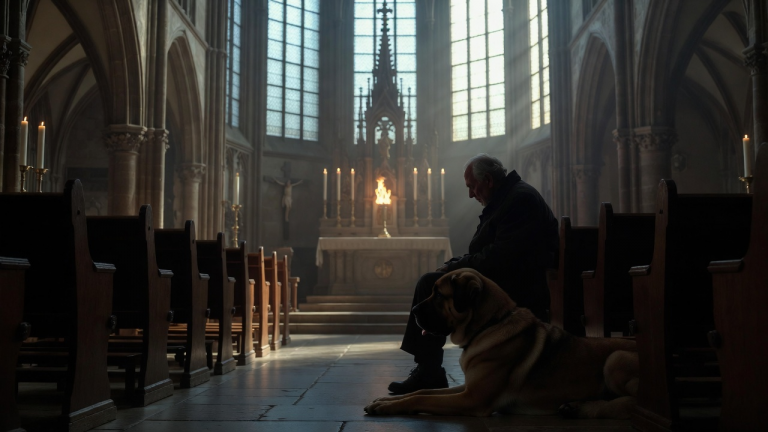
The Rich Man Laughed When I Begged For A Nickel To Call My Mom. But When I Picked Up The Phone And Spoke Into The Dead Line, The Entire Store Went Silent. He Didn’t Know Who I Was Calling… Or Where She Really Was.
Chapter 1: The Cold and The Crumb
The cold in the Midwest doesn’t just sit on your skin; it hunts you. It finds the gaps in your coat, the holes in your shoes, and the places in your spirit that are already cracked. It was Christmas Eve, 5:30 PM, and the wind outside was screaming like a banshee, tearing through the streets of our small town.
I was Billy. I am Billy. And on that night, I was seven years old, sixty pounds of skin and bone, and carrying a weight that would have crushed a linebacker.
I stood outside “Miller’s General Store,” pressing my nose against the frost-covered glass. Inside, it looked like a different planet. A golden planet. The lights were yellow and warm. There were garlands of red and green tinsel strung up like lazy snakes along the ceiling. I could see people—lots of people—bundled up in wool and fleece, their breath not visible like mine was out here. They were buying hams. They were buying batteries. They were buying life.
I looked down at my feet. My sneakers were a disaster. The left one had split open at the toe two weeks ago, and I had wrapped it in silver duct tape. The tape was peeling now, wet from the slush, flapping like a dead tongue every time I took a step. My socks were wet. My toes felt like little stones in a bag.
But the physical pain wasn’t why I was there.
I reached into my pocket. It was deep and empty, except for a ball of gray lint and a wrapper from a piece of gum I’d found on the sidewalk three days ago. No money. Not a penny.
I needed a nickel. Just five cents.
Most kids my age wanted a PlayStation or a bike or a Transformer that turned into a jet. I just wanted five minutes of make-believe. I wanted to hear a voice that I knew wasn’t there anymore, but I needed to pretend, just for tonight.
I took a deep breath. The air tasted like car exhaust and ice. I pushed the heavy wooden door open.
Jingle-jangle.
The bell above the door announced me to the room. A blast of heat hit me in the face, smelling of cinnamon brooms, floor wax, and damp wool. It was heaven. It was terrifying.
I tried to make myself small. That’s a trick you learn when you don’t have parents to stand behind. You shrink. You round your shoulders. You keep your head down. You become invisible.
I shuffled toward the fruit bin. I didn’t need fruit. I wasn’t even that hungry, despite my stomach growling loud enough to rival the wind. I picked up an apple. It was small, red, and had a soft brown bruise on one side. It was the kind of apple nobody else would want. Ideally, it was the kind of apple a cashier might just let you have if you looked pathetic enough.
But I wasn’t going to steal it. That wasn’t the plan.
I clutched the apple like a lifeline and moved toward the checkout counter. The line was long. It wound through the narrow aisle, flanked by shelves of canned soup and boxes of crackers.
My heart was hammering against my ribs. Thump. Thump. Thump.
I had to time this perfectly. I had to ask at the exact right moment. If I asked too soon, they’d kick me out. If I asked too late, the store would close.
I got in line behind a wall of a man. He was huge. Not fat, just… solid. He was wearing a navy blue wool coat that looked softer than my pillow. His shoes were polished black leather, dry and spotless despite the blizzard outside. He smelled like pine needles and expensive aftershave.
He was tapping his foot. Tap. Tap. Tap.
Every tap felt like a countdown.
I looked past his massive frame to the cashier. It was Sarah. I knew Sarah. She didn’t know me, but I knew her. She looked exhausted. Her hair was frizzy from the humidity, and she had dark circles under her eyes that looked like bruises. She was scanning items as fast as she could—beep, beep, beep—but the line wasn’t moving fast enough for the man in front of me.
I gripped the bruised apple tighter. My knuckles were white.
“Please,” I whispered to no one, my voice lost in the hum of the store. “Please let him be nice. Please let her be nice.”
I looked over at the corner of the store, past the magazine rack. There it was. The payphone.
It was an ancient relic, a black box on the wall with a silver cord that hung in a loop. It was covered in dust. Nobody used payphones anymore. Everyone had cell phones. Everyone except me.
But that phone was my portal. It was the only place in the world where I could talk to her. I just needed the coin to make the connection.
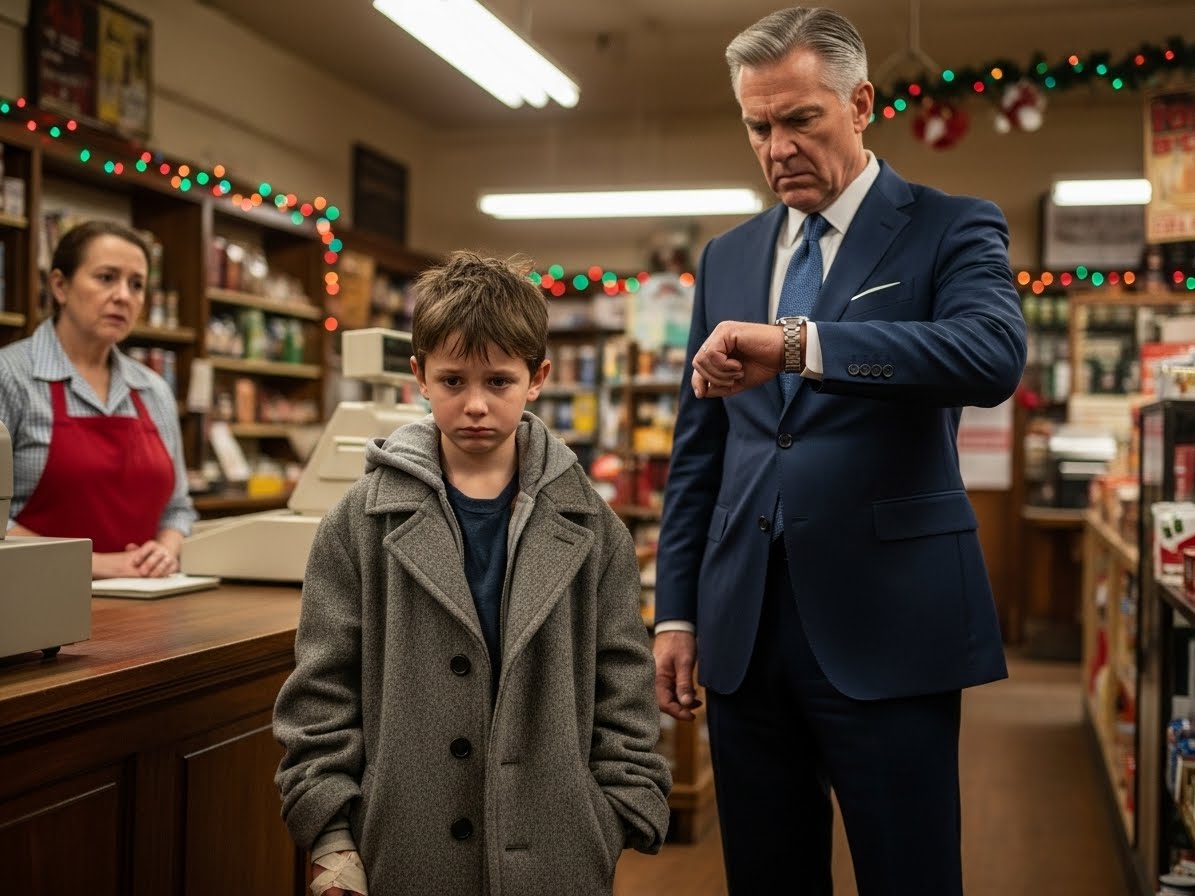
The man in front of me let out a loud, dramatic sigh. He checked a gold watch on his wrist.
“Unbelievable,” he muttered, loud enough for the people behind us to hear. “absolute incompetence.”
My stomach dropped. He wasn’t nice.
I swallowed hard, the dryness in my throat making it click. I was seven years old, alone, and about to walk into a storm inside the store that was far worse than the one outside.
Chapter 2: The Giant in the Suit
The line inched forward. The man in the blue coat—Mr. Vance, I would later learn his name was—seemed to grow larger with every second of delay. He radiated a heat that wasn’t warm; it was searing. It was the heat of a man who is used to getting what he wants, exactly when he wants it, and who takes it as a personal insult when the universe makes him wait.
I stood in his shadow, shivering as the ice on my coat began to melt and drip onto the worn wooden floorboards. Drip. Drip. Drip.
“Price check on aisle four!” Sarah yelled out, her voice cracking slightly. She looked like she was about to cry.
Mr. Vance threw his hands up in the air. “For God’s sake,” he barked. The sound was like a gunshot in the crowded store. Conversations stopped. The ambient hum of holiday chatter died instantly.
He turned his head slightly, not looking at me, but looking at the general audience of “peasants” behind him. “It’s a general store, not a physics exam. How hard is it to ring up a bag of charcoal?”
He looked down then. His eyes, cold and grey like the winter sky, landed on me.
I froze. I stopped breathing.
He didn’t see a boy. He saw a nuisance. He saw the dirt on my face. He saw the duct tape on my shoe. He saw the snot running from my nose that I hadn’t wiped because my hands were frozen. His lip curled upward, just a fraction of an inch, revealing a perfect row of white teeth. It was a sneer of pure, unfiltered disgust.
“And stop sniffing,” he snapped at me. “It’s vile.”
I nodded quickly, terrified. I sniffed again, purely by reflex, and then clamped my hand over my mouth.
Finally, it was his turn. He stepped up to the counter, throwing his items down with aggressive force. A bottle of expensive wine. A bag of gourmet coffee. A stack of lottery tickets.
“Merry Christmas, sir,” Sarah said, her voice trembling. She didn’t look him in the eye. She focused on the scanner.
“It would be merry if I was home an hour ago,” Vance shot back. “But apparently, speed isn’t a requirement for employment in this town.”
He paid with a black credit card that he slapped onto the counter. He didn’t sign the receipt; he just scribbled a line and snatched his bag.
He turned to leave, and that was the moment. The universe aligned, or maybe it broke. It was my turn.
I stepped up to the counter. The top of my head barely cleared the register. I put the bruised apple on the moving belt. It rolled slightly and stopped.
Sarah looked down at me. Her expression softened. She saw the coat. She saw the eyes. She saw the desperation.
“Hi, honey,” she said, her voice dropping to a whisper. “Are you okay? Where’s your mom?”
The question hit me like a physical blow. My throat closed up. I couldn’t say the words. Not yet.
“I…” My voice was a croak. I cleared it and tried again. “I don’t have any money, ma’am.”
Sarah sighed, but it was a sad sigh, not an angry one like Vance’s. She reached for her purse under the counter. “It’s okay, sweetie. It’s Christmas. Take the apple.”
“No,” I said quickly, louder than I intended.
Mr. Vance had stopped. He hadn’t walked out the door. He was standing three feet away, adjusting his leather gloves, listening.
I looked at Sarah, my eyes wide. “I don’t want the apple. I mean… I do, but I don’t need it. I need… I need a nickel.”
Sarah paused, her hand halfway to her purse. “A nickel?”
“For the phone,” I pointed a trembling finger toward the dark corner. “I need to call someone. It’s really important. Please. I promise I’ll pay you back when I grow up.”
Before Sarah could answer, a shadow fell over me.
Mr. Vance had turned around. He loomed over me like a thunderhead.
“A nickel?” his voice boomed. It wasn’t a question; it was an accusation. “You’re holding up the line, begging for money to make a prank call?”
I shrank back, clutching the edge of the counter. “No, sir. It’s not a prank. It’s—”
“This is what’s wrong with this country!” Vance shouted, addressing the room again. He was performing now. He was the judge, and I was the defendant. “Begging at seven years old? Where are your parents, boy?”
I looked at my shoes. The tape was coming loose.
“Look at me when I’m talking to you!” he roared.
I looked up, tears stinging my eyes. “They’re… they’re not here.”
“Of course they’re not here!” Vance laughed, a harsh, barking sound. “Probably at the bar, right? Drinking away their welfare checks? Or maybe they’re ‘sick’? That’s the usual excuse, isn’t it? Leaving you to harass honest, hard-working people for change.”
The store was deadly silent. The air felt heavy, suffocating. People were watching. Some looked angry at him, but most just looked uncomfortable, shifting their weight, looking at the floor. Nobody said a word. Nobody stood up for the boy in the taped shoes.
“I just need to make a call,” I whispered, the tears finally spilling over, hot tracks on my cold cheeks.
Vance reached into his pocket. He pulled out a handful of change. He picked out a single, shiny nickel.
“You want a handout?” he sneered. “Fine. Here.”
He didn’t hand it to me. He threw it.
He tossed the nickel onto the floor at my feet. It hit the dirty wood with a sharp ping, bounced once, and spun.
“Take it,” Vance spat. “Call your ‘special person.’ Tell them to come get you so we can all get on with our lives.”
I stared at the coin. It was heads up. Thomas Jefferson stared back at me.
I had a choice. I could leave. I could run out into the snow and freeze rather than take this man’s insult. My pride, small as it was, screamed at me to run.
But then I thought about her. I thought about her smile. I thought about the promise I made.
I swallowed my pride. I swallowed the lump in my throat.
Slowly, painfully, I bent my knees. I lowered myself to the floor in front of Mr. Vance’s polished shoes. I reached out with my shaking hand and picked up the nickel. It was cold metal against my skin.
I stood up. I wiped the dust from the coin onto my coat.
“Thank you, sir,” I said softy.
I didn’t look at his face. I turned my back on him. I turned my back on the store. I walked toward the corner, toward the phone, clutching that nickel like it was a diamond.
I had the coin. Now, I just had to make the call. And I knew, with a terrifying certainty, that this call was going to change everything.
Chapter 3: The Longest Walk
The distance from the checkout counter to the back corner of Miller’s General Store was perhaps thirty feet. In geographical terms, it was nothing. A few seconds of walking. But as I turned away from Mr. Vance and the line of staring customers, those thirty feet stretched out like a desert.
Every step was a battle. My left sneaker squelched with the wet slush that had soaked through the duct tape. Squish. Step. Squish. Step. The sound seemed amplified in the silence, a rhythm of poverty that announced my presence to everyone.
I could feel their eyes. It’s a physical sensation, being watched with pity and judgment. It feels like a thousand tiny needles pricking the back of your neck.
I knew what they were seeing. They saw a dirty kid in oversized clothes. They saw the “welfare trash” Mr. Vance had screamed about. They imagined a mother passed out on a couch somewhere, surrounded by beer cans, while her son roamed the streets.
If only they knew.
I clutched the nickel so hard the edge of it dug into my palm. That pain was good. It kept me focused. It grounded me.
Don’t cry, I told myself. Mommy hates it when you cry. She says brave boys stand tall.
I tried to straighten my spine, but the coat was so heavy. It was a wool coat I’d found in a donation bin three months ago. It was meant for a teenager. The sleeves hung down past my hands, and the hem dragged on the floor, collecting dust and grime. It was my house, my blanket, and my armor.
Behind me, the silence broke.
“Unbelievable,” Mr. Vance’s voice carried through the stagnant air. He wasn’t yelling anymore, but his tone was dripping with self-righteous annoyance. “We’re held up for five minutes so a delinquent can make a phone call. I’ve got a board meeting in Chicago tomorrow morning. My time is worth five hundred dollars an minute, and I’m spending it watching… this.”
I heard the cashier, Sarah, murmur something soft, probably trying to calm him down, but Vance just huffed. “Don’t bleed heart at me, Sarah. You’re enabling him. That’s the problem with this town. No discipline.”
I kept walking. I didn’t look back. I couldn’t. If I looked back, I might see the disgust on his face again, and I didn’t think I could handle that. I was fragile. I felt like I was made of thin glass, and one more stone would shatter me into a million pieces.
I reached the back of the store. The air was different back here. It was cooler, away from the heaters at the front. It smelled of old cardboard, dust, and the faint, sweet scent of pipe tobacco that must have lingered in the wood for decades.
The payphone was mounted on a wooden panel that had been darkened by years of greasy hands and leaning shoulders. It was a relic from another time. The chrome was pitted and dull. The black handset hung vertically, the silver cord coiled like a sleeping metal snake.
To anyone else, it was just a piece of obsolete technology. A junk item that should have been ripped out years ago.
To me, it was a church. It was the only place left where the magic still worked.
I stood in front of it, my breath visible in the cooler air of the corner. I was shaking. Not from the cold anymore, but from the anticipation.
My heart hammered against my ribs, a frantic bird trying to escape a cage. Thump-thump-thump.
I needed to do this right. I needed to follow the rules. Mommy always said that rules were important. She said that even if you have nothing, you have your integrity. You don’t take what isn’t yours. You pay your way.
That’s why I needed the nickel. I couldn’t just pick up the phone and pretend. That would be stealing the service. That would be lying. I had to pay. Even if the call wasn’t going to go where Mr. Vance thought it was going.
I looked at the coin in my hand. It was warm now, heated by my fear.
I took a deep, shuddering breath, filling my lungs with the dusty air. I blocked out the store. I blocked out Mr. Vance. I blocked out the cold snowstorm raging against the windows.
It was just me and the machine.
Chapter 4: The Dead Line
The store was quiet. Even the ambient hum of the refrigerator motors seemed to fade away. It was as if the building itself was holding its breath, waiting to see what the “delinquent” boy would do.
I reached up with both hands. The handset was heavy, solid black plastic that felt cold against my ear. I tucked it between my shoulder and my ear, the way I’d seen businessmen do in movies. It made me feel important. It made me feel like I existed.
I lifted the nickel. My hand was trembling so bad I almost dropped it.
Steady, Billy. Steady.
I brought the coin to the slot. The metal slot was scratched and silver. I pushed the nickel in.
Clink.
The sound was loud. It was a mechanical, decisive sound. Then came the whirrr-clunk as the machine swallowed the coin, digesting my only asset.
I listened.
There was a dial tone. A long, monotonous drone. Hummmmmmmmmmmmm.
It was the sound of potential. The sound of a connection waiting to be made.
Normally, this is when you would dial a number. You would press the buttons—area code first, then the seven digits. You would wait for the ringing. You would wait for someone to pick up on the other side.
But I didn’t move my hand to the keypad.
I just stood there, staring at the silver buttons. The numbers 1 through 9, plus the 0, the star, and the pound key. They were worn down, the white paint fading on the most popular numbers.
I didn’t dial. I couldn’t dial.
Because the number I needed didn’t exist in a phone book. It didn’t exist on a SIM card. It didn’t exist in Ohio, or New York, or anywhere on Earth.
From the front of the store, Mr. Vance’s voice cut through the silence like a serrated knife.
“Well? What’s the hold-up?” he called out, his patience officially evaporated. “Did you forget the number? Or is your mother too drunk to find the phone?”
A few people chuckled nervously. It was a cruel sound.
I closed my eyes. I squeezed them shut so tight that stars exploded behind my eyelids. I shut out his voice. I shut out the hate.
I pressed the phone tighter against my ear, pressing the hard plastic into my skin until it hurt. I needed to feel it. I needed to believe.
The dial tone hummed on. To anyone else, it was an annoying noise. To me, it was the white noise of heaven.
I licked my dry, cracked lips. I took a breath that rattled in my chest.
And then, I spoke.
“Hi, Mommy,” I whispered.
My voice was small, shaky, barely a ghost of a sound. But in the dead silence of the store, it carried.
I paused, imagining her voice on the other end. I imagined her warm, soft tone—the one she used when she tucked me in, back when we had a bed. Back when we had a room.
“It’s Billy,” I continued, my voice gaining a tiny bit of strength, though it wobbled with unshed tears. “I… I know I’m not supposed to call late. But I really needed to talk to you.”
The atmosphere in the store shifted instantly. The nervous chuckles died. The rustling of coats stopped.
Mr. Vance, who had been about to shout another insult, froze. His mouth was open, the words dying in his throat. He was listening. Everyone was listening.
I kept my eyes closed. I was visualizing her face. The way her nose crinkled when she laughed. The way her hair smelled like vanilla shampoo, even when we were living in the car.
“I’m at the store, Mommy,” I said into the droning dial tone. “The one with the nice lady. It’s snowing really hard outside. The wind is scary. It sounds like the wolves in my storybook.”
I gripped the phone cord, twisting it around my finger.
“But I’m being brave. Just like you said. I haven’t cried. Well… maybe a little bit. But only because my feet hurt.”
I sniffled, wiping my nose on the oversized sleeve of my coat.
“The lady at the shelter… Mrs. Higgins… she told me you couldn’t come home for Christmas this year,” I said, my voice cracking, fracturing under the weight of the truth. “She said you were with the angels now. She said you had to go away to a place where there’s no more coughing and no more pain.”
A gasp came from the front of the store. It sounded like Sarah. It was a wet, sharp intake of breath.
I ignored it. I had to get the message through. I had to make sure she knew.
“But I wanted to call and tell you I’m being a good boy,” I said, the tears finally breaking through, spilling hot and fast down my face. “I washed my face this morning with snow. And I’m taking care of my little sister, Suzie. I gave her my socks because hers had holes. I’m holding her hand when we cross the street, Mommy. I promise.”
I paused again. The dial tone was relentless, indifferent. But in my heart, I heard her. I heard her telling me she was proud.
“I just…” I sobbed, my composure crumbling. “I just really miss you, Mommy. It’s so cold here. And the man… the man in the suit was yelling at me. But I didn’t yell back. I was polite. I said thank you.”
I took a shuddering breath, my small chest heaving.
“Please tell God to give you a warm blanket,” I whispered, my voice barely audible now. “And maybe… maybe if He has extra… could He send one for me and Suzie too? We’re really cold.”
I stood there for a second longer, listening to the hum.
“Merry Christmas, Mommy. I love you to the moon and back.”
I slowly pulled the phone away from my ear. I looked at the receiver. I didn’t want to hang up. Hanging up felt like saying goodbye forever. But my time was up. The nickel was spent.
With a trembling hand, I placed the receiver back onto the cradle. Click.
The connection was broken.
I stood there, facing the wall, wiping my face with my dirty sleeve. I didn’t want to turn around. I didn’t want to face the giant in the suit. I expected him to yell again. I expected him to laugh at my game of make-believe.
But there was no yelling.
There was no laughter.
There was only a silence so profound, so heavy, that it felt like the entire world had stopped spinning. It wasn’t the silence of awkwardness anymore. It was the silence of a room full of people whose hearts had just been ripped out of their chests at the same time.
I took a deep breath, steeled myself, and slowly turned around.
Chapter 5: The Sound of Hearts Breaking
I turned around slowly, bracing myself. I expected the anger. I expected Mr. Vance to be checking his watch again, tapping his foot, asking why I had wasted his precious time talking to a dead phone line. I expected the security guard to be walking over to escort me out.
But the store was unrecognizable.
It was as if someone had paused a movie.
Sarah, the cashier, was the first thing I saw. She wasn’t scanning items anymore. She wasn’t rushing. She was standing behind her counter, her hands pressed tightly over her mouth, her eyes wide and swimming in water.
A single tear escaped her left eye, tracking through the makeup on her cheek, leaving a dark, wet streak. Then another. Then a sob, choked back, that sounded like a hiccup.
Next to the magazine rack, an elderly woman in a purple coat had her hand over her heart. She was looking at me like I was her own grandson. She reached into her purse for a tissue, her hands shaking almost as bad as mine had been.
Even the big, burly man in the construction vest, who had been grumbling about the price of beer earlier, had taken off his hat. He held it against his chest, staring at the floor, his jaw tight.
I blinked, confused. My heart started racing again, but for a different reason.
Did I do something wrong?
Panic flared in my chest. Had I broken the phone? Was it illegal to talk to Heaven? Maybe the nickel got stuck?
I looked at Sarah, my voice trembling. “I… I’m sorry, ma’am. Did I take too long? I tried to be fast.”
That broke the dam.
Sarah let out a wail. It wasn’t a polite cry. It was a guttural, ugly sound of pure heartbreak. She abandoned her register. She didn’t care about the line. She didn’t care about her boss. She walked around the counter, her apron strings flapping.
“Oh, honey,” she choked out. “Oh, my sweet boy.”
She didn’t come all the way to me. She stopped a few feet away, respecting the space, but she looked at me with such intensity it felt like a hug.
“You didn’t take too long,” she whispered, shaking her head violently. “You take as long as you need. You can talk all night. I’ll pay for it. I’ll pay for every minute.”
I looked down at my shoes, confused by her kindness. “I already paid,” I said softly. “I used the nickel. You have to pay, or else it’s stealing. Mommy said if you steal, the angels can’t hear you.”
A collective gasp went through the room. It was the sound of twenty adults realizing they were standing in the presence of a morality they had long forgotten.
I had paid for a service that didn’t exist, with money I didn’t have, to honor a code of ethics taught by a mother who was gone.
The silence that followed wasn’t empty. It was heavy. It was suffocating. It was filled with the sudden, crushing weight of perspective.
People started moving. Not to leave, but to hide their faces. A woman turned into the aisle of cereal boxes to weep. A man pretended to tie his shoe so he could wipe his eyes.
But there was one person who hadn’t moved. One person who stood like a statue in the center of the storm he had created.
I shifted my gaze past Sarah, past the crying old lady, to the front of the line.
To Mr. Vance.
He was still standing there. His expensive leather bag was gripping in his hand, but his knuckles were white. He was staring at me.
But the sneer was gone. The arrogance that had coated him like armor was stripped away. His face had gone a sickly shade of gray, like old ash. His mouth was slightly open, slack.
He looked like a man who had just been punched in the gut by a ghost.
I took a step back, pressing myself against the wall next to the phone. “I’m leaving now, sir,” I stammered, terrified he was going to yell again. “I’m sorry I made you wait. I won’t come back.”
I buttoned my coat with clumsy, frozen fingers. “I have to go find Suzie. She’s waiting under the awning at the library.”
I started to move toward the door, skirting the edge of the aisle to stay as far away from him as possible. I just wanted to get back into the cold. The cold made sense. The cold was honest.
This room—filled with crying strangers and a frozen giant—was too much for me.
Chapter 6: The Giant Crumbles
Mr. Arthur Vance had spent sixty years building a fortress around his heart. He built it with money. He built it with cynicism. He built it with the belief that everyone in the world was either a predator or a parasite.
He looked at poverty and saw laziness. He looked at struggle and saw bad choices. He looked at a child in taped shoes and saw a future criminal.
But as he watched the small boy try to sneak past him—apologizing for existing—the fortress didn’t just crack. It disintegrated.
The words the boy had spoken into the dead phone line were echoing in Vance’s head, bouncing around like shrapnel.
“She’s with the angels now.”
“I’m taking care of my little sister.”
“I washed my face.”
“I polite. I said thank you.”
Vance looked at the boy. Really looked at him.
He saw the red, chapped skin on the boy’s cheeks. He saw the way the boy’s wrists were too thin for the cuffs of the coat. He saw the dignity in the boy’s posture—a seven-year-old who refused to steal an apple, who paid a nickel to talk to his dead mother because he believed in being “good.”
And then Vance looked at himself.
He saw his reflection in the glass of the refrigerated display case next to him. He saw a man in a $3,000 suit. A man who had everything. A man who had screamed at an orphan on Christmas Eve.
A wave of nausea rolled over him. He felt physically sick. The shame was a hot, oily liquid rising in his throat.
He had judged the boy’s parents. He had mocked the boy’s “drunk mother.” He had thrown a nickel on the floor like he was feeding a stray dog.
And the boy had picked it up. He had picked it up and said thank you.
The realization hit Vance with the force of a freight train: I am the villain in this story.
His hand, holding the leather bag of wine and gourmet coffee, went slack.
Thud.
The bag hit the floor. The sound of a wine bottle shattering inside the bag crunched through the silence. Red liquid began to seep through the leather, staining the expensive material, pooling on the dirty wood floor.
Vance didn’t even look down. He didn’t care. That bag cost more than this boy had likely seen in his entire life, and Vance didn’t care if it burned.
He took a step toward the boy.
“Son,” he rasped.
His voice was unrecognizable. It wasn’t the booming baritone of the boardroom. It was a cracked, broken sound.
I froze near the door. I flinched, pulling my shoulders up to my ears, expecting a blow. I squeezed my eyes shut.
That flinch. That instinctive reaction of fear. It was the final dagger in Vance’s heart.
He stopped. He looked at the boy terrified of him.
Vance’s legs, which had carried him through construction sites and corporate takeovers, suddenly felt weak. He couldn’t stand above this boy anymore. He didn’t deserve to stand above anyone.
Slowly, awkwardly, the billionaire lowered himself.
He didn’t crouch. He knelt.
He dropped both knees onto the wet, slush-covered floorboards, ruining the fabric of his suit trousers instantly. He didn’t care about the wet. He didn’t care about the cold.
He needed to be lower. He needed to be at eye level.
“Billy,” Vance said, his voice trembling. He had heard the name when I whispered it to the phone.
I opened one eye, peering at him. The scary man was on the floor. He looked… smaller. He looked sad.
“Billy, please… wait,” Vance said. He reached out a hand, palm up, imploring. His hand was shaking.
“I…” Vance struggled to find the words. What do you say when you have been monstrous? How do you apologize for breaking a child’s spirit?
“I think…” Vance swallowed hard, fighting back a sob that was threatening to tear his chest open. “I think the line was bad.”
I stared at him, confused. “The line?”
“The phone,” Vance whispered, tears finally spilling from his gray eyes, tracking through the wrinkles of his face. “The connection was bad. It’s an old phone. She might not have heard everything.”
He reached into the inner pocket of his suit jacket. He pulled out his phone. It was the latest model, sleek and silver, worth a thousand dollars.
“This one…” Vance held it out, his hand shaking violently. “This one has a better signal. It calls straight to the clouds. It calls… everywhere.”
He looked at me with a desperation that frightened me. He was pleading with me to accept his offering. He was begging for a chance to fix the unfixable.
“Do you…” Vance choked. “Do you want to tell her again? On a clear line? Just to be sure?”
I looked at the shiny phone. Then I looked at Mr. Vance’s wet eyes.
I didn’t understand everything that was happening. I didn’t understand why the angry man was crying. But I understood kindness. I knew what it looked like when someone was trying to help.
I took a hesitant step toward him.
“Does it really reach the clouds?” I asked softly.
Vance nodded, a tear dripping off his chin. “Yes. I promise. It goes all the way to the top.”
He wasn’t just offering a phone. He was offering his soul. He was offering a bridge across the chasm he had created.
And as I stepped closer, the tension in the room didn’t break—it transformed. It turned into hope.
Chapter 7: The Signal to Heaven
The distance between Mr. Vance and me was only a few feet, but it felt like we were standing on opposite sides of a canyon. He was on his knees in the slush, a position I had never seen a grown man take unless he was hurt. His hand, holding the sleek silver phone, was steady now, offering it to me like it was a holy relic.
I looked at Sarah. She nodded, wiping her eyes with her apron. She gave me a watery smile that said, It’s okay. You can trust him.
I stepped forward. My sneakers squished on the floor. I reached out and took the phone.
It was warm. It was smooth. It didn’t have a cord. It felt like magic in my dirty, frostbitten hand.
“How do I… how do I dial?” I whispered.
Vance shook his head, his voice thick. “You don’t need to dial numbers on this one, Billy. It’s voice-activated. Just… just talk. She’ll hear you.”
I held the phone to my ear. There was no dial tone this time. Just a soft, digital silence. It felt clearer. It felt expensive.
I closed my eyes again.
“Mommy?” I said, my voice stronger this time. “It’s me again.”
Vance bowed his head. He was looking at the floor, watching his tears stain the wood, listening to every word like it was a verdict on his soul.
“The man…” I paused, looking at the top of Vance’s head. “The man isn’t yelling anymore. He gave me his special phone. He said the signal is better. So I just wanted to make sure you heard me about the blanket.”
I took a deep breath.
“And… and I wanted to tell you not to be mad at him. He was just… he was just cold too, I think. But he’s nice now. He’s letting me use his minutes. And you know how expensive minutes are.”
A sob wracked Vance’s body. His shoulders shook. To hear this child—this child he had abused and humiliated—defend him to his dead mother… it was the most crushing, beautiful thing he had ever heard. It destroyed the last remnants of his ego.
“I have to go now, Mommy,” I whispered. “Suzie is waiting. But I feel better now. I feel like you’re close. Bye-bye.”
I pulled the phone away. I looked at the screen. It was black, reflecting my own dirty face.
I handed it back to Vance.
“Thank you, sir,” I said. “That was… that was much better.”
Vance didn’t take the phone. He ignored it. He let it drop from his hand, clattering onto the floor next to the broken wine bottle. He didn’t care about the technology. He cared about the boy.
Suddenly, he lunged forward.
I flinched again, but he didn’t hit me.
He wrapped his arms around me.
It was a clumsy, desperate hug. His expensive wool coat was rough against my cheek. He smelled of pine and sorrow. He squeezed me tight, pulling me into his chest, burying his face in the hood of my dirty, oversized coat.
“I’m sorry,” he wept into my shoulder. “I’m so, so sorry.”
He wasn’t speaking to the room. He wasn’t speaking to the crowd. He was speaking to me, and maybe to the children he hadn’t spoken to in ten years, and maybe to the God he had stopped believing in.
“I’m sorry I didn’t see you,” he sobbed. “I’m sorry I was blind.”
I stood there, stiff at first. I wasn’t used to being hugged. Not since Mommy left. But then, slowly, the warmth of his big coat seeped into my frozen bones. The shaking of his body matched the shaking of mine.
I reached up with my small hands and patted his back.
“It’s okay,” I whispered. “Everyone gets mad sometimes.”
The store was silent, save for the sound of the storm outside and the weeping of a billionaire on his knees. It was a tableau of redemption. The man who had everything had just found the only thing he was missing: his heart.
Chapter 8: The Warmth of Christmas
After a minute, Vance pulled back. He kept his hands on my shoulders, gripping me firmly, as if he was afraid I might vanish if he let go.
He looked me in the eyes. His face was red, wet, and ruined, but his eyes were clear for the first time.
“Billy,” he said, his voice steadying. “Where is your sister?”
“At the library,” I said. “Under the awning. It’s closed, but it’s dry there.”
Vance nodded. He stood up. His knees were soaked with slush and red wine. His pants were ruined. He didn’t even brush them off.
He turned to the crowd. He didn’t look ashamed anymore. He looked like a man on a mission.
“Sarah,” he said.
“Yes, Mr. Vance?” Sarah sniffled, wiping her face.
“Ring up everything in the store,” he said. He pointed to the shelves. “The toys. The blankets. The food. Everything that can fit in a car.”
“Everything?” Sarah gasped.
“Everything,” Vance commanded. “And call the shelter. Tell Mrs. Higgins I’m making a donation. A big one. Tell her… tell her the heating bill is paid for the next ten years.”
He looked back down at me. He held out his hand. Not a fist. Not a finger pointing in blame. An open hand.
“Come on, son,” he said. “Let’s go get Suzie.”
I looked at his hand. It was big and warm. I reached out and took it.
We walked out of Miller’s General Store together. The bell jingled—jingle-jangle—but this time, it sounded like a victory march.
The wind outside was still howling, but it didn’t feel as cold. Vance walked between me and the wind, shielding me with his body. We walked down the snowy sidewalk, past the holiday lights that blurred in my vision.
We found Suzie curled up in a ball behind a concrete pillar at the library entrance. She was five. She was wearing my socks on her hands like mittens. She was shivering so hard her teeth were chattering.
When she saw the big man, she screamed.
“It’s okay, Suze!” I yelled over the wind. “It’s okay! He’s a friend. He knows Mommy.”
Vance didn’t hesitate. He scooped Suzie up in his arms. He took off his expensive scarf and wrapped it around her head. He took off his gloves and put them on her feet over her sneakers.
“I’ve got you,” he whispered to her. “I’ve got you both.”
We didn’t go back to the shelter that night.
Mr. Vance took us to the diner down the street. It was warm. It smelled of bacon and coffee. He ordered everything on the menu. Pancakes. Burgers. Hot chocolate with extra whipped cream.
He sat across from us in the booth, still wearing his ruined suit, watching us eat like we were starving wolves. He didn’t eat. He just watched. And every time Suzie smiled, a little more of the hardness in his face melted away.
He made a phone call that night. A real one. He called a hotel. He got us a suite. A warm one. With two beds and a TV.
But he didn’t stop there.
Over the next few weeks, the town talked. They talked about how the “Grinch” had turned into Santa Claus. But they didn’t know the half of it.
Mr. Vance didn’t just buy us dinner. He hired a lawyer. He worked with social services. He found out that he had empty bedrooms in his mansion that hadn’t been used since his own kids left.
He became a foster parent. Not because he wanted to look good, but because that night in the store, when the line was dead, something inside him came alive.
I remember asking him, years later, why he did it. Why he saved us.
We were sitting on his porch. I was sixteen, healthy, and happy. Suzie was inside playing the piano.
Vance looked at the sunset. He looked older, but softer.
“I didn’t save you, Billy,” he said quietly.
He reached into his pocket and pulled out a small, silver object. It was a nickel. The same nickel I had given Sarah. She had framed it for him, but he kept it in his pocket.
He rubbed his thumb over the face of Thomas Jefferson.
“You saved me,” he said. “I was drowning in an ocean of money, and I didn’t even know it. You threw me a lifeline for five cents.”
He looked at me and smiled.
“Best investment I ever made.”
And that’s the truth. The world thinks I paid a nickel to talk to my mom. But I know better. That nickel didn’t just buy a few minutes of pretend time. It bought a father. It bought a future. It bought a family.
Sometimes, the most expensive things in life aren’t the ones that cost a million dollars. Sometimes, the most valuable thing in the world is just a little bit of change, and the courage to make the call.
Epilogue: The Interest on a Nickel
Time is a funny thing. When you are seven years old and shivering in the snow, five minutes feels like a lifetime. When you are twenty-seven, a decade goes by in the blink of an eye.
It has been twenty years since that Christmas Eve in Miller’s General Store.
Miller’s is gone now. It was replaced by a mega-mart with automatic doors and self-checkout lanes where you never have to look a cashier in the eye, let alone beg them for a favor.
Mr. Vance—Dad—passed away three days ago.
He didn’t die alone. He died in the master bedroom of the house that used to be a museum of loneliness but became a home filled with noise, messy teenagers, and eventually, college degrees. Suzie was holding his left hand, and I was holding his right.
He wasn’t the “Titan of Industry” when he went. He was just an old man who loved bad jokes and insisted on putting extra marshmallows in his cocoa.
Yesterday, the lawyer called us for the reading of the will. I expected it to be complicated. Dad had assets, properties, and investments.
But when Suzie and I sat down in the mahogany-paneled office, the lawyer, Mr. Henderson, handed me a small, sealed envelope.
“He wanted you to read this first, Billy,” Henderson said. “Before we discuss the estate.”
My hands were shaking, just like they were when I held that apple. I opened the envelope. inside, there was no legal jargon. No typed letterhead.
There was just a handwritten note on yellow legal paper, and a small, heavy object taped to the bottom.
It was a nickel.
Not just any nickel. It was scratched, dull, and dated 1998. It was the nickel. He had kept it. He had carried it in his pocket every single day for twenty years. The metal was worn smooth by the friction of his thumb, a worry stone he used whenever the world got too heavy.
I unfolded the note. The handwriting was shaky—written in his final weeks.
To Billy,
If you are reading this, I’ve gone to make a call on the cloud phone. Hopefully, the reception is as good as I promised you it was.
You’re going to inherit the money, the house, and the business. That’s the easy part. But I want to leave you with the only thing I ever really owned that had any value.
This nickel.
For a long time, I thought I was the one who saved you that night. I told myself I was the hero. But as I got older, I realized the truth. You didn’t need my money. You had a strength in you—a faith in the goodness of things—that I had lost long ago. You were willing to stand in front of a giant and speak your truth.
This nickel reminded me every day that the cost of redemption is cheap. It only costs five cents to change a life. It only costs a moment of patience to save a soul.
Don’t hoard the fortune I’m leaving you, son. Build tables, not walls. And always, always keep a nickel in your pocket. You never know when someone might need to make a call.
Love, Dad
I sat in that office and wept. I wept for the terrified seven-year-old boy I used to be, and for the angry, broken man my father used to be. I wept for the miracle that happened in the space between us.
I pocketed the nickel.
I walked out of the office and down to the street. It was snowing again. The wind was biting, just like it was that night.
On the corner, there was a young man. He couldn’t have been more than twenty. He was sitting on a cardboard box, holding a sign that said “Hungry.” People were walking past him, clutching their phones, ignoring his existence.
I stopped.
I felt the weight of the nickel in my pocket. It felt warm.
I didn’t give him the nickel. I gave him my hand.
“Hey,” I said, my voice catching in the wind. “My name is Billy. You look cold. Do you want to get some coffee?”
The young man looked up, startled. He saw my suit. He saw my shoes. He looked ready to run.
“I… I don’t have any money,” he stammered.
I smiled. A genuine, tear-filled smile.
“It’s okay,” I said. “My dad already paid for it. He left a really big tip.”
The cycle doesn’t end. The love doesn’t stop. It just changes hands, passed along like a shiny silver coin, from one frozen soul to another, until the whole world is finally, mercifully, warm.
[END OF STORY]