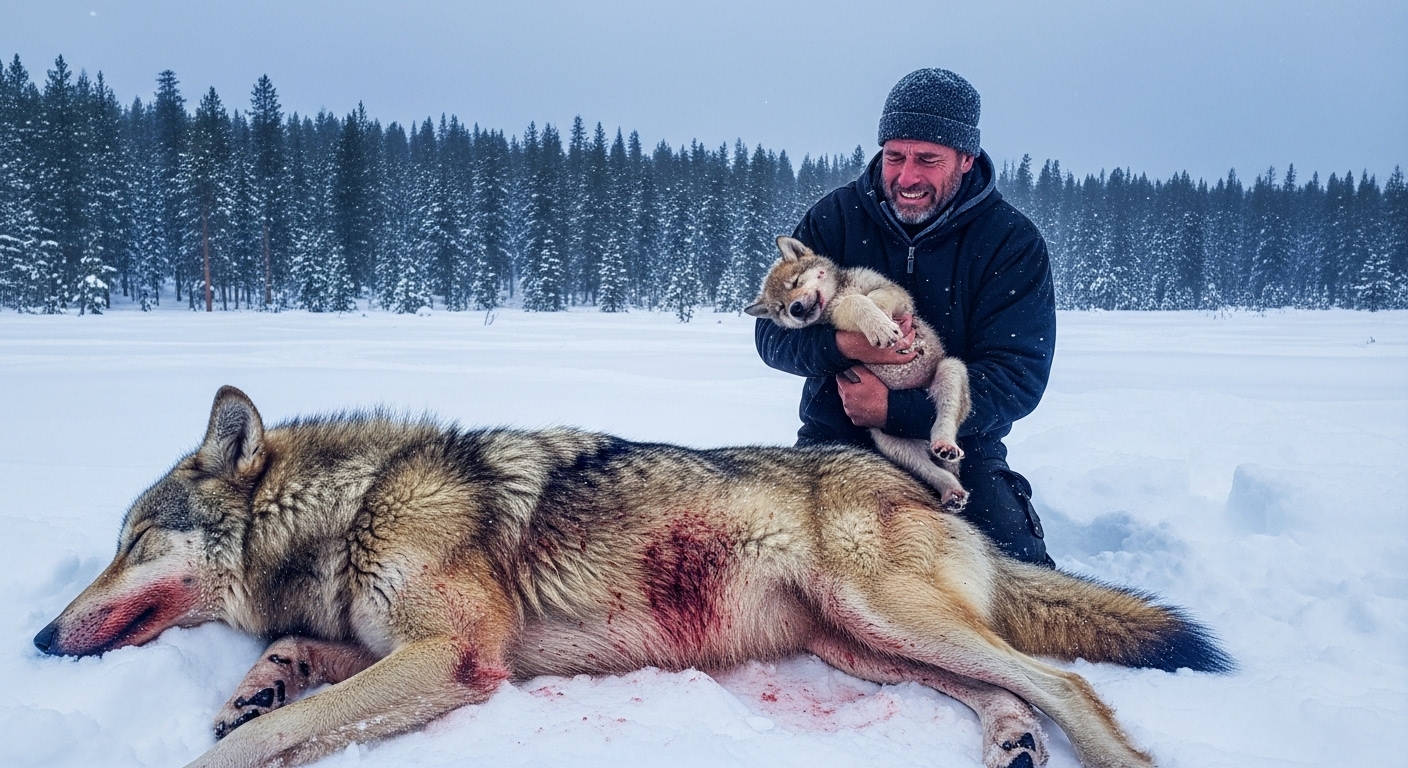
I Made a Fatal Mistake in the Montana Wilderness When I Saved a Dying She-Wolf and Her Pup From a Hunter’s Trap, Thinking I Was Doing God’s Work, But I Had No Idea That My Act of Mercy Would Lead a Bloodthirsty Pack Straight to Our Doorstep and Unleash a Night of Terror That Our Small Community Will Never Forget
PART 1
They say that no good deed goes unpunished, but out here in the deep, unforgiving valleys of Montana, a good deed can get you killed. It can get your neighbors killed. I learned that lesson the hard way, and the guilt is something I’ll carry until the cold finally claims me, just like it almost claimed her.
It was mid-February, and we were in the middle of a polar vortex that had turned our little off-grid community into a frozen hellscape. The thermometer on my porch hadn’t risen above minus twenty degrees in a week. The snow was waist-deep, a heavy, suffocating blanket of white that muffled every sound, turning the forest into a silent tomb. At night, the silence was broken only by the timber of the cabins groaning under the freeze and the howling.
God, that howling. It was closer this year. Hungrier.
We all knew the rules: Don’t go past the tree line after dusk. Don’t go out alone unless you’re armed. And never, ever interact with the wildlife. Nature out here isn’t a Disney movie; it’s a meat grinder. But when the main water line feeding our cluster of six cabins froze solid, rules had to be bent. If we didn’t clear the blockage at the spring head, three miles up the ridge, we’d be melting snow for water within a day.
I drew the short straw. I’m the youngest guy in the hollow, just turned thirty-five, and I’ve got the best gear. So, I layered up—thermals, wool, GORE-TEX—strapped on my snowshoes, and loaded a sixty-pound pack with heating torches, wrenches, and a propane tank. I didn’t take a rifle. It was heavy, and I figured the weight of the tools was enough. That was my first mistake.
The trek up was brutal. The air was so cold it felt like inhaling broken glass. My eyelashes froze together every time I blinked too long. I kept my head down, trudging through the powder, focusing on the rhythm of my breath and the crunch of the snowshoes.
I was about halfway to the spring, crossing a wide, exposed clearing that we call “The Anvil” because the wind hammers it so hard, when I saw it.
A dark shape, stark against the blinding white.
At first, I thought it was a trick of the light, or maybe an elk carcass dragged down by the snow. I should have kept walking. The sun was already dipping, casting long, bruised purple shadows across the valley. Every minute wasted was a minute closer to frostbite. But curiosity is a curse.
I altered my course. As I got closer, the shape resolved itself. It wasn’t an elk. It was a wolf. A massive timber wolf, her fur a mix of slate grey and charcoal.
My heart hammered against my ribs like a trapped bird. I stopped dead, about fifty yards out, hand instinctively reaching for the bear spray on my belt. But she didn’t move. She was lying on her side, half-buried in a drift.
Then I saw movement. A tiny ball of fluff, no bigger than a football, was frantically circling her. A pup. It was whining—a high-pitched, desperate sound that cut right through the whistling wind. It was nudging her snout, licking her closed eyes, trying to wake her up.
The mother let out a breath, a puff of steam that barely rose before vanishing. She was alive, but fading fast.
I stood there for a long time. The wind bit at my exposed cheeks. My brain was screaming at me: Turn around. Walk away. This is natural selection. If you interfere, you’re an idiot.
But then the pup looked at me. It didn’t run. It was too cold, too terrified to run. It just looked at me with these wide, golden eyes that were already glazing over with the beginning of the end.
“Dammit,” I whispered, my voice cracking in the dry air.
I couldn’t leave them. Not like this.
I dropped my pack, the heavy tools sinking into the snow. I moved slowly, making myself big but non-threatening. “Easy, girl. Easy now.”
As I got within ten feet, I saw the problem. It wasn’t just the cold. Her back leg was a mess of matted blood and twisted metal. She’d stepped into a poacher’s snare—probably some rusty old wire left over from the summer—and in her panic, she’d torn herself open trying to get free. She was exhausted, bled out, and freezing to death.
She opened one eye. It was cloudy, filled with pain, but sharp. She growled, a low rumble that vibrated in her chest, but she didn’t have the strength to lift her head. The pup scurried behind her, shivering violently.
“I’m not gonna hurt you,” I said, feeling stupid for talking to a wild animal that could rip my throat out if she had the energy.
I knelt down in the snow. The smell hit me then—copper blood, wet fur, and the musk of infection. I pulled out my Leatherman tool. The wire was dug deep, cutting into the muscle.
I had to work fast. I took off my heavy outer gloves, my fingers instantly stinging in the freezing air. I grabbed the wire. The wolf flinched and snapped her jaws, her teeth clicking inches from my wrist.
“Hey! Quit it!” I shouted, adrenaline flooding my system. “I’m trying to help you!”
I don’t know if she understood the tone or if she just gave up, but she laid her head back down. I worked the wire cutters. Snip. The tension released. I gently pulled the barbed metal from her leg. The wound was ugly, but the cold had stemmed the bleeding.
I dug into my first aid kit. I poured nearly a whole bottle of rubbing alcohol over the wound—she whimpered, her body convulsing—and then wrapped it tightly with gauze and heavy tape.
She was shivering so hard her teeth were chattering. She wasn’t going to make it through the night without heat.
I made a decision that still haunts me. I took off my heavy canvas work jacket—the one lined with sheepskin—and draped it over her and the pup. I tucked it in around them, creating a cocoon. I was left in just my wool sweater and shell. I was freezing, but I figured I could move fast enough to stay warm.
“Good luck,” I muttered.
I grabbed my tools. I didn’t look back. I practically ran the rest of the way to the spring, cleared the ice in record time, and sprinted back down the mountain as the sun vanished. I didn’t check on them on the way back. I assumed they’d be gone, or dead.
I got back to my cabin just as true night fell. My lips were blue, my fingers numb. I drank half a bottle of whiskey to stop the shaking, stoked the wood stove until the iron glowed red, and passed out on the rug.
I slept the sleep of the righteous. I thought I was a hero. I thought I had done something beautiful.
I was wrong.
PART 2
The next morning, the world was too quiet.
Usually, you hear the birds, the wind, or the distant hum of a neighbor’s generator. But when I woke up, there was a heavy, oppressive silence. The kind of silence that feels like a held breath.
I grabbed my coffee and walked to the front window to check the thermometer.
My heart stopped.
Outside, in the pristine white snow of my front yard, the snow was churned up. Mud and dirt were streaked across the white.
I ran to the door and threw it open. The cold air rushed in, but I didn’t feel it. I was too busy staring at the carnage.
My chicken coop, which I had reinforced with heavy gauge wire and wood, was decimated. It looked like a bomb had gone off. Wood splinters were scattered everywhere. Feathers—white and brown—floated on the breeze like tragic confetti. Blood turned the snow into a horrific abstract painting. Of my twenty hens, not a single one was left. Just pieces.
But it wasn’t just the coop.
I stepped off the porch, my boots crunching on something hard. I looked down. It was my heavy canvas work jacket. The one I had left over the she-wolf.
It was shredded. Torn to ribbons.
And then I saw the tracks.
They weren’t just wolf tracks. It was a highway of them. Dozens of paw prints, circling the house, circling the coop, circling the jacket.
A neighbor, Old Man Miller from the cabin two hundred yards down, came running up the road. He was carrying his shotgun, his face pale as a sheet.
“Jack!” he screamed. “Jack, are you alive?”
“I’m here!” I yelled back. “What the hell happened?”
“They’re everywhere,” Miller gasped, doubling over, trying to catch his breath. “The pack. They came down last night. They didn’t just hit you. They hit the Smiths. They tried to get into the Anderson’s barn.”
My stomach dropped.
“The jacket,” I whispered, looking at the tattered remains of my “good deed.”
It hit me with the force of a physical blow. The she-wolf hadn’t just survived. She had been found by her pack. And on her, on her fur, on that jacket I wrapped her in… was my scent.
Wolves have a sense of smell that is thousands of times stronger than a human’s. To them, I didn’t just leave a jacket. I left a map. I left a calling card that smelled of sweat, home, and prey.
They hadn’t come to thank me. They had tracked the scent of the “human helper” back to the source. They smelled the weakness, the charity, and they followed it straight to our front doors.
“Jack,” Miller said, his voice trembling. “Look at the tree line.”
I looked up.
At the edge of the forest, where the shadows of the pines met the bright snow, they were watching.
Not one or two. A dozen.
Standing in the front was a massive, grey beast. She was favoring her back leg, leaning slightly to the left. Beside her sat a small, fluffy pup.
She stared right at me. There was no gratitude in those eyes. There was no connection. There was only the cold, calculating assessment of a predator looking at food.
She let out a howl—a long, mournful, terrifying sound that made the hair on my arms stand up. The rest of the pack joined in, a cacophony of yips and howls that echoed off the mountains, signaling that we were surrounded.
They knew we were here. They knew where the food was. And now, they weren’t afraid.
We spent the next three nights in a state of siege. We had to board up the windows. We took shifts watching the perimeter with rifles. They tested the doors at night. We could hear their claws scratching against the wood, sniffing at the cracks. They killed every piece of livestock in the settlement. A dog belonging to the family down the road was snatched right off the porch in broad daylight.
We eventually drove them back with warning shots and fire, pushing them deep into the high country, but the damage was done. The peace of our valley was shattered.
I looked at the shredded remains of my jacket one last time before I burned it in the stove. I wanted to be angry at her. I wanted to hate her. But I couldn’t.
I had projected my human morality onto a creature of the wild. I saved her life, yes. But in doing so, I invited the wild into my home. I forgot the most basic law of nature: There are no friends in the food chain.
Now, whenever I hear a howl in the night, I don’t feel awe. I feel a chill that has nothing to do with the cold. I check the locks. I load the rifle. And I pray that the scent of my mercy has finally faded from the wind.