The Billionaire Who Burned Her Own Empire: A Grandmother’s Choice Between Blood Money and an Innocent Life
Chapter 1: The Girl in the Recycling Bin
The winter wind in Manhattan didn’t just blow; it sliced. It cut through the canyons of steel and glass on the Upper East Side, hunting for any gap in a coat or a scarf.
Margaret “Maggie” Sterling, at sixty-five, was insulated from such things. Her coat was cashmere, her scarf was silk, and her life was wrapped in the impenetrable armor of a nine-figure net worth. She was the matriarch of Sterling-Hale Pharmaceuticals, a company her late husband, Richard, had built from a single drugstore into a global titan. Since Richard’s passing five years ago, Maggie had become the “Face of Philanthropy,” leaving the ruthless mechanics of the boardroom to her son, Brad.
It was a Tuesday evening in late November. The city was gearing up for the holidays, draped in silver bells and red ribbons. Maggie was scheduled to attend the “Gala for Global Health” at the Met, a black-tie affair where she would smile, hold a champagne flute, and sign a oversized check.
But tonight, the noise of the paparazzi out front was too much. The flashing bulbs gave her a migraine.
“I’m taking the service exit, Jenkins,” she told her doorman, adjusting her gloves.
“Very good, Mrs. Sterling. Be careful of the ice.”
Maggie slipped out the heavy iron back door into the alleyway behind her townhouse. It was a narrow, cobblestone strip usually reserved for garbage trucks and delivery vans. It was quiet here, the roar of the city muffled by the high brick walls.
Or it should have been quiet.
Instead, Maggie heard a distinct scratching sound. Like a raccoon digging for scraps.
She tightened her grip on her purse, her heart doing a nervous flutter. She walked toward the large blue recycling bins near the gate.
“Hello?” she called out, her voice echoing slightly. “If you’re looking for bottles, the superintendent clears them out on Mondays.”
The scratching stopped.
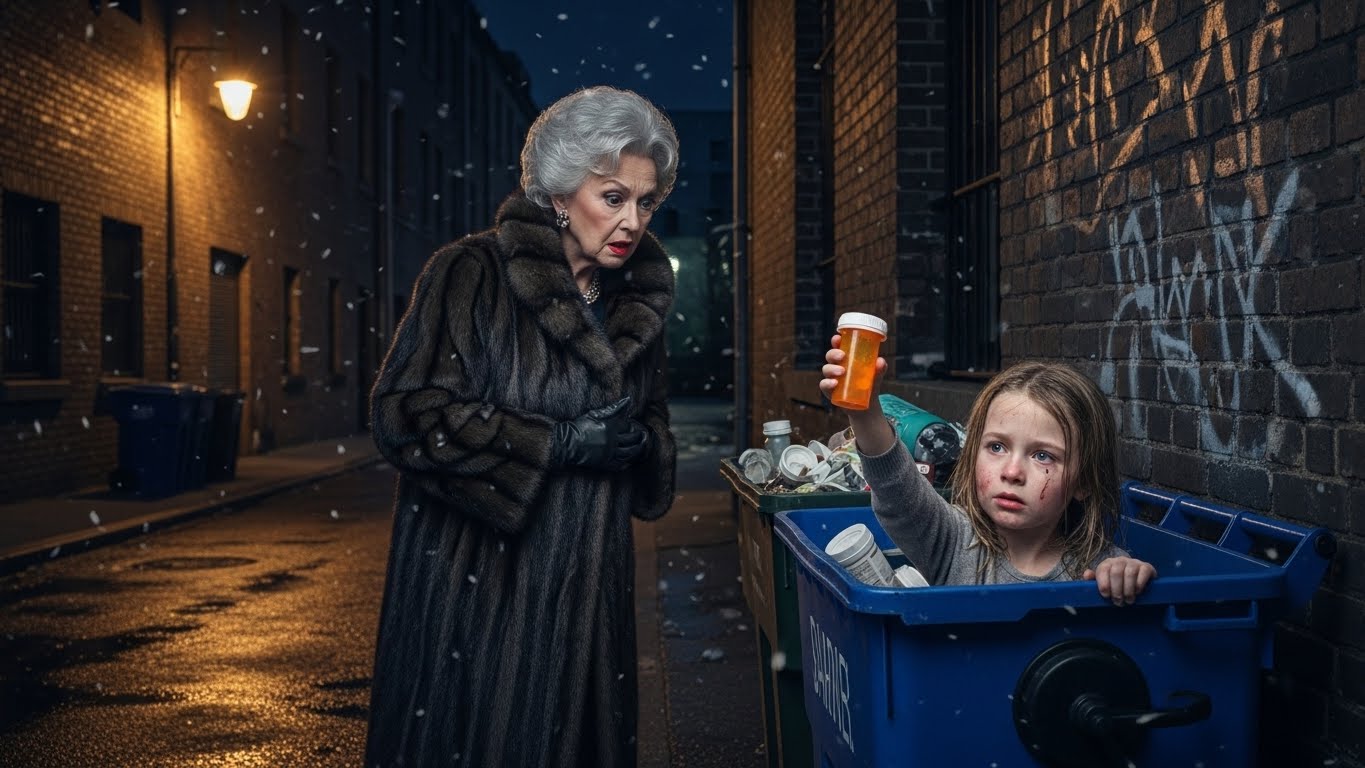
Slowly, a small head popped up from inside the blue bin.
Maggie gasped. It wasn’t a raccoon. It was a child. A girl, no older than seven, with matted brown hair and a face smudged with grime. She was wearing a thin, pink windbreaker that was entirely insufficient for the thirty-degree weather. Her lips were a terrifying shade of pale violet.
“Oh, my god,” Maggie breathed, her maternal instincts overriding her caution. She stepped closer. “Child, get out of there. You’ll freeze to death.”
The girl didn’t move. She just stared at Maggie with eyes that looked too old for her face. They weren’t pleading eyes; they were frantic, focused. In her small, trembling hand, she clutched an orange prescription bottle.
“I can’t go,” the girl chattered, her teeth clicking together. “I haven’t found the paper yet.”
“The paper?” Maggie frowned, stepping right up to the bin. “What paper? Are you hungry? Is that what you need?”
The girl shook her head violently. “No! The paper. The… the instructions. I think I broke Mommy.”
The words hit Maggie like a physical shove. “You broke Mommy? What does that mean?”
The girl held up the bottle. “She was hurting. Her back. I gave her the pills like the bottle said. But she went to sleep and she won’t wake up. Her skin is cold. I threw the paper away yesterday with the boxes. I need to find it so I can read how to fix her. Maybe I gave her too many. I’m so stupid.”
The girl began to sob, a dry, heaving sound. “I’m so stupid. I just want to fix her.”
Maggie reached out and took the bottle from the girl’s freezing hand. She looked at the label.
Relievox.
The name punched the air out of Maggie’s lungs. Relievox was Sterling-Hale’s flagship painkiller. It was the “Miracle Pill” that had doubled their stock price last year.
She looked at the label closer. Prescribed to: Elena Ramirez. Dosage: 1 tablet every 6 hours.
And then, her eyes caught the batch number printed in small black ink near the bottom.
Batch 909.
A memory, sharp and jagged, flashed in Maggie’s mind. A dinner conversation with her son, Brad, two months ago. He had been on the phone, screaming at a supply chain manager. “I don’t care about the purity variance in 909! Just ship it to the secondary markets! We have a quarterly target to hit!”
Maggie had asked him about it. Brad had smiled, that charming, shark-like smile, and said, “Just manufacturing boring stuff, Mother. Eat your salad.”
Maggie looked at the shivering girl. “What is your name?”
“Lily,” the girl whispered.
“Lily, show me where your mother is. Now.”
Maggie didn’t wait for the gala. She didn’t call her driver. She followed the child.
They walked three blocks, crossing the invisible line where the manicured wealth of the Upper East Side bled into the older, grittier tenements. Lily led her down a set of crumbling concrete stairs into a basement apartment.
The smell hit Maggie first. Dampness, boiled cabbage, and beneath it all, the sickly-sweet scent of unwashed sickness.
“Mommy?” Lily called out, running to a mattress on the floor.
Elena Ramirez lay still. She was young, perhaps thirty, still wearing a waitress uniform from a diner. Her skin was gray. Her breathing was shallow, jagged, like a rattle in her chest.
Maggie knelt beside her. She checked the pulse. Thready. Weak.
“Is she sleeping?” Lily asked, tugging on Maggie’s cashmere coat. “Did I give her too much?”
“No, darling,” Maggie said, her voice trembling with a rage she hadn’t felt in decades. “You didn’t do this. You didn’t do this at all.”
Maggie pulled out her phone. She didn’t dial 911. She dialed the private number of Dr. Aaronson, the Chief of Medicine at Mount Sinai, a hospital to which the Sterling family had donated a wing.
“Arthur,” Maggie said, her voice steel. “I need an ambulance at 412 East 94th Street. Basement apartment. Total discretion. No police yet. And Arthur? Prepare the toxicology unit. I suspect an opioid overdose caused by chemical toxicity.”
“Maggie?” the doctor sounded confused. “Who is the patient?”
“A victim of my legacy,” Maggie whispered.
The next three hours were a blur of sirens and sterile hallways. Because Maggie was Maggie Sterling, Elena was whisked into a private VIP suite, bypassing the crowded ER waiting room.
Maggie sat in the waiting area, Lily asleep on her lap. The little girl had finally stopped shivering after drinking three cups of hot chocolate. She clung to Maggie’s coat as if it were a life raft.
Dr. Aaronson came out, looking grim. He sat beside Maggie.
“She’s in a coma, Maggie. Her liver is shutting down. Kidneys are failing. It looks like an overdose, but… the blood work is strange.”
“Strange how?”
“The toxicity levels. It’s not just the opioid. There are impurities. Heavy metals. Solvents. It’s like she swallowed a handful of pills mixed with paint thinner. If she takes standard Relievox, this shouldn’t happen. Did she buy these off the street?”
Maggie closed her eyes. “No. She got them from a pharmacy. It’s Batch 909, Arthur.”
Arthur went silent. He knew the industry. He knew what that meant.
“My son,” Maggie whispered, a tear sliding down her cheek. “My son poisoned her.”
Maggie looked down at Lily. The girl was twitching in her sleep, mumbling about “finding the paper.” Lily blamed herself. She thought she was stupid. She thought she had killed her mother because she couldn’t read the instructions right.
But the instructions weren’t the problem. The poison was in the pill.
Maggie smoothed Lily’s matted hair. A cold resolve settled over her. She had spent five years being the “Queen Mother” of the company, cutting ribbons and smiling. She had let Brad run the show because she thought he was smarter than her.
She was wrong. He wasn’t smart. He was a monster.
And monsters needed to be slain.
Chapter 2: The Poisoned Tree
The Sterling-Hale headquarters was a glass needle piercing the sky of Midtown Manhattan. It screamed power, transparency, and sterility.
The next morning, Maggie walked into the lobby. She wasn’t wearing her usual pastel Chanel suit. She was wearing black. A severe, sharp black suit she hadn’t worn since Richard’s funeral.
“Mrs. Sterling!” the receptionist chirped, looking surprised. “We weren’t expecting you. Mr. Sterling is in a meeting with the merger partners.”
“He’ll see me,” Maggie said, walking past the security turnstile without scanning a badge. The guards didn’t dare stop her. Her name was on the building.
She took the private elevator to the 50th floor. The doors opened to a panoramic view of the city. Brad’s office was at the end of the hall, glass-walled, imposing.
She pushed the doors open.
Brad Sterling was standing by a whiteboard, laughing with three other men in expensive suits. He was forty years old, handsome in a polished, manufactured way. He had his father’s jawline but none of his father’s warmth.
“Mother?” Brad stopped, his smile faltering slightly. “This is a surprise. Gentlemen, give us a moment.”
The suits filed out, casting curious glances at Maggie.
When they were alone, Brad sighed, checking his Rolex. “Mom, I’m busy. The merger with OmniCorp is three days away. If you’re here about the Gala seating chart…”
Maggie reached into her purse and slammed the orange pill bottle onto his mahogany desk.
Clack.
Brad looked at it. He didn’t flinch. That was what terrified Maggie. He recognized it, and he didn’t flinch.
“Relievox,” Brad said dryly. “Our best seller. Need a refill for your arthritis?”
“Batch 909,” Maggie said.
Brad’s eyes flickered. Just for a microsecond. A twitch of the eyelid.
“What about it?”
“I found a seven-year-old girl digging in my trash last night,” Maggie said, her voice trembling with suppressed fury. “She was looking for instructions because her mother is in a coma. Her mother took this. From this batch.”
Brad walked over to his wet bar and poured a sparkling water. “That’s tragic. Truly. But addicts misuse our products all the time, Mom. It’s an opioid crisis. You read the papers.”
“It’s not an overdose, Brad. It’s toxicity. Solvents. Heavy metals.” Maggie stepped closer. “I remember the call. Two months ago. You told them to ship the bad batch to the secondary markets.”
Brad spun around, his face hardening. The mask dropped. “I saved the quarter, Mother! Do you have any idea how much it costs to recall a million units? The stock would have tanked. The OmniCorp merger would be dead in the water. That merger is going to make us the biggest pharma company in history.”
“You poisoned people to save the stock price?” Maggie whispered. “You targeted free clinics? Poor neighborhoods? Because you thought they wouldn’t fight back?”
Brad laughed. It was a cold, ugly sound. “They’re distinct demographics, Mother. Statistically, they have higher rates of comorbidities anyway. It’s hard to prove cause and effect. It was a calculated risk. A business decision. Dad would have done the same.”
“Don’t you dare speak his name,” Maggie hissed. “Your father wanted to cure people. You want to monetize their death.”
“I am securing your legacy!” Brad shouted, slamming his hand on the desk. “Who do you think pays for your townhouses? Your drivers? Your galas? Me! I do the dirty work so you can play Saint Margaret of New York. Grow up, Mother. This is the real world.”
He leaned in close to her face. “Now, go home. Go back to your garden. If you mention this to anyone—anyone—I will have you declared incompetent. Senile dementia. I have doctors on payroll who will sign the papers before lunch. You’ll spend the rest of your life in a very nice facility in Connecticut watching birds.”
Maggie stared at him. She saw the stranger in her son’s eyes. He wasn’t bluffing. He would lock his own mother away to protect his deal.
She picked up the pill bottle. “You’re right, Brad. I’ve been away from the business too long.”
She turned and walked out.
“Where are you going?” Brad called after her.
“To bake a cake,” she lied.
Maggie didn’t go home. She went to the sub-basement.
The physical archives.
Brad was a digital creature. He trusted the cloud. But Richard, her husband, had been old school. He insisted that every manufacturing log be printed and stored in the fireproof vault in the basement. Brad had probably forgotten the vault even existed.
Maggie still had the key on her keyring. A small, brass key that looked like it belonged to a diary.
She spent six hours in the dusty silence of the archives. She wasn’t looking for digital footprints that Brad could delete. She was looking for the raw data. The quality control inspector’s initial reports.
She found it in a box marked Q4 – Production Anomalies.
It was a memo from the floor manager at the New Jersey plant.
Subject: CRITICAL FAILURE – Batch 909. Date: September 12th. Report: Filtration system failure led to contamination of active ingredients with industrial cleaning agents. Toxicity levels are 400% above FDA limits. Recommendation: IMMEDIATE DESTRUCTION OF BATCH.
And below it, scrawled in red ink, was Brad’s handwriting. His initials. B.S.
Override. Re-label for Tier 3 Distribution (Charity/State-Funded Clinics). Do not log in the digital system.
Maggie took the paper. Her hands were shaking, but not from age. From grief. She had the smoking gun.
Her phone buzzed. It was Dr. Aaronson.
“Maggie… you need to come to the hospital. Now.”
Maggie rushed back to Mount Sinai.
When she entered the room, the air was heavy. The machines were beeping with a slow, rhythmic finality.
Elena had woken up.
Lily was on the bed, curled up next to her dying mother.
Elena looked at Maggie. Her eyes were yellowed from liver failure, but she was lucid. She reached out a hand. Maggie took it. It was rough, calloused from years of scrubbing floors.
“Who… who are you?” Elena whispered.
“I’m a friend,” Maggie said, choking back tears. “I’m helping Lily.”
“The pills…” Elena gasped. “I just… needed to work. Lily’s birthday… is next week. She wants… a dress. A sparkly one. I couldn’t… call in sick.”
“I know,” Maggie soothed. “I know.”
“Please,” Elena squeezed Maggie’s hand with surprising strength. “Don’t let… the state take her. They split… families. Please.”
“I promise,” Maggie vowed. “I will protect her with my life.”
Elena looked at Lily. She kissed the top of her daughter’s head. “Be good, baby. Mommy loves you. Be smart.”
Then, Elena let out a long, shuddering breath. The monitor flatlined. The high-pitched tone filled the room.
“Mommy?” Lily sat up. “Mommy, wake up. I found the lady. She’s gonna fix you.”
Lily looked at Maggie, her eyes full of terrified hope. “Fix her. Please. You have money, right? You can fix anything.”
Maggie pulled Lily into her arms, burying the child’s face in her shoulder so she wouldn’t see the light leave Elena’s eyes. Maggie sobbed. She had billions of dollars. She could buy hospitals. She could buy governments.
But she couldn’t buy this woman’s life back. A life that cost less to end than the price of Maggie’s lunch.
Elena died because she was poor. Because she mattered less to Brad Sterling’s spreadsheet than a fraction of a percentage point.
Maggie held the weeping child and looked out the window at the city skyline. Somewhere in that glass tower, her son was toasting a merger.
The Lioness is awake, Maggie thought. And she is hungry.
Chapter 3: The Matriarch’s Roar
The funeral for Elena Ramirez was a pauper’s service paid for by a billionaire. It was held three days later in a small church in Queens.
There were only three people in attendance: The priest, Maggie, and Lily.
Lily didn’t cry anymore. She had gone silent. She stood by the grave in a black coat Maggie had bought her, holding the empty orange pill bottle like a talisman. She still blamed herself. Maggie tried to tell her, but the child’s logic was ironclad: I gave the pills. Mommy died. I am bad.
That evening, back at the townhouse, Maggie’s lawyer, Mr. Henderson, sat in her living room.
“It’s a difficult situation, Maggie,” Henderson said, sipping his scotch nervously. “Brad has legal custody of the company. You have voting shares, but he has the board. If you go to the press with this memo… he will destroy you. He wasn’t joking about the competency hearing. He’s already floated rumors that you’re grieving Richard and losing your grip.”
“Let him try,” Maggie said, staring into the fireplace.
“And Lily?” Henderson asked. “You have no legal standing. Brad can call CPS anonymously. They’ll take her to an orphanage tonight just to spite you.”
Maggie looked at Lily, who was sitting on the expensive Persian rug, staring blankly at a cartoon on the TV.
“He thinks I have something to lose,” Maggie murmured. “That’s his mistake. He thinks I care about the money. Or the reputation. or the Sterling name.”
“Don’t you?”
Maggie stood up. She walked over to the mantle and picked up a photo of Richard. “Richard built this company to heal pain. My son turned it into a weapon. The name is already dead, Henderson. It’s rotting.”
“Tomorrow is the shareholder meeting,” Henderson noted. ” The vote on the merger. It’s at the Grand Ballroom of the Waldorf. Every financial journalist in the world will be there.”
“Perfect,” Maggie said. A cold smile touched her lips. “I need you to do something for me, Henderson. Liquidate my personal trust. All of it.”
“All of it? Maggie, that’s… that’s nuclear.”
“Liquidate it. Put it into a trust for Lily Ramirez. And get me a guest pass for the ballroom floor. Not the VIP box. The floor.”
“He’ll have security stop you.”
“He won’t,” Maggie said. “Because I’m going to bring him a gift. A peace offering.”
The next morning, the Waldorf Astoria was buzzing. It was the business event of the decade. The Sterling-Hale merger with OmniCorp would create a trillion-dollar entity.
Brad Sterling was backstage, checking his tie in the mirror. He felt invincible. The stock was up 15% in pre-market trading. The toxicity issue was buried. His mother had been quiet for three days. She had learned her place.
He walked out onto the stage to thunderous applause. Five hundred shareholders, analysts, and reporters cheered. Giant screens behind him displayed the soaring graph of their profits.
“Thank you!” Brad beamed. “Today, we don’t just build wealth. We build a future. A future where pain is a memory. Sterling-Hale is dedicated to the sanctity of human life.”
In the middle of the crowd, a movement caught his eye.
Maggie was walking down the center aisle.
She looked stunning. She wore a floor-length black gown, regal and imposing. But she wasn’t alone. Holding her hand was a small girl in a black dress.
The crowd murmured. The cameras pivoted. Is that the grandmother? Who is the child? Is this a part of the show?
Brad froze. He squinted against the stage lights. He saw the look on his mother’s face. It wasn’t the look of a defeated old woman. It was the look of an executioner.
Security guards stepped toward the aisle, but they hesitated. You don’t tackle Margaret Sterling.
Maggie reached the stage. Brad covered his microphone. “Mother, what the hell are you doing? Get off the stage.”
Maggie ignored him. She walked up the stairs, pulling Lily with her. She walked right to the podium.
Brad tried to block her, but the optics were terrible. He couldn’t physically shove his elderly mother on live TV. He stepped back, forcing a tight smile. “Ladies and gentlemen, my mother, Margaret Sterling! Here to celebrate with us!”
He handed her the mic, thinking she would say a few nice words and leave. He squeezed her shoulder hard—a warning.
Maggie took the microphone. The room went silent.
“My son,” Maggie began, her voice soft but amplified to every corner of the room, “says this company is dedicated to the sanctity of life.”
She reached into her evening bag. She didn’t pull out a speech. She pulled out the orange bottle.
“This is Relievox,” she said. “Batch 909.”
On the screens behind her, the graph of profits was still rising.
“Three days ago, I met this little girl,” Maggie put her hand on Lily’s shoulder. “Her name is Lily. I found her in my garbage can. She was digging through my trash in the freezing cold.”
The audience shifted uncomfortably. Brad’s smile vanished. He signaled to the sound guy to cut the mic, but the sound guy was mesmerized.
“She wasn’t looking for food,” Maggie continued, her voice gaining strength, ringing like a bell. “She was looking for the instructions for this bottle. Because she gave this medicine to her mother, Elena. And Elena went to sleep and wouldn’t wake up.”
Maggie looked directly at the camera. “Lily thought she was stupid. She thought she gave the wrong dose. She blamed herself.”
Maggie knelt down next to Lily. She held the mic to the child. “Lily, what did you want to tell the people?”
Lily looked at the sea of faces. She was terrified, but she trusted Maggie. She spoke into the mic, her small voice echoing through the ballroom.
“I just wanted to fix my Mommy. But the blue pills made her cold.”
A collective gasp went through the room.
Maggie stood up. She pulled a piece of paper from her bag. The memo from the archives.
“Lily didn’t kill her mother,” Maggie roared, her voice cracking with emotion. “Sterling-Hale did! This is a memo from September 12th. It confirms Batch 909 was contaminated with industrial solvents. Lethal toxicity.”
Brad lunged for her. “Cut the mic! She’s senile! Cut it!”
But Maggie stepped back, holding the paper up to the cameras. “My son, CEO Brad Sterling, signed the order to override the safety recall. He shipped poison to poor neighborhoods because he needed to save a quarterly bonus. He murdered Elena Ramirez for a stock price!”
Pandemonium.
Reporters jumped over chairs. Flashbulbs erupted like a strobe light. The giant screen behind Brad suddenly flickered as the real-time stock ticker plummeted. A red line dropping straight down.
Brad grabbed Maggie’s arm. “You crazy b*tch! You ruined us! You ruined everything!”
Maggie looked him in the eye. “I saved us. I saved our souls.”
Suddenly, the side doors burst open. Not security. Police. NYPD detectives, led by a captain Maggie had met with an hour ago.
“Brad Sterling!” the Captain shouted. “You are under arrest for criminal negligence and manslaughter.”
Brad looked around wildly. The investors were booing. The partners from OmniCorp were on their phones, killing the deal. His empire was dissolving in seconds.
He looked at his mother one last time. “Why?” he screamed. “I did this for you!”
“No,” Maggie said, holding Lily tight. “You did it for yourself. Richard would be ashamed.”
Brad was handcuffed and dragged off the stage, screaming obscenities.
Maggie stood alone in the wreckage of her family legacy. The stock was crashing. The company would be bankrupt by morning. She was no longer a billionaire. She would likely lose her home, her status, everything.
She looked down at Lily.
“Did we fix it?” Lily asked quietly.
Maggie smiled through her tears. “No, sweetie. We can’t fix the past. But we made sure no one else gets hurt. And we made sure everyone knows it wasn’t your fault. You are good, Lily. You are so good.”
Epilogue: The Sweetest Cake
One Year Later.
The kitchen was small, but it smelled like vanilla and lemon zest. Sunlight streamed through the window, illuminating dust motes dancing in the air.
It was a modest house in a suburb of Philadelphia. The townhouse in New York was sold to pay the settlements. The Sterling fortune was gone, redistributed to the families of the victims of Batch 909.
Maggie wiped flour off her forehead. She wore an apron, not Chanel.
“Grandma! Is it ready?”
Lily ran into the kitchen. She looked different. Taller. Her cheeks were round and pink. She wore a bright yellow dress—sparkly, just like her mother had wanted.
“Patience, little bug,” Maggie laughed. “It needs to cool.”
Lily hopped onto a stool. “Can I lick the spoon?”
“Only if you set the table.”
“Okay!”
Lily grabbed the forks and skipped to the small dining table.
Maggie watched her. She had legally adopted Lily six months ago. It had been a fight, but without Brad’s interference and with the public sympathy on her side, Maggie had won.
Brad was serving twenty years in federal prison. Maggie visited him once a month. He refused to see her. She kept going anyway, hoping that one day, he might wake up.
Maggie took the cake out of the oven. It wasn’t perfect. It was a little lopsided. But it was made with safe ingredients. It was made with love.
She looked around her small house. She didn’t have servants. She didn’t have galas. She drove a Honda.
But as Lily laughed at something on the radio, Maggie realized she had never been richer. She had traded a poisoned empire for a clean conscience and a granddaughter’s smile.
She carried the cake to the table.
“Happy birthday, Lily,” she said.
“Make a wish, Grandma!” Lily said, pointing to the candle.
Maggie looked at the flame. “I don’t need to wish,” she said, kissing Lily’s forehead. “I already have everything I need.”