The Monk Who Hid a Senator’s Darkest Secret: A 50-Year-Old War Crime Resurfaces on a Temple Doorstep
Chapter 1: The Ghost at the Door
The cold in the Pacific Northwest was different from the damp heat of the jungle, but it made Arthur Vance’s bones ache just the same. At seventy-two, Arthur—now known to the few souls who visited the Mountain Cloud Monastery as Master Tenzin—had made peace with the ache. It was a reminder that he was still alive, a penance he accepted with a bowed head.
The Oregon winter was particularly brutal this year. The Douglas firs that surrounded the isolated temple were bowed heavy under thick blankets of snow, and the wind coming off the Cascade Range howled like lost souls. It was 4:00 AM. The hour of the tiger. The hour of waking.
Tenzin rose from his thin mat, his joints popping like dry twigs. He wrapped his maroon and saffron robes tight around his thermal undershirt—a concession to the climate and his age—and moved to light the incense at the altar. The smell of sandalwood usually calmed him, grounding him in the present, away from the nightmares that still stalked his sleep. But this morning, the air felt heavy. Charged.
“Om Mani Padme Hum,” he whispered, the mantra vibrating in his chest. The jewel is in the lotus.
He sought peace. He had been seeking it for fifty years, ever since he traded his Marine Corps fatigues for these robes, ever since he ran away from a world that called him a hero but felt like a graveyard. He had built this silence brick by brick, hiding atop this mountain where the air was too thin for ghosts to follow.
Or so he thought.
A sound cut through the silence.
It wasn’t the wind. It was too rhythmic, too desperate. A thudding against the heavy wooden gates of the temple courtyard. Then, silence. Then, a sound that stopped Tenzin’s heart cold: a cry. Not a bird, not a coyote. A human cry. A child’s cry.
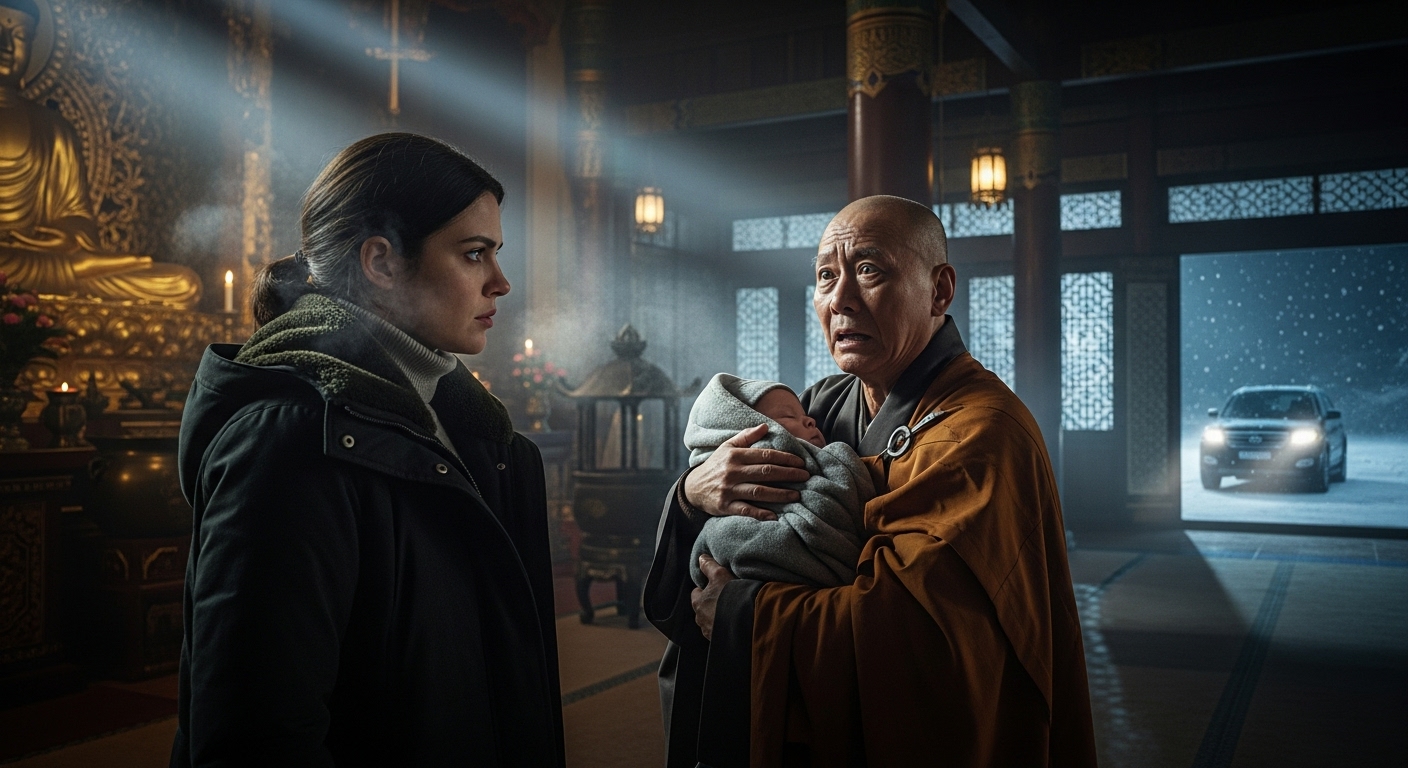
Tenzin grabbed his heavy flashlight and moved faster than he had in years. He unbarred the heavy oak doors, his breath pluming in the icy air, and pushed them open against the drift of snow.
The beam of his flashlight cut through the swirling white flakes and landed on a bundle at his feet.
It was a plastic laundry basket, lined with a dirty, oversized men’s parka. Inside, blue-lipped and shaking violently, was a baby boy. He couldn’t have been more than six months old. His dark eyes were wide, filled with a terror that no infant should know. The silence of the mountain was shattered by his whimpering, a sound so fragile it threatened to break Tenzin apart.
“Great Buddha,” Tenzin gasped. He dropped to his knees in the snow, ignoring the biting cold soaking through his robes.
He scooped the child up, parka and all. The boy was freezing. Tenzin tucked the bundle inside his own robes, pressing the tiny body against his chest to share his warmth. That was when he felt the crinkle of plastic.
Pinned to the inside of the dirty parka was a Ziploc bag. Inside was a piece of paper and a photograph.
Tenzin didn’t look at it yet. He rushed inside, kicking the door shut. He brought the child to the wood stove in the main hall, stoking the embers until a roar of heat filled the room. He rubbed the boy’s limbs, checking for frostbite. The child let out a weak wail, the life returning to him as the blood began to flow.
Only when the boy was settled and drinking warm goat’s milk from a spoon did Tenzin look at the plastic bag.
His hands, usually steady as stone from decades of meditation, began to tremble.
He pulled out the photograph first. It was a black-and-white Polaroid, aged and yellowed around the edges. 1971. The date was stamped on the back.
The image was a nightmare he had spent half a century trying to forget. It showed a young Marine—Arthur Vance, strong-jawed and hollow-eyed—standing next to a charismatic Lieutenant with a brilliant smile. The Lieutenant was holding a Zippo lighter, the flame captured in a blur of motion. Behind them, a straw hut was consumed by fire. In the corner of the frame, bodies lay in the mud.
The Lieutenant was William Sterling.
Tenzin felt bile rise in his throat. Sterling. The man who was now Senator William Sterling. The man currently polling ten points ahead in the national primaries. The man the news called an “American Hero,” a philanthropist, a savior.
Tenzin turned the photo over. The handwriting on the back was jagged, hurried, written by someone whose hand was shaking with adrenaline and fear.
“You promised to keep our secret. But you forgot about the survivors. His name is An. Hide him, or Sterling will finish what he started.”
Tenzin dropped the photo as if it were burning coal. The room spun. The memories he had locked away in the deepest dungeons of his mind broke free. The smell of napalm. The screaming of the pigs. The screaming of the women. The wet heat of the Mekong Delta.
Survivors.
He had let one go. He remembered her clearly. A young girl, no older than twelve, running into the dense jungle foliage while Sterling laughed and burned her home to the ground. Arthur had raised his rifle. He had her in his sights. It was a direct order. Clean sweep. No witnesses.
Arthur hadn’t fired. He had lowered the gun. He had let her run. He had told Sterling she was down.
And now, fifty years later, her daughter—or granddaughter—had come back.
Tenzin stood up, panic seizing him. If the mother had left the baby, where was she? The note said Sterling will finish what he started. The implications were terrifying. Sterling wasn’t just a politician; he was a man who had built an empire on a foundation of bones. If he knew an heir to the Cao Lanh village was alive, he wouldn’t stop until the lineage was erased.
“The river,” Tenzin whispered, a sudden, horrific intuition gripping him.
He ran back to the temple gates. The snow was falling harder now, covering the tracks. But he saw them—footprints leading away from the door, not down the main path toward the road, but veering sharply toward the cliffs overlooking the Rogue River.
Tenzin ran. He ran until his lungs burned, his sandals slipping on the ice. He reached the edge of the cliff, the flashlight beam cutting into the abyss below.
Far down, caught in the jagged rocks of the riverbank, a shape bobbed in the icy water. A woman. She was wearing a coat that matched the baby’s blanket. She wasn’t moving.
Tenzin fell to his knees in the snow, a primal scream of grief ripping from his throat. He hadn’t just found an orphan. He had found a war that never ended. The past had not just knocked on his door; it had kicked it down.
Chapter 2: The River’s Witness
The flashing lights of the police cruiser looked alien against the serenity of the monastery. They cut through the morning mist, painting the ancient pines in strokes of red and blue. The silence of the mountain was violated by the crackle of a police radio.
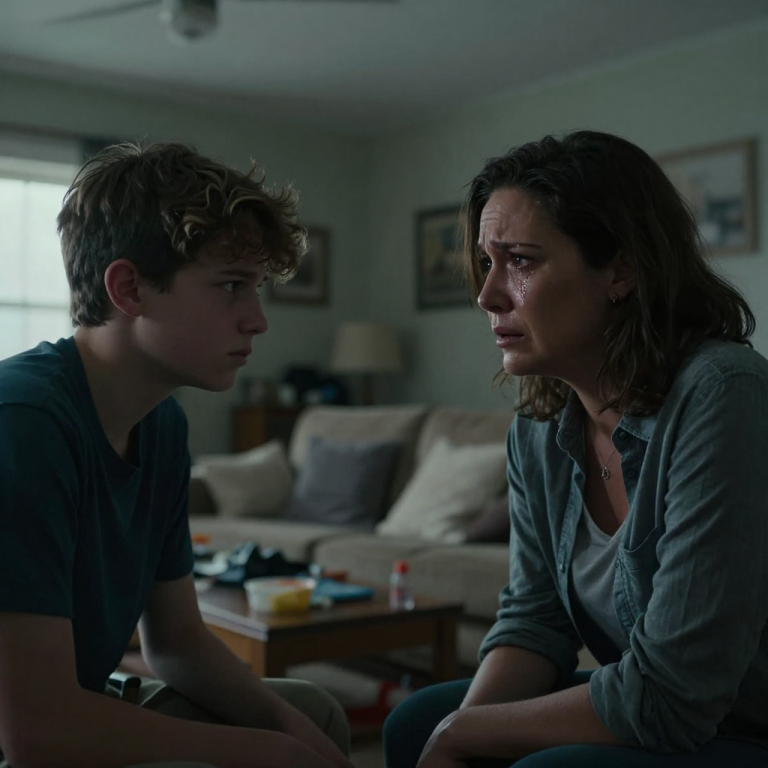
Detective Sarah Miller looked as tired as Tenzin felt. She was a woman in her forties who wore her exhaustion like a second skin. Her coat was cheap, her coffee was cold, and her eyes had seen too much of the ugly side of Oregon’s rural drug crisis. She wasn’t used to monasteries, and she certainly wasn’t used to dead bodies washing up near them.
She stood in the main hall of the temple, her notebook open. Tenzin sat on a cushion, the baby—now sleeping—tucked into a makeshift crib made of blankets. The heat from the stove was the only comfort in the room.
“We found the body, Mr. Vance,” Miller said softly. She used his legal name. To the state, he wasn’t Master Tenzin; he was just Arthur Vance, an eccentric recluse living on a tax-exempt hill. “Jane Doe. No ID. But the coroner says… well, it looks like she took a fall. But she has defensive wounds on her arms. Bruising that happened before she hit the water.”
Tenzin stared at the tea in his cup, watching the steam rise. “She was hunted.”
Miller sighed, clicking her pen. She looked around the sparse room, her eyes lingering on the military precision of Tenzin’s folded robes. “You said she left a note? And the baby?”
“The baby is safe here,” Tenzin said, his voice like gravel.
“Mr. Vance, you can’t keep an infant in a monastery. Child Protective Services is on the way. They’ll take custody until we can identify next of kin.”
Tenzin looked up. His eyes, usually clouded with age, were sharp, dangerous. They were the eyes of a sniper, not a monk. “No.”
Miller blinked, taken aback by the sudden steel in his voice. “Excuse me?”
“If you put that boy in the system, he will die. The men who killed his mother… they have reach. They have eyes in the police, in the courts. A Jane Doe’s baby in the foster system is an easy target.”
Miller’s expression hardened. She stepped closer. “You’re talking about a conspiracy? Look, I know you’re a veteran. I respect that. But you’re sounding paranoid. Who would want to kill a baby?”
Tenzin reached into his robe. He hesitated. Giving Miller the photo was a risk. If she was one of them, he was dead. But he looked at her face—the weary lines, the cheap shoes. She wasn’t bought. She was just tired. He slid the Polaroid across the low table.
Miller picked it up. She squinted at the image. Then her eyes went wide. She looked from the photo to Tenzin, then back to the photo.
“Is that… is that Senator Sterling?”
“Cao Lanh. 1971,” Tenzin said. “It wasn’t a firefight, Detective. It was a liquidation. The official report said we engaged Viet Cong insurgents. The truth was, Sterling wanted the land cleared for a firebase to boost his promotion record, and the villagers wouldn’t leave. So he burned them. All of them.”
“And you?” Miller asked, her voice tight with revulsion.
“I was his radio operator. I was twenty years old. I was scared. I followed orders.” Tenzin closed his eyes, the shame burning as hot as it did fifty years ago. “Except once. I let a girl run. That baby… is her grandson.”
Miller sat back, the air leaving the room. “If this is true… if this gets out…”
“Sterling is running for re-election on a platform of moral fortitude,” Tenzin said bitterly. “A war crime would destroy him. He knows the family survived. He’s tying up loose ends.”
“You’re saying a United States Senator had a woman murdered last night?”
“I’m saying the man in that photo hasn’t changed. He just wears better suits. And he has more money to hire people who do the dirty work.”
Miller stood up and walked to the window. She looked down the winding temple road. Through the breaks in the trees, she could see a vehicle parked at the turnoff.
“There’s a black Suburban down there,” Miller said, her voice dropping. “Tinted windows. No plates. I clocked it on my way up, thought it was weird for this area.”
Tenzin joined her at the window. “They’re waiting for you to leave. They’re waiting for you to take the baby. If you drive down that hill with him, you won’t make it to the precinct.”
Miller turned to him. She was a small-town cop, but she had good instincts. She knew fear when she saw it, and she knew the look of a predator. The hair on her arms was standing up.
“I can’t leave the baby here,” she repeated, but with less conviction.
“Sanctuary,” Tenzin said. “It’s an old law, maybe not legal anymore, but spiritual. This is holy ground. If you take him, you sign his death warrant. Give me 24 hours. Let me prove it.”
Miller looked at the baby, then at the photo, then at the old man. She put the photo in her pocket. It was evidence now.
“I didn’t see a baby,” Miller said. Her voice was trembling slightly. “I came here to interview a witness about a suicide. The witness was uncooperative. I’m going back to the station to file a report. It’ll take me… maybe a day to process the paperwork. The roads are icy. Things get delayed.”
Tenzin bowed his head deeply. “Thank you.”
“Don’t thank me yet,” Miller said, putting her hand on her holster. “If that’s Sterling’s people down there, you’re sitting ducks.”
“I was a Marine before I was a monk,” Tenzin said quietly. “I know how to dig in.”
Chapter 3: The Wolves at the Gate
Night fell like a hammer. The darkness in the mountains was absolute, swallowing the temple whole. The snow had stopped, leaving a silence so profound it felt suffocating.
At 8:00 PM, the power died. The hum of the refrigerator ceased. The single lightbulb in the hallway flickered and died.
“They cut the line,” Tenzin whispered into the darkness.
He moved through the temple with the familiarity of a ghost. He had strapped the baby, An, to his chest using a tightly wound sash, swaddling the child so he wouldn’t cry. He could feel the boy’s heartbeat against his own—a frantic, tiny rhythm.
Tenzin wasn’t wearing his robes anymore. He had gone to the old cedar chest in the attic. He was wearing his old fatigues. They were tight around the waist, but they fit. He wore his combat boots, the leather stiff but durable. In his hand, he didn’t hold a rifle—he had vowed never to touch a gun again—but he held a long, heavy bo staff made of ironwood.
He heard the crunch of snow outside. Multiple footsteps. Tactical. Precise.
They weren’t government agents. Tenzin knew the difference. Government agents knocked. These were cleaners. Mercenaries. Men paid to erase mistakes.
The front door lock clicked. A pick gun. Professional.
Tenzin retreated to the shadowed alcove of the Meditation Hall. He controlled his breathing. Inhale peace. Exhale fear. But peace wouldn’t save the boy tonight. Tonight, Arthur Vance had to take the wheel. The monk had to step aside for the soldier.
The door creaked open. Three figures entered. Night vision goggles. Silenced pistols. They moved in a diamond formation.
“Sweep the rooms,” a voice whispered. “Find the kid. Make it look like a fire.”
A fire. Just like the village. Sterling had no imagination. He only knew how to burn things.
The first mercenary moved toward the hallway. Tenzin waited. He waited until the man passed the statue of the Laughing Buddha, entering the “kill zone” Tenzin had prepared.
Tenzin struck.
He didn’t strike to kill; that vow he would keep. But he struck to break. The ironwood staff whipped out of the darkness, connecting with the mercenary’s kneecap with a sickening crack.
The man went down screaming, his gun skittering across the floor.
The other two spun around. “Contact right!”
Tenzin was already moving. He rolled into the shadows, disappearing behind a pillar. He knew every loose floorboard, every echo in this building. He was the temple, and the temple was him.
“Where is he?” one mercenary hissed, sweeping his laser sight across the room. The red dot danced over the face of the Buddha.
Tenzin grabbed a heavy brass singing bowl from the altar. He tossed it across the room. It clanged against the far wall.
The mercenaries fired. Thwip-thwip-thwip. Bullets chewed into the wood, tearing through the screen doors.
Distracted.
Tenzin lunged from the left. He swung the staff like a baseball bat, catching the second man in the solar plexus. The air rushed out of him, and he collapsed, wheezing, his ribs shattered.
The third man—the leader—was faster. He turned and fired blindly. A bullet grazed Tenzin’s shoulder. The hot sting was familiar. It woke him up. It reminded him that he was flesh and blood.
Tenzin didn’t stop. He closed the distance. The leader aimed at Tenzin’s chest.
But Tenzin didn’t hit him. He hit the floorboards. Specifically, a loose board he had pried up earlier that evening.
The mercenary stepped on it, stumbled, and Tenzin swept his legs. The man hit the ground hard. Before he could raise his weapon, the ironwood tip of the staff was pressed against his throat, right on the windpipe.
“Drop it,” Tenzin growled. It wasn’t the voice of a monk. It was the voice of a Sergeant.
The man dropped the gun, his eyes wide with shock beneath the goggles.
“Who sent you?” Tenzin demanded, pressing harder.
“You know who,” the man spat, blood on his teeth. “You can’t stop him, old man. He’s coming. He’s coming tomorrow. And he’s bringing the world with him.”
Tenzin knocked the man unconscious with a sharp blow to the temple.
He stood up, panting, clutching his bleeding shoulder. The baby against his chest began to whimper, disturbed by the violence.
“It’s okay, little one,” Tenzin whispered, his adrenaline fading into exhaustion. “We bought one night. Just one night.”
He looked at the three unconscious men. He dragged them to the cellar and locked the door. He knew this was just the first wave. Sterling wouldn’t send mercenaries again. He would send something worse. He would send the truth—twisted to serve him.
Chapter 4: The Reckoning
The morning sun didn’t bring warmth; it brought the circus.
By 9:00 AM, the road to the monastery was clogged with vans. News vans. CNN, Fox, MSNBC. The satellite dishes were aimed at the temple like mortars. And right in the center, gleaming in the winter sun, was a campaign bus.
STERLING FOR SENATE: INTEGRITY. HONOR. SERVICE.
Tenzin stood on the temple steps. He had put his robes back on, covering the bandage on his shoulder. He held the baby in his arms. The child was awake, looking out at the crowd with innocent eyes.
Detective Miller stood beside him, her hand on her weapon, looking terrified but resolute. She had called for backup, but the State Troopers were being held back at the roadblock by Sterling’s private security, claiming a “National Security Issue.”
Senator William Sterling walked up the steps. He looked incredible for seventy. Silver hair, a tan face, a compassionate smile that had charmed millions of voters. He was wearing a casual jacket, looking every bit the concerned statesman. He was surrounded by cameras.
“Arthur,” Sterling said, his voice projecting for the microphones. “My old friend. When I heard… when I heard you were in distress, that you had taken a child… I came as fast as I could.”
He played the role perfectly. The concerned war buddy checking on the unstable veteran. The narrative was set: The crazy monk had kidnapped a baby, and the hero Senator was here to talk him down.
“I’m not in distress, William,” Tenzin said, his voice calm, carrying over the wind. “And I didn’t take this child. Your men chased his mother off a cliff.”
The cameras clicked furiously. A murmur went through the press pool.
Sterling’s smile didn’t falter, but his eyes went cold—reptilian. He stepped closer, leaning in so only the microphones near them could hear, but mostly for Tenzin.
“You’re confused, Arthur. The dementia… it’s tragic. Look at you. Living in a hut. Playing dress-up.” Sterling lowered his voice to a whisper, a sound like dry leaves sliding on pavement. “Give me the boy. And the photo. Or I burn this place down with you inside. I did it before. I’ll do it again. Who will miss an old crazy man and a nameless brat?”
Tenzin looked at the cameras. He looked at the red recording lights. “You hear that?” he asked the crowd. “He wants to help.”
Tenzin reached into his robe. Sterling flinched, stepping back, his bodyguards tensing.
Tenzin pulled out the photo.
“He wants this,” Tenzin said, holding it up. “A picture from 1971. Cao Lanh.”
Sterling lunged. “That’s classified material! He’s mentally unstable! Cut the feed!”
“It’s a war crime!” Detective Miller shouted, stepping forward, her badge catching the light. “And it’s evidence in a murder investigation.”
Sterling laughed, a nervous, jagged sound. “A blurry photo? From fifty years ago? Who are they going to believe, Arthur? Me, a United States Senator? Or you, a coward who hid in the woods while the rest of us built a country?”
Tenzin looked at Sterling. “You’re right. I was a coward.”
The admission silenced the crowd. The wind whipped the robes around Tenzin’s legs.
“I watched you burn that village,” Tenzin said, tears filling his eyes. “I watched you kill those people. And I said nothing. I wanted to go home. I wanted to forget. I committed the sin of silence.”
He looked down at the baby. “But I kept something else, William.”
Tenzin pointed to the massive golden Buddha statue behind him in the open hall.
“The Mission Log,” Tenzin said. “The official radio logs. You thought you burned them. You thought I destroyed the carbon copies. But I didn’t. I buried them under the Sakyamuni for fifty years.”
Sterling’s face went pale. The color drained out of him like water from a cracked jar.
“The coordinates. The kill orders. Your signature. It’s all there,” Tenzin said. “I carried the guilt for fifty years so I could save this one life today. You carried the lie so you could keep your power.”
Sterling looked around. The cameras were zooming in. The reporters were sensing blood. The narrative was shifting. The “Hero” mask was slipping, revealing the monster underneath.
Panic, raw and ugly, took over. Sterling forgot the cameras. He forgot the election. He saw only the threat.
“You traitor!” Sterling screamed. He grabbed the heavy brass incense burner from the railing and swung it at Tenzin.
It was a clumsy, desperate swing.
Tenzin didn’t even move his feet. He simply shifted his weight, catching Sterling’s wrist with one hand. He twisted.
Sterling shrieked, dropping the burner. He fell to his knees in front of the monk and the baby.
On live television, the American Hero was on his knees, snarling like a rabid dog, attacking a monk holding an infant.
“Senator William Sterling,” Detective Miller said, her voice ringing out as she slapped handcuffs on him. “You are under arrest.”
Chapter 5: The Lotus Blooms
The scandal was, as the pundits said, “biblical.”
The logs were authenticated. The photo was corroborated. The body of the mother was identified as Lien, the granddaughter of the village elder of Cao Lanh. The story dominated the news cycle for months.
Senator Sterling didn’t make it to trial. He suffered a massive stroke in his holding cell two weeks after the arrest. The stress of his crumbling empire was too much for his heart. He died alone, stripped of his titles, his legacy reduced to ashes.
Tenzin was not charged. The District Attorney cited self-defense regarding the mercenaries, and the statute of limitations regarding the war crimes had long passed. But the court of public opinion had judged him, and strangely, they had forgiven him. They saw an old man who had finally put down a heavy burden.
One year later.
The snow was gone. The Mountain Cloud Monastery was blooming with wild rhododendrons and azaleas. The air smelled of pine and damp earth.
Tenzin sat on a wooden bench by the river, the same river that had taken Lien. He placed a floating lantern on the water, watching it drift downstream, joining the current.
“For her,” he whispered.
“Baba!”
A toddler, steady on his feet now, came waddling through the garden. An. He was healthy, loud, and full of joy. He carried a small plastic watering can, splashing more water on his shoes than on the plants.
Tenzin smiled. He stood up, his knees aching a little less these days. He picked the boy up.
“Not the rocks, An. The flowers. We water the flowers so they can grow.”
The boy giggled and grabbed Tenzin’s nose.
Detective Miller walked up the path. She visited every Sunday now. She brought groceries, and sometimes, she just sat and breathed the clean air, escaping the noise of the precinct.
“He’s getting big,” Miller said, shielding her eyes from the sun.
“He is strong,” Tenzin agreed. “Like his mother.”
Miller handed Tenzin a large envelope. “The adoption papers. It’s final. You’re his legal guardian, Arthur. The state… well, they made an exception. Given the circumstances.”
Tenzin took the papers. He looked at the boy running in the grass, chasing a butterfly.
He reached into his pocket and pulled out a new photograph. He had taken it last week. It was a selfie—blurry, poorly framed—of him and An laughing, with the temple in the background.
There was no fire in this picture. No death. Only life.
Tenzin looked at the sky. The weight was gone. The silence was broken.
“Om Mani Padme Hum,” he whispered.
The jewel was in the lotus. And out of the mud of the past, the lotus had finally bloomed.