THE RUSTED BOX: SHE DUG UP HER FATHER’S GARDEN AND FOUND THE TROPHIES OF A SERIAL KILLER
THE SINS WE BURIED
Chapter 1: The Roots of Oakhaven
The house on Elm Street smelled of lavender, dust, and the slow, sweet decay of old paper. It was a smell Martha Caldwell had associated with safety for sixty years, but lately, it had begun to smell like something else entirely: forgetting.
At sixty-two, Martha was tired. It was a bone-deep weariness that settled into her joints like the Ohio damp. She had retired from teaching third grade three months ago, not to travel to Europe or learn pottery, but to move back into the Victorian relic of her childhood to watch her father fade.
Dr. Arthur Caldwell was a monument in Oakhaven. There wasn’t a family in this rust-belt town he hadn’t touched. He had delivered half the population and closed the eyes of the other half. People stopped Martha in the grocery store, gripping her arm with earnest, teary eyes, telling her, “Your father is a saint, Martha. A living saint.”
Martha would smile, thank them, and buy her frozen dinners. They didn’t see the saint at 3:00 AM, wandering the hallway in his urine-soaked pajama bottoms, calling out for a wife who had been dead for fifteen years. They didn’t see the terror in his eyes when he looked at his own hands, as if they belonged to a stranger.
“Martha?”
The voice was thin, reedy. Martha looked up from her coffee. Her father was standing in the doorway of the kitchen, clutching his robe. He looked frail, a paper lantern of a man.
“I’m here, Dad,” she said, softening her voice. “Do you want some oatmeal?”
Arthur blinked, the fog behind his eyes thick this morning. “I… I have rounds. Mrs. Higgins is due.”
“Mrs. Higgins died in 1998, Dad,” Martha said gently, a rehearsed line. “You’re retired. Sit down.”
He sat. He ate. He forgot.
By noon, the silence of the house was suffocating. The nurse, a sturdy woman named Brenda, arrived to take the afternoon shift, and Martha felt the desperate need to touch something real, something that wasn’t decaying. She went to the backyard.
The garden had been her mother’s pride. Now, it was a tangle of weeds and overgrown briars. Martha put on her heavy canvas gloves and grabbed a spade. She decided she would plant roses again. Hybrid Teas, just like her mother loved. It was a foolish task for late October, but the ground wasn’t frozen yet, and Martha needed the exertion. She needed to sweat.
She chose a spot near the old oak tree, where the shade was deep and the soil looked dark. She drove the spade into the earth, the metal biting into the dirt with a satisfying crunch. She established a rhythm. Dig. Lift. Turn. Dig. Lift. Turn.
The physical labor quieted the noise in her head. She thought about Lucas, her brother. The Golden Boy. He was currently polling six points ahead in the State Senate race. He hadn’t visited in three weeks. “Campaign trail, Marty,” he’d said on the phone, his voice slick with that practiced charm that made voters swoon. “I’m doing this for the family name. You hold down the fort.”
Martha grunted and stomped on the spade. Hold down the fort. That’s all she had ever done. Lucas got the glory; Martha got the bedpans.
Clang.
The vibration traveled up the handle of the shovel and rattled her teeth. She had hit a rock. Martha shifted her stance and dug around the obstruction. It wasn’t a rock. It was metal. Flat, rusted, and purposeful.
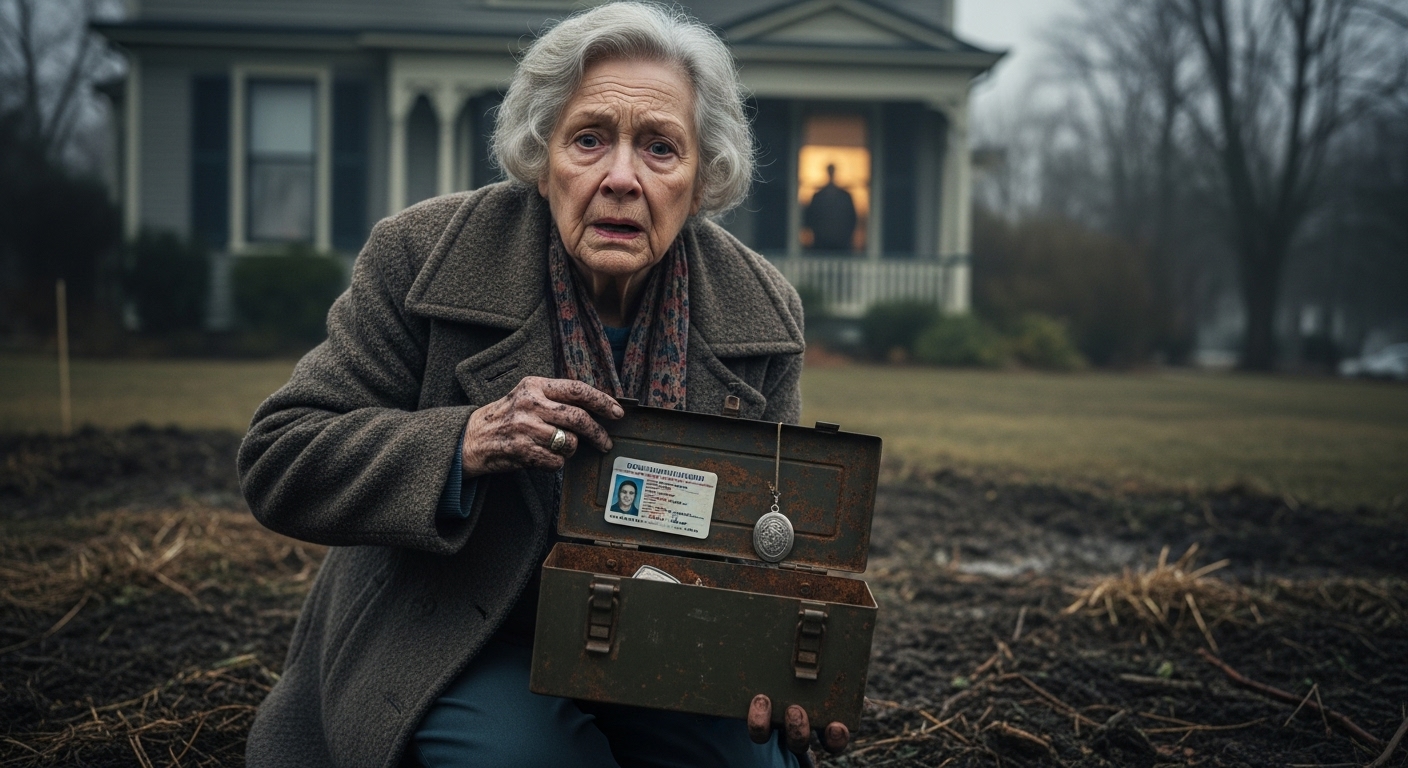
Curiosity piqued, she fell to her knees, clawing at the dirt with her gloved hands. It was a box. An old military ammunition box, the green paint flaked away to reveal orange corrosion. It was heavy.
“What in the world…” she whispered, pulling it free from the roots that had tried to claim it.
She sat back on her heels, wiping sweat from her forehead. Arthur had served in Korea, a medic. He had boxes like this in the garage, usually filled with old spark plugs or fishing tackle. But why bury one under the rose bushes?
Martha looked at the house. Brenda was in the living room watching a game show. Arthur was likely napping.
She shouldn’t open it. It felt like an intrusion, a violation of the privacy she guarded so fiercely for him. But the weight of the box felt wrong. It didn’t shift like loose metal. It felt solid. Dense.
With a grunt of effort, she pried the latch. It was fused with rust, but Martha was strong—years of wrangling school children and lifting her father had given her a grip of iron. The latch gave way with a screech that sounded like a wounded animal.
She threw the lid back.
The smell hit her first. Not mold, but the scent of old oil and stale air.
Inside, wrapped tightly in heavy, oil-stained cloth, was a bundle. Martha unwrapped it slowly.
The first thing she saw was a wallet. It was red leather, cracked and faded. She opened it. The driver’s license inside showed a smiling young woman with feathered blonde hair.
Name: Sarah Jenkins. DOB: 05/12/1968. Exp: 05/12/1994.
Martha’s breath hitched. She knew that name. Everyone in Oakhaven knew that name. Sarah Jenkins was the first. The first of the “Lost Girls.” She had vanished on her way home from a shift at the diner in 1993. They never found a body, just her car abandoned on Route 9.
Martha’s hands began to tremble. She reached back into the box.
A silver locket. She popped it open. A picture of a baby. Engraved on the back: For Emily. Emily Vance. Disappeared 1999.
A blue hair ribbon. Jessica Cole. Disappeared 2005.
And at the bottom, a hunting knife. The blade was clean, but the handle… the wooden handle was stained dark, a stain that no amount of scrubbing could fully remove.
Martha scrambled backward, crab-walking away from the box as if it contained a viper. She knocked over her bucket of gardening tools. The noise seemed deafening in the quiet yard.
She stared at the open box. These weren’t random items. These were trophies.
The world tilted. The gray Ohio sky seemed to spin. Her father. The Saint. The man who stitched up knees and cooled fevers. The man who held her hand when her mother died and promised everything would be alright.
He was here all along, a voice whispered in her head. The monster was in the house.
She remembered the dates. 1993: Arthur was working late nights at the clinic. “Flu season,” he had said. 1999: He had gone on that fishing trip alone. To “clear his head.” 2005: He was retired, but he still took long drives. “Looking for birds,” he claimed.
Martha gagged. Bile rose in her throat, hot and acidic. She turned her head and vomited into the freshly turned earth, right next to where she had planned to plant beauty.
She wiped her mouth with the back of her dirty glove, leaving a smear of mud on her cheek. She looked up at the house. In the second-story window, she saw a silhouette. Arthur. He was standing there, looking down at her.
For a second, just a split second, he didn’t look like a confused old man. He looked still. Watchful.
Martha grabbed the box. She didn’t know why, but she couldn’t leave it there. She couldn’t let Brenda see it. She couldn’t let the police see it—not yet. Panic was a cold rider on her back, whipping her into irrational action. She bundled the items back in, slammed the lid shut, and ran.
She ran not to the house, but to the garage. She shoved the box behind a stack of winter tires, covering it with an old tarp.
Her heart was hammering against her ribs like a trapped bird. She stared at her hands. They were covered in dirt. Grave dirt.
She walked into the house through the back door, stripping off her gloves. She went straight to the kitchen sink and turned the water on scalding hot. She scrubbed her hands until the skin was raw and red, but she couldn’t get them clean. She felt the grease of the dead girls on her skin.
“Martha?”
She spun around. Arthur was standing there, holding a half-eaten cookie. He looked innocent. Fragile.
“Dad,” she choked out.
“Did you plant the roses?” he asked, a child-like curiosity in his voice. “Your mother loves the yellow ones.”
Martha looked at him, really looked at him. She searched for the killer behind the cataracts. She searched for the man who could slice a throat and then come home to read bedtime stories.
“I… I found something, Dad,” she whispered.
Arthur chewed his cookie slowly. “Found what?”
“In the garden. A box.”
Arthur stopped chewing. The room went dead silent. The clock on the wall ticked. Tick. Tick. Tick.
A shadow passed over Arthur’s face. His jaw tightened. The hand holding the cookie trembled, then clenched. For a moment, the dementia vanished, replaced by a terrified, lucid awareness.
“You shouldn’t be digging,” Arthur said. His voice wasn’t weak. It was low. Firm. “Some things are buried for a reason, Martha.”
“Dad, whose IDs are those?” She took a step toward him. “Sarah. Emily. Jessica. Did you… Dad, tell me you didn’t.”
Arthur’s eyes filled with tears. He dropped the cookie. It shattered on the linoleum.
“I fixed it,” he whispered, his voice cracking. “I fixed it. I always fix it.”
“Fixed what?” Martha screamed, grabbing his shoulders. “What did you do?”
But the window had closed. The clarity was gone. Arthur looked at her with wide, frightened eyes, pulling away. “I want my mother,” he whimpered. “Where is my mother?”
Martha let him go. She backed away, hitting the counter. She was alone. Alone in a house with a man she didn’t know, a box of horrors in the garage, and a truth that was going to destroy everything.
She needed help. But who do you call when the devil is your own father?
She thought of Lucas. The Golden Boy. He had to know. He was the smart one, the politician, the fixer.
She grabbed her keys. She wasn’t going to the police. Not yet. She was going to see her brother.
Chapter 2: The Golden Boy’s Rot
The drive to Lucas’s campaign headquarters in the neighboring town of Crestwood took forty minutes. Martha drove on autopilot, the wipers slapping away the drizzle that had started to fall. Her mind was a chaotic loop of images: the red wallet, her father’s trembling hands, the look in his eyes when he said, I fixed it.
Lucas’s headquarters was a storefront downtown, draped in red, white, and blue bunting. Giant posters of his face—handsome, tanned, trustworthy—plastered the windows. LUCAS CALDWELL: A LEGACY OF CARE.
The irony made Martha want to scream.
She parked the car and stormed in. The office was buzzing with volunteers, mostly young college students fueled on caffeine and idealism. They looked up as she entered. Martha must have looked deranged—mud on her cheek, hair wild, eyes wide.
“I need to see Lucas,” she demanded of a young woman with a clipboard.
“Mr. Caldwell is in a strategy meeting, ma’am. Do you have an appointment?”
“I’m his sister,” Martha snapped. “Tell him it’s an emergency. Tell him it’s about Dad.”
The girl paled and hurried to the back office. Two minutes later, Lucas emerged. He was wearing a crisp navy suit, his tie perfectly dimpled. He flashed his famous smile, but it didn’t reach his eyes when he saw her.
“Marty? What the hell? You look like you’ve been wrestling a bear.” He took her elbow and guided her into his private office, closing the blinds.
“What is it? Did he fall? Is he… gone?” Lucas asked, pouring her a glass of water.
Martha ignored the water. She stood in the center of the room, vibrating with adrenaline. “I found them, Lucas.”
“Found what?” He sat on the edge of his mahogany desk, checking his watch.
“The girls. The Lost Girls.”
Lucas froze. The air in the room seemed to drop ten degrees. He didn’t ask what girls. He didn’t look confused. He looked… annoyed.
“Keep your voice down,” he hissed. He stood up and walked to the door, checking the lock. He turned back to her, his face hard. “What are you talking about?”
“I was digging in the garden. I found a box. An ammo box. Sarah Jenkins’ license. Emily Vance’s locket. A knife, Lucas. A bloody knife.” Martha’s voice broke. She sobbed, covering her mouth. “Dad… Dad had them. He buried them.”
She expected Lucas to crumble. She expected him to slide down the wall in horror, to weep for the father they thought they knew.
Instead, Lucas sighed. He walked over to the window and peeked through the blinds. “Where is the box now?”
Martha blinked, confused by his calm. “In the garage. Behind the tires. Lucas, we have to go to Brody. We have to… oh god, Dad is a monster. All these years.”
Lucas turned around. “No.”
“What do you mean, no?”
“I mean you are not going to Brody. You are not going to anyone.” Lucas walked toward her. He didn’t look like her little brother anymore. He looked like a stranger. “Dad isn’t a monster, Martha. He’s a sick old man. He’s dying. What good does it do to drag his name through the mud now? To destroy my campaign? Do you know how close I am?”
“People died, Lucas!” Martha screamed. “He killed women! He hunted them!”
“He didn’t kill anyone!” Lucas shouted back, his face flushing red.
Martha stopped. “How do you know?”
Lucas ran a hand through his perfect hair. He paced the small room. “Because I know, okay? Just… trust me. Burn the box, Martha. Put it in the furnace. Let him die with dignity. Let the town keep their hero.”
“I can’t do that.” Martha shook her head. “I can’t let those families go on wondering. I’m going to the police.”
She turned to the door.
Lucas grabbed her arm. Hard. His fingers dug into her bicep.
“Don’t,” he said. His voice was low, dangerous. “You have no idea what you’re starting.”
“Let go of me.” Martha pulled away, shocked by the violence in his grip. She looked at him, and suddenly, a new terrible thought bloomed in her mind.
Why wasn’t he surprised? Why was he so sure Arthur wasn’t the killer?
“Lucas,” she whispered. “Why aren’t you shocked?”
Lucas stared at her, his jaw working. “Just go home, Martha. I’ll handle it. I’ll come over tonight. We’ll talk.”
Martha backed out of the office. She fled past the confused volunteers and into her car. She locked the doors, her hands shaking so hard she dropped the keys twice.
She didn’t go to the police. Not yet. She needed proof. Not just of the crimes, but of whatever Lucas was hiding.
She drove back to the house, but she didn’t go inside. She went to the garage. She retrieved the box. She put it in her trunk. Then she went inside the house.
Arthur was asleep in his chair in front of the TV. He looked peaceful.
Martha went to his study. It was a room she rarely entered. It was lined with medical journals and dusty books. She began to tear the room apart. She opened drawers, pulled books off shelves. She was looking for something, anything, that explained the madness.
In the bottom drawer of his heavy oak desk, hidden under a false bottom that she only found because she dropped a pen, lay a journal. A black, leather-bound book.
She opened it. The entries went back decades.
June 12, 1993. I found it in his room. Under the mattress. God help me. It was Sarah’s. He said he found it. He said he didn’t do it. But the blood on his shirt… his eyes… he was high on something. Or manic. I should call Brody. I should turn him in. But he’s my boy. My only son. I can’t let him rot in a cage. I’ll treat him myself. I can fix this.
Martha read on, tears blurring her vision.
May 4, 1999. He did it again. Emily. I thought the therapy was working. I thought the medication was working. I failed. I had to clean the car. I had to hide the proof. God forgive me. I am damned. I am burying the sins in the garden because I cannot bear to look at them, but I cannot destroy them. They are my penance.
Martha dropped the journal.
It wasn’t Arthur.
Arthur was the cleaner. The protector. The father who loved his son too much to do the right thing.
The monster wasn’t the old man sleeping in the chair.
The monster was the man running for State Senate. The man who had just grabbed her arm.
And he was coming over tonight.
Chapter 3: The Reckoning & Redemption
The storm arrived at dusk. It battered the old house, the wind howling like the ghosts Martha had unearthed.
Martha sat in the living room, the shotgun across her lap. It was Arthur’s old 12-gauge. She had loaded it with trembling hands, praying she wouldn’t have to use it, but knowing she might.
She had sent Brenda home early. “Weather’s getting bad,” she’d lied.
Arthur was awake now. He was pacing the room, agitated by the drop in pressure. He kept muttering about “The boy. The boy needs help.”
“Sit down, Dad,” Martha said, her voice steel.
“Is Lucas coming?” Arthur asked, a sudden clarity piercing his fog. “He shouldn’t come here. It’s not safe.”
“He’s coming, Dad. And we’re going to end this.”
Headlights swept across the front window. A car door slammed.
The front door opened without a knock. Lucas stood there, dripping wet, his suit soaked. He looked at Martha, then at the shotgun. He didn’t look afraid. He looked weary.
“Put it down, Marty,” he said, closing the door behind him. “Don’t be dramatic.”
“I read the journal, Lucas,” she said. She raised the barrel. “I know.”
Lucas froze. His mask slipped completely. The charm evaporated, revealing a hollow, cold darkness beneath. “The old man never could throw anything away,” he muttered. “I told him to burn that book years ago.”
“You killed them,” Martha said, her voice shaking. “Sarah. Emily. Jessica. Why?”
Lucas shrugged, walking slowly into the room. “Why does the wind blow? I have urges, Martha. Needs. Dad understood. He knew I was… special. He knew I was destined for greatness. He knew a few mistakes shouldn’t ruin a future like mine.”
“Mistakes?” Martha screamed. “They were human beings!”
“They were nobodies!” Lucas roared, his face twisting into a snarl. “And I am going to be a Senator! I am going to save this state! Do you think I’m going to let a dried-up schoolteacher and a senile old fool ruin me?”
He lunged.
Martha pulled the trigger.
Click.
Safety. She had forgotten the safety.
Lucas was on her before she could rack the slide. He knocked the gun from her hands. It skittered across the floor. He backhanded her, a heavy, brutal blow that sent her crashing into the coffee table.
Martha tasted blood. She looked up. Lucas was standing over her, breathing hard. He reached into his jacket pocket and pulled out a syringe.
“A sedative,” he said, his voice eerily calm again. “For Dad. But I think you need one too. A massive stroke. Tragically young. The stress of caretaking…”
He stepped toward her. Martha scrambled backward, trapped against the sofa.
“Lucas, don’t,” she pleaded.
“It’s better this way,” he whispered.
“NO!”
The voice was thunderous. It wasn’t the voice of a frail old man. It was the voice of the Father.
Lucas turned.
Arthur was standing by the fireplace. He held the shotgun. He had picked it up while they struggled. He held it steady, the stock pressed firmly against his shoulder, his stance perfect.
The fog was gone. His eyes were clear, sharp, and filled with an infinite, crushing sorrow.
“Dad?” Lucas faltered. He took a step back, raising his hands. “Dad, it’s me. It’s Lucas. Put the gun down. She’s crazy. She’s trying to hurt me.”
Arthur looked at his son. He looked at the monster he had created, the monster he had watered with his silence and protected with his lies.
“I buried the truth,” Arthur said, his voice steady. “And it grew roots. I won’t let it grow anymore.”
“Dad, give me the gun,” Lucas smiled, that charming, political smile. “Come on. I’m your boy.”
Arthur’s face crumpled. “You are my boy,” he wept. “And that is my sin.”
Arthur shifted his aim. Not at Lucas’s chest. But at the floor, inches from Lucas’s feet.
BOOM.
The sound was deafening in the small room. The floorboards exploded. Lucas screamed and jumped back, tripping over the ottoman and crashing to the floor. The syringe flew from his hand.
The front door burst open. Sheriff Brody stood there, rain dripping from his hat, his service weapon drawn. He had seen the car. He had heard the shot.
“Drop it! Arthur, drop it!” Brody yelled.
Arthur looked at the Sheriff. He looked at Martha, bleeding on the floor. He looked at Lucas, cowering like a child.
Arthur lowered the gun. He collapsed into the armchair, the energy leaving him as quickly as it had come. The fog rolled back in. He looked at the smoking gun in his hand with confusion.
“I… I think I missed the pheasant,” he mumbled.
Epilogue: The Harvest
Lucas was arrested that night. The journal, combined with the box Martha gave to Brody, was enough. The DNA tests confirmed it within the week. The “Golden Boy” was charged with three counts of first-degree murder. The scandal made national news.
Arthur didn’t live to see the trial. He died in his sleep three weeks later. His heart simply stopped. Martha believed he had finally allowed himself to let go, his final duty discharged.
The funeral was small. The town was confused, angry, betrayed. They didn’t know how to mourn a man who was both a savior and an accomplice.
Six months later, spring had come to Oakhaven.
Martha knelt in the garden. The weeds were gone. The soil was rich and dark.
She dug three holes.
She planted three rose bushes. One for Sarah. One for Emily. One for Jessica.
She patted the dirt down around the roots.
“Grow,” she whispered to them. “Grow in the light.”
She stood up, wiping her hands on her jeans. The house behind her was silent, but it no longer felt haunted. The secrets were out. The air was clear.
Martha walked back inside, leaving the door open to let the spring breeze blow through the halls, sweeping away the last of the dust.