They told us the odds were one in a million, a genetic anomaly that shouldn’t happen, but the moment the doctor stopped breathing and the delivery room in Atlanta went dead silent, I knew my life had shattered into two completely different worlds because the second twin didn’t look anything like the first—in fact, she didn’t even look like she belonged to the same family, sparking a nine-year journey of judgment, viral fame, and a terrifying fight to prove that love doesn’t need to match in color.
PART 1: The Silence in Room 304
The monitor was screaming. That’s the sound that still wakes me up at 3:00 AM, nine years later. It wasn’t a steady beep; it was a chaotic, rhythmic thrashing that mirrored the panic rising in my throat.
“Push, Clementina! You have to push now!”
My husband Michael’s hand was crushed inside mine. I could feel the sweat on his palm, slick and cold. We were at a hospital in Atlanta, outside the heat was oppressive, heavy with humidity, but inside, the air conditioning was biting my skin. I was exhausted. Twenty hours. I had been in this bed, wired up to machines, listening to the heartbeat of two lives inside me for twenty hours.
“I can’t,” I gasped, the air feeling like broken glass in my lungs. “Michael, I can’t do it anymore.”
“Yes, you can,” Michael said, his voice trembling but firm. He looked terrified. His dark skin was ashen, his eyes wide. He knew what was at stake. “We’re almost there, Clem. Just one more. One more and we’re a family.”
The doctor, Dr. Evans, was a calm woman usually, but even she looked tense. The positioning was tricky. Twin A was ready. Twin B was… waiting.
“Here she comes!” Dr. Evans announced, her voice cutting through the haze of my pain.
With a scream that felt like it tore my soul from my body, Isabella arrived. The relief was instantaneous, washing over me like a cold wave. I heard that cry—the most beautiful sound in the world. A squalling, angry, life-affirming cry.
“She’s beautiful,” the nurse whispered, quickly cleaning her off. “Look at those curls. Light skin, just like her mama.”
I caught a glimpse of her. She was perfect. Pale, flushed pink from the effort of being born, with wisps of chestnut hair plastered to her skull. I collapsed back against the pillows, tears streaming down my face. One down. One safe.
“Okay, Clementina, don’t stop now,” Dr. Evans said, her tone shifting. “Twin B is right behind her. We have to move fast.”
The pain returned, sharper this time. The adrenaline was fading, leaving only raw nerve endings. I pushed. I pushed for Michael, I pushed for Isabella, I pushed for the unknown life still clinging to my insides.
And then, Gabriella arrived.
But there was no announcement. No “She’s beautiful” from the nurse immediately. Just a pause. A beat of silence that lasted maybe two seconds but felt like an eternity. The kind of silence where you can hear the hum of the refrigerator in the hallway.
“Is she okay?” I choked out, trying to sit up, panic clawing at my chest. “Why isn’t she crying? Michael, why isn’t she crying?”
“She’s fine, she’s fine,” Dr. Evans said quickly, but her eyes—I saw her eyes flick to the nurse, a look of pure, unadulterated surprise.
Then, the wail came. Louder than Isabella’s. A warrior’s cry.
The nurse brought her to the warmer, and as she wiped away the vernix, the room seemed to tilt on its axis. I looked at Michael. He was staring at the baby, his mouth slightly open.
“Michael?” I whispered.
He looked at me, then back at the baby. “Clem… she’s… she’s absolutely black.”
I frowned, confused by the medication and the exhaustion. “What?”
“Look.”
They brought them to me. One in each arm.
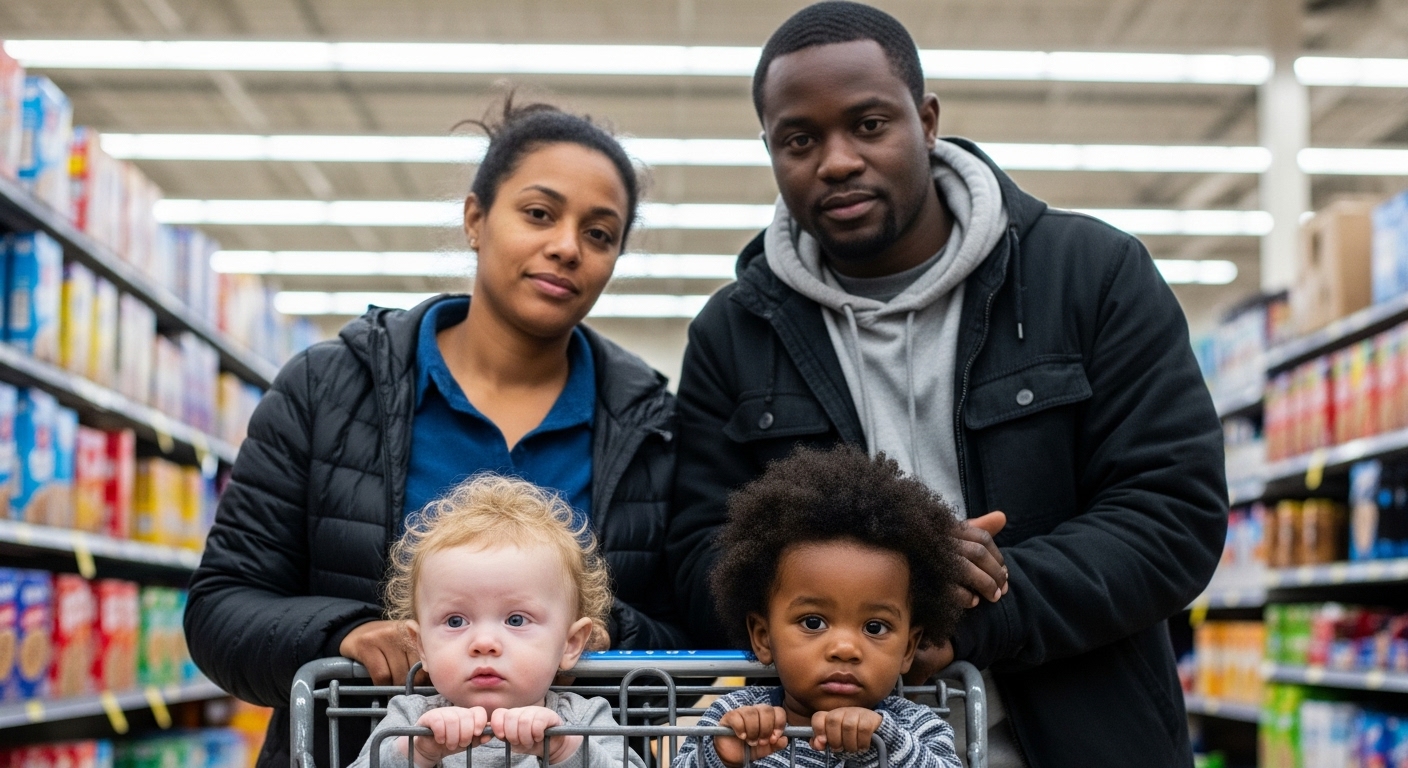
On my left, Isabella. Light skin, chestnut curls, looking for all the world like a white baby. On my right, Gabriella. Dark skin, rich and deep like her father’s, with hair that was already thick, black, and coiling tight.
I looked from one to the other. Minutes apart. Same womb. Same parents. But if you laid them side by side in a nursery, you would bet your life savings they were strangers.
The doctor cleared her throat. “It’s rare,” she said, her voice filled with scientific fascination. “Extremely rare. But with your mixed heritage… the genetics just… rolled the dice in two completely different directions.”
I looked down at them. My brain was trying to catch up with my heart. My heart didn’t care. My heart just saw two daughters. But my brain? My brain was already calculating the stares. The questions. The world outside this room.
“They’re twins?” the nurse asked, almost to herself.
“Yes,” I whispered, pulling them closer, a fierce protectiveness surging through my veins. “They are. And God help anyone who tries to tell them otherwise.”
PART 2: The World Was Not Ready
We brought them home to our quiet suburb in Atlanta three days later. The bubble of the hospital burst the moment we walked into the grocery store for the first time as a family of four.
I remember it vividly. It was a Tuesday. I had the double stroller. Michael was at work. I just needed milk and diapers. I felt strong enough to venture out.
I was in the produce aisle, squeezing avocados, when I felt it. The weight of a gaze. You know that feeling when someone is watching you? It pricks the back of your neck.
I turned around. An older woman was staring into the stroller. She looked at Isabella, then at Gabriella, then up at me. I offered a polite, tired smile.
“Are you babysitting?” she asked.
The question hit me like a slap. “Excuse me?”
“The little dark one,” she gestured with a wrinkly hand. “Are you babysitting her? Or is she adopted?”
My blood ran cold. “No,” I said, my voice shaking. “They are twins. They are both mine.”
The woman laughed. A dry, dismissive cackle. “Honey, you don’t have to lie. That’s biologically impossible.”
“It’s not,” I snapped, gripping the handle of the stroller so hard my knuckles turned white. “And it’s none of your business.”
I walked away, my heart hammering against my ribs. But it didn’t stop there. It never stopped.
By the time they were eight months old, the isolation was eating me alive. I felt like I had to carry birth certificates around just to prove I hadn’t kidnapped one of my own children. I needed an outlet. I needed someone to tell me I wasn’t crazy.
So, I did what any millennial mom does. I posted a photo on Instagram.
It was a simple shot. Isabella and Gabriella, lying on a white rug, holding hands. The contrast was stark—the creamy skin against the mahogany skin, the loose curls against the tight coils.
Caption: My miracles. Isabella and Gabriella. Yes, they are twins. Yes, they are mine.
I put my phone down and went to change a diaper.
Two hours later, my phone buzzed. Then it buzzed again. And again. Within ten minutes, it was vibrating so constantly it walked itself off the kitchen counter and fell onto the floor.
I picked it up. The screen was flooded. 500 likes. 1,000 likes. 10,000 likes.
Comments were pouring in from all over the world. Russia, Brazil, Japan, the UK. “Is this real?” “Photoshop!” “Omg so beautiful!” “How is this possible?”
And then, the darker side of the internet arrived. The trolls. “She cheated on her husband.” “That family is a mess.” “Why does she dress the black one in lighter colors? She hates her race.”
I sat on the kitchen floor, scrolling, tears blurring my vision. Michael came home to find me huddled in the corner, the phone glowing in the dark.
“What happened?” he asked, dropping his keys.
“We went viral,” I whispered. “And people are cruel, Michael. They are so cruel.”
Michael took the phone from me. He read for a minute, his jaw tightening. Then he looked at me, and his eyes were fierce. “Let them talk. Look at our girls, Clem. Look at them.”
Isabella was rolling over, giggling. Gabriella was chewing on her fist, watching her sister. They didn’t know about race. They didn’t know about genetics. They just knew that the person next to them was their other half.
“We are going to own this,” Michael said. “We aren’t going to hide them. We are going to show the world that this is what beauty looks like. This is what family looks like.”
The Middle Years: A Divide
As they grew, the differences became more than just skin deep. By age four, their personalities were splitting as drastically as their appearances.
Isabella was the artist. She was quiet, observational. She could sit for hours with a box of crayons, drawing intricate worlds where everyone was purple or green. She hated loud noises.
Gabriella was a tornado. She was loud, physical, athletic. She ran before she walked. She had a laugh that could shatter glass. She was the one who would push a boy on the playground if he was mean to Isabella.
I remember the first day of kindergarten. The anxiety was back, worse than the delivery room. We dressed them in matching outfits—a mistake, looking back, but I wanted to reinforce their bond.
I watched from the car as they walked into the school building. Isabella was clutching Gabriella’s hand. Gabriella was marching forward, chest out, ready to take on the world.
When I picked them up, the teacher pulled me aside. Ms. Henderson looked uncomfortable.
“Mrs. Shipley,” she started. “We had a… situation today.”
“What happened?” I asked, immediately defensive.
“During circle time, one of the other students told Gabriella she couldn’t sit with Isabella because…” She hesitated. “Because families have to match.”
My heart broke. It physically hurt. “And? What happened?”
Ms. Henderson smiled a little. “Well, before I could intervene, Isabella stood up. She’s usually so quiet. But she stood up, put her hands on her hips, and said, ‘We do match. We match in our hearts. You just can’t see it because you’re not smart enough.'”
I laughed through my tears. My girls. My fighters.
The Crisis
But it wasn’t always a victory. When they were seven, we had a scare that shook me to my core.
Gabriella got sick. It started as a fever, but it spiked fast. We rushed her to the ER. They needed to run blood tests. They needed to check for genetic markers for a rare infection.
The doctor looked at Michael and me. “We might need a donor if her platelets drop. Family is the best match.”
He looked at Isabella. Then he looked at Gabriella. He hesitated.
“I know they look different,” I said, my voice hard steel. “But they are monozygotic in origin, even with the phenotype variance. Test her sister.”
The nurse took Isabella’s blood. We waited. The longest hour of my life. If their genetics were so different on the outside, had they drifted too far apart on the inside? Was the bond severed by whatever anomaly gave them their skin?
The doctor came back in. He looked stunned.
“It’s a perfect match,” he said. “Biologically, they are incredibly synced. The immune markers… they are nearly identical.”
I looked at Isabella, sleeping in the chair next to Gabriella’s hospital bed. She was holding her sister’s hand through the rails. Even in sleep, they gravitated toward each other.
That was the moment I stopped caring about the comments. I stopped caring about the stares in the mall. Science could explain the skin, but it couldn’t explain the soul. And their souls were identical.
Today: Nine Years Later
Now, they are nine. They are almost pre-teens. The dynamic has shifted again.
They are local celebrities here in Atlanta, but we try to keep it normal. Isabella is deep into music now, playing the piano with a delicacy that makes me cry. Gabriella is the star of her track team, fast as lightning.
But the world is changing. America is changing. Conversations about race are everywhere.
Last week, we were sitting at the dinner table. Gabriella was poking at her broccoli.
“Mom,” she said suddenly. “Am I black?”
The table went silent. Michael put down his fork.
“Yes, baby,” he said. “You are African American. Like Daddy.”
She looked at Isabella. “Is Bella white?”
“Bella is African American too,” I said. “She just has light skin like Mommy. We are all a mix.”
Gabriella thought about this. “But the police… do they see us the same?”
That question. That shattered me. How do you explain to a nine-year-old that the world will treat her differently than her twin sister, simply because of the amount of melanin in her skin? How do you explain that Isabella might get a warning, while Gabriella might get handcuffs?
“No,” Michael said, his voice heavy with a pain generations deep. “They might not see you the same. And that is why you have to be twice as smart, twice as careful. But you also have to remember that you have a secret weapon.”
“What?” Gabriella asked.
“You have a sister who looks like the other side,” Michael said. “And together, you two are the bridge. You are the proof that none of this—” he gestured to his skin, then mine “—none of this separates us. You are the living proof.”
The Message
We still get the stares. We still get the whispers. Just yesterday, a cashier asked if they were “friends from school.”
I just smile now.
“No,” I say, loud enough for the people in line behind me to hear. “They are twins. They are sisters. They are the same.”
Isabella and Gabriella Shipley are not just a genetic curiosity. They are a mirror held up to society. When you look at them, you are forced to confront your own biases. Do you see a black girl and a white girl? Or do you see sisters?
Because when I look at them, I don’t see color. I see the two halves of my heart, walking around outside my body.
The journey hasn’t been easy. It’s been filled with fear, judgment, and the constant pressure to justify our existence. But every time I see them laughing together, heads thrown back, one set of curls bouncing against the other, I know that nature didn’t make a mistake.
Nature created a masterpiece.
And if you’re reading this, and you’re judging a book by its cover—or a human by their skin—take a look at my girls. And ask yourself: what are you really seeing?