THE IMITATION GAME: A Daughter Copied Her Mother’s Style and Unlocked Her Criminal Secret
Chapter 1: The Idol and The Imitator
The Sterling home was a showcase of contemporary elegance in a wealthy New England suburb, but within its immaculate walls, the atmosphere was perpetually cold and strained. Celine, seventeen years old, was quiet, intensely observant, and struggling under the crushing weight of typical teenage insecurity. Her entire universe revolved around her mother, Victoria “Vicky” Sterling, whom she idolized with a profound, almost desperate fervor. Vicky, forty-five, was an art consultant—successful, effortlessly elegant, and perpetually distant, her busy, demanding schedule serving as a convenient shield for her emotional absence. She projected an image of untouchable sophistication, moral integrity, and financial acumen that Celine desperately wished to share.
Celine’s father, Robert, fifty, was a kind, stable, but often overlooked corporate lawyer. He was focused on his own career and trusted his wife implicitly, accepting her frantic schedule and sudden, unexplained trips as the cost of supporting a high-flying career woman.
Celine’s goal was simple, yet heartbreaking: she believed that if she could just become her mother, if she could flawlessly inhabit Vicky’s persona, they would finally bond, and the wall of emotional distance would dissolve. Her transformation began subtly and soon accelerated into a meticulous, all-consuming project. She dyed her naturally brown hair to match Vicky’s striking, salon-perfect blonde. She spent her allowance on precise duplicates of Vicky’s distinctive, expensive makeup—the perfect shade of nude lipstick, the subtle, smoky eye. She copied Vicky’s specific, subtle jewelry choices—the slender gold cuff, the small, diamond-stud earrings. She even practiced her mother’s precise, slightly cold voice inflection in the mirror, attempting to master the look of sophisticated, unapproachable confidence.
The imitation worked too well, too quickly, serving as an unsettling foreshadowing of the secrets it would unlock. One afternoon, Celine was walking through the lobby of her mother’s office building, dressed in a near-perfect replica of Vicky’s expensive gray suit and high heels. A hurried, nervous man—a colleague of Vicky’s she recognized from a past event—mistook Celine for her mother from a distance. He rushed toward her, his face etched with cryptic, nervous urgency.
“Vicky! Thank God. The transfer deadline is tomorrow. Did you sign off on the supplemental papers yet? We need confirmation on the Zurich account.”
Celine, instinctively adopting Vicky’s dismissive glare and cold posture, paused, holding the gaze just long enough to convey a non-verbal warning. “That is handled,” she replied, using Vicky’s precise, slightly cold vocal inflection. “Do not interrupt me with trivialities.” The man, intimidated by the icy authority, backed away immediately, mumbling apologies. Celine had successfully fended him off, but the strange, cryptic interaction—the mention of a “transfer deadline” and a “Zurich account”—registered with terrifying clarity. It was the first glitch in the immaculate facade, the first crack in the mirror.
Celine’s determination solidified. Her mother was not just elegant; she was a woman who moved in a world of high-stakes secrets and whispered demands. Celine had to find out what those secrets were, believing, in her naive devotion, that understanding the glamour would finally win her mother’s approval. The line between imitation and investigation had begun to blur. The mirror was reflecting a double life she was utterly unprepared to face.
Chapter 2: Following the Double and the Discovery
Celine’s obsession intensified, fueled by the mystery of the Zurich account. She moved from mere imitation to forensic examination, searching for the key to her mother’s secret world. She began to focus on the unique, crucial details that only an imitator would notice.
She realized that her mother always signed important documents with an overly elaborate, distinctive “V” in her signature—a stylized, complex loop that Vicky often used to sign checks and legal forms. Celine began practicing this signature on scraps of paper, trying to master the precise arc and pressure. This practice led her to the devastating truth. While trying to perfectly replicate the “V” in her mother’s office, she stumbled upon a folder of documents Vicky had accidentally failed to shred before rushing out.
The documents were not art appraisal reports or museum contracts. They were complex, sophisticated fraudulent loan applications, shell company formation papers, and detailed financial maneuvers, all signed with that identical, elaborate “V.” The documents were evidence of deep, large-scale financial crimes, linking Vicky to an illegal network of money laundering and fraud. The gay cấn (tension) was suffocating as Celine realized her glamorous mother was a dangerous criminal.
The ultimate twist came days later. Celine, dressed in a perfect replica of her mother’s expensive trench coat, large sunglasses, and silk scarf, was walking past the main gate of the estate. A high-end, discreet delivery service van pulled up. The courier, a meticulous man who focused only on the signature and the package, mistook Celine for Vicky. He asked her to sign the ledger and handed her a small, heavy, locked metal briefcase.
Celine, adopting Vicky’s cold confidence, accepted the briefcase without question, signing the ledger with the same overly elaborate “V” she had spent hours practicing. The courier, satisfied, drove away, leaving Celine standing in the drive with the evidence of her mother’s secret life in her hands. The imitation had paid off, delivering the final piece of the puzzle directly into the imitator’s lap.
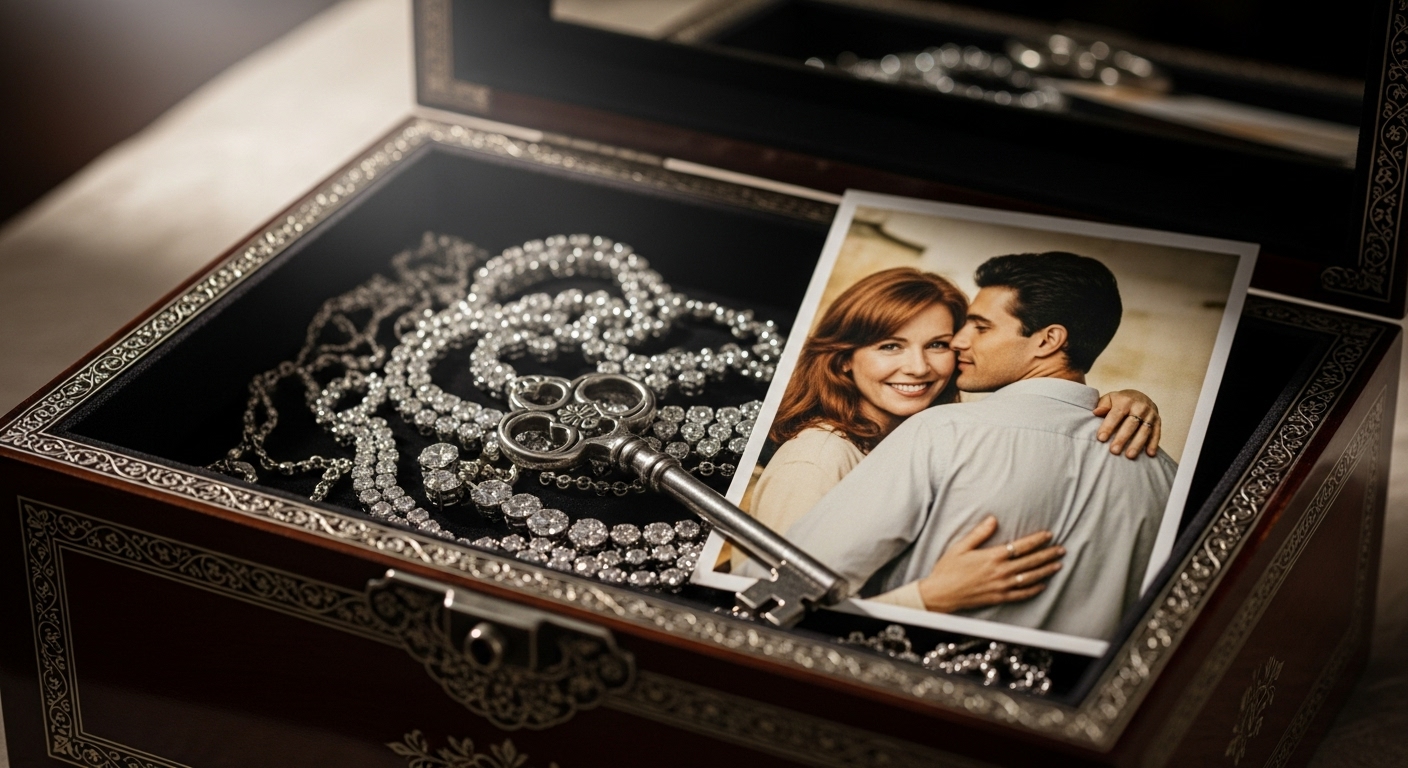
The briefcase was clearly central to her mother’s secret. Unable to force the lock, Celine realized she needed the key. She mimicked her mother’s routine—searching the only place Vicky ever left valuables—her ornate, hidden jewelry box in the master closet. There, beneath a layer of diamond necklaces, she found the key.
And next to the key, she found the shocking, irrefutable evidence of the betrayal: a small collection of cheap, disposable burner phones and a heavily creased photograph of Vicky intimately embracing a man who was definitely not Robert. The man was handsome, older, and possessed a slick, dangerous confidence. The discovery was a devastating bi kịch (tragedy)—the destruction of her family, confirmed by the intimate photo and the tools of secrecy.
Celine raced back to her room and unlocked the briefcase. Inside were bundles of untraceable cash in multiple currencies, three falsified passports (one for Vicky, one for the man Marco, and one blank), and detailed plans for an imminent, large-scale financial exit—a move that involved liquidating shell accounts and disappearing, a move that would bankrupt several local businesses that had invested in her “art fund” and expose Robert to massive legal and financial liability through shared assets.
The truth was a cold, hard slap of bất bình (injustice/outrage). Her mother was not just cheating; she was a dangerous, calculated criminal preparing to abandon her family, leave them financially ruined, and destroy the lives of countless innocent people. The pedestal on which Celine had placed her idol shattered, revealing a calculating predator beneath.
Chapter 3: The Final Meeting
The clock was ticking. Vicky, having realized the briefcase was missing and sensing Celine’s new, unnerving distance—a distance that felt like accusation—decided to accelerate her exit. She told Robert and Celine she had an emergency business trip to Geneva, timing her flight for the next morning.
Celine, still in the throes of shock and betrayal, but driven by a new, cold clarity, knew she had to stop her. She dressed in a perfect replica of her mother’s favorite travel attire: the expensive, black suit, the stylish sunglasses, the high heels, and the exact shade of lipstick. She took the briefcase—now filled with the falsified passports and cash—and began her pursuit.
She followed Vicky’s meticulously planned route, which led not to the airport, but to a remote, luxury hotel on the outskirts of the city—a clandestine meeting point. Celine watched from the shadows of the hotel’s manicured garden as Vicky met the man from the photograph: her lover and criminal accomplice, Marco. The meeting was quick, professional, and entirely devoid of affection.
As Vicky handed Marco a small packet of travel documents and finalized the details of their escape, Celine stepped out of the shadows.
The sight of two identical figures—the mother and her flawless mirror—caused Marco to momentarily freeze, his criminal mind momentarily incapable of processing the perfect double.
Celine, using Vicky’s exact, cold mannerisms and her practiced, dismissive tone, presented the metal briefcase. Her voice was flat, echoing the cold sophistication she had spent months mastering.
“Mother,” Celine stated, her voice slicing through the tense air. “I think you forgot the original capital.”
Vicky’s flawless facade collapsed entirely. She saw the terror, the accusation, and the profound, absolute betrayal in Celine’s eyes, magnified by her own identical reflection. She realized that her daughter’s adoration, her meticulous imitation, had become the precise instrument of her downfall. The scene was a perfect, terrible mirror: the daughter holding the key to the mother’s prison.
At that moment, the final element of the walked in. Robert, having become suspicious of his wife’s hurried, frantic departure and the unusual contents of the unsheddable financial documents Celine had found, had followed his daughter. He entered the garden and witnessed the horrifying tableau: two identical women, one holding the evidence, the other standing with her lover, the architect of his impending financial ruin.
The final family moment—the ultimate confrontation—was a scene of perfect, agonizing betrayal.
Chapter 4: Restoration of Self and Justice
The climax gave way to immediate, swift justice. Robert, a sharp corporate lawyer, had spent his drive to the hotel discreetly alerting the authorities and contacting his own legal counsel. The police, already aware of the massive financial crimes linked to Vicky’s offshore accounts (thanks to the documents Celine found and Robert verified), arrived swiftly.
Vicky and Marco were arrested amidst a flurry of sirens and confusion. Robert was devastated, but profoundly grateful to Celine for her terrifying, meticulous act of self-defense. The marriage was instantly and irrevocably over. The final clause of the will was not triggered, but the crime was exposed, saving Robert from massive legal and financial ruin.
Celine, the courageous mirror, suffered a massive emotional crash. Her imitation of her mother had become her identity, and now that identity was inextricably linked to betrayal, criminality, and utter moral rot. The discovery shattered the pedestal and left her raw and disoriented.
The first act of chữa lành (healing) was an external surrender of the image. Celine went to a local salon and ruthlessly cut her hair back to her natural, unassuming brown. She threw away the expensive makeup and the perfectly replicated clothes. She stopped wearing the elaborate jewelry. She needed to find herself, her true self, not the destructive glamour of her idol’s image.
Robert, heartbroken but focused on his daughter, was steadfast. He liquidated assets to minimize the financial fallout and focused on creating a foundation of unconditional stability and honesty for Celine. He ensured she entered intensive therapy, recognizing the depth of the psychological trauma she carried—the burden of witnessing her mother’s soul collapse.
The court case against Vicky was massive, resulting in convictions for fraud, money laundering, and conspiracy. The mother who sought endless glamour was reduced to the anonymity of a prison jumpsuit.
Chapter 5: The New Reflection
Months later, Celine and Robert were truly rebuilding their lives. Their home was quieter, simpler, filled not with the cold aesthetics of the art world, but with the genuine warmth of shared meals and open conversation. Robert was focused on stability and honesty, completely present in his daughter’s life.
Celine continued therapy, slowly shedding the paralyzing insecurity that had driven her to seek validation in her mother’s image. She began exploring her own interests, her own style, and her own voice.
The final scene occurs on her eighteenth birthday. Celine is in her room, standing before her full-length mirror. She is dressed simply—her favorite jeans and a soft cotton shirt. Her hair, her natural brown, is short and messy. She wears no makeup, no expensive jewelry—only the simple, slender gold cuff that Robert had gifted her, a piece that symbolized not glamour, but quiet strength.
She looks at her reflection. She sees a young woman dressed simply, with her own distinct, genuine smile. There is no trace of Vicky’s calculating sophistication, no coldness, no fear. She realizes the greatest connection she could forge was not with her idol’s image, but with her own true, honest self—a self defined by courage, not conceit.
The was complete. Celine no longer seeks to emulate her mother’s destructive glamour, but to cultivate her own quiet integrity. She had exposed the ultimate deception by becoming the perfect double, and in doing so, had found the path to becoming perfectly, uniquely, and safely herself. The mirror no longer reflected a lie; it reflected the truth. The end.