The $3.50 Lie: A Starving Boy’s Secret to Save His Blind Grandmother
Chapter 1: The Furnace
The heat in Macon, Georgia, in July is not just a weather condition; it is a physical weight. It presses down on the rooftops, turns the asphalt into a black, sticky river, and sits in the lungs like wet cotton. The weatherman on the radio had called it a “historical anomaly,” a record-breaking dome of high pressure that had parked itself over the South, baking the red clay until it cracked. The thermometer outside the drugstore read 102 degrees Fahrenheit, but down on the pavement, where Leo stood, it felt closer to the surface of the sun.
Leo was eight years old, though if you looked at his ribcage through his sweat-drenched t-shirt, you might guess he was six. He had hair the color of dried corn husks and eyes that were far too old for a face that should have been smeared with ice cream, not grime. He wore a pair of sneakers that had belonged to a neighbor’s son two years ago; the toes were cut out to let his feet grow, and the laces were knotted in three places.
He was not playing. While other children were chasing ice cream trucks or splashing in the municipal pool three miles away, Leo was at work.
He stood outside the Chain-Link fence of the minor league baseball stadium. Inside, the roar of the crowd rose and fell like a tide. He could hear the crack of a bat and the organ playing a jaunty tune. He could smell the hot dogs—rich, salty, savory meat grilling over charcoal. The scent was a torment. It made the empty hollow of his stomach cramp violently.
Leo swallowed the saliva rushing to his mouth and turned his back on the stadium. His business was not with the game; his business was with what the fans left behind.
He approached a large, green municipal trash can. It was overflowing. The heat had cooked the contents, creating a stench of rotting fruit, sour beer, and wet cardboard. Flies buzzed in a thick, angry black cloud.
Leo didn’t flinch. He reached into his back pocket and pulled out his tool: a stick with a small metal hook he’d fashioned from a wire coat hanger. He was too short to reach the bottom of the can, and he had learned the hard way about reaching blindly into the trash. Last week, a shard of broken glass had sliced his thumb. Two days ago, a wasp guarding a half-eaten apple had stung his eyelid, swelling it shut for a day.
He began to fish.
Clink.
He hooked a plastic soda bottle. He carefully lifted it out, shaking off a paper plate comprised of mustard and half a bratwurst. He inspected the bottle. It was a brand name cola, the 20-ounce size.
“Five cents,” he whispered, his voice raspy from dehydration.
He unscrewed the cap. There was still an inch of warm, brown liquid at the bottom. The sugar syrup was thick and inviting. Leo stared at it. His throat was so dry it felt like sandpaper. Just one sip. Just one sip of that sugar would give him the energy to walk to the next block.
He tilted the bottle. The liquid touched his lips.
No, a voice in his head said. Sticky means ants. Ants mean Mr. Henderson won’t take them.
Mr. Henderson, the manager of the recycling center, was a man who looked for any excuse to dock pay. If the bottles were sticky, he claimed they jammed the machines. If they were crushed, he said the barcode scanner couldn’t read them.
With a heavy sigh, Leo poured the soda onto the baking asphalt. It sizzled as it hit the ground, evaporating almost instantly. He shook the bottle dry and dropped it into the black garbage bag slung over his shoulder.
The bag was already heavy, bumping against his calves with every step. He had been walking since 6:00 AM. It was now past noon.
He moved to the next can.
Clink. An aluminum beer can. Ten cents.
He did the math in his head. He was good at math. Mrs. Gable, his teacher, said he had a “mind for numbers,” though she often asked why he fell asleep during subtraction drills. She didn’t know he was usually up until midnight sorting glass on the back porch so the neighbors wouldn’t hear the noise during the day and complain to the landlord.
I have forty-two plastic bottles. That’s $2.10. I have eighteen cans. That’s $1.80.
He stopped. He closed his eyes and recalculated. $3.90? No, that couldn’t be right. He counted the shapes in the bag through the plastic.
Wait. The price of plastic had dropped. Mr. Henderson had posted a sign yesterday. Plastic was now three cents.
Leo felt a wave of dizziness that had nothing to do with the heat.
Forty-two times three is… $1.26. Eighteen cans times ten is… $1.80. Total: $3.06.
He needed $3.50.
He needed exactly $3.50 plus tax, but the nice lady at the diner usually waived the tax for him. The target was the “Creamy Potato Soup.” It was the daily special on Tuesdays.
Nana Rose couldn’t chew anymore. Her dentures had broken four months ago, and they couldn’t afford to fix them. Solid food hurt her gums. Last week, he had tried to feed her soft bread, but she had choked, her frail body shaking with coughs that terrified him. The potato soup was perfect. It was rich, salty, and she could swallow it without pain. It was the only thing that kept her weight from dropping further.
She hadn’t eaten a real meal since Sunday. Today was Tuesday.
“Forty-four cents short,” Leo whispered.
He looked down the long, shimmering avenue. The heat waves distorted the air, making the traffic lights look like melting lollipops. His legs trembled. The sun beat down on the back of his neck, a relentless hammer.
He needed at least five more cans. Or fifteen more bottles.
He gripped the black plastic bag tighter, the plastic stretching white at his knuckles. He couldn’t go home yet. Nana was waiting. She was sitting in the dark apartment, rocking in her chair, listening to the radio, waiting for the boy she thought was out “playing explorers.”
Leo gritted his teeth. He ignored the black spots dancing in his vision. He ignored the blisters forming on his heels.
“Five more cans,” he told himself.
He started walking toward the construction site three blocks away. Construction workers drank a lot of soda.
Chapter 2: The Mercy of Iron
The journey to Henderson’s Recycling & Redemption Center was a mile-long trek through the industrial underbelly of the town. Here, there were no sidewalks, only gravel shoulders littered with broken glass and cigarette butts.
Leo walked with the gait of an old man. The two bags—he had filled a second one with the bounty from the construction site—were slung over his shoulders, tied together with a piece of twine. He looked like a miniature, grimy Santa Claus carrying a sack of toys, except his sack was full of other people’s garbage.
His hands were sticky with residue. His t-shirt was soaked through, clinging to his protruding shoulder blades. Every car that whizzed past kicked up a cloud of hot dust that coated his teeth and stung his eyes.
He finally saw the sign: Henderson’s Recycling. We Pay Cash. The “S” in Cash was a dollar sign.
The building was a corrugated metal shed that acted like an oven. As Leo stepped inside, the smell hit him—stale beer, sour milk, and rust. It was cooler than outside, but only barely.
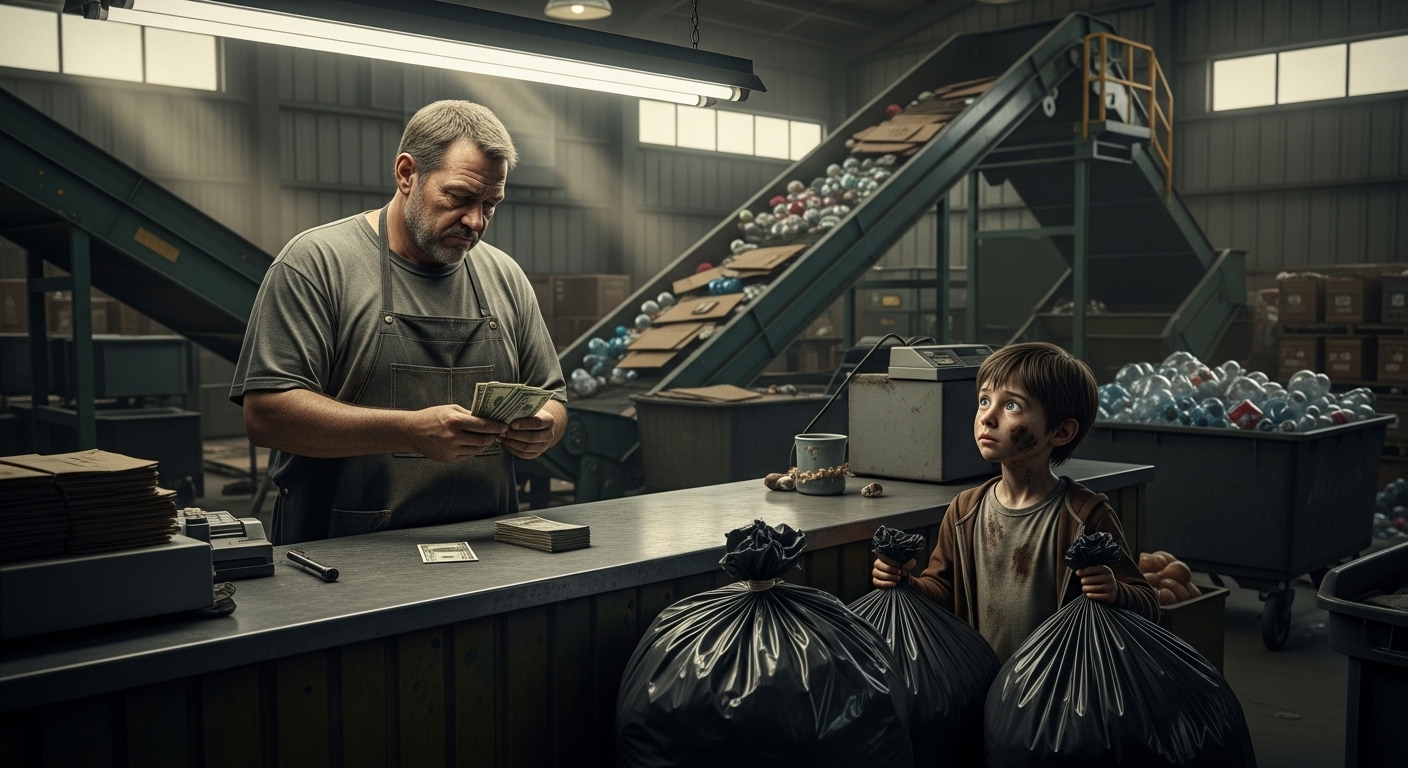
Mr. Henderson sat behind a high counter, protected by a wire mesh cage. He was a thick man with a face that looked like kneaded dough, permanently set in a scowl. A spinning fan blew hot air directly onto his face, rippling his comb-over. He was reading a newspaper and chewing on a toothpick.
Leo dragged the bags to the scale. The plastic scraped loudly against the concrete floor.
Henderson didn’t look up. “I told you, kid. Read the sign. We stop taking bulk at 2:00. It’s 2:15.”
Leo’s heart hammered against his ribs. “Please, Mr. Henderson. The clock outside says 2:05.”
Henderson lowered the paper. He looked at the dirty, sweating boy with eyes devoid of any warmth. He looked at the clock on the wall, which indeed read 2:05.
“My watch says 2:15,” Henderson lied. He didn’t even check his wrist. “But since you’re already dragging dirt into my shop, put ’em up. Hurry up.”
Leo lifted the bags. It took all his strength to hoist them onto the metal scale. He stood back, wiping his sweaty palms on his shorts, waiting for the verdict.
Henderson stood up slowly, groaning as if the effort cost him money. He opened the first bag. He poked around with a gloved hand.
“Trash,” Henderson muttered. “Garbage. Trash.”
“I rinsed them,” Leo said quickly. “I poured them out.”
“There’s a wrapper in here. Snickers bar.” Henderson held up a soggy wrapper triumphantly. “Contamination. That docks the price.”
“It’s just one wrapper…”
“Rules are rules, kid. You want the EPA on my back?” Henderson dumped the cans into the sorter. The machine roared to life, a deafening clatter of metal on metal.
Leo watched the digital counter tick up. 10… 20… 30…
Then came the plastic bottles. Henderson sighed loudly. “These are crunched. Look at this.” He held up a bottle that was slightly dented. “Scanner can’t read the barcode if it’s crunched. I gotta enter these manually. That’s a processing fee.”
“Please,” Leo’s voice was a whisper. “You said three cents.”
“Three cents for pristine bottles. These are scavenged. I know you got ’em from the stadium trash. I told you, digging in dumpsters looks bad. People think my business is attracting rats.”
He looked directly at Leo when he said rats.
Leo felt the sting of tears, but he bit the inside of his cheek until he tasted copper. He would not cry. Not here. Not in front of this man.
“Just count them, please,” Leo said.
Henderson finished the tally. He scribbled on a receipt pad.
“Alright. After the contamination fee and the manual entry fee… and the price drop on aluminum today…”
Leo’s breath hitched. “Price drop?”
“Market fluctuates, kid. Supply and demand. Everyone’s drinking soda in this heat; got too much aluminum.” Henderson tore the slip of paper off. “Two dollars even.”
The world tilted.
“Two dollars?” Leo choked out. “But… I counted. Even with the plastic at three cents… it should be over three dollars. I have enough for…”
He stopped himself. He wouldn’t tell this man about the soup. He wouldn’t give Henderson the satisfaction of knowing he was hurting a grandmother.
“Two dollars,” Henderson repeated, opening the register. He slammed two wrinkled bills onto the counter. “Take it or leave it. Or you can haul those bags back out to the dump yourself.”
Leo looked at the money. It wasn’t enough. It wasn’t even close. The soup was $3.50.
He looked at Henderson’s face. There was no negotiation there. Only a cruel boredom.
Leo reached up with a trembling hand and took the bills. “Thank you,” he said, because Nana had raised him to be polite, even to monsters.
“Don’t come back tomorrow,” Henderson called out as Leo turned to leave. “I’m closing early for the heat.”
Leo walked out of the shed. The sun blinded him. He stood on the gravel, clutching the two dollars. He felt a scream building in his chest, a hot, expanding ball of pure frustration. He had worked for eight hours. He had walked six miles. He had been stung, cut, and burned.
And he had failed.
He looked at the two bills. He could buy a candy bar. He could buy a soda for himself. His body was screaming for sugar and water.
No, he thought. The soup.
He needed $1.50 more.
He looked at his hands. They were shaking uncontrollably. He looked down the street toward the park. Sometimes, people dropped change near the vending machines.
He started walking.
Chapter 3: The Shadow
The heat had changed by mid-afternoon. It was no longer a sharp sting; it was a heavy, suffocating blanket. The humidity had risen, turning the air into soup.
Leo was in trouble. He knew the signs. Nana had told him about heatstroke. If you stop sweating, Leo, you find shade immediately.
He touched his forehead. It was dry. Hot, like a fever, but dry.
I have to hurry, he thought. Just $1.50.
He reached the city park. The playground was deserted, the metal slides shimmering dangerously hot. He checked the coin return slots of the vending machines. Nothing. He checked the ground under the benches.
He found a penny. Then a dime, stuck in a wad of gum. He pried it loose. $2.11.
Then, he saw it.
On a bench near the fountain, a half-eaten ham sandwich sat on a napkin. It had been left there, abandoned. A bite mark was visible, but the rest looked untouched.
Leo stopped. The smell of the ham wafted toward him—salty, meaty. His stomach gave a violent lurch, a roar so loud he thought the pigeons heard it. He hadn’t eaten since a slice of toast at 5:00 AM.
He stared at the sandwich. It was right there. He could just take it. It was trash, technically. Nobody wanted it.
He took a step forward. His hand reached out.
“HEY!”
The voice cracked like a whip.
Leo jumped, spinning around. A woman was sitting on a blanket ten feet away, reading a book. She wore sunglasses and a wide-brimmed hat.
“Shoo!” she yelled, waving her hand at him as if he were a stray dog. “Get away from there! That’s nasty! Don’t be digging around where my kids are playing!”
Leo froze. Shame, hot and red, flooded his face, hotter than the sun.
“I… I wasn’t…”
“Go on! Get!” she pointed toward the park exit. “Where are your parents? Letting you wander around looking like a beggar.”
Leo turned and ran. He ran despite the dizziness. He ran until his lungs burned and his vision blurred. He ran until he was behind the old library, in the alley where nobody could see him.
He leaned against the brick wall, gasping for air. He slid down until he was sitting on the dirty pavement. He buried his face in his knees.
I can’t do it, he thought. I’m too little.
He closed his eyes. He saw Nana Rose. She was sitting in her rocking chair, her milky eyes staring at nothing. She was trusting him. She believed he was strong. She believed he was her “little man.”
If I go home now, she eats toast. And she’ll choke.
Leo opened his eyes. He saw something glinting in the debris of the construction site next to the library.
Copper.
It was a piece of piping, discarded in a pile of rubble. Copper paid more than aluminum. Much more.
He crawled through a gap in the fence. The construction site was quiet; the workers had likely knocked off early due to the heat.
He scrambled over a pile of bricks. There it was. A twisted length of copper pipe, maybe two feet long.
He grabbed it.
Slice.
He didn’t feel the pain at first. He just felt the cold shock. He looked down. A jagged piece of rusted rebar sticking out of the concrete had caught his palm. A gash, red and angry, opened up across the meat of his hand.
Blood welled up, bright and fast, dripping onto the dusty concrete.
Leo stared at it. Then, he took off his t-shirt. He was bare-chested now, his ribs showing starkly against his pale skin. He wrapped the dirty shirt around his hand, pulling it tight to stop the bleeding.
He picked up the copper pipe with his other hand.
He crawled back out of the fence. He walked four blocks to a scrapyard—not Henderson’s, but a smaller one that bought metal.
The man there was nicer. He looked at Leo’s shirtless torso, the bloody rag on his hand, and the copper pipe. He didn’t ask questions. He just weighed it.
“Dollar fifty,” the man said.
Leo nodded. He took the money.
$3.61 total.
He walked to the diner.
When he entered “Sally’s Diner,” the air conditioning hit him like a physical blow. He shivered violently.
The waitress, a kind woman named Betty, dropped her notepad when she saw him.
“Lord have mercy, Leo!” she rushed around the counter. “Look at you! You’re beet red! And your hand!”
“I’m okay, Miss Betty,” Leo said, his teeth chattering. “I just need the soup. To go. Please.”
“Honey, sit down. Let me get you a water. Let me look at that hand.”
“No!” Leo backed away. “Please. Just the soup. Nana is waiting. I have the money.”
He dumped the crumpled bills and the sticky coins onto the counter.
Betty looked at the money, then at the boy. Her eyes filled with tears. She didn’t argue. She went to the kitchen and came back with a large container of Potato Cream Soup. She had filled it to the brim. She also put a cold bottle of water and a bandage in the bag.
“It’s on the house, Leo. Keep your money.”
Leo shook his head stubbornly. He pushed the money toward her. “Nana says we pay our way. Please.”
He wouldn’t take charity. Charity meant admitting they were failing. Charity meant social services might come and take him away.
Betty hesitated, then took the two dollars bills, leaving the coins. “Okay, sugar. But you drink that water on the walk home. Promise me.”
“Yes, ma’am.”
Leo took the bag. The soup was hot against his leg. It was the best feeling in the world.
Chapter 4: The Lie
The apartment was on the fourth floor of a building with no elevator. The hallway smelled of boiled cabbage and mildew. Inside, it was stifling. They couldn’t afford to run the window unit AC until after sunset.
Leo unlocked the door quietly. The apartment was dim, the curtains drawn to keep out the sun.
“Leo? Is that you?”
Nana Rose’s voice was thin, trembling. She was sitting in her armchair, her hands gripping the armrests.
“It’s me, Nana,” Leo said, trying to steady his voice. He leaned against the door for a moment, closing his eyes. The room was spinning.
“You’ve been gone so long,” she said. “I was worried. The radio said it’s over a hundred degrees.”
“I was at Billy’s house,” Leo lied effortlessly. “We were playing in the basement. It was cool down there. We played explorers.”
“Oh. That’s good. Did you have fun?”
“Yes, Nana.”
Leo moved to the tiny kitchenette. He opened the container of soup. The smell filled the room—creamy potatoes, butter, a hint of chives. His stomach cramped so hard he almost doubled over. The pain was sharp, a gnawing hunger that felt like an animal clawing at his insides.
He poured the soup into her favorite ceramic bowl. He found a spoon.
He walked over to her and placed the bowl in her hands.
“Careful, Nana. It’s hot.”
“Potato soup?” She inhaled deeply, a smile spreading across her wrinkled face. “Oh, Leo. My favorite. But… how did you pay for this?”
“Billy’s mom,” Leo said. “She made too much. She said she sent some home for you.”
“Bless that woman,” Nana said. She took a spoonful. She swallowed easily, no coughing. “Oh, it’s wonderful. It’s so warm.”
Leo sat on the floor at her feet. He watched her eat. Every spoonful she took was a victory. Every swallow was a battle he had won against the world.
“Where is yours?” Nana asked, pausing with the spoon halfway to her mouth. She turned her face toward him, her cloudy eyes searching the darkness. “Leo, are you eating? Billy’s mom must have fed you, but you’re a growing boy.”
Leo looked at the empty Styrofoam container. He looked at the empty pot on the stove. There was nothing in the house but tap water and half a jar of mustard.
His hunger was dizzying now. His hands were shaking.
“I’m eating, Nana,” Leo said. “I have a big ham sandwich. Billy’s mom gave me a huge one.”
“Is it good?”
“It’s the best,” Leo said. He picked up a cup of lukewarm tap water.
He took a sip, and then he made a noise. Chomp. Smack. Chew.
He exaggerated the sound of chewing, moving his jaw up and down, grinding his teeth together on nothing.
“Mmm,” he said. “So much cheese.”
Nana smiled, relaxing back into her chair. “Good. Eat up. You need your strength to play tomorrow.”
Leo sat there, sweat dripping from his nose onto his bare chest. He watched his grandmother eat the soup that cost him his blood and his dignity. He chewed on the air, swallowing his hunger, swallowing the truth.
He felt a tear slide down his cheek. He wiped it away quickly, terrified she might hear it fall.
“Is it filling, Leo?”
“Yes, Nana,” he whispered, clutching his cramping stomach. “I’m so full I might burst.”
Chapter 5: The Photograph
Sarah Jenkins was tired of writing about potluck dinners and cat rescues. She was a junior photographer for the Macon Gazette, yearning for a real story.
She had been at Sally’s Diner when the boy came in. She had seen the blood on his t-shirt wrapped around his hand. She had seen the pile of sticky change. But mostly, she had seen his eyes. They were the eyes of a soldier returning from war, not an eight-year-old boy.
She had followed him. It felt predatory, but her gut told her this was important.
She watched him enter the run-down apartment building. She noticed the window on the fourth floor was open, the curtain fluttering in the hot breeze.
From the fire escape of the adjacent building, she had a clear view. She raised her camera, twisting the long lens into focus.
What she saw through the viewfinder made her stop breathing.
She saw the old woman, blind and frail, eating soup with a look of pure bliss. And she saw the boy. He was sitting on the floor, shirtless, his ribs counting the cost of his life. He was holding a cup of water. He was mimicking the motion of eating a sandwich that didn’t exist.
Sarah saw the pain in his face. She saw the love in his eyes as he watched the woman eat.
Click.
The shutter snapped. The image was captured.
The story ran on Sunday morning. It wasn’t tucked in the back. It was on the front page, above the fold.
THE RICHEST BOY IN TOWN While we complain about the heat, an 8-year-old bleeds to feed his blind grandmother.
The article detailed everything. The trash cans. The cheating recycling manager (Sarah had gone there undercover the next day). The lie about the sandwich.
The reaction was instantaneous. And it was explosive.
By 9:00 AM, a crowd had gathered outside Leo’s apartment building. It wasn’t a mob of anger; it was a mob of repentance.
Leo heard the noise. He went to the window, terrified that they were being evicted.
He saw people. Hundreds of them.
There was Mr. Henderson—not the recycling manager, but the owner of the local car dealership—holding a check. There was Miss Betty from the diner with a catering van. There were doctors. There were neighbors who had lived next door for years and never said hello.
When Leo opened the door, he was engulfed.
They brought groceries—bags and bags of them. Fresh fruit, roasted chickens, soft bread, cakes. They brought clothes that fit. They brought an air conditioner unit and installed it within the hour.
But the biggest miracle walked in at noon. Dr. Aris Thorne, the state’s leading ophthalmologist. He had read the paper over coffee and driven two hours.
“I want to see Nana Rose,” he said.
Two weeks later.
The bandages were coming off. The surgery had been complex, removing the cataracts that had stolen Rose’s world for five years.
Leo stood at the foot of the hospital bed. He was clean. He was wearing a new shirt. He had eaten three square meals a day for fourteen days. His cheeks had a little color.
“Okay, Rose,” Dr. Thorne said gently. “Open your eyes slowly. The light will be bright.”
Nana Rose blinked. Her eyelids fluttered.
At first, everything was a blur of white. Then, shapes formed. Colors. The blue of the curtains. The silver of the tray.
And then, the small boy standing at the end of the bed.
She squinted. She saw the sun-bleached hair. She saw the knobby knees. She saw the hands resting on the bedrail—hands that were scarred, with a healing cut across the palm and callouses on the fingers.
She gasped. The air left her lungs in a sob.
“Leo?” she whispered.
“I’m here, Nana,” he said, his voice trembling.
She reached out. She didn’t look at the flowers the nurses had brought. She didn’t look at the doctor. She only had eyes for him.
She grabbed his hands. She pulled them to her face. She kissed the scar on his palm. She kissed the rough fingertips that had sorted through garbage to keep her alive. She felt the truth of his sacrifice against her lips.
Tears streamed from her newly healed eyes, washing away the blindness of the past.
“I see you, Leo,” she sobbed, pulling him into her chest. “I see you. I finally see you.”
Leo buried his face in her shoulder. For the first time in a long time, he didn’t have to be the parent. He didn’t have to be the soldier. He just let go.
Outside, the heatwave had finally broken. A gentle rain began to fall, washing the dust from the city, leaving the world clean and new.