THEY LEFT US TO DIE FOR A ROULETTE WHEEL: I Dragged My Dying Newborn Brother Through A Blizzard Because My Guardians Chose The Casino Over His Life.
PART 1
Chapter 1: The Cold Within
My brother, Tommy, was burning up. I didn’t need a thermometer to know; I could feel the heat radiating off his tiny, shivering body through his onesie. His lips were turning a terrifying shade of blue, the color of a bruise.
I stood in the doorway of the living room, clutching the doorframe with sticky fingers, watching Aunt Margaret apply her lipstick in the hallway mirror. It was a bright, violent shade of red that clashed with the peeling yellow wallpaper of our trailer. Uncle Rick was already by the door, jingling his car keys, checking his watch impatiently. He wore his “lucky” leather jacket, the one that smelled of stale beer and old rain.

“Aunt Margaret,” I whispered. My voice was small, trembling, barely audible over the television blaring a rerun of a game show. “Tommy won’t wake up. He’s breathing funny. Like a whistle.”
She didn’t even look at me. She smacked her lips together, checking her reflection, fluffing her hair. “He’s fine, Lily. Just a cold. Babies get colds. Stop being dramatic. We’ll be back late. Don’t touch the thermostat; oil costs a fortune and we’re low.”
“But—he’s really hot. And he won’t eat.”
“Let’s go, Marge! Table opens in an hour! I got a feeling about tonight!” Rick barked, throwing the front door open.
A gust of wind slammed into the house, carrying snow that bit my exposed skin like tiny needles. The weatherman on the TV had been screaming about it all day. A “Bomb Cyclone.” A historic arctic blast. The Governor had declared a state of emergency. The roads were closing. The power lines were icing over.
But Rick didn’t care about the weather. He only cared about the itch in his palms that only cards could scratch.
They walked out. They actually walked out.
I watched through the grimy front window as the taillights of their rusted pickup truck disappeared into the swirling white void. The red lights faded, then vanished, swallowed by the snow.
They were going to the casino. They left us to die.
I was seven years old.
The silence in the house was heavy, broken only by the wind howling against the aluminum siding and Tommy’s ragged, wet wheezing coming from the playpen. I ran back to him. He was so still. Too still.
I placed my hand on his chest. It was rising and falling, but the rhythm was wrong. Fast, then slow. Fast, then slow. Hiccup-wheeze. Hiccup-wheeze.
I looked at the thermostat on the wall. 58 degrees. Rick had locked the plastic cover on it so I couldn’t turn it up. The cold inside the house wasn’t just about the temperature; it was the cold of indifference. It seeped into the furniture, into the walls, into my bones.
I grabbed the phone from the kitchen wall. No dial tone. The lines must be down.
I knew, with a terrifying clarity that no seven-year-old should possess—a clarity forged by years of navigating adults who looked right through you—that if we stayed in this house, Tommy would not survive the night.
I had to get him to the hospital.
Chapter 2: The Whiteout
I went to the shed out back first. The door was frozen shut, and I had to kick it three times with my boots before the ice cracked and it swung open. The snow was already up to my knees, thick and heavy wet snow.
I dug out an old, splintered piece of plywood—the remains of a shelf Uncle Rick broke last summer in a fit of rage. It was about three feet long. It would have to do. I found my old jump rope, the pink one with the plastic handles that I used to play with before Mom died, before we came here.
I ran back inside, my teeth chattering so hard I bit my tongue. I stripped the cushions off the couch. I dressed Tommy in everything I could find. Three onesies layered on top of each other. A wool sweater that was five sizes too big. I wrapped him in the quilt from my bed, then the thick, scratchy afghan from the couch.
He looked like a bundle of laundry, a shapeless mass of fabric. But I left a small opening for his face. His skin was pale grey.
I tied the bundle to the wood with the jump rope, knotting it over and over again until my fingers hurt. I tied the other end around my waist, making a double loop.
“I got you, Tommy,” I said, though the words were swallowed by the empty, freezing house. “I got you. We’re going to see the doctors.”
I opened the back door and stepped into the white.
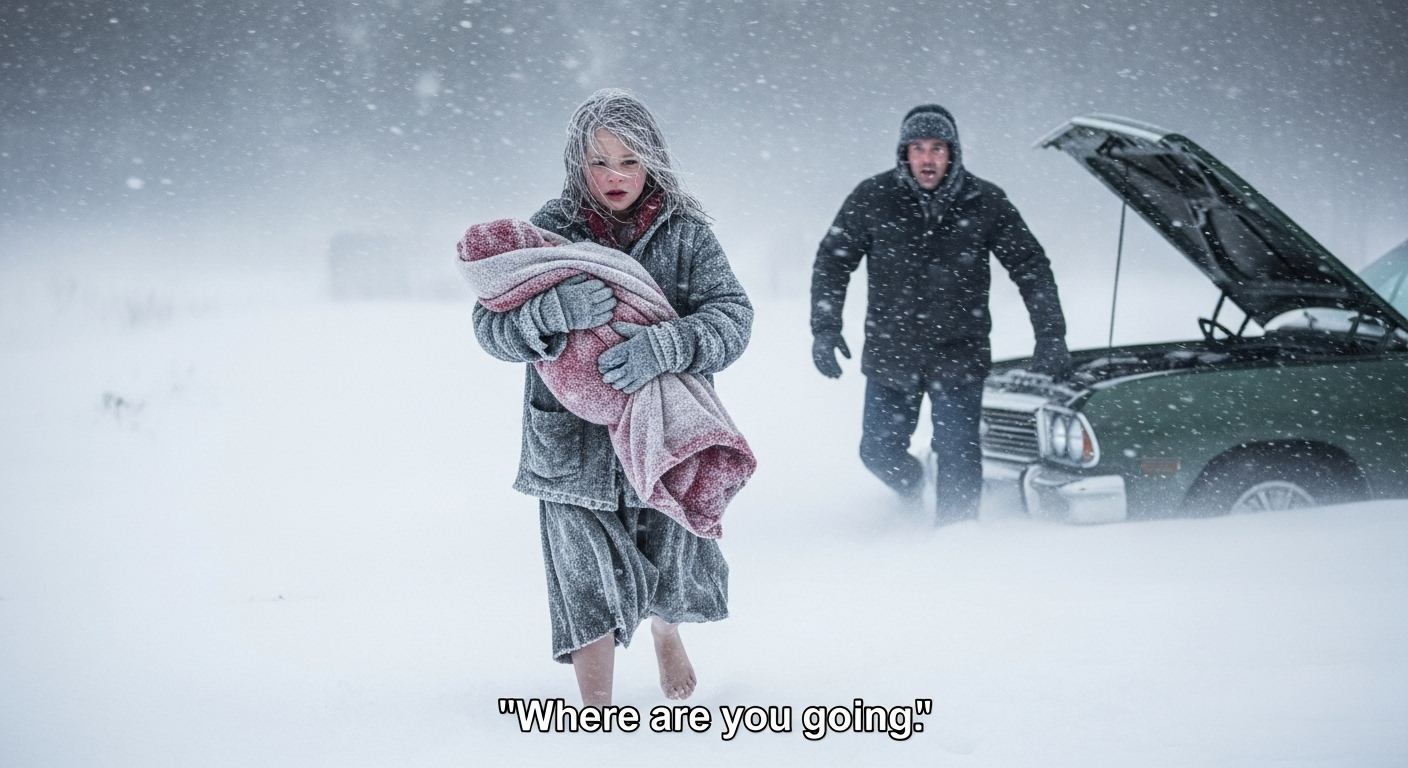
The shock of the cold was instant. It wasn’t just cold; it was an assault. The wind roared like a freight train. My hands were too small for the rope. It froze in minutes, stiffening into a hard wire that cut into my skin even through my thin, knitted mittens.
My knuckles were white. I pulled. I leaned my entire forty-five-pound body weight forward, digging my heels in, and dragged my brother into the storm.
The hospital was three miles away. I knew the way because I’d heard Aunt Margaret screaming at the billing department on the phone last week about a collection notice. Three miles. Up Route 9. Past the old mill.
Three miles. In a blizzard. With a seven-year-old girl as the engine.
The wind hit us like a physical blow, nearly knocking me over as soon as we cleared the driveway. The snow wasn’t falling down; it was being driven sideways, parallel to the ground. It felt like the sky was choking us.
My boots were hand-me-downs from a church donation box, two sizes too small. The soles were worn smooth, offering zero traction. Within twenty minutes, I couldn’t feel my toes. It felt like I was walking on wooden stumps.
Left foot. Right foot. Drag. Left foot. Right foot. Drag.
I kept checking over my shoulder. Tommy was just a lump on the board, bouncing slightly over the uneven ice. The snow was piling up on him fast. I had to stop every fifty yards to brush his face off, terrified he would suffocate.
“Stay with me,” I screamed into the wind. “Please, Tommy. Don’t go to sleep.”
An hour passed. Maybe two. Time doesn’t exist in a whiteout. The world had dissolved into grey and white. There was no horizon, no sky, no ground. Just the swirl.
The road was empty. No cars. No plows. No police. Just the endless, deafening roar of the storm.
My legs began to shake uncontrollably. My lungs burned as if I were inhaling crushed glass. My vision started to blur at the edges. I wanted to stop. I wanted to curl up in a soft snowbank and close my eyes. It would be so warm, so easy. The snow looked like a fluffy blanket.
Just for a minute, a voice in my head whispered. Just rest for a minute.
But then I looked back. I saw the faint puff of steam coming from the bundle. Tommy’s breath.
He’s fighting, I thought, slapping my own face to stay awake. He’s fighting, so I have to fight.
I pushed forward. My foot caught on a chunk of ice buried in a drift. I fell hard, face-first into the asphalt. The impact knocked the wind out of me. My knees smashed against the road, and I felt the skin tear. The rope around my waist jerked tight, bruising my ribs.
I lay there, the ice melting against my hot, tear-streaked face. I couldn’t get up. I was done. I was just a little girl. This was impossible. The monsters were right—I was weak.
I sobbed into the snow, my tears freezing on my cheeks instantly. “I’m sorry, Tommy. I’m so sorry. I tried.”
Then, through the howling wind, I heard a rumble. A deep, mechanical purr that didn’t sound like the wind.
I lifted my head, wiping the slush from my eyes. Two beams of light cut through the swirling snow like lasers, blinding me.
A car.
A black Mercedes G-Wagon, massive and sleek, looking like a spaceship in this frozen wasteland, rolled to a stop inches from my head. The engine idled, a low, powerful growl. The driver’s door opened against the wind.
A man stepped out. He wasn’t wearing a parka or snow gear. He was wearing a long, expensive cashmere coat, pristine against the chaos of the storm. He looked down at me—a heap of rags and misery in the middle of the road.
He didn’t rush. He didn’t run to help me. He walked toward me calmly, his dress shoes crunching on the ice. He crouched down, his face obscured by the shadows and the falling snow.
“I’ll take you somewhere safe,” he said.
His voice was smooth, calm, and oddly flat. It cut right through the storm, louder than the wind.
I froze. I looked at the expensive car. I looked at the dark, empty road behind us. I remembered the “stranger danger” talks at school. But I also remembered Tommy’s blue lips.
I scrambled backward, crab-walking on the ice, shielding the bundle that was my brother with my small, trembling body.
“Who are you?” I choked out, shivering so hard my teeth clicked.
He smiled, but the smile didn’t reach his eyes. It was a practiced smile. “Does it matter, little one? The cold doesn’t negotiate. Get in.”
PART 2
Chapter 3: The Leather Tomb
The interior of the car smelled like new leather and expensive cologne—a sharp, musky scent that made my nose itch. It was warm, aggressively warm. The silence inside was sudden and jarring. The moment the heavy door thudded shut, the roaring wind was cut off as if someone had hit a mute button.
I sat on the edge of the backseat, clutching Tommy to my chest. The leather was soft, softer than anything I had ever touched. I was dripping wet. Snow was melting off my coat, creating a dark puddle on the pristine upholstery. I looked at the man, terrified he would yell at me for making a mess. Uncle Rick would have hit me by now.
But the man didn’t look back. He just put the car in gear.
“Check the child,” he said. His eyes met mine in the rearview mirror. They were grey, steel grey. Unreadable.
I pulled the blanket back. Tommy’s face was still pale, but the warmth of the car was already hitting him. He let out a small cough.
“He’s… he’s breathing,” I whispered. “Please, mister. The hospital is just up the road. St. Mary’s.”
The man nodded slowly. “St. Mary’s. Of course.”
He pressed the gas pedal. The car surged forward with a power I wasn’t used to. It didn’t slide or fishtail like Uncle Rick’s truck. It clawed through the snow like a tank.
I watched out the window. The snow was a blur of white lines.
“Where are your parents?” he asked. His tone was casual, like he was asking about the weather.
“I don’t have parents,” I said, my voice small. “They died. I live with my Aunt and Uncle.”
“And where are they?”
I hesitated. Shame washed over me. It felt like my fault that they left. “They… they had to go out. To the casino.”
The man’s eyes in the mirror narrowed slightly. “The casino. In a blizzard.” He let out a short, dry chuckle. It wasn’t a happy sound. “Priorities.”
We drove for five minutes. The warmth was making me sleepy. My adrenaline was crashing. My eyelids felt heavy.
Suddenly, I sat up straight. I looked out the window. We had just passed a large green sign: St. Mary’s Hospital – NEXT RIGHT.
The man didn’t slow down. He kept his hands steady on the wheel.
“Mister!” I shouted, pointing. “You missed the turn! The hospital! It was back there!”
He didn’t blink. He didn’t look at me. He just kept driving, staring straight ahead into the white tunnel of the headlights.
“Mister!” I screamed, panic rising in my chest, sharper than the cold had been. “My brother needs a doctor! Stop the car!”
“The hospital is overcrowded,” he said calmly. “They’ll make you wait in the lobby for hours. He doesn’t have hours, does he?”
“Where are you taking us?” I clutched Tommy tighter.
” somewhere better,” he said. “Somewhere private.”
My heart hammered against my ribs. This was wrong. This was all wrong. I looked at the door handle. I reached for it.
Click.
The sound of the central locks engaging echoed through the cabin.
“I wouldn’t do that,” he said softly. “At this speed, you’d both die instantly.”
I shrank back into the seat. I was trapped. I had escaped the cold only to walk into a cage.
He turned the radio on. Classical music filled the car. Violins. It was terrifyingly peaceful.
“What’s your name?” he asked.
I didn’t answer.
“Politeness is a virtue, even in a storm,” he chided gently.
“Lily,” I whispered.
“Lily,” he tasted the name. “A delicate flower. Not suited for winter. You’re a brave girl, Lily. Dragging a sled through a cyclone. Most adults wouldn’t do that.”
He turned the car onto a side road I didn’t recognize. The trees here were thicker, closing in on the road. There were no streetlights.
“Please,” I begged, tears leaking from my eyes again. “Just let us go.”
“And go where?” he asked. “Back to the snow? Back to the aunt and uncle who left you to freeze? No, Lily. Destiny put me on that road. I don’t believe in accidents.”
The car began to climb. We were heading up into the hills, away from town, away from help.
PART 2 (Continued)
Chapter 4: The Glass Fortress
The car climbed higher, the tires crushing the fresh snow with an expensive crunch. We passed massive iron gates that swung open automatically, sensing the car’s approach. We were entering a property that looked less like a home and more like a fortress.
The house came into view through the blizzard. It was a modern monstrosity of glass, steel, and concrete, perched on the edge of a cliff overlooking the frozen valley. It was dark, except for a single amber light glowing from what looked like a garage.
The man pulled the car into the heated garage. The heavy door slid shut behind us, sealing out the wind. The silence returned, ringing in my ears.
“Out,” he commanded.
I hesitated. The garage was cleaner than our kitchen. The floor was polished concrete. There were other cars—a red sports car, a vintage convertible—all sleeping under dust covers.
“I said, out. Bring the boy.”
I unbuckled my seatbelt with trembling fingers. I hauled Tommy, still strapped to the plywood board, out of the backseat. The man sighed, walked over, and effortlessly lifted the board from my arms. He untied the knots I had made with the jump rope in seconds.
He lifted Tommy into his arms. My brother looked so small against the man’s black cashmere coat.
“Follow me. Don’t touch anything.”
We walked into the house. The hallway was cavernous. The walls were lined with strange art—paintings of storms, jagged metal sculptures. It felt cold, despite the heat pumping through the vents. There were no photos of family. No coats on the rack. It was a house where no one lived, only existed.
He led us into a room that looked like a doctor’s office. It had a padded table, bright surgical lights, and glass cabinets filled with rows of colored bottles.
“Put him there,” he pointed to the table with his chin.
He placed Tommy down. He stripped off his coat, revealing a pristine grey suit underneath. He rolled up his sleeves, revealing a tattoo on his forearm—a date. 12.24.1998.
He washed his hands at a stainless steel sink, scrubbing them until they were pink. Then he turned to Tommy. He moved with a speed and precision that terrified me. He put a stethoscope to Tommy’s chest. He shined a light in his eyes. He pricked Tommy’s heel with a needle.
Tommy screamed.
“Stop!” I lunged forward. “You’re hurting him!”
The man didn’t even look at me. He just extended one arm, holding me back with a hand of iron. “He’s screaming. That’s good. It means his lungs are working. It means he has fight left.”
He hooked Tommy up to a machine that beeped rhythmically. He placed a tiny oxygen mask over his nose and mouth.
“Severe hypothermia. Beginning stages of pneumonia,” the man diagnosed, his voice devoid of emotion. “Another hour in that house, or on that sled, and his heart would have stopped.”
He turned to look at me. His eyes were piercing. “You saved him, Lily. But you also almost killed him.”
I shrank back against the cold wall. “I… I didn’t know what else to do.”
“No,” he said, his voice softening just a fraction. “You didn’t. Sit down.”
He pointed to a leather chair in the corner. I sat. I watched him work on my brother for the next hour. He inserted an IV. He wrapped him in warming blankets. He administered fluids.
Finally, the beeping on the monitor slowed to a steady, strong rhythm. Tommy’s color began to change from grey to pink. He fell into a deep, quiet sleep.
The man turned off the overhead surgical light. The room dimmed.
“He will live,” the man said.
I let out a breath I felt like I’d been holding since I left the trailer. “Thank you. Thank you, mister.”
“Don’t thank me yet,” he said. He walked over to a cabinet and pulled out a bottle of water and a protein bar. He tossed them to me. “Eat.”
I tore into the wrapper. I hadn’t eaten since breakfast.
“Now,” he said, leaning against the counter, crossing his arms. “We need to discuss what happens next. Because you are not going back to that trailer.”
Chapter 5: The Ledger of Sins
“Are you… are you kidnapping us?” I asked, the food turning to ash in my mouth.
“Kidnapping implies I am taking you from somewhere you belong,” he said darkly. “You do not belong with people who choose roulette over a dying infant.”
“But they’re my guardians,” I said, reciting the words the social worker had told me years ago. “They have papers.”
“Papers,” he scoffed. He walked over to a massive desk in the corner of the room and opened a laptop. “What are their names?”
“Rick and Margaret Miller,” I whispered.
He typed. The clicking of the keys echoed in the room. His face was illuminated by the blue glow of the screen. He stared at it for a long time, his expression hardening.
“Rick Miller. Three DUIs. Assault charge in 2019. Gambling debts totaling forty thousand dollars. Margaret Miller. Shoplifting. Neglect complaint filed in 2021—dismissed for lack of evidence.”
He looked up at me. “The system failed you, Lily. It failed you because it is designed to process paperwork, not protect children.”
He stood up and walked to the window. The blizzard was still raging outside, slamming against the thick glass.
“I was a surgeon once,” he said quietly. “Pediatric trauma. I spent twenty years trying to fix what people like your uncle broke. I stitched up children who ‘fell down stairs.’ I reset bones for toddlers who ‘walked into doors.'”
He turned to face me, and for the first time, I saw something behind his steel eyes. Rage. Pure, cold rage.
“I got tired of patching them up and sending them back to the wolves. So I stopped being a surgeon. And I started being… a solution.”
A shiver went down my spine that had nothing to do with the cold. “What do you mean?”
“I mean, Lily, that you are safe here. But safety has a price. The price is the truth.”
He pulled a phone out of his pocket. Not a smartphone, but an old sleek flip phone.
“Do they have a cell phone?”
“Yes,” I said. “But they won’t answer. They’re at the casino.”
“They’ll answer this,” he said.
He dialed a number. He put it on speaker.
Ring… Ring… Ring…
“Yeah? Who is this?” Uncle Rick’s voice. I could hear the ding-ding-ding of slot machines in the background. He sounded drunk.
“Mr. Miller,” the stranger said. His voice changed. It became warmer, friendlier. “This is security at the Lucky Star Casino. We have a situation with your vehicle.”
“My truck? What about it? I parked it in the lot!”
“Yes, sir. It seems there’s been an accident. A plow hit it. It’s totaled. You need to come out to the lot immediately.”
“What?! You gotta be kidding me! That’s my truck!”
“And sir?” the stranger added. “Bring your wife. There are insurance papers.”
“We’re coming!” Rick yelled. The line went dead.
The stranger closed the phone. “They are leaving the warmth of the casino. They are going out into the storm to check on a truck.”
“Why did you do that?” I asked.
“Because,” he said, walking back to Tommy and adjusting the blanket. “Now we see. They will go to the parking lot. They will see the truck is fine. Then they will realize they have been tricked. And then… let’s see if they decide to go home and check on the children they left to freeze.”
He looked at his watch. “If they drive straight home, they will be at the trailer in forty minutes. If they go back inside to gamble… well.”
He looked at me. “We wait.”
Chapter 6: The Basement Door
The waiting was agony. The stranger—he told me to call him Dr. Thorne—sat in his leather chair, reading a thick book, as if he hadn’t just manipulated my uncle into a blizzard.
I couldn’t sit still. The warmth of the room was making me dizzy.
“Can I… can I use the bathroom?” I asked.
“Down the hall, second door on the left,” he said without looking up. “Do not go anywhere else.”
I walked out into the hallway. It was dimly lit. I found the bathroom. It was filled with marble and gold fixtures. I looked at myself in the mirror. My face was dirty, streaked with dried tears and snot. My hair was a bird’s nest. I looked like a wild animal that had broken into a palace.
I washed my face. The warm water felt like a miracle.
As I stepped back out into the hall, I saw a door slightly ajar at the very end of the corridor. A strange, flickering blue light was coming from it.
I knew I shouldn’t. He had told me not to. But curiosity is a powerful thing when you’re frightened. I tiptoed down the hall. The carpet swallowed the sound of my socks.
I pushed the door open.
It wasn’t a room. It was a monitoring station.
There was a wall of screens. Twelve of them. Some showed the outside of the house—the driveway, the gate, the garage. But others…
One screen showed a view of a messy living room. Another showed a kitchen with dirty dishes piled high. Another showed a backyard with a chained-up dog.
They were feeds. Live camera feeds.
And then, my blood ran cold.
On the center screen, I saw our trailer.
The camera was positioned high up on a telephone pole across the street. I could see the snow-covered roof. I could see the dark windows. I could see the tire tracks of the truck leaving.
He had been watching us.
“I told you not to wander, Lily.”
I spun around. Dr. Thorne was standing right behind me. He moved so silently. I hadn’t heard him approach.
“You… you’re watching our house,” I stammered, backing away until I hit the desk. “Why? Who are you?”
He didn’t look angry. He looked sad. He walked over and looked at the screen showing our trailer.
“I watch the houses where the children cry,” he said softly. “I watch the places where the system turns a blind eye. I’ve been watching your uncle for months. I was building a case. I was going to call CPS next week with video evidence.”
He turned to me. “But the storm came early. And you, Lily… you were faster than the bureaucracy. You didn’t wait for permission to save your brother.”
He pointed to another screen. A truck was pulling into the driveway of the trailer on the screen.
“Look.”
I watched. Uncle Rick’s truck skidded into the driveway. They hadn’t gone back to the casino. They had come home.
“They came back,” I said, a tiny spark of hope in my chest. “Maybe they were worried.”
“Watch,” Thorne said.
On the grainy black-and-white screen, we saw Rick and Margaret stumble out of the truck. They ran to the front door. They went inside.
A light flicked on in the living room window.
We waited. One minute. Two minutes.
Then, the front door opened again. Rick walked out. He didn’t look frantic. He didn’t look like a man whose children were missing.
He had a beer in his hand.
He stood on the porch, looked at the storm, took a sip, and went back inside.
“They haven’t even checked the crib,” Thorne said, his voice trembling with suppressed fury. “If they had, they would be running out screaming. They assume you are both asleep. They don’t care.”
He looked down at me. “Do you understand now, Lily? You are ghosts to them. You only exist when you are a burden.”
He reached into his pocket and pulled out his car keys.
“Get your coat,” he said.
“Where are we going?” I cried.
“We are going to pay them a visit,” he said. “It’s time they learned what happens when the cold gets inside.”