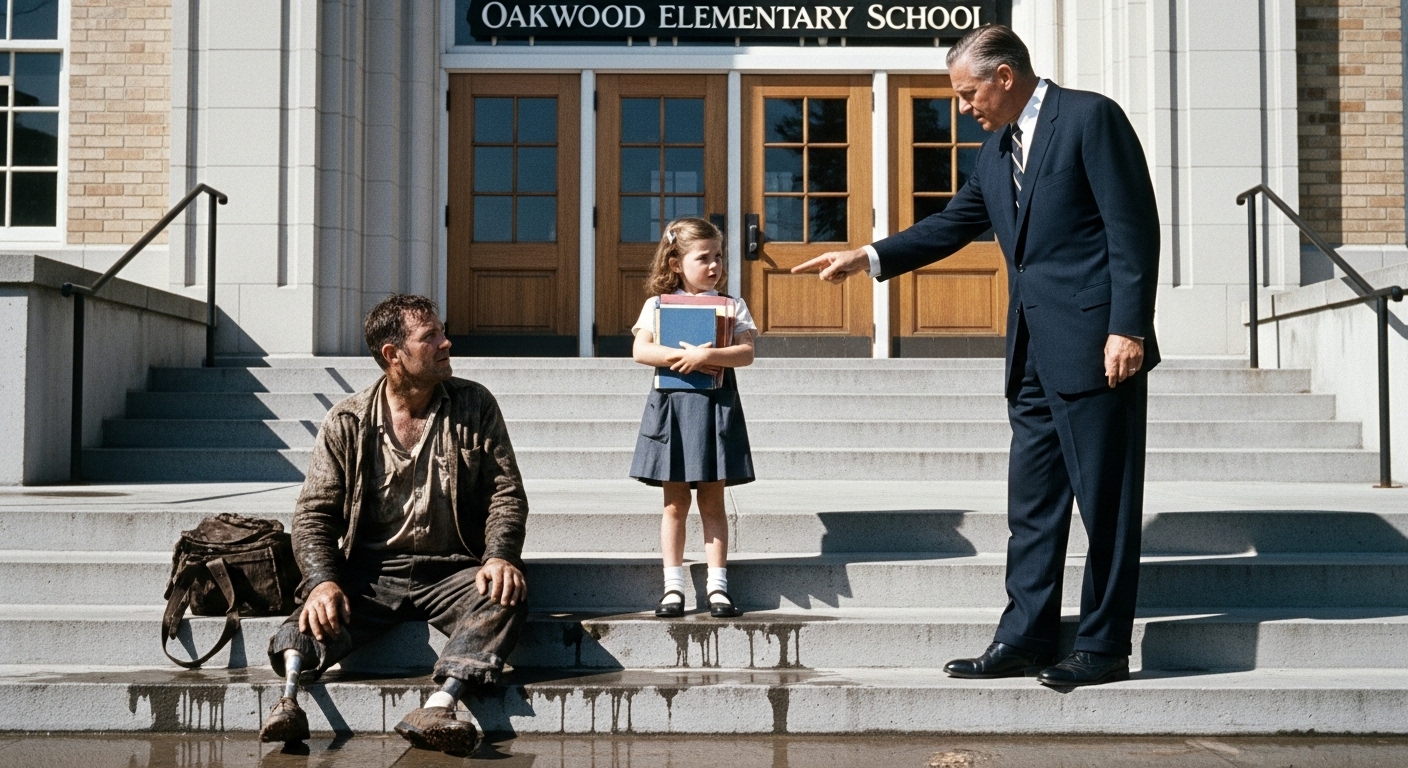
The Man Who Walked on His Knees: A Father’s 5-Mile Crawl Through Hell for His Daughter’s Future
Chapter 1: The Iron Will
The year was 1954, and the Appalachian Mountains of West Virginia wore their autumn colors like a bruised king. The hills were ablaze with burnt orange and dying crimson, a stark contrast to the soot-stained reality of Coal Hollow. Here, the sun seemed to apologize before it rose, filtering through a haze of coal dust that settled in the lungs of every man, woman, and child.
Elias Thorne sat on the edge of his porch, the rough-hewn wood groaning under his shifting weight. He was a man carved from the very bedrock of these mountains—broad-shouldered, with hands the size of shovels and a face weathered by forty-five years of hard labor and harder luck. But looking at Elias, your eyes were inevitably drawn downward, past the sturdy torso, past the faded denim of his cut-off overalls, to where his legs ended abruptly just below the knees.
The accident at the Black Ridge Mine three years ago hadn’t killed him, though some nights, when the phantom pains shot through his missing limbs like lightning, he wished it had. The mountain had taken his legs as payment for the coal he’d stolen from her belly. Now, he navigated his world on thick leather pads strapped to his stumps, swinging his torso forward on calloused knuckles, a movement that was part ape, part broken angel.
Inside the small, drafty cabin, the smell of chicory coffee and woodsmoke hung heavy in the air. It was a poor house, but clean. The floorboards were scrubbed white, and the curtains, though patched, were bright yellow.
“Daddy?”
The voice was small, fragile, like a bird chirping in a thunderstorm. Elias turned, his movements pivoting on his hips. Standing in the doorway was Lily. At eight years old, she was tiny for her age, her growth stunted by the same malnutrition that plagued the whole hollow. But her eyes—God, her eyes—were vast pools of intelligence that seemed to swallow the world whole.
“I’m here, Lil-bit,” Elias said, his voice a gravelly rumble.
Lily held up a scrap of newspaper she had found lining the pantry shelf. It was months old, stained with grease. “I read the big word, Daddy. ‘Con-sti-tu-tion.’ Is that right?”
Elias felt a familiar ache in his chest, sharper than the pain in his stumps. He couldn’t read. He knew his name, and he knew numbers, but the letters were like scattered ants to him. Yet, Lily… Lily had taught herself the alphabet from soup cans.
“That’s right, baby,” he lied, trusting her more than he trusted himself. “That’s exactly right.”
Today was the day everything was supposed to change. The county had finally approved Lily for the elementary school across the ridge—Cedar Creek Elementary. It was the only school with a real library, with heat, with teachers who had degrees. It was her ticket out of a life of scrubbing floors and marrying a miner who would die at forty.
“Get your coat,” Elias said, pulling himself up. “Bus’ll be at the bottom of the holler in twenty minutes.”
The descent from their cabin to the main road was a quarter-mile of steep, rutted dirt. Usually, Elias stayed close to the house, but today, he moved with purpose. He swung his body, his leather-padded knees thudding against the hard earth, his knuckles acting as feet. Lily walked beside him, clutching her one treasure: a notebook made of brown paper bags stitched together.
When they reached the bottom, the yellow school bus was already idling, spewing gray smoke. The driver, a man named Miller with a face like a pinched crab, watched them approach through the rearview mirror. He didn’t open the door immediately.
Elias pulled himself up to the first step, his breath visible in the cold morning air. “Morning, Miller. Bringing Lily for her first day.”
Miller looked down at Elias, then at the steep, winding dirt road that led up to the hollows, and finally at Lily’s worn-out shoes.
“Can’t take her, Elias,” Miller said, not bothering to kill the engine.
Elias froze. “She’s registered. I got the papers right here in my pocket.”
“It ain’t the papers,” Miller spat, chewing on a toothpick. “It’s the route. The board said the bus don’t go up to the hollows no more. Too much wear and tear on the suspension. The paved road ends five miles back. If she wants to catch the bus, she’s got to meet it at the junction.”
“The junction?” Elias’s voice rose. “That’s five miles over the ridge. Through the woods. She’s eight years old, Miller. She can’t walk that alone.”
“Then she don’t go to school,” Miller said, reaching for the lever to close the door. “Rules are rules. This bus is for taxpayers, not hillbillies who don’t pay a dime.”
“I paid my taxes with my legs!” Elias roared, grabbing the door frame. His biceps bulged, threatening to rip the metal.
Miller flinched but didn’t back down. “Get off, Elias. Before I call the sheriff.”
The door slammed shut, missing Elias’s fingers by an inch. The engine roared, and the bus pulled away, spraying gravel and dust over the crippled man and his daughter.
Elias sat there in the dirt, the silence of the mountain rushing back in to fill the space left by the engine. He looked at Lily. She wasn’t crying. She was staring at the departing bus with a look of utter resignation, a look that said she expected this, that she knew the world didn’t want her.
That look broke Elias Thorne’s heart, and then, it forged it into iron.
He looked at the ridge—the jagged spine of the mountain that separated their hollow from Cedar Creek. Five miles. Ten miles round trip. Steep shale, icy creeks, tangled undergrowth. A death march for a man with no legs.
He looked at his hands. They were scarred, thick, and tough as leather.
“Daddy?” Lily whispered. “It’s okay. I can learn from the newspapers.”
Elias turned to her. He reached out and brushed a smudge of coal dust from her cheek.
“No,” he said, his voice low and terrifyingly calm. “You ain’t learning from trash anymore, Lily. You’re gonna read books. Real books. With gold letters on the spine.”
“But the bus…”
“To hell with the bus,” Elias growled. He looked up at the mountain, his eyes narrowing. He had fought the mountain his whole life. The mountain had taken his father, his brothers, and his legs. But it wasn’t going to take his daughter’s mind.
“Come on,” he said, turning back toward the steep climb home. “We got work to do.”
Back at the cabin, Elias went to the shed. He pulled down his old mining belts—thick, industrial leather meant to hold heavy battery packs. He found a canvas sack and sturdy buckles. For three hours, he cut and riveted, his brow furled in concentration.
“What are you making?” Lily asked, watching him from the porch.
Elias held up his creation. It looked like a harness, sturdy and reinforced, designed to strap securely to his broad back.
“I can’t walk like other daddies,” Elias said, looking her in the eye. “And you can’t walk that ridge alone. So, we’re gonna make a deal, you and me.”
He crawled over to her, holding out the harness.
“I’ll be your legs,” Elias said, his voice cracking with emotion. “And you… you be my eyes. We’re going to that school, Lily. Every single day.”
Lily touched the rough leather. “It’s five miles, Daddy.”
“I know.”
“It’s steep.”
“I know.”
“You’ll get hurt.”
Elias smiled, a sad, crooked smile. “I’m already broken, baby girl. Can’t break what’s already smashed. But you… you’re whole. And you’re gonna stay that way.”
Chapter 2: The Bloody Miles
The routine began the next morning, long before the sun dared to crest the peaks.
At 5:00 AM, the world was pitch black and biting cold. Elias strapped the heavy leather pads onto his stumps. He had doubled the thickness, adding layers of old tire rubber to the bottom, but he knew it wouldn’t be enough. The earth here wasn’t soft loam; it was shale and granite, teeth of the mountain waiting to chew.
He knelt, and Lily climbed onto his back. He secured the harness, buckling her tight against him. She weighed barely fifty pounds, light for a child, but heavy for a burden carried five miles over a mountain.
“Hold tight,” Elias grunted.
He stepped off the porch—not with feet, but with his hands. Thud-swing. Thud-swing.
The first mile was familiar territory, the path leading up out of their hollow. But as they reached the ridge line, the terrain turned hostile. The path narrowed to a deer trail, littered with sharp rocks and tangled roots.
Every step was a calculation. Elias had to plant his hands, ensuring they wouldn’t slip on the wet leaves, then swing his torso forward, landing on his knees. The impact jarred his spine every time. Thud. A shockwave of pain traveled up his thighs. Thud.
“Tell me a story, Daddy,” Lily whispered into his ear, her breath warm against his cold neck.
“Once…” Elias grunted, sweating despite the freezing air. “Once there was a giant… who lived in a coal mine…”
He distracted her. He told her lies about a world where food was plentiful and winters were warm. Meanwhile, the ground was tearing him apart. The jagged shale sliced through the tire rubber on his pads. By the third mile, he could feel the sharp edges pressing against the scar tissue of his stumps.
They crossed a creek, the water freezing. Elias didn’t hesitate. He plunged his hands into the icy mud, the water soaking his pants, freezing his stumps. He didn’t stop. If he stopped, the cold would seize his muscles, and they would die out here.
When they finally crested the last hill and saw the school in the valley below, Elias was panting like a dying dog. His arms trembled uncontrollably.
He crawled to the front gate of Cedar Creek Elementary just as the bell rang. The other children, clean and delivered by cars or the bus, stopped and stared. Mothers in pressed dresses gasped, pulling their children back.
Elias Thorne was a terrifying sight. He was covered in mud up to his chest. His hair was wild, his face streaked with sweat and dirt. But on his back, Lily was pristine. Her dress was clean, her shoes dry. She hadn’t touched the ground once.
He lowered himself near the steps and unbuckled the harness. “Go on,” he wheezed. “Learn something.”
Lily hesitated, looking at him. “Daddy, your knees…”
“Go!” he barked softly.
As Lily ran up the stairs, a shadow fell over Elias. It was Mr. Abernathy, the head of the school board—a tall man in a pristine wool suit who smelled of expensive tobacco and arrogance.
“Thorne,” Abernathy sneered, looking down at the man on the ground. “You’re making a scene. Look at you. You’re an animal.”
Elias wiped the mud from his face, looking up. “Just bringing my girl to school, Mr. Abernathy.”
“You’re getting mud on the school steps,” Abernathy pointed a polished shoe at the dirt Elias had dragged in. “Why torture the girl? Look at where she comes from. She’s destined for a housekeeping apron, not a diploma. You people… you don’t need books. You need shovels.”
The other parents murmured in agreement. It was the unspoken law of the town: the hill people stayed in the hills.
Elias felt a rage burn in his gut, hotter than the mine fires. He wanted to reach up, grab Abernathy by his perfect ankles, and snap them. But that would get Lily expelled.
Instead, Elias slowly pulled a rag from his pocket. With dignity that silenced the crowd, he wiped the mud from the concrete step where he had rested.
“Mr. Abernathy,” Elias said, his voice projecting across the silent courtyard. “My legs are broken, sir. The mine took them to heat your big house.”
He paused, staring deep into the rich man’s eyes.
“My legs are broken. But her mind ain’t. And as long as I got breath in my lungs, she’s gonna sit in that classroom. You can hate me, you can mock me. But you will teach her.”
He turned around, swinging his body back toward the mountain. He had five miles to crawl back home, alone, only to turn around and do it all again at 3:00 PM to pick her up.
As he moved away, he left two trails in the dirt—drag marks from his knees. But to anyone watching closely, they looked like the tracks of a tank going to war.
Chapter 3: The Storm
November turned to December, and the mountain became a white beast. The snow wasn’t the fluffy kind seen on Christmas cards; it was heavy, wet, and lethal.
Elias’s stumps were a mess. The skin was constantly chafed, raw, and bleeding. He wrapped them in rags soaked in moonshine every night to fight off infection, biting on a leather strap to keep from screaming. But every morning, he strapped the pads back on.
Then came the day of the blizzard.
The sky had been gray all morning, but by noon, the snow began to fall in sheets. At the cabin, Elias watched the window. The wind was howling like a banshee. He knew the school would close early, but he also knew the bus wouldn’t run, and the teachers wouldn’t drive Lily home.
He left the house at 1:00 PM. The snow was already six inches deep.
By the time he reached the school, it was a whiteout. The teachers were huddling the children in the hallway. When the principal saw Elias—caked in snow, his eyebrows frozen with ice—he looked like a yeti.
“Mr. Thorne! You can’t take her in this!” the principal shouted over the wind.
“Can’t leave her neither!” Elias yelled back. “This school ain’t got coal for the night. She’ll freeze here.”
He strapped Lily in. She was shivering violently. “Put your head in my coat, Lily. Don’t look out.”
The journey back was a descent into hell. The snow hid the treacherous rocks. Elias couldn’t use his hands to feel the ground anymore; they were numb blocks of ice. He moved on instinct and pure, adrenaline-fueled desperation.
Two miles from home, disaster struck.
They were traversing a narrow ridge known as ‘Devil’s Elbow.’ Elias placed his right hand on what looked like solid ground, but it was a patch of black ice hidden under powder.
His hand slipped.
“Daddy!” Lily screamed.
Gravity took them. They tumbled off the path, rolling down the steep embankment. The world was a blur of white snow and black rock. Instinctively, Elias curled his body, wrapping his massive arms around his back to shield Lily.
They slammed into a limestone outcrop with a sickening crunch. Elias took the entire force of the impact on his side and his exposed stumps.
Silence returned to the woods, broken only by the wind.
“Daddy? Daddy wake up!”
Elias groaned. The pain was blinding. He tried to move, and a scream tore from his throat. His left pad had been ripped off in the fall. The stump was bare, bleeding onto the snow, and worse—his ribs felt shattered.
“Are you hurt, Lily?” he rasped, spitting blood.
“No, Daddy. You saved me. But… look at your leg.” Lily was sobbing now, terrifying, heaving sobs.
Elias looked. The snow around them was turning crimson.
“Don’t look at it,” he commanded. “Get back on the harness.”
“Daddy, you can’t!”
“GET ON!” he roared, the loudest he had ever yelled at her.
Terrified, she climbed onto his back. Elias dug his fingers into the frozen earth. He couldn’t lift his torso anymore. He had to drag himself. Inch by inch. Belly to the snow.
He began to hallucinate. He saw his dead wife beckoning him to sleep. He saw the mine foreman telling him to quit.
Just sleep, Elias. It’s warm in the snow.
No, a voice inside him whispered. She’s heavy. She’s real. Feel her heart.
He could feel Lily’s frantic heartbeat against his spine. Thump-thump. Thump-thump.
It became his rhythm.
Pull. Drag. Scream. Pull. Drag. Scream.
He left a trail of blood a mile long. He crawled over rocks that stripped the skin from his stomach. He clawed through briars that tore his face. He was no longer a man; he was a machine of will fueled by love.
When the cabin finally came into view, Elias didn’t feel relief. He felt nothing. The lights were out. He dragged himself up the wooden steps, his fingernails leaving gouges in the wood, and collapsed halfway through the door.
“Daddy!” Lily’s scream echoed down the hollow, piercing the storm.
Chapter 4: The Silence and The Sound
Elias didn’t die, though the doctor said he should have.
Neighbors found them an hour later—drawn by Lily’s ringing of the emergency bell on the porch. They found Elias unconscious in a pool of melting red snow, Lily curled on top of him, trying to warm him with her body.
The recovery was slow and brutal. The frostbite took two toes from his remaining foot structure (what little there was of his knees). The infection nearly took his life. He was bedridden for three months.
Winter passed into spring. The birds returned, but Elias Thorne did not leave his bed.
A dark depression settled over him. He looked at his ruined stumps, now wrapped in thick bandages. He could barely move to the outhouse, let alone hike the mountain.
“I failed you,” he whispered to Lily one evening. She was sitting by his bed, reading Huckleberry Finn.
“No, you didn’t,” she said firmly.
“You ain’t been to school in three months, Lily. You’re gonna fall behind. You’ll end up… like me.”
“I won’t,” she said. “I read every book you brought home. I’m teaching myself.”
But Elias knew it wasn’t enough. The light in her eyes was dimming. She was becoming a nursemaid, a creature of the dark cabin. The victory of the autumn was gone. Abernathy had won. The mountain had won.
Then, on a Tuesday morning in April, a sound broke the silence.
It was the rumble of a truck engine, followed by heavy boots on the porch.
The door opened without a knock. Standing there was Jim Miller—not the bus driver, but a big, burly miner from the next hollow over. Behind him stood three others. Men Elias had worked with in the mines. Men with coal dust in their pores.
“Get the girl ready, Elias,” Jim said, taking off his cap.
Elias propped himself up on his elbows. “What?”
“We heard what you did,” Jim said, looking at the floor, shifting uncomfortably. Hill men didn’t talk about feelings. “We saw the blood on the snow, Elias. The whole damn mountain saw it.”
Jim gestured to the window. Outside, the men had built something. It was a sort of sedan chair—a sturdy seat mounted on two long poles, with wheels for the flat parts and handles for the carrying.
“We made a roster,” another miner said. “There’s twelve of us. We work shifts. I take the morning leg; Jim takes the afternoon. We’re carrying her over the ridge.”
Elias felt tears prick his eyes—hot, unfamiliar tears. “Why? You barely know us.”
Jim looked Elias in the eye. “You crawled, Elias. You crawled so she could fly. A man does that… well, it wakes the rest of us up. We figure, if you can give your legs, we can give our backs.”
Elias looked at Lily. She was already grabbing her books, her face glowing like the sunrise.
“Mr. Abernathy ain’t gonna like it,” Elias choked out.
Jim grinned, revealing a missing tooth. “Mr. Abernathy can kiss my black, coal-dust-covered ass.”
For the next seven years, the rotation never missed a day. Rain, shine, or snow, the men of the hollow came. They carried Lily Thorne like a princess of the Appalachians, over the ridge, past the dangers, to the door of education. Elias watched from the porch, a broken man who had moved a mountain.
Chapter 5: The Giant’s Shoulders
Fifteen Years Later – 1969
The auditorium of the University of Virginia was a sea of black caps and gowns. The air buzzed with the excitement of graduation. Parents in their Sunday best fanned themselves with programs.
At the podium, the Dean adjusted the microphone. “And now, it is my distinct honor to introduce the Valedictorian of the Class of 1969, graduating Summa Cum Laude in Medicine… Dr. Lily Thorne.”
Applause rippled through the hall, polite at first, then swelling.
Lily walked to the stage. She was tall now, striking, with a confidence that commanded the room. But she didn’t look at the audience immediately. She looked down at the front row.
There was a space reserved for wheelchairs. It was empty.
Elias had passed away the winter before, his heart finally giving out after years of struggle. He hadn’t lived to see this moment, not with his eyes. But Lily felt him. She felt the weight of the leather harness. She felt the rhythm of his crawl.
She gripped the podium, her knuckles white.
“Ladies and gentlemen,” she began, her voice clear and strong. “They tell me I have walked a long road to get here. They praise my diligence, my study, my hard work.”
She paused, scanning the crowd until her eyes landed on a row of old men in the back—Jim Miller and the surviving miners who had driven five hours to be here. They looked out of place in their cheap suits, but they sat taller than anyone else.
“But the truth is,” Lily continued, her voice trembling slightly, “I didn’t walk. I never walked.”
The room went silent.
“I was carried,” she said. “I was carried by a man who had no feet, yet stood taller than any man I have ever known. My father, Elias Thorne, was a coal miner. He was told that people like us didn’t need books. He was told to stay in the mud.”
She pulled a small, tattered object from under her gown. It was a piece of old, bloodstained leather—a scrap of the pad Elias had worn on his knees.
“He crawled five miles a day, on bleeding stumps, through blizzards and ridicule, just so I could learn the alphabet. He broke his body so I could build my mind.”
Tears streamed down her face, but she didn’t wipe them away.
“I am not standing here because I am smart,” she declared, her voice soaring. “I am standing here because I soared on the back of a giant who walked on his knees so I could stand on my feet.”
She looked at the camera capturing the event.
“This degree is not mine. It belongs to Elias Thorne. And in his name, I am announcing the opening of the Thorne Rural Education Fund. We will build schools in the hollows. We will buy buses. No father will ever have to bleed again for his child’s future.”
The silence held for a heartbeat, and then, the auditorium exploded. It wasn’t just applause; it was a roar. People stood. They wept. The miners in the back threw their caps in the air.
Lily looked up toward the ceiling, past the lights, past the roof, toward the sky.
We made it, Daddy, she thought. We finally got to the top of the mountain.