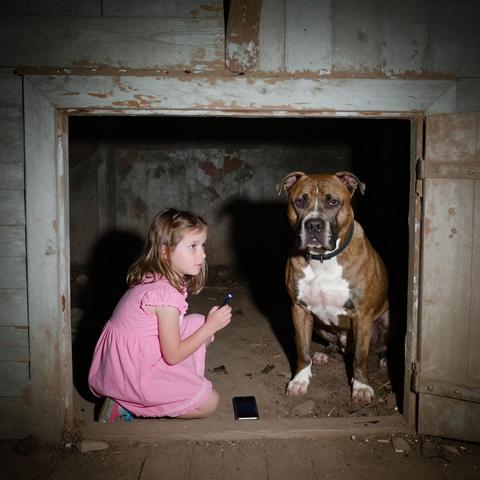
Teacher Banned Her From The Daddy-Daughter Dance For “Ruining The Photos”—Then The Gym Doors Kicked Open And Everyone Froze
Chapter 1: The Silence of the Blue Star
The late October wind in Virginia had a bite to it, swirling the fallen maple leaves into miniature tornadoes that danced across the pristine asphalt of the Oak Creek Academy parking lot. Sarah tightened her scarf, her knuckles white as she gripped the steering wheel of her 2014 sedan. It was the oldest car in the pickup line by a decade, a rust-spotted blemish amidst a sea of glistening Range Rovers and Teslas.
In the backseat, seven-year-old Mia was humming. It was a soft, melodic sound, entirely at odds with the knot of anxiety tightening in Sarah’s chest.
“Mommy?” Mia stopped humming. “Do you think the mail came yet?”
Sarah’s heart sank. It was the same question every afternoon for the past six months. “We’ll check as soon as we get home, baby.”
“Maybe today is the day,” Mia whispered, more to herself than to Sarah.
Sarah didn’t have the heart to tell her that “the day” might not come for a long time. Her husband, Jack—Staff Sergeant Jack Miller—had been deployed two years ago. The first year, they had video calls and sporadic emails. But for the last eight months, there had been nothing. Total radio silence. His unit had gone “dark” on a classified mission. The military liaison officer, a sympathetic man named Captain Reynolds, had told Sarah, “No news is good news, Mrs. Miller. It means they are focused. It means they are safe.”
But “safe” felt like a hollow word when you were a seven-year-old girl who was forgetting the sound of her father’s voice.
The financial strain was another beast entirely. Oak Creek Academy was expensive. Jack’s salary and Sarah’s double shifts at the diner barely covered the tuition. But Jack had insisted. “I want her to have the best, Sarah. I want her to have the opportunities I didn’t get.” So, they scraped. They sacrificed. Sarah wore shoes with worn-out soles so Mia could have the correct uniform blazer.
As they pulled into the driveway of their small, rented bungalow, Mia unbuckled before the car fully stopped. She bolted to the mailbox, her small sneakers pounding the pavement.
Sarah watched through the windshield, holding her breath. She saw Mia open the black metal box, reach her hand inside, and pull it out.
Empty.
Mia’s shoulders slumped. The light went out of her eyes, replaced by a dull resignation that no seven-year-old should ever know. She trudged back to the car, head down.
“Nothing,” Mia said, climbing back in.
“Maybe tomorrow,” Sarah said, forcing a smile she didn’t feel. “Come on. Let’s go inside. I made mac and cheese.”
That evening, after homework, Mia sat at the kitchen table, staring at a flyer she had pulled from her backpack. She pushed it across the laminate table toward Sarah.
THE OAK CREEK ACADEMY ANNUAL DADDY-DAUGHTER DANCE A Night of Elegance and Bonding November 12th – 6:00 PM Grand Ballroom Gymnasium
Sarah felt a chill. She knew this was coming. Last year, Mia had “flu” on the night of the dance—a convenient lie Sarah had told to spare her daughter the pain. But Mia was older now. She noticed things.
“Everyone is going, Mommy,” Mia said softly. “Chloe’s dad bought her a dress that looks like Cinderella’s. And Madison’s dad hired a limo.”
“Mia, honey,” Sarah started, sitting down and taking her daughter’s small hands. “You know Daddy is… he’s working very hard right now. He’s far away protecting us.”
“I know,” Mia said, her voice trembling. “But I don’t need a limo. And I don’t need a Cinderella dress. I just want to go. Can… can Uncle Mike take me?”
Sarah bit her lip. Her brother Mike lived in California. “Uncle Mike is working too, sweetie.”
“What about Grandpa?”
“Grandpa’s knees can’t handle the travel, baby.”
Mia looked down at her hands. “So I can’t go?”
“We can have a Mommy-Daughter dance right here!” Sarah suggested, trying to inject enthusiasm into her voice. “We can order pizza, put on loud music, and dance until we fall down!”
Mia looked up, tears brimming in her large brown eyes—eyes that were the exact shade of Jack’s. “But Mrs. Vanderwalt said it’s the most important night of the year. She said it’s where the young ladies learn to be treated like princesses.”
Cynthia Vanderwalt. The mere mention of the name made Sarah’s blood boil. The PTA President. The Queen Bee of Oak Creek Academy. A woman who wore pearls to drop-off and judged anyone whose net worth was under seven figures.
“Mrs. Vanderwalt says a lot of things,” Sarah said tightly.
“Please, Mommy?” Mia begged. “I won’t dance with anyone. I’ll just watch. I just want to see the lights and wear my Easter dress. Please? I don’t want to be the only one not there again.”
Sarah looked at her daughter’s desperate face. She couldn’t say no. She couldn’t break another piece of her heart.
“Okay,” Sarah sighed. “We’ll go. You can wear your pink dress. And you know what? You’ll be the most beautiful girl there.”
Mia shrieked with joy, throwing her arms around Sarah’s neck. “Thank you, thank you, thank you!”
But as Sarah held her daughter, staring at the “Daddy-Daughter” flyer, she felt a heavy pit in her stomach. She knew the social landscape of Oak Creek Academy. She knew that showing up without a father wasn’t just unusual; in the eyes of women like Cynthia Vanderwalt, it was a disruption of the aesthetic.
It was a declaration of war.
Chapter 2: The Gatekeeper of “Symmetry”
The week leading up to the dance was a blur of anxiety. Sarah worked extra shifts to buy Mia a new pair of white patent-leather shoes to match her pink dress. She wanted Mia to feel armored in beauty, to be so undeniable that her lack of a chaperone wouldn’t matter.
Three days before the dance, Sarah was waiting in the school lobby to pick up Mia for a dentist appointment when she heard the click-clack of expensive heels.
“Sarah! Just the person I wanted to see.”
Sarah stiffened. She turned to see Cynthia Vanderwalt approaching. Cynthia was wearing a white cashmere coat that probably cost more than Sarah’s car. Her smile was tight, reaching nowhere near her icy blue eyes.
“Hello, Cynthia,” Sarah said politely.
“I was looking over the RSVP list for Saturday’s gala,” Cynthia said, flipping through a clipboard. “I noticed you marked ‘Yes’ for Mia.”
“That’s right. She’s very excited.”
Cynthia sighed, a sound of exaggerated pity. She stepped closer, lowering her voice to a conspiratorial whisper. “Sarah, dear. I assume… Jack is still… away?”
“He is deployed, yes. Serving his country,” Sarah said, her voice firm.
“Of course, of course. So brave,” Cynthia waved a manicured hand dismissively. “But that does present a logistical issue. You see, the opening ceremony involves a traditional waltz. Father and daughter. It’s choreographed. It’s about… symmetry. Connection.”
Sarah narrowed her eyes. “Mia knows she can’t do the waltz without a partner. She just wants to attend. She wants to be with her friends.”
Cynthia pursed her lips. “Well, that’s just it. It can be quite… traumatic for a child to be on the sidelines. Seeing all the other girls being spun around, receiving corsages… I’m just thinking of Mia’s well-being. Wouldn’t she be happier at home? Perhaps watching a movie?”
“Mia wants to be there, Cynthia. She’s seven. She doesn’t care about your choreography. She cares about being included.”
Cynthia’s mask slipped, just for a fraction of a second, revealing the sneer underneath. “It is a Daddy-Daughter dance, Sarah. Not a ‘Single Mother Pity Party.’ We have standards at Oak Creek. We have an image to maintain for the newsletter photos. A lone child standing in the corner ruins the aesthetic.”
Sarah felt the heat rise up her neck. “Are you telling me my daughter is banned because her father is fighting a war?”
“I’m not saying ‘banned,'” Cynthia said sweetly, stepping back as other parents began to filter in. “I’m strongly suggesting that for the sake of the event’s dignity—and Mia’s—you keep her home. It’s couples only for the main floor. If she comes, she’ll have to stay in the spectator seating. Alone.”
“She can handle it,” Sarah spat out.
“We shall see,” Cynthia said, checking her watch. “Oh, look at the time. Ta-ta, Sarah. Give my best to… wherever Jack is.”
Sarah drove home shaking with rage. She wanted to scream. She wanted to pull Mia out of that school. But she remembered Jack’s letters from the first year. “Don’t let them push us out, Sarah. We belong there just as much as they do. Mia deserves the best education.”
She wouldn’t let Cynthia win.
On the morning of the dance, the atmosphere in the Miller house was electric. Mia woke up at 6:00 AM, too excited to sleep. She spent hours brushing her hair. Sarah curled Mia’s locks into perfect ringlets, securing them with a ribbon that matched the sash of her dress.
“You look like an angel,” Sarah whispered, fighting back tears as she adjusted the straps of the pink satin dress.
“Do I look like a princess?” Mia asked, twirling.
“Better. You look like a Queen.”
But as the afternoon wore on, the reality set in. They drove to the school as the sun began to set. The parking lot was already filling up. Men in tuxedos and military dress uniforms (mostly officers from the Pentagon who worked desk jobs) were escorting their daughters. The girls held flowers. The fathers held doors.
Sarah parked the car and walked Mia to the entrance of the gymnasium.
“Okay, baby,” Sarah said, kneeling down. “I can’t go inside. It’s dads only. But I’ll be right outside in the lobby with the other moms. If you need anything—anything at all—you come find me.”
“I will,” Mia said. She looked a little small, standing there in the shadow of the brick building.
“And remember,” Sarah said fiercely. “You hold your head up high. You are Sergeant Jack Miller’s daughter.”
Mia nodded, took a deep breath, and walked through the double doors. Sarah watched her go, her heart breaking, before retreating to the “Mother’s Waiting Lounge” the PTA had set up in the cafeteria.
Inside the gym, the transformation was breathtaking. The PTA had spared no expense. Fairy lights draped from the rafters. Tables were covered in white linen and silver candelabras. A live string quartet was warming up in the corner.
Mia walked in, clutching her small beaded purse. She saw her friends instantly. Chloe and Madison were by the punch bowl, laughing. But as Mia approached, she stopped.
Standing beside every girl was a towering figure. A dad. A protector.
Mia felt the first prickle of isolation. She walked toward the group.
“Hi, Chloe!” Mia chirped.
Chloe turned, her smile fading slightly as she looked behind Mia. “Where’s your dad?”
“He’s… he couldn’t make it,” Mia said, her voice smaller than she intended.
Before Chloe could answer, a shadow fell over them. It was Cynthia Vanderwalt. She was wearing a floor-length gold gown, holding a microphone. She looked down at Mia with a look of distaste.
“Mia Miller,” Cynthia said, her voice projecting slightly. “I see you decided to come.”
“Yes, Mrs. Vanderwalt,” Mia squeaked.
“Well,” Cynthia gestured to the far corner of the gym, away from the tables, away from the dance floor. There was a single metal folding chair set up near the emergency exit. “Since you don’t have an escort, you cannot sit at the banquet tables. Those are reserved for the pairs. You may sit there.”
“But… can’t I sit with Chloe?”
“Chloe is sitting with her father. It’s a seating chart, dear. We can’t rearrange the room for one person. Go on now. The ceremony is starting.”
Mia felt the eyes of the room on her. Other fathers were looking at her with pity, some with annoyance. She kept her head down, her face burning, and walked the long, lonely walk across the polished floor to the folding chair in the shadows.
She sat down, smoothing her pink dress. She was the only person sitting alone.
Chapter 3: The Cruelty of Silence
The next hour was a slow-motion torture. Mia watched as the waiters served sparkling cider and hors d’oeuvres to the tables. No one came to the folding chair. She was invisible, a ghost in a room full of life.
She tried not to cry. She counted the fairy lights. She traced the pattern of the lace on her dress. She thought about her dad. She imagined him walking in, wearing his camouflage, smelling like dust and peppermint gum. But the image was fading. She couldn’t quite remember his laugh anymore.
Then, the lights dimmed. A spotlight hit the center of the floor.
Cynthia Vanderwalt took the center stage, the microphone in hand. “Ladies and Gentlemen, distinguished fathers and beloved daughters. Welcome to the Oak Creek Gala.”
Applause rippled through the room.
“Tonight is about the bond that cannot be broken. The bond between a father and his little girl. And now, for our opening tradition. I ask all fathers to take the hand of their daughters for the Opening Waltz.”
The scraping of chairs filled the room. dozens of men stood up, offering hands to their beaming daughters. They moved to the dance floor, forming a perfect circle. The string quartet raised their bows.
Mia sat on her hands to stop them from shaking. She watched Chloe glide past. She watched Madison spin.
Cynthia stayed on the microphone. “Look at this perfection,” she cooed. “This is what Oak Creek is about. Family. Presence. Commitment.”
Then, Cynthia’s eyes flicked to the corner. To Mia.
“And let this be a lesson,” Cynthia said, her voice dripping with faux-sweetness but loud enough for the whole room to hear over the PA system. “To those who couldn’t be bothered to prioritize their children tonight… absence has consequences. We cannot hold up the symmetry of tradition for those who are… unavailable.”
It was a direct hit. A cruel, unnecessary jab at a seven-year-old girl.
A few fathers looked uncomfortable. One man whispered to his wife, “That was uncalled for.” But no one moved. No one spoke up. The social hierarchy of Oak Creek was too strong.
Mia finally broke. The first tear rolled down her cheek, hot and fast. Then another. She put her head in her hands, her shoulders shaking. She wanted to disappear. She wanted to melt into the floor. She felt rejected, unloved, and utterly alone.
The conductor raised his baton to start the music.
Wham.
The sound wasn’t the music.
It was the double doors of the gymnasium. They didn’t just open; they were thrown open with such force that they banged against the brick walls, echoing like a gunshot.
The entire room jumped. The conductor froze. The silence that followed was absolute.
Standing in the doorway, framed by the night, was a figure.
He wasn’t wearing a tuxedo. He was wearing the Dress Blues of the United States Army. The uniform was impeccable, the gold stripes shining under the gym lights, a chest full of ribbons and medals. But the man himself looked like he had been through hell. His face was gaunt, his eyes sunken with exhaustion, a fresh, jagged scar running along his jawline. There was dust on his polished shoes.
It was Staff Sergeant Jack Miller.
He stood there for a moment, breathing heavily, his eyes scanning the room. He looked like a lion who had just walked into a den of hyenas.
Cynthia Vanderwalt dropped her microphone. It hit the floor with a screech of feedback, but no one flinched. All eyes were on Jack.
He didn’t look at the parents. He didn’t look at the decorations. He didn’t look at Cynthia.
His eyes locked onto the small, trembling figure in the pink dress sitting on a folding chair in the dark corner.
Chapter 4: The Long Walk Home
Jack Miller stepped into the gym.
Clack. Clack. Clack.
The sound of his dress shoes on the hardwood floor was the only sound in the room. He walked with a purpose that terrified the civilians in the room. This was a man who had spent the last two years hunting high-value targets in the mountains of a foreign land. The air around him felt heavier.
He walked right through the center of the dance floor. Fathers stepped back, pulling their daughters out of his path, parting like the Red Sea. He walked past the expensive tables. He walked past the frozen waiters.
He never blinked. He never looked left or right. His gaze was a tether attached to his daughter.
Mia had lifted her head. Her eyes were wide, disbelief warring with hope. She stood up slowly, her hands clutching her dress.
“Daddy?” she whispered. It was too quiet to be heard, but Jack saw her lips move.
He closed the distance. When he reached the corner, he didn’t grab her. He didn’t rush. He stopped three feet in front of her.
Up close, the guests could see the toll the mission had taken. His hands were rough. His skin was weathered. He looked like he hadn’t slept in a week. (In fact, he hadn’t. He had been extracted from a combat zone 48 hours ago, hopped three cargo planes, and drove a rental car 14 hours straight from the airbase without stopping, changing into his uniform in a gas station bathroom just to make it here).
Jack swallowed hard, his Adam’s apple bobbing. His stoic military mask cracked, and a tear escaped his eye.
He took a step back, snapped his heels together, and bowed low—a formal, courtly bow that put every tuxedo-wearing banker in the room to shame. He extended his hand, palm up.
His voice was raspy, thick with emotion, but it carried to the back of the room.
“I apologize for being late, Princess. The traffic coming back from the other side of the world was a nightmare.”
A few mothers in the crowd let out audbile sobs.
“Daddy!” Mia screamed.
She didn’t take his hand. She launched herself at him.
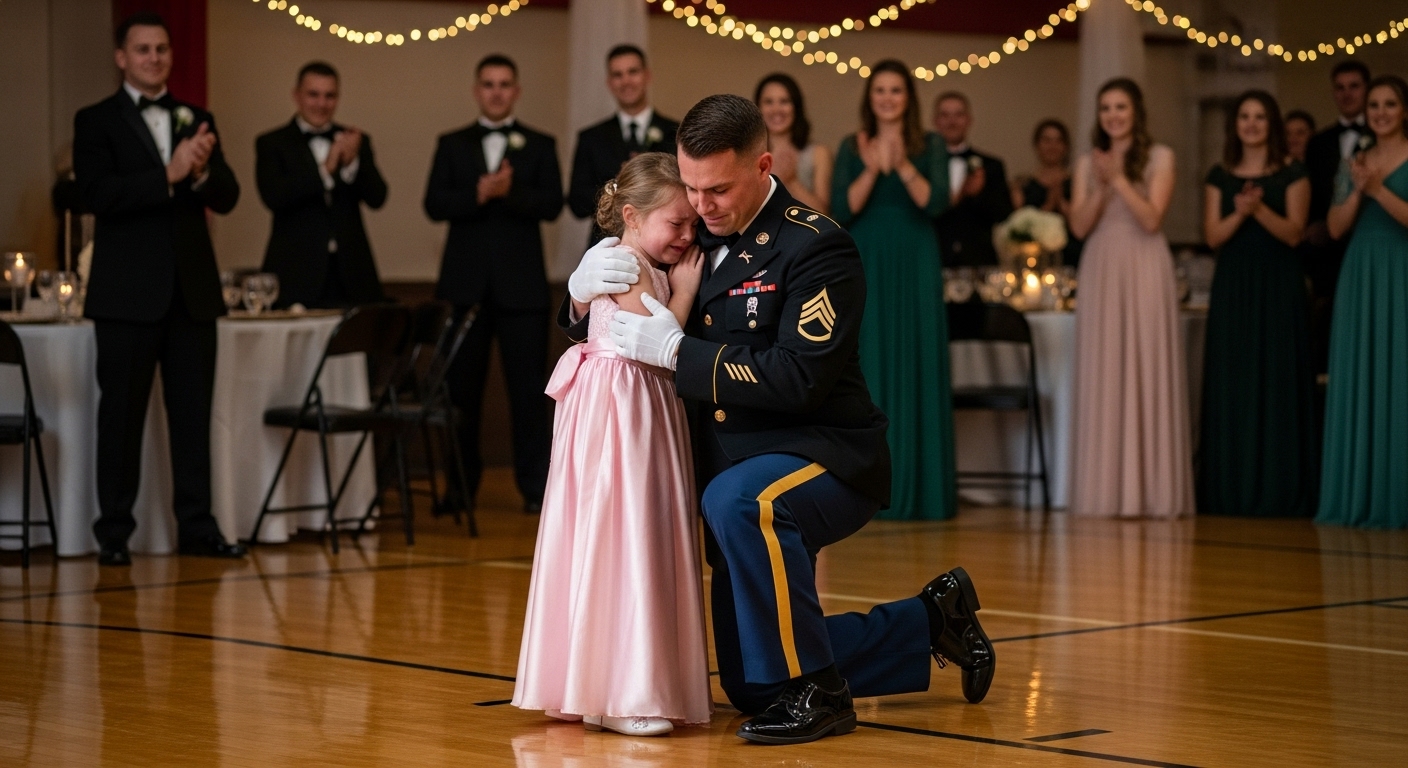
Jack caught her, dropping to his knees to embrace her. He buried his face in her neck, his shoulders shaking. The strong, terrifying soldier dissolved into a father holding his world.
“I missed you,” he choked out. “I missed you so much, baby. I’m sorry. I’m so sorry I was gone.”
“You came,” Mia sobbed into his shoulder. “You came.”
“I will always come for you, Mia. Always.”
Jack stood up, lifting Mia effortlessly into his arms. He turned around to face the room. He held Mia tight with one arm.
His eyes found Cynthia Vanderwalt, who was standing frozen near the stage, her face pale.
Jack walked toward the center of the floor, carrying Mia. He stopped in front of the string quartet. He looked at the conductor and gave a sharp nod.
“Play,” Jack commanded. It wasn’t a request.
The conductor scrambled to signal his musicians. The strains of “The Blue Danube” began to fill the air.
Jack set Mia down. He adjusted his uniform. He wiped the tears from her face with his thumb.
“May I have this dance, Miss Miller?”
Mia nodded, beaming brighter than the fairy lights above.
They began to dance. It wasn’t the perfect, choreographed waltz the other fathers had practiced. It was clumsy. Jack was stiff, and Mia was stepping on his toes. But it was the most beautiful thing anyone in that room had ever seen.
For a full minute, they were the only ones moving.
Then, slowly, the other fathers began to clap. It started with one—the man who had whispered earlier. Then another. Then the mothers.
Within seconds, the gymnasium erupted. It wasn’t polite golf claps. It was a roar. People were cheering. Fathers were whistling. The applause was a tidal wave that washed over the gym, drowning out Cynthia Vanderwalt’s planned “symmetry.”
Other fathers began to join in, leading their daughters onto the floor, but they left a wide circle around Jack and Mia, giving them the honor they deserved.
Sarah, who had heard the commotion and rushed to the door, stood at the entrance, her hands covering her mouth, tears streaming down her face. Jack saw her over Mia’s shoulder. He winked.
It was the wink she fell in love with.
As the song ended, Jack dipped Mia, and she laughed—a pure, bell-like sound that erased two years of silence.
Cynthia Vanderwalt was nowhere to be seen. She had quietly slipped out the back exit, realizing that her reign of terror had been broken by a man who had faced far scarier things than a PTA President.
Jack lifted Mia up again.
“Did I ruin the photos?” Jack asked, loud enough for the nearby parents to hear.
“No, Daddy,” Mia said, hugging his neck. “You made them perfect.”
And as the camera flashes went off, capturing the tall soldier and the girl in pink, everyone knew she was right. It was the only picture that mattered.