THE LAST DEAL: A Dying Millionaire Mother’s Secret Video Tapes Revealed
Chapter 1: The Silence of the Penthouse
The phone on the mahogany desk buzzed, vibrating against the polished wood like an angry hornet. It was a sound that had dictated the rhythm of Margaret Sterling’s life for forty years. At sixty-eight, Margaret was a legend in Chicago real estate. She didn’t just sell buildings; she brokered empires. She was the “Iron Lady of the Loop,” a woman who could stare down a boardroom of sharks without blinking.
But today, for the first time in decades, Margaret didn’t answer.
She sat in her Eames chair, staring out the floor-to-ceiling windows of her forty-second-floor penthouse. Lake Michigan looked like a sheet of hammered steel under the gray November sky. The view cost three million dollars, but the silence inside the apartment was free, and it was deafening.
“Stage four,” the doctor had said. He hadn’t used medical jargon. He knew who Margaret was; he knew she appreciated the bottom line. “Pancreatic. Aggressive. With treatment, maybe three months. Without it… perhaps four weeks.”
Margaret had nodded, checked her watch, and walked out. She didn’t cry. She had a closing at 2:00 PM.
But she never made it to the closing. Instead, she had told her driver to go home. Now, surrounded by Italian leather and modern art, the weight of the diagnosis finally settled on her chest, heavier than any contract.
She looked around the room. It was a museum, not a home. There were no photos on the mantle. No finger paintings on the fridge. Just sleek surfaces and dust-free corners.
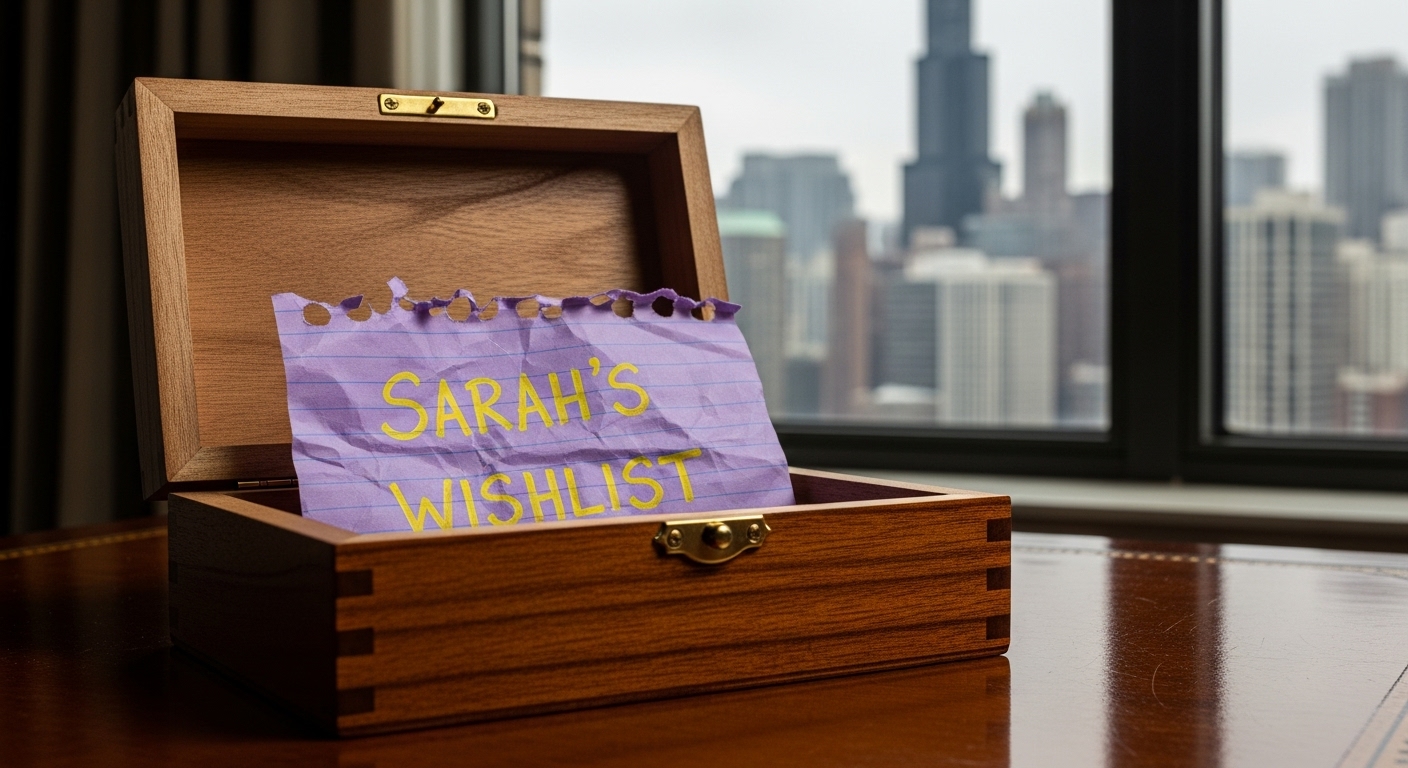
Her gaze drifted to the bottom drawer of her desk—the only drawer she kept locked. With trembling hands, she pulled out a small brass key from her necklace and opened it. Inside lay a wooden box, smelling of cedar and old memories.
Margaret lifted the lid. It wasn’t filled with jewelry or stocks. It contained a single, yellowed piece of construction paper, folded into a square.
She unfolded it. The handwriting was large, loopy, and done in purple crayon.
Sarah’s Wishlist (Age 10)
- Go to Disney World with Mom.
- Bake a crooked cake (with sprinkles).
- Catch a firefly in a jar.
- Have a tea party.
- Watch the sunset at Miller’s Point.
Margaret traced the letters with a manicured finger. She remembered the day Sarah wrote this. It was a Sunday. Margaret had been on a call with a developer from Tokyo. Sarah had tugged on her sleeve, holding up the list. Margaret had waved her away, mouthing, “Not now, honey. Mommy is working for our future.”
That was thirty years ago.
Ten years ago, Sarah had called one last time. She was getting married to a mechanic in Ohio. Margaret had laughed, calling it a mistake, and said she couldn’t miss the annual shareholders’ meeting. Sarah hung up. Margaret hadn’t heard her voice since.
Margaret picked up her phone. Her thumb hovered over Sarah’s name in her contacts—a number she had saved but never dialed. She pressed call.
Ring. Ring.
“The number you have reached is not accepting calls from this number.”
Blocked.
The automated voice felt like a physical slap. Margaret dropped the phone. A sob, ugly and jagged, ripped through her throat. She doubled over, clutching the purple crayon list to her chest. She had millions in the bank, a reputation that commanded fear and respect, and a closet full of designer suits. But in this cold, glass tower, she was the poorest woman in Chicago.
She had bought Sarah everything except her time. She had built a kingdom, but the princess had fled, and the queen was dying alone.
For two days, Margaret didn’t leave the apartment. She watched the sun rise and set over the lake. She thought about legacy. What would they say at her funeral? That she increased market share by 15%? That she was efficient?
On the third morning, Margaret woke up with a strange clarity. The pain in her abdomen was a dull roar, a constant reminder of the clock ticking down. She looked at the list again.
Bake a crooked cake.
She stood up. She walked to her bathroom, washed her face, and applied her lipstick—Chanel Red, her armor. But this time, she wasn’t dressing for a boardroom.
She went to her closet and pulled out a video camera she had bought years ago, intending to film virtual tours of luxury estates. She set it up on the tripod in the center of her pristine, unused kitchen.
She hit Record. The red light blinked.
Margaret sat on a barstool in front of the lens. She looked older without the professional lighting. Her eyes were tired.
“Hello, Sarah,” she began, her voice cracking. She cleared her throat and started again, her tone regaining some of that famous Sterling steel, though brittle now. “And… hello, Lily.”
She knew about Lily, her six-year-old granddaughter, only through a fake Facebook account she used to stalk her daughter’s life.
“I don’t expect you to forgive me,” Margaret said to the camera. “I don’t deserve it. I’m dying, Sarah. The doctors say I have a month. And I realized… I have a lot of unfinished business. Not deals. Not contracts.”
She held up the crumpled purple paper.
“I found this. Your list. I was too busy to do it with you then. And now… now you don’t want to do it with me. I can’t blame you. But I can’t leave this world with this list unchecked. So, I’m going to do it. For you. For Lily. So you can see that I did listen. I always listened, even when I didn’t look up.”
She took a deep breath.
“This is the last deal I’ll ever close. And it’s the only one that matters.”
Chapter 2: The Crooked Cake and The Carousel of Ghosts
The kitchen of Margaret’s penthouse was designed by an Italian architect. It featured a marble island large enough to land a helicopter on and appliances that cost more than most cars. It had never seen a bag of flour.
Until today.
Margaret stood before the camera, wearing a silk blouse covered in a frantic dusting of white powder. She looked at the recipe on her iPad.
“Okay,” she said to the camera, wiping sweat from her forehead. “It says to separate the eggs. I… I think I can do that.”
It was a disaster. Margaret, who could dismantle a complex merger agreement in ten minutes, could not crack an egg without shattering the shell. She fished out the crunchy bits with a spoon, laughing nervously.
“You wanted a crooked cake, Sarah,” she said, whisking the batter violently. “I remember you said ‘crooked’ because the cakes from the bakery were too perfect. You wanted it to lean. Well… I think Mom is going to deliver on that.”
The pain in her stomach flared, sharp and biting. She gripped the counter, her knuckles turning white. She waited for the wave of nausea to pass, forcing a smile for the lens.
“Grandma is okay, Lily,” she lied to the camera. “Just… a little tired.”
When the cake came out of the oven, it was indeed crooked. It slumped heavily to the left, resembling a sinking ship. Margaret covered it in an inch of neon pink frosting and showered it with rainbow sprinkles.
She lit a single candle.
“Happy un-birthday, Sarah,” she whispered. She blew out the candle. Then, she cut a slice, took a bite, and grimaced. It was dry and overly sweet. Tears streamed down her face, mixing with the flour on her cheeks. “It tastes terrible, baby. I’m so sorry. I should have baked this with you when you were ten.”
The next week, the decline was rapid. Margaret lost ten pounds. Her skin took on a grayish hue. But she refused to stop. She hired a private investigator, Mr. Henderson, a solemn man with kind eyes.
“I don’t want you to find them to bother them,” Margaret told him, handing him a thick envelope. “I want you to deliver the package when I’m… gone. Not a minute before.”
Item number three: Catch a firefly. It was November in Chicago. There were no fireflies.
Margaret didn’t care. She flew to a conservatory in the south that bred exotic insects. She rented the entire facility for an hour. With the camera rolling, the frail old woman shuffled through the humid, green space.
“It’s not quite the backyard, Sarah,” she wheezed, holding a jar.
When she finally caught one, its glow illuminating her hollowed face, she brought the jar close to the lens. “Look, Lily. Magic. Your mom used to say these were fairies. I told her they were just bioluminescent beetles. I was so stupid. They are fairies.”
Item number one: Disney World.
She couldn’t fly to Florida; she was too weak. Instead, she went to the Navy Pier. It was a Tuesday afternoon, cold and windy. She bought a ticket for the carousel.
The operator, a bored teenager, looked at her. “Just you, lady?”
“Just me,” Margaret said, adjusting her scarf to hide the port in her chest.
She climbed onto a painted horse. The music started—a calliope tune that sounded cheerful and haunting all at once. As the world spun, Margaret held her camera out. Around her, young mothers held their toddlers. Fathers snapped photos.
Margaret was an island of gray in a sea of color.
“I’m riding the horse, Sarah,” she said, her voice barely audible over the music. The wind whipped her hair. She closed her eyes and imagined a ten-year-old girl sitting on the horse next to her. She imagined the laughter she had silenced with her ambition.
She rode the carousel for an hour, until she was so dizzy she couldn’t stand. She vomited in a trash can nearby, wiping her mouth with a monogrammed handkerchief.
“I’m doing it,” she whispered fiercely to herself. “I’m checking the boxes.”
By the fourth week, Margaret could barely walk. Her driver, Thomas, had to carry her to the car.
“Ms. Sterling, please,” Thomas begged. “Let me take you to the hospital.”
“No,” Margaret rasped. She was wrapped in a cashmere blanket, her body frail as a bird’s. “One more. Number five. Miller’s Point.”
Miller’s Point was a cliff overlooking the lake, three hours north. It was where she and her late husband had taken Sarah for picnics before the business took over Margaret’s soul.
“It’s a three-hour drive, ma’am,” Thomas said, tears in his eyes.
“Then drive fast, Thomas,” she smiled weakly. “I have a sunset to catch.”
Chapter 3: The Sunset and The Sunrise
The drive was agony. Every bump in the road sent shockwaves of pain through Margaret’s body. She drifted in and out of consciousness, clutching the video camera like a lifeline.
When they arrived at Miller’s Point, the sun was beginning its descent, painting the sky in bruises of purple and orange.
“Thomas,” she whispered. “Set up the tripod. Facing the water. Put me in the chair.”
Thomas, weeping openly now, set up the folding chair near the edge of the cliff. He placed the camera on the tripod and hit record.
“Leave me for a moment, Thomas,” she ordered gently. “Go to the car.”
Margaret sat alone. The wind from the lake was biting, but she didn’t feel the cold anymore. She felt light. She looked into the lens.
“This is it,” she said. Her voice was stronger now, fueled by the last reserves of her adrenaline. “Item number five. Watch the sunset.”
The sun dipped lower, turning the water into liquid gold.
“Sarah,” Margaret said, staring directly into the lens. “I worked eighty hours a week because I was terrified. I grew up with nothing. I wanted to build a fortress of money around you so nothing could ever hurt you. I wanted to give you the best schools, the best clothes, the best life.”
She paused, a tear tracking through the deep lines of her face.
“I was so busy building the fortress that I forgot to live inside it with you. I thought love was providing. I didn’t know that love was just… being there. I didn’t know that a crooked cake was worth more than a trust fund.”
She coughed, a wet, rattling sound.
“I’m leaving you everything, Sarah. But the money doesn’t matter. This…” she tapped the camera. “This is all I have left to give. My time. Even if it’s borrowed time at the very end.”
She looked at the setting sun.
“It’s beautiful, honey. I wish you were here. I wish… I wish I had just come home that Sunday.”
Margaret closed her eyes. The camera continued to roll. It captured the sun slipping below the horizon. It captured the sky turning from gold to violet to black. It captured Margaret’s head tilting forward, her breathing slowing, until finally, it stopped.
The tape ran out ten minutes later.
Two weeks later, in a modest house in Ohio, a doorbell rang.
Sarah, now forty, wiped her hands on a dish towel. She looked tired. Her daughter, Lily, was drawing at the kitchen table.
Sarah opened the door. A man in a trench coat stood there. Mr. Henderson.
“Sarah Miller?”
“Yes?”
“My name is Henderson. I was hired by your mother, Margaret Sterling.”
Sarah’s face hardened. “I don’t want anything from her.”
“She passed away two weeks ago, ma’am,” Henderson said softly.
The anger on Sarah’s face didn’t vanish, but it cracked. She stood frozen. “Oh.”
“She wanted you to have this.” He handed her a heavy box and a large envelope. “And she wanted you to know… she finished the list.”
“What list?”
Sarah took the box inside. Her husband, Mark, joined her. They opened it. Inside was the video camera, SD cards labeled 1 through 5, and a jar containing a dead firefly. And a crumpled piece of purple construction paper.
Sarah recognized the handwriting immediately. Her breath hitched.
They plugged the camera into the TV.
For the next two hours, the house was silent except for the voice of Margaret Sterling. Sarah watched her mother—the invincible Iron Lady—covered in flour, looking ridiculous and frail. She watched her mother sitting alone on a carousel, looking small. She watched her mother in the greenhouse, talking to the bugs.
Sarah cried. She cried with a grief she hadn’t expected. She had mourned the loss of her mother years ago, but this was different. This was mourning the woman who was trying to come back.
Then came the final video. The sunset.
When Margaret spoke about building a fortress, Sarah leaned into Mark, sobbing uncontrollably. She saw the regret etched into her mother’s dying face. She saw the love that had been buried under layers of ambition and fear.
The screen went black.
Sarah sat there for a long time. Then, she felt a small hand on her shoulder.
“Mommy?” Lily asked. “Why is the grandma crying?”
Sarah pulled Lily into her lap. “Because she missed us, baby. She missed us very much.”
Sarah stood up. She walked to the kitchen. She opened the pantry and pulled out a bag of flour, sugar, and a tub of rainbow sprinkles.
“What are we doing?” Mark asked, wiping his own eyes.
“We have to finish the list,” Sarah said, her voice trembling but strong. “Lily, get the stool.”
They baked. It was messy. Eggshells fell into the bowl. Flour covered the floor. When the cake came out, it was lopsided. It leaned heavily to the right.
Sarah frosted it with pink icing and covered it in sprinkles. She cut a slice for Lily and one for herself.
She took a bite. It was dry, too sweet, and crunchy from the eggshells.
Sarah looked up at the ceiling, tears streaming down her face, but she was smiling.
“It tastes terrible, Mom,” she whispered. “It’s perfect.”