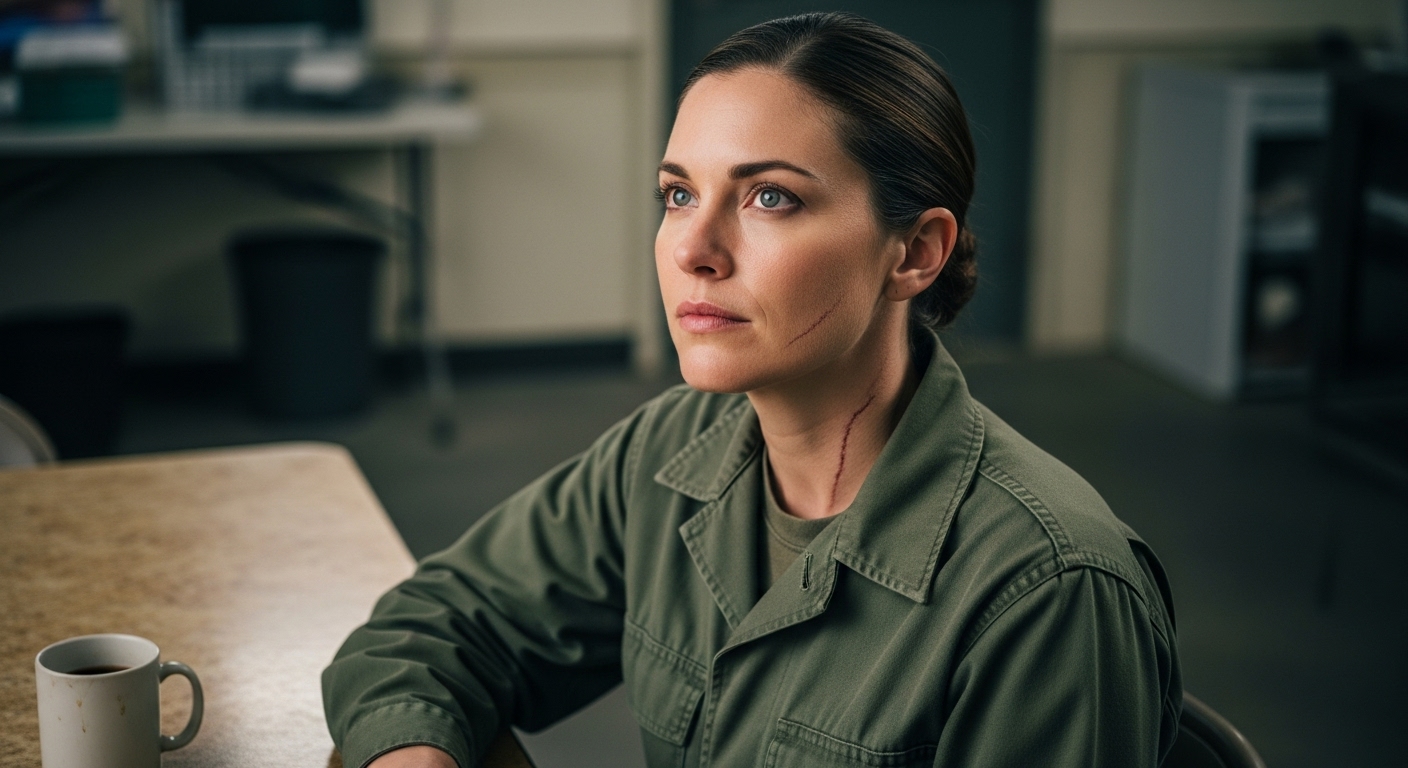
He laughed at the “admin lady” holding the clipboard, telling his friends I was just a secretary who needed to stay in my lane. He didn’t notice the combat scar hidden by my collar or the way the battle-hardened Sergeant froze in terror when he saw my eyes. He certainly didn’t know that the invisible woman he was publicly ridiculing was actually the Brigadier General sent to decide the fate of his entire career—and I was standing three feet away, taking notes on every single arrogant word.
PART 1: THE GHOST IN THE ROOM
It was the silence that I noticed first. Or rather, the specific kind of silence that people create around things they deem irrelevant. To them, I was just texture. I was part of the beige walls, the flickering fluorescent lights, the smell of floor wax and stale coffee in the Camp Pendleton training center. I was the “admin lady.” The help. The furniture.
And that was exactly what I wanted.
At 0500 hours, I had been standing in front of a mirror in a Motel 6 just off the highway, stripping away twenty years of identity. I took off the collar that held my rank. I placed the single silver star—heavy, cool to the touch, and earned through blood and fire in the Korengal Valley—into a velvet-lined wooden box. I smoothed out my uniform. Without the insignia, without the ribbons, without the command presence I usually projected like a forcefield, I looked like exactly what I was pretending to be: a mid-level bureaucrat from the Pentagon’s administrative support division. A paper-pusher.
My name is Brigadier General Artemis Blackwood. In the circles that matter, they call me “The Ghost,” a nickname earned during a rescue operation in 2009 that technically never happened. But today, I was nobody.
I had come to Camp Pendleton because of the reports. The kind of reports that don’t make it to the official files but whisper through the backchannels. Reports of a rot setting into the roots of my Corps. Favoritism. The “Good Old Boys” network protecting its own while burying real talent under bureaucracy.
I needed to see it. Not from behind a desk in D.C., and not as a General getting the “dog and pony show” tour where everyone paints the grass green before you arrive. I needed to see them when they thought no one who mattered was watching.
I stood at the back of the briefing room, clipboard in hand, looking non-threatening.
“All right, listen up!”
The voice boomed through the room, dripping with the kind of confidence that usually comes from a trust fund, not a trench. Captain Dominic Ror.
I watched him. He was handsome in a way that he was clearly very aware of. His uniform was tailored a little too tightly, his boots polished by someone else. He stood in the center of a circle of junior officers, holding court.
“My old man called me last night,” Ror was saying, loud enough for the whole room to hear. “General Richards is coming down next week for the final review. But honestly? It’s a formality. The promotion board already has the list. If your last name isn’t on the ‘Legacy’ registry, well… good luck with logistics.”
His sycophants laughed. It was a nervous, eager sound. They were satellites orbiting his gravity, hoping some of his shine would rub off on them.
I made a small checkmark on my clipboard. Captain Ror: Openly discusses nepotism as a career strategy. Undermines meritocracy.
Then, my eyes drifted to the corner of the room.
She was standing alone. Lieutenant Zara Nasar. She was small, wire-thin, with eyes that looked like they were constantly scanning a horizon for threats. She wasn’t laughing. She was reading a tactical manual, her lips moving silently. I knew her file. Top of her class at the Academy. Two tours. Commendations for innovation under fire.
And she was completely isolated.
“Hey, Nasar!” Ror shouted across the room. The laughter died down. “You still reading that thing? You know the enemy doesn’t actually follow the manual, right? Or did you miss that day in ‘How to be a Soldier 101’?”
Nasar didn’t flinch. She slowly lowered the book. “I’m reviewing the urban extraction protocols for the simulation, Captain. Since we’re leading a joint team today.”
Ror smirked. “Right. The ‘Joint Team.’ Just try to keep up, Lieutenant. And if the shooting starts, maybe stay behind the big boys. We don’t want you getting a papercut.”
The room erupted in laughter again. Ror winked at his friends.
I felt a cold, familiar calm settle in my chest. It was the same calm I felt before kicking in a door.
I walked over. My boots were soft-soled, silent on the tile.
“Mind if I observe your team today, Lieutenant?” I asked.
Nasar jumped slightly, as if surprised to be spoken to by a human being. She looked at me, then at my empty collar. She saw an admin. A civilian.
“Of course not, ma’am,” she said, her voice polite but tired. “Are you with the audit team?”
“Something like that,” I said softly.
Across the room, Ror saw us. He nudged a buddy. “Look at that. The library club found a new member. Looks like Nasar got herself a babysitter. Maybe the admin lady can help her file a complaint later.”
He raised his voice. “Hey! Make sure you spell my name right on the evaluation form, sweetheart!”
I didn’t look up. I didn’t blink. I just wrote.
Captain Ror: Displays aggressive chauvinism. Underestimates the intelligence of observers. Mark for immediate review.
The morning exercise was a disaster, and it was fascinating to watch.
The scenario was a hostage rescue in a dense urban environment. It was a simulation, but the stress was real. Ror took command immediately, shouting orders, dominating the radio channels. His plan was “Shock and Awe”—kick in the front door, throw flashbangs, and shoot anything that moved.
“Captain,” Nasar interrupted during the briefing. “Intel suggests the building is rigged. A frontal assault triggers the deadman switch. We need to breach from the roof and go silent.”
Ror rolled his eyes. “This isn’t a spy movie, Nasar. We go in hard. Speed is security. Dismissed.”
I watched Nasar’s face. She knew he was wrong. She knew his plan would get the hostages killed. But the chain of command was a heavy chain, and Ror was strangling her with it.
The simulation played out exactly as she predicted. Ror’s team hit the front door. The “booby traps” triggered. The simulation computer registered 100% casualties for the hostage team.
“Technical glitch,” Ror announced loudly to the room as the lights came back on. “The sensors are off. In the real world, we would have cleared that room before the trigger pulled.”
He took zero responsibility. He learned nothing.
Lunch was where the real war began.
The mess hall at Camp Pendleton is a social map. Officers on the left, enlisted on the right. Ror sat at the high table, loud and boisterous. Nasar ate alone in a corner.
I grabbed a tray. Standard chow—mystery meat, gray beans, coffee that tasted like battery acid. I walked past the officers. I walked past Nasar. I headed straight for the enlisted tables.
The conversation died as I approached. Marines are the most observant creatures on earth. They saw a woman in a uniform with no rank, walking into their territory.
“Seat taken?” I asked a young Lance Corporal.
He looked terrified. “No… uh, no, ma’am.”
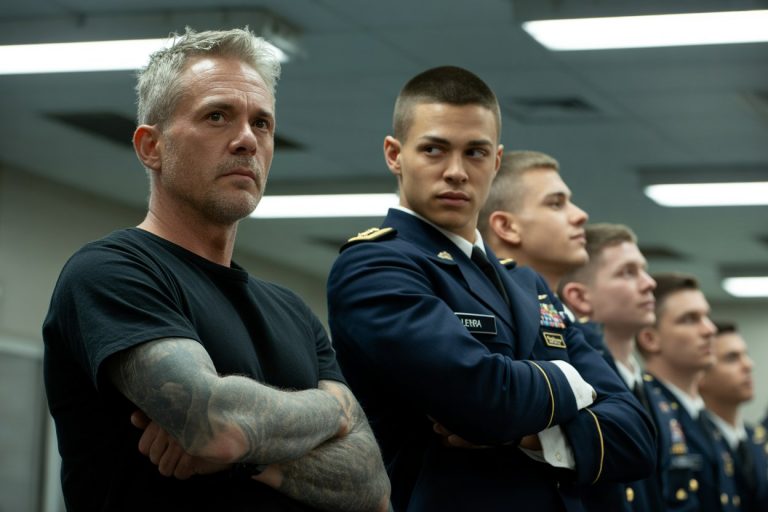
I sat down. Across from me sat a Sergeant. He was older, maybe mid-thirties, with a face that looked like it had been carved out of granite. A jagged scar ran from his temple to his jawline. He was eating methodically, but his eyes were locked on me.
He wasn’t looking at my tray. He was scanning me.
“You lost, ma’am?” the Sergeant asked. His voice was low, gravelly. “Officer’s Country is that way.”
“I prefer the company here,” I said, taking a bite of the beans. “Besides, the conversation is usually more honest.”
The Sergeant narrowed his eyes. He looked at my hands—calloused, not soft like an admin’s. He looked at the way I sat—spine not touching the back of the chair, eyes covering the exits.
“I know you,” he whispered.
It wasn’t a question.
Before I could answer, a shadow fell over the table.
“Ma’am.”
It was Captain Ror. He had actually gotten up from his throne to come over here. He was flanked by two of his lieutenants.
“You’re confused,” Ror said, his voice dripping with fake concern. “The civilian staff eats in the admin block. Or, if you must eat here, you sit with the officers. You’re making these men uncomfortable.”
The Sergeant across from me tensed. His knuckles went white on his fork. He started to stand up. “Sir, she’s fine—”
“Sit down, Sergeant!” Ror snapped. “I didn’t ask for your opinion. I’m trying to maintain standards.”
He turned back to me. “Come on. Let’s go. You can sit at my table if you promise not to bore us with paperwork talk.”
I slowly wiped my mouth with a napkin. I didn’t stand up. I looked up at him, letting the silence stretch until it became uncomfortable.
“I’m perfectly fine where I am, Captain,” I said. My voice was flat, devoid of emotion.
Ror’s smile twitched. He wasn’t used to being told no. Especially not by “the help.”
“Listen,” he leaned in, invading my personal space. “I don’t know who sent you here, but you need to learn how things work. You don’t fraternize with the enlisted. It looks bad. Now, get up.”
The Sergeant was vibrating with rage. He looked at Ror, then at me. And then, he looked closer at me.
His eyes widened. He saw the tiny, faded burn mark on my neck. He saw the way I held the fork, like a weapon.
“Oh my god,” the Sergeant whispered. “Korengal.”
Ror ignored him. “Are you deaf?” he asked me.
I stood up. Slowly. I am not a tall woman, but I have learned to take up space. I smoothed my uniform.
“Captain,” I said, “You seem very concerned with appearances. You should be more concerned with your flank. You left your entire left side exposed during the simulation this morning. If that had been real, your men would be dead.”
Ror’s face went red. “Excuse me? You’re an admin. What do you know about flanking maneuvers?”
“I know that dead men don’t write evaluation reports,” I said.
I picked up my tray. “Enjoy your lunch, Captain.”
I walked away. I could feel his eyes burning a hole in my back. I could hear him muttering to his friends. “Unbelievable. I’m going to have her fired by the end of the day.”
But as I walked past the Sergeant, I caught his eye. He gave me the slightest, almost imperceptible nod. He knew.
I went back to the command center. Colonel Grayson was waiting for me. He was the only one on base who knew who I really was.
“How’s it going, General?” he asked, keeping his voice low.
“He’s a liability, Thad,” I said, watching Ror on the security monitor. “He’s arrogant, reckless, and he bullies his subordinates. He’s exactly what we feared.”
“So, do we pull the plug?”
“Not yet,” I said. “I want to see how far he’ll go. And I want to see what Lieutenant Nasar can do when the leash is taken off.”
We set up the afternoon scenario. It was the “Kobayashi Maru”—the no-win scenario. A complex extraction with deteriorating weather, failing comms, and a rogue element.
We assigned Ror and Nasar to the same team again. But this time, I added a variable.
I walked into the ready room. Ror was lecturing Nasar on her “attitude.”
“Excuse me,” I said.
Ror groaned. “You again? Don’t you have some filing to do?”
“Actually,” I said, “I have a message from the control tower. There’s been a change in the exercise parameters.”
“What change?” Ror demanded.
“The team leader has been designated as a casualty at the start of the mission,” I said. “The second-in-command has to take point.”
Ror laughed. “Great. So I have to sit out the first five minutes while she,” he pointed at Nasar, “tries to figure out which end of the map is up? Fine. Easy day for me.”
“Actually, Captain,” I said, my eyes locking onto his. “According to the roster… you are the casualty.”
Ror froze. “What? No. I’m the ranking officer.”
“Not in this scenario,” I lied. “The scenario assumes the commanding officer was taken out by a sniper. Lieutenant Nasar is in command.”
Ror looked like he was going to explode. “This is ridiculous. I’m not playing dead while a junior officer runs my unit into the ground.”
“Then you can explain to General Richards why you refused a direct training parameter,” I said softly.
He ground his teeth. “Fine. Fine! Go ahead, Nasar. Lead the way. Don’t get us all killed.”
The exercise began.
Ror “died” in the first ten seconds (symbolically). He had to walk behind the team, silent, observing.
It was a revelation.
Without Ror’s shouting, the radio channels were clear. Nasar didn’t shout. She spoke in a calm, measured voice. “Alpha, suppress left. Bravo, bound and cover. Charlie, secure the asset.” Her movements were fluid. She anticipated enemy fire before it happened. She used the terrain. She didn’t use brute force; she used leverage.
Ror watched, arms crossed, waiting for her to fail. But she didn’t fail. She excelled.
When the “rogue element” ambush happened—the part designed to break the team—Nasar didn’t panic. She improvised. She split her force, created a diversion, and flanked the enemy. It was a textbook maneuver, executed with the grace of a symphony.
They extracted the asset with zero casualties.
As the “End Exercise” whistle blew, Ror stormed up to her.
“You got lucky,” he spat. “That was reckless. You split your force? If that had been real, you would have been overrun.”
“It worked, Captain,” Nasar said, breathing hard.
“It worked because the simulation is broken!” Ror yelled. He turned to me. “You saw that, right? Write that down! She endangered the team!”
I looked at him. “I saw a successful extraction, Captain.”
“You don’t know what you’re seeing!” Ror screamed. He was losing it now. The exhaustion, the hunger, and the humiliation of watching a woman he despised succeed was too much.
“You’re just a clerk!” he shouted, pointing a finger in my face. “You walk around here with your clipboard, judging real warriors? You have no idea what sacrifice is! You have no idea what it takes to lead men!”
The room went silent. The other officers gathered around. The enlisted Marines stopped cleaning their gear.
“I bet you’ve never even held a rifle,” Ror sneered. “I bet the closest you’ve ever been to combat is a paper cut. So do us all a favor—take your little notes, go back to your cubicle, and leave the fighting to the men.”
He looked around, expecting applause. Expecting laughter.
Instead, he heard footsteps.
Heavy. Fast.
The breakroom door flew open. It was the Sergeant from lunch. Sergeant Ramirez.
He looked at Ror, then he looked at me. His face was pale.
“Captain,” Ramirez said, his voice shaking. “Step away.”
“Excuse me, Sergeant?” Ror snapped.
“Step away from her, sir,” Ramirez said, stepping between us.
“Have you lost your mind, Sergeant?” Ror yelled. “I’ll have you court-martialed!”
“No, sir,” Ramirez said. He turned to me. He stood as straight as a steel rod. He snapped a salute so sharp it vibrated in the air.
“Ma’am,” Ramirez said. “Echo Company, 2nd Battalion. Korengal Valley. 2009. You came for us when command said the weather was too bad to fly. You walked in on foot.”
Ror looked confused. “What the hell are you talking about?”
Ramirez didn’t look at Ror. He looked at me with pure reverence. “She’s not an admin, sir. That’s The Ghost.”
Ror looked at me. He looked at the plain collar. He looked at the clipboard. And then, he looked at my eyes. Really looked. And for the first time, he saw the predator behind the disguise.
“Who… who are you?” Ror whispered.
I handed my clipboard to Lieutenant Nasar. “Hold this for me, Lieutenant.”
I reached into my pocket. I pulled out the small wooden box. I opened it. The silver star caught the fluorescent light.
“ATTENTION ON DECK!” Colonel Grayson’s voice roared over the PA system.
Every person in the room slammed to attention. The sound was like a gunshot.
I slowly unpinned the empty tab on my collar. My hands were steady. I pinned the star in place.
I looked at Captain Ror. He was shaking. He was actually shaking.
“Brigadier General Artemis Blackwood,” I said. My voice wasn’t loud, but it filled the room. “And you are correct, Captain. I do take notes. Copious ones.”
Ror opened his mouth, but no sound came out.
“You wanted to know what I evaluate?” I stepped closer to him. “I don’t evaluate tactics. Anyone can learn tactics. I evaluate character.”
I walked around him, circling him like a shark. “I saw a leader today. A leader who was calm under pressure. Who listened to intelligence. Who improvised. Who protected the team.”
I stopped in front of Nasar. “It wasn’t you, Captain.”
I turned back to Ror. “You told your men that I belonged in a cubicle. You dismissed Lieutenant Nasar because she didn’t fit your image of a soldier. You used your father’s name as a shield.”
I leaned in close. “My father was a coal miner, Captain. I earned this star in the mud. And I can smell a fake from a mile away.”
“General… I… I didn’t know…” Ror stammered.
“That,” I said, “is exactly the problem. You treat people based on what they can do for you, not who they are. You respect rank, not the human being wearing it.”
I turned to the room. “This exercise is over. But the education is just beginning.”
I looked at Colonel Grayson. “Colonel, Captain Ror is relieved of command effective immediately.”
“Yes, General.”
“He is to be reassigned to the logistics depot,” I said. “As an administrative assistant.”
The room gasped.
“He will learn the value of ‘paperwork,'” I said. “He will learn that every bullet he fires, every meal he eats, comes from the hard work of the people he mocks.”
I turned to Nasar. “Lieutenant Nasar.”
“Ma’am!” She was beaming.
“Pack your bags. You’re coming with me to the Pentagon. My tactical planning team needs a leader who knows how to use a brain, not just a mouth.”
I walked toward the door. I stopped in front of Sergeant Ramirez. “Good to see you, Sergeant.”
“Good to see you, General,” he said, grinning.
I turned back to Ror one last time. He was slumped against the wall, his career in ashes.
“Oh, and Captain?” I said. “Try not to get a papercut. I hear they sting.”
PART 2: THE AFTERMATH
The story of Captain Ror’s downfall didn’t just stay in that room. It traveled through Camp Pendleton like a shockwave. By the time I reached my temporary office, my inbox was already flooding. But it wasn’t the viral gossip that mattered to me. It was what happened next.
I didn’t just fire Ror to make a point. I did it to save lives. The military is a machine, but it’s fueled by blood. When you have a cog like Ror—rusted with arrogance—the machine breaks. And when the machine breaks, people don’t come home.
I sat down at the desk, the silver star now gleaming openly on my collar. Colonel Grayson walked in, pouring two fingers of bourbon into a paper cup.
“You really sent a legacy admission to the logistics basement?” he asked, though he was smiling.
“He needs to learn humility, Thad,” I said. “He’s been told he’s special his whole life. Now he’s going to be invisible. Just like I was this morning. If he survives a year of being ignored, talked down to, and overworked… maybe he’ll make a decent officer someday. But not until he understands that the rank doesn’t make the man.”
“And Nasar?”
“She’s the future,” I said. “I saw her file. She applied for the Advanced Strategy Course three times. Rejected every time. Ror’s father sat on the board.”
Grayson shook his head. “The rot runs deep.”
“We’re cutting it out,” I said. “Starting today.”
The next morning, before I flew back to D.C., I made one last stop.
The motor pool.
Captain Ror—former Captain of the elite tactical unit—was standing by a truck, holding a clipboard. He was checking tire pressure. His uniform was stained with grease.
He saw me approach. He stiffened. He didn’t salute—he was too ashamed, or maybe too angry.
“General,” he said.
“How’s the view from down here, Dominic?” I asked. I used his first name. It wasn’t a compliment. It was a stripping of titles.
“It’s… quiet,” he said.
“Good. Listen to the quiet. You might hear something important.”
I watched him for a moment. He looked miserable. But for the first time, he didn’t look arrogant. He looked like a man who had hit rock bottom and was finally touching solid ground.
“I read your file too, General,” he said suddenly. “Last night. After… everything.”
“And?”
“Korengal,” he said. “You held a ridge with twelve people against two hundred. For three days.”
“Four days,” I corrected.
He looked down at his clipboard. “I always thought… I thought the stories were just propaganda. I didn’t think a woman could…”
He trailed off.
“Could do your job better than you?” I finished.
He nodded slowly. “Yes.”
“That’s your first honest sentence in twenty-four hours,” I said. “Keep going.”
“I… I treated Nasar like dirt. Because I was scared.”
“Scared of what?”
“That she was better than me,” he whispered. “And she didn’t even have to yell to do it.”
I looked at this broken man. This was the moment. He could either become bitter, or he could become better.
“Here’s the deal, Ror,” I said. “You do six months here. You do every inventory check. You sweep the floors. You learn the name of every mechanic and cook in this battalion. You learn about their families. You learn what they sacrifice so you can play soldier.”
I stepped closer.
“And if Colonel Grayson tells me that you’ve learned how to respect the people you serve… I’ll let you re-apply for command. At the bottom. As a Second Lieutenant.”
His head snapped up. “Start over?”
“Rank is just metal, Dominic. You lost your honor. That takes time to earn back. Do you want the shortcut, or do you want to be a soldier?”
He looked at the grease on his hands. He looked at the busy mechanics around him—men and women he had ignored for years.
“I’ll do the work, General,” he said.
“We’ll see.”
I walked to my car. Lieutenant Nasar was waiting in the passenger seat, her bags packed. She looked nervous but ready.
“Ready to go to the Pentagon, Lieutenant?” I asked.
She smiled. “Ready, General.”
As we drove away, I looked in the rearview mirror. Ror was back at the truck, talking to a mechanic. He wasn’t shouting. He was listening.
The silence I had felt yesterday—the silence of being invisible—was gone. In its place was the sound of change. It was loud. It was messy. But it was real.
They thought I was just an admin with a clipboard. They were right about one thing. I was there to take out the trash.
And I never leave a job unfinished.