I Paid $80,000 A Year For This School. I Never Expected A 7-Year-Old Girl To Reveal The Sickening Truth Hidden In The Basement.
Part 1
Chapter 1: The Golden Cage
The champagne in my glass cost more than my first car, but it tasted like acid.
I stood in the center of the Oakhaven Academy ballroom, surrounded by the elite of Connecticut. To my left was a senator; to my right, a hedge fund manager discussing his third divorce. I was Richard Thorne, the tech mogul, the man who had “revolutionized cloud computing.” I was wearing a bespoke suit that fit like a second skin, projecting an image of absolute control.
Inside, I was drowning.
It had been six months since the car accident took Sarah. Six months of silence in a mansion that was too big for two people, let alone one man and a grieving seven-year-old boy. I didn’t know how to handle Leo’s grief, so I did what men like me do: I outsourced it.

Oakhaven Academy was the solution. It was marketed as a “holistic sanctuary for the gifted.” When Dr. Aris, the headmaster—a man with a smile as polished as his loafers—told me they had a specialized “immersion program” for children dealing with trauma, I wrote the check without blinking. $80,000 a year. A small price for my son’s sanity. And, if I’m being honest, for my own freedom to go back to work.
“Richard! Magnificent turnout, isn’t it?”
Dr. Aris appeared beside me, clapping a hand on my shoulder. He smelled of expensive cologne and old books.
“It’s impressive, Aris,” I said, forcing a smile. “How is Leo doing? I haven’t heard much from his advisors this week.”
Aris’s smile didn’t waver, but his eyes ticked to the side for a fraction of a second. “Leo is… adjusting. He’s in the Deep Focus module. It requires total separation to break the cycle of grief. That’s why we recommended limited contact for the first month. You remember the brochure?”
I nodded vaguely. I hadn’t read the brochure. I had just signed the papers. “Right. Separation. But he’s here tonight, isn’t he? I’d like to say hello.”
“Ah,” Aris sighed, feigning regret. “He’s actually resting. The emotional work is exhausting. Let him sleep, Richard. Trust the process.”
I trusted the process. I trusted the reputation. I turned back to my drink, checking my watch. I had a conference call with Tokyo in an hour.
That was when I felt the tug.
It wasn’t a polite tap. It was a desperate yank on the hem of my jacket. I looked down.
Standing there was a little girl, maybe seven or eight. She didn’t look like the other Oakhaven kids. Her uniform was clean but worn. Her hair was pulled back in a messy ponytail, not the sleek braids of the senator’s daughters. She was clutching a plastic cup of water with both hands, her knuckles white.
“Mr. Thorne?”
Her voice was barely a whisper, drowned out by the string quartet playing Vivaldi in the corner.
I crouched down, balancing my drink. “Hello there. Do I know you?”
“I’m Maya,” she said. She looked terrified. Her eyes darted around the room, scanning the adults. “I sit behind Leo in math. When he’s there.”
“When he’s there?” I frowned. “What does that mean? Is he skipping class?”
Maya took a step closer. She was so small, so fragile. She looked at Dr. Aris, who was now laughing with a donor across the room. Seeing that his back was turned, she leaned in toward my ear.
“They said I’d lose my scholarship if I told,” she breathed, her voice trembling with the weight of a child’s worst fear. “But he’s my friend. He gave me his fruit snacks.”
“Maya, what are you talking about?” My patience was thinning. I wanted to get back to my phone.
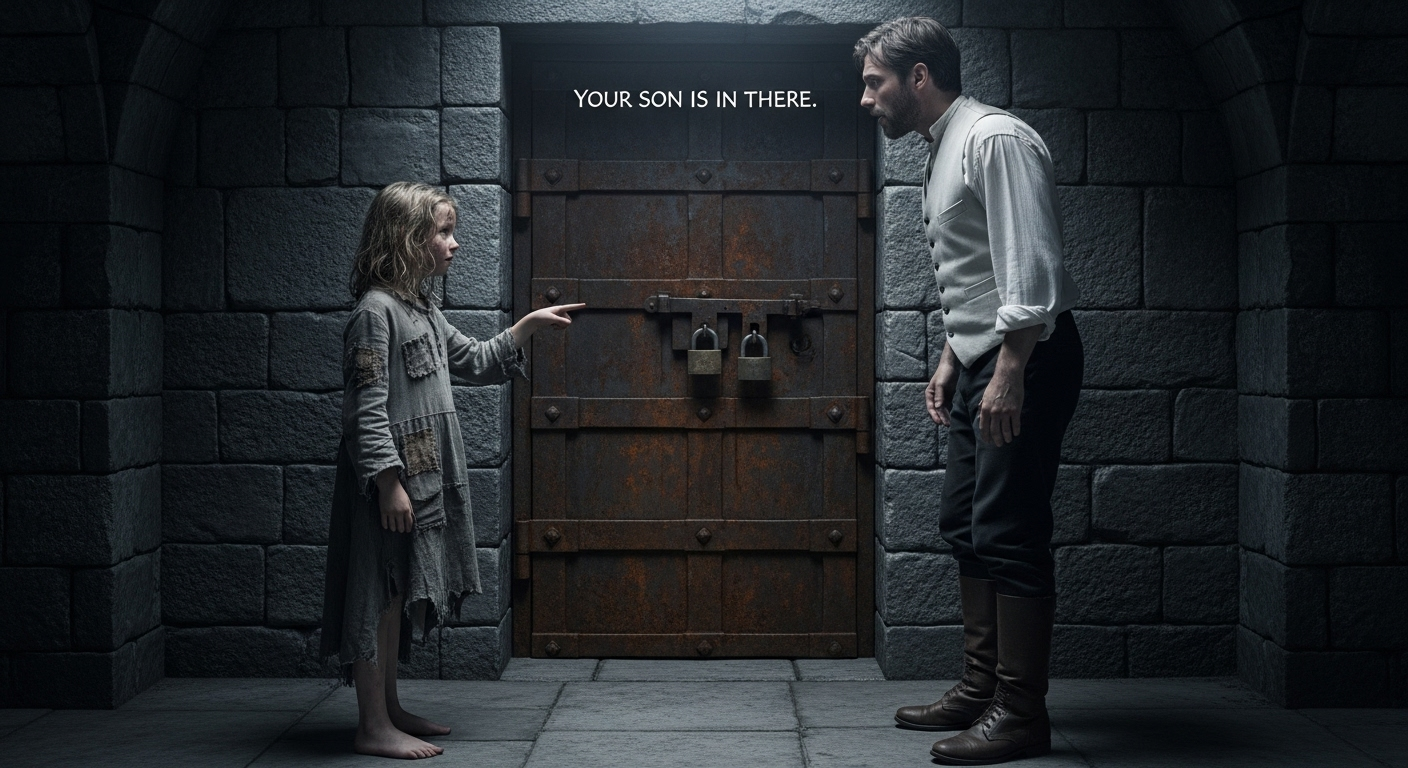
“You need to go to the basement, Mr. Thorne,” she said. The words came out in a rush. “Not the library one. The old one. Behind the boiler room.”
I stared at her. “The boiler room? Maya, Leo is in his dorm room sleeping.”
She shook her head violently, tears welling up in her wide, brown eyes. “No, sir. That’s what they tell the parents. Leo lives in the basement now. He’s been there for three weeks.”
The glass of champagne slipped from my fingers. It shattered on the marble floor, the sound cutting through the Vivaldi like a gunshot.
“What?” I hissed, ignoring the mess.
“He’s in the dark,” she sobbed quietly. “He told me through the vent. He said… he said he’s crying for his daddy, but nobody comes.”
Chapter 2: The Crack in the Veneer
The shattered glass drew attention. A waiter rushed over with a towel, apologizing profusely, but I didn’t move. I remained crouched, staring at Maya. The fear in her eyes was too real to be a prank. Kids lie about homework; they don’t lie with this kind of terror.
“Maya,” I said, my voice dropping to a dangerous low. “Show me.”
“I can’t!” she squeaked, backing away. “If Dr. Aris sees me talking to you…”
“Richard?” It was Aris. He had noticed the commotion. He was walking toward us, his smile tight, his eyes cold and calculating. “Is everything alright? Did this student bump into you?”
Maya froze. She looked like a deer in the headlights of a semi-truck.
“She’s fine,” I said, standing up and smoothing my jacket. My heart was hammering against my ribs like a trapped bird. I needed to play this cool. If what she said was true, making a scene now would only give them time to hide him. “Just a spill. My fault entirely. Clumsy.”
Aris looked at Maya, his gaze withering. “Maya, run along to the dormitory. It’s past curfew for scholarship students.”
“Yes, Dr. Aris,” she whispered, and she bolted. She didn’t look back.
“Apologies, Richard,” Aris said, signaling for another drink. “Some of our charity cases… they lack the social graces.”
“Right,” I said. My hands were shaking, so I shoved them into my pockets. ” actually, Aris, I’m feeling a bit under the weather. I think I’ll head home. But first, I need to use the restroom.”
“Of course. Down the hall, second door on the left.”
“Thanks.”
I walked toward the restroom until Aris turned back to his donors. Then, I took a sharp right.
I knew the layout of the school vaguely from the orientation tour I had half-ignored. The main building was a labyrinth of mahogany and marble, but Maya had said behind the boiler room. That meant the service wing.
I moved quickly, blending into the shadows of the corridors. The sounds of the party faded, replaced by the hum of the HVAC system and the drumming of rain against the high windows. The air grew colder the further I went. The polished floors gave way to industrial linoleum.
“He’s crying for his daddy.”
The words echoed in my skull. Guilt, hot and agonizing, clawed at my throat. I had been so busy “securing his future” that I hadn’t noticed he was gone. I checked my phone. The “Find My Family” app. I opened it.
Leo’s dot was on the map. It was right on top of me.
But the elevation indicator… it read -15 feet.
My stomach turned over. He wasn’t in the dorms on the second floor. He was underground.
I reached the end of the service hallway. A heavy steel door marked AUTHORIZED PERSONNEL ONLY blocked the way. It was locked. I rattled the handle, panic starting to override my logic.
“Can I help you, Mr. Thorne?”
I spun around.
Standing ten feet away was the head of security, a man named Graves. He was built like a tank, with a buzz cut and eyes that looked like they’d seen combat. He wasn’t smiling. His hand was resting casually on his belt, dangerously close to a taser.
“I got lost,” I lied, stepping away from the door. “Looking for the exit.”
“The exit is the other way,” Graves said, his voice flat. “The East Wing is closed for renovations. There are… structural hazards. We wouldn’t want a parent to get hurt.”
“Renovations,” I repeated. I looked at the door again. I could hear a faint humming sound coming from behind it. And something else. A smell. Not the smell of construction dust.
It smelled like bleach. Strong, industrial bleach. Used to cover things up.
“Right,” I said, forcing my posture to relax. “My mistake. Lead the way.”
Graves escorted me all the way to the front entrance. He watched me get into my car. He watched me drive away.
I drove down the winding driveway, past the iron gates, and turned onto the main road. I drove for two miles until I was sure they couldn’t see my taillights. Then, I pulled over onto the muddy shoulder of the dark road.
I killed the engine. The silence of the car was suffocating.
I pulled out my phone and dialed the nanny.
“Hello, Mr. Thorne?” she answered, sounding sleepy.
“Elena,” I said, gripping the steering wheel so hard the leather creaked. “When was the last time you actually saw Leo? Not a text from the school, not an email. When did you see his face?”
There was a pause. “Well, sir… you know the school has a no-phone policy for the Immersion Program. I haven’t seen him since drop-off three weeks ago. Dr. Aris sends the weekly reports.”
“Three weeks,” I whispered.
“Is something wrong, sir?”
“Everything is wrong, Elena.”
I hung up. I looked back toward the school, the gothic spires rising into the stormy night sky like jagged teeth.
Maya wasn’t lying. The GPS confirmed it. The security guard’s reaction confirmed it.
My son was in that basement.
I reached into the glove compartment and pulled out the flashlight I kept for emergencies. Then, I opened the trunk and took out the tire iron.
I wasn’t Richard Thorne, the CEO, anymore. I was a father. And I was going to burn that school to the ground if I had to.
Part 2
Chapter 3: The $5,000 Suit in the Mud
I didn’t drive back up the main road. That would be suicide. Oakhaven had cameras on the gates, and Graves would be watching the monitors like a hawk.
Instead, I parked my Tesla a mile down the road, hiding it behind a cluster of overgrown pines. I took off my dress shoes. They were Italian leather, slippery as glass on wet asphalt. I tossed them into the backseat and pulled on a pair of running sneakers I kept in the trunk for the gym.
The rain was coming down in sheets now, freezing and relentless. I climbed the embankment, the mud sucking at my feet. My tuxedo jacket, tailored on Savile Row, was soaked through in seconds. I didn’t care.
I circled the perimeter of the school grounds. The stone wall was eight feet high, topped with decorative—but sharp—iron spikes.
I wasn’t a young man anymore. I spent my days in boardrooms, not obstacle courses. But adrenaline is a hell of a drug. I found a section of the wall where an old oak tree had grown too close.
I scrambled up the wet bark, scraping my hands raw. I swung one leg over the wall, the iron spike catching the lining of my trousers and tearing a long gash up my thigh. I gritted my teeth, ignoring the sting, and dropped down onto the other side.
I landed hard in a puddle of mulch and mud. I lay there for a moment, chest heaving, listening.
Nothing but the rain and the distant hum of the gala still happening inside. The parents were warm, drinking wine, listening to lies. I was in the bushes, shivering, clutching a tire iron.
I moved toward the back of the main building. Maya had said behind the boiler room.
The service wing was dark, a stark contrast to the illuminated ballroom on the other side of the campus. I crept along the brick wall, ducking under windows.
I found the boiler room. It was a massive brick extension with steam venting from the top. The door was locked, obviously. I shone my flashlight, covering the lens with my fingers to let only a sliver of light out.
There.
At ground level, half-obscured by overgrown ivy, was a ventilation grate. It was old, rusted at the hinges.
I wedged the flat end of the tire iron into the gap.
Creak.
The metal groaned. I froze, looking around. No guards. I pushed harder, putting my entire body weight into it. With a snap of corroded metal, the grate gave way.
The smell hit me instantly. Damp earth, stale air, and that faint, chemical scent of bleach.
I squeezed through the opening, sliding on my stomach into the darkness below. I fell about four feet, landing on a concrete floor.
I was in.
Chapter 4: The Dungeon of Prestige
I stood up, clicking my flashlight on fully now.
I was in a maintenance tunnel. Pipes ran along the ceiling like thick, metal veins, dripping condensation. The heat down here was oppressive, a suffocating humidity that made my wet clothes cling to my skin.
“Maya, you better be right,” I whispered to the darkness.
I followed the tunnel. It sloped downward. This was deeper than the building’s foundation should have been. This was the “old basement” she talked about—probably part of the original structure from the 1920s that they hadn’t bothered to renovate, or… hadn’t wanted anyone to see.
The tunnel opened up into a narrow hallway. The floor wasn’t polished tile here; it was cracked cement. The walls were painted a peeling institutional green.
I saw a row of doors. They were heavy, wooden doors with small, sliding viewports at eye level. Like a prison. Or an asylum.
My heart was thumping so hard I could feel it in my throat. I approached the first door.
I slid the viewport open.
Empty. Just a bare mattress on the floor and a bucket.
I moved to the next one.
Empty.
I was starting to panic. Had Maya imagined it? Was this just storage?
Then I heard it.
It was a sound so soft I almost missed it over the hum of the boiler.
Sobbing.
It was a low, rhythmic whimpering. The kind a child makes when they’ve been crying for so long they have no energy left to scream.
I ran to the end of the hall. The sound was coming from the last door. It was reinforced with a heavy padlock on the outside.
“Leo?” I whispered, pressing my face to the wood.
The sobbing stopped instantly.
“Leo, it’s Dad. Are you in there?”
For a agonizing five seconds, there was silence. Then, a small, broken voice drifted through the wood.
“Daddy?”
My knees almost gave out. It was him. But his voice… it sounded weak. Raspy.
“I’m here, buddy. I’m right here.” I grabbed the padlock, pulling at it uselessly. It was solid steel. “Leo, listen to me. I’m going to get you out. Are you hurt?”
“It’s dark,” Leo said. He sounded like he was hallucinating. “The bad man said I have to stay in the dark until I fix my brain. Did I fix it yet, Daddy? Am I normal yet?”
Rage.
Pure, white-hot rage flooded my system. It washed away the fear, the cold, the exhaustion. They weren’t treating his grief. They were torturing him. They were breaking him down to “rebuild” him into a compliant, emotionless robot.
“You’re perfect, Leo,” I choked out, tears mixing with the rain on my face. “You never needed fixing. Daddy was stupid. Daddy was so stupid.”
I stepped back and raised the tire iron.
“Cover your head, Leo!” I shouted. “Move away from the door! Go to the back corner!”
“Okay,” he whimpered.
I took a breath, gripped the iron with both hands, and swung it with everything I had at the padlock hasp.
CLANG.
The sound echoed like a gunshot in the confined space. My hands vibrated with the shock, but the wood splintered.
I swung again.
CRACK.
And again.
CRASH.
The hasp tore free from the rotting wood. I kicked the door open.
The beam of my flashlight cut through the gloom.
The room was no bigger than a closet. No windows. No ventilation. Just a thin foam mat on the damp floor.
And curled up in the corner, shielding his eyes from the light, was my son.
He looked terrifyingly thin. His clothes were dirty. But what broke me was the way he flinched when I stepped inside. He didn’t run to me. He cowered. He thought I was one of them.
“Leo,” I dropped the tire iron and fell to my knees. “It’s me. It’s Dad.”
He lowered his hands slowly. His eyes adjusted to the light. When he saw my face, his bottom lip trembled.
“Dad?”
I scooped him up. He felt light. Too light. I buried my face in his dirty hair, holding him so tight I was afraid I’d crush him.
“I’ve got you,” I sobbed. “I’ve got you. We’re going home.”
“Well, isn’t this touching.”
The voice came from the doorway behind me.
I froze. Slowly, I turned around, shielding Leo with my body.
Standing in the hallway was Dr. Aris. He wasn’t smiling anymore. He was holding a syringe.
Behind him stood Graves, holding a taser.
“I told you, Richard,” Aris said, his voice calm, almost academic. “He’s in the middle of a breakthrough. You’re interrupting the treatment.”
“Treatment?” I spat, standing up but keeping Leo behind me. “You’re locking children in a dungeon!”
“We are building resilience,” Aris said, stepping into the room. “The world is a hard place, Richard. You of all people know that. Weakness is a liability. We strip it away. We make them strong.”
“You’re insane,” I said. I looked at the tire iron on the floor. It was three feet away. Too far.
“Grab the boy, Graves,” Aris commanded. “Mr. Thorne needs to be escorted off the property. Permanently. And if he speaks of this… well, we have the psychological evaluations stating he’s an unstable, grieving widower. Who will believe him?”
Graves stepped forward, the taser crackling with blue electricity.
“Don’t touch him!” I shouted.
Graves lunged.
I didn’t go for the tire iron. I went for Graves.
Part 3
Chapter 5: The Animal Inside
The taser prongs exploded from the device with a sharp pop.
Maybe it was the adrenaline, or maybe it was just pure, dumb luck, but I slipped on the wet concrete just as Graves pulled the trigger. The probes missed my chest by an inch, sparking violently against the damp wall behind me.
I didn’t wait for him to reload.
I launched myself at Graves. I’m not a fighter. I’m a tech CEO. I play tennis on weekends. Graves was a trained security professional, likely ex-military. In a fair fight, I would be dead in ten seconds.
But this wasn’t a fair fight. My son was watching.
I slammed into Graves’ midsection, driving him back into the hard doorframe. The air whooshed out of his lungs. We crashed to the floor, grappling in the dirty water and grime.
He was strong. Terrifyingly strong. He brought a knee up into my ribs, and I felt something crack. The pain was blinding, white-hot and instant. I gasped, my vision swimming.
“Stay down, Thorne!” Graves grunted, trying to pin my arms. “Don’t make me break your neck!”
I saw Leo in my peripheral vision. He was pressed against the corner, hands over his ears, screaming soundlessly.
That image—my son, broken and terrified—unlocked something primal in me. A reservoir of hysterical strength I didn’t know I possessed.
I headbutted Graves.
I slammed my forehead into the bridge of his nose. I felt the cartilage crunch. Graves roared in pain and loosened his grip for a split second.
That was all I needed.
I scrambled away, grabbing the heavy tire iron I had dropped earlier.
Graves was already getting up, blood pouring down his face, his eyes murderous. “You rich little—”
I swung the iron. I didn’t aim for his head; I wasn’t a murderer. I swung low, aiming for the knee.
CRACK.
Graves howled and collapsed, clutching his leg.
“Richard, stop!” Dr. Aris shouted.
I spun around, breathing like a bellows, the iron raised.
Aris was frozen. He still held the syringe, but his arrogant composure had vanished. He looked at Graves writhing on the floor, then at the blood on my face, and finally at the steel bar in my hand.
He realized, perhaps for the first time, that money doesn’t make a man civilized. It just gives him more to lose.
“Drop the needle,” I snarled. My voice didn’t sound like mine. It sounded like a growl.
“Richard, be reasonable,” Aris stammered, holding his hands up but keeping the syringe. “If you leave with him in this state… without proper discharge papers… it’s kidnapping. I’ll call the police.”
“Call them,” I dared him. “Call the police. Call the FBI. Let’s show them the cage you kept my son in.”
Aris hesitated. He knew he couldn’t let that happen. He took a step toward Leo. “Leo, come here to Dr. Aris. Your father is having an episode.”
Leo looked at me, then at Aris. The brainwashing ran deep. He took a tiny step toward the headmaster.
“NO!” I roared. “Leo, look at me! I’m your dad! He hurt you! Come to me!”
Leo stopped. He looked at the open door. He looked at the darkness. Then, he looked at the tears streaming down my bloody face.
“Daddy?” he whispered.
“Run to me, Leo. Now!”
Leo bolted. He didn’t run to Aris. He ran straight into my arms.
I scooped him up with my left arm, keeping the tire iron ready in my right. He wrapped his legs around my waist, burying his face in my wet, ruined suit. He was trembling so hard he was vibrating.
“You’re making a mistake,” Aris hissed, backing away as I advanced.
“The only mistake I made,” I said, stepping over Graves, who was groaning on the floor, “was signing that check.”
I kicked the door shut on them. I jammed the tire iron through the handle, trapping them inside the dungeon hallway. It wouldn’t hold them forever, but it would give us a head start.
“Hold on tight, buddy,” I whispered to Leo. “We’re going for a ride.”
Chapter 6: The Ballroom Crash
My ribs screamed with every step. I was carrying a fifty-pound boy, running up a steep, slick maintenance ramp, with a likely concussion and a fractured rib cage.
But I felt weightless.
We burst out of the boiler room and into the cool night air. The rain was still pouring, washing the blood from my face.
“Are we going home?” Leo asked, his voice muffled against my shoulder.
“Yes,” I panted. “But first… we have to do something.”
I could have run to the car. I could have driven away and called the lawyers in the morning. But Aris had powerful friends. Senators. Judges. Billionaires. If I left now, the story would be “Richard Thorne has a mental breakdown, kidnaps son.” They would spin it. They would destroy me. And they would sweep this place under the rug.
I needed witnesses. I needed to make this impossible to hide.
I turned back toward the main building.
“Dad, where are we going?” Leo cried, tightening his grip.
“We’re going to the party, Leo.”
I kicked open the service entrance to the kitchen.
Chaos.
Waiters in white coats dropped trays of hors d’oeuvres. A chef shouted at me in French. I ignored them all. I marched through the kitchen, a bloody, muddy, soaked madman carrying a child who looked like a prisoner of war.
I reached the double doors that led to the Grand Ballroom.
I could hear the polite applause. Someone was giving a speech. Probably the Senator.
I took a deep breath.
“Close your eyes, Leo,” I said.
I kicked the doors open.
BANG.
The doors swung wide, crashing against the walls.
The silence was instantaneous.
Three hundred heads turned. The string quartet screeched to a halt. The Senator, standing at the podium with a glass of champagne, froze mid-toast.
I stood there in the doorway. My $5,000 suit was shredded. My face was a mask of blood and mud. And in my arms was Leo—pale, emaciated, wearing filthy rags that used to be a uniform.
A collective gasp ripped through the room. A woman in the front row screamed.
“Richard?” The Senator lowered his glass, squinting under the bright chandeliers. “What is the meaning of this?”
I walked into the room. I didn’t shout. I didn’t need to. The visual was screaming for me.
I walked right up to the center of the dance floor. The crowd parted like the Red Sea, recoiling from the filth, from the reality I had brought into their fantasy world.
“Look at him,” I said. My voice was hoarse, but it carried to the back of the room.
I turned in a circle, showing Leo to everyone. To the hedge fund managers. To the heiresses. To the people who had recommended this school to me.
“Look at my son!” I yelled, the anger finally boiling over.
Leo lifted his head. He looked at the crowd with wide, terrified eyes. The contrast was sickening—the golden chandeliers reflecting in his dark, hollow eyes.
“He wasn’t in a therapy session,” I said, staring directly at the Senator. “He was in a cage. In the basement. Behind the boiler room.”
Murmurs broke out. Phones started coming out. I saw flashes going off. Good. Record this.
“Dr. Aris,” I continued, “kept him in the dark for three weeks. To ‘break’ him. To fix his grief.”
“That’s preposterous!” a voice boomed from the back.
I saw Graves limping into the ballroom from the side entrance, clutching his radio. Security guards were flooding in behind him.
“Seize him!” Graves shouted, pointing at me. “He’s dangerous! He attacked staff!”
The guards moved in. Four of them. Big men.
I held Leo tighter. “If you touch me,” I warned, “you better be ready to kill me. Because I am not letting him go.”
The crowd was restless. They were confused. But then, something happened that Aris hadn’t calculated.
A woman stepped forward. It was the Senator’s wife. She looked at Leo. She saw the grime under his fingernails. She saw the way he clung to me. She was a mother before she was a politician’s wife.
She stepped between me and the guards.
“Stop,” she commanded. Her voice was ice cold.
“Mrs. Sterling, please step aside,” Graves barked. “He is mentally unstable.”
“He is holding a child who looks like he’s been starving,” she shot back. She turned to her husband on the stage. “John. Look at the boy.”
The Senator looked. He looked at Graves. He looked at the guards closing in. He realized the optics. He realized the livestream counts on the phones in the audience.
“Stand down,” the Senator said into the microphone.
“Sir—” Graves started.
“I said stand down!” the Senator roared.
The guards hesitated.
I looked at the camera of the nearest phone—a teenager live-streaming on TikTok.
“My name is Richard Thorne,” I said to the lens. “They tortured my son. And there are other doors down there. There are other children.”
The room exploded.
Parents began shouting, running toward the exits, demanding to see their kids. The facade of Oakhaven Academy didn’t just crack; it shattered into a million expensive pieces.
I sank to my knees, the adrenaline finally leaving me. I hugged Leo.
“It’s over, buddy,” I whispered. “We’re safe.”
But as I looked up, I saw Aris standing in the shadows of the balcony above. He wasn’t looking at me. He was on his phone. And he wasn’t looking at the police arriving outside.
He was smiling. A cold, terrifying smile.
He turned and vanished into the darkness of the upper floor.
The police sirens wailed in the distance, getting closer. But I knew, deep in my gut, that for men like Aris, the police were just another obstacle to be managed.
This wasn’t over.
Part 4
Chapter 7: The Aftermath
The next six hours were a blur of flashing lights, legal shouting matches, and hospital antiseptics.
The police didn’t arrest me. The Senator made sure of that. Once the parents stormed the dorms and found two other children in similar states of neglect—though none as bad as Leo—the narrative shifted instantly. Oakhaven Academy wasn’t a sanctuary; it was a crime scene.
We were taken to St. Jude’s Medical Center. I refused to let Leo out of my sight, even when the nurses insisted I needed stitches for the gash on my head. I sat in the chair beside his bed, holding his hand while he slept, my suit jacket finally discarded in a biohazard bin.
Around 4:00 AM, a detective walked in. Detective miller. She looked tired.
“Mr. Thorne?”
“Is he in custody?” I asked, not looking up from Leo’s sleeping face.
Miller sighed, pulling up a chair. “We have Graves. He’s singing like a canary to cut a deal. Assault, unlawful imprisonment, child endangerment. We have the staff. We have the basement logs.”
“And Aris?” I looked at her then.
Miller hesitated. “Dr. Aris… is gone, Mr. Thorne.”
My blood ran cold. “Gone? The place was surrounded.”
“He has a private helipad on the north ridge. We didn’t know about it until the chopper was already in the air. Flight plan was filed for a private airfield in New Jersey, but he never landed there. He’s in the wind.”
I slammed my fist onto the armrest. “He’s a monster. You can’t just lose him!”
“We have an APB out. Interpol is involved. His assets are frozen. He won’t get far.”
I looked back at Leo. He looked peaceful for the first time in months. But I knew the nightmares would come. I knew the damage wasn’t just physical.
“He said something,” I murmured. “In the ballroom. Before he left.”
“Who?”
“Aris. He looked at me from the balcony. He was on the phone. And he smiled.”
Miller frowned. “Probably talking to his pilot.”
“No,” I shook my head. “It was… triumphant. Like this was part of the plan. Or like he had a backup plan.”
My phone buzzed on the bedside table. It was an unknown number.
I picked it up. “Thorne.”
“Richard.”
The voice was smooth, cultured, and terrifyingly familiar.
“Aris,” I whispered. Detective Miller’s eyes widened, and she frantically signaled for me to keep him talking while she radioed for a trace.
“I trust Leo is comfortable,” Aris said. There was no static. He sounded like he was in the next room.
“You sick son of a—”
“Tut, tut. Language, Richard. There are children present. Or… there were.”
“Where are you?”
“Far enough. I’m calling to give you a piece of advice. Consider it a refund for your tuition.”
“I’m going to find you,” I said, my voice shaking with rage. “I will spend every penny I have. I will hunt you down to the ends of the earth.”
Aris laughed softly. “I admire your resolve. It’s what makes you a good candidate.”
“Candidate for what?”
“You think Oakhaven was the only one, Richard? You think I’m the man in charge?” He paused. “I’m just a proctor. The experiment… it has many campuses. Leo was a promising subject. Resilience is a commodity, Richard. We were forging steel.”
“He’s a seven-year-old boy!”
“He is the future. And so are you, now.”
“What does that mean?”
“It means watch your back, Mr. Thorne. You broke the cage, but you’re still in the zoo. Give Leo my regards.”
Click.
The line went dead.
Chapter 8: The New Mission
Six months later.
I stood on the balcony of my new home in Oregon. We had moved across the country. I sold the Connecticut mansion. I stepped down as CEO, keeping only a board seat and my shares.
Leo was in the yard, playing with a golden retriever puppy we named “Buster.” He was laughing. It was a real laugh. He was seeing a therapist three times a week, and he was starting public school in the fall.
He was healing.
But I wasn’t.
I looked down at the tablet in my hands. On the screen was a grainy photo taken three days ago in Zurich. It showed a man getting into a black sedan. He had shaved his head and grown a beard, but I knew the eyes.
Aris.
And behind him, holding the car door, was a man wearing a uniform with a strange insignia. A triangle inside a circle.
I swiped to the next photo. It was a list of names. A list of schools. “The Ascendancy Group.”
Aris was right. Oakhaven was just one branch.
I had hired a team. Ex-Mossad, cyber-warfare experts, private investigators. I was spending my fortune not on yachts or galas, but on a war.
“Dad?”
I turned. Leo was standing at the glass door, holding the puppy.
“Yeah, buddy?”
“Are you okay? You look mad again.”
I forced my face to soften. I put the tablet down, screen side down.
“I’m not mad, Leo. I’m just… thinking.”
“About the bad man?”
I walked over and knelt down. He was taller now. Stronger.
“No,” I lied. “I was thinking about what to make for dinner. Tacos or pizza?”
“Tacos!” Leo cheered.
“Tacos it is.”
I watched him run back inside, the puppy yapping at his heels.
I walked back to the railing and looked out at the vast, dark forest surrounding our property.
I had saved my son. I had exposed the school. The world thought the story was over. They thought it was a scandal about a greedy headmaster and a brave father.
But they didn’t know about the list. They didn’t know about the other kids, in other basements, in other countries.
I picked up the tablet again.
I wasn’t just a father anymore. I wasn’t just a businessman.
I was the man who was going to burn the entire zoo to the ground.
I typed a message to my lead investigator in Zurich: “Confirm the location. I’m flying out tonight.”
I hit send.
The wind howled through the trees, sounding like a whisper.
Resilience is a commodity.
“We’ll see about that,” I whispered to the night.
I turned off the light and went inside to make tacos.
The nightmare was over for Leo. But for me?
The hunt had just begun.
[END OF STORY]