Her Husband Hadn’t Spoken in 30 Years. She Thought It Was a Cruel Tradition, Until She Found the Secret Notebook That Changed Everything.
Chapter 1: The Sound of Leaving
The humidity in Blackwood, Georgia, didn’t just sit on you; it owned you. It wrapped around the eaves of the Vance family farmhouse like a wet wool blanket, stifling the air, stifling the light, and, if you asked Sarah Vance, stifling the very life out of the people who lived there.
Sarah slammed the lid of the suitcase shut. The sound echoed like a gunshot in the silent house.
“I won’t let you do it,” she whispered to the empty room. “I won’t let this house take him.”
In the hallway, the grandfather clock ticked. Tock. Tock. Tock. It was a heavy, rhythmic sound that felt less like the passing of time and more like a countdown.
Jacob was turning ten in three days.
To any other family in America, a tenth birthday was a milestone. Double digits. A reason for pizza parties, laser tag, and a new bicycle. But for the Vance family, the tenth birthday was a funeral for childhood. It was the beginning of the “Ceremony of Quiet.”
Sarah had married into this silence. Twelve years ago, she had fallen in love with Elias Vance not for what he said, but for how he listened. Elias was a carpenter, a man who could coax beauty out of knobby oak with a chisel and patience. He hadn’t spoken a word since 1993.
When they were dating, the townspeople whispered. They said the Vance men were cursed. They said they were part of some backwoods cult. Sarah, young and blinded by the intensity of Elias’s dark eyes, had ignored them. She thought his silence was trauma, or perhaps a vow of piety. She thought she could fix him.
She was wrong. Elias communicated with complex hand signs, furious scribbles on notepads, and a gaze that could convey a novel’s worth of emotion. But he never opened his mouth. Not when he proposed. Not when Jacob was born. Not when Sarah wept with postpartum depression.
And now, the family tradition—the “curse”—was coming for her son.
Jacob was in his room, oblivious. He was singing along to the radio, his voice high and sweet, cracking slightly as he tried to hit the high notes of a classic rock song. He was a chatterbox. He narrated his life. He debated baseball stats with the wall. He loved the sound of his own voice.
“Mom?” Jacob called out, hearing the zipper of the suitcase. “Are we going to Aunt Lisa’s?”
Sarah wiped a bead of sweat from her forehead. “Yes, baby. Grab your baseball glove. We’re leaving now.”
“But Grandpa Silas is whittling me a bat for my birthday,” Jacob said, appearing in the doorway. “He said I have to be here for the Ceremony.”
“There is no Ceremony,” Sarah snapped, her nerves fraying. She grabbed his hand, perhaps too tightly. “We are going to Boston. Now.”
She dragged him down the creaking stairs, past the parlor where Grandfather Silas sat. The patriarch of the Vance clan was seventy-five years old. He sat in a high-backed leather chair, whittling a piece of cedar. He hadn’t spoken a word since 1958. He didn’t look up as Sarah rushed past. He just kept carving, the shhh-shhh of the knife against wood following them like a warning.
Sarah threw the suitcase into the trunk of her sedan. The sky above was turning a bruised purple. A storm was brewing—a bad one. The air pressure was dropping so fast her ears popped.
“Get in, Jacob,” she ordered.
She rounded the car to the driver’s side. And there he was.
Elias.
He stood in the middle of the gravel driveway, blocked by the old oak tree that arched over the entrance. He was soaking wet, though the rain hadn’t started yet. He looked like a statue carved from grief.
“Move, Elias,” Sarah warned, her hand trembling on the door handle.
Elias didn’t move. He shook his head slowly. His eyes were red-rimmed.
“I am not letting you do this to him!” Sarah screamed, the years of frustration finally erupting. “I am not letting you cut out his tongue with your fear! He is a boy! He deserves to sing! He deserves to speak!”
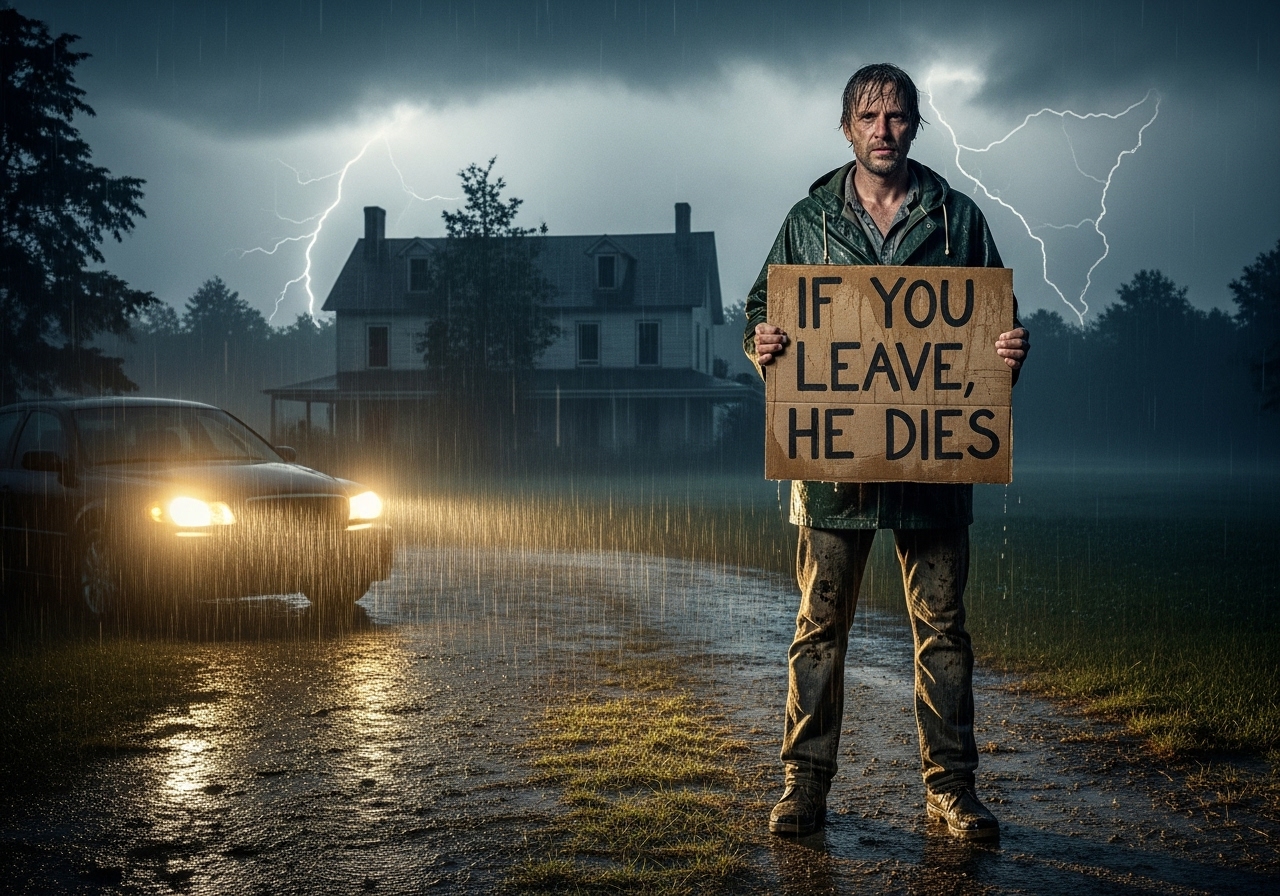
Elias took a step forward. He reached into the pocket of his work shirt and pulled out a piece of cardboard, written in thick black marker. He held it up.
IF YOU LEAVE, HE DIES.
Sarah stared at the sign. The absurdity of it, the superstition, made her blood boil.
“You’re insane,” she spat. “You and your father and this whole godforsaken farm. You’re sick. I’m leaving, Elias. If you don’t move, I will drive through the grass.”
She got in the car and slammed the door. She turned the key.
The engine sputtered. It whined. But it didn’t catch.
She tried again. Click-click-click.
She looked through the windshield. Elias was standing there, lowering the sign. He wasn’t angry. He looked… devastated. He raised his hand and pointed to the sky.
Thunder cracked, loud enough to shake the chassis of the car. The heavens opened up. Rain didn’t just fall; it was driven down in sheets. Within seconds, the dirt driveway was turning into a river of mud.
Sarah pounded the steering wheel, tears streaming down her face. She was trapped.
Chapter 2: The Ink of History
The storm raged for two days. The power lines went down within the first hour, plunging the farmhouse into a gloom illuminated only by lightning and kerosene lamps.
The silence in the house was heavier than ever. Jacob, sensing the tension, had retreated to his room with a flashlight and his comic books. Grandfather Silas remained in his chair, whittling by candlelight, his shadow dancing on the wall like a specter.
Sarah refused to sleep in the master bedroom. She slept on the sofa, clutching a kitchen knife, though she didn’t know who she was protecting herself from—her husband, or the house itself.
By the morning of the third day—the day before Jacob’s birthday—Sarah decided she was done being a victim. If she couldn’t leave, she would burn the truth out of this place.
Elias was outside, trying to secure the barn roof in the gale-force winds. Sarah seized her chance.
She knew where Grandfather Silas kept the keys to his study. He wore them on a chain around his neck. But he was asleep in his chair, his chest rising and falling with a rattling wheeze.
Sarah crept into the parlor. Her heart hammered against her ribs. She reached out, her fingers brushing the cold metal of the key ring resting on the old man’s flannel shirt.
Silas’s eyes snapped open.
Sarah gasped, pulling her hand back.
But Silas didn’t grab her. He didn’t look angry. He looked at her with milky, cataract-clouded eyes. He lifted the chain over his head and held the keys out to her.
His hand was shaking.
Sarah took them, confused. “Why?” she whispered.
Silas tapped his lips with a gnarled finger, then pointed to the heavy oak door at the end of the hall.
Sarah didn’t waste time. She ran to the study, unlocked the door, and slipped inside.
The room smelled of old paper and pipe tobacco. The walls were lined with books. But Sarah wasn’t interested in literature. She went to the large safe in the corner. It was unlocked.
Inside were journals. Dozens of them. Leather-bound, cloth-bound, some just stacks of paper tied with twine.
She grabbed the oldest one. The date on the cover was 1864.
She opened it. The handwriting was elegant, frantic.
November 12, 1864. My tenth birthday. The voice came at noon. It told me Mother would burn. I screamed for her to run. She tripped. The lamp fell. The fire took her. I spoke, and she died. I must never speak again.
Sarah’s hands trembled. She grabbed another. 1920.
June 4, 1920. My tenth birthday. The Voice whispered of the barn collapsing on my brother. I held my breath. I clamped my hand over my mouth. The barn stood. The wind howled, but the wood held. Silence is the shield.
She grabbed another. 1955. Grandfather Silas’s journal.
October 10, 1955. The flood. I heard the water rising in my head before the rain even started. I saw the town drowning. I saw Mary—my sweet Mary—swept away. I sealed my lips. The river rose to the doorstep and stopped. It stopped because I did not speak the tragedy into existence.
Sarah felt a chill that had nothing to do with the drafty room. She was seeing a pattern. A terrifying, impossible pattern.
She reached for the final journal. The one dated 1993.
Elias.
She opened it. The pages were stained with tear marks.
May 12, 1993. Today I am ten. I heard it. I heard the screech of tires. I heard the crunch of metal. I saw the girl with the yellow ribbon in her hair. The Voice told me she would die at 4:00 PM at the intersection of Main and Elm.
Sarah stopped breathing. In 1993, she was eight years old. She lived on Elm Street. She wore a yellow ribbon in her hair every day that spring.
She read on.
I wanted to warn her. The words were in my throat. But Grandfather held my hand. He told me the rule. “Speak the death, and it is fixed. Hold the silence, and you hold back the reaper.” So I bit my tongue until it bled. 4:00 PM came. The drunk driver swerved. He hit the telephone pole instead of the girl. She lived. I bought her life with my voice.
Sarah dropped the journal. It hit the floor with a dull thud.
She wasn’t just the wife of a mute man. She was the reason he was mute.
Chapter 3: The Weight of the Oracle
Sarah found Elias in the attic. He was checking for leaks near the chimney.
When he saw her, he froze. He saw the journal in her hand. He saw the look on her face—not anger anymore, but a shattered, horrified awe.
“Is it true?” Sarah asked, her voice breaking. “You saved me? Before you even knew me?”
Elias climbed down the ladder. He walked over to an old dusty chalkboard he kept up there for measurements. He picked up a piece of chalk.
YES.
“But why didn’t you tell me?” Sarah wept. “Why let me hate you for it? Why let me think you were just stubborn?”
Elias wrote quickly, the chalk screeching.
THE BURDEN IS TOO HEAVY TO SHARE. IF YOU KNEW, YOU WOULD HAVE ASKED ME TO SPEAK. YOU WOULD HAVE WANTED TO HEAR MY VOICE MORE THAN YOU WANTED TO LIVE.
Sarah fell to her knees on the dusty floorboards. She realized, with a crushing clarity, the magnitude of his sacrifice. For thirty years, this man had denied himself the simple pleasure of a laugh, a shout, a whisper of love, just to ensure her heart kept beating. Every morning he woke up and didn’t say “Good morning” was an active choice to keep her alive.
“The silence isn’t a wall,” Sarah whispered, touching his face. “It’s a shield.”
Elias nodded, tears spilling over his cheeks. He took her hand and placed it over his heart. It was beating wildly.
“But Jacob,” Sarah gasped, the realization hitting her like a physical blow. “Tomorrow is his birthday.”
Elias closed his eyes. He wrote again.
THE VOICE COMES TO ALL VANCE MEN AT TEN. HE WILL HEAR IT. HE WILL KNOW HOW SOMEONE HE LOVES DIES. HE MUST CHOOSE. SPEAK AND KILL. OR SILENCE AND SAVE.
“No,” Sarah moaned. “He’s a baby. He can’t carry that. No child should carry the power of God.”
Elias dropped the chalk. He pulled Sarah into his arms. They held each other in the dusty light of the attic, weeping for the son who was about to lose his voice to save a life.
Chapter 4: The Midnight Watch
The storm intensified as night fell. The wind howled around the farmhouse like a grieving mother.
The family gathered in the parlor. It was 11:50 PM.
Jacob sat on the rug, playing with the half-carved baseball bat Silas had made him. He looked small. Fragile. He didn’t know why everyone was crying. He didn’t know why his mother was gripping his shoulder so hard it hurt.
“Mom, I’m scared,” Jacob whispered. “Why are you looking at the clock?”
“It’s okay, baby,” Sarah said, though her voice trembled. “We’re just… waiting for your birthday.”
Grandfather Silas sat in his chair, his eyes closed. He looked paler than usual. His chest barely moved.
Elias stood by the window, watching the lightning.
Tick. Tock. Tick. Tock.
11:58 PM.
“I feel funny,” Jacob said, rubbing his temples. “My ears are ringing.”
Sarah’s heart stopped. It was starting.
11:59 PM.
“Mom, who is talking?” Jacob asked, looking around the empty room. “Someone is whispering.”
“Don’t listen, Jacob,” Sarah sobbed. “Cover your ears.”
“But they’re loud,” Jacob said, his voice rising in panic. “They’re saying… they’re saying…”
The clock began to chime. DONG. DONG.
Midnight.
Jacob screamed.
He clutched his head with both hands. His eyes rolled back for a second, then snapped forward, wide with a terror no ten-year-old should ever know.
He looked at Sarah.
The blood drained from his face. He scrambled backward, away from her, as if she were a ghost.
“Mom,” he gasped. “I see it. I hear it.”
He knew. The Voice had told him. He knew when Sarah was going to die.
“Don’t say it!” Elias rushed forward, grabbing Jacob’s hands. He shook his head violently. He made the sign for silence. He pressed his finger to Jacob’s lips.
Jacob’s lip quivered. Tears streamed down his face. He looked at his mother—his beautiful, loving mother—and he understood the price. To save her, he had to be quiet. Forever.
Jacob clamped his hand over his mouth. He squeezed his eyes shut. He began to hyperventilate. He was making the pact. He was joining the order of silence.
“No!” Sarah screamed. “Take it back! Take it back!”
Suddenly, a sound cut through the room.
It wasn’t the storm. It wasn’t a scream.
It was a scrape. The sound of a chair being pushed back.
Grandfather Silas stood up.
The old man stood straighter than he had in twenty years. He walked to the center of the room. The floorboards groaned under his weight.
He looked at Jacob, huddled in fear. He looked at Elias, trapped in his sacrifice. He looked at Sarah, begging for mercy.
Silas reached into his pocket. He pulled out a notepad and a pen. He wrote four words and handed the paper to Sarah.
THE CYCLE ENDS HERE.
Silas turned to the window, facing the raging storm. He took a deep breath. His chest expanded, his ribs cracking audibly. He was preparing muscles that hadn’t been used since Eisenhower was president.
He looked at his grandson. He smiled. A genuine, soft smile.
And then, Grandfather Silas opened his mouth.
Chapter 5: The Broken Seal
The sound was terrifying. It was raspy, guttural, like dry leaves being crushed underfoot, like stones grinding together in a quarry. But it was a human voice.
“My… time… is… now.”
The words hung in the air, heavy and absolute.
By speaking, Silas had broken the rule. He had heard the Voice decades ago—he knew the date of his own death, or perhaps the death of someone else that he had been holding back. By speaking, he was inviting the reaper in. He was trading his life for the curse.
Thunder shook the house so hard the window panes shattered inward. The wind roared into the room, extinguishing the candles.
“Dad!” Elias lunged for his father.
Silas collapsed. He didn’t fall in pain. He fell like a marionette whose strings had been cut. He landed in his favorite chair, his head lolling back.
But the look on his face was one of profound peace.
The wind died down instantly. The rain stopped. The silence that followed wasn’t heavy anymore. It was empty. Clean.
Jacob took his hand off his mouth. He blinked.
“Mom?” he whispered.
Sarah froze. “Jacob?”
“I… I don’t hear it anymore,” Jacob said. He rubbed his ears. “The whispering. It’s gone. It just stopped.”
Sarah looked at Silas. The old man was gone. His chest was still. He had taken the Prophecy with him. He had offered himself as the final payment to whatever ancient force held the Vance family hostage.
Elias was kneeling beside his father, holding the old man’s hand. He was shaking. He looked up at Sarah.
He opened his mouth. He closed it. He tried again.
His vocal cords were atrophied. His throat was tight. But the curse was broken.
“Sss…” Elias hissed. He coughed. He took a ragged breath.
“Saa… Sarah.”
It was barely a whisper. It was cracked and broken. But it was the most beautiful sound Sarah Vance had ever heard.
“I love you,” Elias croaked.
Sarah collapsed onto the floor, pulling her husband and her son into a pile of limbs and tears. They cried together, not in silence, but with loud, messy, glorious sobs that filled the house with life.
Epilogue: The Symphony of the Living
The funeral for Silas Vance was held a week later. The sun shone brightly on the wet earth of the family cemetery.
The entire town came. They came to see the crazy Vance family. They expected a silent vigil.
Instead, they heard singing.
Jacob stood by the grave, holding his new baseball bat. He was singing “Amazing Grace,” his voice clear and strong, echoing off the hills.
Elias stood next to him. He didn’t sing—his voice was still too rough for that—but he spoke the eulogy. It was short. It was raspy. But every word was heard.
“He gave us… the world,” Elias said, his voice grinding like gravel. “He gave us… our sound.”
After the funeral, the family sat on the porch. The same porch where Silas used to whittle in silence.
Sarah brought out a pitcher of lemonade.
“I think the Braves have a shot this year,” Jacob argued, his mouth full of a sandwich.
“No way,” Elias rasped, smiling. “Pitching is… weak.”
“Is not!” Jacob yelled.
“Is too!” Elias countered, laughing—a rusty, wheezing sound that made Sarah’s heart soar.
Sarah sat back in the rocking chair. She closed her eyes and listened. She didn’t listen to the wind or the ticking clock. She listened to her husband and son arguing over baseball.
She touched her throat, feeling the vibration of her own hum as she joined in the conversation. The weight of the whisper was gone. In its place was the heavy, beautiful, chaotic symphony of a family that was finally, truly alive.