THEY LAUGHED WHEN A BARISTA BECAME MAYOR. THEN HE FOUND THE SECRET FILES THAT SAVED THE TOWN—AND COST HIM EVERYTHING.
The Mayor of Broken Dreams
Chapter 1: The Write-In Rebellion
The heat in Oakhaven, Texas, didn’t just sit on you; it hunted you. It pressed down on the corrugated tin roofs and cracked the asphalt of Main Street until the whole town looked like a spiderweb of fractures. It was a dry, dusty heat that tasted of rust and old oil, the ghost of the industry that had once made this town rich before leaving it to rot.
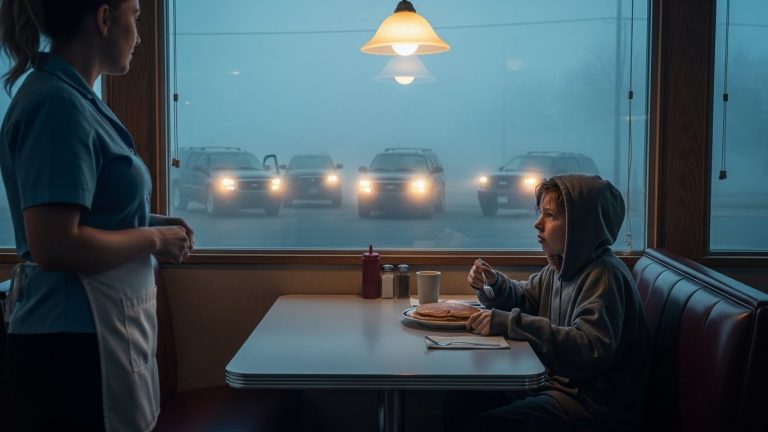
Inside Sally’s Diner, however, the air conditioning rattled with a desperate, mechanical wheeze, keeping the temperature a bearable eighty degrees. This was the sanctuary. The linoleum floor was worn through to the subfloor near the counter, marking the path of a thousand work boots and walkers.
Caleb Wright wiped down the counter for the fiftieth time that morning. At thirty, Caleb felt like he was wearing a skin that didn’t fit. He was too young to be this tired, but too old to be this lost. He had gone to Austin with big dreams of a tech startup, and he had come back two years later with a maxed-out credit card and a father in hospice care. Now, his world was measured in coffee spoons and the hiss of the espresso machine.
“You’re rubbing the pattern off the Formica, son,” a voice rasped from the corner booth.
Caleb looked up and smiled, a genuine, soft expression that crinkled the corners of his eyes. “Just trying to get the ghost of yesterday’s gravy out, Mrs. Higgins.”
Martha Higgins sat in her usual spot. At seventy-eight, she was a bird of a woman—frail bones and bright, sharp eyes. She had taught history at Oakhaven High for forty years. She knew where every skeleton in this town was buried because she had likely taught the people who dug the graves.
“Leave the gravy,” Martha said, tapping her cane on the floor. “It adds character. Speaking of character, have you seen the ballot for the special election?”
Caleb sighed, tossing the rag into the sanitizer bucket. “I try not to look, Martha. It’s depressing. ‘Bull’ Rourke running unopposed? It’s not an election; it’s a coronation.”
The diner went quiet. The regulars—mostly Vietnam vets in trucker hats and widows nursing single cups of decaf—grumbled in agreement. Councilman “Bull” Rourke owned the Chrysler dealership, the land the dealership sat on, and, effectively, the Town Council. With the old Mayor dropping dead of a heart attack two weeks ago, Rourke was poised to take total control.
“He called the Senior Center ‘expired inventory’ at the rotary club meeting,” Old Man Miller said, his hands shaking as he held his coffee. Miller was a Korean War vet who came in every day just for the air conditioning. “Said the town spends too much keeping ‘dead weight’ alive.”
Caleb’s jaw tightened. “He’s a bully, Mr. Miller. But he’s a rich bully. And in Oakhaven, that makes him King.”
“Kings can be toppled,” Martha said quietly. She pulled a pen from her purse. It was a red grading pen, the kind that used to strike fear into the hearts of slackers. “We just need a better option.”
“There’s no one else on the ballot, Martha,” Caleb said gently, pouring her a fresh cup on the house.
“That’s why God invented the ‘Write-In’ line,” she winked.
Caleb didn’t think much of it. He went back to work, listening to their stories. He listened to Miller talk about the drought drying up his well. He listened to the widows talk about their rising property taxes. He was the ear of the town. He absorbed their pain because he had nowhere else to put his own.
Three days later, the impossible happened.
It was a Tuesday night. The diner was closed, and Caleb was mopping the floor when the phone rang. It was the County Clerk.
“Mr. Wright?” the clerk sounded confused. “I… uh… I need you to come down to City Hall.”
“Is it my dad?” Caleb asked, panic seizing his chest.
“No, sir. It’s the election results. You won.”
Caleb dropped the mop. “Excuse me?”
“You won, Mr. Wright. By twelve votes. It seems there was a… coordinated effort.”
When Caleb arrived at City Hall, it was chaos. Bull Rourke was there, his face the color of a boiled lobster, screaming at the election officials. He was a massive man, wearing a suit that cost more than Caleb made in a year.
“It’s a fraud!” Rourke bellowed, pointing a thick finger at the clerk. “A joke! You can’t let a coffee jockey run this town!”
Standing in the back of the room was Martha Higgins, surrounded by twenty seniors. They looked tired, but they were smiling.
Caleb walked over to them, ignoring Rourke. “Martha, what did you do?”
“We organized, Caleb,” she said matter-of-factly. “We don’t have internet, but we have a phone tree that would put the Pentagon to shame. We called every senior, every vet, every person Rourke has stepped on.”
“I can’t be Mayor, Martha,” Caleb whispered, pulling her aside. “I’m a barista. I’m a failed businessman. I don’t know how to run a city.”
Martha grabbed his arm. Her grip was surprisingly strong. Her eyes filled with tears, losing the hard edge of the schoolteacher and revealing the terrified woman beneath.
“Son, look at them,” she gestured to the group of elderly folks behind her. “We didn’t vote for you because it’s funny. We didn’t vote for you as a prank. We voted for you because you are the only person in this godforsaken town who still looks us in the eye. You pour us a fresh cup when we can’t afford to pay. You listen. Rourke wants to bury us. You… you see us.”
Caleb looked at Rourke, who was currently threatening to sue the county. He looked at Mr. Miller, who was leaning on his walker, giving Caleb a thumbs up.
Caleb took a deep breath. He straightened his spine, shaking off the posture of a man who had given up.
He turned to the Clerk. “Swear me in.”
Chapter 2: The Water Contingency Plan
The transition of power was less of a handshake and more of a cold war. Caleb moved into the Mayor’s office the next morning. It smelled of stale cigar smoke and cheap cologne—Rourke’s scent.
The first week was a nightmare of bureaucracy. The Sheriff, a man named Grady who had played football with Rourke in high school, openly laughed when Caleb asked for the crime reports. The secretary, Rourke’s niece, “accidentally” deleted Caleb’s email access.
They treated him like a child playing dress-up.
“Go back to foaming milk, boy,” Rourke had sneered when they passed in the hallway. “The adults are talking business. Just sign the papers we put in front of you and enjoy the title.”
But Caleb had a superpower Rourke didn’t understand: he was used to invisible work. He was used to cleaning up messes no one else wanted to touch.
While the town slept, Caleb went to the basement of City Hall. The digital files were locked out, but Oakhaven was a town of paper. Decades of records were stacked in damp cardboard boxes.
He started digging.
He was looking for the reason Rourke was so desperate to be Mayor. A man like that didn’t want public service; he wanted profit.
On the fourth night, under the flickering light of a single bulb, Caleb found it.
It was a folder labeled infrastructure Maintenance, but inside was a contract drafted by “Permian Resources,” a massive fracking conglomerate.
Caleb sat on the dusty concrete floor, reading the legal jargon. His blood ran cold.
It was titled “The Water Contingency Plan.”
Oakhaven’s water table was critically low due to the drought. The contract outlined a deal where the town would sell 60% of its municipal water rights to Permian Resources for hydraulic fracturing.
To make the math work, the town had to cut usage. The plan explicitly listed “Zone 4” as the area for “resource diversion.”
Zone 4 was the low-income district. It was where the Senior Center was. It was where the Veterans’ housing was.
Rourke wasn’t just selling the water; he was planning to shut off the tap to the people he considered “expired inventory.”
The next morning, the heatwave broke a record. It was 104 degrees by 10 AM.
Caleb drove his rusted Toyota to the Senior Center. He expected to find the seniors playing bingo in the AC.
Instead, he found the front doors propped open. The inside was a sauna. The air conditioning was silent.
“What’s going on?” Caleb asked the receptionist, a young girl sweating through her shirt.
“Maintenance order,” she said, fanning herself with a magazine. “City Hall cut the power to the HVAC units this morning. Said it was a ‘load shedding’ test. And the water pressure… nothing is coming out of the taps.”
Caleb pushed past her into the main hall. It was a scene from a nightmare. Elderly people were slumped in chairs, faces flushed red.
“Mr. Miller?” Caleb called out.
He found the Korean War vet in the back corner. Miller was unconscious. His skin was dry and hot to the touch.
“Get water!” Caleb screamed, lifting the frail man into his arms. “Someone call 911!”
“We can’t,” a widow cried out. “Phones are dead too.”
Caleb carried Miller out to his car, his heart hammering against his ribs. This wasn’t negligence. This was a trial run. Rourke was testing how fast they would die.
He drove Miller to the county hospital in the next town over, speeding the whole way. Once Miller was stabilized with IV fluids, Caleb drove back to Oakhaven. He didn’t go to City Hall. He went to Sally’s Diner.
It was lunchtime. Rourke was there, holding court in the center booth, laughing with the Sheriff and two men in expensive suits—lawyers from Permian Resources.
Caleb walked in. He was covered in sweat and dust from the basement. He looked like a madman.
The diner went silent.
Caleb walked right up to Rourke’s table.
“You shut off the water to Zone 4,” Caleb said, his voice trembling not with fear, but with rage.
Rourke didn’t even stand up. He took a bite of his burger. “Technical difficulties, Mr. Mayor. Old pipes. We need that fracking money to fix them. It’s called progress.”
“Mr. Miller is in the hospital,” Caleb said. “Dehydrated. You almost killed him.”
Rourke wiped his mouth with a napkin. He looked at Caleb with eyes dead as a shark’s. “People die, Caleb. especially old, useless people. It’s the circle of life. Now, run along. I hear the cappuccino machine calling your name.”
Caleb grabbed the ketchup bottle on the table and slammed it down. The plastic cracked. Ketchup exploded onto Rourke’s suit.
Rourke stood up, his face turning purple. The Sheriff stood up too, hand on his gun.
“I know about the contract,” Caleb hissed, loud enough for the whole diner to hear. “I know about Permian Resources. I know you’re selling our water to pump oil while our people die of thirst.”
Rourke’s eyes narrowed. The mockery vanished. “You’re playing a dangerous game, boy. You have no idea what you’ve stepped into.”
“I’m not playing,” Caleb said. “I’m the Mayor. And I’m shutting you down.”
That night, Caleb returned home to the small bungalow he shared with his dying father. The front door was open.
Inside, the house had been tossed. Drawers pulled out, furniture slashed. His father was safe in the hospice facility, thankfully, but the message was clear.
Stuck to the refrigerator with a serrated steak knife was a note written on Council stationery:
RESIGN OR BLEED.
Chapter 3: The Storm on the Steps
The vote to finalize the water rights sale was scheduled for Friday night. Rourke had moved it up, citing “emergency fiscal measures.”
The weather turned with the mood of the town. The relentless sun was replaced by rolling black clouds. A massive electrical storm was brewing over the oil fields, lighting up the horizon with purple bruises of lightning.
Caleb spent the day at the diner. It had become his war room. He wasn’t hiding anymore.
“They won’t let us in,” Martha said. She had a bandage on her arm from a fall, but she was pacing the diner floor like a general. “Rourke hired private security. ‘Consultants,’ he calls them. Mercenaries. They’re blocking the doors to City Hall.”
“Then we don’t ask for permission,” Caleb said. He was wearing his best suit—cheap polyester, but pressed. He looked at the faces around him.
There were fifty of them now. Veterans in wheelchairs. Farmers with calloused hands. Widows who had lost everything but their dignity.
“This is our town,” Caleb said. “Not Permian’s. Not Rourke’s. Ours.”
At 7:00 PM, they marched.
It was a strange parade. Caleb walked at the front, flanked by Martha and the young waitress from the diner. Behind them came the “Army of the Forgotten.” The sound of wheelchair motors, canes tapping on pavement, and the shuffle of work boots filled the air.
Thunder cracked overhead, shaking the ground. The rain began to fall—hard, cold, stinging rain.
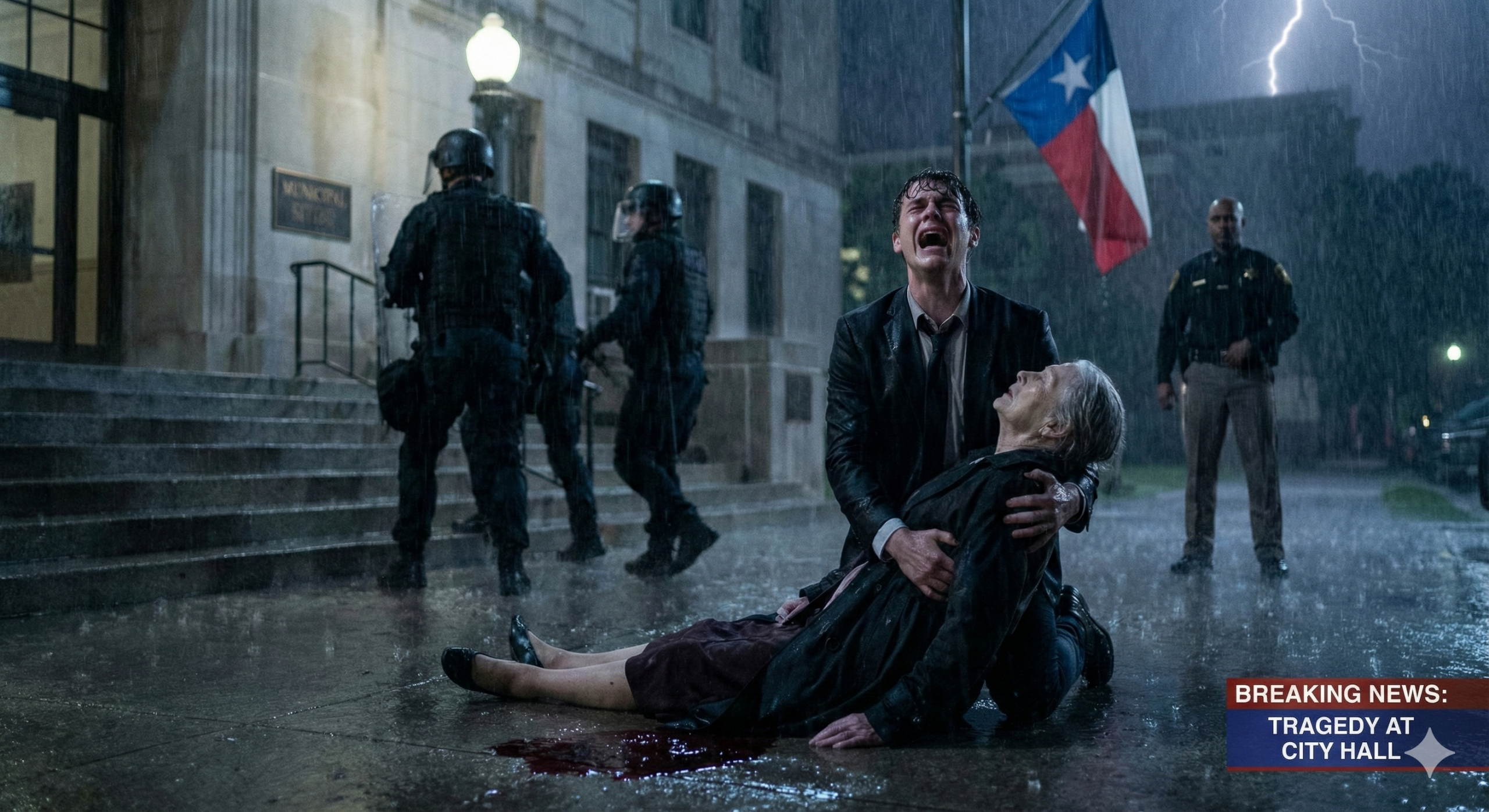
When they reached City Hall, the steps were lined with men in black tactical gear. They held batons. They wore visors. They looked like stormtroopers occupying a foreign land.
Rourke stood at the top of the stairs, shielded by an umbrella held by the Sheriff.
“Turn back!” Rourke shouted over the megaphone. “This is a closed session! Any attempt to enter will be considered a riot!”
“We have a right to be heard!” Caleb shouted back, his voice raw. He held up the file folder—the proof of the deal. “I have the contracts, Rourke! The town knows!”
“Arrest him!” Rourke screamed to the Sheriff. “Inciting violence!”
The Sheriff hesitated. He looked at Caleb. He looked at the old faces in the crowd—faces he had known his whole life.
“Do it, Grady, or you’re fired!” Rourke roared.
The mercenaries didn’t wait for the Sheriff. As the crowd surged forward, the guards pushed back.
“Hold the line!” a guard shouted. He shoved a farmer backward.
Then, chaos.
A guard swung his baton, aiming for Caleb. Caleb ducked, but the blow hit the person standing next to him.
It was Martha.
The strike hit her shoulder, spinning her around. She lost her footing on the slick, wet concrete.
“Martha!” Caleb screamed.
Time seemed to slow down. Martha tumbled backward down the steep stone steps of City Hall. Her cane clattered away. Her body hit the bottom landing with a sickening, heavy thud.
The crowd gasped. The shouting stopped. Even the rain seemed to hold its breath.
Caleb scrambled down the stairs, falling to his knees beside her.
“Martha? Martha!”
She was lying on her back, eyes open, staring up at the storm. Blood was pooling dark and thick around her head, mixing with the rainwater.
The mercenaries stepped back, lowering their batons, realizing they had gone too far.
Caleb lifted her head into his lap. “Someone call an ambulance! Now!”
Martha blinked. Her eyes focused on Caleb. She looked so small, so fragile.
“Caleb…” she whispered, a bubble of blood forming on her lips.
“I’m here, Martha. Hold on.”
She reached up, her hand shaking, and gripped his lapel. “Make them see us,” she wheezed. “Don’t let them… look away. Make them… remember.”
Her hand went slack. The light in her sharp, intelligent eyes faded into the grey of the storm.
Caleb froze. He felt the life leave her. He felt the cold rain soaking his shirt, mixing with her warm blood.
A sound started deep in his chest. It wasn’t a scream. It was a roar of pure, unadulterated grief.
He looked up.
At the top of the stairs, Rourke looked pale. He was backing away toward the door.
But the Sheriff was standing still. Grady was looking down at the body of Martha Higgins. She had been his 10th-grade history teacher. She had given him a passing grade when he was failing so he could stay on the football team.
Grady looked at Rourke. Then he looked at the mercenary who had pushed her.
Grady unholstered his gun. He didn’t point it at the crowd. He pointed it at the mercenary.
“Get on the ground,” Grady said, his voice breaking. “Get on the ground right now!”
Chapter 4: The Coffee Cup on the Empty Stool
The ambulance lights were a blur of red and blue against the wet pavement, but it was too late. Martha was gone before they loaded her in.
The local news crews had arrived, alerted by the chaos. They were filming live.
Caleb stood at the bottom of the steps. He was drenched. His suit was ruined. His hands and shirt were stained with the blood of the woman who had believed in him.
A reporter shoved a microphone in his face. “Mayor Wright! Mayor Wright! What happened here? Is the deal going through?”
Caleb looked at the camera. He didn’t wipe the blood off his face. He wanted them to see it.
He held up the folder, now soggy with rain.
“They killed her,” Caleb said. His voice was quiet, dead calm. The cameras zoomed in. “Martha Higgins. She taught this town its history. And tonight, Councilman Rourke killed her to sell our water for pennies on the dollar.”
He opened the folder. He read the names of the people in Zone 4. He told the world about Mr. Miller. He told them about the water shutoff.
“They think we are expired inventory,” Caleb said, tears finally mixing with the rain on his face. “They think because we are poor, because we are old, because we serve coffee or fix cars, that we don’t matter. But this is our home. And you will not take it.”
The broadcast went statewide. Then national.
By morning, the Texas Rangers were at City Hall.
They found Rourke in his office, shredding documents. He was arrested for corruption, fraud, and involuntary manslaughter. The mercenary who pushed Martha was charged with murder.
Permian Resources pulled the contract within an hour of the broadcast. They released a statement saying they were “unaware” of the local mismanagement. The water stayed with Oakhaven.
One Month Later
The heat had returned to Oakhaven, but the heaviness was gone. The town was still dusty, still struggling, still poor. But the air felt different. It felt clean.
It was 7:00 AM on a Tuesday.
Mayor Caleb Wright walked into Sally’s Diner. He wore a suit jacket, but he took it off and hung it by the door, rolling up his sleeves.
“Morning, Mayor,” the new waitress said.
“Morning, Jess. I’ll take the rush,” Caleb said, stepping behind the counter.
He wasn’t doing it for the money. He refused the Mayor’s salary until the town’s debt was paid down. He was doing it because this was where the truth lived.
The door chimed. Mr. Miller walked in, looking better, though he moved slower now.
“Coffee, Caleb?” Miller asked.
“Coming right up, Mr. Miller.”
Caleb poured a fresh mug. Then, he poured a second one.
He walked to the end of the counter. There was a stool there that no one sat in anymore. A small brass plaque had been screwed into the wood: Reserved for Martha Higgins – The Teacher Who Saved Us.
Caleb placed the steaming cup of black coffee on the counter in front of the empty stool.
He stood there for a moment, watching the steam rise in the sunlight that filtered through the blinds. He touched the rim of the cup, a silent toast.
“We made them see us, Martha,” he whispered.
He looked out the window. Oakhaven wasn’t a paradise. The roads still needed paving. The economy was still tough. But as he looked at the town—his town—Caleb didn’t see broken dreams anymore. He saw a fight worth fighting.
“Order up!” Caleb called out, turning back to the espresso machine.
He was the Mayor. But first, he was a barista. And the coffee was finally fresh.