The Golden Pillar’s Fall: How a 10-Year-Old’s Lie Blew Apart the Wealthy Stevens Family’s Perfect Life
Chapter 1: The Weight of Guilt and The Whispered Lie
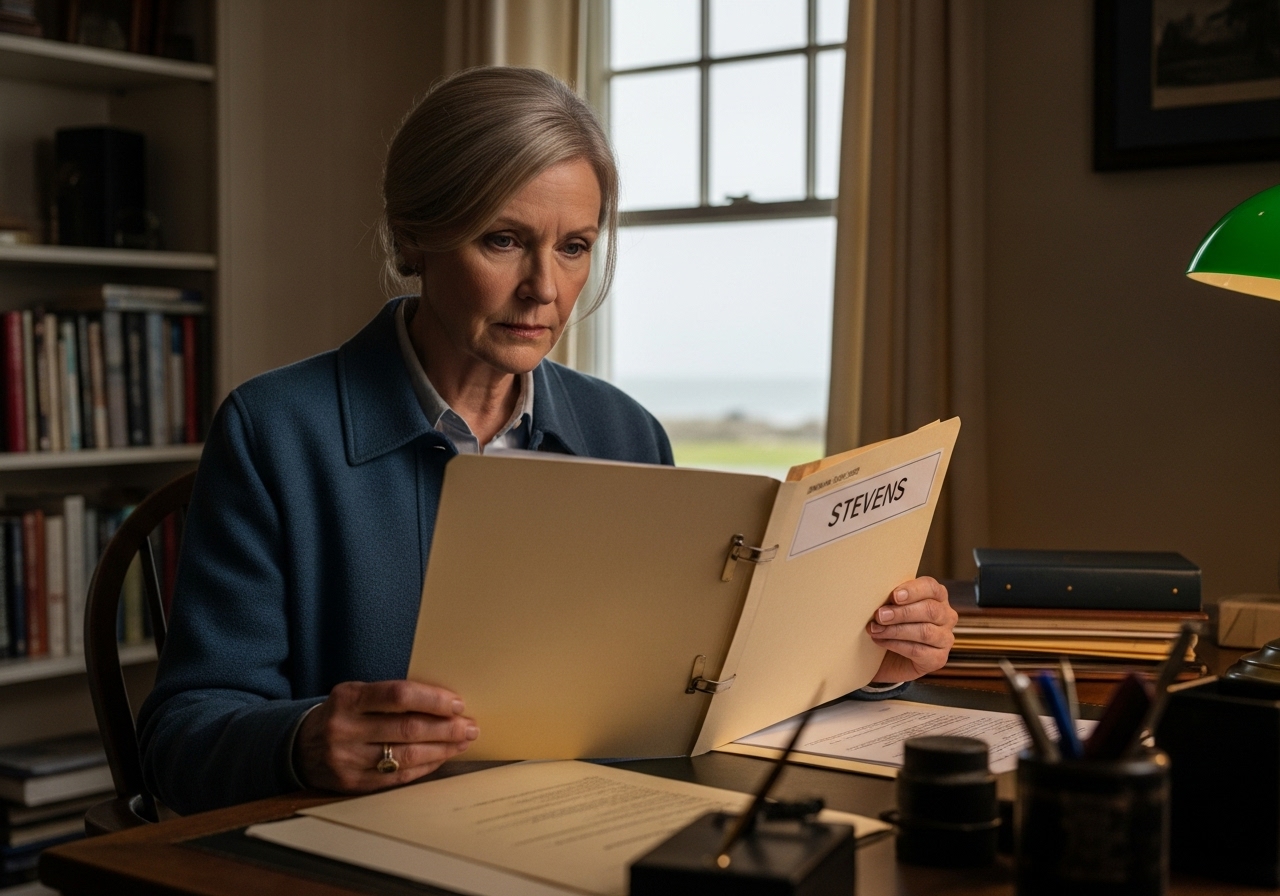
Judge Anna Henderson had traded the elevated mahogany bench and the demanding rhythm of the courtroom for the quiet solitude of her coastal Maine cottage. At sixty-three, her retirement was supposed to be a graceful retreat, a time to tend to her garden and finally read the stacks of classic literature that had accumulated over thirty years of relentless law practice. Yet, the peace she sought was constantly undermined by the persistent, cold echo of her past.
She carried a particular, profound guilt—a case a decade ago where she had missed the subtle, almost invisible signs of domestic abuse during a complicated custody hearing. She had prioritized procedural efficiency over emotional truth, and the outcome had been tragic. That failure had become a silent, heavy coat she wore every day, preventing her from ever truly resting.
Anna remained sharp. Her mind, honed by years of analyzing human deceit and procedural loopholes, could still dissect a conversation and locate the weak seam in a narrative within seconds. But she had sworn off the bench, believing that her emotional scar made her unfit to hold the power of judgment again.
The call came on a brisk October morning, cutting through the silence of her cottage. It was Chief Justice Warren, his voice tight with urgency. Anna’s immediate replacement, Judge Carver, had been hospitalized following an unexpected surgery. The docket was clogged, and a crisis had emerged: an emergency custody case demanding an immediate, experienced hand.
“It’s temporary, Anna, I promise,” Warren pleaded. “Just until we can get a visiting judge in from the city. But this one… it involves Gary Stevens. The name alone carries weight.”
Anna felt a chill. She knew the name. Gary Stevens was more than just wealthy; he was the golden boy of the affluent community of Fairhaven, a sprawling suburban landscape of perfection just outside Portland. A real estate mogul whose developments defined the town’s prosperity, Stevens was the chairman of the school board, the major donor to the arts center, and the very definition of a community pillar. Presiding over a case involving him would be navigating a minefield of local politics and influence.
Reluctantly, haunted by her past failure to intervene, Anna agreed. She drove the two hours back to the courthouse, the familiar drive raising her anxiety. She was stepping back onto the razor’s edge.
The case that brought her back was labeled In Re: Custody of Lilly Stevens. The originating incident was shockingly slight, almost negligible: during a mandatory school mental health check-in, the school social worker, Ms. Reynolds, asked Lilly Stevens, a ten-year-old girl, about her family life.
Lilly, quiet and exceptionally intelligent, with a nervous tic of constantly touching the small silver locket around her neck, had offered a simple, but profound, statement: “He’s not my father.”
The statement was demonstrably false. Gary Stevens was her biological father. But Ms. Reynolds, seasoned in reading the subtext of a child’s pain, flagged the statement. It was a seemingly throwaway line—a lie designed to create emotional distance—that sparked the investigation and the emergency temporary custody filing. Lilly’s mother, Sarah Stevens (40s), had vehemently denied any issues, but her agitation was alarming.
The emergency hearing was held in a small, private conference room adjacent to the main courtroom to minimize public exposure—an accommodation clearly made for the “prominence” of Gary Stevens.
When Gary walked in, Anna instantly understood the source of his power. He was charismatic, impeccably dressed in a custom suit, radiating an aura of calm, reasonable competence. He offered a firm handshake to his lawyer, a renowned litigator, and spoke to the bailiff with courteous, controlled authority.
“Judge Henderson,” Gary began, his voice smooth and deep, an instrument of persuasion. “This entire affair is a deplorable overreaction based on a childish fabrication. My daughter is prone to flights of fancy. This social worker has allowed herself to become overzealous.”
Anna observed him closely, noticing the subtle tension around his jaw that contradicted his relaxed posture. She then turned her attention to Sarah.
Sarah Stevens was beautiful, but fragile, like the glass creatures Lilly was rumored to collect. Her composure was forced, her eyes wide, constantly darting to Gary as if seeking permission or fearing reprisal. She clutched a designer handbag so tightly her knuckles were white. When addressed, her answers were curt, almost rehearsed. She spent the entire session avoiding Anna’s gaze.
“Ms. Stevens,” Anna asked gently, “Does Lilly ever express fear of her father?”
Sarah’s response was immediate and fervent, too fervent. “No! Never. Gary is a wonderful father. He provides everything. This is just… Lilly is very sensitive. She has a vivid imagination.” She immediately launched into a monologue about Lilly’s recent obsession with a dark fantasy novel, trying to frame the lie as a creative flourish.
But Anna noticed the Bối Cảnh (Context) of the room. Gary did not interrupt Sarah’s defense, but his eyes never left her. They were a steady, controlling force. When Sarah finished, Gary placed a hand on her shoulder—a gesture that looked supportive to an outsider, but which made Sarah physically flinch and then immediately still herself. Anna saw the hidden message: You have done well, now be quiet.
“Mr. Stevens,” Anna interjected, leaning forward, “The social worker’s report notes that Lilly’s behavior—the avoidance, the nervous tic, the immediate, firm statement about non-parentage—is highly symptomatic of emotional distress related to a primary caregiver. Can you offer any explanation for the intense distance Lilly seems to want from you?”
Gary maintained his composure perfectly. “Judge, with all due respect, I am a very busy man. I travel constantly. Perhaps the lack of consistent presence makes her seek attention in odd ways. I love my daughter. She has access to the best schools, the best care, everything a child could desire. This is a clear case of professional overreach and a deeply irresponsible temporary seizure of my child.”
Anna listened, her guilt from the past case a cold reminder in her gut. She would not miss the signs this time. The surface—the wealth, the charm, the powerful lawyer—was too perfect, too smooth. It was the perfect illusion. Anna could practically feel the silent terror emanating from Sarah, masked by layers of self-control.
The temporary decision was fraught. Anna could not, at this stage, definitively prove harm. But she could not ignore the alarm bells ringing in her head. She issued a carefully worded order: Lilly would remain in temporary non-custodial care, at a neutral location supervised by child services, pending a comprehensive psychiatric evaluation and a full evidentiary hearing.
Gary Stevens’ composure finally slipped for a split second. A flash of pure, cold fury crossed his face before he masked it with a practiced look of injured indignation. “You are making a grave mistake, Judge,” he stated, his voice now edged with a dangerous, subtle threat.
“The Court,” Anna replied, her voice firm and level, “is prioritizing the safety of a minor child, Mr. Stevens. We will reconvene for the full hearing in two weeks.”
As Gary and his lawyer swept out, Sarah remained, clutching her bag, her eyes glued to the door. Anna watched her go, realizing that the most urgent question wasn’t what Gary had done, but what Sarah was being forced to endure. The seemingly innocent lie of a ten-year-old had cracked the glass surface of Fairhaven’s perfection, and Anna knew that beneath it lay something truly sharp and dangerous. The weight of her past decision galvanized her resolve: she would find the truth in this fractured family.
Chapter 2: The Façade of Perfection
The two weeks leading up to the full evidentiary hearing were a masterclass in influence and intimidation orchestrated by Gary Stevens. Anna, having officially returned to the bench for the duration of this case, found the air in the courthouse thick with pressure.
Gary’s powerful network swung into action. Op-eds appeared in local papers gently questioning the sensitivity and objectivity of the courts regarding high-profile family disputes. Members of the Fairhaven School Board called the Chief Justice, expressing “concern” about the handling of the case and the “reputational damage” being inflicted upon their respected chairman.
The social worker, Ms. Reynolds, found her professional history undergoing a sudden, intense review by an anonymous committee, subtly undermining her credibility.
Anna observed all this with quiet Bất Bình (Outrage). This was Gary’s non-physical form of assault—using his wealth and position to create an atmosphere where the truth simply could not survive. The evidence was not being refuted; it was being asphyxiated.
The prosecution, represented by a cautious attorney named Ms. Davies, struggled to build a strong case. They had circumstantial evidence: Lilly’s withdrawal, Sarah’s emotional fragility, and the documented pattern of Gary’s controlling nature in business dealings. But they lacked the smoking gun of physical abuse or a clear, uncontroverted testimony. Gary was too careful for violence, his abuse more systemic, corrosive, and insidious—the kind that leaves no bruises, only scars on the soul.
Anna took control of the proceedings, ensuring that every piece of procedural protocol was met, meticulously cataloging every potential bias, determined to give Gary no legitimate appeal. She insisted the courtroom remain open to the public, a move that flew directly in the face of Gary’s expectation of privacy.
The defense presented a parade of character witnesses that painted Gary Stevens as a saint. The head of the Fairhaven Rotary Club testified about Gary’s generous spirit. The pastor of their prestigious community church described Gary as a devoted family man and pillar of faith. An esteemed family psychologist, paid handsomely by the defense, offered clinical testimony that Lilly’s statement was merely a classic symptom of “parental alienation syndrome,” subtly shifting the blame to Sarah’s overprotectiveness.
“We have before us,” Gary’s lead attorney concluded, gesturing toward the benevolent-looking client, “a man of unimpeachable character, facing the destruction of his family and reputation based on the overactive imagination of a sensitive child and the overzealousness of an unprofessional social worker.”
When the prosecution finally presented its side, the contrast was jarring. They called Sarah Stevens. She was dressed elegantly, but looked gaunt, her eyes sunken. She was a devastating witness for her own case.
Under cross-examination, she crumbled. She admitted that Gary never hit her. She admitted that she lived in a stunning house and lacked for nothing material. When asked about her emotional life, she froze.
“Does your husband make you feel loved and safe, Ms. Stevens?” the defense attorney pressed, his tone solicitous yet firm.
Sarah stared at Gary, who was seated at the defense table, his expression one of wounded concern. She saw the familiar, silent threat in his eyes—the threat of financial ruin, of total abandonment, of being cast out and having Lilly taken permanently.
“Yes,” she whispered, her voice barely audible. “He… he makes us safe.”
The prosecution’s case was severely damaged. Sarah had folded under pressure, prioritizing the fear of immediate catastrophe (financial ruin) over the possibility of distant freedom.
Anna, watching Sarah’s agonizing capitulation, felt the cold weight of her past guilt press down. She saw the signs now—the forced smile, the physical withdrawal, the fear of the Antagonist that transcended the fear of the Court. Sarah was not protecting Gary; she was terrified of him.
The prosecution’s last and most crucial witness was Lilly. Anna had fought hard to ensure Lilly’s testimony would be treated delicately, and she arranged for Lilly to testify from a separate, closed-circuit room, shielded from the presence of her father. But Gary’s lawyer insisted that Gary be present in the courtroom during the testimony, arguing that observing her father was essential to Lilly’s “therapeutic reconnection.” Anna, constrained by the law’s preference for transparent testimony, reluctantly agreed.
Lilly walked into the remote testimony room, small and frail, clutching the small silver locket around her neck. She was exceptionally articulate, but her gaze was fixed downward. She confirmed that her life was excellent, that her father bought her beautiful gifts, and that her mother loved her very much.
The prosecution cautiously guided her toward the incident. “Lilly, can you tell the Judge why you told Ms. Reynolds that Mr. Stevens was not your father?”
Lilly looked at the camera, and Anna could see the sheer, crippling terror in her eyes, even through the screen. She saw Gary lean forward at the defense table, his gaze fixed on the monitor, a silent, powerful weapon aimed at his daughter.
Lilly began to recite the rehearsed lines that Sarah had been coached to make her repeat. “I was reading a lot of fantasy books, Judge. About dragons and heroes. I was playing a game. I made a mistake. He is my father.”
The courtroom relaxed. The defense lawyer allowed a small, satisfied smile to curl his lip. It was over. The child had recanted.
But Anna knew, with the clarity of a veteran observer of trauma, that the performance was flawless, and the lie was suffocating the girl. The locket tic was constant, Lilly’s hand rubbing it raw.
Anna decided to intervene, stepping outside the typical judicial protocol for child testimony, her voice soft but commanding.
“Lilly,” Anna said, addressing the camera directly, her voice calm and conversational, “I noticed you touch that locket quite a bit. It’s very pretty. Can you tell me what’s inside it?”
Lilly paused, her eyes widening slightly at the unexpected question. She looked down at the locket, then back at the camera, momentarily forgetting the monster watching her.
“It’s… it’s a drawing,” Lilly whispered. “It’s a drawing of my first puppy. Buster.”
“Buster. That’s a lovely name. Did you love Buster very much?”
Lilly nodded, a small, genuine tear tracking down her cheek. “More than anything. He was just a small mutt, but he loved to sleep on my feet.”
“I bet he did,” Anna said, her tone sympathetic. “Lilly, what happened to Buster?”
The change in the girl was immediate and catastrophic. The memory of the animal’s trauma, a trauma Gary had inflicted, was the one thing she hadn’t been coached to suppress. The dam broke.
Her voice rose to a terrified, desperate wail. “Daddy kicked him! He was mad about a phone call. Buster was barking. Daddy said he was a stupid, filthy creature and he kicked him so hard! He made Mommy drive him to the vet, but Buster died that night. And Daddy told me if I ever told anyone that, I would be gone, just like Buster was gone. He said I was just like Buster—useless and loud!”
Lilly Stevens was no longer reciting a lie. She was screaming her truth. She sobbed, burying her face in her hands, her whole small body shaking.
Through her muffled tears, she repeated the lie that was no longer a lie, but a desperate cry for life: “He’s not my father… He’s the monster my father warned me about! He’s the monster!”
The courtroom, which had been silent, exploded.
Chapter 3: The Monster Unveiled
The courtroom was plunged into instant chaos.
The moment Lilly’s harrowing confession ended, the composure that had defined Gary Stevens for fifty years evaporated. The golden pillar cracked, revealing the raging instability beneath.
He shot up from his seat, knocking over his leather chair with a crash that echoed through the stunned silence immediately following Lilly’s scream. He wasn’t the calm, wounded patriarch anymore; he was pure, uncontrolled Bi Kịch (Tragedy) and terrifying aggression.
“SHE IS LYING! ALL LIES!” Gary roared, his face scarlet, veins bulging in his neck. He lunged across the defense table, his hands gripping the edges, aimed at the empty space where the camera was transmitting Lilly’s image. “YOU ARE A SICK, PATHETIC LIAR! YOU HEAR ME, LILLY? YOU WILL REGRET THIS!”
His threats and denials were not aimed at the Judge or the lawyers; they were directed with terrifying intensity at the memory of his daughter’s vulnerability.
The bailiffs reacted instantly, scrambling to restrain the powerful man. Gary fought them, shouting that his reputation, his life, was being destroyed by “this ungrateful child.” His lawyer tried desperately to pull him back, whispering frantic pleas for composure.
Anna Henderson, watching the live feed of the violence he inflicted even now—the exposure of the raw, contemptuous rage Lilly had described—slammed her gavel down repeatedly, the sound cracking like rifle shots in the room.
“Order! Order in this Court!” she commanded, her voice cutting through the noise.
But the outburst was the ultimate, irrefutable evidence. The man who stood before the community as a model of control and success had, under the pressure of truth, revealed the calculating, volatile monster his daughter described. The Bất Bình (Moral Outrage) of the entire courtroom was palpable.
Sarah, seated near the prosecution, didn’t move. She didn’t flinch. She simply watched her husband’s total meltdown with a look of terrifying, vacant resignation—the look of a person who had known this man all along.
As the bailiffs wrestled Gary Stevens out of the room, still shouting threats, Anna addressed the court, her voice now steady with cold, resolved fury.
“Mr. Stevens’ outburst is noted for the record. The Court finds his behavior to be a direct, incontrovertible corroboration of the testimony of the minor child, Lilly Stevens. There is clear and overwhelming evidence of a pattern of emotional and psychological abuse.”
She was about to issue her permanent protection order when the large, ornate doors of the courtroom slowly creaked open.
Standing framed in the doorway was an elderly, frail woman, using a cane. It was Mrs. Martha Chance, the Stevens’ former housekeeper. She looked terrified, but determined, her thin shoulders braced for confrontation.
“Your Honor,” Mrs. Chance’s voice was reedy but clear, cutting through the residual tension, “I apologize for the interruption, but I have something the Court needs to hear.”
Gary’s lawyer, realizing the catastrophe was escalating, jumped up. “Objection, Your Honor! This is an unauthorized witness! This is completely improper!”
Anna silenced him with a single, furious look. “The Court will hear the witness. Mrs. Chance, approach the bench.”
Mrs. Chance shuffled forward, holding a small, old-fashioned voice recorder, the kind used for dictation.
She recounted her story in a simple, factual tone: She had worked for the Stevens family for twenty years. She loved Lilly and watched as Sarah slowly withered under Gary’s systematic control. Sarah, desperate and terrified, had, years ago, given Mrs. Chance the recorder.
“She told me, ‘Martha, if something ever happens to me, if he makes me disappear or take my own life, please, let the judge hear this. Let them know why.'”
Mrs. Chance pressed play.
The courtroom fell into an absolute, suffocating silence, broken only by the tinny sound of the recording.
The voice was Gary Stevens’—not the roaring beast of moments ago, but the quiet, chilling voice of calculated evil. It was a private, late-night conversation, clearly recorded without his knowledge.
Gary’s voice: “You are utterly useless, Sarah. I give you everything, and all you can manage is to make a mess. You know, without my name, without my money, you’d be nothing. A waitress in some greasy diner. I chose you because you were pretty and compliant. Now you’re just a burden. And if you ever try to leave, if you ever try to take Lilly, I will make sure the court knows you’re an unstable, hysterical mother. I will use every lawyer I own to make your life an absolute hell, and I will make sure Lilly is gone—sent to a boarding school in Switzerland where she’ll forget you ever existed. Do you understand, Sarah? Your silence is all that keeps you relevant. Don’t be a fool.”
The recording played for five agonizing minutes, revealing the systematic emotional destruction of Sarah’s self-worth, the financial bondage, and the explicit threat to weaponize Lilly against her. It was a recording of terror, quiet and chillingly professional.
When the recording ended, Anna Henderson was crying—not the hysterical, weeping kind, but the quiet, internal overflow of a woman whose empathy and past guilt had finally found justice. She took a deep breath, her eyes blazing with righteous indignation.
“This court,” she stated, her voice trembling slightly, but firm, “has heard irrefutable evidence of a dangerous pattern of psychological and emotional cruelty and abuse.”
She reached for her pen. The time for deliberation was over. The perfect illusion was shattered, not by a lawyer’s argument, but by the combined courage of a ten-year-old child and a frightened housekeeper. The golden pillar had crumbled entirely.
Chapter 4: The Order and The Beginning of Healing
The gavel slammed one last, definitive time.
Judge Anna Henderson issued her immediate, sweeping orders. The courtroom, still reeling from the devastating recording, held its breath.
“Effective immediately,” Anna announced, her voice clear and strong, “the Court grants permanent protective custody of Lilly Stevens to the state’s care, with her mother, Sarah Stevens, being granted sole temporary custody under the supervision of Child Protective Services. Furthermore,” she continued, looking directly at Gary’s disgraced attorney, “a permanent restraining order is hereby issued against Gary Stevens. He is to have zero contact with either Lilly Stevens or Sarah Stevens, including all electronic, verbal, and third-party communication. Any violation will result in immediate detention.”
The ruling was crushing. But Anna did not stop there.
“Given the clear evidence of coercion, emotional battery, and criminal threat revealed in the testimony and the recording, the Court deems this case warrants further investigation. I am referring the entirety of the file to the District Attorney’s office for immediate review and potential criminal prosecution of Mr. Gary Stevens.”
The town’s golden boy was not just losing a custody battle; he was facing indictment. The fall was complete.
Gary Stevens’ lawyer immediately attempted to motion for an appeal and a stay on the criminal referral, but Anna cut him off with a look of pure steel.
“Motion denied. The interests of the child and the safety of the mother supersede all procedural attempts to silence the truth, Counselor. This court is adjourned.”
As the room emptied, Sarah Stevens remained seated, utterly still. Ms. Davies, the prosecution attorney, gently placed a hand on her shoulder. The fear on Sarah’s face was slowly, almost imperceptibly, giving way to a nascent look of relief, the first true emotion Anna had seen in her.
Lilly was brought from the remote room, initially confused and overwhelmed. When she saw her mother, Sarah rose, and the two embraced—the most genuine, heartfelt embrace Anna had witnessed in years. It was the first act of Chữa Lành (Healing) in the aftermath of the emotional catastrophe. Sarah, now legally protected and emotionally supported, held her daughter not with the frantic grip of fear, but with the tenderness of a mother finally free to protect her child.
Anna watched this small, profound moment unfold, tears finally running freely down her face. She realized that her past failure—the case where she had missed the signs and a child had been lost—had been redeemed here, today, by her decision to listen to the desperate whisper behind the practiced lie. She had prioritized the emotional truth over the legal surface, and it had saved them.
She walked back to her chambers, the silence of the court now a comforting sound, no longer oppressive. She sat at her desk, the cold marble surface familiar beneath her hands. She called Chief Justice Warren.
“The case is concluded, Warren,” she stated. “I’ve issued the final orders and the criminal referral. You can send in the visiting judge now.”
“Anna, you were brilliant,” Warren said, clearly shaken by the details of the case. “The town is in an uproar. You took down a king.”
“I just listened to a child,” Anna corrected him quietly. “And I did what I should have done ten years ago. Thank you for making me come back.”
She officially resigned again, but this time, the retirement was laced with peace. The guilt that had haunted her for a decade was lifted, replaced by the profound, quiet satisfaction of having used her considerable power to protect the innocent and expose true corruption. She left the courthouse, carrying not the weight of the past, but the light of her present resolution.
The town of Fairhaven, shaken to its core by the revelation of Gary Stevens’ monstrous hidden life, began its own process of internal reflection. The pillar of their community was a domestic terrorist. The illusion of perfection was shattered, forcing neighbors to look past the manicured lawns and ask difficult questions about what they choose to ignore in the name of respectability.
Chapter 5: The Unseen Courage
Weeks turned into months. Gary Stevens was formally indicted on multiple counts, including criminal threat and emotional abuse. His business empire, built on shaky ground and sheer influence, began to crumble under the weight of his public disgrace.
The focus shifted entirely to the recovery of Sarah and Lilly. They moved away from the sprawling mansion, finding a quiet, anonymous apartment far from Fairhaven.
The narrative followed Lilly’s slow journey of Chữa Lành (Healing). Initially, she was still withdrawn, her hand constantly seeking the locket. But with intensive therapy and her mother’s unwavering, fear-free support, the small signs of her recovery emerged.
The locket—the symbol of her trauma—eventually became a symbol of her courage. She stopped touching it with a nervous tic and began holding it gently, a memory of the truth she had to speak to save herself.
The greatest sign of her recovery came during a mundane shopping trip with her mother. Sarah noticed Lilly looking at a window display of puppies. Before, she would have flinched. Now, Lilly looked at her mother and offered a small, tentative, but absolutely genuine smile. It was a smile of pure, unburdened happiness—the first one Sarah had seen in years. The monster was gone.
Anna, back in her Maine cottage, received occasional updates from Ms. Davies. The latest update included a small, handwritten card from Lilly.
Dear Judge Henderson, Thank you for listening to my mistake. It wasn’t really a lie. I hope you are having a nice retirement now. Love, Lilly.
Anna sat holding the card, realizing the depth of the child’s intelligence. Lilly’s initial statement—”He’s not my father”—was not a factual lie; it was a spiritual truth. He was not the protector, the role of a father; he was the destroyer.
Anna retired permanently, her heart finally unburdened. The Thấm Thía (Profound) final reflection solidified her belief: courage often comes in the most unexpected and quiet forms. It didn’t always roar from a judge’s bench or in the headlines. Sometimes, courage was the desperate, flawed testimony of a frightened child, a small lie intended to create distance from a monster, and the profound bravery of an elderly housekeeper who chose integrity over security.
The shattered illusion of the Stevens family perfection became the community’s necessary lesson. They learned, brutally, that respectability is not a substitute for morality, and that the greatest darkness often hides behind the brightest gold. The small, quiet voice of Lilly Stevens had torn down years of systematic deceit and, in the process, had redeemed the career and the conscience of the retired judge who finally chose to listen. The story ends not with a grand statement, but with the quiet, lasting image of Lilly, finally playing freely, her small hand no longer clutching the locket in fear, but reaching for her future.