The Blind Detective and the Thief of Sins: A Serial Killer Was Stealing Masterpieces, But He Wasn’t Selling Them—He Was Turning Them Into Confessions.
The Canvas of Judgment
Chapter 1: The Fading World
The world was ending, not with a bang, but with a blur.
Detective Arthur Vance sat at his mahogany desk in the 4th Precinct, squinting at the paperwork that had once been as clear as day. Now, the letters swam like black insects in a pool of milk. He blinked, rubbing his eyes with the heel of his hand, but the gray smudge in the center of his vision—the hallmark of advanced Macular Degeneration—refused to move.
He was sixty-four years old. A relic. A man of vinyl records, cold cases, and silence in a city that had become loud, digital, and fast. In three weeks, the Department would force him into retirement. They called it “medical leave,” but Vance knew it was a mercy killing for his career. He was a detective who could no longer see the clues.
“Package for you, Vance,” the desk sergeant called out, dropping a heavy, flat crate onto his desk.
Vance jumped slightly. He hadn’t seen the man approach. That was happening more often lately. People materialized out of the fog like ghosts.
“Who’s it from?” Vance asked, reaching for his letter opener.
“No return address. Courier dropped it. Said it was urgent.”
Vance sliced the tape. He pried open the wooden lid. inside, wrapped in layers of velvet and bubble wrap, was a canvas.
He pulled it out and gasped. Even with his failing eyes, he recognized the shimmer of the pearl, the exotic turban, the liquid gaze of the girl.
It was The Girl with a Pearl Earring by Johannes Vermeer.
The precinct went silent. The news had been screaming about this for two days. The Vermeer had vanished from the City Museum on Tuesday night. The security system hadn’t been tripped. The sensors hadn’t twitched. It was as if the painting had simply dissolved and reformed elsewhere.
“My God,” the sergeant whispered. “Is that the real thing?”
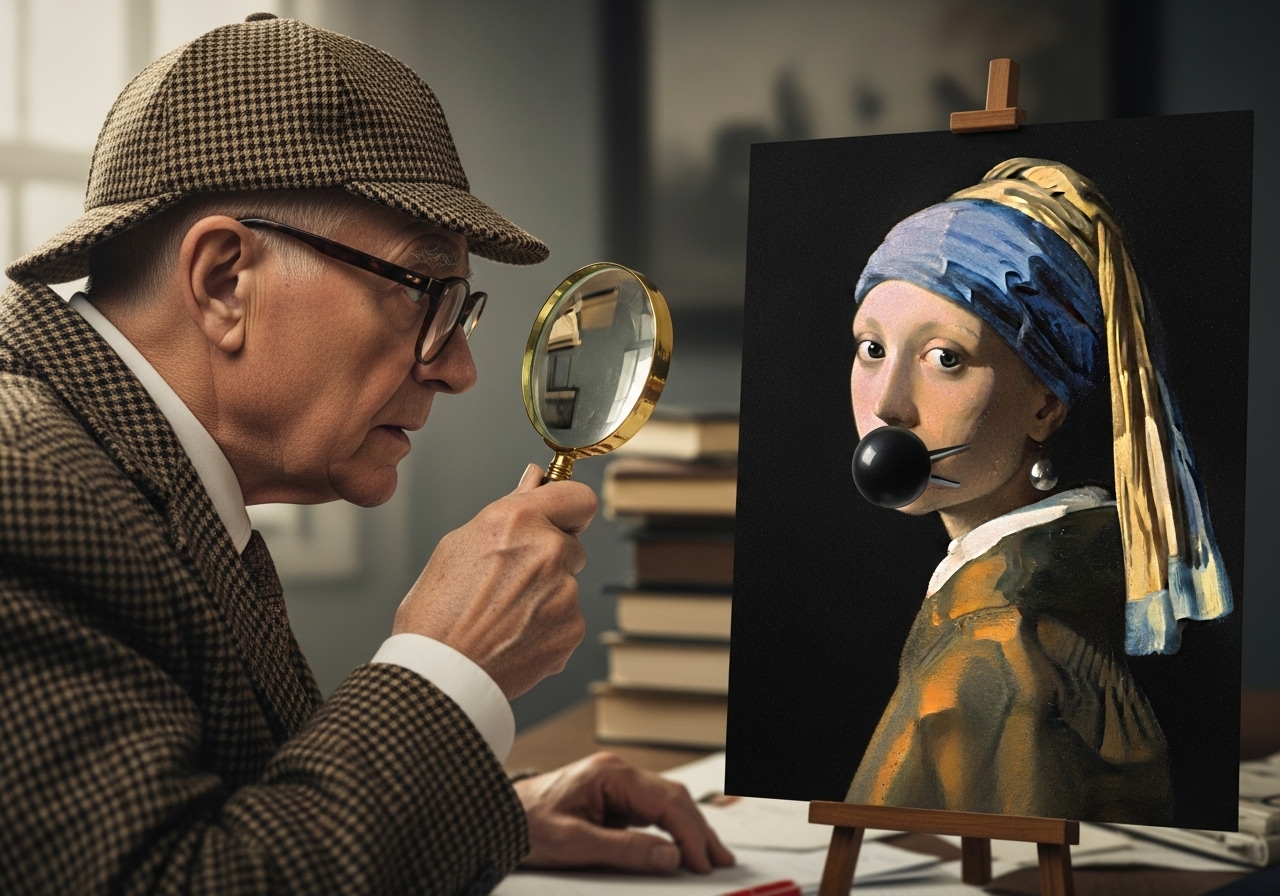
Vance leaned in. He pulled a magnifying glass from his drawer—his constant companion these days. He brought the lens close to the canvas. The craquelure—the tiny spiderweb cracks in the varnish—looked authentic. The light was perfect.
But something was wrong.
“Get the crime lab,” Vance said, his voice trembling. “And get me Helena Rostova.”
“Why? Is it a fake?”
“No,” Vance said, feeling a chill crawl up his spine that had nothing to do with the drafty AC. “It’s real. But look at her mouth.”
The sergeant leaned in. He recoiled.
In the original painting, the girl’s lips are slightly parted, moist, sensual, speaking to the viewer across centuries.
But on this canvas, that mouth was gone. In its place, painted with terrifyingly realistic precision, was a ball gag. A black, leather strap cut across the girl’s delicate skin, buckling behind her head. The paint was fresh, oily, and violent.
Vance moved his magnifying glass down to the gilded frame. There, etched into the wood with a knife, were numbers.
40.7128° N, 74.0060° W.
“Coordinates,” Vance murmured. “He didn’t steal it for money. He stole it to send a message.”
Chapter 2: The Art of Silence
The coordinates led them to a brownstone in the Upper East Side. It was a fortress of limestone and iron, belonging to Richard Sterling, a real estate mogul whose name was plastered on half the skyscrapers in the city.
Sterling had been missing for forty-eight hours. His family assumed he was on his yacht.
Vance stood in the basement wine cellar, the air thick with the smell of vintage Bordeaux and something copper-like. Blood.
“Watch your step, Arthur,” Dr. Helena Rostova said gently, taking his elbow.
Helena was fifty-five, an art historian with sharp eyes and a mind that held the entire history of Western civilization. She was the only person Vance allowed to see him stumble.
“I can see the shapes, Helena,” Vance grunted, though he was grateful for her touch. “Tell me what we have.”
“It’s… it’s grotesque, Arthur,” she whispered.
In the center of the room, tied to a heavy oak chair, was Richard Sterling. He was dead.
He was dressed in period clothing—a silk tunic, a turban wrapped around his head. And in his mouth was a black leather ball gag.
He had been posed. He was a macabre mirror image of the defaced Vermeer.
“The killer is an artist,” Vance said, kneeling carefully beside the body. He used his magnifier to look at the knot on the gag. It was tied with surgical precision. “Sterling… he was known for what?”
“For silencing his tenants,” a uniform officer spoke up from the doorway. “He bought up low-income housing, turned off the heat, and forced people out. When they tried to sue, he buried them in NDAs. Gag orders. He loved gag orders.”
Vance stood up, his knees popping. “A gag for a gag. The killer isn’t just murdering them. He’s restoring the moral balance.”
“Arthur,” Helena called out. She was inspecting the wall behind the body. “Look at this.”
Vance squinted. On the pristine white wall, painted in what looked like Sterling’s own blood, was a single word.
VARNISH.
“Varnish,” Vance repeated. “A protective layer. A shine used to cover the paint.”
“Or to hide the cracks,” Helena said. “He’s stripping them, Arthur. He’s stripping away the varnish of these people’s lives to show what’s underneath.”
Vance looked at the dead billionaire, then at the empty space where his soul should have been. The blurring gray spot in his vision pulsed. He was running out of time. The killer was just getting started, and Vance was going blind.
Chapter 3: The Feast of Rot
Three days later, the city was in a panic. The “Restorationist,” as the press had dubbed him, struck again.
This time, the theft was from the Modern Art Wing. The Banquet by Francisco Goya. A dark, moody piece depicting a lavish spread of food.
It arrived at the precinct at dawn, left on the front steps wrapped in a homeless man’s blanket.
Vance was waiting. He felt the tension in the station. The younger detectives were running around with laptops and cell phone data. They were looking for digital footprints. Vance knew this killer didn’t leave digital prints. He left brushstrokes.
He unwrapped the Goya.
“What did he do to it?” the Chief asked, chewing on an unlit cigar.
Vance peered through his glass. The table in the painting was still set. The goblets were there. But the food—the roast pheasant, the grapes, the bread—had been painted over.
Instead of food, the platters were piled high with pills.
Thousands of tiny, painted pills. Blue, white, red. They looked like rotting maggots feasting on the table.
“Identifying the pills,” Helena said, stepping into the office. She had become a fixture there, Vance’s eyes in the art world. “These are OxyContin. And these… these are insulin vials.”
“The victim,” Vance said, his voice heavy. “Who is the patron of the Modern Art Wing?”
“Marcus Thorne,” Helena said. “CEO of Zenith Pharmaceuticals.”
“The man who raised the price of insulin by 600% last year,” Vance recited. “And who claimed opioids were non-addictive.”
They found Marcus Thorne four hours later.
He was in the dining room of his penthouse. He was slumped face-first into a bowl of soup. But the soup wasn’t broth. It was a sludge of dissolved pills. He had been force-fed his own product until his heart stopped.
The public reaction was terrifying.
Vance sat in a diner later that night, trying to eat a sandwich he could barely see. The television above the counter was blaring the news.
“…police are calling him a monster, but social media is calling him a hero,” the anchor said. “Thorne was untouchable by the law. He paid millions in settlements to avoid jail. This killer… he’s doing what the courts couldn’t.”
“They’re cheering for him,” Vance muttered.
“People are angry, Arthur,” Helena said, stirring her tea. “They see a system that protects the rich and punishes the poor. This killer… he’s tapping into a very deep vein of indignation.”
“He’s a murderer,” Vance said stubbornly. “Justice isn’t revenge, Helena. Justice is process. It’s order.”
“Is it?” Helena challenged gently. “Or is that just what we tell ourselves to sleep at night? Look at you, Arthur. You’ve given forty years to the law. And what do you have? A pension that barely covers your rent and eyes that are failing you. Meanwhile, men like Thorne buy Goya paintings with blood money.”
Vance looked at her. He saw only the outline of her face, the halo of her hair. “Are you defending him?”
“No,” she said. “I’m explaining him. He views himself as a restorer. In art restoration, sometimes you have to use harsh solvents to remove the layers of dirt and grime to reveal the truth. He thinks he’s cleaning the city.”
Vance rubbed his eyes. The gray spot was bigger today. It was like a thumbprint on a camera lens.
“I need to see the brushwork,” Vance said. “The way he painted those pills. It was too good. He’s not an amateur. He’s trained.”
Chapter 4: The Pentimento
The breakthrough came from the chemistry, not the police work.
Vance was in the crime lab, the smell of formaldehyde and coffee warring in the air. The lab tech, a young man named Chen, was running a spectral analysis on the paint the killer used to deface the Goya.
“It’s weird, Detective,” Chen said. “The pigment. It’s lead-based.”
“Lead?” Vance asked. “They banned lead paint in the seventies.”
“Exactly. And the binding agent… it’s egg tempera. Old school. Renaissance style. Nobody mixes paint like this anymore. Except maybe traditionalists. Hardcore restorers.”
Vance turned to Helena. “A restorer.”
Helena’s face went pale. “Arthur. The provenance.”
“The what?”
“The history of ownership,” she said, pacing the small lab. “I was looking at the stolen paintings. The Vermeer. The Goya. And the Hopper that was stolen this morning.”
“What about them?”
“They all have a gap in their history,” Helena said. “Between 1939 and 1945. They disappear from the records.”
” The war,” Vance realized.
“The Nazis looted them,” Helena said. “These paintings… they belonged to the focal Jewish collection of the Weiss family in Paris. The Nazis stole them. After the war, they weren’t returned to the family. They were ‘laundered’ through Swiss auctions and bought by American collectors. By Sterling. By Thorne.”
“They bought stolen goods,” Vance said.
“They knew,” Helena said, her voice angry now. “Everyone in the art world knew the Weiss collection was cursed. But they didn’t care. They wanted the prestige.”
“So the killer isn’t just punishing them for being corrupt CEOs,” Vance realized. “He’s punishing them for being fences. For owning stolen history.”
“The Weiss family,” Helena typed furiously on her tablet. “They were wiped out in the camps. Except for one. The grandson. He survived. He was an artist. A restorer.”
“Name?” Vance barked.
“Julian Weiss. He changed his name when he came to America. He goes by Julian Vane. He runs a restoration studio in the Bronx. It’s been closed for years.”
Vance grabbed his coat. “Let’s go.”
“Arthur,” Helena grabbed his arm. “You can’t drive. You can barely see.”
“Then you drive,” Vance said. “I don’t need to see him to catch him. I just need to talk to him.”
Chapter 5: The Studio of Dust
The studio was in a condemned warehouse district. The windows were boarded up. The air smelled of rain and wet ash.
Vance and Helena pushed open the heavy iron door.
Inside, it was like stepping into a cathedral of shadows. The space was vast, filled with dust motes dancing in the shafts of light coming through the cracked roof.
And on the walls…
Vance gasped. Even with his bad eyes, he could feel the power of the room.
Dozens of paintings lined the walls. Not the defaced ones. These were masterpieces. A missing Rembrandt. A lost Van Gogh. The “Weiss Collection.”
And sitting in the center of the room, on a simple wooden stool, was an old man. He was mixing paint on a palette.
“Julian Vane?” Vance called out, his hand resting on his service revolver.
The man didn’t look up. He continued to mix a vibrant red.
“My name is Weiss,” the man said. His voice was dry, like paper rubbing together. “Detective Vance. I expected you sooner. Your eyesight must be slowing you down.”
Vance stepped forward. “How do you know about my eyes?”
“I watch people,” Julian said. “I see the way you tilt your head. The way you hesitate before a step. You are losing the light, Detective. Just like this city.”
“You killed two men,” Vance said. “You tortured them.”
“I revealed them,” Julian corrected. He finally looked up. He had a kind face, wrinkled and sad, with eyes that were frighteningly clear. “They were thieves. They sat in their high towers, surrounded by beauty they didn’t earn, beauty that was soaked in the blood of my family. I simply… corrected the record.”
“By becoming a murderer?” Helena asked, stepping out from behind Vance.
“Dr. Rostova,” Julian smiled. “You of all people should understand. What is restoration? It is the removal of the false to reveal the true. These men… Sterling, Thorne… they were the false layers. They were the dirt obscuring the masterpiece of humanity.”
“That’s not for you to decide,” Vance said. “Put the brush down, Julian.”
Julian sighed. He stood up slowly. “I am tired, Detective. I have finished my work. The Ledger is over there.”
He pointed to a thick, leather-bound book on a table.
“That book,” Julian said, “contains the proof. Every bribe Sterling paid. Every safety report Thorne buried. It exposes the entire network of the city’s elite. It is the truth you have been looking for your whole career.”
“And the paintings?” Vance asked.
“The paintings belong to the dead,” Julian said.
He reached into his pocket. Vance drew his gun. But Julian didn’t pull a weapon. He pulled a lighter.
He flicked it.
“No!” Helena screamed.
The floor was soaked. Vance smelled it now. Not just turpentine. Kerosene.
Julian dropped the lighter.
Chapter 6: The Choice of Fire
WHOOSH.
The room ignited instantly. A wall of orange flame shot up, separating Vance from Julian. The heat was a physical blow, punching the air out of Vance’s lungs.
“Run, Detective!” Julian yelled from behind the wall of fire. “Take the truth and run!”
“Julian!” Vance shouted, shielding his face.
“The law cannot touch them!” Julian’s voice was fading, swallowed by the roar of the fire. “Only the truth can burn them down!”
Vance spun around. The fire was spreading fast, licking at the dry canvasses on the walls. The masterpieces. The lost history. They were curling, bubbling, dying.
“Arthur!” Helena screamed. “The Ledger!”
She was pointing at the table. The book was dangerously close to the flames.
But Vance was looking at the wall. There, hanging crookedly, was a small portrait. It was of a woman holding a child. It was signed Weiss, 1938. It was the only painting Julian hadn’t stolen. It was his family.
Vance had a split second. His vision was failing. The smoke was blinding him completely. He saw only shadows and light.
He could save the evidence that would convict the billionaires. Or he could save the art.
“The truth,” Vance grunted.
He lunged. He grabbed the heavy ledger, feeling the leather burn his fingers.
“Helena! Grab the portrait!” he roared.
Helena didn’t hesitate. She dove through a gap in the flames, snatched the small painting, and rolled back.
“Go! Go!” Vance shouted.
They stumbled toward the door, the heat searing their backs. The ceiling groaned. A beam crashed down right where Vance had been standing a second before.
They burst out into the cool, rainy night, gasping for air, collapsing onto the wet pavement.
Behind them, the warehouse collapsed in a shower of sparks. The Weiss collection was gone. Julian was gone.
Vance lay on his back, clutching the ledger to his chest. He couldn’t see the stars. He could only see a gray fog. But he felt the weight of the book.
Chapter 7: The Gallery of Truth
Three months later.
Vance sat on a park bench. The autumn air was crisp. He wore dark sunglasses. The gray spot had finally won. He was legally blind now. He could distinguish light from dark, but faces were just memories.
He heard footsteps. Familiar, purposeful footsteps.
“Helena,” he smiled.
“You didn’t need eyes for that,” she laughed, sitting beside him.
“How is it?” Vance asked.
“It’s beautiful, Arthur,” she said. “The new wing of the City Museum. They named it ‘The Weiss Gallery.'”
“And the exhibit?”
“It’s empty,” she said.
Vance nodded. “Good.”
“Well, not empty,” she corrected. “In the center of the room, there is one painting. The portrait of the woman and child. The one we saved. And on the walls surrounding it… are the pages.”
“The pages of the ledger?”
“Yes. Blown up to ten feet tall. Everyone is reading them, Arthur. Sterling’s bribes. Thorne’s emails. The corruption. It’s all there. The Mayor resigned this morning. Thorne’s company filed for bankruptcy yesterday. You didn’t just catch a killer. You burned down the whole corrupt kingdom.”
Vance leaned back, listening to the wind rustle the leaves. He couldn’t see the leaves, but he could hear them. They sounded like applause.
“Julian was wrong about one thing,” Vance said softly.
“What’s that?”
“He said the law serves the rich. And he was right, mostly. But sometimes… sometimes the truth serves everyone.”
“Are you happy, Arthur?” Helena asked, taking his hand.
Vance closed his useless eyes. In his mind, he saw the Vermeer. He saw the Goya. But they weren’t defaced. They were restored. They were whole.