I Pulled My Gun on My Son’s Teacher. What I Found in Her Desk Shattered Everything I Knew About Justice.
PART 1
Chapter 1: The Silence in the Hallway
I’ve been a cop in Riverside for fifteen years. You see things in this job that scrape the insulation off your nerves. I’ve seen the wreckage of drunk driving accidents on I-95, I’ve intervened in domestic disputes that turned violent, and I’ve held the hands of people taking their last breaths. You build a wall. You have to. If you let every tragedy in, you drown.
But that wall doesn’t exist when it comes to your own kids.

My son, Ethan, is nine. My wife, Sarah, and I adopted him three years ago. When we first got him, he was like a frightened bird. He wouldn’t speak above a whisper. He flinched if you moved your hand too fast. The foster system hadn’t been kind to him, and his biological parents had been even worse. It took a year of therapy and patience just to get him to look me in the eye. It took two years for him to call me “Dad.”
So, I’m protective. Maybe overprotective.
It was a Tuesday afternoon. I had just finished a shift, still in uniform, still smelling like stale coffee and cruiser upholstery. I had my partner with me—Rex, a ninety-pound German Shepherd who looks like a wolf but acts like a golden retriever when Ethan is around.
“We’re going to get the boy, Rex,” I said, glancing in the rearview mirror. Rex’s ears perked up at the word boy. He let out a soft woof.
I had promised Ethan I’d pick him up early. He had aced a math test—something he struggled with—and I promised him ice cream. The simple things. The things normal families do.
I pulled the cruiser up to the curb of Lincoln Elementary. It’s a good school. Brick building, well-maintained lawn, the kind of place where parents worry about gluten allergies, not violence.
I stepped out, adjusting my belt. The sun was hiding behind a layer of gray clouds, making the afternoon feel later than it was. I told Rex to stay, leaving the back window cracked for him, and headed for the main entrance.
Usually, the school buzzes. Even before the bell rings, there’s a hum of energy. Teachers moving around, kids laughing in the distance, the clatter of janitorial staff.
But as soon as the heavy double doors clicked shut behind me, I felt it.
Silence.
Not the quiet of a library. This was the heavy, suffocating silence of a held breath.
I frowned, my boots squeaking softly on the waxed linoleum. I walked past the front office. Empty. The secretary wasn’t at her desk.
Weird, I thought. Maybe a staff meeting?
I turned the corner toward the fourth-grade wing. The lockers lined the walls, bright blue and yellow, cheerful colors that clashed with the knot tightening in my stomach.
My instinct, honed by years on the street, started pinging. Something is wrong.
I sped up.
Then, I heard it.
It came from the end of the hall. Room 4C. Mrs. Carter’s room.
“Do you think you can just sit there?”
The voice was female, high-pitched, and laced with a hysteria that made my blood run cold. It wasn’t a teacher scolding a student for chewing gum. It was the sound of someone who had lost control.
“Do you think silence will save you?”
I broke into a run. My hand dropped instinctively to my waist, not drawing a weapon, but ready.
CRACK.
The sound echoed down the empty corridor. It was sharp and dry. Wood striking something.
My heart hammered against my ribs. That was the sound of violence. And my son was in that room.
Chapter 2: The Monster with the Yardstick
I didn’t pause at the door. I didn’t knock.
I planted my boot near the handle and shoved. The door flew open, banging violently against the stopper.
“POLICE!” I shouted, force of habit taking over.
The scene froze. It was like stepping into a nightmare freeze-frame.
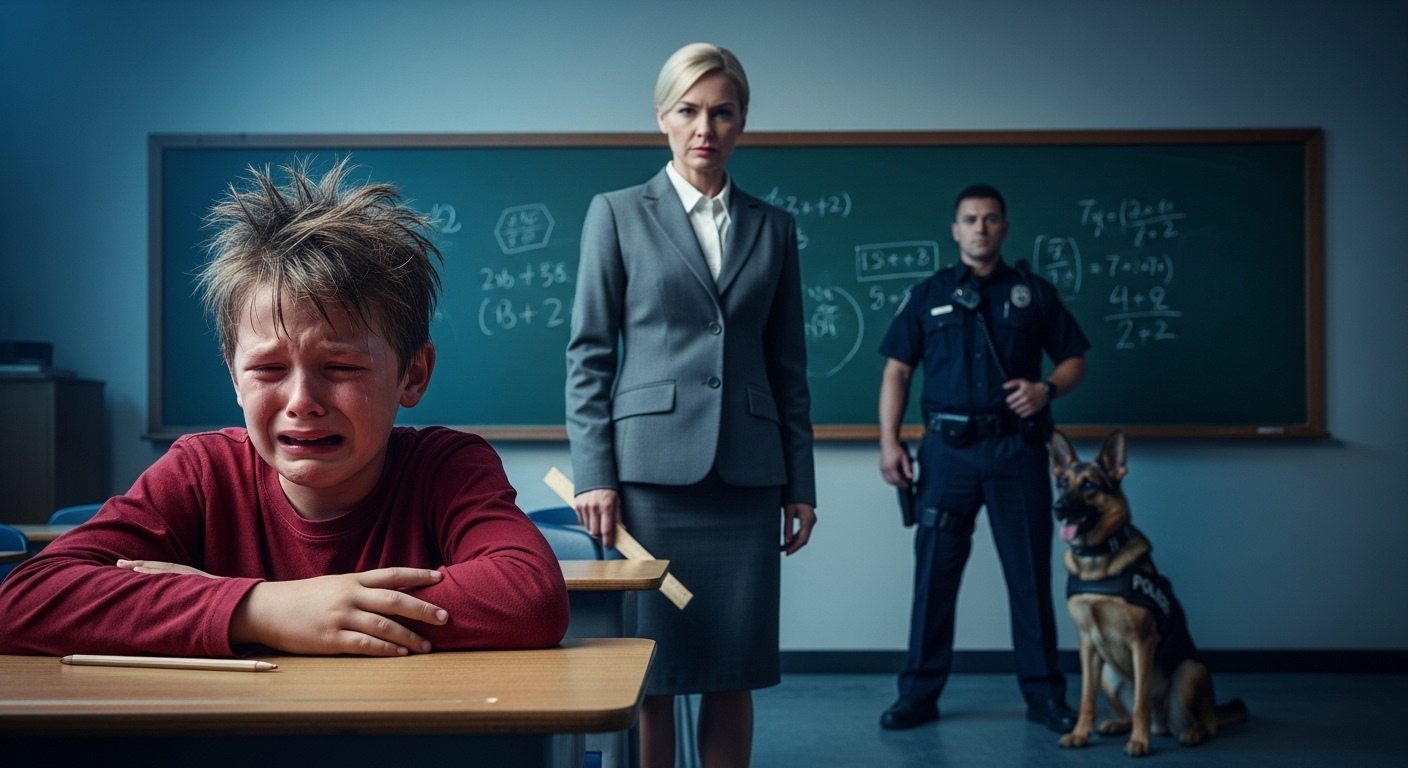
The classroom was in chaos, but a silent kind of chaos. Desks were pushed askew. About twenty children were huddled against the back wall near the cubbies. Their eyes were wide, terrified saucers. I saw a little girl, Maya, who comes to our house for playdates, crying into her hands, her shoulders shaking.
But my eyes locked on the center of the room.
Ethan.
My boy was sitting at his desk, isolated from the others. He looked so small. He was curled in on himself, his shoulders hunched up to his ears. He was trembling violently.
He was clutching his left hand to his chest, cradling it with his right. Even from the doorway, I could see the angry red welt rising across his knuckles.
And looming over him was Mrs. Carter.
I knew Margaret Carter. I had met her at Parent-Teacher conferences. She was a soft-spoken woman in her late fifties, usually wearing cardigans and reading glasses on a chain. The kind of woman who baked cookies for the bake sale.
The woman standing there was not Margaret Carter.
Her hair was wild, escaping her bun in frantic wisps. Her face was flushed a deep, unhealthy crimson. Her eyes were bulging, fixated on my son with a mix of fury and desperation that looked psychotic.
In her hand, she held a heavy wooden yardstick. She had it raised high, cocked back like a baseball bat.
She didn’t even look at me when the door slammed. She was locked in a trance.
“Answer me!” she screamed at Ethan. “Why won’t you write it? Why won’t you save him?”
I didn’t understand the words. I didn’t care.
“MRS. CARTER!” I bellowed, my voice dropping into the command tone I used to control riots. “DROP THE WEAPON!”
She blinked, her head snapping toward me. For a split second, she looked confused, as if she didn’t know how I got there. But the yardstick didn’t lower.
Behind me, I heard the scrabble of claws on tile. Rex. He must have jumped the window or squeezed through the crack when he heard my shout. He barreled past me, a black-and-tan missile.
He didn’t attack. He’s trained better than that. He planted himself between Mrs. Carter and Ethan and let out a bark that shook the windows. He lowered his head, teeth bared, waiting for the command.
Mrs. Carter stumbled back, finally realizing there was a ninety-pound German Shepherd ready to take her arm off. The yardstick clattered to the floor.
I moved in. Fast.
I grabbed her arm, twisting it behind her back—firmly, but not to break it. I spun her around and pushed her against the whiteboard.
“Margaret Carter, you are under arrest for assault on a minor,” I growled close to her ear.
She didn’t fight. All the fight drained out of her the moment the wood hit the floor. She slumped against the board, sobbing. Not angry sobs anymore. Broken, gut-wrenching sobs.
“I had to,” she gasped, her face pressed against the dry-erase marker tray. “He wouldn’t… he wouldn’t write the letter. He has to write the letter.”
I cuffed her. The metal ratcheting shut was the only sound in the room besides her crying.
I keyed my radio on my shoulder. “Dispatch, this is Unit 7-Alpha. I need backup at Lincoln Elementary. Immediate. Suspect in custody. I need a paramedic for a minor.”
I turned to look at Ethan.
He hadn’t moved. He was staring at Mrs. Carter, his eyes huge. But there was something strange in his expression. He wasn’t looking at her with hate. He was looking at her with… recognition?
“Ethan?” I said, my voice softening instantly. “Buddy, it’s over. Dad’s here.”
Rex trotted over to Ethan and licked the tears off his face. Ethan buried his face in the dog’s fur, finally letting out the sob he had been holding back.
I looked at the teacher, now slumped in a chair where I’d sat her. She looked broken. Shattered.
I thought I knew what I was looking at. I thought I was looking at a woman who had simply lost her mind and hurt my son.
I was wrong. The truth was buried in the assignment on Ethan’s desk, and in a grave three towns over.
PART 2
Chapter 3: The Glass Wall
The ambulance lights painted the school parking lot in rhythmic strobes of red and white. I stood by the open doors of the rig, my arms crossed so tight my chest ached, watching the EMT gently wrap gauze around Ethan’s hand.
He wasn’t crying anymore. That was almost worse. He was staring at his knees, swinging his legs, completely checked out. It was the “foster kid stare”—the dissociation technique he used to survive before he met us. Seeing it back on his face broke my heart more than the bruise did.
“It’s just a contusion, Mark,” the paramedic, a guy I’d known for years named Tony, said softly. “Bone isn’t broken. But he’s in shock. Take him home. hug him.”
I nodded, unable to speak. Sarah, my wife, had arrived five minutes ago. She was in the back of the ambulance with Ethan, her face pale, whispering things into his ear that made him nod slowly.
I walked over to my cruiser. Mrs. Carter was in the back.
She wasn’t thrashing. She wasn’t screaming for a lawyer. She was sitting perfectly still, staring straight ahead through the cage, her eyes fixed on nothing. She looked like a statue made of ash.
“Mark,” a voice came from behind me. It was Captain Miller. He had arrived on the scene with the second wave of units. “You can’t transport her. Protocol. You’re the victim’s father. You’re compromised.”
“I’m fine, Cap,” I lied. My hands were shaking.
“You’re not fine. You look like you’re about to put a hole through a wall. Officer Davis will take her in. You go home with your family.”
“I need to know why,” I said, my voice low and dangerous. “I need to know why a woman who brought cupcakes to the Halloween party tried to beat my son with a piece of lumber, Miller. I’m coming to the station.”
Miller looked at me, saw the look in my eye, and sighed. “Fine. But you stay behind the glass. You do not enter that room. You do not talk to her. If you so much as twitch wrong, I’m pulling your badge. Understood?”
“Understood.”
I sent Sarah and Ethan home. Kissing Ethan’s forehead felt like kissing a ghost. He didn’t lean into me. He just sat there.
The drive to the precinct was a blur of anger. Every time I closed my eyes, I saw that yardstick raised high. I saw the terror in the other kids’ eyes.
When we got to the station, the mood was grim. word travels fast. Everyone knew a teacher had been arrested. Everyone knew it was my kid. The other officers gave me a wide berth, offering silent nods of support.
I went straight to the observation room. The one-way mirror looked into Interrogation Room B.
Mrs. Carter sat at the metal table. They had uncuffed her one hand so she could drink water, but the styrofoam cup sat untouched. She was murmuring to herself.
I pressed the button to turn up the audio feed.
“…didn’t say it. He just sat there. Just like them. Just like the others…”
My stomach twisted.
Detective Gomez, our best interviewer, walked into the room. He carried a manila folder. He sat down opposite her, calm, methodical.
“Margaret,” Gomez said gently. “We need to talk about what happened in Classroom 4C.”
She didn’t look at him. She looked at her hands. “I ran out of time,” she whispered.
“Time for what?”
“To make them understand,” she said, her voice gaining a sudden, terrifying clarity. “To teach them the lesson. The only lesson that matters.”
Chapter 4: The Blank Page
Gomez opened the folder. inside was the evidence collected from the scene. He pulled out a piece of paper.
It was standard lined notebook paper. The kind with the three holes punched in the side.
“This was on Ethan’s desk,” Gomez said. “This is what you were upset about?”
I leaned closer to the glass. The paper was blank. Completely blank. Not a single word.
“He wouldn’t write it,” Mrs. Carter said. Her voice was trembling now. “I gave them thirty minutes. The assignment was simple. ‘Write a letter to someone you lost. Tell them what you would say if you had one more chance.’ That was the assignment.”
I felt a cold chill. Someone you lost.
Ethan had lost everyone. His biological parents lost their rights due to neglect. His grandmother, who tried to take him in, died of a stroke right in front of him. For a kid with Ethan’s trauma, that assignment wasn’t homework. It was a minefield.
“He just sat there,” Mrs. Carter continued, her breathing picking up speed. “Staring at me. With those big, dark eyes. He looked so much like him.”
“Like who, Margaret?” Gomez asked.
“Like Danny.”
She squeezed her eyes shut, tears leaking out. “He looked just like Danny when he was scared. The silence. The absolute, heavy silence.”
“Who is Danny?” Gomez asked.
I searched my memory. I knew Margaret Carter had been teaching for twenty years. I knew she was a widow. I didn’t know she had a son.
“My son,” she whispered.
I froze.
“Danny died twelve years ago,” she said, her voice cracking. “Today. Today is the anniversary.”
I checked the date on my watch. October 24th.
“I didn’t know that, Margaret,” Gomez said softly. “I’m sorry. But what does that have to do with Ethan?”
She looked up then, and for the first time, she looked lucid. But it was the lucidity of deep, agonizing pain.
“Danny didn’t die of a sickness,” she said. “He wasn’t hit by a car. He was murdered.”
The room went silent. I looked at Miller, who was standing next to me in the observation booth. He looked just as shocked as I was.
“He was taken,” she said. “From the park. Two blocks from our house. It was broad daylight. 3:00 PM. Just like today.”
She leaned forward, her hands gripping the edge of the table so hard her knuckles turned white.
“There were people there. A woman walking her dog. A man washing his car. Two other kids playing on the swings. They saw it. They saw a man drag my Danny into a van. They saw him fighting. They heard him scream.”
She paused, a sob catching in her throat.
“And do you know what they did?” she hissed. “Nothing. They did nothing. They didn’t call 911. They didn’t scream for help. They didn’t write down the license plate. They watched. They watched him get taken because they didn’t want to get involved. They were scared. They stayed silent.”
The temperature in the observation room seemed to drop ten degrees.
“We found him three days later,” she said, her voice devoid of emotion now. “If they had called… if just one person had spoken up in that first hour… the police said they could have saved him.”
She looked at the blank paper on the table.
“Silence isn’t neutral, Detective. Silence is a weapon. Silence kills children.”
Chapter 5: The Ghost in the Classroom
I stared at the woman through the glass. The monster I wanted to destroy was dissolving, replaced by a mother who had been destroyed a decade ago.
“I tried to teach them,” she said, rocking back and forth. “Every year, on this day, I give this assignment. I need them to understand that words matter. That speaking up matters.”
“But Ethan,” Gomez pressed. “Why Ethan?”
“He wouldn’t write,” she cried. “He just sat there. He wouldn’t pick up his pencil. I asked him to write. I begged him. I told him, ‘Write to someone you miss.’ And he just stared at me.”
She grabbed her head in her hands.
“And suddenly, he wasn’t Ethan anymore. In my head… I don’t know… the room got blurry. I looked at him, and I didn’t see a student. I saw the man washing his car. I saw the woman with the dog. I saw the people who let my son die.”
She was sobbing now, deep, guttural sounds.
“I saw the silence. And I just wanted to break it. I wanted to smash the silence before it took another child. I didn’t want to hurt him. I wanted to beat the silence out of him. I shouted, ‘Do you think silence will save you?’ because it didn’t save Danny! It killed him!”
I stepped back from the glass, feeling like I’d been punched in the gut.
She had suffered a psychotic break. The anniversary, the stress, the specific trigger of a child refusing to communicate—it all created a perfect storm. She wasn’t attacking my son. She was attacking the ghost of the bystanders who let her son die.
It didn’t make what she did right. My son was still injured. He was still traumatized. But suddenly, the line between “villain” and “victim” was so blurred I couldn’t see it anymore.
“I need a break,” I told Miller.
I walked out of the observation room and into the hallway. I needed air. I needed to call Sarah.
I dialed home. Sarah picked up on the first ring.
“Mark? Are you okay? Is she… is she in jail?”
“She’s in custody,” I said, rubbing my temples. “How’s Ethan?”
“He’s quiet,” Sarah said. “He ate a little soup. Mark… he said something strange.”
“What?”
“He asked where his paper was. The one from school.”
“The blank one?” I asked. “The police have it.”
“No,” Sarah said. “He said, ‘Not the blank one. The one I was holding.'”
I paused. “He wasn’t holding a paper. He was holding his hand.”
“He says he crumpled it up in his fist when she started yelling. He says he still has it in his pocket. He wouldn’t let me take his jeans to the wash. He’s guarding them.”
My heart skipped a beat.
“Don’t touch it,” I said. “I’m coming home.”
Chapter 6: The Note in the Pocket
I drove home faster than I should have. The streets of Riverside were dark now, the streetlights casting long, orange shadows.
When I walked into Ethan’s room, he was sitting up in bed, surrounded by his stuffed animals. His hand was wrapped in the white gauze, resting on a pillow. Rex was lying on the rug beside the bed, his chin on his paws, watching Ethan with unblinking devotion.
“Hey, buddy,” I whispered, sitting on the edge of the bed.
Ethan looked at me. His eyes were puffy.
“Did you arrest Mrs. Carter?” he asked. His voice was a raspy whisper.
“Yes. She’s with the police now. She can’t hurt you.”
Ethan looked down at his quilt. “She was crying,” he said. “Before she got mad. She was crying at her desk.”
“I know, bud. She was sad about something that happened a long time ago.”
“She wanted me to write a letter,” Ethan said.
“I know. Mom told me. To someone you lost.”
Ethan nodded. He reached into the pocket of his pajama pants—he must have transferred the paper from his jeans. He pulled out a tight, sweaty ball of paper. It was wrinkled and torn at the edges.
“I couldn’t write it on the big paper,” he said softly. “Everyone would see. So I wrote it on this. I was going to give it to her. But then she started yelling.”
He held the crumpled ball out to me.
My hand shook as I took it. I carefully uncrumpled the paper. It was a scrap torn from a notebook.
In Ethan’s messy, third-grade handwriting, written in pencil, were three sentences.
Dear Mom and Dad, I am sorry I hid under the bed when the police came. I should have yelled so you wouldn’t fight anymore.
I stared at the words. The air left my lungs.
Ethan’s trauma wasn’t just neglect. He blamed himself. He thought his silence—hiding under the bed while his biological parents had the domestic dispute that finally got them arrested—was his fault. He thought if he had spoken up, he could have fixed them.
Mrs. Carter had triggered his deepest guilt. And he had triggered hers.
Two people, generations apart, both haunted by the idea that their silence had caused a tragedy.
Mrs. Carter saw the bystanders in Ethan. Ethan saw his own failure in Mrs. Carter’s anger.
“Ethan,” I choked out, tears stinging my eyes. “Buddy, look at me.”
He looked up.
“You didn’t do anything wrong. Hiding didn’t cause anything. You were a little boy. You were surviving.”
“Mrs. Carter said silence doesn’t save you,” he whispered.
“Mrs. Carter was wrong,” I said firmly. “Sometimes, silence keeps you safe until you’re strong enough to speak. And you’re strong now.”
I pulled him into a hug, burying my face in his neck. I held him until he fell asleep.
Then I went back to the kitchen, the crumpled note in my hand. I knew what I had to do.
Chapter 7: The Unexpected Meeting
The next morning, I went back to the station. I wasn’t in uniform. I was there as a father, and as a man who knew that justice isn’t always about punishment.
Mrs. Carter was being transferred to a psychiatric evaluation facility. The DA was pressing charges, obviously—Assault with a Weapon, Child Endangerment. But with the context of her mental break, her lawyer was pushing for a plea of temporary insanity.
I asked to see her before they moved her.
Miller was hesitant, but after I showed him Ethan’s note, he agreed.
She was in a holding cell. She looked ten years older than she had yesterday. Her eyes were red and swollen. When she saw me, she flinched.
“Officer Jensen,” she whispered. “I… I don’t know how to say…”
“Don’t,” I said. I sat on the metal bench across from her. “I’m not here to hear your apology, Margaret. I’m here to tell you something.”
She looked down. “I deserve whatever happens. I hurt him. I saw the bruise.”
“You did,” I said. “And I was ready to kill you for it. But then I found this.”
I slid the smoothed-out scrap of paper through the bars.
She picked it up with trembling fingers. She read Ethan’s words. I should have yelled…
She gasped, her hand flying to her mouth. She read it again and again.
“He wasn’t being stubborn,” I said. “He wasn’t ignoring you. He was drowning. Just like you were.”
She started to cry, but these were soft, healing tears. “He blamed himself,” she whispered. “Oh, God. He thought it was his fault. Just like I think it’s mine.”
“He wanted you to have it,” I lied. Well, half-lied. Ethan had given it to me, but I knew my son. He had a heart bigger than the ocean. “He wanted you to know that he was writing. He just couldn’t show you yet.”
Mrs. Carter pressed the paper to her chest. “Tell him… please tell him that he is brave. Tell him that silence isn’t a sin. Tell him I’m so, so sorry.”
“I will.”
I stood up. “You’re going to get help, Margaret. You’re going to go to a hospital. You’re going to deal with Danny’s death properly, for the first time.”
She nodded. “I know.”
“And when you get out,” I said, “don’t come near my son again. I forgive you. But I’m still a father.”
“I understand,” she said.
Chapter 8: The Sound of Forgiveness
Six months later.
The legal system moves slow, but in this case, it moved with surprising compassion. Mrs. Carter pleaded guilty by reason of temporary insanity. She was sentenced to two years in a secure psychiatric facility, followed by probation. She would never teach again.
It was a sunny Saturday. We were at the park—the one with the big wooden castle.
Ethan was climbing the ropes. His hand had healed perfectly within weeks, the bruise fading to a memory. But the emotional healing took longer. We went to therapy. We talked about Danny. We talked about the “bad days” with his bio parents.
“Dad!” Ethan yelled from the top of the slide. “Watch this!”
He slid down, laughing, and landed in the woodchips. Rex barked and ran to lick his face.
I sat on the bench, watching them.
It’s easy to look at the world and see monsters. It’s easy to see a teacher hitting a kid and see only evil. And sometimes, it is just evil.
But sometimes, it’s pain. Unprocessed, festering, explosive pain.
Mrs. Carter was wrong to do what she did. There is no excuse for hurting a child. But understanding why she did it saved me from being consumed by my own hatred. It allowed me to explain it to Ethan in a way that didn’t make him fear the world.
We told him Mrs. Carter was sick, that her heart was broken because she missed her son, and she got confused. He understood that. Kids understand broken hearts better than adults do.
I pulled my phone out. I had an email from the district attorney. Mrs. Carter had requested to send a letter to Ethan. The DA wanted to know if I would accept it.
I opened the attachment.
Dear Ethan,
Thank you for showing me your note. You were right. Sometimes words are too heavy to carry. You are a brave boy. You are not silent. You are strong.
I am getting better. I am learning to forgive myself. I hope one day, you can forgive yourself too.
Mrs. C.
I looked up at Ethan. He was running in circles with Rex, shouting at the top of his lungs, his voice ringing clear and loud across the park.
There was no silence today.
“Hey, Ethan!” I called out. “Ice cream?”
He stopped, grinned, and gave me a thumbs up. “Chocolate!”
I smiled.
We protect our children from the world, but we can’t protect them from the truth. The world is messy. People are broken. But as long as we keep talking, as long as we break the silence, we can survive it.
“Do you think silence will save you?” she had asked.
No. Silence won’t save you.
But love? Forgiveness? And a loud, barking dog?
Yeah. That might just do the trick.