I WAS STARVING AND BEGGED A BILLIONAIRE FOR HIS LEFTOVER STEAK. HE LOOKED AT MY HAND, TURNED PALE, AND IMMEDIATELY SCREAMED FOR THE POLICE—BUT NOT TO ARREST ME. WHAT HE SAW ON MY SKIN UNLOCKED A 20-YEAR-OLD MYSTERY THAT CHANGED BOTH OUR LIVES FOREVER.
PART 1: THE INVISIBLE MAN
Chapter 1: The Glass Wall
Hunger isn’t just a feeling. That’s the biggest lie people with full refrigerators tell themselves. They think hunger is a grumble in the stomach or a craving for a cheeseburger at 2 AM. It’s not.
Real hunger—the kind that hollows out your bones and turns your blood into slush—is a vibration. It’s a constant, low-frequency hum in your ears that screams, over and over, that you are dying.
I had been hearing that hum for three days straight.

It was a Tuesday night in Chicago, late November. If you know the Windy City, you know “The Hawk.” The wind coming off Lake Michigan wasn’t just cold; it was malicious. It felt personal. It felt like it had a vendetta against anyone stupid enough to be out on Michigan Avenue without a Canada Goose jacket.
I was wearing three layers of flannel I’d fished out of a Goodwill drop-box and a green army surplus coat that smelled like diesel fuel and wet dog. The wind cut right through it like it was lace.
I stood outside The Gilded Steer, one of those Gold Coast steakhouses where a glass of tap water costs more than my entire net worth. The front window was my television.
Inside, the world was golden. It was warm. It smelled of rosemary, melting butter, and seared beef. I could see the heat lamps. I could see the condensation on the crystal wine glasses. It looked like a different planet, separated from my frozen hell by a single pane of reinforced glass.
I wasn’t begging. Not yet. I was scouting.
You learn to read people when you live on the pavement. You look for the ones who won’t make eye contact—they’re guilty. You look for the ones who sneer—they’re dangerous. And you look for the ones who are bored.
That’s when I saw him.
He was sitting alone at a corner booth, bathed in the soft amber light of the restaurant. He looked like he owned the block, maybe the whole city. Silver hair, perfectly coiffed. A charcoal gray suit that probably cost five grand, tailored to fit broad shoulders that hadn’t carried a physical load in years.
He was cutting into a T-bone steak the size of a license plate. But he wasn’t eating it. He was pushing it around the plate, staring out the window.
Staring right at me.
But he didn’t see me. People like him never do. To him, I was just part of the urban scenery, like a fire hydrant or an overflowing trash can. A smudge on the landscape of his perfect evening.
My stomach cramped—a sharp, twisting knot of pain that nearly doubled me over. The hum in my ears got louder.
I had to do it. I had to go in.
Usually, the maitre d’ or the bouncers will toss you onto the concrete before you get three feet inside the door. But I had been watching. The host stand was empty. The staff was busy singing “Happy Birthday” to a large table in the back.
This was my window.
I adjusted my beanie, trying to cover my matted hair, and wiped my grime-stained hands on my pants. Not that it helped. My hands were stained with the permanent soot of the city—the kind you can never scrub off when your bathroom is a gas station sink.
I pushed the heavy oak door open.
The warmth hit me like a physical blow. It was intoxicating. The smell of garlic and red wine filled my lungs, making me dizzy. I kept my head down, moving fast but trying not to look like I was running.
I made a beeline for the silver-haired man.
Chapter 2: The Mark
I was five feet away when the smell of the steak hit me with full force.
It was medium-rare, glistening with juices. He had eaten maybe two bites. The rest sat there, a wasted masterpiece.
I stopped at the edge of his table. My heart was hammering against my ribs like a trapped bird. This was the dangerous part. This was the moment where they either yelled, called the cops, or—in rare, beautiful cases—showed mercy.
“Sir?”
My voice was a croak. I hadn’t spoken to another human being in forty-eight hours. I cleared my throat, trying to sound less like a monster and more like a man.
“Sir, excuse me.”
The man didn’t jump. He didn’t even look up immediately. He slowly sliced another piece of meat, his knife moving with surgical precision. Then, he paused. He put the knife down.
He turned his head slowly, his steel-blue eyes locking onto mine.
They were cold eyes. Calculating. The eyes of a man who made hard decisions for a living and slept soundly afterwards.
“You’re lost,” he said. His voice was deep, smooth, like expensive bourbon. “The exit is behind you.”
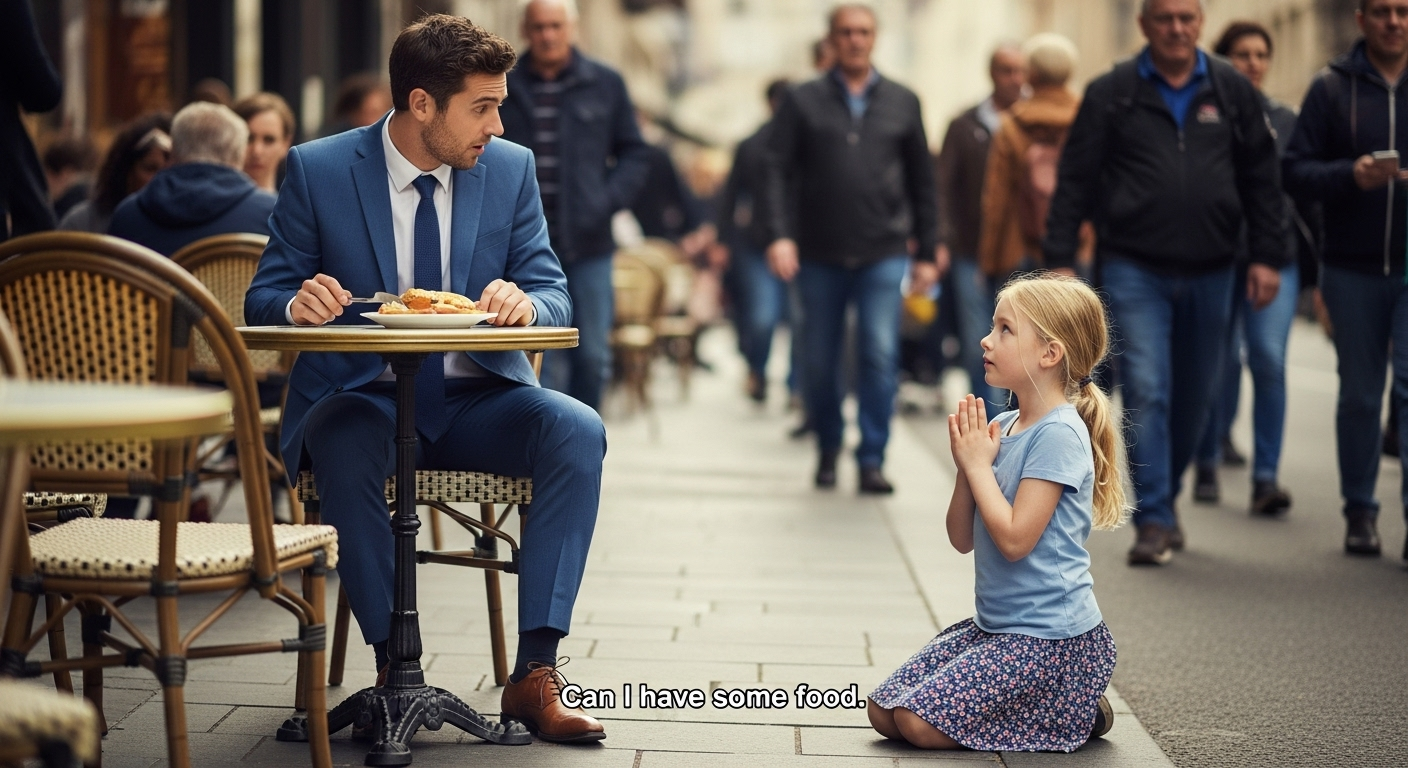
“I’m not lost, sir,” I said, my eyes glued to the plate. I couldn’t help it. I was salivating. It was humiliating, primal. “I… I see you’re not finishing that. I haven’t eaten in three days. I don’t want money. I just… if you’re going to throw that away, could I have the rest? Please. I’ll take it outside. You won’t even know I was here.”
The restaurant had gone quiet around us. I could feel the eyes of the other patrons burning into my back. The disgust. The judgment. Why doesn’t anyone call security? Why is that thing near the food?
The man looked at the steak, then back at me. A flicker of something crossed his face. Annoyance? Pity? It was hard to tell.
“You have some nerve,” he said quietly. “Walking into a place like this. Dressed like that.”
“Hunger makes you do crazy things,” I whispered, gripping the edge of the table to steady myself. I was feeling faint from the sudden heat.
He sighed, a sound of heavy resignation. He reached for his napkin and wiped his mouth.
“Take it,” he said, waving a hand dismissively. “Take the whole plate. Just get out of my sight.”
Relief washed over me, so strong my knees buckled.
“Thank you,” I gasped. “God bless you, sir.”
I reached out with my right hand to grab the plate. I moved too fast. My sleeve—the tattered cuff of that old army jacket—rode up my arm.
That’s when it happened.
As my hand hovered over the plate, the man’s gaze dropped to my wrist.
He froze.
He went completely still, like a statue. His eyes widened, staring at the inside of my forearm.
I tried to pull my hand back, thinking he was disgusted by the dirt under my fingernails, but he was faster.
His hand shot out—shockingly strong, incredibly fast—and clamped around my wrist. His grip was like iron.
“Hey!” I yelped, trying to pull away. “I said I’m leaving! Let go!”
He didn’t let go. He yanked my arm closer to the candle on the table, twisting my wrist so the underside was illuminated by the flickering flame.
He was staring at the scar.
It wasn’t just a scar. It was a burn mark, jagged and ugly, shaped almost like a starburst, right over the radial artery. I’d had it for as long as I could remember—which wasn’t long, considering my memory was a fractured mess of shadows and fog.
The man’s face drained of all color. He went from a healthy tan to a ghostly white in a second. His jaw dropped. He looked from the scar to my face, searching my eyes with a frantic, terrifying intensity.
“Where did you get this?” he whispered. His voice wasn’t smooth anymore. It was shaking.
“I… I don’t know,” I stammered, terrified now. “Let me go, man! I don’t want the food!”
He stood up, knocking his chair over with a loud crash. The entire restaurant gasped.
“Daniel?” he choked out. Tears instantly welled in his eyes, spilling over onto his expensive suit. “Daniel? Is it you?”
I shook my head violently. “My name isn’t Daniel. I’m… I go by Jack. Let me go!”
He didn’t listen. He was gripping my arm so hard it hurt. He looked around the room, wild-eyed, and then screamed at the top of his lungs.
“CALL 911! SOMEBODY CALL THE POLICE! NOW!”
I panicked. I thought I was being arrested. I thought he was framing me for assault. I tried to wrench free, but he lunged across the table, grabbing me in a bear hug, burying his face in my filthy, reeking jacket.
“Don’t you run,” he sobbed into my chest, ignoring the smell, ignoring the dirt. “Don’t you dare disappear again. I’ve been looking for this scar for twenty years.”
What happened next didn’t just explain the scar. It explained why I had nightmares of fire every time I slept. And it revealed that the man crying into my chest wasn’t a stranger.
He was the reason I was alive—and I was the reason his life had fallen apart.
PART 2: THE ASHES OF MEMORY
Chapter 3: The Golden Cage
The restaurant dissolved into chaos. It wasn’t the kind of bar-fight chaos I was used to in the shelters—loud, violent, and messy. This was a different breed of panic. It was the hushed, terrified scramble of wealthy people who had never seen a raw emotion in public before.
“Sir, please step back!”
Two uniformed officers burst through the oak doors, their hands hovering over their holsters. The wind from outside followed them in, a brief reminder of the freezing reality I had just escaped.
I tried to pull away. The “fight or flight” instinct was screaming in my brain, drowning out the hunger. Run. Run now. He’s crazy. He’s going to get you locked up.
“I didn’t steal anything!” I yelled, my voice cracking. “He gave it to me! ask him!”
The officers didn’t look at me. They looked at the silver-haired man. He was still gripping my shoulders, his expensive suit now smeared with the grime from my jacket. His face was wet with tears, but his eyes—those terrifyingly blue eyes—were hard as diamonds.
“Officer,” the man barked. It wasn’t a request. It was a command. “Stand down.”
The lead officer blinked, recognizing him. “Mr. Sterling? Is this man bothering you? We received a 911 call about an assault.”
“There is no assault,” the man—Mr. Sterling—said, his voice steadying, though his hands still trembled on my arms. “I called you. But not for an arrest. I need a medical team. And I need Detective Miller. Immediately.”
“Detective Miller is off duty, sir,” the cop stammered, clearly confused by the sight of Chicago’s most prominent real estate tycoon hugging a man who smelled like a dumpster fire.
“Then wake him up,” Sterling snapped. He finally loosened his grip on me, but he didn’t let go. He guided me—forcefully—back into the booth. “Sit down.”
I sat. I didn’t have a choice. My legs were shaking too bad to stand. The adrenaline was fading, leaving behind the crushing weight of starvation.
Sterling looked at the waiter, who was hovering nearby, pale as a sheet. “Bring him water. Bring him bread. Bring him the filet, medium-rare. Now.”
The waiter scrambled away.
I sat there, shivering in the warmth. “Look, mister,” I whispered, keeping my hands on the table where he could see them. “I don’t know who Daniel is. My name is Jack. I’ve been Jack since I was a kid in the foster system in Ohio. You’ve got the wrong guy.”
Sterling stared at me. He looked like he was trying to memorize my face. He reached into his jacket pocket and pulled out a silk handkerchief. He offered it to me.
“Wipe your face,” he said gently.
I hesitated, then took it. It was softer than anything I’d ever touched. I wiped the soot and sweat from my forehead.
“You have his nose,” Sterling murmured, almost to himself. “And you have her chin.”
“Whose?” I asked, the smell of fresh bread suddenly hitting the table. I tore into the roll before the plate even touched the tablecloth. I didn’t care about manners. I didn’t care about the staring cops. I ate like a wolf.
“My wife’s,” Sterling said, watching me eat with a heartbreaking mixture of sadness and joy. “And the scar… Jack, look at me.”
I paused, a piece of bread halfway to my mouth.
“That scar on your wrist,” he said, pointing to the starburst burn. “You said you don’t remember how you got it.”
“I don’t,” I said, chewing quickly. “I woke up in a hospital in Cleveland when I was six. Smoke inhalation. Concussion. No parents. No name. The nurses called me Jack because I was holding a jack-in-the-box toy.”
Sterling closed his eyes, and a fresh tear escaped. He looked like he had been punched in the gut.
“It wasn’t a jack-in-the-box,” he whispered. “It was a music box. A silver star. It played ‘Clair de Lune.'”
I froze.
A sound. A tinkling, mechanical melody. It flashed in the back of my mind—not a memory, but a ghost of one. A sensation of heat. A melody slowing down as the metal warped.
“The fire,” Sterling said, his voice dropping to a haunt. “The night the Sterling Manor burned down. November 24th. exactly twenty years ago today.”
He leaned across the table.
“You aren’t Jack. You are Daniel Sterling. My son. And that scar is where the brand of the family crest, which hung above your crib, fell onto your arm when the ceiling collapsed.”
Chapter 4: The Ghost of 2004
The food turned to ash in my mouth.
I put the bread down. The warmth of the restaurant suddenly felt suffocating. The cops were standing by the door, arms crossed, watching us like hawks. The other diners had been cleared out, leaving the vast room empty except for the two of us and the ghosts he was summoning.
“You’re crazy,” I said, pushing my chair back. “I’m a bum, man. Look at me. I eat out of garbage cans. I sleep under the Wacker Drive bridge. I’m not… I’m not a billionaire’s kid.”
“Circumstances change,” Sterling said, his voice gaining strength. “Blood doesn’t.”
“I was in Ohio!” I argued, desperation rising. If I let myself believe him—if I let myself hope for even a second that I wasn’t just disposable trash—the disappointment would kill me. It was safer to be nobody. “How does a kid from a Chicago mansion end up in a Cleveland hospital?”
“That,” Sterling said, his expression darkening, “is the question that has haunted me for two decades.”
He pulled a smartphone from his pocket. He tapped the screen a few times and then slid it across the table to me.
It was a digital scan of an old photograph. A man—younger, with jet-black hair and a smile that lit up the room—holding a laughing toddler on his shoulders. The toddler had messy brown hair and a small birthmark above his left eyebrow.
I instinctively reached up and touched my own forehead. My fingers brushed the small, raised bump above my eye.
My heart stopped.
“The fire was ruled an accident,” Sterling said, his eyes never leaving mine. “Faulty wiring in the nursery. The entire east wing went up in minutes. The firefighters… they found remains. They told us you were gone. They told my wife that our son had been incinerated.”
He paused, his hands clenching into fists on the white tablecloth.
“My wife… your mother… she couldn’t handle it. She took her own life two years later.”
The air left the room. I stared at the man. I saw the lines of grief etched into his face. This wasn’t just a rich guy throwing his weight around. This was a broken man who had been gluing himself together with money and power for twenty years.
“But three years ago,” Sterling continued, “I received a letter. No return address. Just a photo of a boy in a foster home group shot. He was twelve. He looked exactly like me. And on the back, it said: ‘He didn’t die in the fire.’“
“So you’ve been looking for me?” I asked, my voice barely a whisper.
“I hired private investigators. FBI contacts. We traced the boy in the photo to the Cleveland system. But he had run away at sixteen. Dropped off the grid. Became ‘Jack.’ I have walked the streets of every major city in the Midwest for three years, looking into the faces of the lost, looking for that scar.”
He reached out and covered my hand with his. His palm was warm, dry, and shaking.
“I didn’t believe it was possible,” he said. “Until tonight. Until you walked in here to eat my leftovers on the anniversary of the fire.”
“This is…” I shook my head, the room spinning. “This is too much.”
“I know,” he said. “But we are going to find out for sure. The police are bringing a DNA kit. We will know in 24 hours.”
Suddenly, the front doors banged open again. A man in a trench coat stormed in, followed by two more uniformed officers. He looked tired, cynical, and annoyed. This had to be Detective Miller.
“Marcus,” Miller said, walking up to the table. “You got me out of bed. This better be good. You found another ‘lead’?”
“I found him, Jim,” Sterling said, standing up. He looked taller now. Stronger. “I found Daniel.”
Miller looked at me. He looked at my clothes, my dirt, my matted beard. He let out a skeptical snort. “Marcus, we’ve been down this road. The grief makes you see things. This guy is a transient.”
“Look at his wrist,” Sterling commanded.
Miller sighed and looked. He shone a flashlight on my scar. He paused. He leaned in closer. He hummed, a sound of reluctant interest.
“Okay,” Miller said, straightening up. “It matches the description. But that doesn’t explain how he got out of a burning building, traveled three hundred miles, and stayed hidden for twenty years.”
“No,” Sterling said. A cold, dangerous look entered his eyes. “But it confirms what I’ve suspected since I got that letter.”
“And what’s that?” I asked.
Sterling looked at me, and for the first time, I saw fear in his eyes. Not for himself, but for me.
“The fire wasn’t an accident, Daniel,” he said softly. “Someone set it. Someone who wanted you dead. And if they find out you’re alive… they will come back to finish the job.”
My blood ran cold. I wasn’t just a homeless man anymore. I was a ghost. And apparently, someone wanted to make sure I stayed that way.
“We need to go,” Sterling said to the Detective. “Secure transport. No press. No radio chatter. Take us to the penthouse.”
“You think he’s in danger?” Miller asked, his hand drifting to his gun.
“I think,” Sterling said, looking out the window at the dark, windy street, “that whoever took him out of that house didn’t do it to save him. They did it to steal him. And he escaped.”
He turned to me.
“You’re not going back to the street, Jack. Tonight, you’re coming home. But I have to warn you… home might be the most dangerous place of all.”
PART 3: THE SHADOW IN THE PENTHOUSE
Chapter 5: The Washing of the Sins
The ride to the Sterling Tower was silent, but it was a loud silence. The kind that screams with unasked questions.
We were in the back of a blacked-out Maybach. It smelled like new leather and money. I was sitting as far away from Marcus Sterling as possible, hugging the door. I was terrified that if I touched anything, I’d stain it. I still smelled like the alley behind the 7-Eleven.
Marcus didn’t look at the city passing by. He watched me. He watched me like I was a fragile vase that had already been shattered and glued back together wrong.
“We have a private doctor waiting,” he said softly. “He’ll do the DNA test. He’ll check your vitals. You look… malnourished.”
“I ate a bagel yesterday,” I muttered, staring at my dirty boots on the plush carpet. “And half that steak.”
“You’ll never be hungry again,” he vowed. The intensity in his voice made me flinch. It sounded like a threat as much as a promise.
The car pulled into an underground garage that looked cleaner than most hospitals I’d been in. Private elevator. No buttons, just a retina scan. The doors slid open to the penthouse.
I stepped out onto marble floors. The place was massive. Floor-to-ceiling windows overlooked the entire Chicago skyline. The city lights looked like jewels scattered on black velvet. Down there, in the cold, I was a rat. Up here, I was a god. The disconnect made me dizzy.
“Showers are to the left,” Marcus said. “There are clothes laid out. They were… they were my brother’s. He’s about your size.”
I walked into the bathroom. It was the size of my old foster home bedroom.
I stripped off the layers. The army jacket, stiff with grease. The flannels, thinning and torn. The undershirt, gray with sweat. I piled them on the floor—a monument to the life I was leaving behind.
I stepped into the shower. I turned it on hot. Scalding hot.
As the water hit me, I watched the runoff spiral down the drain. It was black. Then gray. Then brown. It took ten minutes for the water to run clear. I scrubbed my skin raw. I wanted to wash off the hunger. I wanted to wash off the cold.
When I stepped out, I wiped the steam from the mirror.
For the first time in years, I really looked at myself. Without the dirt, without the beanie.
I saw the blue eyes. His eyes. I saw the nose. I touched the scar on my wrist. It was red from the hot water, throbbing in time with my heart.
Daniel Sterling.
The name felt foreign in my mouth. But as I stared at my reflection, a strange sense of vertigo hit me. I didn’t see “Jack” the bum. I saw a stranger who looked hauntingly familiar.
I got dressed. The clothes fit perfectly. Cashmere sweater. Soft denim. I felt like I was wearing a costume.
When I walked back out into the living room, Marcus was standing by the fireplace. He turned. His breath hitched.
“My God,” he whispered. “You look just like him. My father.”
A man in a white coat was waiting—the doctor. He was efficient, silent. He swabbed my cheek, took a vial of blood, and packed up.
“Results in four hours, Mr. Sterling,” the doctor said, eyeing me with professional curiosity before leaving.
Now, it was just us. The billionaire and the beggar.
“Jack… Daniel,” Marcus corrected himself, motioning to a leather armchair. “Sit. We need to talk about the night of the fire. I need to know what you remember.”
I sat on the edge of the chair, ready to bolt. “I told you. I don’t remember anything. Just smoke. Then the hospital.”
“Think,” Marcus pressed. He poured two glasses of amber liquid. He handed me one. “Bourbon. It helps.”
I took a sip. It burned, but it was a good burn.
“The police said it was electrical,” Marcus said, pacing the room. “But the fire alarms were disabled. The nursery window was unlocked. And you… you were gone. If you had just wandered out, they would have found you in the yard. But you ended up in Cleveland.”
“Maybe I was kidnapped,” I said, the word feeling heavy.
“That’s what I’ve said for twenty years!” Marcus shouted, his composure cracking. “But who? Who takes a child and then abandons him in a hospital three states away?”
“Maybe they panicked,” I suggested. “Maybe I got hurt, and they dumped me.”
“Or maybe,” a new voice said from the elevator, “maybe the boy is just a grifter who did his research.”
I spun around.
A man had just walked in. He was tall, thin, with a face that looked like it was carved out of granite. He wore a suit that cost more than the house I grew up in. He had the same silver hair as Marcus, but his eyes weren’t blue. They were black. Shark eyes.
“Julian,” Marcus said, his voice tightening. “I didn’t expect you.”
“Clearly,” the man—Julian—said. He walked into the room, his eyes scanning me up and down with open contempt. “I heard the scanner chatter. ‘The Lost Prince Returns.’ Again. Is this the fifth one this year, Marcus? Or the sixth?”
“This one is different,” Marcus said, stepping between us. “Look at him, Julian. Look at the scar.”
Julian laughed. It was a dry, rasping sound. “Scars can be faked. DNA can be faked. Desperation, however… that’s always real.”
He walked right up to me. He smelled of expensive cologne and stale tobacco.
“So,” Julian sneered, leaning in close. “What’s your game, son? You want a payout? A settlement to go away? Tell me your price. I’ll write the check right now, and you can go back to the gutter where you belong.”
I stared at him. And suddenly, the hum in my ears—the hunger hum—changed pitch. It became a high-pitched ring.
I knew this man.
I didn’t know his name. I didn’t know his face. But I knew his smell. And I knew the sound of his voice.
Chapter 6: The Spider in the Web
The air in the penthouse seemed to drop ten degrees.
“I don’t want your money,” I said, my voice steady for the first time all night. “And I don’t know who you are.”
“I’m his brother,” Julian said, gesturing to Marcus. “Your ‘Uncle’ Julian. The one who has been running Sterling Industries while your father chases ghosts.”
He reached into his pocket and pulled out a gold object. A cigar cutter. He clicked it open and shut. Snip. Snip.
The sound echoed in the silent room.
Snip. Snip.
FLASHBACK.
Darkness. The smell of smoke. Acrid, choking smoke. I am small. I am in a crib. I am coughing.
The door opens. A silhouette stands there. The firelight from the hallway outlines him. He isn’t rushing to save me. He is walking slowly.
He stands over the crib. I reach up, crying. “Daddy?”
The figure shakes his head. He reaches into his pocket. He pulls out something shiny. It catches the firelight.
Snip. Snip.
“Not Daddy,” the shadow whispers. “Just a problem solver.”
He reaches down, but not to lift me. He grabs the heavy Sterling Crest hanging on the wall above the crib. He yanks it loose. He holds it over the fire that is starting to lick up the curtains. The metal heats up.
Then, he drops it.
END FLASHBACK.
I gasped, stumbling back, knocking the glass of bourbon onto the floor. It shattered.
“You,” I whispered.
Marcus looked at me, alarmed. “Daniel? What is it?”
I pointed a shaking finger at Julian. “The sound. The cutter. You were there.”
Julian’s face didn’t change, but his eyes… his eyes flickered. Just for a microsecond. A tiny crack in the granite mask.
“The boy is delusional,” Julian said smoothly, slipping the cutter back into his pocket. ” Trauma response. He’s projecting.”
“No!” I shouted. The memory was flooding back now, a dam breaking. “You were in my room! You called yourself a ‘problem solver.’ You dropped the crest! You watched it burn me!”
Marcus turned slowly to his brother. “Julian? You said you were at the gala that night. You said you arrived after the fire trucks.”
“I was,” Julian said, his voice dropping an octave, becoming dangerous. “Marcus, don’t listen to this street rat. He’s playing you. He sees a mark.”
“I remember the smell,” I said, stepping forward, the fear replaced by a cold, white-hot rage. “Tobacco and vanilla. The same cologne you’re wearing right now.”
Julian laughed again, but this time, there was no humor in it. “Half of Chicago wears this cologne, kid.”
“But only you knew about the crest,” Marcus whispered.
The room went silent.
“What?” Julian asked.
“The crest,” Marcus said, his voice trembling. “The firefighters said it fell because the wall weakened. But the wall stood. Only the ceiling collapsed. I never understood how the heavy iron crest detached from the studs unless…”
“…Unless someone pulled it down,” I finished.
Marcus stared at his brother. The realization was dawning on him, horror washing over his face. “You… You handled the insurance claim. You handled the police report. You insisted we declare him dead so the trust fund would revert to the company.”
“To save the company!” Julian snapped, his mask slipping further. “You were a wreck! You were going to bankrupt us looking for a corpse! I did what had to be done to protect the legacy!”
“You set the fire,” Marcus said. It wasn’t a question.
Julian adjusted his cuffs. He looked bored. “You have no proof. Just the ramblings of a homeless junkie you picked up off the street. No court in the world will believe this.”
“The DNA is coming,” Marcus said. “If he is Daniel, then the trust fund reverts to him. You lose your majority share. You lose everything.”
Julian smiled. It was the smile of a predator who realizes the cage door is open.
“Well,” Julian said, walking casually toward the elevator. “That would be a problem. If he lives that long.”
He pressed the button.
“I’d be careful, Marcus. Accidents happen. Fires happen. People disappear.”
The elevator doors opened.
“Get out,” Marcus roared. “GET OUT!”
Julian stepped in. As the doors closed, he looked at me. He winked. And then he clicked the cigar cutter one last time.
Snip.
The doors sealed.
Marcus collapsed onto the sofa, burying his head in his hands. “My own brother. My God. My own brother.”
I didn’t sit. I walked to the window. I looked down at the city. I wasn’t just a survivor anymore. I was a target.
“He’s not going to wait for the DNA results,” I said, watching the headlights of a car—Julian’s car—peel out of the garage below.
“What do you mean?” Marcus asked, looking up, his face gray.
“He’s going to finish what he started twenty years ago,” I said. “He knows I remember. He can’t let me testify.”
I turned to my father.
“We can’t stay here. This building… he built it, didn’t he? He has the codes. He has the security access.”
Marcus’s eyes widened. “He controls the entire security grid.”
Suddenly, the lights in the penthouse flickered. Then, they went out completely. The smart-home panel on the wall flashed red.
SYSTEM LOCKDOWN INITIATED. OXYGEN VENTILATION: OFF. ELEVATORS: DISABLED.
“He’s locking us in,” Marcus gasped, fumbling for his phone. “I have to call Miller.”
He looked at his screen. “No signal.”
I looked at the heavy steel doors of the penthouse. I heard the mechanical thud of the deadbolts sliding into place.
“He’s not just locking us in,” I said, smelling something faint coming from the vents. A familiar smell. Gas.
“He’s going to burn us out.”
PART 4: THE HOMECOMING
Chapter 7: The Spark
The smell of gas was no longer faint. It was thick, heavy, and tasting of rotten eggs. It coated the back of my throat, a suffocating blanket that promised a violent end.
“He’s going to blow the floor,” Marcus coughed, pulling his collar up over his nose. “The pilot light in the kitchen… the water heater… any spark triggers it.”
“We need fresh air,” I yelled, scanning the room. The panoramic windows were our only hope, but they were reinforced hurricane glass. Thick enough to stop a bullet. “Is there a manual override for the balcony doors?”
“In the master bedroom!” Marcus pointed. “Behind the painting!”
We scrambled toward the bedroom. My head was already swimming from the fumes. The hunger that had plagued me for days was gone, replaced by a pure, primal drive for survival. I had survived the streets. I had survived the cold. I wasn’t going to die in a velvet cage.
We tore the painting off the wall—a priceless abstract piece that crashed onto the floor. Behind it was a small keypad and a red lever.
“It’s electronic!” Marcus shouted, punching in a code. “It’s not working! The system is dead!”
“The lever!” I screamed. “Pull the lever!”
He yanked it. It was jammed. Rusted or sabotaged.
The gas was getting denser. I could feel the pressure building in the room, the air becoming volatile.
I looked around the room for something heavy. A bronze bust of some dead Roman emperor sat on the dresser. I grabbed it. It weighed at least fifty pounds.
“Move!” I shouted.
Marcus scrambled back.
I didn’t aim for the glass. I aimed for the lever housing. I swung the bronze head with every ounce of strength I had left.
CRACK.
The drywall shattered. The mechanism groaned. I swung again. And again. Screaming with the effort, channeling twenty years of rage, twenty years of being invisible, twenty years of pain into the metal.
On the fourth hit, the housing snapped. The red lever jerked downward.
A pneumatic hiss echoed through the room as the seal on the balcony door broke.
“GO!” I roared, tackling Marcus.
We tumbled out onto the limestone terrace just as the sliding door groaned open a few inches. The freezing wind of Chicago hit us like a sledgehammer, but it was the sweetest thing I had ever felt.
I kicked the door shut behind us, jamming the bronze bust into the track to seal it as best as I could.
We scrambled to the edge of the railing, fifty stories up. The wind was howling, tearing at our clothes.
“Get down!” Marcus yelled, pulling me to the floor of the balcony.
We curled up against the limestone wall, shielding our heads.
Inside, something sparked. Maybe the fridge motor. Maybe a timer.
BOOM.
The sound wasn’t a noise; it was a physical punch. The reinforced glass windows bowed outward for a fraction of a second before shattering into a billion diamonds. A fireball, orange and angry, rolled across the ceiling of the penthouse, licking against the glass door we had just jammed shut.
The heat was intense, even through the glass and the wind. Debris rained down on us.
We lay there, huddled together, the billionaire and the beggar, shivering in the cold as the fire alarm finally—finally—began to wail.
Sirens wailed from the street below. Red and blue lights reflected off the smoke billowing from the penthouse.
“He missed,” I whispered, my voice hoarse. “He missed again.”
Marcus looked at me. His face was covered in soot, his silver hair a mess. He didn’t look like a titan of industry. He looked like a dad.
“I lost you once to fire,” he said, gripping my shoulder. “I wasn’t going to let it happen twice.”
Chapter 8: The Feast
The next hour was a blur of paramedics, firefighters, and flashbulbs.
They brought us down the service elevator. The lobby was a zoo. News crews had already gathered, drawn by the explosion at the famous Sterling Tower.
As we walked out, wrapped in shock blankets, I saw him.
Julian was standing by the police line, talking to a reporter. He was putting on a performance worthy of an Oscar. He looked devastated. He was wiping a fake tear from his eye.
“It’s a tragedy,” Julian was saying into the microphone. “My brother… he was unstable. He brought a homeless man into the building. We think there was a struggle…”
He stopped when he saw us.
The color didn’t just drain from his face; it vanished. He looked like he was seeing a ghost. Two ghosts.
Marcus walked right past the paramedics. He walked right up to Julian.
The cameras turned. The reporters went silent.
“Marcus?” Julian squeaked. “You’re… thank God, you’re alive! I was just telling them—”
SMACK.
Marcus Sterling punched his brother in the jaw. It was a solid, meaty connection that knocked Julian flat on his back.
“Arrest him!” Marcus roared, pointing a trembling finger at the man on the floor. “Arrest him for arson! Arrest him for attempted murder! And arrest him for the murder of my wife!”
Detective Miller stepped out of the crowd. He was holding a plastic bag. Inside was a charred, gold cigar cutter found in the lobby trash can—hastily discarded.
“Way ahead of you, Mr. Sterling,” Miller said, snapping handcuffs on a dazed Julian. “We found the override logs. Someone manually disabled the safety sensors from the admin account five minutes before the blast. Your account, Julian.”
As they dragged Julian away, screaming about lawyers and incompetence, a medic approached me.
“Sir,” he said gently. “We have the results.”
He held up a tablet. It was the DNA test, fast-tracked by the police lab.
Marcus froze. He looked at me. He looked at the tablet.
PROBABILITY OF PATERNITY: 99.99%
Marcus let out a sound that was half-laugh, half-sob. He pulled me into a hug that crushed the air out of my lungs. The cameras flashed, capturing the image that would be on the front page of every paper in America the next morning: The Billionaire hugging the Homeless Man.
“Welcome home, Daniel,” he whispered.
One Month Later.
The wind was still cold, but I didn’t feel it. I was wearing a coat that actually fit.
I sat in the corner booth of The Gilded Steer. The same booth.
Marcus sat across from me. He looked ten years younger. The lines of grief were fading.
The waiter arrived. He placed a plate in front of me.
A T-bone steak. Medium-rare. Sizzling.
“For Mr. Sterling,” the waiter said with a smile. “And for… Mr. Sterling.”
I picked up the knife. I looked at my wrist. The scar was still there, ugly and jagged. I would never remove it. It was the map that had led me back.
I cut a piece of the meat. I took a bite. It was hot, salty, and perfect.
“How is it?” Marcus asked, watching me.
“It’s good,” I said. “But you know what?”
“What?”
“I’m not that hungry anymore.”
I looked out the window. I saw a man standing outside. He was wearing a tattered jacket. He was shivering. He was looking at the food with that hollow, desperate stare I knew so well.
I put my fork down.
“Dad,” I said. “Order another one. To go.”
Marcus followed my gaze. He saw the man. He smiled, and his eyes were wet.
“No,” Marcus said, standing up. “Invite him in. We have plenty of room at the table.”
I smiled. The hum in my ear was gone. The silence was beautiful.
I stood up and walked toward the door to open it.