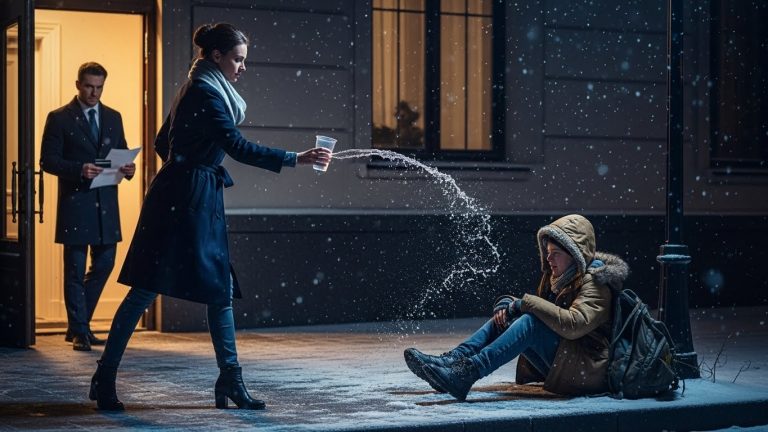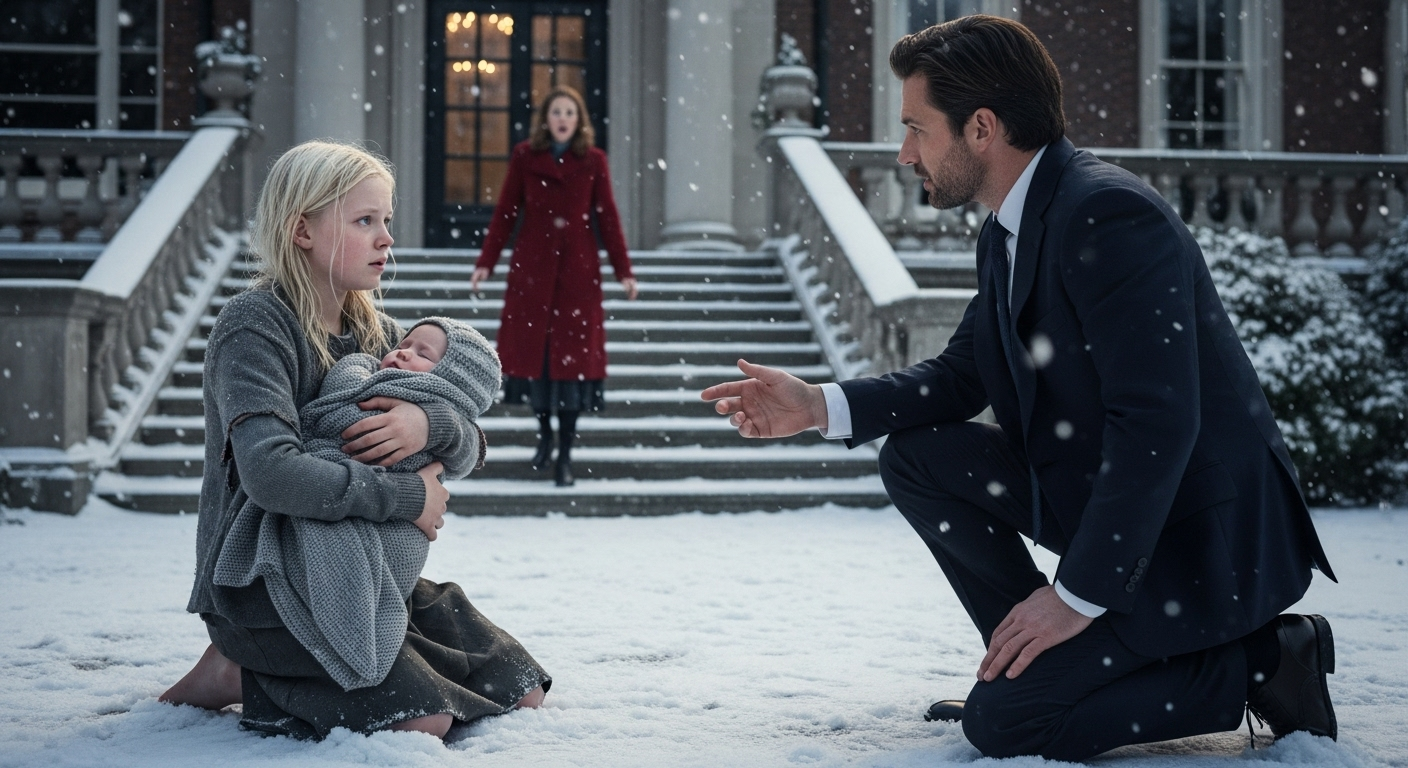
I Stopped My $200,000 Car To Scream At A Jaywalker In The Blizzard, But When I Saw Her Purple, Bare Feet Bleeding Into The Ice While She Shielded Her Little Brother, My Rage Turned Into A Horror That Will Haunt Me Forever.
PART 1
Chapter 1: The Ivory Tower
The heater in my Bentley was set to exactly seventy-two degrees, but I couldn’t stop shivering. It wasn’t the temperature inside the cabin; it was the world outside. It was Christmas Eve in Chicago, and the city was being strangled by the kind of blizzard that the news anchors talk about for decades.
I was Julian Vance. Thirty-eight years old. CEO of Vance Logistics. My net worth was somewhere north of forty million dollars. I had the world at my fingertips, or so Forbes magazine liked to say. But as I gripped the leather steering wheel, my knuckles white, I knew the truth.

I was driving home to a penthouse that was five thousand square feet of empty silence. My wife, Sarah, had finally packed her bags three months ago. She said she couldn’t live with a ghost anymore. She said I was physically present but emotionally dead, buried under spreadsheets and acquisition mergers. My two daughters were with her at her parents’ house in Vermont.
Tonight, my only company was going to be a bottle of Macallan 25 and the howling wind rattling the floor-to-ceiling windows of my forty-second-floor apartment.
The visibility was terrible. The snow wasn’t drifting down; it was being fired horizontally like buckshot. The wind screamed around the chassis of the car, rocking the heavy vehicle. The streets of the industrial district were abandoned. Sensible people were home, wrapped in blankets, drinking cocoa.
I wasn’t sensible. I was restless. I was angry. I was driving too fast because speed was the only thing that made me feel alive. The engine purred—a deep, throaty growl that usually gave me a sense of power. Tonight, it just sounded lonely.
I checked my watch. 11:15 PM.
“Merry Christmas to me,” I muttered, the cynicism tasting like copper in my mouth.
I took a sharp turn onto Wacker Drive, the tires slipping slightly on the black ice before the traction control kicked in. I tightened my grip. This was dangerous. reckless. Exactly what I needed.
Then, my headlights caught something.
It was just a flash of movement in the swirling white void. A shadow. A lump in the middle of the road.
My reflexes took over before my brain could process what I was seeing. I slammed on the brakes.
The Bentley was heavy, a tank of luxury, but physics is physics. The car didn’t stop. It slid. The backend swung out, drifting sideways toward the concrete divider. I counter-steered, my breath caught in my throat, fighting the slide.
The car came to a halt at a forty-five-degree angle, the engine humming nervously.
Silence returned, save for the relentless wind.
My heart was hammering against my ribs like a trapped bird. Then, the adrenaline faded, and the familiar, toxic rage set in.
“Are you kidding me?” I shouted at the windshield.
Who leaves something in the middle of the road in a whiteout? A trash bag? A piece of construction debris?
I peered through the glass. The wipers slapped back and forth, fighting a losing battle against the accumulation.
The lump moved.
It wasn’t debris. It was a person.
The rage spiked hot and fast. Some drunk. Some junkie who had stumbled out of an alley and passed out, nearly causing me to wreck a car that cost more than most people’s houses.
I rolled down the window. The cold air punched me in the face, instantly freezing the moisture in my nose.
“Get out of the road!” I roared. “Do you have a death wish?”
The figure didn’t stand up. It just curled tighter.
I laid on the horn. The sound was jarring, aggressive, echoing off the nearby brick warehouses. Hoooooonk.
Nothing.
“Fine,” I spat. “Have it your way.”
I threw the door open and stepped out. The wind nearly knocked me over. The cold was violent, biting through my suit instantly. My Italian leather shoes, designed for boardrooms and galas, offered zero traction on the ice. I slipped, recovered, and marched toward the figure, ready to drag them to the sidewalk by their collar.
I was going to yell. I was going to lecture them on responsibility. I was going to feel superior.
I got within five feet, and the words died in my throat.
Chapter 2: The Frozen Truth
It wasn’t a man. It wasn’t a drunk.
It was a child.
A girl. She couldn’t have been more than seven years old.
She was on her knees, her body bent over, creating a human shield against the wind. Her hair was a matted mess of dirty blonde, stiff with ice.
But it wasn’t her hair that paralyzed me. It was her clothes.
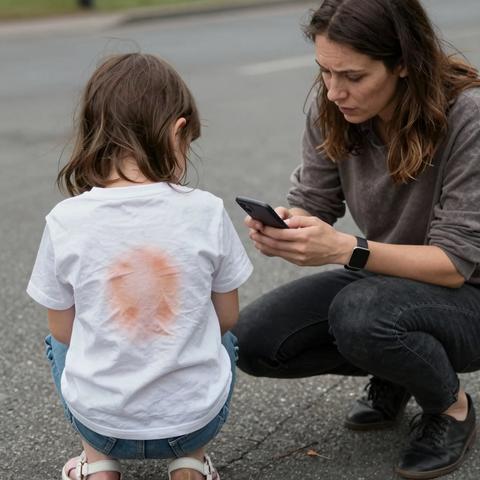
She was wearing a t-shirt. A faded, oversized promotional t-shirt from a car wash. That was it. No coat. No hat. No gloves.
And no shoes.
I stared, my brain refusing to compute the data. Her feet were bare. They were buried in the slush. The skin was a terrifying shade of purple, mottled with white patches. Frostbite. Severe frostbite. Where the jagged ice had cut her skin, the blood hadn’t dripped; it had frozen in dark, crusty lines down her ankles.
The anger that had propelled me out of the car vanished, replaced by a hollow, sickening horror.
“Hey,” I croaked. The wind snatched the sound away.
I took a step closer. The crunch of my expensive shoes on the snow sounded like a gunshot.
The girl’s head snapped up.
I flinched. Her face was gaunt, the skin pulled tight over her cheekbones. Her lips were the color of slate. But her eyes… they were wide, terrified, and fierce. She didn’t look like a victim. She looked like a cornered animal.
“Get away!” she screamed. Her voice was thin, brittle, shattering in the wind.
She scrambled backward, slipping on the ice. As she moved, I saw what she was hiding. What she had been curling her body around.
A bundle of rags. No, not rags. A blanket.
And inside the blanket, a small, pale face. A boy.
“Please,” she stammered, her teeth chattering so violently it sounded like stones rattling in a jar. She put a hand out, placing herself between me and the bundle. “Don’t take him. We’re not… we’re not bothering anyone.”
“I’m not going to take him,” I said, my voice trembling. I raised my hands, showing her I was empty-handed. “I just… look at you. You’re freezing.”
“We’re fine,” she lied. It was the most heartbreaking lie I had ever heard. “We’re waiting for my dad. He’s coming. He’s just around the corner.”
I looked around. The street was desolate. There were no footprints leading away. No cars. Just the endless, swirling snow.
“Honey,” I said, stepping closer. “Nobody is coming.”
She flinched as if I’d slapped her. “He is! He told us to wait!”
I looked at the boy in the blanket. He was maybe four. His eyes were closed. His skin had a waxy, translucent quality that made my stomach turn. He wasn’t shivering.
I knew enough about hypothermia to know that when the shivering stops, the body is shutting down.
“Is he awake?” I asked, pointing.
“He’s sleeping,” she said defensively. She shook him gently. “Sammy? Sammy, wake up. The man wants to say hi.”
Sam didn’t move. His head lolled to the side, limp.
Panic, cold and sharp, pierced through my shock.
“He’s not sleeping,” I said, my voice rising. “He’s dying.”
“No!” she shrieked. She tried to stand up to fight me, to push me away, but her frozen feet couldn’t hold her weight. She collapsed, her knees hitting the pavement with a sickening thud. She started to cry, but there were no tears. It was too cold for tears. Just dry, heaving sobs. “Momma said no strangers! Momma said they’ll split us up! You can’t take Sam to the foster home! You can’t!”
The Foster Home. The System. That was her boogeyman. She was more afraid of being separated from her brother than she was of the blizzard that was actively killing them.
I didn’t think. I just reacted.
I tore off my cashmere overcoat, the wind instantly biting through my suit jacket and shirt. I didn’t feel it.
“I’m not the police,” I said, dropping to my knees in the slush. I didn’t care about the suit. I didn’t care about the wetness soaking into my knees. “I’m just a guy with a warm car. Look at Sam. Look at his lips.”
She looked down. The boy’s lips were grey.
“He needs heat,” I urged her. “Right now. Or he won’t wake up. Do you understand me?”
She looked at me, then at the car, then at her brother. The fight went out of her. Her shoulders slumped.
“Promise?” she whispered. “Promise we stay together?”
“I swear on my life,” I said.
I reached out and scooped up the boy. He was terrifyingly light. It felt like holding a bundle of sticks. I pulled the girl up with my other arm, wrapping my heavy coat around her shoulders.
“Come on,” I commanded.
I half-carried, half-dragged them to the Bentley. I opened the passenger door and shoved them inside.
“Don’t touch anything!” she cried out, trying to hover over the leather seat so she wouldn’t dirty it.
“Ruin it,” I snarled, not at her, but at the absurdity of it all. “Ruin the whole damn thing. Just get in.”
I slammed the door and ran to the driver’s side. I jumped in, locking the doors against the wind.
The silence inside the car was deafening. The engine hummed. The heat blasted from the vents.
I turned to look at them. The girl was holding the boy so tight her knuckles were white. She was staring at the dashboard lights, her eyes wide with awe and terror.
“My name is Julian,” I said, my hands gripping the wheel to stop them from shaking. “What’s yours?”
She hesitated. “Lily,” she whispered.
“And him?”
“Sam.”
“Okay, Lily. Okay, Sam.” I put the car in gear. “We’re going to get you help.”
I didn’t know it then, but as the tires crunched onto the snow, I was driving away from my old life. The man who had stopped the car was a millionaire CEO. The man driving away was something else entirely.
And the story Lily was about to tell me would burn my ivory tower to the ground.
PART 2
(Continuing from Chapter 2…)
Chapter 3: The Golden Ticket
I drove like a madman. The rules of the road didn’t apply to me anymore. Red lights were suggestions. Speed limits were irrelevant.
Beside me, Lily had stopped shivering. That terrified me more than the shaking. The heat was blasting, but she was fading, her head lolling against the window.
“Lily!” I shouted, reaching over to squeeze her arm. “Talk to me. What’s your favorite color?”
“Purple,” she murmured, eyes closed. “Like the grapes.”
“Purple. Good. Keep talking. What about school? You like school?”
“Miss Henderson is nice,” she whispered. “She gives me extra crackers.”
Hunger. They weren’t just freezing; they were starving.
I pulled up to the emergency entrance of St. Jude’s. I didn’t park. I threw the Bentley onto the sidewalk right in front of the automatic doors.
Security guards rushed out, ready to yell, until they saw who I was. Or rather, until they saw the suit, the car, and the desperation in my face.
“Stretcher!” I screamed, my voice cracking. “I need a pediatric team, now!”
I didn’t wait for them. I grabbed Sam first. He was limp, a dead weight that felt wrong in my arms. I passed him to a nurse who had just run out.
“Hypothermia,” I barked. “Unresponsive. Maybe ten minutes in the car with heat. Before that… God knows how long outside.”
I went back for Lily. She tried to walk, but as soon as her bare feet touched the pavement, she screamed—a high, piercing sound that cut through the chaotic noise of the ER entrance. The thawing process had begun, and the pain was starting.
“I’ve got you,” I said, lifting her up.
We burst into the ER. It was a flurry of activity. White coats, beeping monitors, the smell of antiseptic.
“Sir, you can’t come in,” a nurse said, blocking my path as they wheeled the gurneys into the trauma bay.
“I’m Julian Vance,” I said, using the only currency I had left. “I funded this wing. You save them. You save them, or I burn this hospital to the ground.”
It was an empty threat, born of panic, but it worked. Or maybe they just saw a man on the edge of a breakdown.
They let me stand by the glass doors.
I watched as they cut the clothes off the children. I watched the doctors’ faces fall when they saw the bruising on Sam’s ribs—not from abuse, but from malnutrition. I watched them work on Lily’s feet, their expressions grim as they assessed the tissue damage.
An hour later, a doctor came out. Dr. Aris. I knew him from charity galas. He looked tired.
“Julian,” he said, stripping off his gloves. “What the hell happened?”
“I found them. On Wacker Drive.”
Aris sighed, rubbing his temples. “The boy, Sam… his core temp was eighty-four degrees. He’s in critical condition. We’re warming him slowly to prevent shock, but his heart… it’s weak, Julian. Starvation and cold are a lethal combination.”
“And the girl?”
“Lily is a fighter. But her feet…” He hesitated. “We’re doing everything we can to save her toes. It’s going to be a long road. But she’s asking for you.”
“Me?”
“She’s asking for the ‘driver.’ She won’t let the nurses give her a sedative until she sees you.”
I nodded, swallowing the lump in my throat. I walked into her room. She was small in the big hospital bed, hooked up to IVs and warming blankets.
“Hey,” I whispered.
Her eyes opened. They were glassy. “Where’s Sam?”
“He’s right next door. The doctors are fixing him up. He’s going to be okay.” I prayed it wasn’t a lie.
“Did you find my dad?” she asked.
The question hung in the air.
“No, Lily. I didn’t find him. But we need to call someone. Is there a number? A grandma? An aunt?”
She shook her head. “Just Dad. And Momma, but Momma went to heaven last year.”
“Where was your dad supposed to meet you?”
“At the warehouse,” she said softly. “The big one with the blue V on it. He used to work there. He said he had to go talk to the boss to get his money.”
My blood ran cold.
The big warehouse with the blue V.
Vance Logistics.
“Lily,” I asked, my voice trembling. “What is your dad’s name?”
“Mark,” she said. “Mark Miller.”
I felt like the floor had opened up and swallowed me whole.
Chapter 4: The Algorithm of Misery
I excused myself and walked out into the hallway. My hands were shaking so hard I could barely hold my phone.
I dialed my COO, Marcus.
“Julian? It’s Christmas Eve,” Marcus answered, annoyed. “Are you drunk?”
“Access the HR database,” I commanded, my voice dead calm. “Look for an employee named Mark Miller. Warehouse District 4.”
“Now?”
“Right now, Marcus! Or you’re fired.”
I heard the clicking of keys on the other end. The silence stretched for an eternity.
“Okay, I found him,” Marcus said. “Mark Miller. Forklift operator. Ten years with the company.”
“Status?”
“Terminated three weeks ago.”
“Why?” I leaned against the cold hospital wall, closing my eyes.
“It was part of the Q4 Efficiency Protocol, Julian. The automated system flagged him. He had three late arrivals in a month. The algorithm auto-generated the termination notice. Standard procedure. You signed off on the batch approval last month.”
I stopped breathing.
The Q4 Efficiency Protocol. I remembered it. A spreadsheet. A way to cut operational costs by 4% to boost the year-end dividend. I had signed it while drinking an espresso, barely looking at the names. Just numbers. Mark Miller wasn’t a person to me then. He was a row in Excel. He was a cost inefficiency.
“Did he… did he try to appeal?” I asked.
“Yeah,” Marcus said, sounding uncomfortable now. “He came by the office today. Security logs show he tried to get in to see a manager about his severance check. Apparently, there was a glitch in payroll. His check was delayed.”
“He was there today?”
“Yeah. Security escorted him off the premises at 4:00 PM. Said he was making a scene. Something about his kids waiting in the cold.”
I dropped the phone. The screen cracked against the linoleum floor.
I killed him.
I didn’t pull the trigger, but I might as well have. I created the policy. I signed the paper. I authorized the security team to remove “disturbances.”
Mark Miller had left his kids in the snow because he had nowhere else to put them. He came to get the money he earned—money my company owed him—and my security guards threw him out.
I slid down the wall, burying my face in my hands. The weeping started then. Not the polite, silent tears of a man in a suit, but ugly, racking sobs that shook my whole body.
I was the villain in their story.
“Mr. Vance?”
I looked up. It was a police officer. He was holding a clipboard.
“Doctor Aris said you brought the kids in. We identified the father.”
I stood up, wiping my face. “Where is he?”
The officer looked down. “They found a body about an hour ago. Two blocks from your warehouse. Looks like he tried to climb the fence to get back in, maybe to find shelter. He slipped. Hit his head. Hypothermia took the rest.”
The world went silent.
Lily was waiting for a dad who was never coming back. And it was my fault.
Chapter 5: The Weight of a Soul
I couldn’t go back into that room. How could I look her in the eye?
I walked to the vending machine, staring at the reflection in the glass. I saw a monster. A well-dressed, wealthy monster.
I had spent my life chasing the bottom line. I justified everything with “business is business.” But business wasn’t just numbers. Business was Mark Miller’s delayed check. Business was Lily’s frozen feet. Business was Sam’s failing heart.
I took a breath. I couldn’t change the past. I couldn’t bring Mark back. But I could be damned if I was going to let the system chew these kids up the way it had chewed up their father.
I walked back to the officer.
“What happens to them now?” I asked.
“CPS is on the way,” the officer said. “They’ll go into emergency foster care. Separate homes, most likely, given the boy’s medical needs.”
“No,” I said.
“Excuse me?”
“No. They don’t go to foster care. They stay together.”
“Sir, that’s not up to you. Unless you’re family…”
“I am,” I lied. “I’m… a distant cousin. I’m taking emergency guardianship.”
The officer looked skeptical. “Mr. Vance, you can’t just buy custody.”
“Watch me.”
I spent the next six hours on the phone. I called my lawyers. I called the mayor (who owed me a favor). I called the head of Child Protective Services at home on Christmas morning.
I threatened. I bribed. I begged.
By 7:00 AM, the paperwork was being faxed. I was the temporary emergency guardian of Lily and Samuel Miller.
I went back into Lily’s room. She was awake, eating a cup of Jell-O.
“Is he here?” she asked, her eyes lighting up.
I sat on the edge of the bed. This was the hardest thing I would ever have to do.
“Lily,” I said, taking her small hand. It was warm now. “Your dad… there was an accident.”
Her face fell. The light went out behind her eyes. She knew. Kids always know.
“He’s not coming,” she whispered.
“No, honey. He’s not coming.”
She didn’t cry. She just stared at the wall. “What about Sam? What about us? They’re going to take us.”
“No,” I said fiercely. “I promised you, remember? Nobody is taking you. You’re coming with me.”
She looked at me, confused. “Why? You don’t know us.”
“I know you now,” I said. “And I’m not going anywhere.”
Chapter 6: A House, Not a Home
Bringing them home three weeks later was surreal.
Sam had recovered, though he was still frail. Lily had lost two toes on her left foot, but she could walk.
My penthouse, usually a pristine museum of modern art and glass, was suddenly filled with chaos. I bought toys. Too many toys. I bought clothes. I hired a private chef to make nothing but chicken nuggets and mac ‘n cheese because that’s all they would eat.
But the atmosphere was tense.
Lily didn’t trust me. She watched me like a hawk. She hoarded food under her pillow. She locked the bathroom door three times. She was waiting for the other shoe to drop. She was waiting for me to get tired of them and throw them out, just like the world had thrown out her dad.
And I was drowning in guilt. Every time I looked at them, I saw the warehouse. I saw the spreadsheet.
One night, about a month in, I found Lily in my home office. She was standing in front of the framed photo of the Vance Logistics ribbon-cutting ceremony. She was staring at the logo.
The blue V.
I froze in the doorway.
She turned to look at me. Her eyes were cold.
“That’s the place,” she said. “That’s where Dad worked.”
I couldn’t lie. Not anymore.
“Yes,” I said.
“You’re the boss?” she asked.
“Yes.”
“Did you know him?”
I walked into the room and knelt down so I was eye-level with her.
“I didn’t know him, Lily. And that is the greatest regret of my life.”
She pointed at the picture. “He said the boss was a bad man. He said the boss didn’t care about us.”
The words hit me like a physical blow.
“He was right,” I whispered. “I was a bad man. I didn’t care. I was blind.”
“Why did you save us then?” she asked, tears finally spilling over. “If you’re the bad man, why did you save us?”
“Because I’m trying not to be him anymore,” I said. “I’m trying to earn the right to be the person who found you.”
She looked at me for a long time. Then, without a word, she walked past me and went to her room.
I didn’t sleep that night.
Chapter 7: The Turning Point
The breakthrough happened on a Tuesday.
I came home early from work. I had spent the day restructuring the entire HR department. I fired the algorithm. I implemented a human-review policy for all terminations. I set up a relief fund for employees in crisis. It was costing the company millions. The board was furious. I didn’t care.
I walked in and found Sam crying. He had dropped a LEGO spaceship he built, and it had shattered.
“Hey, hey,” I said, dropping my briefcase. “It’s okay, buddy. We can fix it.”
“It’s broken!” he wailed. “Gone!”
“Nothing is gone forever,” I said. I sat on the floor in my three-thousand-dollar suit and started clicking the pieces back together. “See? We just have to be patient. We have to rebuild.”
Lily was watching from the couch.
I finished the spaceship and handed it back to Sam. He grinned, wiping his nose, and hugged my neck.
I looked up at Lily.
“I’m sorry,” I said to her, as I did every day.
She slid off the couch and walked over. She sat down next to me on the floor.
“Dad liked LEGOs too,” she said quietly.
“Yeah?”
“Yeah. He built a castle once. But we had to leave it behind when we moved.”
“We can build a castle,” I said. “We can build the biggest castle in the world.”
She looked at the LEGOs, then at me. She leaned her head on my shoulder. It was a small gesture, but it carried the weight of the world.
“Okay,” she said.
That night, my wife called. Sarah. She had heard the rumors. She had seen the paparazzi photos of me taking two kids to school.
“Julian,” she said. “Is it true? Are you… parenting?”
“I’m trying, Sarah. I’m really trying.”
She was silent. “I’m coming home for the weekend. I want to meet them.”
Chapter 8: The Real Christmas
It was Christmas Eve again. One year later.
The blizzard outside was just as fierce as the night I found them, but inside, the penthouse was warm.
It looked different. There were scuff marks on the hardwood floors. There were drawings taped to the floor-to-ceiling windows. The sterile white couches were covered in colorful throws.
Sarah was in the kitchen, laughing. She had moved back in six months ago. It wasn’t easy. We had to rebuild our marriage just like I had to rebuild the LEGO spaceship. Piece by piece. But we were doing it.
I sat by the fireplace, watching Sam and Lily. Sam was five now, healthy and loud. Lily was eight. She still had scars on her feet, and she still got anxious when food ran low, but she smiled now. A real smile.
The adoption papers had been finalized three days ago. They were officially Vance’s.
But I made sure they knew about Miller. We visited Mark’s grave every month. We talked about him. He wasn’t a secret. He was a hero who did the best he could.
Lily walked over to me, holding a small box wrapped in messy newspaper.
“For me?” I asked.
She nodded.
I opened it. Inside was a painted rock. It was purple. And on it, she had painted a crude, crooked stick figure of a man holding hands with two smaller stick figures.
“It’s you,” she said. “And us.”
I looked at the rock, blurring through my tears. I had merged companies worth billions. I had bought yachts and cars. But this rock was the most valuable thing I owned.
“Thank you,” I choked out.
“Dad would have liked you,” she said suddenly.
I looked at her, stunned. “You think so?”
“Yeah. He said everyone deserves a second chance. Even the boss.”
I pulled her into a hug, burying my face in her hair.
I had saved their lives that night in the snow. But they had saved mine. They thawed a heart that had been frozen for years.
I looked out the window at the storm. The city was white and cold, but for the first time in my life, I felt warm.
They say you can’t buy happiness. They’re right. But you can find it. Sometimes, you find it barefoot in the snow, waiting for a ride.