I Screamed When I Saw What The Little Girl Was Eating Through The Basement Window—But Nothing Prepared Me For The Chilling Secret Hidden Inside That House Of Horrors.
Part 2: The Descent
Chapter 3: The Breach
The barrel of the shotgun was cold, dark, and leveled right at my chest. In the movies, the hero knocks the gun away, delivers a swift punch, and saves the day. In real life, when you are staring down the barrel of a 12-gauge held by a man who has nothing to lose, your knees turn to water.
But I had an image burned into my retina: the little girl, the dog bowl, the baby chewing on kibble.

“You pull that trigger,” I said, my voice surprisingly steady, “and every cop in the city will be here in three minutes. My car is right there. It has cameras. They’re recording right now.”
It was a bluff. My Porsche had sensors, sure, but it wasn’t live-streaming to the precinct. But the man behind the door didn’t know that. He hesitated. That split second of doubt was all I needed.
I didn’t hit him. I slammed my shoulder into the door with every ounce of weight I had.
The wood was old, but the man was frail, weakened by whatever substances were rolling through his veins. He stumbled back. The gun discharged, the blast deafening in the small entryway, blowing a hole through the porch ceiling. Plaster and dust rained down on us.
My ears rang. I lunged at him before he could rack the slide for another shell. We crashed onto the filthy linoleum floor of the hallway. He smelled of sweat and decay. He was gaunt, his eyes wild and yellowed.
“You don’t understand!” he shrieked, clawing at my face. “You don’t know what they are!”
I pinned his arms down. He was weak. Shockingly weak. This wasn’t a monster; this was a shell of a human being. I kicked the shotgun away, sliding it down the hall.
“Stay down!” I roared.
I scrambled to my feet, gasping for air. The house was a maze of hoarding. Stacks of newspapers, broken appliances, and garbage bags lined the walls, creating narrow, suffocating tunnels. The air was thick with the smell of ammonia—cat pee, or maybe meth.
“Where are they?” I demanded.
The man just curled into a fetal position, laughing. A dry, hacking laugh. “Feeding time,” he wheezed. “You interrupted feeding time.”
I didn’t wait for him to explain. I ran down the hallway, looking for the door to the basement. I found it under the staircase. It was secured with a heavy padlock on the outside.
My blood ran cold. You don’t padlock a door from the outside unless you are keeping something—or someone—in.
“Where’s the key?” I shouted back at the man.
He didn’t answer. He was just rocking back and forth.
I looked around frantically. I needed something to break the lock. In the kitchen, amidst a pile of dirty dishes, I saw a cast-iron skillet. No, too light. I saw a toolbox open on the floor. A hammer. A heavy framing hammer.
I grabbed it and sprinted back to the basement door. I smashed the hammer against the padlock. Once. Twice. Sparks flew. My hand vibrated with the impact.
On the third strike, the rusted hasp gave way. The lock clattered to the floor.
I ripped the door open.
The smell rushed up to meet me. It was heavier down here. Damp earth, mold, and human waste.
“Kids?” I called out, my voice cracking. “I’m coming down.”
The stairs were wooden and rotting. I took them two at a time, risking a broken ankle.
When I reached the bottom, the scene was exactly as I had seen it through the window, but the reality of being in the room was suffocating.
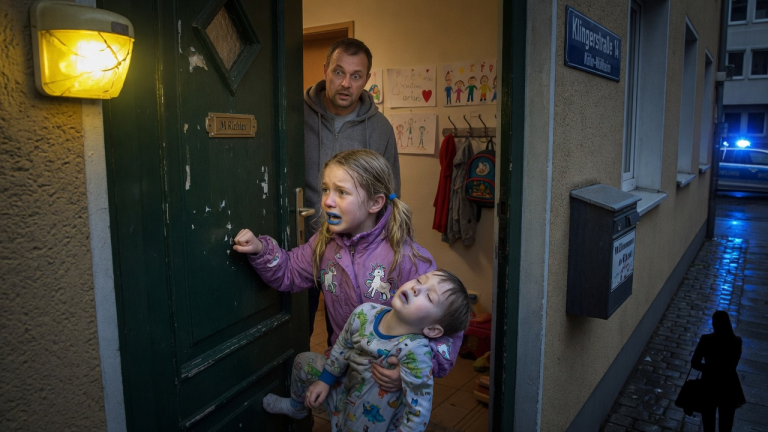
The girl was standing in front of the baby, holding a piece of jagged wood she must have ripped from a pallet. She was shaking, holding it like a sword.
“Get back!” she screamed. Her voice was raspy, unused.
“It’s okay,” I said, dropping the hammer and holding up my hands. “I’m the man from the window. I’m not going to hurt you.”
She didn’t lower the wood. “He sends tricks,” she whispered. “He sends people to trick us.”
“No tricks,” I said softly. I reached into my pocket. I didn’t have food. I had a wallet, keys, a phone. Useless. Then I remembered. I had a protein bar in my inside jacket pocket. I kept it for after the gym.
I slowly pulled it out. The wrapper crinkled loudly in the silence.
“I have food,” I said. “Real food. Chocolate and peanut butter.”
The baby let out a whimper at the word “food.”
The girl’s eyes darted to the bar, then back to my face. She was calculating. Weighing the risk of death against the pain of hunger.
Hunger won.
She lowered the wood slightly. “Give it to him,” she commanded.
I tossed the bar gently. It landed on the mattress. She ripped it open with feral speed, broke it in half, and gave the larger piece to the baby.
As she ate her small piece, I looked around the room. There was no bathroom. Just a bucket in the corner. The “bed” was a pile of rags. And in the corner…
I walked closer to the corner where I had seen the dog earlier.
It wasn’t a dog.
It was a stuffed animal. A large, realistic plush German Shepherd. It was filthy, missing an eye.
“That’s Buster,” the girl said, her mouth full. “He protects us.”
My heart broke. The bowl said Buster because they were eating from the imaginary dog’s bowl.
“What is your name?” I asked, tears stinging my eyes.
“Sarah,” she said. “This is Timmy.”
“Sarah,” I said, “we need to leave. Now.”
“We can’t,” she said, shrinking back. “He’ll shoot us. He said if we cross the line, the floor explodes.”
She pointed to a red line painted on the concrete floor at the base of the stairs.
“He’s lying,” I said, though a small part of me feared the madness of the man upstairs. “He’s not going to hurt you anymore. I took care of him.”
“You killed him?” she asked. There was no horror in her voice. Only hope.
“No. But he can’t stop us.”
I stepped forward, crossing the red line. Nothing happened. No explosion. Just the creak of the floor.
“See?” I held out my hand.
Sarah looked at Timmy. She picked him up. He was heavy for her, his legs dangling, too weak to walk properly.
She took a step. Then another. She took my hand. Her fingers were ice cold and sticky.
“Let’s go,” I whispered.
We walked up the stairs. I went first, ready to fight the man again if I had to.
But when we got to the hallway, the man was gone.
Chapter 4: The Trap
The front door was wide open, swinging in the wind. The rain was blowing into the hallway.
“Stay behind me,” I told Sarah.
We moved toward the door. I scanned the street. My Porsche was still there, hazard lights blinking, looking like a spaceship that had crash-landed in a war zone.
“We’re going to my car,” I said. “It’s warm.”
We stepped onto the porch.
Click.
The sound came from the bushes to the left.
I spun around.
It wasn’t the old man.
It was a woman. She was younger, maybe in her thirties, but she looked fifty. Her skin was pockmarked, her hair stringy. She was holding a pistol—a small, cheap Saturday Night Special.
“Where do you think you’re taking my assets?” she sneered.
Assets. Not children. Not kids. Assets.
“I’m taking them to the police,” I said, shielding Sarah and Timmy with my body. “Put the gun down.”
“The police?” She laughed. “You think the police care about what happens in this zip code? The old man is soft. I’m not.”
She wasn’t shaking like the old man. She was steady. She was high on something that made her feel invincible.
“I have money,” I said quickly. “I have cash in the car. Take it. Just let us go.”
Her eyes flickered. “How much?”
“Two thousand. Maybe three. In the glove box.”
She licked her lips. “Get it. Bring it here. The brats stay on the porch.”
“No,” I said. “We go to the car together.”
She cocked the hammer. “I drop the kid first.” She pointed the gun at Timmy’s head.
Sarah let out a silent scream, burying her face in my coat.
I froze. I couldn’t risk it.
“Okay,” I said. “Okay. I’ll get the money.”
I took a step toward the car. The rain was pouring down now, blinding.
“Hurry up!” the woman yelled.
I reached the car. I opened the passenger door. I didn’t reach for the glove box. I reached for the specialized heavy flashlight I kept in the side panel—a Maglite heavy enough to crack a skull.
“I’m getting it!” I yelled.
I grabbed the flashlight and a stack of cash I kept for emergencies.
I turned back to the house.
The woman was distracted. She was yelling at Sarah, grabbing her by the arm.
“You little snitch! You signaled him, didn’t you?”
She raised her hand to strike the girl.
“Hey!” I screamed, waving the cash. “Look at the money!”
The greed in her eyes was instantaneous. She turned toward me, momentarily lowering the gun.
I threw the stack of bills into the air. The wind caught them, scattering hundred-dollar bills into the mud and rain like confetti.
Her instinct took over. She looked at the flying money. She scrambled for a bill that landed near her feet.
It was the distraction I needed.
I didn’t run to her. I ran to the kids.
“Run!” I yelled at Sarah.
I scooped up Timmy with one arm and grabbed Sarah’s hand with the other. We bolted off the porch, past the woman who was on her knees clawing at the muddy money.
“My money!” she screamed, realizing what was happening. She raised the gun.
Bang.
A bullet hit the brickwork right next to my head. Shards of masonry stung my cheek.
I threw Sarah into the backseat of the Porsche. I tossed Timmy in after her.
Bang.
The rear windshield shattered. Safety glass rained down on the leather seats. Sarah screamed.
I dove into the driver’s seat. I slammed the car into gear.
The tires spun on the wet pavement, screeching, smoking. Then the traction control kicked in, and the car launched forward like a rocket.
We were moving. We were fast.
I looked in the rearview mirror. The woman was standing in the middle of the street, firing wildly, the gun flashes illuminating the rain.
But we were gone.
I drove for ten blocks before I let myself breathe. My hands were shaking so hard I could barely hold the wheel.
“Are you okay?” I yelled over the roar of the wind coming through the broken back window. “Is anyone hit?”
“He’s crying!” Sarah yelled. “Timmy is crying!”
“Check him! Is there blood?”
“No blood! He’s just scared!”
I let out a breath that was half sob, half laugh.
We were safe.
Or so I thought.
I pulled into a gas station under the bright, sterile lights of the suburbs. I needed to call 911. I needed to get them to a hospital.
I turned to look at them properly for the first time.
Sarah was hugging Timmy. They were covered in filth, shivering.
But Sarah was staring at me with that same intense, terrified look.
“You can’t call the police,” she said.
“Why not, honey? They’ll protect you.”
“No,” she said, her voice trembling. “The bad lady… she is the police.”
Chapter 5: The System
The words hung in the air, heavier than the smell of wet dog and gasoline. She is the police.
I stared at Sarah. “What do you mean?”
“She wears the uniform sometimes,” Sarah whispered, wiping grime from Timmy’s face. “She brings the badge home. She says… she says nobody will believe us because she owns the law.”
My blood ran cold. Corruption. It wasn’t uncommon in the city, but this? Selling kids? Or just keeping them as prisoners for checks?
I looked at my phone. My thumb hovered over 9-1-1. If I called, the dispatch would route to the local precinct—the precinct responsible for that neighborhood. If that woman was a cop, or an admin, or connected to someone high up, I might be handing these kids right back to their executioners. And I would be arrested for kidnapping.
I put the phone down.
“Okay,” I said. “No police. Not yet.”
“Where are we going?” Sarah asked.
“My house,” I said. “It’s a fortress. Nobody gets in unless I say so.”
I drove to the hospital first? No. Reporting a gunshot wound or abuse triggers a mandatory police report. The system was a trap. I had to bypass it until I had leverage.
I called my private doctor. Dr. Aris. He was a concierge doctor for the elite. Discreet. Expensive.
“Aris,” I said when he answered. “I need you at my penthouse. Now. Bring a pediatric kit. And Aris… this is off the books.”
“David, are you in trouble?”
“Not me. Just get there.”
I drove to my building in the financial district. The doorman’s jaw dropped when he saw my shattered window and the two filthy children I was carrying.
“Mr. Vance? Should I call the—”
“You saw nothing, Frank,” I snapped, slipping him a hundred-dollar bill—a habit, though it felt dirty now after throwing money in the mud earlier. “Let no one up. Absolutely no one.”
We went up to the 40th floor.
My apartment was white. Stark, modern, pristine white. Everything these kids were not.
I set them down on the Italian leather sofa. The dirt from their clothes stained it instantly. I didn’t care.
“Are we in heaven?” Sarah asked, looking at the floor-to-ceiling windows overlooking the city skyline.
“No,” I said gently. “Just a safe place.”
Dr. Aris arrived twenty minutes later. He was a professional. He didn’t ask questions about why two emaciated children were eating sandwiches in a millionaire’s living room. He just worked.
“Malnutrition,” Aris murmured, checking Timmy. “Severe. Dehydration. Lice. Signs of long-term physical abuse on the girl. Old fractures that healed wrong.”
I clenched my fists. “Will they be okay?”
“With care, yes. But David… legally…”
“I’ll handle the legal part,” I said. “I need you to document everything. Every bruise. Every scar. I need proof that undeniable.”
Aris nodded. He took photos. He wrote a report.
While he worked, I went to my study. I needed information on the house on 5th Street. I pulled up the property records.
The owner was listed as a “Shell Corp LLC.” Dead end.
I dug deeper. Who paid the taxes?
The name popped up. Martha Higgins.
I ran a background check.
Martha Higgins. Dispatcher for the 12th Precinct for 15 years.
Sarah was right. She wasn’t a cop, but she was the voice in their ears. She knew the schedules. She knew who was on patrol. She knew how to make calls disappear.
And the “old man”? Gerald Higgins. dishonorably discharged vet. History of domestic violence.
These people were ghosts in the machine.
Then, my phone rang. Unknown number.
I answered.
“Mr. Vance,” a distorted voice said. “You took something that doesn’t belong to you.”
“I took two children out of hell,” I said. “And I have evidence. I have a doctor’s report. I have photos.”
“Photos disappear,” the voice said. “Evidence gets lost. But you… you have a lot to lose. Your company. Your reputation. It would be a shame if people found out David Vance was kidnapping children for… unspeakable reasons.”
The threat was clear. They would flip the narrative. They would make me the predator.
“Who is this?” I demanded.
“Bring them back to the corner of 5th and Main in one hour. Or we release the statement to the press. ‘Billionaire caught with missing children.’ You know how the mob reacts, David. They won’t wait for a trial.”
The line went dead.
I stood there, looking out at the city lights. I had money. I had power. But they had the narrative. And in 2024, the narrative was the only weapon that mattered.
I walked back into the living room. Sarah was asleep, finally, holding Timmy’s hand. She looked like an angel covered in soot.
I couldn’t give them back. I would burn my entire empire to the ground before I gave them back.
But I needed help. I needed someone who didn’t care about the law.
I scrolled through my contacts until I found a name I hadn’t used in years. A relic from my days before the suits and the condos.
Ray.
Ray was a journalist. The kind who got fired from major papers for being too aggressive. The kind who hated people like me, but hated injustice more.
I hit dial.
“Ray,” I said. “I have the story of the decade. But you have to get here in twenty minutes, and you have to bring a live stream crew.”
Chapter 6: The Standoff
Ray was there in fifteen. He smelled like stale coffee and cynicism. But when he saw the kids, his expression changed. He pulled out his camera.
“Tell me everything,” he said.
I told him. I showed him the photos Aris took. I told him about the call.
“They’re going to frame you,” Ray said. “Classic play. Project the guilt.”
“So we go live,” I said. “We tell the truth before they can lie.”
“It’s risky. If you expose the dispatcher, and she has friends in the force, they could storm this place.”
“Let them come,” I said.
We set up the camera. I sat on the couch, the sleeping children visible in the background but their faces blurred for protection.
” we’re live in 3… 2…”
I looked into the lens.
“My name is David Vance. An hour ago, I found two children eating dog food in a basement.”
I held up the photos of the basement. I held up the report.
“The people who did this are threatening to destroy me if I don’t return them. One of them works for the emergency dispatch in this city.”
I named names. Martha Higgins.
“If the police come through that door,” I said, “know that I am protecting these children. And I will not stop.”
The stream exploded. thousands of viewers in minutes. Then tens of thousands. The comments were a blur of rage and support.
Twenty minutes later, the sirens started.
Not one siren. A dozen.
I walked to the window. The street below was filled with flashing red and blue lights. SWAT vans.
My intercom buzzed.
“Mr. Vance,” the doorman said, his voice shaking. “They’re coming up. They have a warrant. Kidnapping.”
“Did you see the stream, Frank?”
“Yes, sir. Everyone is watching it. The lobby is full of people recording with their phones.”
The police were here. But so was the public eye.
I heard the heavy boots in the hallway.
Bang-bang-bang.
“Police! Open up!”
I opened the door.
A SWAT team stood there, rifles raised. Behind them, a captain I recognized. Captain Miller. A good man, I hoped.
“David Vance, you are under arrest for the abduction of minors,” Miller said, though he didn’t look happy about it.
“They aren’t abducted,” I said, raising my hands. “They are rescued. Check the dispatcher logs, Miller. Check Martha Higgins.”
“We have orders,” Miller said. “Step aside.”
“Look at the kids!” I yelled, pointing to the living room where Ray was filming the police entry. “Look at them! Do they look like I kidnapped them? Or do they look like they just escaped a concentration camp?”
Miller looked past me. He saw the frail, bruised children. He saw the doctor. He saw the live stream camera.
He lowered his weapon.
“Hold,” he said to his team.
“Captain?” one of the officers asked.
“I said hold.” Miller looked at me. “If you’re lying, Vance, I’ll bury you.”
“If I’m lying, I’ll bury myself.”
Miller walked over to Sarah. She woke up, terrified by the uniforms.
“It’s okay,” Miller said, taking off his helmet. He looked human now. “I’m not going to hurt you. Did this man take you?”
Sarah looked at me. Then at Miller.
“He saved us,” she said. “From the basement. From the dog food.”
Miller closed his eyes. He tapped his radio.
“Control, this is Miller. Situation is… complicated. Suspend the warrant. And someone get me Internal Affairs. Now.”
Part 2: The Descent (Continued)
Chapter 7: The Rot Beneath the Floorboards
The standoff in my penthouse didn’t end with gunfire. It ended with a phone call.
Captain Miller stayed on the line with Internal Affairs for ten minutes. Ten minutes where the only sound in the room was the hum of the refrigerator and the soft, ragged breathing of Timmy on the couch. Sarah sat up, watching the police officers with eyes that were too old, too alert. She didn’t trust them. She trusted only the man who had broken the lock—me.
When Miller hung up, his face was pale. He looked at the other officers, then at me.
“We just pulled the dispatch logs,” Miller said, his voice low. “Martha Higgins tried to delete the recording of your 911 call—the one you didn’t make.”
“What?” I asked.
“She created a phantom call,” Miller explained, disgust dripping from his words. “She logged a call from your number reporting a ‘hostage situation’ to justify a tactical entry. She was trying to get you killed by us.”
The realization hit the room like a physical blow. The officers lowered their rifles completely. They weren’t just looking at a kidnapping suspect anymore; they were looking at a man who had almost been “swatted” by one of their own.
“Where is she?” I asked.
“She’s on shift,” Miller said. “At Central.”
“And the house?”
“We’re executing a search warrant now. A real one.”
“I’m coming with you,” I said.
“Mr. Vance, you’re a civilian—”
“I’m the only witness she didn’t kill,” I snapped. “And I need to know what else is in that house. Sarah said there were ‘others.'”
Miller looked at Sarah. “Others?”
Sarah nodded slowly. “The ones who went away. The ones who stopped crying.”
A heavy silence fell over the penthouse.
“Let’s go,” Miller said.
We left the kids with Dr. Aris and a protective detail of two officers I trusted—fathers themselves, who looked ready to tear anyone apart who touched those kids.
I rode in the back of Miller’s cruiser. We didn’t go to the precinct. We went back to 5th Street.
The scene was chaos. The live stream Ray had broadcast had done its work. Neighbors were out on the street. The press was swarming. But the police had cordoned off the block.
When we entered the house this time, it was with forensic lights and crime scene investigators. The smell was even worse with the door open—the ventilation of the night air just seemed to stir up the rot.
They found Gerald Higgins in the kitchen, trying to wash gunpowder off his hands with bleach. He didn’t fight. He just crumbled. He looked at Miller and started weeping, babbling about how Martha made him do it.
“Check the basement,” I told Miller. “But check the walls, too.”
We went down. The dog bowl was still there. The dirty mattress.
But the investigators found something else. Behind a stack of rotting drywall in the corner, there was a hollow space.
Inside, they found a ledger. A simple, spiral-bound notebook.
Miller put on gloves and opened it.
It was a list. Names. Dates. Amounts.
” Foster care checks,” Miller whispered. “Disability checks. Survivors’ benefits.”
It wasn’t just abuse. It was an industry. Martha Higgins had been using her access to the system to identify vulnerable children—kids falling through the cracks, kids with no family—and funneling them into her “care” or the care of her associates. She collected the state checks, the monthly stipends, which amounted to thousands of dollars a month per child.
And to keep expenses low, she fed them dog food.
“Look at the last page,” I said, pointing to a crossed-out name. Marcus.
“Where is Marcus?” Miller asked Gerald, who was being dragged down the stairs in cuffs.
Gerald didn’t answer. He just looked at the concrete floor near the red line.
We all looked at the floor. The concrete there was slightly different in color. Newer.
I felt sick. “The ones who stopped crying,” Sarah had said.
They brought in the cadaver dogs.
I didn’t stay for that part. I couldn’t. I walked out into the rain, gasping for air, the image of that little girl protecting her brother from a monster searing my mind. I had thought I was saving them from hunger. I had saved them from a graveyard.
Chapter 8: A New Foundation
The arrest of Martha Higgins was televised live. They dragged her out of the dispatch center in handcuffs. She looked defiant, screaming about her pension, about her rights. But when they played the audio of her threatening me—audio Ray had captured on the live stream—the public sympathy she hoped for evaporated.
The trial was swift. The evidence was overwhelming. The ledger, the state of the children, the bodies found in the basement—it was a house of horrors that shocked the nation.
But the story didn’t end in the courtroom.
For weeks, Sarah and Timmy stayed in the hospital. I visited every day. At first, Sarah wouldn’t sleep unless I was in the room. She would wake up screaming, checking to see if the “bad lady” was there.
“I’m here,” I would say, holding her hand. “I’m not leaving.”
The system wanted to put them back in foster care. The irony was bitter. The system that had failed them wanted them back.
“Over my dead body,” I told the caseworker.
I hired the best family lawyers in the country. I didn’t just want to foster them; I wanted to adopt them.
“Mr. Vance,” the judge said during the hearing. “You are a single man, a CEO with a demanding schedule. You have no experience with children, let alone children with this level of trauma.”
I stood up. I adjusted my tie. I looked at the judge, then at Sarah, who was sitting in the back row, clutching a new teddy bear—a clean one.
“Your Honor,” I said. “I have spent my life building skyscrapers. I know about foundations. I know that if the foundation is cracked, the building falls. These children have been living in the rubble. I’m not asking to be their babysitter. I’m asking to be their architect. I want to rebuild their world, brick by brick, with safety, and food, and love. I have the resources, yes. But more importantly, I was the one who saw them in the window when everyone else drove by. I saw them. And I will never stop seeing them.”
The judge looked at Sarah. “Sarah, do you want to go with Mr. Vance?”
Sarah stood up. She walked past the social workers. She walked up to me and took my hand.
“His name is David,” she said. “And he shares his food.”
The gavel came down.
One Year Later
The smell of roasting turkey filled the penthouse. It was Thanksgiving.
I was in the kitchen, wearing an apron over a cashmere sweater, trying to figure out how to carve the bird. I was better at corporate mergers than poultry anatomy.
“You’re doing it wrong, Dad,” a voice said.
I turned around. Sarah was standing there. She was taller now. Her hair was shiny, tied back in a ponytail. Her cheeks were full and rosy. The hollow, terrified look was gone, replaced by the typical sass of a seven-year-old.
“Oh, really?” I laughed. “You want to take over?”
“No, Buster wants to,” she giggled.
A Golden Retriever puppy—a real one—came bounding into the kitchen, sliding on the marble floor. We named him Buster, of course. It was the only way to reclaim the name from the darkness.
Timmy toddled in after the dog. He was three now, walking strong, talking a mile a minute. He grabbed my leg.
“Up!” he commanded.
I scooped him up. “You hungry, buddy?”
“Hungry!” he shouted.
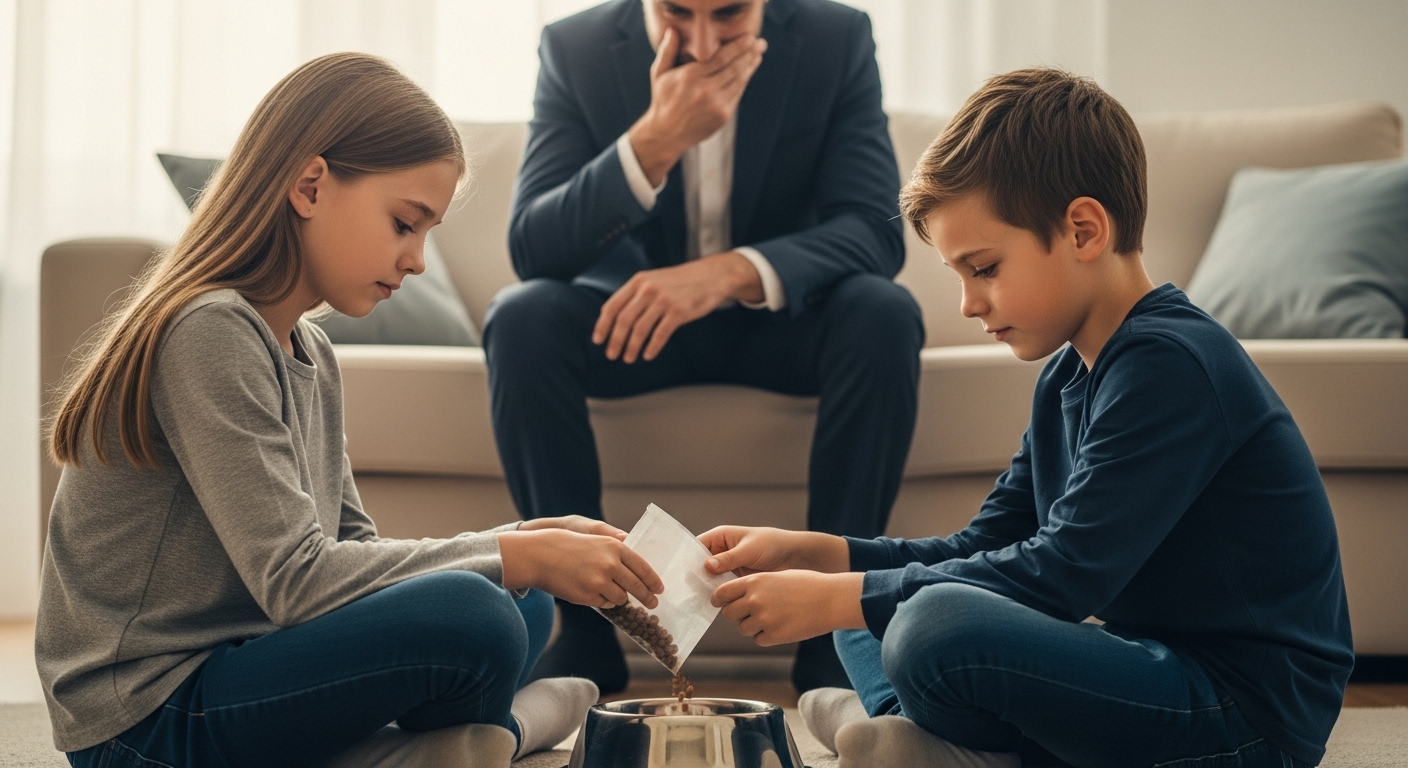
I walked them over to the dining table. It was set with fine china, crystal glasses, and enough food to feed an army. But in the center of the table, in a place of honor, sat a small, red plastic bowl.
It was the bowl from the basement.
I had kept it. washed it, sanitized it.
Every night at dinner, we put a single coin in it. A donation.
“What’s the rule?” I asked them.
“We eat,” Sarah said seriously.
“And then?”
“And then we help,” she finished.
The “Buster Foundation” was now the largest child advocacy group in the state. We funded investigators to check on foster homes. We provided meals. We ensured that no child in our city would ever have to eat from a dog bowl again.
I looked at my family. I looked at the rain falling gently against the glass of the penthouse windows.
I used to think success was the car in the garage or the numbers in the bank account. I used to drive by the broken windows of the world and look away.
Now, I look. I always look.
Because the greatest thing I ever built wasn’t a condo. It was a home for two kids who had forgotten what a home was.
“Alright,” I said, putting Timmy in his high chair. “Let’s eat.”
And for the first time in a long time, the meal tasted like redemption.