I Found a Homeless Girl Sobbing on My Wife’s Fresh Grave—She Refused My Money, Handed Me a Photo, and Revealed a Secret That Shattered My 20-Year Marriage.
PART 1
Chapter 1: The Intruder
The rain in Seattle doesn’t wash things clean; it just makes the grime slicker. It was the third day since I put Eleanor in the ground, and the sky hadn’t stopped weeping. I wished I could say the same for myself, but Arthur Sterling doesn’t cry. I convert grief into capital, into buildings, into silence.
But today, I just wanted to stand over the woman who had been the only soft thing in my life and demand answers from God.
We were at the grandest cemetery in the state. The Sterling plot was prime real estate for the dead—on a hill, overlooking the grey skyline. I signaled Marcus, my head of security, to stop the black town car at the bottom of the path.
“Wait here,” I told him. “I need a minute.”
“Sir, it’s pouring,” Marcus said, eyeing the radar on the dashboard.
“I’m not made of sugar, Marcus.”
I stepped out, opening my black umbrella. The wind immediately tried to snatch it, but I held firm. I walked up the cobblestone path, the scent of wet pine and decaying leaves filling my nose.
When I crested the hill, I stopped dead.
I expected silence. I expected the white roses I’d ordered to be the only splash of color against the grey stone.
I didn’t expect the girl.
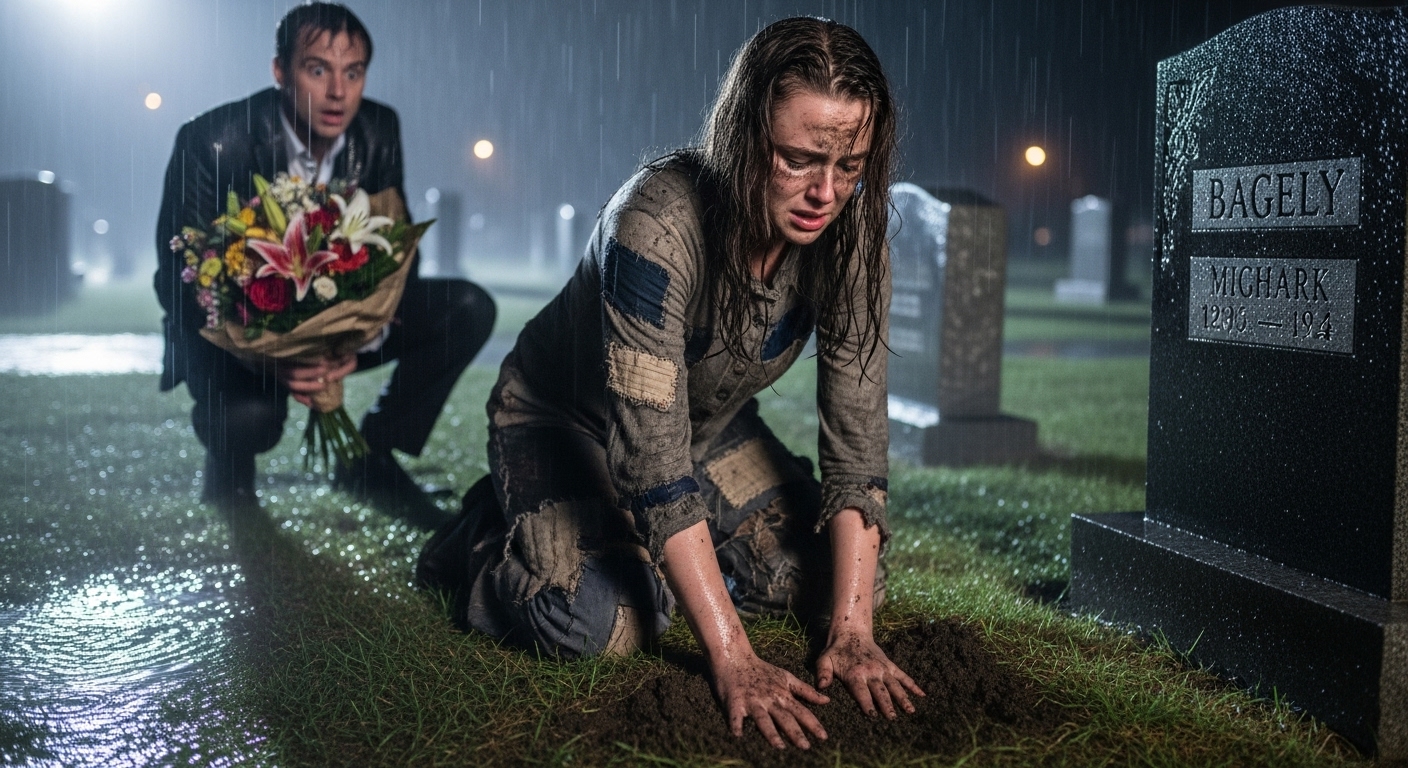
She was huddled at the foot of the grave, a small, soaked pile of rags. She was wearing a grey hoodie that was two sizes too big and jeans that were shredded at the hems. Her sneakers were soaked through, held together by silver duct tape that glinted in the dull light.
She was digging her fingers into the mud. The fresh, wet earth where my wife lay.
A surge of possessive rage hot-wired my nervous system. That was my wife. My grief.
I closed the distance with long, angry strides.
“Get away from there!” I bellowed, my voice booming over the wind.
The girl flinched violently, her shoulders hunching up as if she expected a blow. She didn’t run, though. She slowly pulled her hands from the mud and turned around.
She was young. Maybe twenty, maybe younger. Poverty ages you, and she wore it like a second skin. Her face was smudged with dirt, her lips blue from the cold.
But it was the eyes that stopped me cold.
They were green. A specific, rare shade of emerald with gold flecks near the pupil.
I felt a phantom punch to the gut. Eleanor had those eyes. I had spent twenty years getting lost in them across dinner tables and pillowcases.

“Who are you?” I demanded, stopping three feet from her. “What are you doing here?”
She wiped her nose on her sleeve, leaving a streak of mud on her cheek. “I… I was just saying goodbye,” she stammered. Her accent was rough, street-hardened, nothing like the cultured tones of my late wife.
“Goodbye?” I scoffed. “To whom? Do you even know who lies here?”
She looked down at the headstone. Eleanor Sterling. Beloved Wife.
“I know,” she whispered. “She was the lady in the magazines.”
“So that’s it?” I felt the cynicism harden my heart again. “You’re a fan? A stalker? Or just a scavenger looking for loose change?”
I reached into my breast pocket, pulling out a money clip thick with hundred-dollar bills. I peeled off five of them. Five hundred dollars. More than she likely saw in a month.
I tossed them at her. The wind caught one, blowing it against the headstone, but the rest landed in the mud near her taped-up shoes.
“Take it,” I spat. “Go get high, go get food, I don’t care. Just get off my property.”
The girl looked at the money. Then she looked up at me. Her expression shifted from fear to a burning indignation that I hadn’t expected.
“I don’t want your money,” she said.
“Everyone wants my money,” I countered.
“I don’t,” she insisted. “I just wanted to tell her… tell her I forgive her.”
The words hung in the air, heavier than the rain.
“Forgive her?” I stepped closer, looming over her. “Forgive her for what? Eleanor was a saint. She ran charities. She saved lives. What could a gutter rat like you possibly have to forgive her for?”
The girl flinched at the insult, but she stood her ground. She reached into the pocket of her hoodie.
Instinctively, I tensed. Marcus was halfway up the hill now, hand on his weapon.
“I have proof,” she said, her voice shaking.
She pulled out a plastic sandwich bag. Inside was a single, water-damaged Polaroid photo.
She held it out to me. Her hand was trembling uncontrollably, whether from cold or fear, I couldn’t tell.
I took it.
Chapter 2: The Polaroid
I shielded the photo from the rain with my umbrella. It was an old Polaroid, the edges yellowing and curling.
The image was slightly blurry, but unmistakable.
It was a woman sitting on a park bench. She was younger—her hair was longer, her face fuller—but it was Eleanor. My Eleanor. She was laughing, her head thrown back in that pure, unbridled joy I hadn’t seen in her final, sickly years.
And in her arms, swaddled in a pink blanket, was a baby.
I flipped the photo over. On the back, in handwriting that made my heart stop—Eleanor’s distinctive, looping script—was written:
My little Sarah. August 18, 1998.
I stared at the date. 1998.
I met Eleanor in 2000 at a gala in New York. She was a curator. I was a developer. We fell in love fast. She told me everything. She told me about her childhood in Vermont, her parents dying young, her struggle to make it in the art world.
She told me she had never been married. Never had kids.
And later, when we tried—God, how we tried—the doctors told us her uterus was scarred. “From a previous infection,” they said. We grieved the children we’d never have.
She lied.
The realization didn’t hit me like a wave; it hit me like a bullet.
She had a child. Two years before she met me.
I looked up at the girl—Sarah.
“You,” I rasped. “You’re Sarah?”
She nodded, hugging herself against the cold. “Yeah.”
“This is a fake,” I said, though I knew it wasn’t. ” Photoshop. AI. Something.”
“It’s real,” Sarah said. “I have more. Letters. Checks. She sent them to my foster mom, Mrs. Higgins. Every month. Three thousand dollars. Cash.”
“Checks?” I narrowed my eyes. “You said cash.”
“Cash in envelopes,” she corrected quickly. “Always cash. She didn’t want a paper trail. She didn’t want you to know.”
That stung more than the wind. “Why?” I asked, my voice cracking. “Why would she hide you? Eleanor wasn’t cruel. If she had a child… we have millions. We could have raised you. You wouldn’t be…” I gestured vaguely at her filth.
Sarah laughed, a bitter, sharp sound. “She didn’t want to raise me. She wanted to be Mrs. Sterling. She said… in one of the letters… she said she needed a fresh start. That a baby from a ‘bad man’ would ruin her chance with the ‘good man.'”
She looked me right in the eye. “You’re the good man, Mr. Sterling. I was the baggage she checked at the door.”
The world tilted on its axis. My perfect wife. My angel. A woman who abandoned her child to marry into money? It didn’t fit. It couldn’t fit.
Marcus was beside me now, breathing hard. “Mr. Sterling, is everything alright? Is she bothering you?”
I looked at Marcus. Then at the grave. Then at Sarah.
If I walked away now, I could pretend this never happened. I could go back to mourning the saint I thought I married.
But Arthur Sterling didn’t build an empire by ignoring the cracks in the foundation.
“Marcus,” I said, my voice low and dangerous. “Open the car door.”
“Sir?” Marcus looked at Sarah with disdain. “She’s… she’s filthy, sir. The upholstery.”
“I can buy a new car, Marcus!” I roared, making both of them jump. “I can’t buy the truth!”
I turned to Sarah. “You say you have letters?”
“In my backpack,” she said. “Stashed under the bridge where I sleep.”
“We’re going to get them,” I said. “And then we’re going to my house. And you are going to tell me everything. Every. Single. Lie.”
“And if I don’t want to go with you?” she asked, lifting her chin.
“You came here for closure, didn’t you?” I challenged. “You want to know why your mother chose me over you? Well, so do I.”
She hesitated, then nodded.
“Fine,” she said. “But I sit in the front. I don’t trust rich guys in the back seat.”
Under any other circumstances, I might have smiled at her grit. Today, I just turned and walked down the hill.
I had just buried my wife. Now, it seemed, I was about to dig her back up.
PART 2
Chapter 3: Under the Bridge
The ride to the overpass was silent. The only sound was the rhythmic thwack-thwack of the windshield wipers and the heater blasting, trying to thaw the shivering girl in the passenger seat.
Marcus drove with white-knuckled tension. He kept glancing at Sarah as if she were a grenade with the pin pulled.
“Turn here,” Sarah mumbled, pointing a grimy finger at a sharp right turn that led into the industrial district.
We parked beneath the concrete canopy of Interstate 5. It was a graveyard of rusted metal, discarded shopping carts, and tents made of blue tarp.
“Wait here,” I told Marcus.
“Sir, I really must insist—”
“You stay with the car, Marcus. If this is a setup, I want you mobile.”
I stepped out into the gloom. Sarah was already scrambling over a concrete barrier, heading toward a small, hidden alcove up near the support beams. It was dry there, at least.
I followed, my Italian leather shoes slipping on wet gravel.
“Here,” she said, pulling a battered, water-resistant hiking backpack from behind a loose concrete block. It was the only thing of value she seemed to possess.
She unzipped it and pulled out a large Ziploc bag. Inside was a stack of envelopes.
She handed me one.
The envelope was high quality, cream-colored linen paper. My stationery. The kind I kept in the study at the mansion.
I opened it. Inside was ten three-hundred-dollar bills and a note.
Mrs. Higgins, *Here is the support for May. Ensure Sarah gets her dental work done. Keep her away from the city center. He is hosting a gala there next week. I cannot risk them crossing paths.
- E.*
“He,” I whispered. That was me.
“There are dozens of them,” Sarah said, her voice hollow. “From when I was five until… until last month. The money stopped coming three weeks ago.”
“She was in the hospital,” I said numbly. “Coma.”
Sarah looked down. “I figured she was dead when the rent wasn’t paid. Mrs. Higgins kicked me out last week. Said the gravy train derailed.”
“Mrs. Higgins sounds like a peach,” I muttered.
“She did her job,” Sarah shrugged. “She kept me alive. Kept me hidden.”
I looked around at the squalor. This was where my wife’s daughter lived? While Eleanor slept on 800-thread-count Egyptian cotton sheets and wore diamonds that cost more than this entire city block?
A nausea rose in my throat. It wasn’t just betrayal. It was disgust.
“Grab your things,” I said, my voice harsh.
“I have them,” she said, patting the backpack.
“Everything,” I commanded. “You’re not staying here tonight.”
“I told you, I don’t need your charity.”
“It’s not charity,” I snapped. “It’s an investigation. And you are the primary witness. Now get in the car.”
Chapter 4: The Lion’s Den
The Sterling Estate is a fortress. Gates, cameras, guards. It was designed to keep the world out. Tonight, it felt like a prison I had built for myself.
When we walked into the foyer, the staff froze. Mrs. Gable, the housekeeper, dropped a duster.
“Mr. Sterling?” she gasped, eyeing Sarah’s muddy boots on the marble floor.
“Mrs. Gable, prepare the guest suite in the East Wing,” I ordered, stripping off my wet coat. “Draw a bath. Get… get some of Eleanor’s old clothes. The ones in storage. Something warm.”
“Sir?” Mrs. Gable looked scandalized. “Mrs. Sterling’s clothes?”
“Do I stutter?” I barked.
Mrs. Gable scurried away.
“Go with her,” I told Sarah. “Get cleaned up. We talk in one hour. Library.”
Sarah looked at the grand staircase, then at me. “You really live here? Just two people?”
“Just one, now,” I said.
She flinched. “Right.”
After she went upstairs, I went straight to my study. I poured three fingers of scotch and sat at my desk. I unlocked the bottom drawer where I kept Eleanor’s personal effects—the things I hadn’t been able to look at yet.
Her diary.
I hadn’t opened it. I thought it would be too painful to read about her love for me, her thoughts on her illness.
Now, I opened it with the desperate hands of a man defusing a bomb.
I flipped back. Way back. 1999. 2000.
The pages were filled with mundane things. Art shows. Weather. And then, an entry from June 2000, two months after we met.
He is perfect. He is everything I dreamed of. But he is so… rigid. He talks about lineage. About purity. If he knew about Vincent… if he knew about the baby… he would look at me like I was damaged goods. I have to make a choice. The past, or the future?
I slammed the book shut.
Rigid? Lineage? Is that how she saw me? A snob who couldn’t handle a woman with a past?
I took a swig of scotch. Maybe she was right. Would I have married her if I knew she had an illegitimate child with a man named… Vincent?
Who the hell was Vincent?
An hour later, the library door creaked open.
Sarah walked in. She looked different. Clean. Mrs. Gable had put her in one of Eleanor’s old cashmere sweaters—a soft cream turtleneck—and black leggings.
With the dirt gone, the resemblance was haunting. She had Eleanor’s nose. Eleanor’s jawline.
But she walked like a fighter, shoulders tight, eyes scanning the room for threats.
“Sit,” I said, gesturing to the leather armchair opposite me.
She sat, curling her legs under her. “Nice place. Quiet.”
“Who is Vincent?” I asked, cutting to the chase.
Sarah froze. Her eyes went wide.
“How do you know that name?”
“It was in her diary,” I lied (partially). “Who is he?”
Sarah looked down at her hands. “My father.”
“And where is he?”
“Prison,” she said softly. “Since I was two. He… he killed a guy. A bad drug deal.”
I closed my eyes. A murderer. Eleanor had a child with a murderer. No wonder she hid it. In my social circles, that wasn’t just baggage; it was a social death sentence.
“And Eleanor?” I asked. “Was she involved?”
“No,” Sarah said. “She was just the stupid college girl who fell for the bad boy. When he went away, she was left with me. And no money. Then she met you.”
“And she chose the money,” I finished bitterly.
“She chose safety,” Sarah corrected. “For both of us. She thought… if she brought me into your world, people would dig. They’d find Vincent. They’d use it against you.”
“So she was protecting me?” I laughed dryly. “By paying strangers to raise her daughter in poverty?”
“I wasn’t always in poverty,” Sarah defended. “The money was good until Mrs. Higgins started gambling it away. Eleanor didn’t know that part.”
“You defend her,” I observed. “Even after she abandoned you.”
“She was my mom,” Sarah shrugged, tears welling up again. “You only get one.”
There was a knock at the door. Marcus entered, looking grim. He was holding a manila envelope.
“Sir,” he said. “The background check you asked for.”
I had texted him from the car.
I opened the envelope.
Sarah Miller. Born August 18, 1998. Mother: Eleanor Vance. Father: Vincent Miller.
It was confirmed.
But there was something else in the file. A police report. Dated three weeks ago.
Attempted Burglary. Suspect: Sarah Miller. Location: 1402 Oak Street.
I looked up at Sarah. “You tried to rob a house three weeks ago?”
Sarah went pale. “I… I had to.”
“Why?”
“Because that’s where she kept the rest of it,” Sarah whispered. “The letters. The proof. Mrs. Higgins was going to burn them. She wanted to blackmail you herself after the payments stopped. I had to steal them back to protect… to protect Eleanor’s secret.”
I stared at her.
She broke into a house, risked jail, lived under a bridge… to protect the reputation of the mother who abandoned her?
“Why protect her secret?” I asked, genuinely baffled. “Why not let the world know?”
“Because,” Sarah said, her voice breaking. “She promised me that if I kept the secret until I was twenty-one… she would finally tell you. She was going to bring me home.”
She reached into her pocket and pulled out a crumpled letter. The last one.
*My darling Sarah, Arthur is a good man, but he is proud. I have been afraid for too long. I am sick, Sarah. The doctors say it’s bad. I need to tell him. I need to make this right before I go. Meet me at the cemetery on Tuesday. I’ll tell him there. I love you.
- Mom.*
Tuesday. The day she died.
She died on Monday night.
She was going to tell me. She died before she could.
The anger in my chest didn’t vanish, but it changed. It turned into a heavy, aching sorrow. Eleanor hadn’t just been a liar. She had been a coward. But in the end, she tried to be brave.
I looked at Sarah. The daughter I never knew I could have had. The daughter who had lived in the shadows so I could shine in the light.
“Marcus,” I said quietly.
“Sir?”
“Call the lawyers. Tell them to bring the estate papers.”
“Sir?” Marcus’s eyes bugged out. “You can’t be serious. She’s… we just met her.”
“She is Eleanor’s blood,” I said, standing up. “And she has done more to protect the Sterling name than anyone in this room.”
I walked around the desk and stood in front of Sarah. She looked up, terrified.
“You’re not going back to the bridge,” I said.
“I’m not?”
“No. You’re staying here.”
“As what?” she asked. “A maid?”
I looked at the green eyes.
“No,” I said. “As my stepdaughter.”
Sarah’s mouth fell open. “But… you hate me. I’m the mistake.”
“You’re not a mistake,” I said, my voice thick with emotion. “You’re the only piece of her I have left.”
Chapter 5: The New Reality
The transition wasn’t smooth. You don’t take a girl from under a bridge and put her in a mansion without friction.
For the first week, Sarah hoarded food in her room. I found granola bars stuffed under her mattress. Old habits die hard.
I had to fight the legal battle of a lifetime. When news broke that Arthur Sterling had a “ward,” the vultures circled. My board of directors panicked. My estranged brother, William, showed up for the first time in ten years, sniffing around for weakness.
“Who is she, Artie?” William asked one night, swirling my scotch in his glass. “Some charity case? Or are you going senile?”
“She’s family,” I said, staring him down.
“She’s a street rat,” William sneered. “I had a PI run her. Daughter of a convict. You let that into our house? Into our company?”
“She has more integrity in her pinky finger than you have in your entire suit, William.”
William set the glass down hard. “Be careful, brother. The board won’t like you playing daddy to a criminal’s spawn. They might think you’re unfit to lead.”
“Let them try,” I threatened.
But William wasn’t the only problem.
Sarah was struggling. She hated the clothes. She hated the dinners. She felt like an imposter.
One night, I found her in the kitchen at 2 AM, eating cereal out of the box.
“I can’t do this,” she said, not looking at me.
“Do what?”
“Be a Sterling. I don’t know which fork to use. I don’t know how to talk about polo. I miss… I miss being invisible.”
” invisibility is safety,” I admitted, leaning against the counter. “But visibility is power. Eleanor wanted you to have power.”
“Eleanor wanted to clear her conscience,” Sarah snapped.
“Maybe,” I conceded. “But she also left you something.”
I placed a velvet box on the counter.
“What is it?”
“Open it.”
She opened the box. Inside was a locket. A simple gold heart.
“I found this in her safety deposit box today,” I said. “It was marked for you.”
Sarah opened the locket. inside was a tiny picture of baby Sarah, and a lock of hair. And an inscription: My greatest work.
Sarah stared at it, tears dripping into the cereal box.
“She loved you,” I said softly. “She did it all wrong. God, she did it so wrong. But she loved you.”
Sarah clutched the locket to her chest. For the first time, she let me hug her. She smelled like expensive soap and old sadness.
Chapter 6: The Threat
Two months later, the calm shattered.
I was in a board meeting when Marcus burst in. He never interrupts meetings.
“Sir,” he whispered, his face pale. “It’s Sarah. She’s gone.”
“Gone? What do you mean gone?”
“Kidnapped,” he said. “We found her phone by the gate. And a note.”
My blood turned to ice. I grabbed the note.
We know who her father is. We know what he did. $10 Million. Or we tell the press that Sterling Industries is harboring the daughter of the Seattle Slasher.
Vincent Miller hadn’t just killed a guy in a drug deal. That was the lie Sarah told me to soften the blow. Vincent Miller was a serial killer. He was serving three life sentences.
If the press found out I was raising his daughter… the company stock would tank. My reputation would be incinerated.
But worse… they had Sarah.
“Who took her?” I growled.
“We’re tracking the van,” Marcus said. “But sir… if we call the police, the press will know.”
I looked at the board members staring at me.
“Meeting adjourned,” I said.
I walked out.
“Call the helicopter,” I told Marcus. “And get the private security team. Not the guys in suits. The guys in tactical gear.”
“Sir, are we paying?”
“No,” I said, buttoning my jacket. “We’re hunting.”
Chapter 7: The Rescue
They were holding her in an abandoned warehouse near the docks—cliché, but effective.
My team moved in silence. I wasn’t a soldier, but I was a man with nothing left to lose. I wore a vest under my suit and carried a handgun I hadn’t fired in years.
We breached the door.
Inside, three men were guarding Sarah. She was tied to a chair, a piece of duct tape over her mouth. Her eyes were wide with terror.
One of the men was… William.
My brother.
I froze. “William?”
William spun around, holding a gun. “Artie. You shouldn’t have come yourself.”
“You?” I stepped forward, ignoring Marcus’s hiss to stay back. “You kidnapped her? Your own niece?”
“She’s not my niece!” William shouted. “She’s a monster’s seed! And you… you were giving her my inheritance! You changed your will, Artie! I saw the drafts!”
“You were stealing from the company, William,” I said calmly. “That’s why I cut you out. Sarah had nothing to do with it.”
“She’s the perfect leverage,” William sneered. “Pay me, or the world learns that Mrs. Sterling was a killer’s groupie.”
Sarah was making muffled noises, thrashing against the ropes.
“Let her go, William,” I said. “This is over.”
“It’s over when I say it’s over!” William raised his gun at Sarah.
Bang.
The shot didn’t come from William.
It came from Sarah.
She had managed to free one hand—the one with the locket. She had grabbed a loose pipe from the floor behind her chair and swung it with a violence born of the streets, smashing William’s hand. The gun flew.
My team swarmed.
William was on the ground, screaming. The other two hired thugs surrendered instantly.
I ran to Sarah. I ripped the tape off her mouth.
“Are you okay?” I gasped, checking her for injuries.
She was panting, her knuckles white. She looked at William, then at me.
“I told you,” she said, her voice shaking but fierce. “I don’t trust guys in suits.”
I laughed. A hysterical, terrified laugh. I hugged her tight.
“Let’s go home,” I said.
Chapter 8: The Legacy
We didn’t hide it.
The next day, I called a press conference. I stood at the podium, Sarah standing next to me. She wore a black blazer and jeans. She looked like a Sterling.
“This is Sarah Sterling,” I told the cameras. “My late wife’s daughter. My daughter.”
“Is it true her father is Vincent Miller?” a reporter shouted.
Sarah stepped up to the mic. I tried to stop her, but she waved me off.
“Yes,” she said clearly. “My biological father is a monster. My mother was a woman who made mistakes to protect me. But my father,” she pointed at me, “is the man who saved me. You can judge me by my blood, or you can judge me by my actions. But I’m not going anywhere.”
The silence was deafening. Then, the camera shutters went crazy.
It’s been a year since then.
William is in prison. The stock dipped, then skyrocketed. People love a redemption story.
I visit Eleanor’s grave every Sunday. But I don’t go alone anymore.
Last week, we were standing there. The rain had finally stopped. The grass was green.
“Do you think she knows?” Sarah asked, adjusting the flowers.
“Knows what?”
“That we’re okay.”
I looked at the girl who had saved my life just as much as I had saved hers. I looked at the green eyes that were no longer filled with fear, but with a future.
“She knows,” I said. “She sent you to me.”
Sarah smiled. She took my arm.
“Come on, Dad,” she said. “Let’s go get lunch. I’m starving.”
“Dad.”
It was the first time she’d called me that.
It sounded better than “Millionaire.” It sounded better than “CEO.”
It sounded like the truth.