He Gripped My Camo Sleeve With Trembling Fingers And Asked A Question That Stopped My Heart Cold: “Sarge, When The Trucks Roll Out, Who’s Gonna Protect Me?”—And I Realized The Storm Was The Easy Part.
PART 1: THE BLACK WATER
CHAPTER 1: THE SILENCE AFTER THE SCREAM
The rain wasn’t rain anymore. It was falling distinct, heavy sheets of lead, hammering against the side of the Humvee like machine-gun fire.
I’m Sergeant Marcus Hayes, 256th Infantry Brigade. I’ve done two tours in the desert, seen things that keep me up at night, but nothing prepared me for the drowning of St. Jude Parish. The levees had blown three hours ago. The radio was a mess of static and panicked screams. “Sector 4 is gone! Repeat, Sector 4 is underwater!”

My orders were simple: Search and Rescue. But in pitch-black water that smelled of sewage, gasoline, and death, “simple” didn’t exist.
We were drifting in a flat-bottom boat, the engine cut to listen. That’s the worst part of flood rescue. You have to listen for the voices. And usually, by the time you get there, the voices have stopped.
“Sarge, over there,” my specialist, Miller, whispered, pointing his flashlight beam toward a crushed roof peaking out of the black sludge. It was a single-story house, submerged to the gutters. A massive oak tree had sliced right through the middle of it, shattering the spine of the home.
I signaled the driver to paddle. No motors. We didn’t want the vibration to collapse the structure. The silence was heavy, broken only by the slosh of the murky water against the aluminum hull.
As we got closer, I saw it. A small hand, waving frantically from a hole in the attic vent.
“Hold on!” I roared, grabbing the fire axe. “We’re coming!”
We hit the roof with a thud. I scrambled up, the shingles slick with oil and mud. I smashed the vent open, disregarding the jagged wood tearing at my gloves. I peered into the gloom of the attic.
“Give me your hand!” I shouted into the darkness.
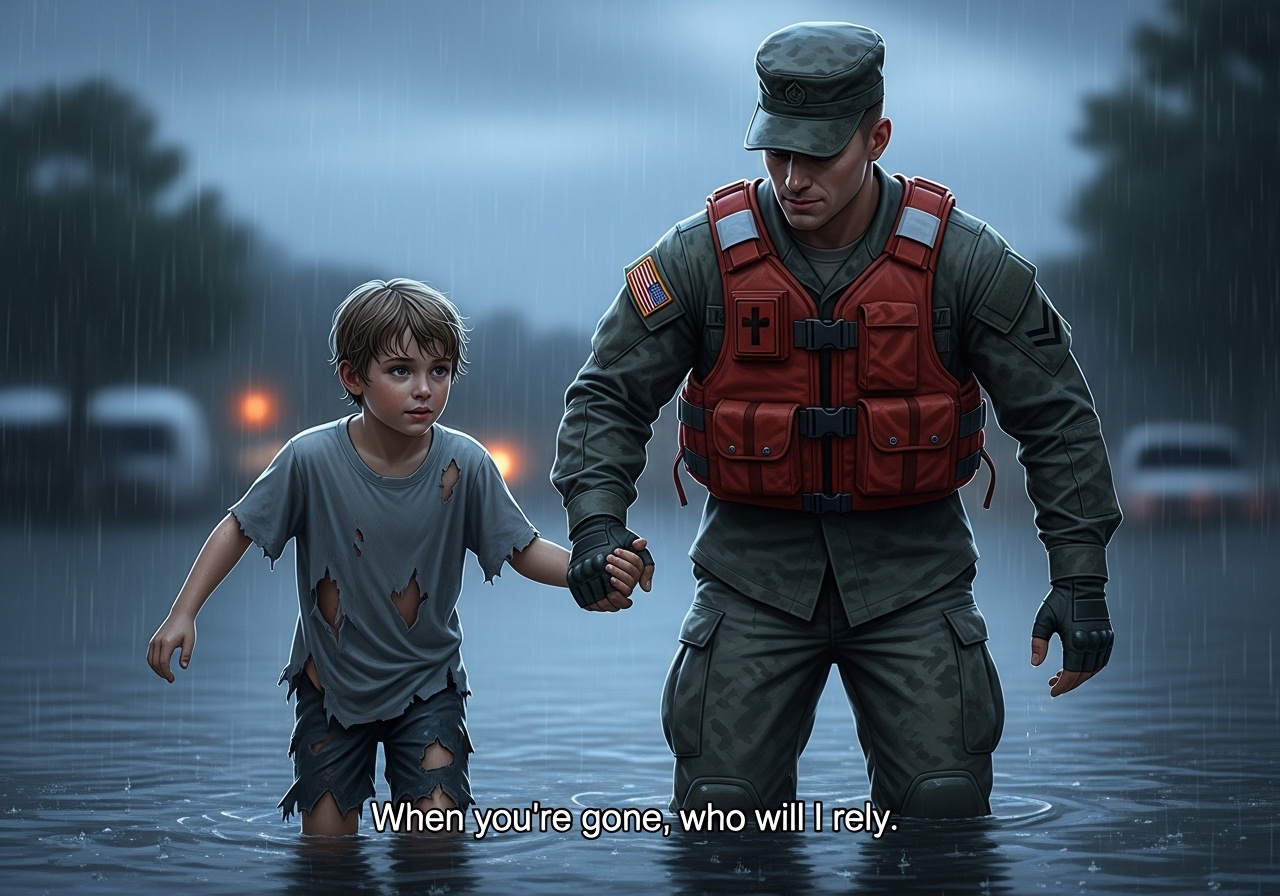
A kid. Maybe nine or ten. Skinny, brown hair plastered to his forehead, shivering so hard his teeth were rattling like dice in a cup. He was clinging to a rafter, the black water lapping just inches below his sneakers. The attic was a tomb waiting to close.
And he was alone.
“Come on, kid. I got you,” I said, locking my eyes on his. He looked terrified—not just of the water, but of me. Of the uniform. Of the sudden violence of his rescue.
He lunged. I caught him.
I hauled him out into the pounding rain, wrapping him instantly in a thermal blanket. He was light. Too light. Like a bird that had fallen out of a nest.
“Is there anyone else?” I yelled over the wind, scanning the hole. “Your mom? Dad?”
The kid buried his face in my chest, his grip tightening on my tactical vest. He shook his head against the ceramic plate carrier.
“Just me,” he croaked, his voice barely audible over the storm. “Just me.”
CHAPTER 2: THE ROOFTOP VIGIL
We couldn’t go back. The current had shifted, turning the street into a raging river of debris. Cars were floating by like toys in a bathtub, crashing into telephone poles. We were stranded on that roof until the birds—the extraction helicopters—could fly at first light.
So, we sat.
Miller was on the radio, trying to get a fix on our extraction. “Command, this is Bravo Two. We are isolated. One civilian secured. Requesting immediate extraction. Over.” The only response was static.
I sat with the kid—he said his name was Leo—under a heavy tarp we’d rigged up against the chimney. The rain drummed rhythmically against the plastic, creating a small, dry bubble in a world of wet chaos.
It’s strange what you talk about when the world is ending.
“You a soldier?” Leo asked, staring at the patch on my shoulder. His eyes were red-rimmed, wide with shock.
“National Guard,” I said, ripping open a ration pack and handing him an MRE cracker with peanut butter. “We help when things go bad here at home.”
“Things are bad,” he stated. It wasn’t a question. It was a fact. A heavy, adult realization.
“Yeah. But we’re here now. You’re safe.”
He ate the cracker in small, deliberate bites, like he was afraid it was the last food he’d ever see.
“My dad said the army only comes when there’s a war,” Leo said quietly.
“Sometimes the weather starts a war, Leo. And we come to fight it for you.”
He looked out at the black expanse of water. The only light came from distant lightning strikes illuminating the carnage.
“My dad… the water took the truck. He pushed me out the window. He told me to climb the tree to the roof.” Leo stopped chewing. He didn’t cry. He was past crying. He was in the numbness. “He didn’t come out.”
My chest tightened. I’ve seen soldiers go down. I’ve written letters to mothers. It never gets easier. But hearing it from a kid who just watched his world dissolve? That breaks you in places you can’t fix.
“Your dad was a hero, Leo. He made sure you were here. He did his job.”
Leo shivered, leaning into my side. I wrapped my arm around him, trying to share whatever body heat I had left. The adrenaline was fading, and the cold was setting in.
“Sarge?”
“Yeah, buddy?”
He looked up at me, his eyes wide and reflecting the flashing amber hazard lights of a distant rescue boat that couldn’t reach us yet.
“You’re not gonna leave me here, right? You’re staying until the water goes away?”
“I’m not going anywhere,” I promised. “I’m right here. I’ve got your six.”
“What’s that mean?”
“It means I’ve got your back. No one gets to you without going through me.”
But I knew the orders. We extract, we drop at the refugee point—usually a sports stadium or a convention center—and we redeploy. That’s the job. You save them, you drop them, you move on to the next roof.
I just didn’t know then that Leo wasn’t going to be just another drop-off.
By the time the sun started to bleed gray light over the horizon, the water had stopped rising. The silence returned.
And then, the question came. The one that haunts me.
Leo gripped my camo sleeve, his fingers turning white from the pressure. He looked at the devastation around us—the erased neighborhood, the floating memories of a thousand lives.
Then he looked at me.
“Sarge… when the trucks roll out… when you guys go home…”
His voice cracked.
“Who’s gonna watch my six then? Who do I rely on?”
I froze. The military teaches you how to shoot, how to breach, how to bandage a sucking chest wound. It doesn’t teach you how to answer a child who has lost everything and is asking you to be his anchor in a drifting world.
I swallowed hard, the lump in my throat tasting like ash. I looked at Miller, but he turned away, pretending to fix the antenna. He knew, too. We were temporary. Leo’s problem was permanent.
“We’ll figure it out, Leo,” I lied. “We’ll make sure you’re okay.”
But as the sound of rotor blades thumped in the distance, signaling our rescue, I felt a pit in my stomach. I wasn’t saving him. I was just moving him to a different kind of hell.
PART 2: THE AFTERMATH
CHAPTER 3: THE DOME OF CHAOS
The helicopter ride was a blur of noise and vibration. Leo clung to my leg the entire time, refusing to look out the window at the drowned world below. When we touched down at the “Safe Zone”—the city’s massive football stadium—the reality of the situation hit me like a physical blow.
It wasn’t a shelter. It was a holding pen.
Thousands of people. The smell of unwashed bodies, wet clothes, and despair hung thick in the humid air. It was loud—a cacophony of crying babies, shouting volunteers, and the constant squawk of megaphones.
“Alright, Sarge, good work,” the FEMA coordinator shouted, clipboard in hand. “Drop the civilian at the processing desk. Sector C. Then refuel and head back out.”
I looked down at Leo. He was staring at the sea of strangers, his eyes wide with panic. He took a step back, pressing himself against my combat boots.
“Don’t make me go,” he whispered.
“Hayes!” Miller yelled from the tarmac. “Bird’s fueling. We go in ten.”
I was torn. My duty was to the mission. There were other people on other roofs. But looking at Leo, I saw something brittle that would shatter the second I walked away.
“Give me a minute,” I snapped at the coordinator.
I knelt down, eye-level with Leo. “Listen to me. This is where you get dry clothes. Food. They have a list of people. Maybe you have an aunt? A grandma?”
Leo shook his head violently. “No one. Just Dad.”
“Okay. Okay.” I took a deep breath. “I have to go back out. There are other kids like you stuck in the water. You understand that, right? I have to help them.”
“But you said you had my six,” Leo accused, tears finally spilling over, cutting tracks through the mud on his cheeks.
“I do. I…”
“Sarge! Move it!” The order came from my Lieutenant this time.
I stood up. I had to make a choice. The soldier or the human.
“Take him to processing,” I told the coordinator, my voice hollow. “Put his name down as a priority. Leo… Vance. Find his kin.”
“Will do, Sergeant.” The coordinator reached for Leo’s arm.
Leo screamed.
It wasn’t a tantrum. It was a primal sound of abandonment. He didn’t fight the coordinator; he just reached for me, his fingers clawing at the air as I turned my back and jogged toward the helicopter.
Every step away from him felt heavier than the last. I climbed into the bird, strapped in, and put my headset on.
“You okay, Hayes?” Miller asked over the comms.
I didn’t answer. I watched the stadium shrink below us. I was leaving a ten-year-old boy alone in a cage full of wolves.
And I knew, right then, I wasn’t going to be able to sleep tonight.
CHAPTER 4: THE SHADOW OF THE SYSTEM
That night, the mission was scrubbed due to lightning. We were grounded back at the base of operations, about five miles from the stadium.
I sat on my cot, staring at the canvas ceiling of the tent. The other guys were playing spades, joking about the crazy things they’d seen floating in the water. Coping mechanisms.
I couldn’t cope.
All I could hear was Leo’s voice. Who do I rely on then?
“I’m going to the Dome,” I said, standing up and grabbing my truck keys.
“Hayes, you’re off duty. You can’t just leave the AO,” Miller warned.
“I need to check on the kid. Cover for me.”
“Marcus, don’t get attached,” Miller said, his voice dropping low. “It’s a tragedy, man. But it’s not your tragedy. You can’t save everyone.”
“I didn’t save him,” I said, grabbing my cap. “I just delayed the inevitable. If I don’t go back, I’m no better than the water.”
I drove the Humvee through the darkened, flooded streets, flashing my ID at three different checkpoints. When I got to the stadium, it was worse than before. The power was flickering. The tension was palpable. People were fighting over water bottles.
I pushed my way through the crowd, scanning Sector C.
“Leo!” I shouted. “Leo!”
Nothing. Just faces of exhaustion and anger.
I found the processing desk. It was abandoned, covered in loose papers. I started rifling through the intake forms. Vance. Vance. Vance.
Nothing.
My heart started hammering. Kids go missing in these situations. Traffickers, confusion, accidents.
I grabbed a passing volunteer by the vest. “Where are the unaccompanied minors? The kids without parents?”
“Sector D, up in the luxury boxes,” the guy stammered. “But you can’t go up there, it’s restricted—”
I didn’t wait. I sprinted up the concrete ramps, my boots heavy on the steps.
When I got to the luxury boxes, I saw a scene that made my blood boil. It wasn’t a safe haven. It was a holding cell. Dozens of kids, crying, sleeping on the floor. And in the corner, three older teenagers were cornering a smaller boy, trying to take his thermal blanket and his shoes.
It was Leo.
He was backed into a corner, holding a plastic fork like a shank. He looked feral. Terrified.
One of the teens lunged.
“Hey!” I roared, my voice echoing off the glass walls.
The room froze. The teenagers looked at me—6 foot 2, combat gear, angry as hell. They scattered like roaches.
Leo looked up. When he saw me, the fork clattered to the floor. The feral look vanished, replaced by pure, crumbling relief.
“Sarge?”
I crossed the room in three strides and scooped him up. He wrapped his legs around my waist and buried his face in my neck, sobbing uncontrollably.
“I thought you were gone,” he wept. “I thought you lied.”
“I’m here,” I whispered, holding him tight. “I’m here. And I’m not leaving you in this place.”
“You can’t take him,” a voice said behind me.
I turned around. A woman in a FEMA vest, looking exhausted but stern. “He’s a ward of the state right now, Sergeant. You can’t just walk out with a minor.”
I looked at the woman. I looked at the chaos of the stadium below. Then I looked at Leo, who was gripping me so hard it hurt.
“Watch me,” I said.
PART 2: THE LONG ROAD HOME
CHAPTER 5: THE UNAUTHORIZED EXTRACTION
The FEMA coordinator blocked my path, her radio in hand. Her face was a mask of exhausted bureaucracy. “Sergeant, stop! Security is on the way. You are crossing a line you can’t come back from. You cannot remove a minor from this facility without paperwork.”
Leo was trembling against my chest, his legs wrapped tight around my waist. I could feel his heart hammering against my own, a frantic bird trapped in a cage.
I stopped. I loomed over her, the red emergency lights of the stadium painting us in blood-colored flashes.
“Look at him,” I growled, my voice low and dangerous. I shifted Leo so she could see his face—the terror, the dirt, the bruise forming on his cheek where one of the teenagers had shoved him. “Up there, in your ‘safe zone,’ they were stealing his shoes. They were hunting him for a thermal blanket. Is that the safety you promised? Because where I come from, that’s a combat zone.”
She hesitated. Her thumb hovered over the ‘talk’ button on her radio. She looked at Leo’s bare, muddy feet. She looked at the desperation in my eyes. She was a volunteer, a mother probably. She saw the reality.
“If you walk out that door,” she whispered, lowering the radio, her voice shaking, “I never saw you. I was in the bathroom. But if you get stopped at the perimeter, you’re on your own, Sergeant.”
“I’m used to it,” I said.
I bolted.
I moved through the crowded corridors of the stadium like a ghost, dodging National Guard patrols and police units. I utilized every ounce of my training—moving with purpose, looking like I belonged, hiding in plain sight. I made it to the loading dock where the unit’s Humvee was parked.
Miller was there, leaning against the hood, smoking a cigarette in the rain. He saw me emerging from the shadows carrying the kid. He saw the wild look in my eyes.
He didn’t ask questions. He didn’t lecture me about regulations. He just opened the passenger door.
“Get him in,” Miller said, flicking the cigarette into a puddle. “I’ll drive. If we get stopped, we’re transporting a civilian casualty to the medic tent at Base Alpha for ‘suspected acute hypothermia and shock.’ That’s the story. Stick to it.”
“Thanks, brother,” I breathed, buckling Leo in.
“Don’t thank me yet,” Miller muttered, climbing into the driver’s seat and firing up the diesel engine. “Thank me when we don’t end up in Leavenworth prison.”
As we sped away from the stadium, the massive concrete dome shrinking in the rearview mirror, Leo finally loosened his grip on my arm. He looked around the cab of the truck, the tactical gear rattling with every bump.
“Where are we going?” he asked, his voice small.
“Somewhere dry,” I said, reaching over and ruffling his damp hair. “My sister lives two towns over. High ground. You’re going to sleep in a real bed tonight.”
But deep down, I knew the hard part wasn’t over. I had the boy. Now I had to fight the United States Army and the Department of Child Services to keep him.
CHAPTER 6: THE COMMANDER’S DESK
The sun was up, but the world still felt dark. I had dropped Leo off at my sister Sarah’s house at 0300 hours. She had taken one look at the muddy, traumatized boy and the haunted look in my eyes, and she had simply opened the door and put a kettle on.
Now, I was standing at attention in front of Captain Reynolds’ desk.
“Do you have any idea the pile of manure you just stepped in, Sergeant Hayes?” Reynolds slammed a file onto his desk. “I have FEMA asking where their ‘ward’ went. I have the MP calling about an unauthorized vehicle use. And I have you, my best squad leader, acting like a cowboy.”
“The boy was in danger, Sir,” I said, staring at the wall behind him. “The shelter was unsecured. He was being assaulted. I made a command decision to extract a civilian from a hostile environment.”
“It was a shelter! Not a war zone!” Reynolds shouted, rubbing his temples.
“With all due respect, Sir, to a ten-year-old who just lost his father and his home, there is no difference.”
The room went silent. Reynolds sighed, leaning back in his chair. He looked tired. We were all tired.
“Where is the boy now?”
“Safe, Sir. secure location.”
“You know CPS (Child Protective Services) is coming for him, right? You can’t just keep a kid, Marcus. That’s kidnapping.”
“I know, Sir. But I promised him. He asked who was going to watch his six. I told him I would.” I broke my stance, leaning forward, my voice cracking. “Captain, his dad pushed him out a window to save him. He died so this kid could live. I’m not gonna let him survive the flood just to drown in the system.”
Reynolds looked at me for a long time. He saw the resolve. He knew I was stubborn, but he also knew I was right.
“You’re confined to administrative duties pending an investigation,” Reynolds said quietly. “And Hayes? You better get a damn good lawyer. Because CPS is going to be at your sister’s house by noon.”
CHAPTER 7: THE STAND
The social worker, Mrs. Gable, was a small woman with glasses and a clipboard that seemed to contain the fate of the world. She sat on my sister’s floral couch, looking out of place amidst the warmth of the home.
Leo was sitting on the floor, playing with my nephew’s LEGOs. He hadn’t spoken since she arrived.
“Mr. Hayes,” Mrs. Gable said, her voice soft but firm. “I understand your intentions were noble. But you are a single male, active duty military, subject to deployment. You are not a blood relative. The state prefers to place children with established foster families.”
“Established foster families?” I scoffed, pacing the room. “You mean strangers? You mean a group home where he’s just a number? I’ve seen your ‘homes,’ ma’am. They’re overcrowded.”
“They are licensed,” she corrected.
“I saved his life,” I said, my voice rising. “We have a bond. You take him now, you re-traumatize him.”
“Sergeant Hayes, please.” She looked at Leo. “Leo, honey? Can you come here?”
Leo stood up. He didn’t look at her. He walked straight to me and stood by my side, his hand finding mine. He didn’t squeeze it; he just held it. An anchor.
“Leo, would you like to go with Mrs. Gable? She can take you to a nice family—”
“No,” Leo said.
“Leo, they have—”
“No,” he said louder. He looked up at me. “He’s my dad now.”
The room froze. My heart stopped. I hadn’t asked him to say that. We hadn’t talked about it.
“He’s my dad,” Leo repeated, his voice shaking but defiant. “My real dad… he gave me to him. In the water. He saved me.”
It wasn’t literally true, but emotionally, it was the only truth that mattered. The torch had been passed in the silence of the flood.
Mrs. Gable looked at the boy, then at me. She saw the way he leaned into my leg. She saw the fierce protectiveness in my stance. She closed her folder.
“This is highly irregular,” she murmured. “However… given the state of emergency… and the lack of available beds…”
She pulled out a different form.
“We can process an Emergency Kinship Placement. It’s usually for relatives. But if you can prove a ‘significant prior relationship’…”
“We met in the storm,” I said. “That’s pretty significant.”
She cracked a small smile. “I’ll need character references. A background check. And you’ll need to take parenting classes.”
“I’ll take a class on how to knit if that’s what it takes,” I said.
CHAPTER 8: THE NEW NORMAL
Six Months Later.
The Louisiana heat was back, thick and humid, but the water was gone. The scars on the land remained—wrecked houses, empty lots—but the green was returning.
I was in the driveway, working on the engine of my old Ford truck.
“Hand me the 10mm wrench,” I said, my head under the hood.
A small, grease-stained hand slapped the tool into my palm.
“Thanks, partner.”
I wiped my hands on a rag and looked down. Leo was wearing a baseball cap that was too big for him and a t-shirt that said 256th Infantry Brigade. He looked healthier. He’d put on weight. The shadows under his eyes were gone.
“Hey, Marcus?”
“Yeah?”
“Coach said I made the starting lineup for baseball. First base.”
“That’s awesome, kid! We gotta practice your grounders then.”
He kicked at the gravel, looking down. “Do you think… do you think my dad would be proud?”
I put the wrench down. I sat on the bumper of the truck and pulled him in between my knees.
“Leo, your dad did the hardest thing a man can do. He gave up everything so you could be here standing in this driveway. Every time you hit that ball, every time you laugh, every time you wake up safe—that’s you making him proud.”
Leo nodded, swallowing hard.
“And what about you?” he asked. “Are you… are you gonna deploy again?”
It was the question we both feared. The world was still dangerous. I was still a soldier.
“I might,” I said honestly. I wouldn’t lie to him. “But if I do, you’re staying with Sarah. And I’ll come back. I always come back.”
“Because you got my six?”
“That’s right,” I smiled, tapping his chest. “And you’ve got mine. Who else is gonna hand me the 10mm wrench?”
He laughed. It was a real laugh, loud and unburdened.
I looked at the sky. It was clear blue. No rain.
I realized then that I hadn’t just saved Leo. He had saved me. He gave me a reason to survive the peace, which can sometimes be just as hard as the war.
“Alright, enough sentimental stuff,” I said, grabbing him in a headlock and rubbing my knuckles on his head. “Let’s go get some ice cream. I’m buying.”
“You always buy!” he shrieked, laughing.
“Yeah, well. That’s what Dads do.”
THE END.