THE DUST SETTLES: A SURGEON’S SCARS AND THE PRICE OF A FATHER’S SINS
Chapter 1: The Red Clay Road
The memory didn’t come to him in pictures. It came in sensations. It came in the phantom stinging of gravel slicing through the tender soles of his feet and the suffocating taste of metallic, red dust coating the back of his throat.
Mississippi, 1985. The heat was a physical weight, a wet wool blanket that smothered the air out of the lungs. The cicadas were screaming in the pines, a high-pitched, manic buzz that sounded like electricity arcing.
Seven-year-old Lucas was running.
He wasn’t running for sport. He was running for his life. His lungs were burning, his small chest heaving as he pumped his skinny legs faster than they were ever meant to go.
“Daddy!” The scream tore from his throat, raw and desperate. “Daddy, wait! I’ll be good! I promise I’ll be good!”
Ahead of him, the black Lincoln Town Car glided over the potholes of the dirt road with shark-like indifference. It was a massive machine, polished to a mirror shine, a symbol of power in a county where most people drove rusted pickups.
Inside that car sat Preston Holloway. A state senator. A man of importance. And Lucas’s father.
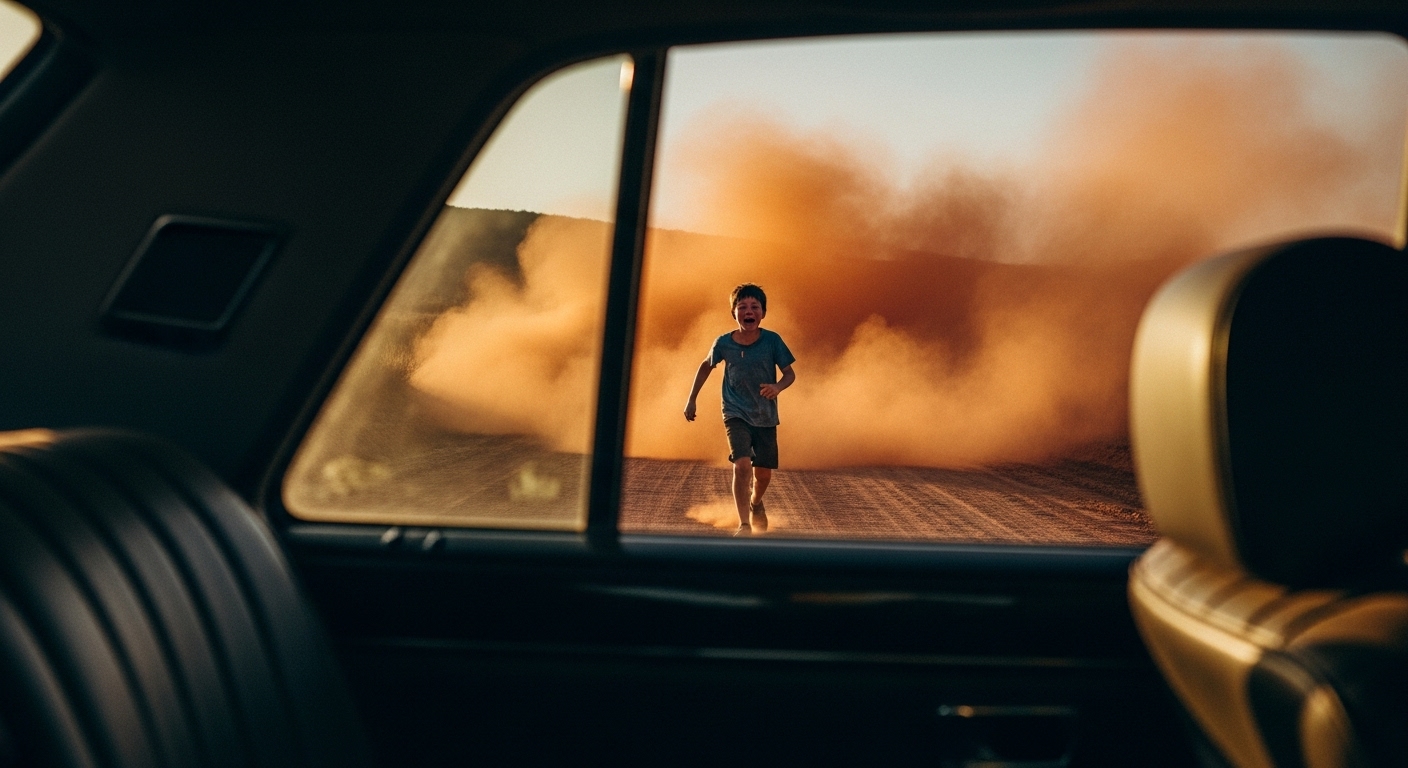
Lucas watched the car pull away. He saw the brake lights flare briefly—a moment of hope that made his heart leap—but the car didn’t stop. Preston was just slowing down to navigate a deep rut.
Through the rear window, Lucas saw the back of his father’s head. He saw Preston glance into the rearview mirror. Their eyes met across the distance—the boy’s wide, terrified, tear-filled eyes locking with the man’s cold, annoyed stare.
Preston didn’t look sad. He didn’t look conflicted. He looked like a man disposing of a bag of trash that had become inconvenient.
Lucas saw Preston’s hand move. A moment later, the electric motor hummed, and the tinted window rolled up, sealing the man inside his air-conditioned sanctuary and sealing the boy out in the heat and the dust.
The car accelerated. The back tires spun, kicking up a massive, blinding cloud of red clay.
“No!” Lucas shrieked, sprinting into the cloud.
He couldn’t see. The dust filled his nose and mouth. He coughed, choking, but he kept running. He ran until his bare feet found the jagged edge of a crushed limestone rock.
He fell hard. His knees skidded across the dirt, skinning them raw. But it was his feet that took the damage. The sharp stones sliced deep into his arches, severing skin and scraping against tendon.
Lucas lay face down in the dirt, the taste of copper and clay in his mouth. He listened to the sound of the Lincoln’s engine fading into the distance, getting smaller and smaller until it was swallowed by the silence of the pines.
He didn’t get up. He just lay there, bleeding into the earth that didn’t want him, realizing for the first time that the person who was supposed to protect him was the monster he needed protection from.
Present Day – Atlanta, Georgia
Dr. Lucas Thorne stood in the scrub room, the water running hot over his hands. He scrubbed with a rhythmic, meditative intensity. Up to the elbows. Rinse. Soap. Scrub.
The operating room was a sanctuary of order. It was cold, sterile, and bright—the exact opposite of a Mississippi dirt road. Here, things made sense. If something was broken, you fixed it. If something was bleeding, you stopped it.
“Dr. Thorne?” A young resident peeked her head in. “The trauma patient in OR 2 is stabilized. Excellent work on that vascular repair. I’ve never seen sutures that precise.”
Lucas turned off the water with his elbow. He looked at his hands—steady, capable, insured for millions of dollars. “Thank you, Dr. Evans. Precision is just practice disguised as talent. Go get some rest.”
He dried his hands and walked to his office. His limp was barely effortless to the untrained eye, just a slight hesitation in his step, a rhythmic click-step, click-step of his Italian leather shoes against the linoleum.
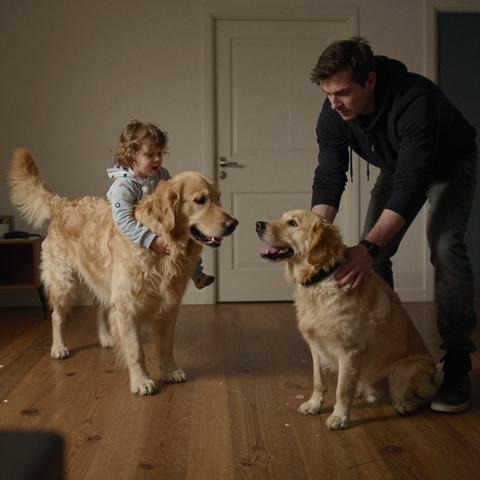
He sat at his mahogany desk. On the corner sat a framed photo of his wife, Sarah, and their seven-year-old son, Leo. Leo had a gap-toothed smile and eyes that were full of light—eyes that had never seen a car drive away from him.
There was a letter on his desk. It wasn’t in a standard envelope. It was heavy, cream-colored stationery with a legal watermark.
Lucas picked it up. He didn’t recognize the return address, but he recognized the postmark: Biloxi, Mississippi.
He felt a cold shiver crawl up his spine, despite the thermostat being set to seventy-two degrees. He used a letter opener to slice the seal.
Dear Dr. Thorne,
I represent the estate of Senator Preston Holloway. I am writing to inform you that the Senator’s health has entered a critical decline. He has been diagnosed with end-stage liver failure.
Due to rare genetic markers, the national transplant list is not a viable option in his remaining timeframe. His legitimate children have been tested and are not compatible donors.
The Senator has requested your presence. He believes that, as his blood, you may be a match for a partial liver donation. He wishes to discuss terms of compensation and, potentially, legacy. He is at the ancestral home in fictional Oakhaven.
Time is of the essence.
Sincerely, Arthur P. Sterling, Esq.
Lucas read the letter twice. Then he laughed.
It was a dry, humorless sound that bounced off the glass walls of his office.
“Legacy,” he whispered.
He dropped the letter onto the desk as if it were contaminated. He spun his chair around and looked out the window at the Atlanta skyline.
Thirty-eight years. Thirty-eight years of silence. Not a birthday card. Not a phone call when Lucas graduated high school valedictorian. Not a check when he was starving his way through medical school, working two jobs to pay tuition.
And now, Preston Holloway needed a spare part.
Lucas looked down at his shoes. He could feel the phantom ache in his arches. The scars were hidden beneath the expensive wool socks, but they throbbed. They always throbbed when the past came knocking.
His phone buzzed. It was Sarah. “Dinner’s almost ready. Leo made a drawing of you. It’s… abstract. Come home.”
Lucas typed back: “Leaving now.”
He grabbed the letter. He intended to shred it. He held it over the trash can.
But he didn’t drop it.
He needed to see him. He didn’t want to save him—God, no. But he needed to see the man who had left him in the dust. He needed to show Preston Holloway that the boy he threw away hadn’t just survived; he had soared.
He shoved the letter into his pocket and grabbed his coat.
Chapter 2: The Rotting Kingdom
The drive took five hours. Sarah had offered to come, but Lucas refused. “This is something I have to do alone,” he had said, kissing her forehead. “I need to close the door that he left open.”
As Lucas crossed the state line into Mississippi, the landscape changed. The steel and glass of the city gave way to kudzu and pine. The air got heavier. The sky turned a bruised purple as a storm brewed in the Gulf.
He turned onto the road that led to the Holloway estate. It used to be a grand avenue lined with ancient oaks. Now, the asphalt was cracked, grass growing through the fissures. The oaks were shaggy with Spanish moss that hung like gray, decaying curtains.
The house itself rose out of the gloom like a dying beast. It was a massive antebellum structure, once white, now gray and peeling. One of the shutters hung crookedly from a second-story window. The sprawling lawn, once manicured by a team of gardeners, was knee-high in weeds.
It smelled of wet earth and neglect.
Lucas parked his Audi SUV next to a rusted tractor. The contrast was stark. The future parked next to the dead past.
He walked up the steps. The wood groaned under his weight. He didn’t knock. He just pushed the heavy oak door open.
“Hello?”
The foyer was dim. Dust motes danced in the sliver of light from the open door.
“In here…” A voice rasped from the parlor.
Lucas walked in. The room was cluttered with medical equipment—monitors, oxygen tanks, IV poles. The sterile beep of a heart monitor was the only sound in the house.
In the center of the room, sitting in a wheelchair, was Preston Holloway.
Lucas barely recognized him. The man in his memory was a giant—broad-shouldered, booming voice, impeccably dressed in linen suits.
The man in the chair was a husk. His skin was the color of old parchment, yellowed by jaundice. His cheeks were hollow. His once-thick hair was wispy and white.
Preston opened his eyes. They were the only things that hadn’t changed—steel gray, calculating, cold.
“You came,” Preston wheezed. He tried to smile, but it looked like a grimace. “I told the lawyer you would. Blood… blood always calls to blood.”
Lucas stood in the doorway, keeping his distance. “I didn’t come for the blood, Preston. I came to see if you were real. Sometimes I wonder if I made you up.”
Preston chuckled, which turned into a hacking cough. He reached for a glass of water with a shaking hand. He couldn’t reach it.
Lucas watched him struggle. The Hippocratic oath whispered in his ear: Help him. But the boy in the dust whispered louder: Let him suffer.
Lucas walked over, picked up the glass, and placed it in Preston’s hand. He didn’t help him drink it.
“You look good, boy,” Preston said, wiping his mouth. “Expensive suit. Good posture. I heard you’re a surgeon. Top of your field.”
“Trauma surgeon,” Lucas corrected. “I fix things that have been smashed.”
“See?” Preston tapped the armrest of his wheelchair. “I knew it. I knew you had the grit. My other kids… the ‘legitimate’ ones…” He spat the word out with bitterness. “They’re weak. Soft. They took my money and ran when the sickness hit. But you… I toughened you up.”
Lucas felt a heat rising in his chest, a fury so pure it almost blinded him. “Is that what you call it? Toughening me up?”
“I made you a survivor,” Preston insisted, his voice gaining a momentary strength. “If I had coddled you, if I had let you stay in this house, you would have ended up soft like them. I drove away to teach you to run. And look at you now. You’re a success.”
He was rewriting history. He was taking credit for Lucas’s survival, twisting his cruelty into some twisted form of benevolence.
“I didn’t survive because of you,” Lucas said, his voice low and dangerous. “I survived in spite of you.”
“Doesn’t matter,” Preston waved a hand dismissively. “You’re here. That’s what matters. Now, about the procedure. The doctors say if we do the transplant next week, I have a 60% chance of five more years. I can rewrite my will. This house… the land… it could be yours. It’s your birthright, Lucas.”
Lucas looked around the rotting room. “This isn’t a birthright. It’s a tomb.”
“It’s heritage!” Preston snapped. “And I’m offering it to you. All I need is a piece of your liver. It grows back, you know. It regenerates. It’s a small price to pay for a legacy.”
Lucas stared at the old man. Preston truly believed that everything was a transaction. He thought he could buy an organ like he used to buy votes.
“A small price,” Lucas repeated.
He took a step back. He reached down and untied his left shoe.
“What are you doing?” Preston asked, frowning.
Lucas didn’t answer. He slid the shoe off. Then he peeled off his black wool sock.
He walked closer to the wheelchair and placed his bare foot on the footrest, right next to Preston’s slippered feet.
“Look at it,” Lucas commanded.
Preston looked down. He gasped softly.
The sole of Lucas’s foot was a roadmap of pain. Thick, white, jagged keloid scars crisscrossed the arch and the heel. The skin looked pulled and tight. It was ugly. It was the foot of someone who had walked through fire.
“Do you know how I got these?” Lucas asked, his voice trembling slightly.
Preston looked away. “That was a long time ago…”
“Look at them!” Lucas shouted, the sound echoing off the peeling wallpaper.
Preston flinched and looked back at the scars.
“I ran for two miles,” Lucas said, his voice dropping to a whisper. “I was seven years old. I was barefoot. The gravel tore my skin off. The limestone cut my tendons. I left bloody footprints for two miles. Do you know why I kept running, Preston?”
Preston shook his head, his eyes wide.
“I ran because I thought if I was fast enough, if I caught the car, you would love me,” Lucas said. “I thought I had done something wrong, and if I could just catch you and apologize, you’d open the door.”
Lucas picked up his sock and put it back on, covering the scars. He slipped his foot back into the expensive Italian shoe.
“But you didn’t stop,” Lucas said. “You rolled up the window.”
“I had to,” Preston whispered. “My wife… the campaign… I couldn’t have a bastard son complicating things. It was complicated, Lucas.”
“No,” Lucas said, standing tall. “It was simple. You chose your comfort over my life.”
Chapter 3: The Open Window
The silence in the room was heavy. The storm outside had started, rain lashing against the windows.
Preston looked small. He looked terrified. The arrogance was slipping away, replaced by the primal fear of a man who knows the end is coming and he is alone.
“So…” Preston stammered. “So you won’t do it? You won’t help me?”
Lucas looked at this dying man. He felt a strange emotion. It wasn’t hate anymore. It was pity. Pity for a man who had everything and ended up with nothing.
“I am a doctor,” Lucas said slowly. “I took an oath to preserve life. I spend every day saving strangers. I have operated on murderers, on saints, on people who couldn’t pay me a dime.”
Preston’s eyes lit up with hope. “Exactly. It’s your duty.”
“But,” Lucas continued, his voice hard as granite. “I am also a father.”
The hope in Preston’s eyes flickered.
“I have a son,” Lucas said. “His name is Leo. He is seven years old. The same age I was when you left me.”
Lucas walked to the window and looked out at his SUV.
“My liver belongs to him,” Lucas said, turning back to Preston. “My health belongs to him. Every extra day I live is a day I can protect him. I will not risk a single second of my life, I will not go under anesthesia, I will not face a 1% chance of complication for you. Because if I die on that table trying to save you, I leave my son without a father. And I will never do that to him.”
Preston began to cry. It was an ugly sound, a high-pitched whining. “You can’t leave me! I’m your father! I’m dying, Lucas! I’m scared!”
“We all die, Preston,” Lucas said calmly. “And we all die the way we lived. You lived for yourself. Now you die by yourself.”
Lucas turned and walked toward the door.
“Wait!” Preston screamed. He tried to wheel himself forward, but his weak arms couldn’t maneuver the chair over the thick rug. He flailed, looking pathetic. “I’ll give you everything! The money! The deeds! Don’t walk away!”
Lucas stopped at the doorway. He looked back one last time.
“Keep your money,” Lucas said. “I have something you never had. I have enough.”
He walked out.
He walked down the rotting steps, into the rain. The water felt good. It felt like a baptism. It washed away the smell of the house, the smell of sickness and old sins.
He got into his car. The engine purred to life—a quiet, reliable sound.
He looked in the rearview mirror.
Preston had managed to wheel himself to the front door. He was silhouetted against the dim light of the foyer, waving his arms, screaming words that Lucas couldn’t hear.
It was the exact reverse of the memory.
Thirty-eight years ago, Preston was in the car, and Lucas was screaming in the dust.
Now, Lucas was in the car, and Preston was the one left behind.
Lucas put his hand on the window control. His finger hovered over the button to roll it up. To seal himself in. To block out the noise of the old man.
He paused.
I am not him, Lucas thought.
He didn’t roll the window up. He rolled it down. All the way down.
He let the wet, humid air flood the car. He let the sound of the rain and the crickets fill the space. He wasn’t afraid of the outside world. He wasn’t hiding from his actions.
He didn’t speed off. He didn’t kick up dust.
He put the car in drive and pulled away slowly, carefully navigating the potholes. He didn’t look back at the mirror again. He looked forward, through the windshield, where the road led back to the highway, back to Atlanta, back to his life.
Chapter 4: The Dust Settles
It was midnight when he pulled into his driveway in Atlanta.
The rain had stopped. The suburban street was quiet and peaceful. The porch light was on—a beacon Sarah always left burning for him.
Lucas turned off the engine. He sat in the driveway for a long time. His hands were shaking on the steering wheel.
He felt lighter. It was a physical sensation, as if he had been carrying a backpack full of stones for four decades and had finally set it down on the side of a Mississippi road.
The front door opened.
Sarah stood there in her robe. And peeking out from behind her legs was Leo.
“Daddy!” Leo yelled.
He was wearing his dinosaur pajamas. He ran out of the house, barefoot on the cool concrete of the driveway.
Panic flared in Lucas’s chest for a split second—barefoot, running, car—but he crushed it. This was not the past.
Lucas opened his car door and stepped out.
He didn’t just stand there. He dropped to his knees. He didn’t care about his suit pants on the concrete.
Leo slammed into him, wrapping his small arms around Lucas’s neck. He smelled of strawberry shampoo and innocence.
“You’re home!” Leo said. “I stayed up! Mommy said I could wait.”
Lucas buried his face in his son’s neck. He held him tight, tighter than usual. He felt the small, steady beat of Leo’s heart against his chest.
“I’m home, buddy,” Lucas choked out, tears finally spilling over his cheeks—tears he hadn’t shed in the dying house. “I’m right here. I’m not going anywhere.”
“Why are you crying?” Leo asked, pulling back to look at him.
Lucas smiled. It was a real smile, one that reached his eyes and stayed there.
“I’m just happy to see you,” Lucas said. “Did you know that? You are the best thing I ever saw.”
Lucas stood up, picking Leo up in his arms. He carried him toward the house.
He looked down at his feet. His shoes were scuffed, but they were planted firmly on the ground. The scars underneath were still there—they would always be there—but they didn’t hurt anymore. They were just history.
He walked through the front door, and Sarah closed it behind them, shutting out the dark, shutting out the ghosts, leaving the dust to settle on the road behind them, miles and lifetimes away.